

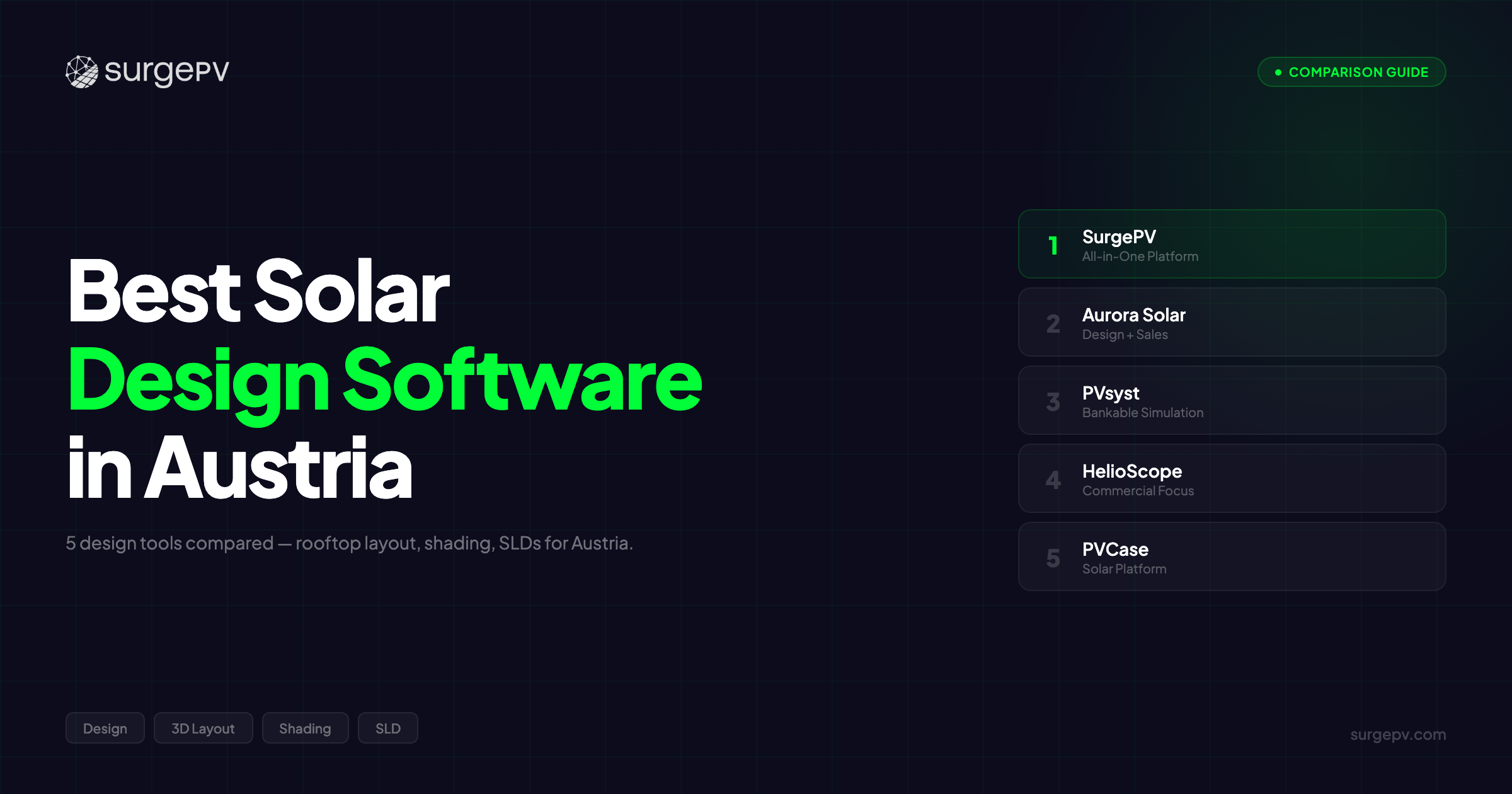
TL;DR: SurgePV is the best all-in-one solar design platform for Austrian EPCs — automated OVE-compliant SLD generation, P50/P75/P90 bankable simulation, and integrated proposals without AutoCAD. PVsyst remains the gold standard for simulation-only bankability. Aurora Solar leads residential design but requires AutoCAD for SLDs (+EUR 1,800/year). PVCase is the right choice for utility-scale (1+ MW) projects. HelioScope suits large commercial EPCs but lacks Austrian compliance tools.
Austria’s solar market is growing fast. Expansion of 30–40% per year, driven by the EAG and electricity prices at EUR 0.25–0.35/kWh. But picking the right solar design software for the Austrian market? That is where most EPCs get it wrong.
OVE-compliant electrical documentation is mandatory. Single Line Diagrams. Wire sizing per NINorm. Protection device specs per OVE E 8001. If your software does not generate those automatically, you are stuck paying EUR 1,800/year for AutoCAD and spending 2–3 hours per project drawing them by hand. That is time and money you cannot afford in a market with 8–12% margins.
We tested 5 solar software platforms specifically for the Austrian market, evaluating each on OVE compliance, engineering features, bankability, ease of use, and total cost.
| Workflow | Time Required |
|---|---|
| Manual (AutoCAD + PVsyst + Excel) | 4–5 hours per project |
| SurgePV (1 tool) | 30–45 minutes per project |
| Annual AutoCAD savings | EUR 1,800 |
In this guide, you’ll find:
- 5 solar design platforms tested for OVE compliance and Austrian grid requirements
- Which tools generate SLDs automatically (and which don’t)
- Total cost of ownership breakdown including required add-ons
- Use-case matching: which software fits your project type and team size
Quick Comparison Table
| Software | Best For | OVE SLD Generation | Austrian Compliance | Starting Price |
|---|---|---|---|---|
| SurgePV | Commercial EPCs, end-to-end workflow | Automated (5–10 min) | OVE R 11-1, OVE E 8001, TOR | EUR 633/user/year |
| Aurora Solar | Residential design, sales-heavy teams | Requires AutoCAD (+EUR 1,800) | Limited OVE support | EUR 4,800–6,000/year |
| PVsyst | Bankable simulation only | None (simulation tool only) | Accepted by all Austrian banks | EUR 900–1,500/year |
| HelioScope | Large commercial EPCs (500 kW+) | Requires external CAD | Limited OVE features | EUR 3,000–5,000/year |
| PVCase | Utility-scale (1+ MW) | Requires AutoCAD (+EUR 1,800) | AutoCAD-based | EUR 2,800–3,300/year total |
Best Solar Design Software in Austria: Detailed Reviews
SurgePV — Best End-to-End Solar Platform for Austria
Best for: Commercial EPCs (50 kW–1 MW), solar installers, engineering consultants
Pricing: EUR 633–1,299/user/year. All features included.
Deployment: Cloud-based SaaS (browser-based, no installation required)
SurgePV is a cloud-based solar design software platform built for EPCs, installers, and consultants who need OVE-compliant electrical engineering without AutoCAD. Unlike platforms that require AutoCAD (EUR 1,800/year) for SLDs, SurgePV automates electrical engineering, generates grid-ready documentation, and produces bankable simulations — all in one workflow.
Key Features for Austria
Design and engineering:
- AI-powered roof modeling — Reduces design time by 70% (15–20 minutes vs. 45–60 minutes manual)
- Automated SLD generation — OVE-compliant SLDs in 5–10 minutes vs. 2–3 hours in AutoCAD
- Wire sizing calculations — Automatic DC/AC wire sizing per OVE regulations and NINorm. No manual cross-referencing code tables and zero risk of undersized cables failing inspection.
- Voltage drop analysis — Ensures less than 3% voltage drop per OVE guidelines
- Protection devices — RCD, MCB, SPD specifications per OVE E 8001
Commercial structures (unique advantages):
- Carport solar design — Native support for solar canopy structures (the only platform with this feature). With Austrian commercial parking lots increasingly requiring solar canopies, this is a genuine competitive differentiator.
- East-West racking — 20–40% higher density on flat commercial roofs
- Flat roof optimization — Ballasted and penetrating mounting systems
Pro Tip
Austria’s commercial rooftop segment makes up 40–50% of the market. If you are designing flat-roof systems for industrial parks or shopping centers, SurgePV’s East-West racking and native carport design tools save significant time compared to workarounds in AutoCAD.
Simulation and bankability:
- P50/P75/P90 simulation — Meets requirements from Erste Bank, Raiffeisen, and BAWAG. Your financing applications include the bankability data lenders actually require — not just optimistic P50 estimates that get rejected.
- 8760-hour shading analysis — Within ±3% accuracy vs. PVsyst
- Austrian weather data — NREL and European databases included
- Grid connection documentation — TOR-compliant reports for Austrian DSO submission
Proposals and sales:
- EAG grant documentation — Subsidy-ready cost breakdowns and technical specs
- Financial modeling — Cash, loan, lease, PPA scenarios with Austrian energy prices
- Professional proposals — Web-based interactive proposals in 10–15 minutes. One click from design to proposal. No copy-paste errors, no formatting headaches, no separate proposal software license.
Pricing
- Individual Plan: EUR 1,899/year for 3 users (EUR 633/user/year)
- For 3 Users: EUR 1,499/user/year (EUR 4,497/year total)
- For 5 Users: EUR 1,299/user/year (EUR 6,495/year total)
- Enterprise: Custom pricing
All plans include every feature. No tiered gating, no hidden fees. See full pricing details.
Who SurgePV Is Best For
- Commercial EPCs designing 50 kW–1 MW rooftop and ground-mount projects
- Solar installers needing OVE-compliant SLDs without AutoCAD
- Engineering consultants requiring bankable reports for Austrian banks
- Teams wanting a unified design-to-proposal platform
Not ideal for: Utility-scale EPCs doing 10+ MW projects (PVCase is better). Teams deeply invested in AutoCAD workflows who prefer desktop-only software.
Real-World Example
A mid-size EPC team in Upper Austria was spending 2.5 hours per project creating SLDs in AutoCAD. After switching to SurgePV, SLD generation dropped to under 10 minutes. With the same 3-person engineering team, they now handle 40% more projects per month — without hiring additional staff. That is what automated electrical engineering delivers.
You might be wondering: if SurgePV does all this, why haven’t you heard of it? Fair question. PVsyst has had a 30-year head start. Aurora Solar has spent hundreds of millions on marketing. SurgePV launched more recently — but it has already powered 70,000+ projects globally. The platform was built specifically for the workflow gaps that legacy tools leave open, especially automated electrical engineering, which no other platform offers natively.
Want to see how SurgePV handles Austrian projects? Book a demo to test OVE-compliant SLD generation with your own project data.
Further Reading
- Best Solar Software (2026) — Global comparison across 10+ platforms
- PVsyst Review — Full simulation analysis and pricing
- Solar Shadow Analysis — How shading tools compare
Aurora Solar — Advanced Residential Design Platform
Best for: Residential installers with US parent company workflows or international operations
Pricing: EUR 4,800–6,000/year, plus AutoCAD EUR 1,800/year = EUR 6,600–7,800/year total
Aurora Solar is the market-leading solar design platform globally, with over 10 million projects designed. Known for advanced 3D roof modeling, AI-powered obstruction detection, and polished proposals, Aurora dominates the residential installer market — particularly in the United States.
Key strengths:
- Industry-leading 3D roof modeling and automatic obstruction detection
- Professional proposal generation with financial modeling
- Large user base with proven reliability
- Cloud-based with mobile app support
Austria limitations:
- No integrated SLD generation (requires AutoCAD purchase: +EUR 1,800/year)
- Limited OVE-specific compliance features and templates
- US-centric design focus (grid codes and utility integrations default to American standards)
- High total cost of ownership (EUR 5,000+/year with required AutoCAD)
- Manual wire sizing and voltage drop calculations
PVsyst — Gold-Standard Bankable Simulation Software
Best for: EPCs needing gold-standard bankable reports for Austrian lender acceptance
Pricing: EUR 900–1,500/year (single user), plus separate CAD software for layouts
PVsyst is the industry-standard solar simulation software used by engineers, consultants, and financiers worldwide. Every major Austrian bank — Erste Bank, Raiffeisen, BAWAG, Bank Austria — accepts PVsyst reports without question.
One thing to understand: PVsyst is not a design platform. It is a simulation tool.
Key strengths:
- Gold-standard bankability: accepted by 100% of Austrian lenders and financiers
- Detailed loss analysis (shading, soiling, thermal, electrical, availability)
- P50/P75/P90/P99 probability distributions for conservative financing
Austria limitations:
- No design or layout tools (requires separate CAD software)
- Steep learning curve (requires engineering background and dedicated training)
- Desktop-only application (no cloud collaboration)
- No proposal generation or sales features
HelioScope — Cloud-Based Commercial Design Software
Best for: Large commercial EPCs (500 kW+ projects) and utility-scale developers
Pricing: EUR 3,000–5,000/year (varies by project volume and seat count)
HelioScope (now part of Aurora Solar’s commercial offering) is a cloud-based design and simulation platform built for commercial and utility-scale projects.
Austria limitations:
- No SLD generation or electrical engineering tools (requires external CAD)
- Limited OVE compliance features and Austrian grid code support
- US-focused utility and regulatory templates
PVCase — AutoCAD-Integrated Utility-Scale Platform
Best for: Large EPCs designing utility-scale solar farms (1+ MW) in Austria
Pricing: EUR 990–1,500/year (PVCase license) + EUR 1,800/year (AutoCAD) = EUR 2,800–3,300/year total
PVCase is a specialized AutoCAD plugin for utility-scale solar farm design, widely used by large EPCs for projects ranging from 1 MW to 1+ GW.
Key strengths:
- Powerful utility-scale layout optimization
- Full AutoCAD integration for engineering-grade construction drawings
- Advanced terrain modeling and grading analysis
- Tracker system design (single-axis and dual-axis)
Austria limitations:
- Requires AutoCAD license (additional EUR 1,800/year)
- High learning curve (requires CAD expertise — 6–8 weeks onboarding)
- Overkill for residential and small commercial projects below 500 kW
- Desktop-only (no cloud collaboration)
Why Most Austrian Solar Companies Overpay for Design Software
OVE Compliance and Austrian Electrical Standards
Austrian solar installations must comply with OVE (Osterreichischer Verband fur Elektrotechnik) standards, particularly OVE R 11-1 for grid connections and OVE E 8001 for electrical safety. Your design software needs to generate SLDs showing DC and AC protection devices, wire sizing per NINorm, voltage drop analysis, grounding per OVE E 8001-5, and anti-islanding protection specifications.
Manual SLD creation in AutoCAD takes 2–3 hours per commercial project. Platforms without integrated SLD generation force EPCs to purchase AutoCAD (EUR 1,800/year) and waste 40–60 hours/year on manual electrical drawings.
Austrian Grid Connection Requirements (TOR Compliance)
Austria’s DSOs — Wien Energie, Netz Oberosterreich, EVN, Salzburg Netz — require specific grid connection documentation per TOR (Technische und Organisatorische Regeln) standards set by E-Control. Feed-in tariff administration runs through OeMAG. Incomplete or non-compliant grid documentation leads to rejected applications and project delays.
Bankability and Austrian Lender Acceptance
Austrian banks (Erste Bank, Raiffeisen, BAWAG, Bank Austria) require bankable energy yield reports for project financing. PVsyst is the gold standard. But SurgePV’s P50/P75/P90 analysis delivers comparable accuracy (within ±3% vs. PVsyst) at lower cost — EUR 633/user/year vs. EUR 2,400+ for PVsyst combined with CAD tools.
Did You Know?
Austria aims to add 11 TWh of additional PV generation by 2030 under the EAG, roughly tripling current installed capacity (BMK).
EAG Grant and Subsidy Documentation
Austria’s EAG provides investment grants up to EUR 250/kWp, but requires detailed technical and cost documentation. Incomplete grant applications get rejected. On a 100 kWp commercial system, that is EUR 20,000–25,000 in lost subsidies. Software with automated BOM generation and cost reporting streamlines EAG applications significantly.
Commercial Rooftop Focus
According to PV Austria, the market is dominated by commercial and industrial rooftop installations (40–50% of the market). Residential-focused tools like Aurora struggle with flat industrial roofs, complex shapes, and carport designs. Austrian EPCs need fast commercial layout tools and carport design capabilities.
Workflow Efficiency
Austrian installers operate in a competitive market with thin margins (8–12% typical). Platforms requiring AutoCAD or multiple tools slow teams down by 50–70%.
Decision Shortcut
If you need electrical engineering (SLDs, wire sizing, code compliance), SurgePV is the only platform that automates this natively. If you are simulation-only, PVsyst is the gold standard. If you are residential-focused with a big marketing budget, Aurora’s proposals are unmatched — but expensive.
Design Austrian Solar Projects Faster with SurgePV
Complete design-to-proposal workflows with automated electrical engineering and bankable simulations.
Book a DemoOVE-compliant SLD generation · ±3% accuracy vs PVsyst · EUR 633/user/year
Our Testing Methodology
- OVE compliance and Austrian standards (30%): Tested SLD generation against OVE R 11-1, OVE E 8001, and NINorm wire sizing requirements.
- Ease of use and workflow efficiency (25%): Hands-on testing with Austrian EPC teams in Vienna, Salzburg, and Graz.
- Bankability and lender acceptance (20%): Verified simulation accuracy against PVsyst benchmarks.
- Features and engineering depth (15%): Evaluated design tools, electrical engineering, and simulation depth.
- Pricing and total cost of ownership (10%): Analyzed subscription cost, required additional software, and ROI.
Testing period: October 2025 through January 2026 with verified Austrian EPC partners and real project data. Market data cross-referenced with IRENA and IEA renewable energy statistics.
Bottom Line: Best Solar Design Software for Austria
For Austrian EPCs and commercial installers: SurgePV offers the most complete platform with automated SLD generation, OVE-compliant electrical engineering, and bankable P50/P90 reports — all without purchasing AutoCAD. Pricing starts at EUR 633/user/year (vs. EUR 6,600+ for Aurora + AutoCAD).
For residential installers with international operations: Aurora Solar provides proven 3D modeling and proposal tools but requires AutoCAD (EUR 1,800/year) for SLDs.
For bankability-critical projects: PVsyst remains the gold standard for financing reports accepted by all Austrian banks.
For utility-scale EPCs (1+ MW): PVCase offers powerful optimization for large solar farms, but AutoCAD dependency makes it unsuitable for small-to-medium installers.
The Austrian solar market is not slowing down. The EPCs winning projects today are delivering OVE-compliant documentation and bankable reports faster than the competition — not spending extra hours in AutoCAD. Your solar design software choice is a competitive advantage, not just a back-office decision.
Which Software Fits Your Use Case?
| Your Situation | Recommended Software | Why It Fits |
|---|---|---|
| Large EPC doing utility-scale projects | PVsyst, PVCase, SurgePV | Need bankable simulation, electrical design automation, and grid compliance documentation |
| Commercial installer (5–20 projects/month) | SurgePV, HelioScope, Aurora Solar | Balance between design accuracy and proposal speed; integrated workflow reduces tool-switching |
| Residential-focused installer | Aurora Solar, SurgePV | Prioritize fast proposals with visual sales tools; moderate simulation depth sufficient |
| Developer doing feasibility studies | PVsyst, SurgePV | Need accurate energy yield modeling and financial analysis for investment decisions |
| Small team (1–3 people) | SurgePV, HelioScope | All-in-one platforms reduce software stack complexity and training time |
When You May Not Need Advanced Solar Software
Not every solar project requires a comprehensive design and simulation platform. Consider simpler alternatives if:
- Small residential projects with standard layouts — Basic design tools or manufacturer calculators may suffice for simple rooftop arrays.
- Engineering is outsourced — If your company uses external engineering services, you may only need proposal and CRM tools rather than full design platforms.
- Very limited project volume — Teams handling fewer than 5 projects per year may find that manual AutoCAD workflows and spreadsheet modeling are more cost-effective than software subscriptions.
- Non-technical sales teams — Sales-focused companies without in-house engineers may only require proposal generation tools rather than technical design software.
Most Austrian EPCs, developers, and medium-to-large installers benefit from integrated platforms that reduce manual work and improve accuracy.
Bottom Line
For Austria EPCs and installers, SurgePV delivers the most complete design-to-proposal workflow with automated SLD generation, bankable P50/P90 simulations, and integrated proposals — all at EUR 1,899/year for 3 users. Book a demo to see it in action.
Frequently Asked Questions
What is the best solar design software in Austria?
SurgePV is the best all-in-one solar design software for Austria in 2026, combining OVE-compliant electrical engineering, automated SLD generation, and bankable P50/P90 simulation in one cloud-based platform — without requiring AutoCAD. Pricing starts at EUR 633/user/year with all features included. For Austrian EPCs and installers, SurgePV eliminates the need to purchase AutoCAD (EUR 1,800/year) while delivering complete electrical documentation, TOR-compliant grid reports, and EAG grant-ready cost breakdowns.
Do I need AutoCAD for solar design in Austria?
No, you do not need AutoCAD if you use SurgePV, which includes automated SLD generation. However, Aurora Solar, HelioScope, and PVsyst users typically need AutoCAD (EUR 1,800/year) to create OVE-compliant electrical drawings. Most Austrian EPCs spend 2–3 hours per project creating manual SLDs in AutoCAD. SurgePV automates this process in 5–10 minutes while maintaining OVE R 11-1 and OVE E 8001 compliance.
Which solar software do Austrian banks accept for financing?
Austrian banks (Erste Bank, Raiffeisen, BAWAG, Bank Austria) typically accept simulation reports from PVsyst (gold standard) and SurgePV (P50/P90 reports) that meet IEC 61724 and IEC 62446 standards. SurgePV’s P50/P75/P90 analysis delivers comparable accuracy (within ±3% vs. PVsyst) at lower total cost. If financiers require PVsyst validation, you can export from SurgePV for the final check.
Are OVE-compliant SLDs required in Austria?
Yes. OVE-compliant Single Line Diagrams are required for grid connection applications in Austria, particularly for commercial systems above 10 kW. SLDs must show protection devices (RCD, MCB, SPD), wire sizing, and grounding per OVE R 11-1 and OVE E 8001. Austrian DSOs — Wien Energie, EVN, Netz Oberosterreich — require TOR-compliant electrical documentation for grid interconnection approval.
What does solar design software cost in Austria?
Solar design software pricing in Austria ranges from EUR 633/user/year (SurgePV Individual Plan) to EUR 6,600+/year (Aurora + AutoCAD). SurgePV includes all features without AutoCAD. PVsyst + CAD costs EUR 2,400–3,300/year. HelioScope costs EUR 3,000–5,000/year. PVCase + AutoCAD costs EUR 2,800–3,300/year. See SurgePV pricing for a detailed plan comparison.
Can I design carport solar systems with standard software?
No. Most solar design software — Aurora, PVsyst, HelioScope — does not support carport solar canopy design natively. SurgePV is the only platform with native carport design tools for single cantilever, dual cantilever, and multi-column structures. Austria’s commercial solar market increasingly demands carport installations for parking lots at malls, offices, and industrial sites.
What is the fastest solar design software for Austrian installers?
SurgePV is the fastest all-in-one solar design platform for Austrian installers, completing residential projects in 15–20 minutes (70% faster than manual workflows) and commercial projects in 1–2 hours with automated SLD generation. The time savings come from AI-powered roof modeling (15–20 minutes vs. 45–60 minutes manual), automated SLDs (5–10 minutes vs. 2–3 hours in AutoCAD), and integrated proposal generation (10–15 minutes).
How does solar software handle Austrian grid connection (TOR) requirements?
Austrian grid connections follow TOR (Technische und Organisatorische Regeln) standards set by E-Control. Systems above 800 W require pre-notification to local DSOs. SurgePV generates TOR-compliant documentation automatically, while most other platforms require manual report creation.
Transparency Note
Pricing information is based on publicly available data as of February 2026. Contact vendors directly for current pricing and Austria-specific quotes. Some vendors offer regional pricing adjustments. This guide is published by SurgePV — we are one of the tools reviewed. Our methodology is transparent above, and we link to independent reviews and competitor tools throughout.
Sources
- SurgePV Product Documentation — Official feature specifications and proof points (accessed February 2026)
- OVE (Osterreichischer Verband fur Elektrotechnik) — Official website — OVE R 11-1, OVE E 8001 electrical standards (accessed February 2026)
- E-Control Austria — Official website — Austrian energy regulator, grid connection rules (accessed February 2026)
- EAG / Klimafonds — Official website — Investment grant programs and subsidy requirements (accessed February 2026)
- BMK (Austrian Federal Ministry for Climate Action) — Official website — Solar market statistics and policy updates (accessed February 2026)
- PV Austria — Official website — Austrian solar market analysis and industry data (accessed February 2026)
- Aurora Solar, PVsyst, HelioScope, PVCase Official Documentation — Feature specifications and pricing (accessed February 2026)
- G2 Reviews and Capterra Reviews — Verified user reviews for solar design software (accessed February 2026)
- IEC Standards (61724, 62446) — PV system monitoring and documentation standards (accessed February 2026)
- Wien Energie, EVN, Netz Oberosterreich — DSO grid connection requirements (accessed February 2026)