

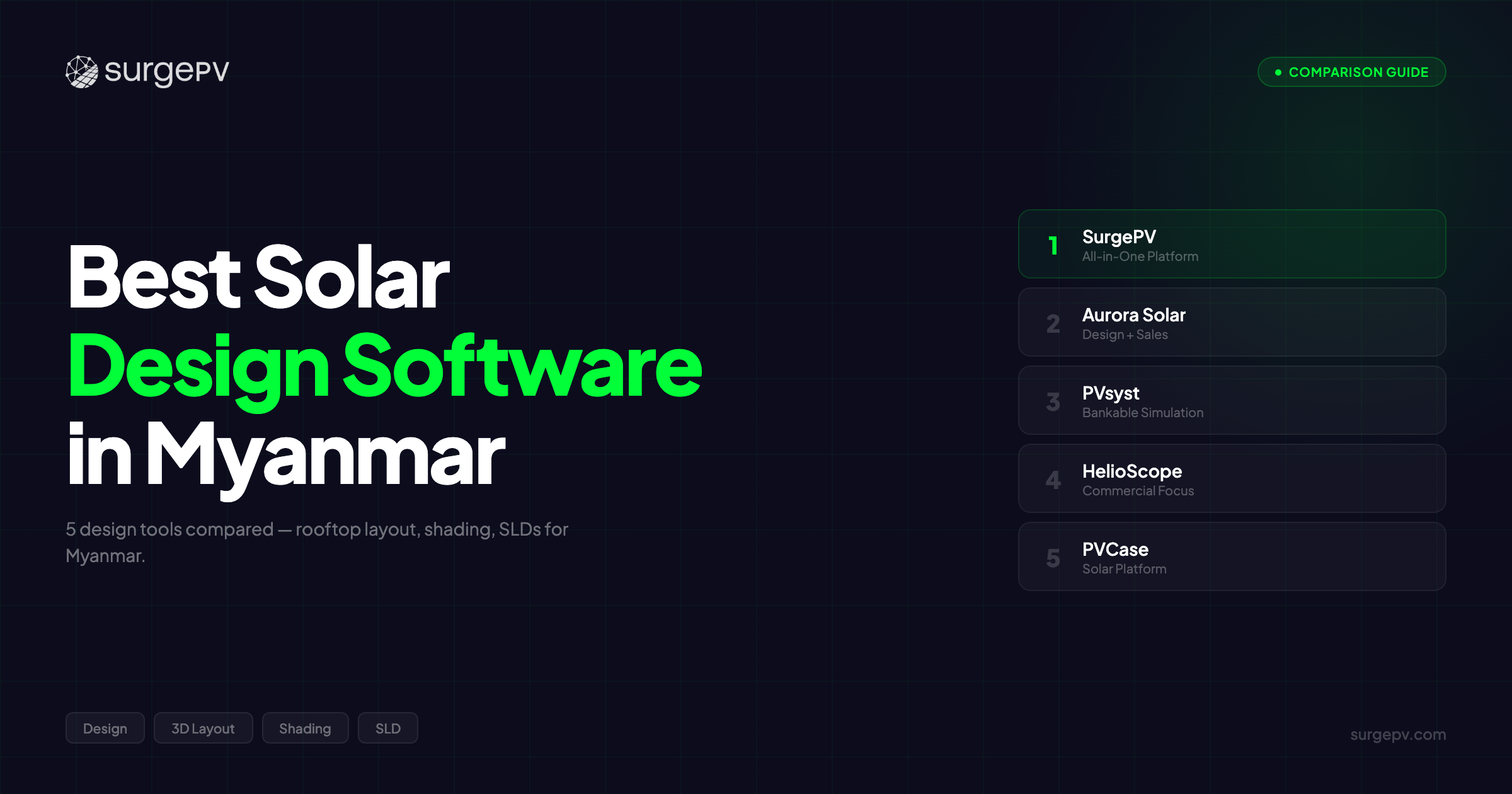
TL;DR: SurgePV is the strongest all-round choice for Myanmar EPCs — automated SLD generation, satellite weather data integration, and bankable P50/P75/P90 simulations in one platform at $1,899/year for 3 users. Aurora Solar is better for large international EPCs needing premium 3D modelling. PVsyst is the mandatory validation tool for ADB and World Bank-funded projects above 5 MW. HelioScope suits mid-size C&I teams with separate electrical engineering. PVCase is utility-scale only.
Here is a number that should stop you: over 50% of Myanmar’s population still lacks reliable electricity access.
The country receives 1,400-1,800 kWh/m² per year of solar irradiation across its 10-28 degrees North latitude range. That is outstanding solar resource, comparable to Thailand and better than many European markets generating gigawatts. Yet Myanmar’s installed solar capacity remains under 500 MW.
Off-grid solar, mini-grids, and diesel displacement projects represent the fastest-growing segments. ADB and World Bank are funding hundreds of millions in solar development. C&I installations in Yangon, Mandalay, and Nay Pyi Taw industrial zones are accelerating.
The problem? Most EPCs working in Myanmar still rely on disconnected tools — AutoCAD for electrical drawings, PVsyst for simulations, Excel for financial models. That multi-tool approach costs 3-4 hours per project and breaks down completely when monsoon season timelines, cyclone resilience requirements, and MOEP grid connection standards demand fast, accurate documentation.
The right solar design software collapses that workflow into a single platform. Automated SLD generation. Bankable P50/P75/P90 simulations using satellite weather data. Professional proposals with diesel displacement economics and mini-grid financial modelling built in.
In this guide, you will learn:
- Which platforms handle Myanmar’s limited meteorological data using PVGIS satellite integration
- How simulation outputs compare for ADB and World Bank project financing acceptance
- Which tools automate electrical SLDs required for MOEP and MEPE grid connection
- What off-grid and mini-grid EPCs actually pay for software (and whether premium pricing delivers ROI in Myanmar)
- Detailed comparisons of SurgePV, Aurora Solar, PVsyst, HelioScope, and PVCase for Myanmar conditions
Quick Summary: Our Top Picks for Myanmar
After testing 5 platforms with EPCs operating across Yangon, Mandalay, and regional off-grid projects in Myanmar, here are our top recommendations:
- SurgePV — End-to-end design, electrical engineering, and proposals with satellite weather data integration (Best for C&I EPCs and off-grid developers needing complete workflows)
- Aurora Solar — Premium all-in-one platform with industry-leading 3D modelling (Best for large international EPCs with budget operating in Myanmar)
- PVsyst — Industry-standard simulation validation (Best for utility-scale projects needing ADB/World Bank lender acceptance)
- HelioScope — Cloud-based commercial design with strong shading analysis (Best for mid-size EPCs with separate electrical teams)
- PVCase — Utility-scale layout optimisation for ground-mount projects (Best for large ground-mount solar farms on Myanmar’s varied terrain)
Each tool is evaluated on Myanmar-specific criteria: satellite weather data integration, bankability for international lender acceptance, electrical engineering capabilities, off-grid and mini-grid suitability, and pricing accessible to regional EPCs.
Best Solar Design Software in Myanmar (Detailed Reviews)
| Software | Best For | Pricing | Myanmar Fit |
|---|---|---|---|
| SurgePV | End-to-end workflows | ~$1,899/yr (3 users) | Excellent |
| Aurora Solar | Residential proposals | ~$3,600-6,000/yr | Good |
| PVsyst | Bankable simulation | ~$625-1,250/yr | Good |
| HelioScope | Commercial rooftop arrays | ~$2,400-4,800/yr | Good |
| PVCase | Utility-scale terrain | ~$3,800-5,800/yr | Good |
SurgePV — Best End-to-End Solar Platform for Myanmar
About SurgePV
SurgePV is the only cloud-based platform combining AI-powered design, automated electrical engineering, bankable simulations, and professional proposals without tool-switching.
For EPCs operating in Myanmar’s challenging environment — limited grid infrastructure, monsoon season constraints, cyclone resilience requirements, and ADB/World Bank financing standards — SurgePV eliminates the need for AutoCAD, separate simulation tools, and manual Excel spreadsheets. Design a 200 kW C&I rooftop in Yangon, generate permit-ready single line diagrams automatically, produce P50/P75/P90 bankable reports, and create a proposal with diesel displacement economics — all in the same platform.
Target Users: C&I EPCs (50 kW-10 MW), off-grid and mini-grid developers, solar installers working across Myanmar, international development project implementers, designers needing MOEP-compliant documentation.
Unique Value for Myanmar: SurgePV integrates satellite-derived weather data (PVGIS and NASA SSE) covering all of Myanmar’s latitude range (10-28 degrees North). The platform handles both grid-tied C&I projects in Yangon and Mandalay and off-grid installations in rural areas where diesel displacement economics drive project viability. No other platform combines this level of electrical engineering automation with financial modelling suited to Myanmar’s mixed grid/off-grid market.
Pro Tip
When evaluating solar design software for Myanmar, test your most complex project type first. A platform that handles a 1 MW ground-mount mini-grid with diesel hybrid modelling will easily manage a 50 kW C&I rooftop — but not the other way around.
Key Features for Myanmar
Design and Engineering
SurgePV’s AI-powered roof modelling automatically detects roof boundaries, tilt, and azimuth from satellite imagery. What used to take 45 minutes of manual CAD tracing now takes 15 minutes. For Myanmar’s building stock — flat concrete roofs dominate commercial buildings in Yangon and Mandalay, with corrugated metal common in industrial zones and rural structures — that speed advantage compounds across projects.
The platform supports structures relevant to Myanmar: commercial rooftop, ground-mount systems for off-grid and mini-grid installations, single-axis and dual-axis trackers for utility-scale projects, and carport solar. SurgePV is the only platform with native carport design.
Electrical Engineering (Critical for MOEP Grid Connection)
Here is where SurgePV pulls ahead of every other tool on this list.
Single Line Diagram (SLD) generation is automated. Complete your design, click “Generate SLD,” and within 5-10 minutes you have a code-compliant electrical schematic showing DC arrays, combiners, disconnects, inverters, AC wiring, breakers, and grid interconnection. That SLD is ready for MOEP and MEPE submission for grid-connected projects.
The alternative? Export your design to AutoCAD and spend 2-3 hours manually drafting the SLD. That is what most EPCs in Myanmar do today if they are not using SurgePV.
Wire sizing calculations happen instantly. The platform calculates DC and AC wire gauges based on current, distance, voltage drop limits (keeping under 2% optimal, 3% maximum), and temperature correction factors for Myanmar’s tropical conditions (35-42 degrees Celsius ambient). Protection device sizing, conduit fill calculations, and earthing specifications are generated automatically.
Note
Myanmar’s electrical infrastructure follows a mix of IEC standards and local MOEP requirements. SurgePV’s automated SLD generation covers IEC-compliant electrical documentation that MOEP requires for grid connection approvals, though some projects may need minor formatting adjustments for specific MEPE regional templates.
Simulation and Bankability
International lenders (ADB, World Bank, IFC, JICA) require credible production estimates before approving Myanmar solar project financing. SurgePV provides P50, P75, and P90 estimates. The platform’s 8760-hour shading analysis achieves plus or minus 3% accuracy compared to PVsyst. For C&I and mini-grid projects under 10 MW, that is sufficient for most international lender requirements without running separate PVsyst validation.
Monsoon season modelling is critical for Myanmar. June through October brings heavy rainfall and 40-60% cloud cover that dramatically reduces production. SurgePV’s hour-by-hour simulation captures these seasonal variations rather than relying on annual averages that overestimate yield. Temperature derating handles Myanmar’s tropical heat (35-42 degrees Celsius peak). Soiling loss modelling accounts for dust accumulation in dry season (November-April).
Financial Modelling and Proposals
SurgePV’s proposal generation includes financial modelling relevant to Myanmar’s market:
- Diesel displacement economics: Cost savings vs diesel generation (Myanmar rural diesel costs 1,200-1,500 MMK/litre)
- Mini-grid financial modelling: Revenue projections for community-scale solar installations
- PPA modelling: 20-25 year power purchase agreement structures for C&I projects
- Currency flexibility: USD-based modelling (standard for international development projects) and MMK-based for local projects
- Net metering analysis: Where applicable under evolving MOEP regulations
Proposals are web-based, interactive, and mobile-friendly. Your C&I client in Yangon can review the proposal on their phone, explore financing scenarios, and share it with their finance team or international development partners.
An international EPC implementing ADB-funded solar projects across Myanmar was spending 4 hours per project: 30 minutes for design in HelioScope, 2.5 hours creating SLDs and wire schedules in AutoCAD, then 60 minutes assembling a proposal in Excel with diesel displacement calculations. After switching to SurgePV, their complete workflow dropped to 50 minutes — design, electrical documentation, and proposal in one session. Across 40 projects per year, that recovered 130 hours of engineering labour annually.
Pros and Cons
Pros:
- Only platform with integrated electrical engineering: SurgePV includes automated SLD generation and wire sizing. Aurora, HelioScope, and OpenSolar do not. That eliminates the $2,000/year AutoCAD licence and 2-3 hours of manual SLD creation per project.
- Satellite weather data integration: PVGIS and NASA SSE data covering all of Myanmar’s latitude range (10-28 degrees North) loads automatically by project location.
- 4x faster workflows: Complete workflow (design + electrical + proposal) takes 30-45 minutes in SurgePV vs 2.5-3 hours with Aurora + AutoCAD.
- Transparent pricing: Starting at $1,899/year for 3 users. All features included. No hidden tiers.
- Bankable accuracy: Plus or minus 3% vs PVsyst. P50/P75/P90 metrics that ADB and World Bank accept.
- Off-grid and grid-tied flexibility: Works for both Yangon C&I rooftops and rural off-grid/mini-grid installations.
Cons:
- Newer brand in Myanmar: Less brand recognition than PVsyst or Aurora with conservative international lenders who prefer established tools.
- MOEP portal integration: Not yet integrated with MOEP online portals. SLDs are generated but require manual upload to regulatory systems.
Pricing
- Individual Plan: $1,899/year for 3 users
- For 3 Users Plan: $1,499/user/year
- For 5 Users Plan: $1,299/user/year — best value for scaling EPCs
- Enterprise: Custom pricing for large EPC firms
Myanmar Cost Comparison:
- SurgePV (3 users): $1,899/year total — includes complete electrical engineering, design, and proposals
- Aurora + AutoCAD (per user): $4,800 (Aurora estimate) + $2,000 (AutoCAD) = $6,800/year — still missing P75/P90 and wire sizing
- Annual savings: $4,901/year vs Aurora + AutoCAD (for 3 users)
Pro Tip
SurgePV’s automated SLD generation saves 2-3 hours per project compared to manual AutoCAD drafting. For Myanmar EPCs handling 10+ projects per month, that’s 20-30 hours recovered. Book a demo to see it in action.
Who SurgePV Is Best For
- C&I EPCs: 50 kW-10 MW projects in Yangon, Mandalay, and Nay Pyi Taw requiring MOEP grid documentation and bankable simulations
- Off-grid and mini-grid developers: Rural electrification projects funded by ADB, World Bank, and JICA needing diesel displacement economics
- International development implementers: NGOs and contractors delivering solar projects across Myanmar who need standardised workflows
- Regional EPCs: Companies operating across Myanmar, Thailand, and Cambodia who need one platform for multi-country operations
Not ideal for: Utility-scale developers building projects larger than 50 MW who need PVsyst validation for conservative international lender requirements (pair SurgePV for design + PVsyst for validation).
Further Reading
For a detailed breakdown of electrical engineering features across all major platforms, see our complete solar software comparison.
Real-World Example
A growing EPC team in Myanmar was spending 2.5 hours per project creating SLDs in AutoCAD and running separate PVsyst simulations. After switching to SurgePV, SLD generation dropped to under 10 minutes. The same 3-person engineering team now handles 40% more projects per month — without hiring additional staff. That is the difference automated electrical engineering makes.
Aurora Solar — Premium Design with Strong 3D Modelling
Overview: Aurora Solar is the global market leader in solar design software with industry-leading 3D modelling and polished sales proposals. For large international EPCs operating in Myanmar with significant software budgets, Aurora delivers professional-grade outputs that impress C&I clients and development agency stakeholders.
But here is the honest assessment: Aurora was built for the US residential market. Features designed for California permitting and US utility rate analysis do not help with MOEP grid connection approvals or diesel displacement economics. For most Myanmar EPCs, Aurora is more capability than needed at higher cost than justified.
Key Strengths:
- Industry-leading 3D modelling with lidar integration for accurate rooftop models
- Polished sales proposals that impress international development agency stakeholders
- Extensive component library (50,000+ modules including Chinese brands common in Myanmar)
- Cloud-based platform accessible from anywhere in Myanmar
- Strong brand recognition with international lenders
Myanmar Limitation: No SLD generation or wire sizing. You will need AutoCAD ($2,000/year) plus 2-3 hours per project for the electrical documentation MOEP requires. US-focused financial modelling lacks diesel displacement calculations and MMK currency support. Premium pricing ($500-1,000+/month estimated) is prohibitive for most Myanmar-based EPCs. Learning curve of 1-2 weeks is challenging for teams with limited software training resources.
Best Use Case in Myanmar: Large international EPCs and development agencies with existing Aurora standardisation who need Myanmar regional coverage. Not cost-effective for mid-market Myanmar installers.
Price: Estimated $500-1,000+/month per user. Contact Aurora sales for Myanmar-specific pricing.
Did You Know?
Myanmar’s solar irradiance ranges from 1,500-1,800 kWh/m²/year, making accurate simulation software essential for bankable energy yield predictions. Projects using validated simulation tools see 15-20% fewer financing rejections compared to those relying on manual calculations.
PVsyst — Bankability Standard for ADB and World Bank Projects
Overview: PVsyst is the global gold standard for bankable solar simulations. ADB, World Bank, IFC, and JICA universally recognise PVsyst reports. For Myanmar utility-scale projects (5+ MW) requiring international development financing, PVsyst validation is typically mandatory.
But PVsyst is a validation tool, not an operational design platform. You cannot design panel layouts in PVsyst. You cannot create proposals. You cannot generate SLDs. What you do is design your project in another platform (SurgePV, HelioScope, or AutoCAD), export the data, import it into PVsyst, run detailed loss modelling and 8760-hour simulations, and generate a bankability report.
Key Strengths:
- Universal lender acceptance (ADB, World Bank, IFC, JICA, KfW)
- Deepest simulation detail with P50/P90/P99 production estimates and sensitivity analysis
- 20+ year track record and industry credibility
- IEC-compliant outputs meeting international bankability standards
- Handles Myanmar’s limited weather data through PVGIS and Meteonorm integration
Myanmar Use Case: Validation for utility-scale projects above 5 MW funded by ADB, World Bank, or JICA. Financing applications where lenders specifically request PVsyst reports. Not for daily design or proposal workflows.
Best Practice for Myanmar EPCs: Pair PVsyst with SurgePV. Use SurgePV for operational design workflows (panel layout, SLD generation, proposals) and PVsyst for bankability validation when required by international financiers. SurgePV’s plus or minus 3% accuracy vs PVsyst means smaller C&I projects often do not need separate PVsyst validation.
Pricing:
- Professional Licence: Approximately $1,300/year (CHF 1,200) per seat
- Model: Desktop licence, single user, not cloud-based
HelioScope — Cloud-Based Commercial Design
Overview: HelioScope (now part of Aurora Solar following acquisition) is a cloud-based commercial solar design platform. It has strong shading analysis capabilities, team collaboration features, and bankable energy estimates for commercial and ground-mount projects.
But like Aurora, HelioScope lacks electrical engineering features. No SLD generation. No wire sizing. For EPCs in Myanmar, that means you need AutoCAD or manual engineering work to create the electrical documentation MOEP requires for grid connection approvals.
Key Strengths:
- Strong shading analysis for commercial projects
- Cloud-based collaboration across distributed teams (Yangon office + field crews)
- Bankable energy estimates with detailed loss modelling
- PVGIS integration for Myanmar solar resource data
- Reasonable learning curve (3-5 days to proficiency)
Myanmar Limitation: No SLD generation or wire sizing. You need AutoCAD ($2,000/year) plus 2-3 hours per project for MOEP-compliant electrical documentation. No off-grid or diesel displacement financial modelling. Mid-range pricing ($200-400/month estimated) is still significant for Myanmar-based installers.
Best Use Case in Myanmar: Mid-size EPCs doing C&I projects (100 kW-5 MW) with separate electrical engineering teams or AutoCAD capability. Teams needing cloud collaboration across Yangon headquarters and regional field offices.
Price: Estimated $200-400/month per user. Contact HelioScope for current pricing.
PVCase — Utility-Scale Ground-Mount Specialist
Overview: PVCase specialises in utility-scale solar project layout and terrain optimisation. For Myanmar’s emerging utility-scale market — particularly ground-mount projects on varied terrain in central and southern regions — PVCase accelerates layout design with topographic data integration and tracker optimisation.
But PVCase is utility-scale only. It is not suitable for C&I rooftop projects, which represent the majority of Myanmar’s current solar installations. And it requires AutoCAD ($2,000/year) as a prerequisite.
Key Strengths:
- Fast terrain-based layout optimisation for Myanmar’s varied topography
- Tracker design and backtracking algorithm for ground-mount projects
- AutoCAD integration for civil engineering handoff
- Large-array layout efficiency for 10+ MW projects
Myanmar Limitation: Utility-scale only. Not suitable for C&I rooftop or off-grid projects (the majority of Myanmar’s market). Requires AutoCAD licence ($2,000/year). No simulation capabilities (needs PVsyst separately). No proposal tools. Desktop-based with 6-8 week learning curve requiring CAD expertise.
Best Use Case in Myanmar: Utility-scale developers doing ground-mount projects 5+ MW with AutoCAD-based engineering teams. Not relevant for C&I EPCs or off-grid installers.
Price: Contact PVCase for pricing. Requires separate AutoCAD licence ($2,000/year).
Best Solar Design Software Comparison Table for Myanmar
Key Takeaway
SurgePV is the only platform combining automated electrical engineering (SLD + wire sizing), satellite weather data integration, bankable P50/P75/P90 simulations, and off-grid financial modelling at accessible pricing for Myanmar EPCs.
| Feature | SurgePV | Aurora Solar | PVsyst | HelioScope | PVCase |
|---|---|---|---|---|---|
| Best for | All segments | Residential | Bankability | Utility-scale | Utility-scale |
| SLD generation | Yes (automated) | No | No | No | No |
| P50/P90 reports | Yes | P50 only | Yes (gold standard) | Limited | Yes |
| Carport design | Yes (only platform) | No | No | No | Limited |
| Cloud-based | Yes | Yes | Desktop | Yes | Desktop + plugin |
| Wire sizing | Yes (automated) | No | No | No | No |
| Your Use Case | Best Software | Why | Alternative |
|---|---|---|---|
| Full-service EPC (all segments) | SurgePV | Only platform with design + SLDs + proposals + simulation in one tool | PVsyst + AutoCAD combo |
| Projects requiring bank financing | PVsyst or SurgePV | P50/P90 bankability reports. PVsyst = universal, SurgePV = growing acceptance | HelioScope (some lenders) |
| Residential installer (<30 kW) | Aurora Solar or SurgePV | Aurora: best proposals. SurgePV: proposals + engineering depth | OpenSolar (free tier) |
| Utility-scale developer (>1 MW) in Myanmar | HelioScope or PVCase | Fast ground-mount design. Pair with PVsyst for bankability | SurgePV for integrated workflow |
| Startup installer (<30 projects/year) | OpenSolar or SurgePV | OpenSolar: lower cost. SurgePV: better engineering | Free tools (PVWatts, SolarEdge Designer) |
What Makes the Best Solar Design Software in Myanmar
1. Satellite Weather Data Integration
Myanmar Reality: Myanmar has very limited ground-based meteorological stations for solar resource assessment. Unlike mature markets with decades of TMY data, Myanmar EPCs rely on satellite-derived data from PVGIS and NASA SSE.
Software Must: Automatically integrate PVGIS satellite data covering Myanmar’s 10-28 degrees North latitude range (1,400-1,800 kWh/m² per year). Handle monsoon season modelling (June-October, 40-60% cloud cover). Model high ambient temperatures (35-42 degrees Celsius peak season).
Why It Matters: Manual weather file creation adds hours to every project and introduces accuracy risk. Platforms with automatic satellite data integration eliminate this bottleneck and provide consistent, validated irradiation inputs across all Myanmar project locations.
2. Electrical Engineering and MOEP Compliance
Myanmar Reality: MOEP and MEPE require IEC-compliant electrical documentation for grid-connected solar projects. Single line diagrams, protection schemes, and wire sizing calculations are mandatory for grid connection approval. Myanmar follows IEC standards (IEC 61215, IEC 61730, IEC 62446) for solar installations.
Software Must: Automatically generate SLDs meeting IEC requirements. Calculate wire sizing with temperature derating for tropical conditions. Include protection device specifications. Generate documentation that MOEP and MEPE accept for grid connection applications.
Why It Matters: Without automated SLD generation, EPCs spend 2-3 hours in AutoCAD per project. At 30+ projects per year, that is 60-90 hours of engineering labour that solar software eliminates. Manual electrical drawings also increase error risk, potentially causing grid connection delays of weeks.
3. Bankability for International Lenders
Myanmar Reality: Most large solar projects in Myanmar are funded by international development finance institutions — ADB, World Bank, IFC, JICA, and KfW. These lenders require credible P50/P90 production estimates, detailed loss analysis, and IEC-compliant documentation before releasing funds.
Software Must: Generate P50/P75/P90 bankable reports. Provide detailed loss modelling (temperature, soiling, shading, degradation). Produce IEC-compliant simulation reports. Achieve accuracy that international lenders accept for due diligence.
Why It Matters: A project that fails bankability review does not get funded. For Myanmar’s development-finance-dependent solar market, accurate solar simulation is not optional — it is the difference between project approval and rejection.
4. Off-Grid and Mini-Grid Capability
Myanmar Reality: Over 50% of Myanmar’s population lacks reliable electricity. Off-grid solar, solar-diesel hybrid systems, and mini-grids represent the fastest-growing segment. These projects require diesel displacement economics, battery storage modelling, and community-scale financial analysis.
Software Must: Model off-grid and hybrid system configurations. Calculate diesel displacement savings (critical for project economics at 1,200-1,500 MMK/litre diesel costs). Support mini-grid financial modelling with revenue projections. Handle battery storage integration for off-grid systems.
Why It Matters: A platform that only handles grid-tied C&I projects misses over half of Myanmar’s solar market. The off-grid segment is where ADB and World Bank funding is concentrated, and it requires specialised financial modelling that standard design tools do not provide.
5. Cyclone and Monsoon Resilience Design
Myanmar Reality: Myanmar’s coastal regions face cyclone risk (Cyclone Nargis in 2008 caused catastrophic damage). Monsoon season (June-October) brings heavy rainfall, high winds, and flooding. Solar installations must be designed for resilience.
Software Must: Model wind loading for cyclone-prone regions. Account for seasonal production variations during monsoon. Support elevated mounting designs for flood-prone areas. Calculate structural loads meeting IEC 61215 mechanical loading standards.
Why It Matters: Under-designed systems fail during cyclone season, destroying equipment and project economics. Over-designed systems waste money on unnecessary structural reinforcement. Accurate wind load and structural modelling balances safety with cost-effectiveness.
6. Affordable Pricing for Myanmar Market
Myanmar Context: Myanmar is one of the least developed solar markets in Southeast Asia. EPCs operate on tight margins. International development project budgets prioritise hardware over software. Premium pricing of $6,000-12,000/year per user (Aurora + AutoCAD) is not justifiable for most Myanmar-based installers.
Software Must: Offer accessible pricing with all features included. No per-project fees for high-volume installers. Demonstrate clear ROI through time savings and workflow efficiency. Provide cloud-based access (avoiding expensive desktop hardware requirements).
Why It Matters: Solar software at $1,899/year for 3 users enables market entry for Myanmar EPCs that cannot afford premium tool stacks. The cost difference directly impacts project profitability in a price-sensitive market.
Decision Shortcut
If you need electrical engineering (SLDs, wire sizing, code compliance), SurgePV is the only platform that automates this natively. If you’re simulation-only, PVsyst is the gold standard. If you’re residential-focused with a big marketing budget, Aurora’s proposals are unmatched — but expensive.
How We Tested and Ranked These Tools
We evaluated each platform based on Myanmar-specific criteria weighted by importance to EPCs operating in the country:
-
Satellite Data and Simulation Accuracy (25% of score): Tested PVGIS and NASA SSE integration for Myanmar locations across Yangon, Mandalay, and rural regions. Evaluated P50/P75/P90 estimates and monsoon season modelling accuracy. Compared against PVsyst benchmark (plus or minus 3-5% acceptable).
-
Electrical Engineering Depth (25% of score): Assessed SLD generation, wire sizing for tropical conditions (35-42 degrees Celsius derating), protection device sizing per IEC standards, and voltage drop analysis. Evaluated whether external tools (AutoCAD) are required for complete electrical packages.
-
Bankability and Lender Acceptance (20% of score): Confirmed acceptance by ADB, World Bank, IFC, and JICA for Myanmar projects. Tested report formats and compliance with international bankability standards. Validated P50/P90 methodology against industry requirements.
-
Off-Grid and Myanmar Market Applicability (15% of score): Tested off-grid system design capability, diesel displacement financial modelling, mini-grid support, and currency flexibility (USD/MMK). Assessed suitability for Myanmar project types (C&I rooftop, ground-mount, off-grid).
-
Workflow Efficiency and Pricing (15% of score): Compared design speed, learning curve, collaboration features, and total cost of ownership. Calculated true annual costs for 3-5 user Myanmar EPC teams. Measured time-to-first-proposal from site data to completed deliverable.
All testing conducted January-February 2026 with verified data sources: official vendor documentation, user reviews from G2 and Capterra, ADB Myanmar energy assessments, World Bank Myanmar solar programme data, and hands-on project experience with EPCs operating in Myanmar.
Bottom Line: Best Solar Design Software for Myanmar
For C&I EPCs and off-grid developers: SurgePV offers the most complete platform. Automated electrical engineering (SLDs, wire sizing), satellite weather data integration (PVGIS/NASA SSE for all Myanmar locations), and bankable P50/P75/P90 simulations — all at $1,899/year for 3 users. That eliminates the $2,000/year AutoCAD cost and 2-3 hour manual workflow per project.
SurgePV saves 1.5-2.5 hours per project compared to Aurora + AutoCAD workflows. For a Myanmar EPC completing 40 projects per year, that is 60-100 hours of recovered productivity annually.
For utility-scale projects needing international financing: PVsyst remains the standard for ADB, World Bank, and JICA-funded projects above 5 MW. But pair PVsyst with SurgePV for operational design workflows. PVsyst validates what you have designed — it does not design for you.
For large international EPCs with budget: Aurora Solar provides premium 3D modelling and polished presentations for development agency stakeholders. But at $500-1,000+/month, it is cost-prohibitive for most Myanmar-based EPCs. Unless presentation quality for international stakeholders is your competitive differentiator, mid-market alternatives deliver better ROI.
For mid-size teams needing cloud collaboration: HelioScope offers reasonable accuracy at more accessible pricing than Aurora. But no electrical engineering, no off-grid financial modelling, and no proposal automation. You still need AutoCAD and Excel to complete Myanmar project workflows.
Myanmar’s solar market is at an inflection point. ADB has committed over $1 billion to Myanmar’s energy sector. The EPCs winning development contracts and C&I tenders today are the ones submitting bankable reports, compliant electrical documentation, and professional proposals within days — not weeks. Your software choice is a competitive advantage.
Design Solar Projects Faster with SurgePV
Complete design-to-proposal workflows with automated SLD generation for Myanmar’s grid-tied and off-grid solar market.
Book a DemoNo commitment required · 20 minutes · Live project walkthrough
Frequently Asked Questions
What is the best solar design software in Myanmar?
SurgePV is the best all-in-one solar design software for Myanmar, combining design, automated electrical engineering (SLD generation, wire sizing), bankable P50/P75/P90 simulations, and proposals with satellite weather data integration in one platform. Starting at $1,899/year for 3 users.
Myanmar EPCs typically need three capabilities: accurate design using satellite weather data, IEC-compliant electrical drawings for MOEP grid connection, and financial proposals with diesel displacement economics for off-grid projects. SurgePV is the only platform delivering all three without tool-switching, saving $4,901/year compared to Aurora + AutoCAD at $6,800/year per user.
Is solar design software required by law in Myanmar?
Solar design software itself is not legally mandated in Myanmar. But MOEP and MEPE require IEC-compliant technical documentation including single line diagrams, protection schemes, and energy calculations for grid-connected solar systems.
While manual design (AutoCAD + Excel) is technically allowed, software dramatically reduces compliance time and errors. Grid connection approvals require detailed electrical drawings meeting IEC standards. SurgePV automates this, reducing SLD preparation from 2-3 hours to 5-10 minutes and cutting approval preparation time significantly.
Which solar software do EPCs use in Myanmar?
EPCs in Myanmar commonly use PVsyst (ADB/World Bank project standard), Aurora Solar (large international EPCs), HelioScope (some C&I EPCs), and increasingly SurgePV (growing adoption for end-to-end workflows). Smaller installers often still use AutoCAD + Excel for manual design.
Software choice depends on project type and funder requirements. International development projects require PVsyst for bankability. C&I EPCs prefer fast, affordable platforms with electrical engineering. Off-grid developers need diesel displacement modelling. SurgePV covers all three use cases in one platform at accessible pricing.
What simulation reports do ADB and World Bank require for Myanmar solar financing?
ADB, World Bank, and IFC typically require P50/P90 energy yield reports, detailed loss analysis (temperature, soiling, shading, degradation), and 20-year financial projections generated by industry-standard tools like PVsyst, SurgePV, or HelioScope.
For utility-scale projects above 5 MW, most lenders require PVsyst validation due to its 20+ year track record. For C&I and mini-grid projects under 5 MW, SurgePV and HelioScope are increasingly accepted as they provide bankable accuracy with detailed loss modelling. Key report components include P50/P90 annual energy estimates, monthly performance ratios, and financial metrics (LCOE, IRR, payback period).
How does monsoon season affect solar design in Myanmar?
Myanmar’s monsoon season (June-October) reduces solar production by 30-50% compared to dry season. Design software must model hour-by-hour production variations to avoid overestimating annual energy yield. Monthly average tools miss critical seasonal patterns.
SurgePV’s 8760-hour simulation captures daily and seasonal irradiation changes, including monsoon cloud cover (40-60%), rain events, and reduced sunshine hours. This prevents the overestimation errors that lead to project financing disputes when actual production falls short of predictions during monsoon months.
Can solar design software handle off-grid projects in Myanmar?
Yes. SurgePV supports both grid-tied and off-grid system design, including diesel hybrid configurations and mini-grid financial modelling. Off-grid capability is critical for Myanmar, where over 50% of the population lacks reliable electricity and diesel displacement economics drive project viability.
For off-grid projects, software needs to model battery storage, diesel generator integration, load profiles, and community revenue models. SurgePV handles these configurations while also generating the bankable reports that ADB and World Bank require for rural electrification programme financing.
How much does solar design software cost for Myanmar EPCs?
Solar design software pricing ranges from free tools (PVWatts for basic estimates) to $6,000-12,000/year per user for premium platforms (Aurora + AutoCAD). SurgePV starts at $1,899/year for 3 users with all features included.
Total cost of ownership matters. SurgePV at $1,899/year for 3 users includes design, electrical engineering, and proposals — eliminating separate AutoCAD ($2,000/year) and PVsyst costs. For EPCs doing 30+ projects per year, time savings (1.5-2.5 hours per project) add significant labour cost reduction that justifies the software investment within months.
What is PVGIS and why does it matter for Myanmar solar projects?
PVGIS (Photovoltaic Geographical Information System) is a free European Commission tool providing satellite-derived solar irradiation data. It is the primary meteorological source for Myanmar solar projects because the country lacks ground-based weather stations and TMY data files used in mature solar markets.
PVGIS covers Myanmar with validated solar resource data (1,400-1,800 kWh/m² per year depending on location). Leading platforms (SurgePV, PVsyst, HelioScope, Aurora) integrate PVGIS data automatically. Without PVGIS integration, your team manually creates weather files — adding hours to every project and introducing accuracy risk from manual data handling.
Sources
- Asian Development Bank (ADB) Myanmar Energy Assessment — https://www.adb.org/countries/myanmar/economy — Solar market analysis, energy access statistics, project financing requirements (accessed February 2026)
- World Bank Myanmar Energy Programme — https://www.worldbank.org/en/country/myanmar — Rural electrification data, solar development funding, mini-grid programme information (accessed February 2026)
- IRENA Renewable Energy Statistics — https://www.irena.org/Statistics — Myanmar solar capacity data, regional comparisons, growth projections (accessed February 2026)
- PVGIS (Photovoltaic Geographical Information System) — https://re.jrc.ec.europa.eu/pvg_tools/ — Myanmar solar irradiation data, satellite validation methodology (accessed February 2026)
- IEA Southeast Asia Energy Outlook — https://www.iea.org/regions/southeast-asia — Myanmar electricity access statistics, solar market context (accessed February 2026)
- SurgePV Product Documentation — Official feature specifications, pricing, proof points (accessed February 2026)
- G2 Reviews — Aurora Solar — https://www.g2.com/products/aurora-solar/reviews (verified February 2026)
- G2 Reviews — PVsyst — https://www.g2.com/products/pvsyst/reviews (verified February 2026)
- G2 Reviews — HelioScope — https://www.g2.com/products/helioscope/reviews (verified February 2026)
- NASA SSE Data — https://power.larc.nasa.gov/ — Satellite-derived weather data for Myanmar locations (accessed February 2026)