

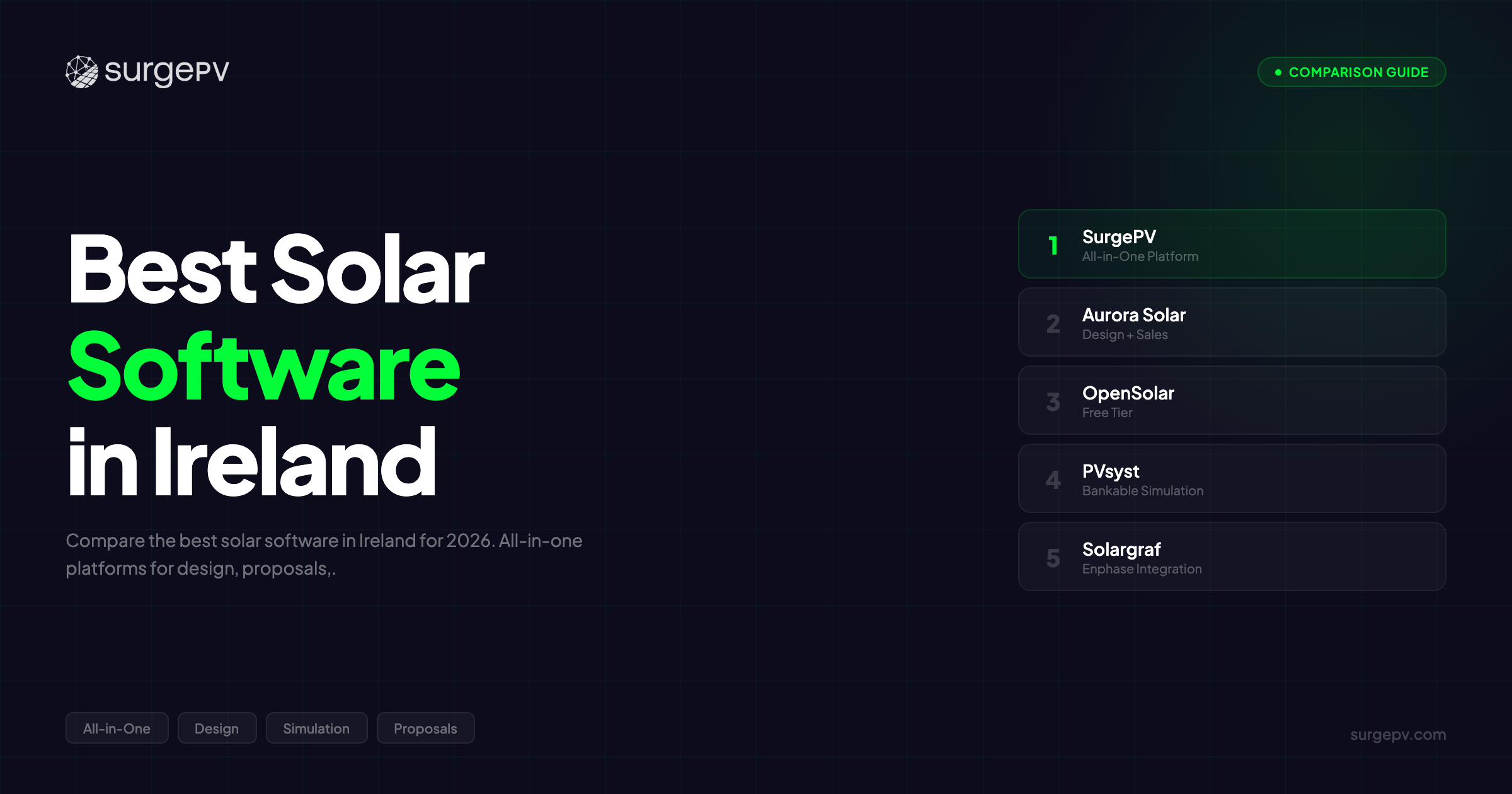
TL;DR: SurgePV is the best all-in-one solar software for Ireland — design, simulation, and proposals in one integrated platform with SEAI and Clean Export Guarantee support. PVsyst is the bankability standard for large utility-scale projects.
Ireland’s solar market is accelerating fast. The government’s Climate Action Plan targets 8 GW of installed capacity by 2030 — nearly 7x the current 1.2 GW installed base (SEAI Solar Energy Overview). SEAI grants, the Clean Export Guarantee, and some of Europe’s highest electricity prices are all fuelling adoption across residential, commercial, and utility-scale segments.
But here is the problem most Irish installers and EPCs run into: they are juggling 3–5 separate tools. Design in one platform, simulation in another, proposals in Excel or Word, project management in spreadsheets. That tool-switching wastes 10–15 hours per week and creates data re-entry errors on every project. Meanwhile, ESB Networks grid documentation, SEAI microgeneration grant paperwork, and DS3 grid code compliance all need manual handling.
The best solar software for Ireland eliminates that fragmentation. It combines design, bankable simulations, proposals, and Irish regulatory compliance in a single platform — so your team spends time closing deals instead of switching tabs.
We tested and compared the top 5 solar software platforms for the Irish market, evaluating each on workflow completeness, Irish regulatory compliance, simulation accuracy, and pricing.
In this guide, you’ll learn:
- Which platform delivers a true all-in-one workflow for Irish installers and EPCs
- How pricing compares across tools (from $625/year to over $6,000/year)
- Which software automates ESB Networks documentation and SEAI grant reporting
- Our recommendation based on 400+ projects across Europe
Quick Comparison Table
| Software | Approach | Pricing/Year | ESB/SEAI Automation | P50/P90 |
|---|---|---|---|---|
| SurgePV | All-in-one (end-to-end) | $1,899 (3 users) | Yes (automated) | Yes |
| Aurora Solar | All-in-one (design + sales) | $3,600–6,000 | No | P50 only |
| OpenSolar | All-in-one (residential) | $1,200–2,400 | No | No |
| PVsyst | Simulation (hybrid) | $625–1,250 | No | Yes (gold standard) |
| Solargraf | All-in-one (budget) | $1,200–1,800 | No | No |
Best Solar Software in Ireland (Detailed Reviews)
SurgePV — Best Complete Platform for the Irish Market
Best For: EPCs and installers who need design, simulation, proposals, and Irish compliance in one tool
Pricing: $1,899/year (3 users); $1,499/user/year (For 3 Users plan)
Onboarding: 2–3 weeks
SurgePV is the only all-in-one solar platform that combines design and engineering, bankable simulations, proposal generation, and Irish regulatory automation in a single cloud-based workflow.
For the Irish market, that distinction matters more than it might seem. Here is the reality most Irish installers face: you design in one tool, run simulations in another, build proposals in Excel or Word, and handle ESB Networks TA documentation and SEAI grant paperwork manually. That workflow wastes 10–15 hours per week across a typical 3-person team — and the data re-entry between systems introduces errors on every project. SurgePV eliminates all of that. One platform, one workflow, one source of truth for every project.
Key Features for Ireland
- ESB Networks automation — Auto-generates Technical Assessment (TA) and Basis of Design (BoD) documentation, single line diagrams, and DS3 grid code compliance reports. Manual ESB documentation takes 4–8 hours per commercial project; SurgePV reduces this to under 30 minutes.
- SEAI grant compliance — Automatically generates pre-works and post-works reports for Ireland’s Microgeneration Support Scheme (EUR 2,100–2,400 grants). Saves 2–3 hours per residential project.
- CEG tariff modeling — Integrated financial modeling calculates Clean Export Guarantee revenue, self-consumption vs. export ratios, and accurate ROI with Irish electricity rates.
- P50/P75/P90 bankable simulations — Production estimates accepted by Irish banks (Bank of Ireland, AIB). Accuracy within +/-3% of PVsyst. Your financing applications include the bankability data lenders actually require.
- Automated SLD generation — Creates ESB-compliant electrical schematics in 5–10 minutes. Manual AutoCAD drafting takes 2–3 hours for the same output — and costs $2,000/year in licensing.
- 8760-hour shading analysis — Hour-by-hour simulation across the full year, calibrated for Ireland’s maritime climate with lower irradiance and frequent cloud cover (900–1,100 kWh/m²/year).
- Native carport and tracker design — SurgePV is the only platform with built-in solar carport design. As Ireland’s commercial segment grows, this is a genuine competitive edge.
- Wire sizing and voltage drop calculations — Automated calculations per IEC and ETCI standards. No manual spreadsheet work.
Streamline Your Irish Solar Workflow with SurgePV
Design, simulate, generate ESB documentation, automate SEAI grants, and deliver proposals — all in one platform.
Book a DemoNo commitment required · 20 minutes · Live project walkthrough
Aurora Solar — Best for Large Irish Commercial EPCs
Best For: Commercial EPCs managing complex rooftop projects with large budgets
Pricing: $3,600–6,000/year
Aurora Solar is the industry leader in AI-powered roof modeling and polished sales proposals. Its design tools are strong for detailed rooftop solar layout, and its CRM integrations make it popular with large sales-driven organisations.
What Works for Ireland
- Industry-leading automatic 3D roof detection speeds up commercial design
- Remote site assessment using aerial imagery — helpful across Ireland’s dispersed geography
- Strong shading analysis for Ireland’s variable weather patterns
- CRM integrations (Salesforce, HubSpot) streamline sales workflows
Where It Falls Short in Ireland
- No integrated SLD generation — ESB Networks documentation requires AutoCAD ($2,000/year) as a separate tool
- No SEAI grant automation — Microgeneration grant documentation must be handled manually
- US-centric pricing — $3,600–6,000/year is steep for Irish market budgets
- P50 only — No P75/P90 metrics, which Irish banks and commercial lenders typically expect
Best for: Large commercial EPCs in Ireland who prioritize 3D modeling and sales automation over engineering depth and Irish compliance.
For a deeper analysis, read our full Aurora Solar review.
OpenSolar — All-in-One for Irish Residential Installers
Best For: Residential installers focused on high-volume SEAI grant projects
Pricing: $1,200–2,400/year
OpenSolar is an Australian-developed platform combining design, proposals, and customer management. Its customer-facing portal with e-signatures and built-in financing options are standout features for the residential segment.
What Works for Ireland
- Fast residential proposals (15–30 minutes from lead to quote)
- Built-in financing and payment options for Irish homeowners
- Customer-facing portal for proposal review and e-signatures
- CRM integration for lead management at scale
Where It Falls Short in Ireland
- No ESB Networks documentation — TA/BoD generation not supported
- Limited DS3 compliance features — Grid code checks must be done manually
- Basic shading analysis — Not suitable for complex commercial sites
- No bankable P50/P90 reports — Not accepted by Irish banks for project financing
Best for: Irish residential installers focused on high-volume SEAI grant projects who prioritise fast proposals and customer engagement tools.
Read our full OpenSolar review for more details.
PVsyst — Simulation Gold Standard for Irish Banks
Best For: Engineers and developers needing bankable reports for Irish lenders
Pricing: CHF 600–1,200/year (~$625–1,250/year)
PVsyst is the industry reference for bankable energy production estimates. If you’re seeking project financing from Irish banks or insurance underwriting for utility-scale developments, PVsyst reports carry unmatched credibility.
What Works for Ireland
- Universally accepted by Bank of Ireland, AIB, Ulster Bank, and commercial lenders
- Detailed loss modeling (temperature, soiling, mismatch, inverter efficiency)
- P50/P90 reports are the gold standard for project financing
- PVGIS and Meteonorm integration includes Irish weather data
Where It Falls Short in Ireland
- Not a design platform — PVsyst is simulation-only
- No SLD generation — Electrical documentation requires external CAD tools
- No proposal generation — Cannot produce client-facing sales documents or SEAI grant paperwork
- Desktop-only — No cloud collaboration, limiting team workflows
Best for: Engineers and developers focused on utility-scale solar farms where bankable simulations are the primary requirement.
Read our full PVsyst review for a detailed breakdown.
Solargraf — All-in-One on a Budget
Best For: Small Irish installers on tight budgets
Pricing: $1,200–1,800/year
Solargraf combines basic design and proposal generation with visual system layouts. It’s a budget-friendly option for small-to-medium volume residential sales, though Irish compliance features are entirely manual.
What Works for Ireland
- Affordable pricing for small installers
- Good proposal design templates with visual system layouts
- Basic financial modeling (ROI, payback, savings)
- Cloud-based platform with easy learning curve
Where It Falls Short in Ireland
- No ESB Networks or SEAI automation — All Irish compliance work is manual
- No bankable simulations — P50/P90 reports not available
- Limited Irish-specific templates — Needs customisation
- No SLD generation — Electrical documentation requires separate tools
Best for: Small Irish installers managing 50–150 residential systems/year and needing affordable design + proposal software.
Read our full Solargraf review.
Comprehensive Comparison: All Features
| Feature | SurgePV | Aurora Solar | OpenSolar | PVsyst | Solargraf |
|---|---|---|---|---|---|
| Approach | End-to-end | Design + sales | Residential | Simulation | Budget |
| ESB Networks automation | Yes (automated) | No | No | No | No |
| SEAI grant automation | Yes (automated) | No | No | No | No |
| SLD generation | Yes (automated) | No | No | No | No |
| P50/P90 reports | Yes | P50 only | No | Yes (gold standard) | No |
| CEG tariff modeling | Yes (built-in) | No | Custom setup | No | No |
| Shading analysis | 8760-hour | Yes | Basic | Yes | Basic |
| Proposal generation | Yes (built-in) | Yes | Yes | No | Yes |
| Financial modeling | Yes (CEG + SEAI) | Basic | Basic | No | Basic |
| Carport design | Yes (only platform) | No | No | No | No |
| Cloud-based | Yes | Yes | Yes | No | Yes |
| Pricing/year | $1,899 (3 users) | $3,600–6,000 | $1,200–2,400 | $625–1,250 | $1,200–1,800 |
Bottom Line: Best Solar Software for Ireland
Ireland’s solar market is scaling fast — but the regulatory environment (ESB Networks, DS3, SEAI, ETCI) and the sheer fragmentation of most installer workflows make software selection a genuine competitive advantage.
Here is how to choose:
For Irish EPCs and installers (50–500+ projects/year): SurgePV is the best all-in-one platform. ESB Networks automation, SEAI grant compliance, P50/P90 bankable simulations, and complete design-to-proposal workflows — all in one platform at $1,899/year for 3 users. No other tool offers this combination for the Irish market.
For large EPCs needing advanced design features: Aurora Solar offers strong AI-powered design, CRM integration, and polished proposals, but ESB and SEAI documentation require manual work and pricing runs $3,600–6,000/year.
For high-volume residential installers: OpenSolar provides the fastest residential proposals with built-in CRM and customer portals, though SEAI grants and ESB documentation need separate handling.
For utility-scale bankability: PVsyst remains the simulation gold standard for Irish bank financing. Pair it with SurgePV or other tools for the complete workflow.
For small budget-conscious installers: Solargraf offers an affordable entry point with visual proposals, though Irish compliance features are entirely manual.
The Irish solar sector is not slowing down. The installers and EPCs growing fastest today are the ones who have replaced their 3–5 tool workflows with a single integrated platform — not the ones still copying data between Excel, AutoCAD, and Word templates. Your solar software choice determines whether you handle 100 projects per year or 200 with the same team.
Want to see how SurgePV handles Irish project workflows? Book a demo and our team will walk you through a project using your actual site data. Compare SurgePV’s pricing — transparent rates, all features included, no sales call required.
Further Reading
- Best Solar Design Software in Ireland — EPC-focused platform comparison
- Best Solar Proposal Software in Ireland — Proposal tools for SEAI grants
Frequently Asked Questions
What is the best all-in-one solar software in Ireland?
SurgePV is the best all-in-one solar software for Ireland in 2026. It combines design, automated SLD generation (meeting ESB Networks requirements), P50/P90 bankable simulations, SEAI grant documentation, and proposal tools in one cloud-based platform at $1,899/year for 3 users. For advanced residential design, Aurora Solar is a strong alternative.
Should I use all-in-one software or multiple tools?
All-in-one platforms (SurgePV, Aurora Solar, OpenSolar) are better for Irish installers managing 50+ projects/year, saving 10–15 hours/week versus multiple tools. Hybrid approaches (PVsyst plus separate proposal tools) suit utility-scale developers prioritising maximum bankability over workflow efficiency. For most Irish businesses, the time savings from all-in-one platforms pay for themselves within 2–3 months.
Does solar software integrate with ESB Networks?
SurgePV is the only platform with built-in ESB Networks integration, auto-generating Technical Assessment (TA) and Basis of Design (BoD) documentation, including single line diagrams and DS3 grid code compliance reports. Other platforms (Aurora, OpenSolar, PVsyst) require manual ESB documentation, adding 4–8 hours per commercial project. See how SurgePV automates electrical documentation.
Can solar software automate SEAI grant documentation?
SurgePV automatically generates SEAI-compliant pre-works and post-works reports for Ireland’s Microgeneration Support Scheme (EUR 2,100–2,400 grants). Other platforms require manual SEAI calculations and documentation, adding 2–3 hours per residential project. See how SurgePV automates proposals.
How much does solar software cost in Ireland?
Costs range from $625/year (PVsyst standalone) to $6,000/year (Aurora Solar). SurgePV starts at $1,899/year for 3 users with all features included. OpenSolar costs $1,200–2,400/year. Consider total cost of ownership — juggling multiple tools (design + simulation + proposals + PM) often costs EUR 500–1,000/month combined. See SurgePV’s transparent pricing.
What is the ROI of all-in-one solar software for Irish installers?
Irish installers typically achieve 5–10x ROI on all-in-one software through time savings (10–15 hours/week) and increased project throughput (30–50% more projects). For installers managing 100 projects/year, SurgePV saves 500–750 hours annually (EUR 25,000–37,500 at Irish labour rates) and enables 30–50 additional projects.
Which solar software do Irish banks accept for project financing?
Irish banks (Bank of Ireland, AIB, Ulster Bank) primarily accept PVsyst P50/P90 reports for project financing. SurgePV simulations (+/-3% accuracy versus PVsyst) are increasingly accepted by Irish lenders for commercial projects. Residential projects typically do not require bankable simulations for consumer financing.
How long does it take to learn solar software?
Cloud all-in-one platforms (SurgePV, OpenSolar, Aurora Solar) require 2–5 days of training. Desktop tools (PVsyst) require 1–2 weeks for proficiency. Modern platforms with intuitive interfaces enable Irish teams to generate proposals within days of onboarding. SurgePV offers 3-minute support response times to accelerate the learning curve.
Important: All pricing data in this article was verified against official sources as of February 2026. Prices may have changed since publication.
Sources
- SEAI (Sustainable Energy Authority of Ireland) — Solar energy overview and market data
- SEAI Solar Electricity Grant — Grant amounts and documentation requirements
- ESB Networks — Grid connection application process and DS3 standards
- IEA PVPS Ireland National Survey Report — Installed capacity and policy data
- Commission for Regulation of Utilities (CRU) — Irish electricity rates and microgeneration regulations
- Met Eireann — Irish meteorological data for solar performance modeling
- G2 Aurora Solar Reviews — User reviews and ratings
- G2 OpenSolar Reviews — User reviews and ratings
- SurgePV Product Documentation — Official feature specifications (accessed February 2026)