

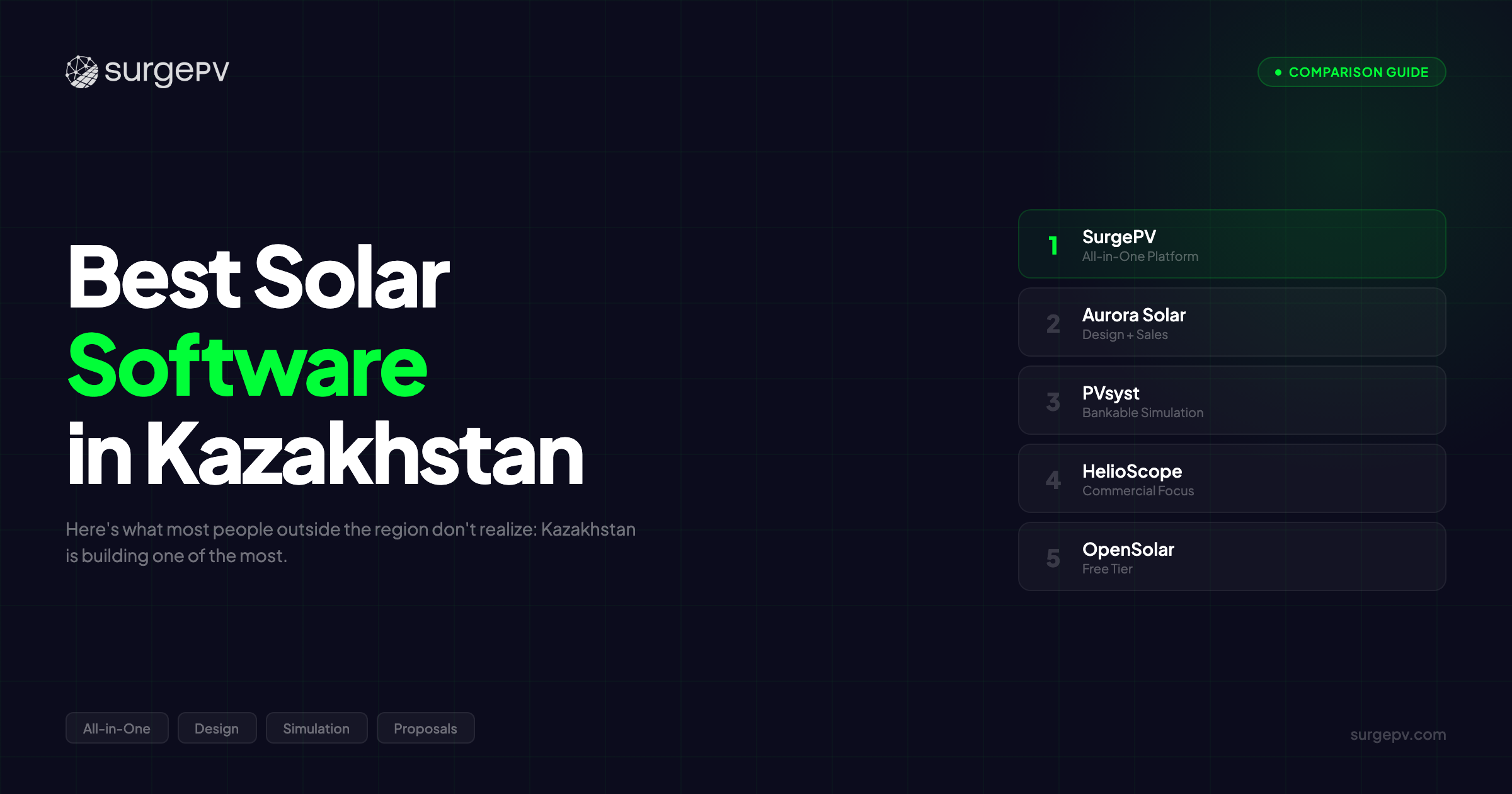
TL;DR: SurgePV is the best all-in-one solar software for Kazakhstan — design, simulation, and proposals in one integrated platform supporting Kazakhstan’s 3 GW renewable target.
Kazakhstan Is Central Asia’s Biggest Solar Opportunity. The Right Software Makes the Difference.
Here’s what most people outside the region don’t realize: Kazakhstan is building one of the most ambitious solar programs in Central Asia, and it’s doing it across one of Earth’s most extreme climates.
The country’s renewable energy targets aim for 2 GW of solar capacity by 2030. KOREM runs competitive auction rounds at KZT 34-45/kWh. International financing from the EBRD and ADB is flowing into utility-scale ground-mount projects across the steppe. Nur-Sultan and Almaty are seeing growing commercial rooftop demand. The market is real, and it’s accelerating.
But Kazakhstan’s climate is unlike any other major solar market. Winter temperatures plunge to -40 degrees Celsius. Summer heat climbs to +45 degrees. That 85-degree temperature swing causes extreme thermal cycling that generic software models don’t capture. Steppe dust storms cause 2-4% annual soiling losses. Snow cover in northern regions reduces winter production. And KEGOC grid connection approvals require complete electrical documentation that most solar platforms can’t generate.
The result: Kazakhstan EPCs are forced to cobble together 3-4 separate tools — one for design, one for simulation, one for electrical engineering, one for proposals. That fragmented workflow costs time, introduces errors, and produces inconsistent deliverables.
In this guide, you’ll discover:
- Which 5 platforms handle Kazakhstan’s extreme continental climate and regulatory requirements
- How each tool manages KOREM tariff modeling, KEGOC compliance, and EBRD bankability
- Real pricing comparisons in KZT (no hidden fees)
- Where most platforms fall short for Kazakhstan-specific workflows
Quick Summary: Our Top Picks for Kazakhstan
After testing 5 platforms with Kazakhstan solar EPCs and commercial clients, here are our top recommendations:
- SurgePV — All-in-one design, engineering, simulation, and proposals with extreme climate modeling (Best for C&I EPCs and developers)
- Aurora Solar — Cloud design with polished proposals (Best for urban commercial teams, expensive for full Kazakhstan workflow)
- PVsyst — Gold standard for bankable simulation (Best for utility-scale validation, simulation-only)
- HelioScope — Commercial layout and simulation (Best for quick commercial designs, limited engineering features)
- OpenSolar — Free basic platform (Best for budget-conscious small installers, limited Kazakhstan features)
Each tool is evaluated on Kazakhstan-specific criteria: extreme climate modeling, KOREM/KEGOC compliance, EBRD/ADB bankability, end-to-end workflow efficiency, and pricing in KZT.
Best Solar Software in Kazakhstan (Detailed Reviews)
| Software | Best For | Pricing | Kazakhstan Fit |
|---|---|---|---|
| SurgePV | Integrated platform | ~$1,899/yr (3 users) | Excellent |
| Aurora Solar | Residential workflow | ~$3,600-6,000/yr | Good |
| PVsyst | Simulation specialist | ~$625-1,250/yr | Good |
| HelioScope | C&I design | ~$2,400-4,800/yr | Good |
| OpenSolar | Free platform | Free tier available | Good |
SurgePV — Best All-in-One Platform for Kazakhstan
Target Users: C&I EPCs designing and selling 50 kW-10 MW projects, KOREM auction developers, solar installers in Nur-Sultan and Almaty, sales teams needing bankable proposals, engineering firms needing automated SLDs.
SurgePV is the only cloud-based platform combining AI-powered design, automated electrical engineering, bankable simulations, and professional proposals — eliminating the multi-tool overhead that defines most Kazakhstan EPC workflows.
For Kazakhstan EPCs juggling KOREM auction requirements, EBRD financing standards, and extreme continental weather, SurgePV provides a single platform that replaces AutoCAD + PVsyst + Excel.
Unique Value for Kazakhstan: The only platform with native carport solar design, single-axis and dual-axis tracker support, and automated SLD generation. For Kazakhstan’s steppe utility-scale projects requiring trackers, and growing urban commercial market requiring complete engineering deliverables, SurgePV delivers the full workflow without tool-switching.
Key Features for Kazakhstan
Extreme Climate Design
Temperature-adjusted production modeling accounts for Kazakhstan’s continental extremes — -40 degrees Celsius winters and +45 degrees Celsius summers. Soiling loss calculations factor 2-4% annual losses from steppe dust. Snow cover modeling addresses winter production impacts in northern regions. Long-term degradation modeling includes cleaning schedule impact for realistic 25-year projections.
Standard test condition estimates at 25 degrees Celsius don’t reflect Kazakhstan’s reality. SurgePV’s climate adjustments give you numbers that match actual production. That’s the difference between a proposal the client trusts and one that gets challenged during EBRD due diligence.
Automated Electrical Engineering
SLD generation automates what Kazakhstan engineers currently spend 2-3 hours creating in AutoCAD. SurgePV produces permit-ready Single Line Diagrams in 5-10 minutes — NEC and IEC compliant, customizable for KEGOC requirements.
Wire sizing calculations follow code requirements with temperature correction (critical for Kazakhstan’s extreme range), conduit fill adjustment, and voltage drop analysis. No more manual spreadsheet calculations.
An engineering department that currently handles 12 projects per month using AutoCAD can handle 20+ with SurgePV. Same headcount. Higher throughput. Lower per-project cost.
Tracker and Ground-Mount Design
Native single-axis and dual-axis tracker support with backtracking algorithms delivers 15-25% production gains — a non-negotiable for competitive KOREM bids. The flat steppe terrain across southern Kazakhstan is ideal for tracker installations, and SurgePV models tracker spacing, row-to-row shading, and backtracking optimization.
Plus native carport solar design (single cantilever, dual cantilever, multi-column) for growing urban commercial demand in Nur-Sultan and Almaty shopping centers, corporate campuses, and institutional facilities.
No other platform offers native carport design. Not Aurora. Not PVsyst. Not HelioScope. Not OpenSolar.
Bankable Simulations
P50/P75/P90 production estimates — not just P50. EBRD, ADB, and international investors require conservative P75/P90 metrics for financing approval. SurgePV provides these natively, achieving ±3% accuracy versus PVsyst.
8760-hour shading analysis runs in 30-60 seconds. Detailed enough for bankable reports. Fast enough for daily design iteration.
Professional Proposals
Web-based proposals with KZT currency formatting, branded templates, and mobile-friendly delivery. Financial modeling includes cash, loan, and PPA options with 25-year projections. KOREM tariff scenarios configurable for KZT 34-45/kWh ranges.
Design-to-proposal integration means proposals auto-fill from design data. No re-entering system size, production, or BOM into a separate tool.
Note
For Kazakhstan’s institutional and government buyers who compare proposals from multiple EPCs, the quality of your deliverables signals the quality of your work. An interactive, bankable proposal in KZT sets a different standard than a static PDF with generic numbers.
Mini Case Study: A C&I EPC based in Almaty was using Aurora for design, AutoCAD for SLDs, and Excel for financial modeling — a 3-tool workflow that took 2.5-3 hours per project. After switching to SurgePV, the complete workflow (design + electrical + simulation + proposal) takes 45 minutes. Across 25 projects per year, that recovers 50+ hours of engineering time. The team now responds to commercial RFPs within 24 hours instead of 3-4 days.
Streamline Your Solar Business with SurgePV
End-to-end solar workflows from design to proposal in one platform.
Book a DemoNo commitment required · 20 minutes · Live project walkthrough
Aurora Solar — Polished Design, Gaps for Kazakhstan
Overview
Aurora Solar is the industry-leading residential and C&I solar platform with polished AI roof modeling and professional sales proposals. The AI roof detection creates accurate 3D models in under 15 seconds from satellite imagery.
For Kazakhstan, Aurora covers urban commercial rooftop design well. But three gaps limit its value for the broader market.
First, no tracker support — Kazakhstan’s utility-scale market relies on single-axis trackers for 15-25% production gain. Aurora can’t model them. Second, no SLD generation — you’ll need AutoCAD for the electrical documentation KEGOC requires. Third, P50 estimates only — no P75/P90 for EBRD/ADB financing.
Key Strengths:
- Industry-best AI roof detection for urban commercial rooftops
- Beautiful, client-facing proposals
- Strong CRM integrations (Salesforce, HubSpot)
- Large user community and support resources
Kazakhstan Limitation: No tracker design, no SLD generation, P50-only simulation. For a market with significant utility-scale steppe projects and KEGOC electrical documentation requirements, these are meaningful gaps.
Best Use Case in Kazakhstan: Urban commercial installers in Nur-Sultan and Almaty focused on rooftop systems under 2 MW with separate electrical engineering teams.
Pricing:
- Basic Plan: $159/user/month (~KZT 940,000/year per user)
- Premium Plan: $259/user/month (~KZT 1,530,000/year per user)
- Add AutoCAD: ~KZT 986,000/year per user minimum
For a 5-user Kazakhstan EPC team: approximately KZT 9,630,000/year (Aurora Basic + AutoCAD) compared to SurgePV’s KZT 3,200,000/year.
PVsyst — Gold Standard Simulation, Not Operational
Overview
PVsyst is the global gold standard for bankable solar simulations. KOREM evaluators and EBRD/ADB accept PVsyst reports without question.
But PVsyst is a validation tool, not an operational design platform. You can’t design panel layouts, create proposals, or generate SLDs. You design in another platform, export the data, import it into PVsyst, run simulations, and generate a bankability report.
Key Strengths:
- Most trusted simulation tool worldwide
- Deep loss modeling with P50/P90/P99 production estimates
- Kazakhstan-specific soiling and snow loss profiles
- Meteo database covering Kazakhstan’s irradiance zones (1,300-1,800 kWh/m²/year)
Kazakhstan Use Case: Utility-scale validation for 50 MW+ KOREM projects, EBRD/ADB financing applications, and projects where tier-1 lenders specifically request PVsyst reports. Pair with SurgePV for operational design.
Pricing:
- Professional License: ~CHF 1,200 (~KZT 640,000) per seat, one-time purchase + annual maintenance (~KZT 105,000/year)
- Model: Desktop license, per-seat
HelioScope — Commercial Layout, Limited Engineering
Overview
HelioScope (now part of Aurora Solar) is a cloud-based commercial solar design platform with solid simulation capabilities and growing acceptance for Central Asian projects.
HelioScope supports tracker modeling and ground-mount design — more relevant to Kazakhstan than Aurora’s core platform. But no SLD generation. No wire sizing. Kazakhstan EPCs will need AutoCAD or a separate electrical engineering workflow.
Key Strengths:
- Commercial and utility-scale focus aligning with Kazakhstan’s project mix
- Cloud-based collaboration for distributed teams
- Tracker support and ground-mount design
- Bankable energy estimates with detailed loss modeling
Kazakhstan Limitation: No SLD generation or wire sizing. Requires AutoCAD ($2,000/year) for KEGOC electrical documentation.
Best Use Case in Kazakhstan: C&I EPCs with separate electrical engineering teams working on 500 kW-10 MW commercial rooftop and ground-mount projects.
Pricing: Starting at ~$79/month (~KZT 467,000/year) — verify current pricing post-Aurora acquisition.
OpenSolar — Free Basic Platform
Overview
OpenSolar is free. For small installers entering Kazakhstan’s market, that removes the software cost barrier. But the capability gaps are real.
No extreme climate modeling. No carport design. No SLD generation. No KOREM tariff modeling. No P75/P90 bankability. OpenSolar works for basic residential installations — not for the commercial and utility-scale segments driving Kazakhstan’s growth.
Key Strengths:
- Free tier with no per-project cost
- E-signature integration
- Basic financial modeling templates
Kazakhstan Limitation: Lacks extreme climate modeling, carport design, SLD generation, KOREM tariff modeling, and P75/P90 bankability. Suitable for residential, not commercial or utility-scale.
Best Use Case in Kazakhstan: Small residential installers (<20 projects/year) entering the market with minimal software budget.
Pricing: Free tier available. Premium plans from ~$99/month.
What Makes the Best Solar Software for Kazakhstan
1. Extreme Continental Climate Modeling
Kazakhstan’s -40 to +45 degree Celsius temperature range is the widest of any major solar market. Software must model temperature derating across the full range, integrate soiling loss factors for steppe environments, account for snow cover losses, and handle high-latitude sun angles for Nur-Sultan (51 degrees North).
Standard test condition estimates overstate Kazakhstan production by 10-15%. Any platform used for Kazakhstan projects must include extreme temperature and soiling adjustments.
2. Tracker Design for Steppe Projects
Single-axis trackers deliver 15-25% more production than fixed-tilt. Kazakhstan’s flat steppe terrain is ideal for tracker installations. Nearly all KOREM utility-scale projects use trackers for competitive bid pricing. Software without tracker support can’t compete for these projects.
3. KOREM Bankability & EBRD/ADB Financing
KOREM utility-scale projects require bankable P50/P90 simulations. EBRD and ADB demand these metrics before project approval. Software must generate bankable production estimates with 8760-hour shading analysis and detailed loss breakdowns.
4. KEGOC Grid Connection Documentation
KEGOC mandates complete electrical documentation — SLDs, protection settings, wire sizing, breaker specifications. Automated SLD generation (like SurgePV provides) saves 2-3 hours per project versus manual AutoCAD drafting.
5. End-to-End Workflow Efficiency
The multi-tool workflow (design + AutoCAD + PVsyst + Excel) costs 2-3 hours per project. At 30 projects per year, that’s 60-90 hours of lost productivity. One platform handling all four functions eliminates that overhead.
Bottom Line: Best Solar Software for Kazakhstan
For Kazakhstan C&I EPCs and developers: SurgePV offers the most complete single-platform solution — combining extreme climate design, carport solar (unique), automated SLD generation, bankable P50/P75/P90 simulations, and KZT-denominated proposals at ~KZT 640,000/user/year.
One platform replaces AutoCAD + PVsyst + Excel. That eliminates KZT 1,000,000+/year in per-user tool costs and saves 1.5-2.5 hours per project. For Kazakhstan EPCs handling 25+ projects per year, the productivity gains are substantial.
For KOREM utility-scale bankability: PVsyst remains the gold standard for EBRD/ADB lender validation. But it’s simulation-only. For daily C&I workflow, SurgePV provides comparable accuracy with complete workflow integration and PVsyst export when lender-specific validation is needed.
For urban commercial design: Aurora Solar delivers excellent AI roof detection and polished proposals. But you’ll need AutoCAD for engineering, and P50-only estimates require separate PVsyst validation for EBRD financing.
For quick commercial layouts: HelioScope produces fast designs with acceptable simulation. But no engineering features and no proposals limit standalone value.
For budget-conscious startups: OpenSolar is free. Suitable for market entry. But lack of Kazakhstan-specific features means you’ll outgrow it as soon as you take on commercial work.
Kazakhstan isn’t just setting solar targets — it’s building the financing mechanisms and regulatory frameworks to hit them. The EPCs winning KOREM bids and C&I contracts today aren’t the ones with the lowest prices. They’re the ones with the fastest, most accurate engineering and proposal workflows.
Your solar software platform determines whether you’re competing — or just participating.
Further Reading
- Best Solar Design Software in Kazakhstan — Design tool comparison
- Best Solar Proposal Software in Kazakhstan — Proposal tool comparison
- PVsyst Review — Simulation specialist deep-dive
Frequently Asked Questions
What is the best solar software in Kazakhstan?
SurgePV is the best all-in-one solar software for Kazakhstan, combining extreme climate design (-40 to +45 degrees Celsius modeling), automated SLD generation, bankable P50/P75/P90 simulations, and KZT-denominated proposals at ~KZT 640,000/user/year.
For Kazakhstan C&I EPCs, SurgePV replaces the typical three-tool workflow (PVsyst + AutoCAD + Excel) with a single cloud platform, saving 1.5-2.5 hours per project and KZT 1,000,000+/year in per-user tool costs.
Which software handles Kazakhstan’s extreme climate?
SurgePV and PVsyst model Kazakhstan’s extreme continental climate including -40 degrees Celsius winter and +45 degrees Celsius summer temperature derating, 2-4% steppe soiling losses, and snow cover effects. PVsyst provides the deepest simulation detail. SurgePV integrates climate modeling into a complete end-to-end design and proposal workflow.
Standard test condition estimates overstate Kazakhstan production by 10-15%. Any platform used for Kazakhstan projects must include extreme temperature and soiling adjustments for credible estimates.
What software is required for KOREM auctions?
KOREM utility-scale projects require bankable P50/P90 simulations accepted by EBRD and ADB. PVsyst is the gold standard for international lender validation. SurgePV provides P50/P75/P90 at ±3% accuracy versus PVsyst, sufficient for most C&I financing.
For KOREM mega-projects, the recommended workflow: SurgePV for design and daily operations + PVsyst for EBRD/ADB bankability validation.
How much does solar software cost in Kazakhstan?
From free (OpenSolar) to ~KZT 1,530,000+/year per user: SurgePV (~KZT 640,000/user/year, all-in-one), PVsyst (~KZT 640,000 one-time, simulation only), Aurora (~KZT 940,000+/user, design + proposals), HelioScope (~KZT 467,000+, commercial layout).
The real cost comparison is total workflow: SurgePV at ~KZT 640,000/user replaces what typically costs KZT 2,000,000+/user across multiple tools. See pricing details.
Does software support trackers for Kazakhstan steppe projects?
SurgePV, PVsyst, HelioScope, and PVCase all support single-axis tracker design. SurgePV additionally supports dual-axis trackers and carport structures. Aurora Solar does not support tracker design.
Kazakhstan’s flat steppe terrain is ideal for tracker installations, delivering 15-25% production gains. Tracker support is non-negotiable for competitive KOREM bids.
Do Kazakhstan banks accept solar software reports?
EBRD and ADB accept PVsyst as the gold standard for utility-scale financing. SurgePV (±3% accuracy versus PVsyst) is accepted for C&I commercial financing. Aurora provides P50-only estimates, which most international lenders consider insufficient without separate P75/P90 validation.
For projects requiring international lender-grade validation, SurgePV exports to PVsyst for final sign-off while providing bankable estimates sufficient for most commercial financing.
Is there free solar software for Kazakhstan?
OpenSolar is free but lacks extreme climate modeling, carport design, SLD generation, KOREM tariff modeling, and P75/P90 bankability. It works for basic residential installations but not for commercial or utility-scale projects.
Free tools trade cost savings for capability gaps. SurgePV at ~KZT 640,000/user/year provides the complete feature set Kazakhstan EPCs need.
Can software handle both Russian and English workflows?
Most solar platforms including SurgePV, Aurora, and PVsyst operate in English — the standard language for technical and engineering software globally. While Kazakhstan’s market is predominantly Russian-speaking, engineering teams typically work in English for solar software. SurgePV’s cloud-based interface is intuitive enough that language is rarely a barrier, and proposals can be formatted with custom text for client-facing documents.
Sources
- IRENA - International Renewable Energy Agency — https://www.irena.org — Kazakhstan renewable energy statistics (accessed February 2026)
- EBRD - European Bank for Reconstruction and Development — https://www.ebrd.com — Kazakhstan renewable energy financing (accessed February 2026)
- ADB - Asian Development Bank — https://www.adb.org — Central Asia renewable energy investment (accessed February 2026)
- KEGOC - Kazakhstan Electricity Grid Operating Company — https://www.kegoc.kz — Grid connection and transmission standards (accessed February 2026)
- Solargis - Solar Resource Maps — https://solargis.com — Kazakhstan irradiance and climate data (accessed February 2026)
- Aurora Solar Official Website — https://aurorasolar.com — Features, pricing (accessed February 2026)
- PVsyst Official Website — https://www.pvsyst.com — Features, pricing (accessed February 2026)
- OpenSolar Official Website — https://www.opensolar.com — Features, pricing (accessed February 2026)
- PV Magazine — https://www.pv-magazine.com — Kazakhstan solar market analysis (accessed February 2026)
- SurgePV Product Documentation — Official feature specifications, pricing, proof points (accessed February 2026)
- G2 Reviews — Verified user reviews for solar software platforms (accessed February 2026)