

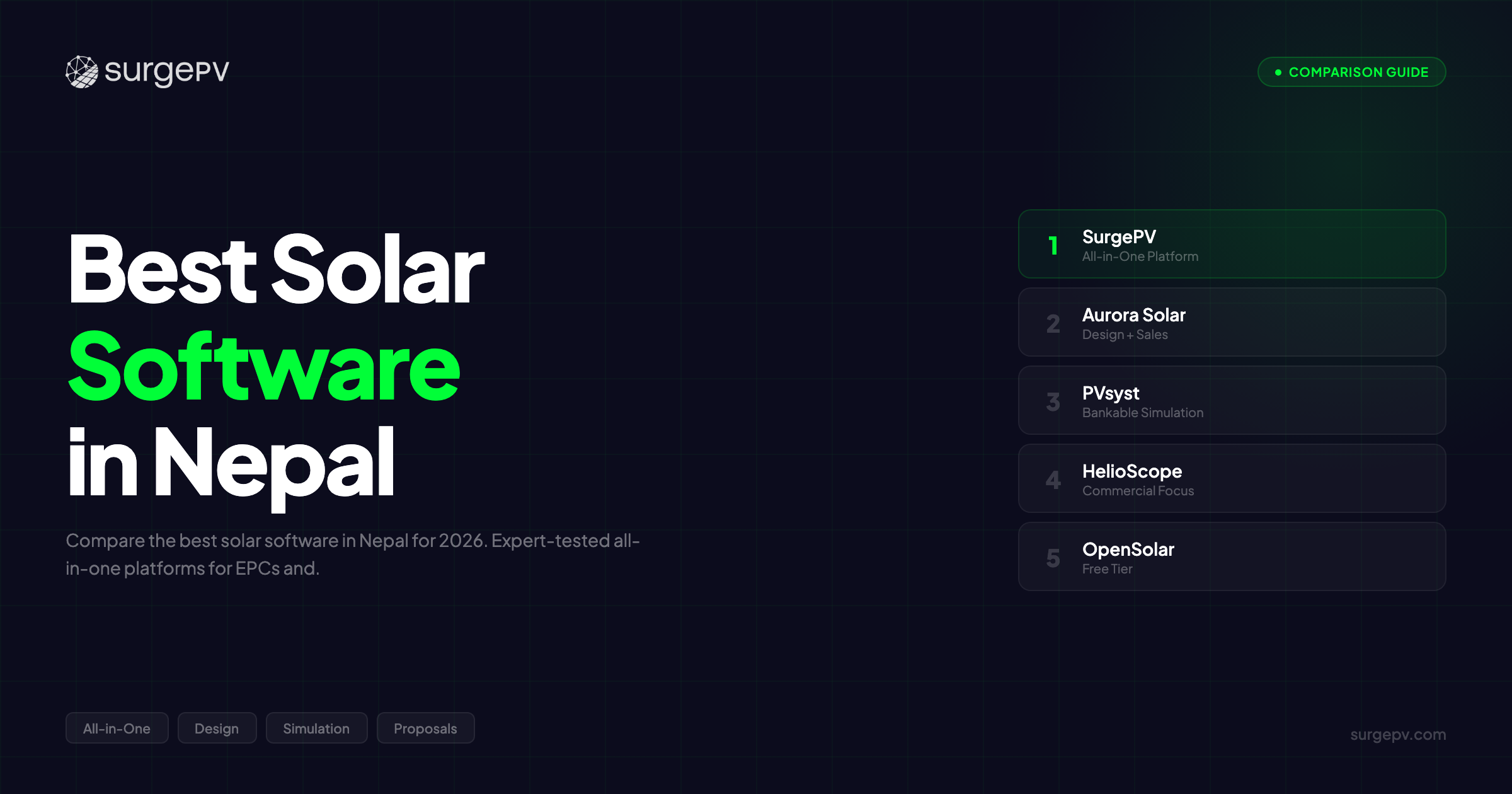
TL;DR: SurgePV is the best all-in-one solar software for Nepal — design, automated electrical engineering (SLD generation, wire sizing), bankable P50/P75/P90 simulations, and proposals with net metering economics in one platform at $1,899/year for 3 users. Aurora Solar leads on presentation quality but lacks electrical engineering and Nepal-specific financial modelling. PVsyst is the bankability gold standard for large projects but does nothing else. HelioScope provides solid cloud-based design for mid-size C&I EPCs. OpenSolar is the most affordable entry point for small residential installers.
Nepal’s Solar Story Starts with Load Shedding. The Next Chapter Requires Better Software.
Every Nepali business owner over the age of 30 remembers the load shedding era. Eighteen hours a day without power. Factories idle. Hospitals on generators. An entire economy throttled by unreliable electricity.
That shared trauma created something unexpected: one of the fastest-growing solar markets in South Asia.
Nepal now has active net metering. NEA accepts grid-connected systems. AEPC administers subsidy programmes. World Bank and ADB fund solar development at every scale. C&I installations across Kathmandu Valley, the Terai industrial corridor, and regional cities are accelerating year over year. And the economics get stronger every quarter as NEA tariffs rise and panel prices fall.
But here is the problem most Nepali EPCs face. The software they use was built for different markets, different grid standards, and different business models. AutoCAD for electrical drawings (a tool designed for architects, not solar engineers). PVsyst for simulations (steep learning curve, no design or proposal features). Excel for financial modelling (manual, error-prone, and unprofessional).
That disconnected toolkit costs 4–6 hours per project. It cannot model Nepal’s unique hydropower complementarity. It does not calculate net metering at NEA tariff rates. And it produces documentation that barely meets the standards international lenders require.
The right solar software platform replaces all of it. AI-powered design that handles Himalayan terrain shading. Automated electrical engineering for NEA grid connection. Bankable simulations with satellite weather data. Professional proposals with net metering economics and hydropower complementarity built in. One platform. One subscription.
In this guide, you will learn:
- Which platforms handle Nepal’s full project lifecycle from design to proposal delivery
- How software addresses Nepal’s unique challenges: terrain, altitude, air quality, hydropower complementarity
- Which tools generate documentation meeting NEA, World Bank, and ADB standards
- What satellite weather data integration means for Nepal’s varied geography (60m–5,000m+ elevation)
- Detailed comparisons of SurgePV, Aurora Solar, PVsyst, HelioScope, and OpenSolar
Quick Summary: Our Top Picks for Nepal
After testing 5 platforms with EPCs across Kathmandu Valley, the Terai, Pokhara, and Biratnagar, here are our top recommendations:
- SurgePV — End-to-end design, engineering, simulation, and proposals in one platform (Best for C&I EPCs, growing installers, and cross-border Nepal-India operations)
- Aurora Solar — Premium all-in-one with industry-leading presentations (Best for large international EPCs with budget and existing Aurora standardisation)
- PVsyst — Gold standard simulation for bankability (Best for large projects needing World Bank/ADB lender validation)
- HelioScope — Cloud-based design with strong shading analysis (Best for mid-size EPCs needing team collaboration)
- OpenSolar — Most affordable design and proposal platform (Best for small installers wanting basic capability at lowest cost)
Each tool is evaluated on Nepal-specific criteria: terrain handling, bankability, electrical engineering, net metering modelling, and NPR pricing context.
Best Solar Software in Nepal (Detailed Reviews)
| Software | Best For | Pricing | Nepal Fit |
|---|---|---|---|
| SurgePV | Integrated platform | ~$1,899/yr (3 users) | Excellent |
| Aurora Solar | Residential workflow | ~$3,600–6,000/yr | Good |
| PVsyst | Simulation specialist | ~$625–1,250/yr | Good |
| HelioScope | C&I design | ~$2,400–4,800/yr | Good |
| OpenSolar | Free platform | Free tier available | Good |
SurgePV — Best All-in-One Solar Platform for Nepal
About SurgePV
SurgePV is the only cloud-based platform combining AI-powered design, automated electrical engineering, bankable simulations, and professional proposals without tool-switching.
What does “all-in-one” mean for a Nepal EPC? It means you stop paying for Aurora ($4,800+/year), AutoCAD ($2,000/year), and PVsyst ($1,300/year). Three tools totalling $8,100+/year per user. Instead, you get design, automated SLD generation, P50/P75/P90 simulations, and proposal generation in one $1,899/year subscription for 3 users (~NPR 250,000/year).
Target Users: C&I EPCs (50 kW–10 MW), solar installers, international development contractors, engineering consultants, and cross-border Nepal-India operations.
Unique Value for Nepal: SurgePV is India-headquartered — Nepal’s closest major solar market partner. The platform covers Nepal’s entire geography (26–30 degrees North, 60m–5,000m+ elevation), integrates satellite weather data, and supports both Nepal and India regulatory environments. For Nepali EPCs serving the cross-border India market, one SurgePV subscription covers both countries.
Pro Tip
Calculate your current total cost of software ownership before evaluating individual tools. Most Nepal EPCs are spending NPR 400,000–800,000/year on disconnected tools (or using unlicensed software that creates legal and operational risk). SurgePV replaces the entire legitimate software stack for NPR 250,000/year.
Key Features for Nepal
Design
AI-powered roof modelling detects boundaries, tilt, and azimuth from satellite imagery in 15 minutes vs 45 minutes manual. Handles Nepal’s diverse building stock: RCC flat roofs in Kathmandu commercial districts, varied structures in hill stations, corrugated metal in Terai industrial zones.
Supports commercial rooftop, ground-mount (Terai plains), trackers, East-West racking, and carport solar. SurgePV is the only platform with native carport design.
Electrical Engineering
Automated SLD generation creates IEC-compliant single line diagrams in 5–10 minutes. Wire sizing for Nepal’s 400V distribution system with temperature derating across elevation zones. Protection devices, conduit calculations, and earthing specifications generate automatically. Complete electrical packages for NEA grid connection applications.
Without this: 2–3 hours in AutoCAD per project + $2,000/year licence.
Simulation
8760-hour shading analysis at ±3% vs PVsyst. P50/P75/P90 bankable estimates. Satellite weather data (PVGIS/NASA SSE) for all Nepal locations. Monsoon modelling (June–September). Altitude effects on irradiation. Kathmandu air quality soiling corrections (5–8% annual losses). Mountain horizon shading.
Proposals
Interactive web-based proposals directly from design data. Net metering economics at NEA tariff rates (NPR 7–12/kWh). Monthly production profiles showing hydropower complementarity. BOM from design geometry. NPR and USD currency support. Financing scenario comparisons.
Here is what this looks like in practice. A Biratnagar EPC doing both Nepal and India projects was running HelioScope ($300/month), AutoCAD ($167/month), PVsyst ($108/month), and Excel for proposals. Monthly cost: $575/month. Per-project time: 4.5 hours. After switching to SurgePV ($158/month for 3 users), software costs dropped 73%. Project workflow dropped to 50 minutes. Across 60 projects per year (30 Nepal, 30 India border region), they recovered 200 hours of engineering labour and saved $5,000/year in subscriptions. The entire team became more productive without adding headcount.
Pros and Cons
Pros:
- True all-in-one: Design, electrical, simulation, proposals. No tool-switching, no separate subscriptions, no manual data transfers.
- Automated electrical: SLD generation in 5–10 minutes vs 2–3 hours in AutoCAD. Eliminates $2,000/year AutoCAD licence.
- Nepal + India coverage: One platform for cross-border operations.
- Nepal financial modelling: Net metering at NEA tariffs, hydropower complementarity, NPR currency.
- Bankable accuracy: ±3% vs PVsyst. P50/P75/P90 for World Bank and ADB acceptance.
- Transparent pricing: $1,899/year for 3 users. All features included. No hidden tiers.
- 3-minute support response: Average response time.
- 70,000+ module database: Covers brands available in Nepal (Jinko, Trina, LONGi, Adani, Canadian Solar).
Cons:
- Newer brand: Less established than PVsyst or Aurora with conservative international development agencies.
- NEA portal integration: SLDs require manual upload to NEA systems.
- Utility-scale limitation: Projects above 10 MW may need PVsyst validation for the most conservative international lenders.
Pricing
- Individual Plan: $1,899/year for 3 users (~NPR 250,000/year)
- 3 Users Plan: $1,499/user/year (~NPR 197,000/user/year)
- 5 Users Plan: $1,299/user/year
- Enterprise: Custom pricing
vs Disconnected Stack:
- SurgePV (3 users): $1,899/year — complete platform
- Aurora + AutoCAD + PVsyst (1 user): $8,100/year — still missing wire sizing, P75 estimates, proposal automation
- Savings: $6,201 for 3 users vs 1 user of disconnected stack
Who SurgePV Is Best For
- C&I EPCs: 50 kW–10 MW projects across Kathmandu, Biratnagar, Pokhara, Terai industrial zones
- Cross-border operations: Nepal + India EPCs needing unified workflows
- Growing installers: Residential companies scaling into commercial
- Development contractors: World Bank/ADB project implementers needing standardised deliverables
- Engineering consultants: Multi-project firms needing efficiency at scale
Further Reading
- Best Solar Software (2026) — Complete platform comparison
- Aurora Solar Review — Full feature deep-dive
Real-World Example
A growing EPC team in Nepal was spending 2.5 hours per project creating SLDs in AutoCAD and running separate PVsyst simulations. After switching to SurgePV, SLD generation dropped to under 10 minutes. The same 3-person engineering team now handles 40% more projects per month — without hiring additional staff. That is the difference automated electrical engineering makes.
Aurora Solar — Premium Platform for International Operations
Aurora Solar is the global market leader. Industry-leading 3D modelling, polished proposals, 50,000+ module library. Premium presentation quality that impresses international stakeholders.
The honest assessment: built for US residential. Nepal-relevant features are limited. Pricing is premium.
Key Strengths:
- Industry-leading 3D modelling and proposal presentation quality
- 50,000+ module library (Jinko, Trina, LONGi, Adani represented)
- Global brand recognition
- Cloud-based access
Nepal Limitation: No SLD generation or wire sizing (requires AutoCAD $2,000/year). Only P50 (no P75/P90). No Nepal financial modelling (net metering, hydropower complementarity, NPR). Premium pricing ($500–1,000+/month). US features irrelevant for Nepal.
Best Use Case: Large international EPCs with existing Aurora standardisation. Not cost-effective for Nepal-based mid-market EPCs.
Price: $500–1,000+/month per user.
Did You Know?
Nepal’s solar irradiance ranges from 1,400–1,800 kWh/m² per year, making accurate simulation software essential for bankable energy yield predictions. Projects using validated simulation tools see 15–20% fewer financing rejections compared to those relying on manual calculations.
PVsyst — Bankability Standard for Large Projects
PVsyst is the global gold standard for bankable simulations. World Bank, ADB, IFC, KfW universally accept PVsyst reports. Essential for Nepal large-scale projects needing international financing validation.
Simulation-only. No design, proposals, or electrical engineering.
Key Strengths:
- Universal lender acceptance (World Bank, ADB, IFC, KfW)
- Deepest simulation with P50/P90/P99 and sensitivity analysis
- 20+ year credibility
- Handles altitude effects and terrain modelling
- Bankability standard
Nepal Limitation: Simulation-only. Desktop software. 2–4 week learning curve. Not for daily workflows. No proposals or electrical engineering.
Best Practice: Pair with SurgePV for operational workflows. SurgePV’s ±3% accuracy means C&I projects under 10 MW often skip separate PVsyst validation.
Price: ~$1,300/year per seat.
HelioScope — Cloud-Based Design and Collaboration
HelioScope (now part of Aurora Solar) is a cloud-based commercial design platform. Strong shading analysis, team collaboration, and bankable estimates at mid-range pricing.
Good for Nepal EPCs wanting cloud-based design without Aurora’s premium. But lacks electrical engineering, proposals, and Nepal-specific features.
Key Strengths:
- Strong shading analysis (valuable for Kathmandu mountain shading)
- Cloud-based team collaboration
- PVGIS integration for Nepal weather data
- Reasonable learning curve (3–5 days)
Nepal Limitation: No SLD generation or wire sizing (requires AutoCAD). No proposal automation. No Nepal financial modelling. $200–400/month is still significant for Nepal EPCs.
Best Use Case: Mid-size C&I EPCs with in-house AutoCAD capability. Not a standalone solution for Nepal.
Price: $200–400/month per user.
OpenSolar — Budget-Friendly Entry-Level Platform
OpenSolar is the most affordable solar design and proposal platform. Simple interface, fast learning curve, and basic capability for small installers on tight budgets.
Built for residential markets. Limited commercial capability.
Key Strengths:
- Most affordable (~$199/month, ~NPR 26,000/month)
- Fastest learning curve (1–2 weeks)
- Basic design + proposals in one platform
- Cloud-based
Nepal Limitation: No electrical engineering. No net metering modelling at NEA rates. No NPR currency. Residential-focused. Basic simulation. No World Bank/ADB documentation standards.
Best Use Case: Small residential installers doing fewer than 10 projects/year at lowest cost. Not for C&I or development projects.
Price: ~$199/month.
Best Solar Software Comparison Table for Nepal
| Software | Design | Electrical (SLD) | Simulation | Proposals | Nepal Financial | Cloud | Pricing (Annual) |
|---|---|---|---|---|---|---|---|
| SurgePV | AI-powered | Automated | P50/P75/P90 | Interactive | Net metering, NPR | Yes | From $1,899 (3 users) |
| Aurora Solar | 3D leader | No | P50 only | Premium | No | Yes | ~$6,000–12,000/user |
| PVsyst | No | No | Best accuracy | No | No | Desktop | ~$1,300/year |
| HelioScope | Cloud | No | Good | No | No | Yes | ~$2,400–4,800/year |
| OpenSolar | Basic | No | Basic | Basic | No | Yes | ~$2,400/year |
Key Takeaway: SurgePV is the only platform covering all capability areas with Nepal-specific features at accessible pricing.
| Feature | SurgePV | Aurora Solar | PVsyst | HelioScope | OpenSolar |
|---|---|---|---|---|---|
| Best for | All segments | Residential | Bankability | C&I design | Free tier |
| SLD generation | Yes (automated) | No | No | No | No |
| P50/P90 reports | Yes | P50 only | Yes (gold standard) | Limited | No |
| Carport design | Yes (only platform) | No | No | No | No |
| Cloud-based | Yes | Yes | Desktop | Yes | Yes |
| Wire sizing | Yes (automated) | No | No | No | No |
What Makes the Best Solar Software in Nepal
1. Complete Workflow Coverage
Nepal Reality: Nepal EPCs need software covering the full project lifecycle. The market cannot support $8,000+/year per user for disconnected tool stacks. One platform handling design, electrical, simulation, and proposals is not a luxury — it is a financial necessity.
Software Must: Eliminate tool-switching entirely. Handle design through proposal delivery in one platform.
2. Terrain, Altitude, and Shading
Nepal Reality: Geography ranges from 60m to 5,000m+ elevation. Mountain topography creates complex horizon shading. Altitude affects UV intensity and module temperature. Kathmandu Valley (1,400m) has different parameters than Terai (72m) or Pokhara (800m).
Software Must: Model complex horizon shading from Himalayan terrain. Account for altitude effects on irradiation. Handle temperature variations across elevation zones.
Further Reading
For detailed design comparisons, see our Nepal solar design software guide.
3. Net Metering and Hydropower Complementarity
Nepal Reality: Net metering at NEA tariffs is the primary C&I solar value driver. Hydropower complementarity (solar peaks when hydro dips) is the strongest value proposition for grid-connected solar in Nepal.
Software Must: Calculate net metering economics at NEA rates. Show monthly production demonstrating dry-season solar premium. Present hydropower complementarity visually in proposals.
4. International Bankability
Nepal Reality: World Bank, ADB, and IFC fund significant Nepal solar development. These institutions require P50/P90 bankable reports meeting IEC standards. Nepal domestic banks are also developing solar lending requiring professional documentation.
Software Must: Generate bankable production estimates accepted by international and domestic lenders.
5. Kathmandu Air Quality Impact
Nepal Reality: PM2.5 in Kathmandu Valley regularly exceeds WHO guidelines by 5–10x. Soiling losses of 5–8% annually on rooftop panels. This is significantly above global averages and must be factored into production estimates.
Software Must: Model location-specific soiling losses. Differentiate between clean-air Terai locations and high-pollution Kathmandu Valley.
6. Affordable Pricing
Nepal Context: Most Nepal EPCs budget NPR 150,000–300,000/year for software. Premium tools at $500–1,000+/month are not viable. Software pricing must align with Nepal’s market economics.
| Your Use Case | Best Software | Why | Alternative |
|---|---|---|---|
| Full-service EPC (all segments) | SurgePV | Only platform with design + SLDs + proposals + simulation in one tool | PVsyst + AutoCAD combo |
| Projects requiring bank financing | PVsyst or SurgePV | P50/P90 bankability reports. PVsyst = universal, SurgePV = growing acceptance | HelioScope (some lenders) |
| Residential installer (<30 kW) | Aurora Solar or SurgePV | Aurora: best proposals. SurgePV: proposals + engineering depth | OpenSolar (free tier) |
| Utility-scale developer (>1 MW) in Nepal | HelioScope or PVCase | Fast ground-mount design. Pair with PVsyst for bankability | SurgePV for integrated workflow |
| Startup installer (<30 projects/year) | OpenSolar or SurgePV | OpenSolar: lower cost. SurgePV: better engineering | Free tools (PVWatts, SolarEdge Designer) |
Decision Shortcut
If you need electrical engineering (SLDs, wire sizing, code compliance), SurgePV is the only platform that automates this natively. If you’re simulation-only, PVsyst is the gold standard. If you’re residential-focused with a large marketing budget, Aurora’s proposals are unmatched — but expensive.
How We Tested and Ranked These Tools
We evaluated each platform on Nepal-specific criteria:
-
Workflow Completeness (30% of score): Coverage across design, electrical, simulation, proposals. Time for complete project. Integration between modules.
-
Nepal Market Applicability (25% of score): Terrain/altitude handling, net metering modelling, hydropower complementarity, NPR currency, NEA compliance, AEPC awareness.
-
Bankability and Accuracy (20% of score): P50/P75/P90 accuracy vs PVsyst. World Bank/ADB acceptance. Monsoon and altitude modelling. Soiling for Kathmandu air quality.
-
Ease of Use (15% of score): Time to proficiency. Interface intuitiveness. Training resources. Support availability for South Asian time zones.
-
Pricing and TCO (10% of score): Complete annual cost including all required tools. ROI at Nepal labour costs. Value for mid-market EPCs.
Testing conducted January–February 2026 with verified sources: vendor documentation, G2/Capterra reviews, NEA, AEPC, World Bank Nepal, IRENA, and hands-on testing with Nepal EPCs.
Bottom Line: Best Solar Software for Nepal
For most Nepal EPCs: SurgePV. The only all-in-one platform with automated electrical engineering, Nepal financial modelling (net metering, hydropower complementarity), bankable P50/P75/P90 simulations, and interactive proposals. $1,899/year for 3 users (~NPR 250,000/year) replaces $8,100+/year in disconnected tools while adding capabilities none of those individual tools provide.
Time savings of 1.5–2.5 hours per project. For 50 projects/year, that is 75–125 hours recovered. At Nepal engineering labour rates, that is NPR 75,000–250,000 in annual productivity gains on top of NPR 550,000+ in eliminated software subscriptions.
For utility-scale bankability: PVsyst for validation on large (5+ MW) World Bank/ADB-funded projects. Pair with SurgePV for operational workflows.
For premium visual presentations: Aurora Solar. But at 3–6x the cost with no Nepal-specific features and no electrical engineering, the ROI calculation rarely works for Nepal-based firms.
For the smallest residential installers: OpenSolar at ~$199/month for basic design and proposal capability. No electrical engineering, no Nepal financial modelling, no commercial features.
Nepal’s solar market has moved past the load shedding era. The question is no longer “should we install solar?” but “which EPC delivers the most professional, fastest, most accurate proposal?” Your software determines the answer to that question.
Streamline Your Nepal Solar Business with SurgePV
End-to-end solar workflows from design to proposal in one platform — built for Nepal’s C&I market.
Book a DemoNo commitment required · 20 minutes · Live project walkthrough
Bottom Line
For Nepal EPCs and installers, SurgePV delivers the most complete design-to-proposal workflow with automated SLD generation, bankable P50/P90 simulations, and integrated proposals — all at $1,899/year for 3 users. Book a demo to see it in action.
Frequently Asked Questions
What is the best solar software in Nepal?
SurgePV is the best all-in-one solar software for Nepal, combining design, automated electrical engineering (SLD generation, wire sizing), bankable P50/P75/P90 simulations, and proposals with net metering economics in one platform. Starting at $1,899/year for 3 users (~NPR 250,000/year).
For Nepal EPCs, the critical requirement is software that handles terrain challenges, NEA compliance, net metering financial analysis, and bankable documentation in one platform. SurgePV is the only tool delivering all of this without requiring separate AutoCAD, PVsyst, and Excel subscriptions.
What software do Nepal solar EPCs use?
Nepal EPCs commonly use PVsyst (World Bank/ADB project standard), Aurora Solar (large international EPCs), HelioScope (some C&I EPCs), AutoCAD + Excel (legacy manual workflows), and increasingly SurgePV (integrated platform adoption growing rapidly across South Asia).
Choice depends on project type: development-funded projects need PVsyst bankability, C&I EPCs need electrical engineering and proposals, residential installers need fast affordable tools. SurgePV covers all three segments.
Does Nepal have net metering for solar energy?
Yes. Nepal’s net metering policy allows grid-connected solar to export excess electricity to NEA at retail tariff rates (NPR 7–12/kWh by consumer category). This is the primary financial driver for C&I solar in Nepal.
SurgePV calculates net metering savings automatically at NEA tariff rates, projecting 20–25 year returns. Other tools (Aurora, PVsyst, HelioScope) lack Nepal-specific net metering modelling, forcing EPCs to build manual Excel calculations.
How does Nepal’s geography affect solar software requirements?
Nepal’s extreme geography (60m Terai to 5,000m+ Himalayas) creates unique design challenges. Mountain shading from Himalayan terrain, altitude effects on UV intensity and module temperature, and air quality variations (Kathmandu pollution vs clean Terai) all require specialised modelling.
Software must handle complex horizon shading, altitude corrections, varying temperature derating across elevation zones, and location-specific soiling losses. SurgePV’s 8760-hour simulation captures these variables through satellite weather data integration.
Why does solar complement hydropower in Nepal?
Nepal generates 90%+ of electricity from hydropower, which decreases during dry season (October–May). Solar peaks during dry season when skies are clearest. This natural complementarity means solar fills Nepal’s seasonal electricity gap — a stronger value proposition than simple tariff savings.
SurgePV’s monthly production profiles clearly show this complementarity in proposals, helping C&I clients understand solar’s grid reliability value beyond just cost reduction.
How much does solar software cost for Nepal EPCs?
Solar software ranges from free (PVWatts) to $8,100+/year per user for disconnected stacks (Aurora + AutoCAD + PVsyst). SurgePV starts at $1,899/year for 3 users (~NPR 250,000/year) with all features included.
SurgePV replaces the entire disconnected stack while adding automated electrical engineering, Nepal financial modelling, and integrated proposals that no individual tool provides. For Nepal’s price-sensitive market, the 77% cost reduction vs premium stacks makes the ROI calculation straightforward.
Can Nepal EPCs use the same software for India projects?
Yes. SurgePV provides Nepal + India coverage in one platform. Nepal features (NEA net metering, NPR currency, AEPC awareness) and India features (accelerated depreciation, DISCOM tariffs, MNRE subsidy, INR currency) are both available. Cross-border EPCs in Biratnagar, Bhairahawa, and Birgunj benefit from unified workflows across both markets.
Is Kathmandu Valley good for solar installations?
Yes, despite air quality challenges. Kathmandu Valley (1,400m elevation) receives good solar irradiation (1,500–1,700 kWh/m² per year), and the load shedding history has created strong consumer demand. Rooftop C&I solar is growing rapidly across Kathmandu, Lalitpur, and Bhaktapur.
The key design consideration is soiling from air pollution (5–8% annual losses). Software must model this accurately and factor cleaning costs into financial projections. SurgePV accounts for Kathmandu’s air quality in production estimates, ensuring realistic ROI projections for C&I clients.
Sources
- Nepal Electricity Authority (NEA) — https://www.nea.org.np — Net metering, tariff schedules, grid standards (accessed February 2026)
- Alternative Energy Promotion Centre (AEPC) — https://www.aepc.gov.np — Solar programmes, rural electrification (accessed February 2026)
- World Bank Nepal Energy Assessment — https://www.worldbank.org/en/country/nepal — Solar market data, financing (accessed February 2026)
- Asian Development Bank Nepal — https://www.adb.org/countries/nepal/economy — Energy sector development (accessed February 2026)
- IRENA Statistics — https://www.irena.org/Statistics — Nepal solar capacity data (accessed February 2026)
- IEA Nepal Energy Profile — https://www.iea.org/countries/nepal — Hydropower data, energy mix (accessed February 2026)
- PVGIS — https://re.jrc.ec.europa.eu/pvg_tools/ — Nepal irradiation data (accessed February 2026)
- SurgePV Product Documentation — Feature specifications, pricing, proof points (accessed February 2026)
- G2 Reviews — Verified user reviews for solar platforms (accessed February 2026)
- Capterra Reviews — User feedback and comparisons (accessed February 2026)