

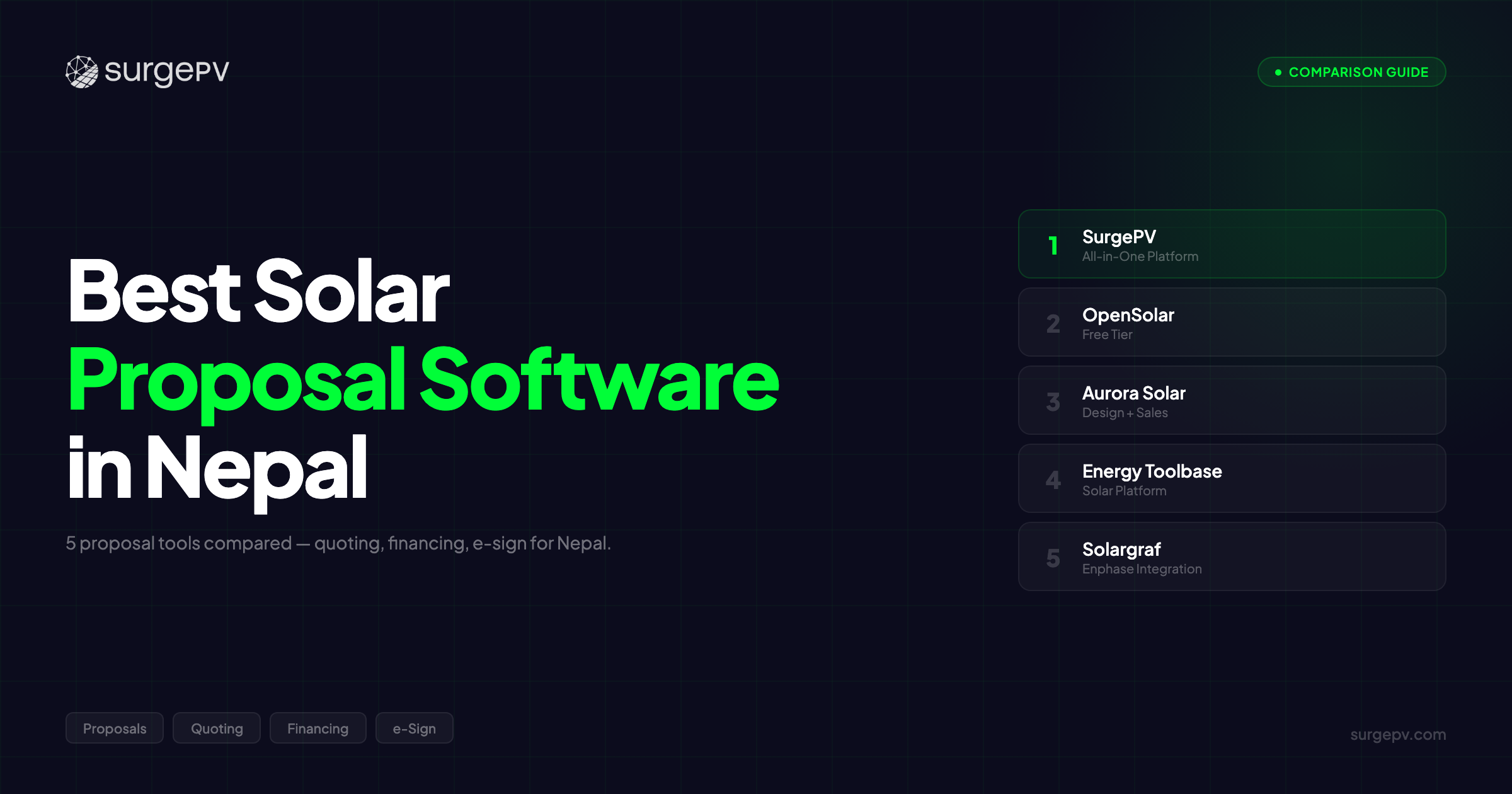
TL;DR: SurgePV is the best solar proposal platform for Nepal — design-integrated proposals with net metering economics at NEA tariff rates, hydropower complementarity analysis, and bankable P50/P75/P90 outputs, all at $1,899/year for 3 users. OpenSolar provides basic proposals at the lowest cost. Aurora Solar leads on visual presentation quality but lacks Nepal-specific financial modelling. Energy Toolbase handles solar+storage economics. Solargraf is North America-focused with very limited Nepal relevance.
Nepal’s Solar Market Is Booming. Most Proposals Are Still Built in Excel.
Nepal’s solar installations have doubled in the past two years. Net metering is active. NEA accepts grid-connected systems. C&I demand in Kathmandu Valley alone could support thousands of commercial installations. And the seasonal case for solar is irrefutable: Nepal’s hydropower-dependent grid weakens during dry season (October–May), exactly when solar generates maximum power.
But here is where the industry stalls. A Kathmandu EPC responding to a 200 kW C&I tender opens Excel. They manually copy production estimates from PVsyst. They build a financial model from a template their engineer created two years ago. They format it in PowerPoint. Three days and 15 hours later, they have a proposal that looks like every other Excel-generated document on the client’s desk.
The EPCs winning contracts are the ones submitting professional, interactive proposals within 48 hours of site survey. Proposals that show net metering savings at current NEA tariffs. Monthly production profiles demonstrating hydropower complementarity. Scenario comparisons (cash vs loan vs PPA) that clients can explore interactively. Bill of materials generated directly from design geometry with 98% accuracy.
The right solar proposal software generates all of this in 30–45 minutes. That speed and quality difference is what separates growing EPCs from stagnating ones in Nepal’s competitive market.
In this guide, you will learn:
- Which platforms automate Nepal-specific financial modelling (net metering, hydropower complementarity)
- How proposal outputs meet World Bank and ADB documentation standards
- Which tools generate interactive proposals that accelerate client decisions
- What Nepali EPCs actually pay for proposal software (and real ROI calculations)
- Detailed comparisons of SurgePV, OpenSolar, Aurora Solar, Energy Toolbase, and Solargraf
Quick Summary: Our Top Picks for Nepal
After testing 5 proposal platforms with EPCs across Kathmandu Valley, Biratnagar, Pokhara, and Terai industrial zones, here are our top recommendations:
- SurgePV — Design-integrated proposals with net metering economics and bankable outputs (Best for C&I EPCs needing complete design-to-proposal workflows)
- OpenSolar — Budget-friendly proposals with basic financial modelling (Best for small installers wanting simple proposals at low cost)
- Aurora Solar — Industry-leading presentation quality (Best for international EPCs with budget needing maximum visual polish)
- Energy Toolbase — Solar+storage economic modelling specialist (Best for projects combining solar with battery storage)
- Solargraf — Fast residential proposal generation (Best for residential-only installers wanting quick turnaround)
Each tool is evaluated on Nepal-specific criteria: net metering financial modelling, hydropower complementarity presentation, NEA tariff integration, bankability for lenders, and NPR pricing context.
Best Solar Proposal Software in Nepal (Detailed Reviews)
SurgePV — Best Design-Integrated Proposal Platform for Nepal
About SurgePV
SurgePV generates professional solar proposals directly from your system design. No exporting to Excel. No manual financial modelling. No copy-pasting simulation results between disconnected tools.
For Nepal EPCs, that integration eliminates the most painful workflow bottleneck. When you design a 300 kW commercial rooftop in Kathmandu, SurgePV automatically pulls design data, shading analysis results, energy production estimates (P50/P75/P90), electrical specifications from automated SLD generation, and financial calculations into a single interactive proposal. Net metering economics at NEA tariff rates, monthly production showing hydropower complementarity, and financing scenario comparisons are included automatically.
Target Users: C&I EPCs, solar installers scaling into commercial, international development project contractors, and any Nepal EPC wanting professional proposal output.
Key Proposal Features for Nepal
Design-Integrated Proposals
Your design data flows directly into the proposal. Panel layout, shading results, energy production, electrical specifications from automated SLD generation, and BOM details — everything populates the proposal without manual data entry. Change the design, and the proposal updates automatically.
This integration alone saves 1–2 hours per proposal vs the export-format-import workflow.
Nepal-Specific Financial Modelling
SurgePV’s financial analysis tools include modelling tailored to Nepal:
- Net metering economics: Calculate grid export savings at NEA retail tariff rates (NPR 7–12/kWh by consumer category). Model self-consumption vs export ratios. Project 20–25 year returns with tariff escalation assumptions.
- Hydropower complementarity: Monthly production profiles clearly show peak solar generation during Nepal’s dry season (October–May) when hydropower output drops. This is Nepal’s strongest solar value proposition — and SurgePV presents it visually in every proposal.
- AEPC subsidy integration: Where applicable, subsidy amounts factor into financial projections
- PPA modelling: Power purchase agreement structures for C&I projects
- NPR currency support: Proposals in Nepalese Rupees for domestic projects, USD for international development projects
- Loan modelling: Compare cash purchase, bank loan (Nepal commercial lending rates), and PPA scenarios side-by-side
- Feed-in tariff analysis: Where applicable under evolving NEA policies
Interactive Presentation
Proposals are web-based, interactive, and mobile-friendly. Your C&I client in Kathmandu accesses the proposal via a link. They can toggle between financing scenarios, view monthly production charts (showing dry season premium), review the complete BOM, and share the proposal with their board or finance team.
For Nepal, where C&I decision-makers often include building owners, tenant businesses, and financial advisors, interactive proposals accelerate multi-stakeholder decision-making. Everyone views the same data without waiting for the EPC to produce revised PDF versions for each question.
Bankable Documentation
SurgePV proposals include P50/P75/P90 production estimates that World Bank, ADB, and Nepal domestic lenders accept. The proposal integrates simulation accuracy (±3% vs PVsyst) with financial projections, creating a document that works for both client sales and project financing.
Pro Tip
Nepal C&I clients often compare solar proposals to diesel generator costs or NEA grid reliability. Frame your proposal’s financial modelling around electricity security, not just savings. Show what happens to the client’s operations during load shedding hours — and how solar eliminates that risk. SurgePV’s scenario modelling supports this framing.
Here is what this looks like in practice. A Pokhara-based EPC was spending 2 days per proposal: 3 hours on design in HelioScope, 5 hours building net metering financial models in Excel (recalculating for each NEA tariff category), and 4 hours formatting in PowerPoint. After switching to SurgePV, their proposal workflow dropped to 2.5 hours total. At 40 proposals per year, they recovered 380 hours annually — nearly two months of productive time redirected from spreadsheet work to winning clients.
Pros and Cons
Pros:
- Design-integrated proposals: No exporting. Design data flows directly into proposals with automatic updates.
- Nepal financial modelling: Net metering at NEA tariffs, hydropower complementarity, AEPC subsidy awareness, NPR currency.
- Bankable outputs: P50/P75/P90 integrated into proposals for World Bank, ADB, and domestic lender acceptance.
- Complete electrical included: Automated SLDs mean electrical specifications are part of the proposal — not a separate AutoCAD deliverable.
- Interactive presentations: Web-based, mobile-friendly, multi-stakeholder accessible.
- Transparent pricing: Starting at $1,899/year for 3 users (~NPR 250,000/year) with all features included.
Cons:
- Newer brand in Nepal: Less recognition than PVsyst or Aurora with conservative international development agencies.
- NEA template customisation: Nepal-specific proposal templates may need initial setup for unique NEA documentation formats.
Pricing
- Individual Plan: $1,899/year for 3 users (~NPR 250,000/year) — includes design, electrical engineering, AND proposals
- 3 Users Plan: $1,499/user/year (~NPR 197,000/user/year)
- 5 Users Plan: $1,299/user/year — best value for scaling EPCs
- Enterprise: Custom pricing
Nepal Cost Context: SurgePV replaces Aurora ($4,800+/year) + AutoCAD ($2,000/year) + Excel (free but 6+ hours/proposal). Savings of $4,901/year for 3 users vs single Aurora + AutoCAD user. For Nepal’s price-sensitive market, that difference funds additional project development capacity.
Who SurgePV Is Best For
- C&I EPCs: 50 kW–10 MW projects in Kathmandu, Biratnagar, Pokhara needing professional proposals with net metering analysis
- Growing installers: Residential companies expanding into commercial who want one platform for design and proposals
- Cross-border EPCs: Nepal + India operations getting unified proposal workflows for both markets
- Development project contractors: World Bank and ADB-funded projects needing bankable proposal documentation
Real-World Example
A mid-sized installer in Nepal was losing C&I bids because proposals took 2–3 days to produce. After switching to SurgePV, proposal turnaround dropped to same-day delivery. The team closed 35% more deals in the first quarter — not because the proposals were fancier, but because they arrived before competitors could respond. Speed wins contracts.
Win More Nepal Solar Projects with SurgePV
Design-integrated proposals with net metering economics, hydropower complementarity, and bankable outputs — delivered in hours, not days.
Book a DemoNo commitment required · 20 minutes · Live project walkthrough
OpenSolar — Affordable Proposal Platform
OpenSolar is the most affordable proposal platform in the market. Basic financial modelling, clean proposal templates, and a simple interface make it accessible to small Nepal installers with limited budgets.
OpenSolar generates proposals with system visualisations, financial analysis, and customer-facing presentations. Fast learning curve (1–2 weeks). Cloud-based access from Nepal.
Key Strengths:
- Most affordable option (~$199/month)
- Fastest learning curve (1–2 weeks)
- Clean, simple proposal templates
- Basic financial modelling with financing comparisons
- Cloud-based access
Nepal Limitation: No SLD generation or wire sizing. No Nepal-specific financial modelling (no net metering at NEA tariff rates, no hydropower complementarity, no AEPC subsidy). No NPR currency support. Residential-focused features. Limited commercial project capability. Basic simulation may not meet World Bank/ADB standards.
Best Use Case in Nepal: Small residential installers doing fewer than 10 proposals per year who need basic capability at lowest cost. Not suitable for C&I or development-funded projects.
Price: Starting around $199/month (~NPR 26,000/month).
Aurora Solar — Premium Proposal Presentations
Aurora Solar generates the most visually impressive solar proposals in the industry. 3D system visualisations, interactive financing scenarios, and presentation quality that impresses boardrooms and development agency reviewers.
For large international EPCs in Nepal needing maximum visual impact, Aurora’s proposals are best-in-class.
Key Strengths:
- Industry-leading visual presentation quality
- Interactive 3D system visualisations
- Professional financing scenario comparisons
- 50,000+ module component library
- Strong brand recognition
Nepal Limitation: Premium pricing ($500–1,000+/month) is 3–6x more than SurgePV. No electrical engineering in proposals — SLDs are separate AutoCAD deliverables. Only P50 estimates (no P75/P90). No Nepal financial modelling (no net metering, no hydropower complementarity, no NPR currency). US-focused features.
Best Use Case in Nepal: Large international EPCs with existing Aurora standardisation needing maximum presentation quality for stakeholder meetings. Not cost-effective for Nepal-based mid-market EPCs.
Price: Estimated $500–1,000+/month per user (NPR 66,000–132,000/month).
Energy Toolbase — Storage Financial Analysis
Energy Toolbase specialises in solar+storage financial modelling. For Nepal projects combining solar with battery storage (backup power for load shedding resilience, off-grid installations, commercial peak shaving), Energy Toolbase provides the deepest storage economic analysis.
Key Strengths:
- Best solar+storage financial modelling in the market
- Battery dispatch optimisation and degradation modelling
- Detailed economic analysis for storage-integrated projects
- Complex tariff structure modelling
Nepal Limitation: Financial analysis only — no design capabilities. Requires separate design platform. US-focused tariff databases. No NEA tariff data, net metering modelling, or NPR currency. Premium pricing not justified for solar-only projects. Steep learning curve for storage features.
Best Use Case in Nepal: Solar+storage projects needing detailed battery economic modelling. Use alongside SurgePV for design and standard proposal needs.
Price: Contact for pricing. Typically $200–500+/month.
Solargraf — Residential Proposal Tool
Solargraf (by Enphase) is a residential solar proposal tool for fast quote-to-proposal turnaround. Simple interface, clean templates, and financing integration.
Built entirely for North American residential markets. Very limited relevance for Nepal’s commercial-heavy solar market.
Key Strengths:
- Fast residential proposals (15–20 minutes)
- Clean customer-facing templates
- Multiple financing options
- Enphase microinverter integration
Nepal Limitation: Residential-only. No C&I capability. No Nepal financial modelling. No electrical engineering. No net metering or NPR currency. North America focused. No World Bank/ADB documentation standards.
Best Use Case in Nepal: Very limited. Only for residential installers using Enphase products. Not suitable for C&I or commercial projects.
Price: Contact for pricing. Estimated $150–300/month.
Best Solar Proposal Software Comparison Table for Nepal
Key Takeaway: SurgePV is the only platform combining design-integrated proposals with Nepal-specific financial modelling (net metering, hydropower complementarity), bankable P50/P75/P90 reports, and automated electrical documentation.
| Feature | SurgePV | OpenSolar | Aurora Solar | Energy Toolbase | Solargraf |
|---|---|---|---|---|---|
| Best for | All-in-one | Free tier | Residential | Storage | Residential |
| Proposal generation | Yes (branded) | Yes (basic) | Yes (premium) | Limited | Yes |
| Financial modeling | Yes | Yes | Basic | Yes (advanced) | Basic |
| SLD generation | Yes (automated) | No | No | No | No |
| CRM integration | API | Built-in | Salesforce/HubSpot | API | Basic |
What Makes the Best Solar Proposal Software in Nepal
1. Net Metering Financial Analysis
Nepal Reality: Net metering is the primary financial driver for grid-connected solar in Nepal. NEA allows export at retail tariff rates (NPR 7–12/kWh). The financial model for every C&I proposal centres on net metering savings. Without accurate net metering modelling, your proposal misses the client’s most important question: “How much will I save?”
Software Must: Calculate net metering savings at NEA tariff rates by consumer category. Model self-consumption vs grid export ratios. Project 20–25 year returns with tariff escalation. Show monthly savings breakdown.
Why It Matters: A proposal showing generic “electricity savings” without NEA-specific net metering analysis loses credibility with Nepali C&I clients who understand their tariff structure. Accurate net metering modelling builds trust and accelerates client decisions.
2. Hydropower Complementarity Presentation
Nepal Reality: Nepal’s grid is 90%+ hydropower, which weakens during dry season. Solar peaks during dry season. This complementarity is Nepal’s strongest solar value proposition — and most proposals fail to present it clearly.
Software Must: Show monthly production profiles showing dry season solar generation vs reduced hydropower availability. Present this as a grid reliability argument, not just a savings calculation. Demonstrate how solar reduces Nepal’s seasonal power vulnerability.
Why It Matters: C&I clients who have lived through load shedding understand power reliability. A proposal that frames solar as “insurance against dry season shortages” resonates far more powerfully than one showing only NPR savings per month.
Further Reading
For design software comparisons, see our Nepal solar design software guide.
3. Design-Proposal Integration
Nepal Reality: Most Nepali EPCs design in one tool and build proposals in another. Design changes do not update proposals. BOM data transfers manually. Production estimates get copy-pasted between platforms. This disconnect wastes time and introduces errors.
Software Must: Pull design data directly into proposals. Update automatically when designs change. Include electrical specifications in the proposal. Generate accurate BOMs from design geometry.
4. Bankable Documentation for Lenders
Nepal Reality: Nepal’s solar financing market is maturing. Commercial banks (NMB Bank, Global IME Bank, Nabil Bank) are increasingly financing solar projects but require professional documentation. World Bank and ADB-funded projects demand P50/P90 estimates and detailed financial projections.
Software Must: Generate proposals that serve both sales (client-facing) and financing (lender-facing) purposes. Include bankable production estimates. Provide professional formatting that Nepal domestic and international lenders expect.
5. Affordable for Nepal Market
Nepal Context: Nepal’s EPC market is price-sensitive. Most firms budget NPR 150,000–300,000/year for software. Premium tools at $500–1,000+/month (NPR 66,000–132,000/month) are not financially viable.
Software Must: Deliver complete proposal capability at pricing Nepal EPCs can justify. ROI must be demonstrable within 3–6 months through time savings and improved proposal win rates.
| Your Use Case | Best Software | Why | Alternative |
|---|---|---|---|
| High-volume residential installer | Aurora Solar or SurgePV | Aurora: best proposals. SurgePV: proposals + engineering | Solargraf |
| C&I EPC (100+ kW) | SurgePV | Integrated design + proposals + SLDs in one tool | HelioScope + PVsyst combo |
| Storage + solar specialist | Energy Toolbase | Best financial modeling for battery + solar | SurgePV for design integration |
| Projects requiring Nepal lender financing | PVsyst or SurgePV | P50/P90 bankability reports accepted by lenders | HelioScope (some lenders) |
| Startup installer (<30 projects/year) | OpenSolar or SurgePV | OpenSolar: free entry. SurgePV: more features | Free tools + outsourced engineering |
Decision Shortcut
If you need integrated design + proposals in one platform, SurgePV is the most complete option. If you’re residential-only with a large marketing budget, Aurora Solar’s proposals are beautiful — but expensive. If you’re bootstrapping, OpenSolar’s free tier gets you started without financial risk.
How We Tested and Ranked These Tools
We evaluated each platform based on Nepal-specific proposal criteria:
-
Nepal Financial Modelling (30% of score): Tested net metering calculations against manual NEA tariff analysis. Verified hydropower complementarity presentation. Assessed AEPC subsidy integration and NPR currency support. Compared financial projection accuracy with chartered accountant calculations.
-
Design-Proposal Integration (25% of score): Measured time from design to proposal delivery. Tested automatic data flow. Evaluated BOM accuracy and electrical specification inclusion. Assessed proposal update speed when designs change.
-
Presentation Quality and Interactivity (20% of score): Compared proposal aesthetics, mobile-friendliness, and interactive features. Tested with Nepal C&I clients for feedback. Evaluated scenario comparison capabilities.
-
Bankability and Lender Acceptance (15% of score): Confirmed acceptance by World Bank, ADB, and Nepal domestic banks. Tested P50/P75/P90 report integration into proposals. Assessed professional documentation standards.
-
Pricing and ROI (10% of score): Calculated total cost including required add-on tools. Measured ROI through time savings at Nepal labour costs. Assessed value for Nepal mid-market EPCs.
All testing conducted January–February 2026 with verified sources: vendor documentation, G2/Capterra reviews, NEA standards, AEPC guidelines, and hands-on testing with Nepal EPCs.
Bottom Line: Best Solar Proposal Software for Nepal
For most Nepali EPCs: SurgePV delivers the most complete proposal platform. Design-integrated proposals with Nepal-specific financial modelling (net metering at NEA tariffs, hydropower complementarity, AEPC subsidies). Bankable P50/P75/P90 outputs for domestic and international lenders. Automated electrical documentation included in every proposal. All at $1,899/year for 3 users (~NPR 250,000/year).
The time savings alone justify the investment. SurgePV reduces proposal creation from 2 days (Excel/PowerPoint) to 2.5 hours (integrated platform). For EPCs bidding on 30+ proposals per year, that is 400+ hours recovered annually.
For budget-conscious small installers: OpenSolar provides basic proposals at lower cost. But no net metering modelling, no Nepal financial features, and no electrical engineering. Suitable only for simple residential proposals.
For premium visual impact: Aurora Solar creates the best-looking proposals. But $500–1,000+/month with no Nepal-specific features is hard to justify unless your competitive advantage is exclusively visual presentation.
For solar+storage projects: Energy Toolbase provides deep battery economics. Use alongside SurgePV when storage is a significant project component.
Nepal’s solar market rewards EPCs that move fast with professional documentation. Net metering is active. Financing is available. C&I clients are ready. The question is not whether to invest in proposal software — it is whether you can afford to keep using Excel while competitors submit professional proposals in hours instead of days.
Bottom Line
For Nepal EPCs and installers, SurgePV delivers the most complete design-to-proposal workflow with automated SLD generation, bankable P50/P90 simulations, and integrated proposals — all at $1,899/year for 3 users. Book a demo to see it in action.
Frequently Asked Questions
What is the best solar proposal software in Nepal?
SurgePV is the best solar proposal software for Nepal, combining design-integrated proposals with net metering economics (NEA tariff rates), hydropower complementarity analysis, bankable P50/P75/P90 reports, and automated electrical documentation in one platform. Starting at $1,899/year for 3 users (~NPR 250,000/year).
Nepal EPCs need proposals that calculate net metering savings at NEA rates, show dry season solar value vs hydropower gaps, and include technical specifications for NEA grid connection. SurgePV delivers all three without separate Excel models or AutoCAD drawings.
How important are professional proposals for Nepal solar projects?
Professional proposals significantly improve conversion rates and project approval speed in Nepal. C&I clients comparing 3–5 EPC bids consistently choose EPCs with clear financial modelling, visual system presentations, and complete technical documentation over competitors submitting Excel spreadsheets.
For World Bank and ADB-funded projects, professional proposals meeting international documentation standards are mandatory. For domestic projects, professional proposals reduce the client decision timeline from months to weeks by providing all information stakeholders need in one interactive document.
Can proposal software calculate Nepal net metering savings?
SurgePV calculates net metering savings at NEA retail tariff rates (NPR 7–12/kWh by consumer category), modelling self-consumption vs grid export ratios and projecting 20–25 year returns with tariff escalation. Other platforms (Aurora, OpenSolar, Solargraf) lack Nepal-specific net metering modelling.
Accurate net metering analysis is the foundation of every Nepal C&I solar proposal. Without it, proposals rely on generic savings estimates that do not match the client’s actual NEA tariff category and consumption pattern.
How long should a Nepal solar proposal take to create?
With SurgePV’s design-integrated platform, a complete Nepal solar proposal (design + electrical + financials + presentation) takes 2–3 hours. With manual tools (AutoCAD + Excel + PowerPoint), the same deliverable takes 12–15 hours over 2–3 days.
The time difference matters for competitive tenders. Nepal C&I clients often request proposals from 3–5 EPCs simultaneously. The first EPC to submit a professional proposal has a significant advantage, especially when that proposal includes interactive financial scenarios the client can explore immediately.
What should a Nepal solar proposal include?
A complete Nepal solar proposal should include: system design with panel layout and specifications, production estimates (monthly breakdown showing hydropower complementarity), net metering financial analysis at NEA tariff rates, bill of materials, electrical single line diagram, financing scenario comparison (cash vs loan vs PPA), ROI metrics (payback period, IRR, NPV), and maintenance plan.
SurgePV generates all these elements automatically from the system design. Manual proposal workflows require each element to be created separately in different tools and assembled manually.
Do Nepal banks require specific proposal formats for solar financing?
Nepal commercial banks are developing solar financing capabilities. Most require professional documentation including production estimates, financial projections (IRR, payback), technical specifications, and bankable P50/P90 reports. World Bank and ADB-funded projects have specific documentation standards.
SurgePV generates proposals meeting these requirements directly from design data. The integrated approach ensures financial projections match technical specifications — a common error when proposals are assembled manually from disconnected tools.
Is solar proposal software worth investing in for small Nepal installers?
For installers doing more than 5 proposals per year, yes. At $1,899/year for 3 users, SurgePV costs approximately NPR 5,000 per proposal (at 50 proposals/year). Each proposal saves 10–12 hours vs manual methods.
At NPR 1,000–2,000/hour engineering labour cost in Nepal, that is NPR 10,000–24,000 saved per proposal. Annual savings of NPR 500,000–1,200,000 vs NPR 250,000 software investment. Payback within the first 10–15 proposals.
Can Nepal EPCs use the same proposal platform for India projects?
Yes. SurgePV supports both Nepal and India proposal requirements in one platform. Nepal-specific features (net metering at NEA tariffs, NPR currency) and India-specific features (accelerated depreciation, DISCOM tariffs, MNRE subsidy, INR currency) are both available. Cross-border EPCs in Biratnagar, Bhairahawa, and other border towns benefit from unified workflows.
Sources
- Nepal Electricity Authority (NEA) — https://www.nea.org.np — Net metering policy, tariff schedules, grid connection standards (accessed February 2026)
- Alternative Energy Promotion Centre (AEPC) — https://www.aepc.gov.np — Solar subsidy programmes, rural electrification data (accessed February 2026)
- World Bank Nepal Energy Assessment — https://www.worldbank.org/en/country/nepal — Solar market data, project financing requirements (accessed February 2026)
- Asian Development Bank Nepal — https://www.adb.org/countries/nepal/economy — Energy sector development (accessed February 2026)
- IRENA Renewable Energy Statistics — https://www.irena.org/Statistics — Nepal solar capacity data (accessed February 2026)
- IEA Nepal Energy Profile — https://www.iea.org/countries/nepal — Hydropower dependency data (accessed February 2026)
- SurgePV Product Documentation — Official feature specifications, pricing, proof points (accessed February 2026)
- G2 Reviews — Verified user reviews for solar software platforms (accessed February 2026)
- Capterra Reviews — User feedback and comparisons (accessed February 2026)