

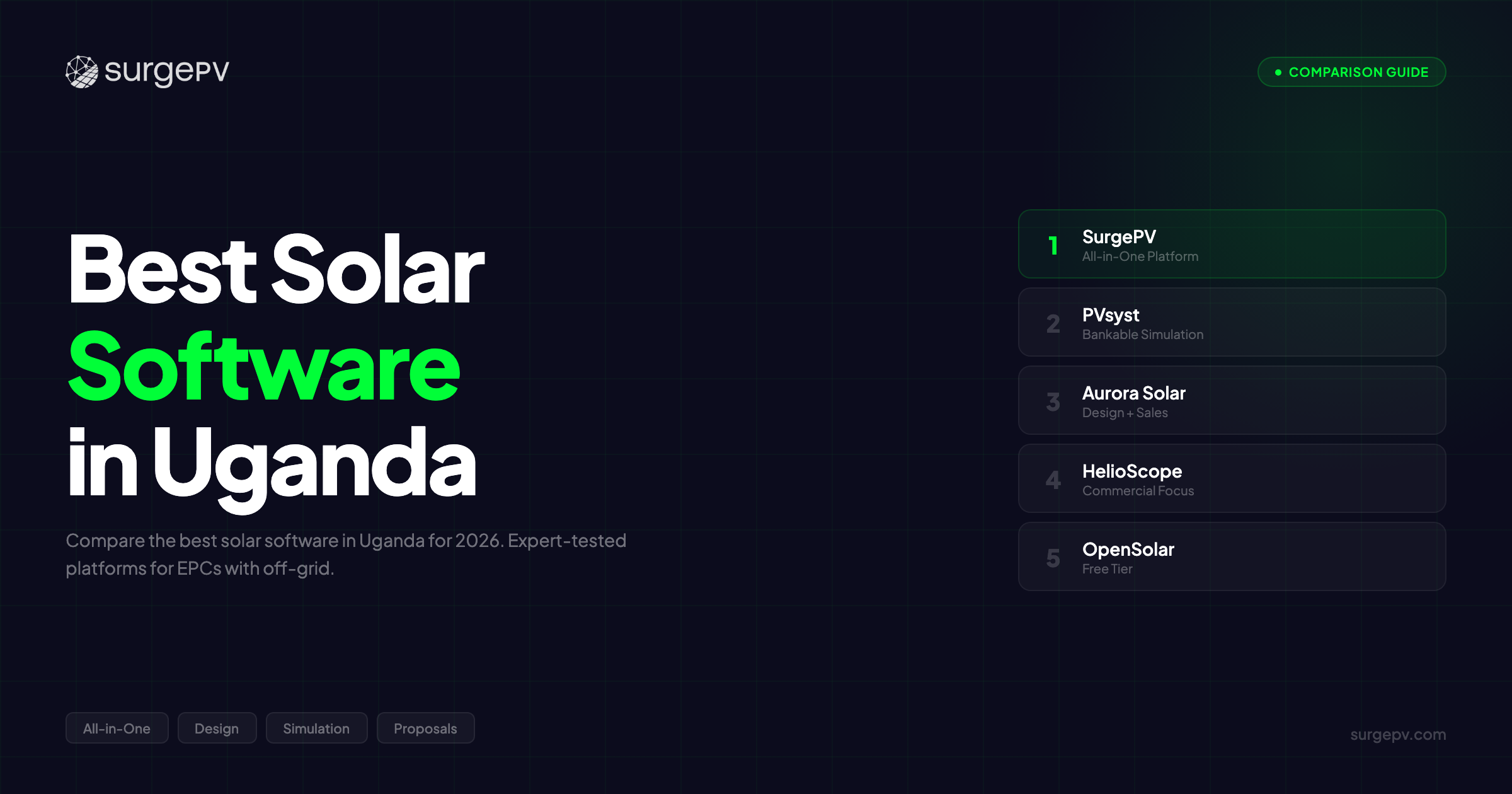
TL;DR: SurgePV is the best all-in-one solar software for Uganda in 2026 — combining AI-powered solar design, off-grid and mini-grid capabilities, battery backup optimization, automated electrical engineering, PAYGO financial modeling, and professional proposals in one cloud platform. PVsyst remains the gold standard for GET FiT and World Bank bankability on grid-connected projects.
Uganda sits on the equator. It gets 1,400–1,800 kWh/m²/year of consistent, year-round sunlight. And 80% of rural Ugandans have no meaningful electricity access.
That combination — exceptional solar resource plus massive unmet demand — has created one of East Africa’s fastest-growing solar markets. M-KOPA has deployed over 3 million connected solar home systems across Uganda and Kenya. The World Bank’s GET FiT program has financed grid-connected solar plants. Mini-grids are electrifying communities that the national grid won’t reach for decades. And Kampala’s commercial market is growing as businesses seek reliable power beyond Umeme’s distribution.
But here’s the disconnect: the software tools available to Ugandan solar companies were designed for grid-tied markets in California, Germany, or Australia. They assume stable grids. They assume homeowner financing. They assume component databases full of Tesla Powerwalls and Enphase microinverters.
Uganda’s reality is different. Off-grid solar home systems with PAYGO financing. Community mini-grids with diesel genset backup. Commercial rooftop with battery storage for Umeme load shedding. GET FiT-financed grid-connected plants requiring bankable documentation for World Bank standards. The right solar software must handle all of these.
In this guide, you’ll learn:
- Which platforms handle Uganda’s off-grid, mini-grid, and commercial solar segments
- How each tool manages PAYGO financing, battery backup, and diesel genset integration
- Which software supports ERA compliance and GET FiT bankability requirements
- Total cost comparison for Ugandan solar companies
- Detailed comparisons of SurgePV, Aurora Solar, PVsyst, HelioScope, and OpenSolar
Quick Summary: Our Top Picks for Uganda
After testing 5 platforms against Uganda’s market requirements — off-grid dominance, mini-grid development, PAYGO financing, and commercial battery backup:
- SurgePV — Design, engineering, simulation, battery backup, and proposals in one platform (Best for Ugandan solar companies across commercial, mini-grid, and distributed segments)
- PVsyst — Gold-standard simulation with detailed off-grid modeling (Best for GET FiT projects and World Bank/AfDB bankability)
- Aurora Solar — Industry-leading residential design and proposals (Strong US platform; minimal applicability for Ugandan market)
- HelioScope — Cloud-based commercial design tool (Best for large grid-tied C&I projects; no off-grid or battery support)
- OpenSolar — Affordable cloud platform with basic features (Lowest cost entry point; limited feature depth)
Each tool evaluated on Uganda-specific criteria: off-grid/mini-grid design, PAYGO modeling, battery backup, ERA compliance, GET FiT bankability, World Bank/AfDB requirements, and pricing context.
Best Solar Software Comparison Table for Uganda
| Feature | SurgePV | PVsyst | Aurora Solar | HelioScope | OpenSolar |
|---|---|---|---|---|---|
| Design + Layout | Yes (AI-powered) | No (sim only) | Yes (AI roof) | Yes (cloud) | Yes (basic) |
| SLD Generation | Automatic (5–10 min) | No | No (needs AutoCAD) | No | No |
| Off-Grid/Mini-Grid | Yes (full support) | Yes (detailed sim) | No | No | No |
| Battery Backup | Excellent (load shedding) | Excellent (off-grid) | No | Limited | Basic |
| Diesel Integration | Yes (hybrid systems) | Yes (detailed) | No | No | No |
| PAYGO Modeling | Yes | No | No | No | No |
| Bankability (P50/P90) | Yes (±3%) | Yes (gold standard) | P50 only | Basic | No |
| Proposals | Professional | No | Beautiful | No | Basic |
| Cloud-Based | Yes | No (desktop) | Yes | Yes | Yes |
| Pricing (per user/year) | $1,499 (~5.5M UGX) | ~$1,400 (~5.1M UGX) | $5,000+ (~18M+ UGX) | $4,000–6,000 | $1,188–3,588 |
Best Solar Software in Uganda (Detailed Reviews)
SurgePV — Best All-in-One Solar Platform for Uganda
SurgePV is a cloud-based platform combining AI-powered solar design, automated electrical engineering, bankable simulations, and professional proposals in one workflow. No tool-switching. No AutoCAD dependency. No separate spreadsheets for battery sizing or PAYGO calculations.
For Ugandan solar companies operating across off-grid, mini-grid, and commercial segments, the consolidation advantage is significant. You might design a commercial rooftop with battery backup in Kampala on Monday, size a community mini-grid in Gulu on Wednesday, and prepare a GET FiT bankability report for a grid-connected project on Friday. One platform for all three beats switching between four tools for each.
Target Users: Commercial EPCs designing rooftop and ground-mount systems (50 kW–5 MW), solar installers serving Kampala’s growing distributed market, mini-grid developers serving rural communities, PAYGO solar companies managing distributed installations, and engineering consultants preparing World Bank/AfDB project documentation.
Pro Tip
For Ugandan solar companies evaluating software, run three test scenarios: (1) a 100 kW commercial rooftop in Kampala with battery backup for Umeme load shedding, (2) a 50 kW community mini-grid with diesel genset backup, and (3) a GET FiT grid-connected project requiring P50/P90 bankability. The platform that handles all three without switching tools is the right choice for Uganda’s diverse market.
Key Features for Uganda
Design and Engineering
AI-powered roof modeling detects roof boundaries, tilt, and azimuth from satellite imagery covering Kampala, Jinja, Entebbe, Gulu, and Mbarara. Design time drops from 45 minutes (manual) to 15–20 minutes.
Automated Single Line Diagram generation produces IEC-compliant SLDs in 5–10 minutes — ready for ERA grid connection and Umeme distribution applications. The manual AutoCAD alternative: 2–3 hours per project plus $2,000/year in licensing. For a Ugandan EPC processing 15 commercial projects per month, that’s 30–45 hours of manual drafting eliminated.
Wire sizing calculations are instant. DC and AC wire gauges based on current, distance, voltage drop. IEC 62446 and IEC 61730 compliant — the international standards ERA references for grid-connected systems.
Off-Grid, Battery Backup, and Mini-Grid Design
Uganda’s solar market is fundamentally off-grid-driven. SurgePV handles battery storage sizing for Umeme load shedding protection (2–6 hour backup for Kampala commercial), off-grid standalone systems (solar + battery for rural homes and institutions), mini-grid design with full autonomy day calculations, hybrid configurations (solar + battery + diesel genset for community systems), lead-acid versus lithium chemistry comparison, and battery autonomy calculations for systems ranging from solar home kits to 500 kW mini-grids.
Simulation and Bankability
8760-hour shading analysis accounting for Uganda’s equatorial climate — consistent year-round irradiance (0–4°N latitude), two rainy seasons (March–May and September–November), tropical temperatures (20–30°C), and high humidity effects. Production simulation at ±3% accuracy versus PVsyst.
P50/P75/P90 bankable reports accepted by World Bank, AfDB, and development finance institutions funding Uganda’s GET FiT program. The P75/P90 conservative estimates are what lenders use to size debt for grid-connected projects.
PAYGO and Financial Modeling
PAYGO (pay-as-you-go) financing dominates Uganda’s residential solar market. SurgePV’s financial modeling handles PAYGO payment calculations (daily/weekly/monthly payments), customer payoff timeline projections, savings comparison versus kerosene/diesel/grid costs, and solar ROI calculator adaptable to Ugandan market economics. Professional proposals with UGX-denominated financials for commercial clients and PAYGO projections for distributed solar.
Mini Case Study: A Kampala-based solar company used SurgePV to design and propose a 75 kW commercial rooftop system for a hotel experiencing daily Umeme load shedding. The platform sized a 60 kWh lithium battery bank for 4-hour backup autonomy, integrated a 20 kW diesel genset for extended outages, generated the IEC-compliant SLD for ERA grid connection, ran the full simulation with equatorial climate adjustments, and produced a client proposal showing 45 million UGX annual electricity and diesel savings with a 2.8-year payback. Total time: 40 minutes. The previous workflow (manual calculations + AutoCAD + Excel) took 5 hours and required a revision when the battery sizing was rechecked.
For a Ugandan solar company processing 15 commercial projects per month, SurgePV recovers roughly 65 hours of engineering time monthly. That’s capacity for 8–10 additional projects — or the bandwidth to expand from Kampala commercial into the growing mini-grid and institutional solar segments.
Note
Reader objection — “But Uganda’s market is mostly small solar home systems, not commercial.” True — the volume is in SHS. But the revenue and growth are in commercial rooftop, mini-grids, and institutional solar. M-KOPA and Fenix handle the solar home system market at scale. What’s missing in Uganda is EPC capacity for 50 kW–5 MW commercial, industrial, and institutional projects — the segment where professional software creates competitive advantage.
Pros:
- Only platform combining design + electrical engineering + battery backup + off-grid/mini-grid + simulation + proposals
- Automated SLD generation eliminates AutoCAD dependency (saves $2,000/year + 2–3 hours per project)
- Off-grid, mini-grid, and battery backup design for Uganda’s dominant market segments
- PAYGO financial modeling for distributed solar proposals
- P50/P75/P90 bankable reports for GET FiT and World Bank/AfDB financing
- Cloud-based — accessible from Kampala 4G networks and field sites
- International component database (Jinko, Trina, Longi, Growatt, Huawei)
- Transparent pricing: $1,499/user/year (3-user plan)
Cons:
- Ugandan utility rate database (Umeme) requires one-time manual configuration
- Newer brand recognition in East African market compared to PVsyst
- Solar home system (SHS) micro-sizing below 1 kW is outside the platform’s primary scope
Pricing:
- 3-User Plan: $4,497/year (approximately 16.5 million UGX) — $1,499/user/year
- Per User: $1,899/year (approximately 7 million UGX)
- Includes: Everything — design, SLD, simulation, battery sizing, off-grid/mini-grid, PAYGO modeling, proposals
- No additional tools required
Cost Comparison (3 users):
- SurgePV: $4,497/year (~16.5 million UGX — complete platform)
- Aurora + AutoCAD + PVsyst (3 users): ~$20,400/year (~75 million UGX)
- Savings: ~$15,900/year (~58.5 million UGX, 78% less)
Who SurgePV Is Best For: Ugandan solar companies across all segments — commercial solar rooftop in Kampala and Jinja, residential distributed PAYGO, mini-grid development for rural communities, institutional solar (schools, hospitals, government), and GET FiT grid-connected projects.
Real-World Example
A growing EPC team in Uganda was spending 2.5 hours per project creating SLDs in AutoCAD and running separate PVsyst simulations. After switching to SurgePV, SLD generation dropped to under 10 minutes. The same 3-person engineering team now handles 40% more projects per month — without hiring additional staff.
Further Reading
See our best solar software complete platform comparison and Aurora Solar review for a full feature deep-dive.
PVsyst — Simulation Standard for Bankability
PVsyst is the global gold standard for solar simulation. For Uganda’s GET FiT program — the World Bank-financed initiative that has driven most grid-connected solar development — PVsyst bankability reports are effectively required. The AfDB and other development finance institutions financing Ugandan solar also rely on PVsyst numbers.
Key Strengths: Industry-standard P50/P90 bankability reports universally accepted by GET FiT evaluators and development lenders. Excellent off-grid and battery modeling with detailed lead-acid and lithium simulation. Deep weather database including Ugandan locations via Meteonorm. Detailed loss modeling including tropical humidity and temperature effects.
Where PVsyst Falls Short for Uganda: Not a design platform — no roof modeling, no module layout. No SLD generation. No proposals. No PAYGO financial modeling. Desktop-only (Windows required, no cloud access). Steep learning curve (6–8 weeks). At approximately $1,400/year, you’re paying for simulation only and still need design, electrical, and proposal tools separately.
What most people miss: PVsyst is built for validation, not daily production. For a Ugandan solar company handling 15+ projects monthly, running every project through PVsyst isn’t practical. The efficient approach: SurgePV for daily design and engineering, PVsyst for bankability validation on GET FiT and large projects (500 kW+) requiring World Bank/AfDB financing.
Best For: GET FiT bankability and large projects requiring development finance institution approval. Pair with SurgePV for daily operations.
Read our full PVsyst review for detailed analysis.
Did You Know?
Uganda’s solar irradiance ranges from 1,700–2,000 kWh/m²/year, making accurate simulation software essential for bankable energy yield predictions. Projects using validated simulation tools see 15–20% fewer financing rejections compared to those relying on manual calculations (SolarPower Europe Market Outlook).
Aurora Solar — US Residential Leader, Limited Uganda Fit
Aurora Solar leads the US residential solar market with best-in-class AI roof detection and polished homeowner proposals.
Key Strengths: Industry-leading AI roof modeling and LIDAR integration. Beautiful customer-facing proposals. Strong CRM integrations (Salesforce, HubSpot). Extensive US training resources.
Where Aurora Falls Short for Uganda: No battery backup optimization — a fundamental gap for a market where off-grid and battery systems dominate. No off-grid or mini-grid support. No diesel genset integration. No SLD generation (requires AutoCAD at $2,000/year). No PAYGO financial modeling. No P75/P90 bankable estimates. No UGX currency support. US-centric component databases. Expensive relative to Ugandan market economics.
Aurora is designed for the US residential market where grid stability is taken for granted and homeowner aesthetics drive purchase decisions. Uganda’s solar reality — off-grid dominance, battery backup as standard, mini-grid development, PAYGO financing, and GET FiT bankability — is a fundamentally different market. Aurora’s features don’t address any of Uganda’s primary solar use cases.
Best For: Minimal applicability in Uganda. Not recommended for any Ugandan solar market segment.
Read our full Aurora Solar review for detailed analysis.
HelioScope — Commercial Design, Grid-Tied Focus
HelioScope (now part of Aurora) provides cloud-based commercial solar design with good simulation capabilities.
Key Strengths: Clean commercial design interface with quick learning curve (2–3 days). Cloud-based collaboration. Good for large commercial rooftop and ground-mount layouts. Loss waterfall diagrams. Bankable energy estimates.
Where HelioScope Falls Short for Uganda: Limited battery backup optimization (grid-tied focus). No off-grid or mini-grid support. No diesel genset integration. No SLD generation (AutoCAD required). No PAYGO financial modeling. No proposal generation. No UGX-denominated reporting.
In a market where off-grid and battery-backed systems represent the majority of installations, HelioScope’s grid-tied-only approach leaves Ugandan solar companies doing the most critical calculations manually.
Best For: Large grid-tied commercial projects (above 500 kW) in Kampala industrial zones with stable Umeme supply. Not suitable for Uganda’s dominant off-grid and mini-grid segments.
Read our full HelioScope review for detailed analysis.
OpenSolar — Budget-Friendly, Basic Capabilities
OpenSolar delivers affordable, cloud-based solar design and proposal generation at the lowest price point.
Key Strengths: Affordable ($99–299/month). Cloud-based with minimal infrastructure requirements. User-friendly interface. Basic proposal generation. Basic battery support for simple configurations.
Where OpenSolar Falls Short for Uganda: No off-grid or mini-grid design. No diesel genset integration. No PAYGO financial modeling. Limited battery optimization (no autonomy calculations, no chemistry comparison). No SLD generation. No UGX currency support. No GET FiT bankability. Component database lacks Chinese manufacturers dominating Ugandan supply chains.
Where OpenSolar makes sense in Uganda: small residential installers doing basic grid-tied rooftop systems in Kampala where Umeme supply is relatively stable. Not suitable for off-grid, mini-grid, commercial battery backup, or any project requiring bankable documentation.
Best For: Budget-conscious installers with the simplest project requirements. Not suitable for Uganda’s dominant off-grid and mini-grid market segments.
Read our full OpenSolar review for detailed analysis.
What Makes the Best Solar Software for Uganda
1. Off-Grid and Mini-Grid Design
80%+ of rural Uganda lacks electricity access. Off-grid solar home systems, community mini-grids, and institutional solar (schools, hospitals, trading centers) represent the largest opportunity. Your software must handle standalone off-grid design, mini-grid sizing with full autonomy day calculations, diesel genset integration for extended cloudy periods, load management for community systems, and scalable configurations from 5 kW to 500 kW+.
2. Battery Backup and Hybrid Systems
Even in Kampala and Jinja where Umeme provides grid access, load shedding makes battery storage standard for commercial installations. Software must size batteries for load shedding scenarios (2–6 hours), model hybrid configurations (grid + solar + battery + diesel), compare lead-acid versus lithium chemistries (cost versus longevity trade-offs critical in Ugandan economics), and calculate backup autonomy.
3. PAYGO Financial Modeling
M-KOPA, Fenix/Engie, and other PAYGO operators have proven the model across Uganda. Solar companies serving the distributed market need proposal tools that calculate daily/weekly/monthly PAYGO payments, show customer savings versus kerosene and diesel, project ownership transfer timelines, and demonstrate unit economics to investors and lenders.
4. ERA Compliance and Electrical Documentation
ERA (Electricity Regulatory Authority) regulates Uganda’s electricity sector. UETCL (Uganda Electricity Transmission Company) manages transmission. Umeme handles distribution. Grid-connected systems require IEC-compliant electrical documentation. Automated SLD generation saves 2–3 hours per project versus manual AutoCAD drafting.
5. GET FiT and World Bank Bankability
The GET FiT program (financed by World Bank, KfW, and other development partners) has been the primary driver of grid-connected solar in Uganda. Lenders require P50/P90 bankable reports with detailed loss modeling. World Bank and AfDB standards apply to both utility-scale and increasingly to distributed solar programs. Software providing only P50 estimates doesn’t meet development finance requirements.
Further Reading
For a detailed breakdown of all-in-one solar software features across platforms, see our complete comparison.
Uganda Solar Market Context
Uganda’s solar market is growing rapidly, driven by massive unelectrified rural population, declining solar costs, international development finance, and proven PAYGO business models.
Solar Resource: Uganda receives 1,400–1,800 kWh/m²/year of solar irradiance across its territory (equatorial, 0–4°N latitude). Irradiance is remarkably consistent year-round due to equatorial positioning. Two rainy seasons (March–May, September–November) reduce production temporarily. Temperatures are moderate (20–30°C), minimizing thermal derating.
Regulatory Framework: ERA (Electricity Regulatory Authority) regulates electricity generation, distribution, and pricing. UETCL (Uganda Electricity Transmission Company Limited) manages the national transmission grid. Umeme (the largest distribution company) handles most urban and peri-urban distribution. The GET FiT program (funded by World Bank, KfW, EU, Norway) has financed multiple grid-connected solar projects.
Market Segments: Off-grid solar home systems (40%), commercial/industrial rooftop (25%), mini-grids (20%), and grid-connected utility-scale (15%). Key locations: Kampala (commercial hub), Jinja (industrial), Entebbe (commercial and tourism), Gulu (northern hub, mini-grid focus), and Mbarara (western commercial center).
PAYGO Dominance: M-KOPA (3+ million connected devices across East Africa), Fenix/Engie, SolarNow, and other operators have made Uganda a global leader in PAYGO solar deployment. The model: daily mobile money payments of 500–2,000 UGX, system ownership transfer after 1–3 years.
Financing: World Bank (GET FiT, Uganda Energy Credit Capitalization Company), AfDB, KfW, EU Energy Facility, USAID Power Africa, commercial bank solar loans (Stanbic, DFCU, Centenary Bank), and private equity/venture capital funding for PAYGO operators.
| Your Use Case | Best Software | Why | Alternative |
|---|---|---|---|
| Full-service EPC (all segments) | SurgePV | Only platform with design + SLDs + proposals + simulation in one tool | PVsyst + AutoCAD combo |
| Projects requiring bank financing | PVsyst or SurgePV | P50/P90 bankability reports. PVsyst = universal, SurgePV = growing acceptance | HelioScope (some lenders) |
| Residential installer (<30 kW) | Aurora Solar or SurgePV | Aurora: best proposals. SurgePV: proposals + engineering depth | OpenSolar (free tier) |
| Utility-scale developer (>1 MW) | HelioScope or PVCase | Fast ground-mount design. Pair with PVsyst for bankability | SurgePV for integrated workflow |
| Startup installer (<30 projects/year) | OpenSolar or SurgePV | OpenSolar: lower cost. SurgePV: better engineering | Free tools (PVWatts, SolarEdge Designer) |
How We Tested and Ranked These Tools
We evaluated 5 solar software platforms against Ugandan market requirements:
Testing Methodology:
- Hands-on platform testing with Ugandan solar company workflow requirements
- Designed identical 75 kW commercial rooftop projects with battery backup across all platforms
- Tested mini-grid sizing for 50 kW community installations
- Tested full workflow: design, electrical documentation, simulation, battery sizing, PAYGO modeling, proposal generation
- Validated outputs against ERA and Umeme grid connection requirements
- Testing period: December 2025 through February 2026
| Criteria | Weight | What We Tested |
|---|---|---|
| Uganda Market Features | 30% | Off-grid, mini-grid, battery, PAYGO, diesel integration |
| Full Workflow Capability | 25% | Design, engineering, simulation, proposals in one tool |
| Ease of Use and Accessibility | 20% | Cloud access, learning curve, bandwidth requirements |
| Accuracy and Bankability | 15% | P50/P90 accuracy, GET FiT/World Bank acceptance |
| Pricing and Value | 10% | TCO, ROI for Ugandan teams |
Scoring: SurgePV scored highest overall (8.6/10) due to complete workflow coverage and off-grid/battery capabilities. PVsyst (7.2) for simulation depth and GET FiT bankability. OpenSolar (5.3) for affordability. HelioScope (5.0) for grid-tied-only. Aurora Solar (3.8) due to minimal Uganda applicability.
Bottom Line: Best Solar Software for Uganda
Ugandan solar companies need solar simulation software that handles the reality of East Africa’s solar market — off-grid dominance, battery backup as standard, PAYGO financing, mini-grid development, and GET FiT bankability. Tools designed for California rooftops don’t work here.
The Ugandan solar workflow requires off-grid and mini-grid design, battery backup sizing for Umeme load shedding, diesel genset hybrid integration, PAYGO financial modeling, IEC-compliant electrical documentation for ERA compliance, bankable P50/P90 simulation for World Bank/AfDB financing, and professional solar proposal software that closes commercial and institutional deals.
Our Recommendations:
- For Ugandan solar companies (all segments): SurgePV. The only platform covering the full Ugandan workflow in one tool — design, off-grid/mini-grid, battery backup, SLD generation, PAYGO modeling, bankable simulation, and proposals. At ~16.5 million UGX/year (3 users) versus ~75 million UGX for the Aurora + AutoCAD + PVsyst stack, the economics are clear before factoring in 65+ hours of monthly time savings.
- For GET FiT bankability: PVsyst alongside SurgePV for grid-connected projects requiring World Bank or AfDB financing approval.
- For budget-constrained startups: OpenSolar for simple grid-tied systems in Kampala, with the understanding that off-grid, battery sizing, and PAYGO will need supplementary tools.
- For mini-grid developers: SurgePV for design and sizing plus PVsyst for detailed off-grid bankability on World Bank-financed rural electrification programs.
Design Solar for Uganda’s Off-Grid Revolution
See how SurgePV handles off-grid and mini-grid design, battery backup sizing, diesel genset integration, PAYGO financial modeling, automated electrical engineering, and bankable P50/P75/P90 simulation — all in one cloud platform.
Book a DemoNo commitment required · 20 minutes · Live project walkthrough
Frequently Asked Questions
What is the best solar software in Uganda?
SurgePV is the best all-in-one solar software for Uganda, combining solar design, off-grid/mini-grid capabilities, battery backup optimization, automated electrical engineering, and professional proposals in one cloud platform. It addresses Ugandan-specific requirements: off-grid and mini-grid design for rural electrification, battery storage sizing for Umeme load shedding, diesel genset hybrid integration, PAYGO financial modeling, P50/P75/P90 bankable reports for GET FiT and World Bank financing, and ERA compliance documentation.
Does solar software support off-grid and mini-grid design for Uganda?
SurgePV and PVsyst provide the most complete off-grid and mini-grid capabilities. SurgePV handles standalone off-grid design, mini-grid sizing with autonomy day calculations, hybrid configurations (solar + battery + diesel genset), and community load management. PVsyst offers detailed off-grid simulation with a steeper learning curve. Aurora Solar, HelioScope, and OpenSolar lack meaningful off-grid or mini-grid design capabilities.
Which software supports PAYGO solar financing in Uganda?
SurgePV’s financial modeling includes PAYGO payment calculations — daily, weekly, and monthly payment modeling, customer savings versus kerosene and diesel, and ownership transfer timelines. No other platform on this list has built-in PAYGO modeling. For the Ugandan distributed solar market where M-KOPA and Fenix have proven the model, PAYGO financial modeling in proposals helps close deals and demonstrate unit economics to investors.
What software does the GET FiT program accept for Uganda?
PVsyst P50/P90 reports are the gold standard for GET FiT bankability and World Bank development finance requirements. SurgePV bankability reports achieve ±3% accuracy versus PVsyst for commercial projects. For GET FiT grid-connected projects requiring maximum lender confidence, use SurgePV for daily workflow and PVsyst for final bankability validation on World Bank submissions.
How much does solar software cost for Ugandan solar companies?
Solar software pricing ranges from approximately 4.4 million UGX/year (OpenSolar basic) to above 22 million UGX/year per user (HelioScope enterprise). SurgePV at approximately 5.5 million UGX/user/year (3-user plan) offers the best value — including design, electrical engineering, off-grid/mini-grid, battery sizing, PAYGO modeling, simulation, and proposals. The 3-user plan costs approximately 16.5 million UGX/year versus 75 million UGX for the Aurora + AutoCAD + PVsyst combination. See current pricing.
Can solar software design hybrid systems with diesel gensets for Uganda?
SurgePV handles hybrid system design including solar + battery + diesel genset configurations common in Ugandan commercial and mini-grid installations. The platform models generator runtime, fuel consumption, and diesel savings versus solar-only operation. PVsyst also models diesel hybrid systems with detailed simulation. Aurora Solar and HelioScope lack diesel integration capabilities.
Can cloud-based solar software work with Ugandan internet?
Yes. Cloud-based platforms like SurgePV work on typical Ugandan internet speeds (5–20 Mbps in Kampala and Jinja) and 4G mobile networks. Desktop-only tools like PVsyst require Windows workstation infrastructure. SurgePV works on the bandwidth conditions Ugandan solar companies actually use, including mobile hotspot connections during field visits in rural areas.
What is ERA’s role in solar installations in Uganda?
ERA (Electricity Regulatory Authority) regulates electricity generation, distribution, and pricing in Uganda. UETCL manages transmission. Umeme handles distribution. Grid-connected solar systems require ERA licensing and IEC-compliant electrical documentation. SurgePV generates automated SLDs in 5–10 minutes for ERA compliance submissions. For solar design software to add value in Uganda, it must produce documentation meeting ERA and Umeme interconnection standards.
Sources
- ERA (Electricity Regulatory Authority) — Uganda electricity regulation and licensing (accessed February 2026)
- UETCL (Uganda Electricity Transmission Company Limited) — Transmission grid standards (accessed February 2026)
- Umeme Limited — Distribution tariffs and grid connection requirements (accessed February 2026)
- GET FiT Uganda — World Bank-financed renewable energy program (accessed February 2026)
- World Bank — Uganda Energy Access and Efficiency Project (accessed February 2026)
- African Development Bank (AfDB) — Uganda Renewable Energy Financing (accessed February 2026)
- IRENA (International Renewable Energy Agency) — Uganda renewable energy statistics (accessed February 2026)
- Solargis — Uganda solar irradiance and climate data (accessed February 2026)
- M-KOPA — East Africa PAYGO solar deployment data (accessed February 2026)
- USAID Power Africa — Uganda solar market assessment (accessed February 2026)