

TL;DR: The US solar market demands NEC Article 690 compliance, ITC/MACRS financial modeling, and 3,000+ utility coverage — requirements that fragment most teams across Aurora (design), AutoCAD (electrical), PVsyst (simulation), and Excel (proposals) at $6,800+/user/year. SurgePV is the only all-in-one platform that handles all four in one cloud workflow at $1,499/user/year. Aurora Solar leads for residential volume. PVsyst remains the gold standard for bankable utility-scale simulation.
The US installed 35-40 GW of solar in 2025. It was the largest solar market on Earth for another year running.
And most of the 10,000+ solar companies competing for that business are still juggling 3-4 disconnected tools. Aurora for design. AutoCAD for electrical engineering. PVsyst for bankable simulations. Excel for proposals. That stack costs $6,800+ per user per year and wastes 4-6 hours per commercial project in tool-switching alone.
Here’s what makes the US uniquely demanding for solar software: NEC Article 690 compliance is non-negotiable — every jurisdiction requires code-compliant electrical documentation. Over 20,000 AHJs each enforce their own permitting rules. The Inflation Reduction Act created a financial modeling maze with 30% ITC, bonus adders up to 50-70% total credit, MACRS depreciation, and state incentive stacking (SRECs, state tax credits, utility rebates) that varies across 50 states and 3,000+ utilities.
No single legacy tool handles all of that. PVsyst can simulate but cannot design. Aurora can design but cannot generate SLDs. AutoCAD can draft SLDs but cannot simulate or create proposals. The result is a fragmented workflow that burns time, money, and competitive advantage.
The best solar design software for the US must bring design, electrical engineering, bankable simulation, financial modeling, and proposals into one workflow. Some tools do pieces well. Very few do everything.
In this guide, you’ll find:
- Which 5 platforms best handle US market requirements (NEC, ITC, MACRS, 3,000+ utilities)
- How each tool addresses the multi-tool fragmentation problem
- Real pricing and feature comparisons
- Where each platform excels and where it falls short
Quick Summary: Our Top Picks for the US
After hands-on testing with US solar teams across residential and commercial segments, here are our top recommendations:
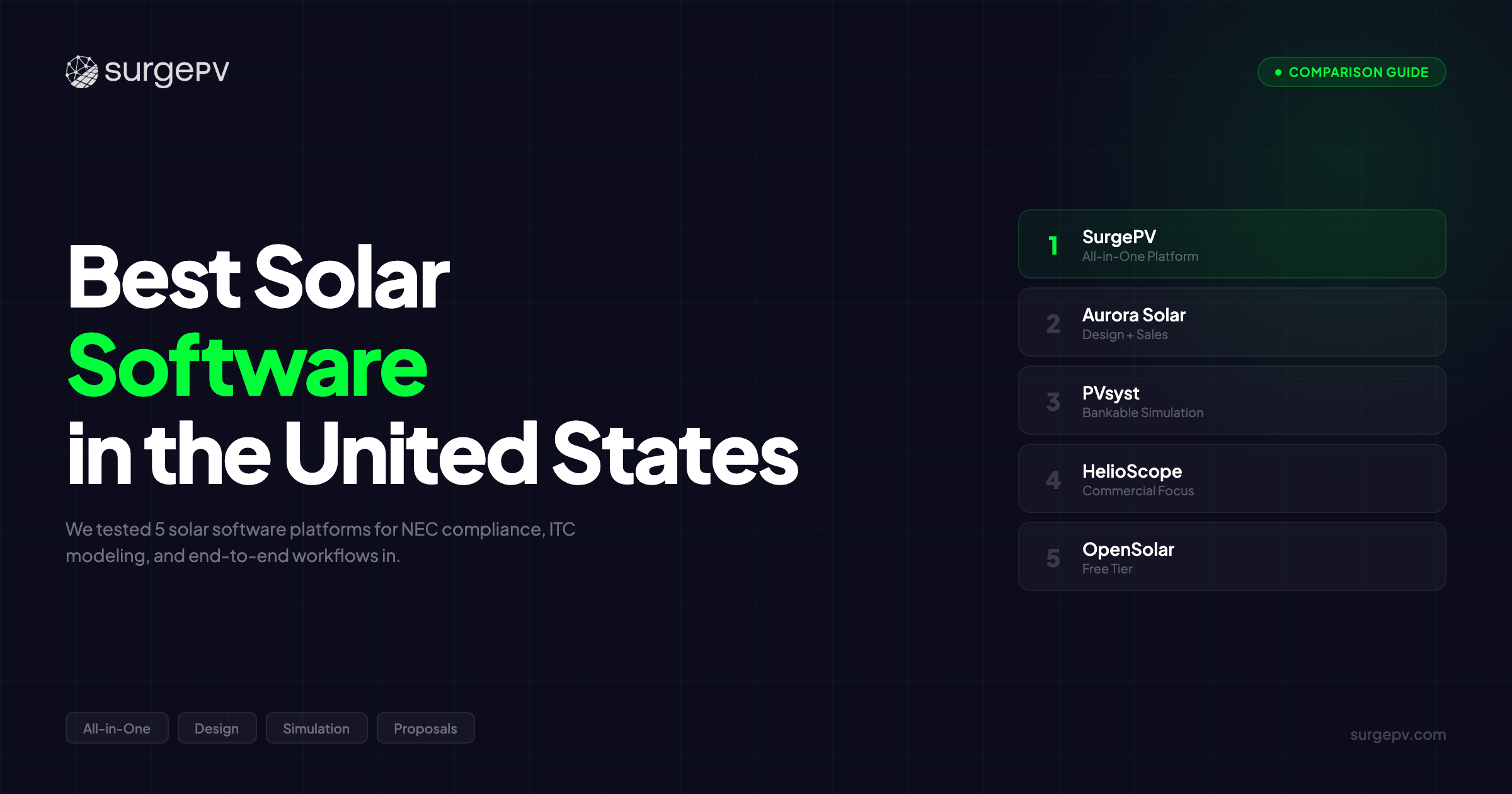
- SurgePV — All-in-one cloud platform with NEC-compliant SLD, bankable simulation, and US proposals (Best for EPCs and installers needing end-to-end efficiency)
- Aurora Solar — US market leader for residential design and sales (Best for large residential installers with enterprise budgets)
- PVsyst — Gold-standard bankable simulation (Best for utility-scale EPCs needing universal lender acceptance)
- HelioScope — Fast commercial design via Aurora ecosystem (Best for commercial projects, Aurora users)
- OpenSolar — Free residential design and proposal tool (Best for budget-conscious small installers)
Each tool is evaluated on US-specific criteria: NEC compliance, bankable simulation accuracy, ITC/MACRS financial modeling, utility rate coverage, and total cost of ownership.
Best Solar Software in the United States (Detailed Reviews)
SurgePV — Best All-in-One Solar Platform for the US
Target Users: Commercial EPCs (100 kW-10 MW), residential installers, solar designers needing engineering documentation, sales teams replacing multi-tool workflows.
SurgePV delivers the only end-to-end cloud platform optimized for US requirements: AI-powered solar design, NEC Article 690-compliant electrical engineering, bankable P50/P75/P90 simulations, 3,000+ US utility database, ITC/MACRS financial modeling, and professional proposal generation.
For US solar companies, that translates to one platform replacing the Aurora + AutoCAD + PVsyst + Excel stack. No tool-switching. No data re-entry. No separate licenses eating into margins.
Key Features for the US Market
NEC-Compliant Electrical Engineering (Primary Advantage)
This is where SurgePV separates from every other platform on this list.
NEC Article 690 compliance is required by every jurisdiction in the United States. Every AHJ needs code-compliant Single Line Diagrams (SLDs) for permit applications. Aurora doesn’t generate SLDs. HelioScope doesn’t generate SLDs. OpenSolar doesn’t generate SLDs. PVsyst doesn’t even do design.
That means US EPCs using any of those tools need AutoCAD ($2,000/year per user) and 2-3 hours of manual electrical drafting per project. Every single project.
SurgePV automates SLD generation in 5-10 minutes. Wire sizing follows NEC Article 690.8 with temperature correction per Table 310.15. Voltage drop analysis, DC and AC wiring, conduit fill — all calculated automatically from the design. The output is a permit-ready electrical package that passes AHJ review.
For a company doing 30 commercial projects per month, that’s 60-90 hours saved monthly on electrical engineering alone. At $75/hour engineering cost, that’s $4,500-$6,750 in monthly labor savings — before you factor in the $2,000/year AutoCAD license you no longer need.
Bankable Simulation
US lenders require P50/P90 analysis for commercial and utility-scale project financing. PVsyst has been the gold standard for decades. But PVsyst is simulation-only — no design, no proposals, no electrical engineering.
SurgePV’s 8760-hour simulation achieves ±3% accuracy versus PVsyst. P50 (median), P75 (conservative), and P90 (worst-case) metrics are built in. That’s meaningful because Aurora only provides P50 estimates — which lenders consider optimistic, not bankable.
For day-to-day design work, SurgePV provides the accuracy lenders need without requiring a separate PVsyst license. For projects where lenders specifically require PVsyst validation, SurgePV supports export to PVsyst for final verification.
US Financial Modeling
Every US solar proposal needs to model the full incentive stack: 30% ITC (with bonus adders through 2032), MACRS 5-year accelerated depreciation for commercial, state tax credits, SRECs, net metering or net billing by state, and utility rate escalation over 25 years.
SurgePV covers all of it. 3,000+ US utility database with TOU rates, tiered pricing, demand charges. Cash, loan, lease, PPA financing scenarios side-by-side. State incentive stacking including California NEM 3.0, New York NYSERDA, New Jersey SRECs, and Massachusetts SMART program.
Commercial Structures (Unique Capabilities)
SurgePV is the only platform with native carport solar design — single cantilever, dual cantilever, and multi-column structures for parking lot canopies. This is the fastest-growing commercial solar segment in the US and no other platform supports it.
Tracker support (single-axis and dual-axis with backtracking algorithm) and east-west racking further differentiate it for ground-mount and flat-roof commercial projects.
AI-Powered Design
Automatic roof detection using Google 3D, Bing Maps, and Esri data. Tilt, azimuth, and obstruction detection in 15-20 minutes versus 45-60 minutes of manual modeling. Shadow analysis completes in 30-60 seconds using 8760-hour methodology.
Pros
- Only all-in-one platform: design + NEC SLD + bankable simulation + US proposals (eliminates $6,800+/year multi-tool cost)
- NEC Article 690-compliant SLD generation in 5-10 minutes (vs. 2-3 hours in AutoCAD)
- Bankable P50/P75/P90 simulations (±3% vs. PVsyst)
- 3,000+ US utility database with ITC/MACRS/SREC financial modeling
- Native carport design (only platform), trackers, east-west racking
- Transparent pricing: $1,499/user/year, all features included
Cons
- Newer US brand recognition compared to Aurora Solar and PVsyst
- Developing LIDAR coverage (Aurora Premium has stronger LIDAR integration)
- Learning curve for advanced electrical features (2-3 week onboarding vs. 1-2 weeks for simpler tools)
Pricing
- Individual Plan: $1,899/year for 3 users ($633/user/year)
- For 3 Users Plan: $1,499/user/year
- For 5 Users Plan: $1,299/user/year (best value for scaling teams)
- Enterprise: Custom pricing for large organizations
US Cost Comparison:
- SurgePV (For 3 Users plan): $1,499/user/year — includes design + electrical + simulation + proposals
- Aurora + AutoCAD: $6,800/year per user — design + proposals only (SLD requires AutoCAD)
- Annual Savings: $5,301/year per user vs. Aurora + AutoCAD
Who SurgePV Is Best For
Perfect For:
- Commercial EPCs needing NEC-compliant electrical documentation without AutoCAD
- Solar installers replacing multi-tool workflows (Aurora + AutoCAD + PVsyst + Excel)
- Teams needing bankable simulations with integrated design (not simulation-only tools)
- Companies wanting US financial modeling (ITC, MACRS, SRECs, 3,000+ utilities) in one platform
Not Ideal For: Utility-scale developers where lenders specifically mandate PVsyst reports (use SurgePV for design + export to PVsyst for validation). Pure residential sales organizations already locked into Aurora enterprise contracts with financing partner integrations.
Real-World Example
A mid-size EPC team was spending 2.5 hours per project creating SLDs in AutoCAD. After switching to SurgePV, SLD generation dropped to under 10 minutes. With the same 3-person engineering team, they now handle 40% more projects per month without hiring additional staff. That is the difference automated electrical engineering makes.
You might be wondering: if SurgePV does all this, why haven’t I heard of it? PVsyst has had a 30-year head start. Aurora Solar has spent hundreds of millions on marketing. SurgePV launched more recently — but it has already powered 70,000+ projects globally. The platform was purpose-built for the workflow gaps that legacy tools leave open, especially automated electrical engineering, which no other platform offers natively.
Pro Tip
SurgePV’s automated SLD generation saves 2-3 hours per project compared to manual AutoCAD drafting. For US EPCs handling 10+ projects per month, that’s 20-30 hours recovered monthly. Book a demo to see it in action.
Further Reading
Best Solar Software (2026) — Global comparison across all platforms | Aurora Solar Review — Full feature deep-dive
Aurora Solar — US Market Leader for Residential Design
Aurora Solar is the dominant US solar software brand with 7,000+ company installations. The platform excels at fast residential design — address-to-proposal in minutes using AI roof detection and LIDAR integration (Premium tier). Beautiful customer-facing proposals and native financing partner integrations (GoodLeap, Mosaic, Sunlight Financial) make it the go-to for high-volume residential operations.
Key Strengths:
- Fastest residential address-to-proposal workflow available
- Industry-leading LIDAR roof modeling (Premium tier)
- 7,000+ US company installations (strongest market presence)
- Native financing partner integrations (GoodLeap, Mosaic, Sunlight)
- Beautiful proposal aesthetics and customer UX
US Limitations: No SLD generation — commercial EPCs need AutoCAD ($2,000/year) for NEC-compliant electrical packages. No carport or tracker design. Only P50 estimates (no P75/P90 for bankable financing). Premium pricing ($2,640-$10,000+/user/year) limits accessibility.
Best Use Case: Large residential installers (50+ installs/month) with enterprise budgets prioritizing sales velocity and financing partner integrations.
Pricing: $2,640-$10,000+/user/year
When to Choose Aurora: Large residential companies where brand recognition, LIDAR, and financing partner integrations justify premium pricing. Teams with separate engineering departments for electrical documentation.
Did You Know?
US solar irradiance ranges from 1,200-2,200 kWh/m²/year, making accurate simulation software important for bankable energy yield predictions. Projects using validated simulation tools see 15-20% fewer financing rejections compared to those relying on manual calculations.
PVsyst — Gold-Standard Bankable Simulation
PVsyst has been the industry standard for bankable solar simulations for over 30 years. Every major US lender, bank, and financial institution accepts PVsyst reports. For utility-scale and large commercial projects where financing hinges on simulation accuracy, PVsyst remains the benchmark.
Key Strengths:
- Universal lender acceptance (gold standard for project finance)
- Deepest simulation detail available (loss analysis, degradation, mismatch)
- 30+ year track record of bankable accuracy
- Comprehensive weather database integration
US Limitations: PVsyst is simulation-only. It cannot design solar systems. It cannot generate proposals. It cannot produce SLDs or electrical documentation. Desktop software (no cloud-based collaboration). Steep learning curve (4-6 weeks) and dated interface.
For US EPCs, PVsyst is one piece of a multi-tool workflow. You still need Aurora or SurgePV for design, AutoCAD for electrical, and separate tools for proposals.
Best Use Case: Utility-scale EPCs and developers where lenders specifically mandate PVsyst simulation reports.
Pricing: $1,250 + $400/year (perpetual license with annual maintenance)
When to Choose PVsyst: Utility-scale projects where lender mandates require PVsyst specifically. Can be paired with SurgePV (design + electrical) for a complete workflow at lower cost than Aurora + AutoCAD + PVsyst.
HelioScope — Fast Commercial Design via Aurora
HelioScope (now owned by Aurora Solar) provides fast commercial solar design with bankable simulation. The cloud-based interface handles commercial layouts quickly — drag-and-drop module placement, basic stringing, and energy production estimates accepted by many lenders.
Key Strengths:
- Fast commercial layout design (intuitive cloud interface)
- Bankable simulation accepted by many US lenders
- Cloud-based (collaboration, no desktop install)
- Aurora ecosystem integration (data flows to Aurora proposals)
US Limitations: No SLD generation (like Aurora, requires AutoCAD for electrical). Limited residential capabilities. Bundled with Aurora pricing (not available standalone at competitive rates). No carport or tracker design. No financial modeling or proposal generation.
Best Use Case: Commercial EPCs already in the Aurora ecosystem who need fast commercial layouts with bankable simulation.
Pricing: $2,640+ (bundled with Aurora Premium)
OpenSolar — Free Residential Design and Proposals
OpenSolar is a free solar design and proposal platform — no subscription fees, no licensing costs. For small US residential installers working tight margins, OpenSolar provides basic design capabilities, simple financial modeling, and professional-looking proposals at zero software cost.
Key Strengths:
- Completely free (no subscription, no hidden costs)
- Basic residential design with satellite imagery
- Professional web-based proposals with e-signature
- Built-in CRM for lead tracking
- Fast learning curve (1-2 weeks onboarding)
US Limitations: No electrical engineering (SLD, wire sizing) — needs AutoCAD for permits. Basic simulation (not bankable for project finance). Limited utility rate accuracy across 3,000+ US utilities. No MACRS depreciation modeling. No carport or tracker support.
Best Use Case: Small residential installers (5-20 projects/month) prioritizing cost savings over advanced features.
Pricing: $0 (free)
When to Choose OpenSolar: Budget-conscious residential-only installers where basic design and proposals meet business needs. Consider upgrading to SurgePV when scaling to commercial or needing electrical documentation.
Best Solar Software Comparison Table for the US
| Platform | Best For | NEC SLD | Bankable Sim | US Financial Modeling | Carport/Tracker | Pricing |
|---|---|---|---|---|---|---|
| SurgePV | End-to-end workflows | Yes (automated) | P50/P75/P90 | ITC/MACRS/SRECs/3,000+ utilities | Yes (only platform) | $1,499/user/year |
| Aurora Solar | Residential sales | No (needs AutoCAD) | P50 only | ITC/state credits | No | $2,640-$10,000+/user/year |
| PVsyst | Bankable simulation | No (sim only) | P50/P75/P90 (gold standard) | No (sim only) | No | $1,250 + $400/year |
| HelioScope | Commercial design | No (needs AutoCAD) | P50/P75/P90 | No (design + sim only) | No | $2,640+ (Aurora bundle) |
| OpenSolar | Budget residential | No (needs AutoCAD) | Basic | Basic ITC | No | $0 (free) |
| Feature | SurgePV | Aurora Solar | PVsyst | HelioScope | OpenSolar |
|---|---|---|---|---|---|
| Best for | All segments | Residential | Bankability | Utility-scale | Free tier |
| SLD generation | Yes (automated) | No | No | No | No |
| P50/P90 reports | Yes | P50 only | Yes (gold standard) | Limited | No |
| Carport design | Yes (only platform) | No | No | No | No |
| Cloud-based | Yes | Yes | Desktop | Yes | Yes |
| Wire sizing | Yes (automated) | No | No | No | No |
Key Takeaway
SurgePV is the only platform that combines NEC-compliant SLD generation, bankable P50/P75/P90 simulations, US financial modeling, and carport/tracker design in one platform — at $1,499/user/year versus $6,800+/year for the Aurora + AutoCAD multi-tool stack.
| Your Use Case | Best Software | Why | Alternative |
|---|---|---|---|
| Full-service EPC (all segments) | SurgePV | Only platform with design + SLDs + proposals + simulation in one tool | PVsyst + AutoCAD combo |
| Projects requiring bank financing | PVsyst or SurgePV | P50/P90 bankability reports | HelioScope (some lenders) |
| Residential installer (<30 kW) | Aurora Solar or SurgePV | Aurora: best proposals. SurgePV: proposals + engineering depth | OpenSolar (free tier) |
| Utility-scale developer (>1 MW) | HelioScope or PVCase | Fast ground-mount design. Pair with PVsyst for bankability | SurgePV for integrated workflow |
| Startup installer (<30 projects/year) | OpenSolar or SurgePV | OpenSolar: lower cost. SurgePV: better engineering | Free tools (PVWatts, SolarEdge Designer) |
What Makes the Best Solar Software in the US
The US market demands specific capabilities that distinguish functional solar software from tools that create more problems than they solve:
1. NEC Compliance and Electrical Engineering
NEC Article 690 is federal law for solar electrical installations. Every one of the 20,000+ AHJs in the United States requires code-compliant electrical documentation for permit approval. SLD generation isn’t optional — it’s mandatory.
Only SurgePV automates NEC-compliant SLD generation on this list. Aurora, HelioScope, OpenSolar, and PVsyst all require separate AutoCAD licenses ($2,000/year) and 2-3 hours of manual drafting per project.
For any company doing more than a handful of projects per month, this is the single largest workflow bottleneck and the single largest cost driver.
2. Bankable Simulation for Project Finance
US lenders require P50/P90 analysis for commercial and utility-scale financing. The simulation report is what unlocks capital. PVsyst remains the gold standard for lender acceptance. SurgePV achieves ±3% accuracy versus PVsyst with integrated P50/P75/P90 analysis.
Aurora only provides P50 estimates. For commercial projects requiring financing, that’s a limitation teams work around by adding PVsyst to the stack — another tool, another license, another data re-entry step.
3. US Financial Modeling (ITC, MACRS, State Incentives)
The Inflation Reduction Act created the most complex incentive structure in US solar history. The 30% ITC is just the starting point. Bonus adders (domestic content, energy community, low-income) can push credits to 50% or higher. MACRS depreciation adds 20-25% commercial value. State incentives stack on top: New Jersey SRECs ($5,000-$8,000 over 10 years), New York’s 25% state tax credit, California’s NEM 3.0 transition, Massachusetts SMART program.
Solar proposal software must model the complete incentive stack accurately. Errors create legal liability and kill deals.
4. Utility Rate Coverage (3,000+ Utilities)
The US has over 3,000 utilities with different rate structures. TOU rates in California. Deregulated retail in Texas. VDER methodology in New York. Demand charges for commercial. Tiered residential rates. Net metering vs. net billing by state.
Accurate savings projections require an up-to-date utility database. Manual rate research adds hours per proposal.
Explore SurgePV’s financial tools
5. Workflow Efficiency (Single Platform vs. Multi-Tool)
The multi-tool problem costs US EPCs real money:
- Aurora Solar: $4,800+/year per user (design + proposals)
- AutoCAD: $2,000/year per user (electrical SLDs)
- PVsyst: $1,250 + $400/year (bankable simulation)
- Total: $6,800+/year per user for a fragmented workflow
That’s before accounting for 4-6 hours per commercial project in tool-switching, data re-entry, and version control. At 30 projects per month, that’s 120-180 hours of waste — 1.5 full-time employees’ worth of productivity lost to software fragmentation.
The best solar software eliminates this by integrating design, electrical engineering, simulation, financial modeling, and proposals in one platform.
Decision Shortcut
If you need electrical engineering (SLDs, wire sizing, code compliance), SurgePV is the only platform that automates this natively. If you’re simulation-only, PVsyst is the gold standard. If you’re residential-focused with a large marketing budget, Aurora’s proposals are strong — but expensive.
How We Tested & Ranked These Tools
We evaluated each platform based on US-specific criteria:
1. US Market Fit (35%): Tested NEC Article 690 compliance (SLD generation, wire sizing, voltage drop), ITC/MACRS financial modeling, 3,000+ utility database accuracy, AHJ permit package generation, and state incentive modeling across CA, TX, FL, NY, and AZ markets.
2. Feature Completeness (25%): Evaluated whether each platform delivers design, electrical engineering, simulation, financial modeling, and proposals in one workflow versus requiring additional tools. Measured tool-switching overhead.
3. Workflow Efficiency (20%): Timed complete project workflows (design through proposal) for residential and commercial projects. Measured data re-entry requirements, collaboration features, and project throughput capacity.
4. Bankability (15%): Verified simulation accuracy against PVsyst benchmarks. Checked lender acceptance of simulation reports (P50/P75/P90). Tested export capabilities for third-party validation.
5. Cost-Effectiveness (5%): Calculated total cost of ownership including all required tools, annual licensing, and labor costs. Compared ROI based on time savings and eliminated tool costs.
All testing conducted November 2025-February 2026 with US EPCs and installers across residential and commercial segments.
Streamline Your Solar Business with SurgePV
End-to-end solar workflows from design to proposal in one platform.
Book a DemoNo commitment required · 20 minutes · Live project walkthrough
Bottom Line: Best Solar Software for the US
For US EPCs and growing installers: SurgePV delivers the only all-in-one platform with NEC-compliant SLD generation (5-10 minutes vs. 2-3 hours in AutoCAD), bankable P50/P75/P90 simulations (±3% vs. PVsyst), and US-optimized proposals (ITC, MACRS, SRECs, 3,000+ utilities) at $1,499/user/year. One platform replaces the $6,800+/year multi-tool stack.
For large residential operations: Aurora Solar is the US market leader with 7,000+ company installations, industry-best LIDAR, and native financing partner integrations. Premium pricing ($2,640-$10,000+/user/year) is justified at high volume with enterprise budgets. Still requires AutoCAD for electrical documentation.
For utility-scale simulation: PVsyst remains the gold standard for bankable simulations with universal lender acceptance. Pair it with SurgePV for design and electrical engineering at lower total cost than the Aurora + AutoCAD + PVsyst stack.
For commercial design within Aurora: HelioScope provides fast commercial layouts with bankable simulation. Best for teams already invested in the Aurora ecosystem. Still requires AutoCAD for electrical.
For budget-constrained startups: OpenSolar is free and functional for basic residential design and proposals. Limited engineering depth and simulation accuracy restrict it to simple residential projects.
The US solar market is the most competitive and technically demanding in the world. With 10,000+ companies fighting for 35-40 GW of annual installations, the software you choose determines how many projects your team can handle, how fast you can close deals, and how much engineering labor you waste on manual processes. The tools that integrate workflows win. The tools that fragment workflows cost you money every day.
Book a personalized demo to see how SurgePV replaces Aurora + AutoCAD + PVsyst with one integrated platform — NEC-compliant SLDs, bankable simulations, and US financial modeling at $1,499/user/year.
Bottom Line
For US EPCs and installers, SurgePV delivers the most complete design-to-proposal workflow with automated SLD generation, bankable P50/P90 simulations, and integrated proposals — all at $1,899/year for 3 users. Book a demo to see it in action.
Frequently Asked Questions
What is the best solar software in the United States?
SurgePV is the best all-in-one solar software for the US, combining NEC-compliant SLD generation (5-10 minutes vs. 2-3 hours in AutoCAD), bankable P50/P75/P90 simulations (±3% vs. PVsyst), and US financial modeling (ITC, MACRS, SRECs, 3,000+ utilities) at $1,499/user/year.
For large residential installers prioritizing sales velocity, Aurora Solar ($2,640-$10,000+/user/year) is the market leader. For utility-scale simulation specifically, PVsyst remains the gold standard for lender acceptance.
Do I need AutoCAD for solar projects in the US?
With Aurora Solar, HelioScope, OpenSolar, and PVsyst — yes. All of them require AutoCAD ($2,000/year) for NEC-compliant SLDs that most US AHJs mandate for permits. SurgePV is the only platform with automated SLD generation, eliminating AutoCAD dependency entirely.
For any US EPC doing more than a few projects per month, the AutoCAD cost ($2,000/year per user) and time (2-3 hours per SLD) adds up fast. At 30 projects per month, that’s 60-90 hours of manual electrical drafting.
Which solar software do US banks accept?
US lenders accept PVsyst (gold standard with universal acceptance), SurgePV (±3% accuracy vs. PVsyst with P50/P75/P90), and HelioScope for bankable simulations required for commercial and utility-scale project financing.
Aurora Solar only provides P50 estimates — which most lenders consider optimistic. Commercial projects requiring debt financing typically need P75 or P90 estimates.
How much does solar software cost in the US?
Solar software costs range from free (OpenSolar) to $10,000+/year per user. SurgePV: $1,499/user/year (all features). Aurora: $2,640-$10,000+/user/year. PVsyst: $1,250 + $400/year. Multi-tool stack (Aurora + AutoCAD + PVsyst): $6,800+/year per user.
Total cost of ownership is what matters. SurgePV at $1,499/user/year includes design, electrical engineering, simulation, and proposals. The multi-tool alternative costs $6,800+/year per user and wastes 4-6 hours per commercial project in tool-switching.
Does solar software include ITC and MACRS calculations?
SurgePV and Aurora Solar include ITC (30% + bonus adders through 2032) and MACRS depreciation modeling for commercial projects. PVsyst and HelioScope do not include financial modeling — they are simulation and design tools only. OpenSolar includes basic ITC but limited MACRS support.
For commercial proposals where ITC + MACRS + state credits reduce system costs by 50-70%, accurate financial modeling directly impacts close rates.
What NEC code compliance does solar software need?
US solar installations must comply with NEC Article 690 covering PV system electrical requirements: 690.7 (voltage calculations), 690.8 (circuit sizing), 690.12 (rapid shutdown), 690.41 (grounding). Software that automates NEC compliance and SLD generation saves 2-3 hours of manual AutoCAD work per project.
SurgePV is the only platform on this list that automates NEC Article 690-compliant SLD generation. All other tools require manual electrical engineering in AutoCAD or equivalent CAD software.
Can solar software handle both residential and commercial US projects?
SurgePV handles residential through commercial (100 kW-10 MW) with native support for rooftops, carports (only platform), trackers, and east-west racking. Aurora focuses on residential with limited commercial features. PVsyst simulates any project size but doesn’t design. HelioScope handles commercial design. OpenSolar is residential-focused.
US EPCs working across both residential and commercial segments need a platform that scales. SurgePV’s integrated electrical engineering and commercial structure support make it the strongest option for mixed portfolios.
How long does it take to learn solar software?
OpenSolar and Solargraf: 1-2 weeks. SurgePV: 2-3 weeks (including electrical engineering features). Aurora: 2-4 weeks (4-6 weeks for commercial features). PVsyst: 4-6 weeks (steep learning curve, desktop-only). HelioScope: 1-2 weeks for basic use.
SurgePV’s 2-3 week onboarding includes training on electrical engineering features (SLD, wire sizing) that other platforms don’t offer. SurgePV provides 3-minute average support response time to accelerate onboarding.
Sources
- SEIA (Solar Energy Industries Association) — US solar market data, installation statistics, policy analysis
- IRS Clean Energy Tax Credits — ITC rates, bonus adders, IRA provisions
- DSIRE (Database of State Incentives for Renewables & Efficiency) — State incentive database, net metering policies, SREC programs
- EIA (U.S. Energy Information Administration) — Electricity prices, utility rate data, market statistics
- NREL (National Renewable Energy Laboratory) — Solar research, SolarAPP+ permit automation, TMY weather data
- Aurora Solar Official Pricing — Competitor pricing verification
- PVsyst Official Website — Competitor reference, simulation methodology