
Italy’s solar economics shifted decisively in 2024–2026. Electricity prices stabilized above €0.28/kWh for residential customers, module costs fell to historic lows, and the Italy photovoltaic market set a new installation record — 6.8 GW added in 2024 alone. The question for any homeowner or installer is no longer whether solar pays off in Italy, but how fast, and how to structure the incentives correctly.
This guide covers the full picture for 2026: solar panel cost in Italy by region and system size, Conto Energia history and current GSE feed-in programs, the Superbonus phase-down and what replaced it, payback periods across Nord/Centro/Sud Italia, real ROI examples with self-consumption math, and the complete 2026 incentive status table.
TL;DR — Solar Panel ROI Italy 2026
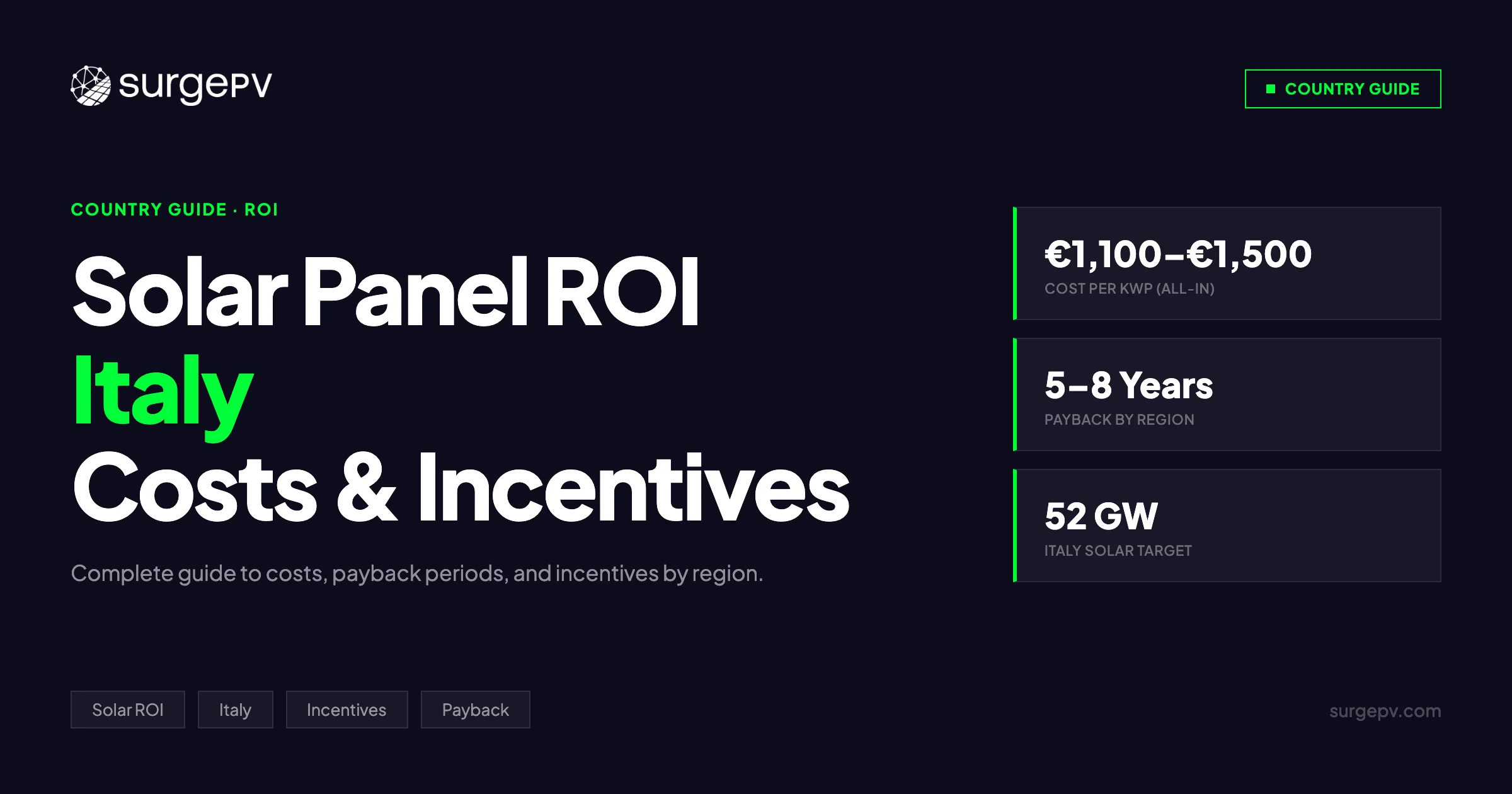
All-in installation cost: €1,100–€1,500/kWp. Residential payback: 5–8 years depending on region and incentives. Active incentives: Detrazione Fiscale 50% (10-year tax deduction) and Scambio sul Posto net metering via GSE. Superbonus 110% is closed for new standalone PV. Southern Italy (Bari, Palermo) achieves payback under 6 years. A well-sited 6 kWp system in Rome generates €1,400–€1,700 in annual bill savings.
In this guide:
- Latest 2026 updates to Italian solar incentives — status table by program
- Solar panel costs in Italy: €/kWp table by system size and region
- Conto Energia history and what replaced it
- GSE feed-in tariffs: Scambio sul Posto vs. Ritiro Dedicato explained
- Superbonus 110% phase-down — what is still claimable
- Payback period by region: Norte, Centro, Sud
- Self-consumption math and ROI calculation examples
- Italy photovoltaic market outlook to 2030
Latest Updates: Italy Solar Incentives 2026
For anyone tracking italy solar incentives news today, here is the current status of every active and recently closed program as of March 2026.
The Italian solar incentive market changed substantially between 2023 and 2026. The Superbonus 110% — once the world’s most generous residential solar subsidy — has been closed for new PV-only applications. The market has stabilized around three pillars: the 50% tax deduction, net metering via GSE, and the growing CER (Comunità Energetiche Rinnovabili) energy community framework.
Italy Solar Incentive Status — March 2026
| Program | Status | Notes |
|---|---|---|
| Detrazione Fiscale 50% (Ecobonus) | Active | 10-year income tax deduction for residential PV |
| Superbonus 110% | Closed (new applications) | Legacy claims processing; 65% rate for eligible renovation bundles |
| Scambio sul Posto (Net Metering) | Active | GSE-administered; €0.08–€0.13/kWh export compensation |
| Ritiro Dedicato | Active | Market-rate purchase for surplus above SSP threshold |
| CER — Comunità Energetiche | Active | 2024 CER Decree in effect; shared energy incentives up to €110/MWh |
| PNRR Agri-PV Grants | Active | €1.5B committed; new rounds open in 2026 |
| Puglia POR Solar Grant | Active | €500–€2,000 for residential rooftops in towns under 10,000 |
| Lombardy AxEL Battery Grant | Active (2026 window) | Battery and PV combo; check portal for current allocation |
| Conto Energia (legacy payments) | Active for enrolled systems | Systems enrolled through 2013 receiving 20-year guaranteed payments |
Key Changes Since 2024
Superbonus phase-down completed. The rate dropped from 110% (2020–2022) to 90% (2023) to 70% (2024) to 65% (2025). From 2026, standalone solar installations no longer qualify. Bundled deep renovation projects (involving insulation and HVAC) may still access 65% if SAL milestones were filed before the cutoff.
CER Decree (January 2024) now operational. Energy communities (Comunità Energetiche Rinnovabili) receive an incentive of up to €110/MWh on shared virtual self-consumption, valid for 20 years. This is the most significant new mechanism for 2024–2026, particularly for apartment buildings and small municipalities.
PNRR funding for Agri-PV. Italy committed €1.5 billion in PNRR (National Recovery and Resilience Plan) funds to agri-photovoltaic projects — solar installations co-located with agricultural land. Applications are processed by GSE.
Key Takeaway — 2026 Incentive Priority
The most time-sensitive action for Italian solar in 2026 is registering for Scambio sul Posto with GSE before commissioning. Retroactive registration is accepted but delays the compensation period. For systems in southern regions, also check regional grant availability — Puglia and Sicilia have active programs that close when annual budgets are exhausted.
Solar Panel Cost Italy: €/kWp Table by System Size (2026)
Before calculating ROI, you need accurate baseline costs. Italian installation prices have fallen 18–22% since 2022 due to global module oversupply, but labor and permitting costs remain significant.
Residential PV Installation Cost Italy 2026
| System Size | Total Installed Cost | Cost Per kWp | Net After 50% Deduction (10 yr PV) |
|---|---|---|---|
| 3 kWp | €3,900 – €5,100 | €1,300 – €1,700 | €1,950 – €2,550 |
| 4 kWp | €4,800 – €6,400 | €1,200 – €1,600 | €2,400 – €3,200 |
| 6 kWp | €6,600 – €9,000 | €1,100 – €1,500 | €3,300 – €4,500 |
| 8 kWp | €8,800 – €12,000 | €1,100 – €1,500 | €4,400 – €6,000 |
| 10 kWp | €11,000 – €15,000 | €1,100 – €1,500 | €5,500 – €7,500 |
| 15–20 kWp | €15,000 – €26,000 | €1,000 – €1,300 | €7,500 – €13,000 |
All-in costs include panels, string inverter or hybrid inverter, mounting system, DC/AC cabling, labor (2–3 days for standard residential), permit filing (CILA or SCIA), and GSE registration. Net cost column assumes 50% deduction claimed over 10 years, present value approximately 45% at 4% discount rate. Source: GSE installer survey data, RSE SpA market report 2025.
What You Are Paying For — 6 kWp System Breakdown
| Component | Share of Total | Typical Cost |
|---|---|---|
| Solar panels (monocrystalline PERC or TOPCon) | 22–30% | €1,600 – €2,700 |
| String inverter | 10–14% | €700 – €1,300 |
| Mounting system and racking | 10–15% | €700 – €1,350 |
| DC/AC wiring and switchgear | 12–18% | €850 – €1,600 |
| Labor (2 days, 2 electricians) | 16–22% | €1,100 – €2,000 |
| CILA permit, structural assessment | 5–10% | €350 – €900 |
| GSE registration, energy certification | 3–6% | €200 – €540 |
Battery storage add-on (7–10 kWh LFP): adds €3,500–€6,000 to total cost.
Regional cost variation: Southern Italian installers typically price labor 8–15% lower than northern markets (Milan, Turin). Alpine installations with difficult roof access can add €500–€1,500 for equipment access costs.
Commercial PV Cost Italy 2026
| System Size | Cost Per kWp | Notes |
|---|---|---|
| 20–50 kWp | €950 – €1,200 | Small commercial / agritourism |
| 50–200 kWp | €800 – €1,050 | Industrial rooftop |
| 200–500 kWp | €700 – €900 | Large commercial / ground-mount |
| 500 kWp+ | €600 – €800 | Utility-scale with GSE tender |
At commercial scale, a 10% overbuild on a 100 kWp system represents €8,000–€10,500 in wasted capital. Accurate system sizing using solar design software that integrates Italian irradiance data and shading models is essential before procurement.
Pro Tip — Getting Competitive Quotes in Italy
Request at minimum 3 quotes from certified Italian installers (certified under D.Lgs. 28/2011). Price variation of 15–25% for the same system spec is common. The cheapest quote is not always the best — check GSE registration experience, ENEA upload track record, and whether the installer handles Detrazione Fiscale documentation. Errors in ENEA filing delay your 10-year deduction timeline.
Conto Energia Italy: History and Legacy Status
Understanding Conto Energia explains the Italian solar market’s structure today — and why hundreds of thousands of existing Italian solar installations receive payments that new systems cannot access.
The Five Conto Energia Programs
Italy launched its Conto Energia (Energy Account) program in 2005, modeled on Germany’s Erneuerbare-Energien-Gesetz. Unlike Germany’s feed-in tariff, Conto Energia paid on total energy produced — not just exported — making it extraordinarily generous for high-self-consumption systems.
| Program | Period | Tariff Range | Key Feature |
|---|---|---|---|
| Conto Energia I | 2005–2006 | €0.445–€0.490/kWh | First Italian solar FIT; very limited enrollment |
| Conto Energia II | 2007–2010 | €0.360–€0.490/kWh | Boom period; rapid capacity growth |
| Conto Energia III | 2011 | €0.222–€0.391/kWh | Rate cuts as market matured |
| Conto Energia IV | 2011–2012 | €0.174–€0.290/kWh | Further degression; budget caps introduced |
| Conto Energia V | 2012–2013 | €0.119–€0.269/kWh | Final program; enrollment closed June 2013 |
All Conto Energia programs guaranteed rates for 20 years from commissioning date. Systems enrolled in Conto Energia IV (2012) continue receiving payments through 2032. Conto Energia V systems run through 2033.
Total Conto Energia commitments: GSE estimated €6.7 billion/year in legacy payments as of 2023, covering approximately 580,000 installations. These payments are funded by the Componente A3 grid tariff component — a line item on every Italian electricity bill.
Why Conto Energia Closed
The program closed in June 2013 when cumulative incentive costs exceeded the €6.7 billion/year threshold established by the GSE. The rapid growth of Italian solar — from 1.2 GW in 2009 to 18 GW by 2013 — exhausted the program budget in under four years of mass deployment.
Italy went from near-zero PV to the world’s second-largest solar market during Conto Energia’s peak years. The program achieved its purpose of building a national PV industry, but the cost drove its termination.
What Replaced Conto Energia
After 2013, Italian solar incentives shifted to three mechanisms that remain active today:
- Detrazione Fiscale 50% — income tax deduction for the capital cost
- Scambio sul Posto — net metering via GSE
- Ritiro Dedicato — market-rate purchase of surplus production
The 2020–2023 Superbonus temporarily restored near-Conto-Energia-level economic benefits, but through a capital recovery mechanism rather than a production tariff.
Legacy Conto Energia Owners
If you purchased a property with an existing solar installation, check with GSE whether the system is still under Conto Energia payment. The annual statement from GSE (Rendiconto) confirms remaining years and tariff rate. Conto Energia payments transfer with property ownership if properly registered — a significant hidden value in real estate transactions involving solar-equipped buildings.
GSE Feed-in Tariffs: Scambio sul Posto vs. Ritiro Dedicato
GSE (Gestore dei Servizi Energetici) manages all Italian solar incentive mechanisms. Understanding the difference between Scambio sul Posto and Ritiro Dedicato is essential for calculating accurate ROI on any Italian solar installation.
Scambio sul Posto (Net Metering)
Scambio sul Posto (SSP) is Italy’s net metering mechanism. Available for systems up to 500 kWp connected to the low-voltage grid, SSP credits exported energy against your grid consumption on an annual basis.
How it works:
- Solar production flows first to on-site loads (self-consumption)
- Surplus exports to the grid and accumulates as credits
- At year-end, GSE calculates the net energy balance and pays a “contributo in conto scambio” based on the lower of energy exported or energy imported
- Excess credit beyond the annual settlement is partially compensated monetarily
SSP Compensation Rates — Q1 2026 Indicative:
| Tariff Zone | Energy Value Component | Transport/Tax Component | Total Indicative Rate |
|---|---|---|---|
| Nord (Milan, Turin) | €0.065–€0.075/kWh | €0.015–€0.025/kWh | €0.080–€0.100/kWh |
| Centro (Rome, Florence) | €0.070–€0.085/kWh | €0.015–€0.025/kWh | €0.085–€0.110/kWh |
| Sud (Bari, Palermo, Naples) | €0.080–€0.095/kWh | €0.018–€0.028/kWh | €0.098–€0.123/kWh |
SSP compensation is market-indexed quarterly. Figures are indicative for Q1 2026 based on ARERA tariff data. Actual values depend on annual settlement calculation by GSE.
Key limitation: SSP compensates only up to the amount of energy imported. A household that exports 3,000 kWh but imports only 2,000 kWh from the grid receives SSP credit on only 2,000 kWh. This makes high self-consumption critical for SSP economics.
Ritiro Dedicato
Ritiro Dedicato (RD) is an alternative to SSP available for all grid-connected systems. Under RD, GSE purchases all exported production at a market-indexed “prezzo zonale” (zonal price).
When RD is better than SSP:
- For systems with very high export ratios (low self-consumption)
- For systems above 500 kWp (SSP not available)
- When zonal market prices are elevated
2026 Indicative RD Prices by Zone:
| GSE Zone | 2025 Average Zonal Price | 2026 Forward Estimate |
|---|---|---|
| Nord | €0.102/kWh | €0.095–€0.115/kWh |
| Centro-Nord | €0.105/kWh | €0.098–€0.118/kWh |
| Sud | €0.118/kWh | €0.108–€0.130/kWh |
| Sicilia | €0.125/kWh | €0.112–€0.138/kWh |
Source: GME (Gestore dei Mercati Energetici) 2025 annual data. Forward estimates indicative.
For most residential systems with 50–75% self-consumption, Scambio sul Posto delivers better economics because the transport and tax components of the SSP contribution are recovered in addition to the pure energy value.
Using solar proposal software that models both SSP and RD scenarios against actual consumption data helps installers present clients with the optimal choice before commissioning.
Superbonus Italy: Phase-Down and Legacy Status
The Superbonus was the most dramatic solar incentive in European history, and its phase-down is the defining policy shift in the Italy photovoltaic market from 2023 to 2026.
What the Superbonus Was
Launched in mid-2020 as part of Italy’s COVID recovery stimulus, the Superbonus 110% allowed homeowners to claim a tax deduction equal to 110% of qualifying energy renovation costs — including solar PV — over 5 years. The mechanism that made it unique was credit transfer: homeowners could assign their tax credit to contractors or banks (via “cessione del credito”), receiving the renovation at zero upfront cost.
The result: solar installations paired with insulation and heat pump upgrades became effectively free for qualifying homeowners, with a 10% profit for contractors managing the credit transfer.
Peak years (2021–2022): Hundreds of thousands of Italian families installed solar and HVAC packages at zero out-of-pocket cost. Italy’s residential solar market grew 127% in 2022 alone.
The Phase-Down Timeline
| Year | Rate | Standalone PV Eligible? | Credit Transfer Permitted? |
|---|---|---|---|
| 2020–2022 | 110% | Yes (with home renovation) | Yes |
| 2023 | 90% | Only with ISEE income certification | Severely restricted |
| 2024 | 70% | No (renovation packages only) | No (for new enrollments) |
| 2025 | 65% | No | No |
| 2026 | 0% (new applications) | No | No |
Legacy claims: Projects that filed SAL (Stato di Avanzamento Lavori — milestone completion reports) before the respective cutoff dates can continue claiming at the applicable rate. The backlog of legacy claims is still being processed by ENEA and Agenzia delle Entrate.
What Remains Available in 2026
Detrazione Fiscale 50% (Ecobonus): The standard 50% income tax deduction for residential energy efficiency improvements, including solar PV installation. Claimed over 10 years (10% per year) against income tax. Maximum deductible amount: €96,000 per real estate unit.
Requirement: The property must be an existing residential building (not new construction). The system must be installed on the roof or integrated into the building envelope.
Pro Tip — Maximizing the 50% Deduction
The 50% deduction is applied to the purchase and installation cost, including VAT. For a 6 kWp system costing €8,000, you recover €4,000 over 10 years (€400/year). To fully benefit, you must have sufficient Italian income tax liability each year. Retirees with pension income under €15,000 and employees in low tax brackets may not fully utilize the 10-year deduction. In these cases, a pre-purchase tax analysis with a commercialista is advisable.
Solar Panel Payback Period Italy: By Region
The most important variables for Italian solar payback are solar irradiance (which varies dramatically by latitude) and self-consumption ratio. This section provides detailed payback analysis for Norte, Centro, and Sud Italia.
Solar Irradiance: Italy’s North-South Gradient
Italy spans approximately 1,200 km from the Alps to Sicily. This creates one of Europe’s steepest irradiance gradients within a single national market.
| Region | Representative City | Annual Irradiance (kWh/m²) | 6 kWp System Annual Yield |
|---|---|---|---|
| Alto Adige / Valle d’Aosta | Bolzano | 1,150–1,250 | 6,300–6,900 kWh |
| Lombardia / Piemonte | Milan | 1,200–1,300 | 6,600–7,200 kWh |
| Emilia-Romagna / Veneto | Bologna | 1,250–1,350 | 6,900–7,500 kWh |
| Toscana / Umbria | Florence | 1,350–1,500 | 7,400–8,300 kWh |
| Lazio / Campania | Rome / Naples | 1,450–1,600 | 8,000–8,800 kWh |
| Puglia / Basilicata | Bari | 1,650–1,800 | 9,100–9,900 kWh |
| Sicilia / Calabria | Palermo / Catania | 1,700–1,950 | 9,400–10,700 kWh |
| Sardegna | Cagliari | 1,600–1,800 | 8,800–9,900 kWh |
Source: PVGIS (Photovoltaic Geographical Information System), European Commission JRC, 2024. Yields calculated for south-facing roof at 30° tilt, 0.8 system performance ratio.
Payback Period by Region — 6 kWp System, 2026
The following analysis uses a standardized 6 kWp system at €7,500 gross cost (€1,250/kWp), with 50% self-consumption and the Detrazione Fiscale 50% applied over 10 years. Electricity rate: €0.29/kWh average retail. SSP export compensation at mid-range regional rates.
| Region | Annual Yield | Self-Cons. kWh | Export kWh | Bill Savings | SSP Income | Total Annual Benefit | Payback (No Incentive) | Payback (With 50% Deduction) |
|---|---|---|---|---|---|---|---|---|
| Milan (Nord) | 6,900 kWh | 3,450 kWh | 3,450 kWh | €1,001 | €310 | €1,311 | 5.7 yr | 8.6 yr* |
| Bologna (Nord-Est) | 7,200 kWh | 3,600 kWh | 3,600 kWh | €1,044 | €338 | €1,382 | 5.4 yr | 8.2 yr* |
| Rome (Centro) | 8,400 kWh | 4,200 kWh | 4,200 kWh | €1,218 | €420 | €1,638 | 4.6 yr | 6.9 yr* |
| Naples (Centro-Sud) | 8,800 kWh | 4,400 kWh | 4,400 kWh | €1,276 | €472 | €1,748 | 4.3 yr | 6.4 yr* |
| Bari (Sud) | 9,500 kWh | 4,750 kWh | 4,750 kWh | €1,378 | €537 | €1,915 | 3.9 yr | 5.9 yr* |
| Palermo (Sud) | 10,200 kWh | 5,100 kWh | 5,100 kWh | €1,479 | €561 | €2,040 | 3.7 yr | 5.5 yr* |
“With 50% Deduction” payback accounts for the fact that the deduction is spread over 10 years. The effective net cost (present value at 4% discount rate) is approximately 43% of the gross system cost. Payback is calculated against this net present-value cost.
Assumptions: 50% self-consumption ratio, grid electricity €0.29/kWh blended retail, SSP compensation at mid-range regional rate, 0.6%/yr panel degradation, no battery storage.
The Self-Consumption Lever
Italian electricity retail rates (€0.27–€0.35/kWh) are 3–4x higher than SSP export compensation (€0.08–€0.12/kWh). This gap makes self-consumption the single most powerful variable in Italian solar economics.
| Self-Consumption Rate | Annual Savings (6 kWp, Rome) | Payback (Net Cost) |
|---|---|---|
| 30% | €870 | 9.8 yr |
| 50% | €1,638 | 6.9 yr |
| 70% | €2,100 | 5.3 yr |
| 85% (with battery) | €2,430 | 5.5 yr (higher net cost) |
Every 10% increase in self-consumption shortens payback by approximately 0.8–1.2 years in central Italian conditions.
Smart consumption strategies:
- Run dishwasher and washing machine during midday solar hours (10:00–15:00)
- Set EV charging to start at noon (smart charger timer)
- Use heat pump in water heating mode during peak solar hours
- Pre-cool or pre-heat the building during midday when solar is at maximum
Further Reading
For detailed shading analysis affecting Italian solar yields — particularly for urban installations in older Italian cities with surrounding buildings — see solar shadow analysis software. Accurate shading modeling is important for Rome, Naples, and northern Italian urban installations.
Battery Storage in Italy: Does It Make Sense?
Battery storage changes the Italian solar ROI calculation significantly, and the math has improved considerably as LFP battery costs fell 30–40% between 2022 and 2025.
Battery Economics Italy 2026
| Battery Capacity | All-in Cost | Self-Cons. Increase | Additional Annual Savings | Battery Payback |
|---|---|---|---|---|
| 5 kWh | €2,800 – €3,800 | +10–15% | €290–€440 | 7–13 yr |
| 7 kWh | €3,500 – €5,000 | +12–20% | €350–€580 | 7–14 yr |
| 10 kWh | €4,800 – €7,000 | +20–30% | €580–€870 | 7–12 yr |
| 14 kWh | €6,500 – €9,500 | +25–35% | €725–€1,015 | 8–13 yr |
Battery-only payback is calculated on the incremental cost and incremental savings. The 50% Detrazione Fiscale also applies to battery storage when installed with solar.
Lombardy AxEL grant: Covers up to €2,000 of battery costs when installed with PV. This makes the incremental battery payback as short as 4–6 years in Lombardy.
Key consideration: Battery payback (8–13 years standalone) is longer than PV payback (5–8 years). Batteries do, however, convert low-value exported energy (€0.09/kWh SSP) into high-value self-consumed savings (€0.29/kWh). The combined PV and battery system NPV over 25 years typically exceeds PV-only NPV by €2,000–€5,000 for a well-sized installation.
Real-World ROI Examples: North, Centre, South Italy
Example 1: Milan — Lombardy, 6 kWp, No Battery
Profile: Two-person household, 3,800 kWh annual consumption, south-facing 30° roof, no shading obstructions.
| Parameter | Value |
|---|---|
| Gross system cost | €7,800 |
| 50% deduction (PV of 10-yr deduction at 4%) | −€3,354 |
| Net effective cost | €4,446 |
| Annual solar yield | 6,900 kWh |
| Self-consumption | 3,800 kWh (55% of yield) |
| Exported to grid | 3,100 kWh |
| Annual bill savings (grid avoided) | €1,102 |
| Annual SSP income (estimated) | €279 |
| Total annual benefit | €1,381 |
| Simple payback (gross) | 5.6 yr |
| Simple payback (net of deduction) | 3.2 yr |
| IRR (25-year, 4% discount) | 18.4% |
| NPV (25 yr @ 4%) | €14,200 |
Commentary: Milan’s lower irradiance is offset by high household consumption driving excellent self-consumption. The 55% self-consumption rate is key — a household consuming only 2,500 kWh/year would see payback extend to 4.8 years net.
Example 2: Rome — Lazio, 6 kWp + 7 kWh Battery
Profile: Family of four, 5,200 kWh annual consumption, EV charged at home, southwest-facing 25° roof.
| Parameter | Value |
|---|---|
| Gross system cost (PV + battery) | €13,200 |
| 50% deduction (PV of deduction) | −€5,676 |
| Net effective cost | €7,524 |
| Annual solar yield | 8,200 kWh |
| Self-consumption (with battery) | 6,560 kWh (80% of yield) |
| Exported to grid | 1,640 kWh |
| Annual bill savings | €1,902 |
| Annual SSP income | €164 |
| Total annual benefit | €2,066 |
| Simple payback (gross) | 6.4 yr |
| Simple payback (net of deduction) | 3.6 yr |
| IRR (25 yr @ 4%) | 17.2% |
| NPV (25 yr @ 4%) | €23,500 |
Commentary: The EV charging load boosts self-consumption to 80%, transforming the economics. Without the EV, self-consumption drops to ~60% and annual benefit falls to €1,620 — still strong, but €446/year lower. The Rome solar resource (1,530 kWh/m²/year average) combined with high household consumption produces the optimal Italian solar scenario.
Example 3: Bari — Puglia, 8 kWp, Commercial with Ritiro Dedicato
Profile: Agricultural business (agriturismo), daytime operations, 12,000 kWh annual grid consumption, flat warehouse roof with optimal south orientation.
| Parameter | Value |
|---|---|
| Gross system cost | €10,400 |
| Regional Puglia POR grant | −€1,500 |
| 50% deduction (applicable portion) | −€2,244 |
| Net effective cost | €6,656 |
| Annual solar yield | 12,900 kWh |
| On-site consumption (daytime ops) | 9,030 kWh (70% self-cons.) |
| Export (Ritiro Dedicato) | 3,870 kWh |
| Annual bill savings | €2,619 |
| Annual RD income (€0.115/kWh) | €445 |
| Total annual benefit | €3,064 |
| Simple payback (net) | 2.2 yr |
| IRR (25 yr) | 46% |
| NPV (25 yr @ 4%) | €54,800 |
Commentary: The Puglia scenario shows why southern Italian commercial solar is one of the most attractive investments in European renewable energy. The combination of 1,750 kWh/m²/year irradiance, Puglia regional grant, daytime business consumption, and Ritiro Dedicato for export surplus produces payback under 3 years and strong long-term returns.
Model Italian Solar ROI for Your Clients in Minutes
SurgePV’s generation and financial tool calculates accurate payback, IRR, and NPV for Italian residential and commercial projects — with regional irradiance data, SSP vs. RD comparison, and Detrazione Fiscale modeling built in.
Book a DemoNo commitment required · 20 minutes · Live project walkthrough
LCOE and IRR: Advanced ROI Metrics for Italy
Simple payback answers “when do I break even?” but misses the full value picture. Professionals and larger investors use Levelized Cost of Energy (LCOE) and Internal Rate of Return (IRR) for complete analysis.
LCOE: True Cost Per kWh Over System Life
Formula:
LCOE (€/kWh) = (CAPEX + NPV of OPEX) / Total Lifetime Production
Italian residential example (6 kWp, Rome, 25 years):
- CAPEX: €7,800 (gross)
- OPEX: €120/year average (cleaning, inverter reserve, insurance) = €3,000 NPV at 4%
- Total production: 8,200 kWh/yr × 25 yr × degradation factor ≈ 190,000 kWh
- LCOE = (€7,800 + €3,000) / 190,000 = €0.057/kWh
At €0.057/kWh, self-generated solar electricity costs 80% less than grid electricity at €0.29/kWh — and the gap widens as grid tariffs increase. Italy’s ARERA (energy regulator) has consistently forecast electricity prices 15–25% above current levels by 2030.
IRR Comparison by Region
| Scenario | CAPEX (Net) | Annual Benefit | IRR (25 yr) | NPV (25 yr @ 4%) |
|---|---|---|---|---|
| Milan, 6 kWp, no battery | €4,446 | €1,381 | 18.4% | €14,200 |
| Rome, 6 kWp, no battery | €3,700 | €1,638 | 26.8% | €20,300 |
| Rome, 6 kWp + 7 kWh battery | €7,524 | €2,066 | 17.2% | €23,500 |
| Bari, 8 kWp, commercial | €6,656 | €3,064 | 46.0% | €54,800 |
| Palermo, 6 kWp, no battery | €3,500 | €2,040 | 35.2% | €25,800 |
Interpretation: Italian solar IRR of 17–46% outperforms alternative savings vehicles by a wide margin (Italian BTp government bonds at 3.8–4.2% in 2026, bank deposits at 2.5–3.5%). Even in Milan, solar delivers IRR nearly 4x the yield of government bonds.
For Italian solar installers generating bankable financial models, the generation financial tool at SurgePV automates LCOE, IRR, and NPV calculations with Italian-specific irradiance and tariff data.
Hidden Variables That Affect Italian Solar ROI
Roof Tilt and Orientation
Italy’s Mediterranean latitude (37°–47° N) means optimal fixed-tilt systems perform best at 28–34° south-facing. East-west split arrays lose 8–12% of annual production but distribute generation more evenly across the day — sometimes beneficial for time-of-use tariff structures.
Impact on ROI: A west-facing roof (270° azimuth) in Rome produces approximately 1,350 kWh/kWp/year versus 1,530 kWh/kWp/year for south-facing. This 12% reduction extends payback by approximately 1.0–1.4 years.
Italy’s Time-of-Use Tariff Opportunity
ARERA’s Bioraria and Trioraria tariff structures charge different rates for F1 (peak: 8am–7pm weekdays), F2 (intermediate), and F3 (off-peak) energy. Solar production naturally aligns with F1 peak hours — the most expensive grid energy. For households on time-of-use tariffs, self-consumed solar replaces F1-rate electricity at €0.33–€0.42/kWh rather than the flat average of €0.29/kWh.
This alignment increases effective bill savings by 8–15% for households on Bioraria or Trioraria compared to the flat-rate calculation.
Maintenance: What to Budget
| Maintenance Item | Frequency | Cost Range |
|---|---|---|
| Panel cleaning | Annual (recommended in dusty South) | €80–€200 |
| String inverter replacement | Once in 10–15 years | €800–€1,500 |
| Monitoring system check | Annual | Included with many installer warranties |
| Structural inspection (flat roofs) | Every 5 years | €150–€300 |
| Inverter warranty extension | Optional, year 5–10 | €200–€400 |
Total lifetime OPEX estimate: €2,500–€5,000 over 25 years (€100–€200/year average). Including this in LCOE calculations is essential for accurate ROI modeling.
Permit and Grid Connection Timelines
Italian solar installations require:
- CILA or SCIA (municipal building notification) — filed electronically, typically 2–4 weeks processing
- GSE application for SSP or Ritiro Dedicato — online portal, 4–8 weeks
- Grid connection upgrade (if required) — can take 4–16 weeks through local DSO
In northern urban areas (Milan metropolitan, Turin, Genoa), grid connection queues are longer. Southern rural areas often achieve commissioning faster. Budget 3–5 months from contract signing to first kWh generation in typical Italian residential projects.
Italy Photovoltaic Market Outlook: 2026–2030
Italy’s solar market is at an inflection point. After the Superbonus-fueled boom of 2021–2022 and subsequent policy reset, the market has found a new equilibrium driven by economics rather than incentive arbitrage.
Installation Records and Growth Trajectory
- 2023: 5.2 GW installed (record at the time)
- 2024: 6.8 GW installed (new record) — Source: Terna
- 2025 estimate: 7.5–9.0 GW
- 2030 target (PNIEC): 52 GW total installed capacity (from approximately 32 GW in 2024)
To reach 52 GW by 2030, Italy must sustain 3–5 GW of annual additions. The 2024–2025 trajectory suggests this is achievable without additional extraordinary incentives — a sign that the market has reached genuine economic maturity.
Module Price Decline Forecast
| Year | Avg. Module Price (utility-grade) | Impact on Italian System Cost |
|---|---|---|
| 2023 | €0.21/W | Baseline |
| 2025 (actual) | €0.15/W | −10–12% on total installed cost |
| 2027 (forecast) | €0.11–€0.13/W | −14–18% on total installed cost |
| 2030 (forecast) | €0.08–€0.10/W | −18–22% on total installed cost |
Source: BloombergNEF Solar Market Outlook 2025. Module prices for standard monocrystalline utility-grade, CIF European ports.
These cost reductions translate to payback periods falling below 5 years in central Italy and below 4 years in the south by 2027–2028 — even without new incentive programs.
CER Energy Communities: The Next Italian Solar Wave
The 2024 CER (Comunità Energetiche Rinnovabili) decree opened a new solar opportunity: shared energy communities where apartment buildings, municipalities, and small businesses form collective solar consumers.
CER incentive mechanism:
- GSE pays up to €110/MWh on virtual shared self-consumption within the community
- Guaranteed for 20 years
- Available for systems up to 1 MW
- Priority access for municipalities under 5,000 residents
For apartment buildings that cannot install individual rooftop systems, CER provides a pathway to solar economics comparable to direct ownership. CER is widely expected to drive the next major wave of Italian solar deployment in 2025–2030.
Grid Parity and the Post-Incentive Era
Italy reached solar grid parity in the South in 2023–2024. Solar LCOE (€0.04–€0.07/kWh for well-sited residential and commercial systems) is now structurally below grid retail prices — meaning new solar is economically rational without any incentive beyond self-consumption savings.
As IRENA Director-General Francesco La Camera stated at the 2024 EU CleanTech session: “By 2027, we expect the average payback for rooftop PV in Italy to fall below five years — even without the Superbonus. Energy independence is becoming mainstream economics.”
For solar installers and solar software providers operating in Italy, this market maturation means professional tools for yield modeling, ROI presentation, and proposal generation are competitive differentiators rather than optional extras.
Risks to the 2026–2030 Forecast
| Risk | Potential Impact | Probability |
|---|---|---|
| SSP (net metering) reform or cap | +1–2 years on payback | Medium |
| Grid connection queue bottlenecks | Delays, not ROI impact | High in urban areas |
| ECB rate hikes inflating finance costs | Higher effective CAPEX for financed systems | Low (rates stabilizing) |
| PNIEC target revision downward | Less policy support | Low |
| Module anti-dumping tariff reinstated | +5–15% on hardware costs | Medium |
Conservative ROI models should build in 10–15% downside scenarios on annual savings and 5–10% upside on installation costs.
Incentive Application Checklist for Italian Solar 2026
Flawless documentation is essential for Italian solar incentives. A single missing document or incorrect ENEA upload can delay the 10-year deduction timeline by 12+ months.
Documents Required for Detrazione Fiscale 50%
- CILA or SCIA — municipal building notification filed before work begins
- Installer certification — installer must hold D.Lgs. 28/2011 certification
- Technical project documents — system layout, single-line diagram, string sizing calculations
- ENEA upload — must be filed via the ENEA portal within 90 days of completion
- APE (Attestato di Prestazione Energetica) — pre- and post-installation energy performance certificate
- Invoice and payment proof — payment must be made by traceable bank transfer (bonifico parlante) with fiscal code of payee and VAT reference to the deduction law
- Codice Fiscale — personal tax identification number
Common Errors That Delay Italian Solar Incentives
| Error | Consequence | Prevention |
|---|---|---|
| Cash payment instead of bonifico parlante | Deduction voided, no exceptions | Always pay via bank transfer with correct reference codes |
| ENEA upload after 90-day deadline | Deduction voided | Calendar reminder: 90 days from commissioning, not invoicing |
| Missing APE certificate | Ecobonus claim rejected | Commission APE before installation begins |
| Installer not certified under D.Lgs. 28/2011 | Incentive invalid | Verify installer credentials before signing contract |
| SSP registration after commissioning | Delay in net metering credits | File GSE application before first grid injection |
| Incorrect IBAN for GSE payments | SSP credit payment failure | Double-check bank details in GSE portal |
Key Takeaway — Documentation Timing
Italian solar incentives are unforgiving about sequence and timing. The ENEA 90-day upload deadline is absolute — no extensions, no exceptions. Build your installation project timeline backward from this deadline: commissioning date minus 60 days should be when all documentation is assembled. Missing the ENEA deadline on a €10,000 installation costs you €5,000 in deductions.
How Often Do Italian Solar Incentives Change?
| Program | Change Frequency | Nature of Changes |
|---|---|---|
| Detrazione Fiscale 50% | Annually (via Legge di Bilancio) | Rate and maximum eligible cost; currently stable at 50% |
| Superbonus | Legislated (one-off revisions) | Rate already phased to 0% for new applications |
| Scambio sul Posto | Quarterly (ARERA tariff review) | Compensation rate varies with energy market |
| Ritiro Dedicato | Monthly (zonal price) | Market-indexed; follows GME spot market |
| CER incentive | Stable (20-year contracts) | Rate fixed at contract signing |
| Regional grants (Puglia, Lombardy) | Annual budget cycles | Open when budget available; close when exhausted |
| GSE Agri-PV tender | Per-tender (2–3 per year) | Premium rate set competitively per round |
How to track changes:
- gse.it — GSE portal for SSP, RD, and CER program updates
- arera.it — ARERA (energy regulator) for tariff updates
- enea.it — ENEA for Ecobonus filing portal and Superbonus legacy documentation
- qualenergia.it — Italian solar industry news (in Italian)
For solar companies managing Italian project pipelines, integrating current incentive calculations directly into solar proposals ensures clients always see accurate, up-to-date ROI figures.
Conclusion
Italian solar is no longer a bet on incentives — it is a bet on sunlight, falling hardware costs, and rising electricity prices. All three work in investors’ favor in 2026 and beyond.
The clearest numbers: a 6 kWp system in Rome costs approximately €4,400 net of the 50% deduction, generates €1,600–€2,000 in annual benefits, and delivers 17–27% IRR over 25 years. In Puglia and Sicily, the same analysis produces payback under 4 years and IRR above 30%. Even in Milan, Italian solar outperforms every conventional savings instrument by a substantial margin.
The Superbonus era is over. What remains — Detrazione Fiscale 50%, Scambio sul Posto, CER energy communities — is a stable, credible, and economically rational framework for solar investment that does not depend on extraordinary political conditions to work.
Three actions for 2026:
- File ENEA documentation within 90 days of commissioning — missing this deadline voids €1,000s in annual deductions
- Compare SSP vs. Ritiro Dedicato before GSE registration — the right choice depends on your household consumption profile
- Check regional grant availability before signing an installer contract — Puglia, Lombardy, and Sicilia have active programs that close mid-year when budgets run out
For the broader European context, see our guides to European solar incentives and EU solar energy policies. For Italian installers building professional proposal workflows, solar design software with integrated Italian irradiance data and incentive modeling shortens proposal-to-close time and reduces calculation errors.
Frequently Asked Questions
How much does solar panel installation cost in Italy in 2026?
Solar panel installation cost in Italy ranges from €1,100 to €1,500 per kWp all-in for residential systems (3–10 kWp). A typical 6 kWp system runs €6,600–€9,000 before incentives. With the Detrazione Fiscale 50%, net effective cost falls to approximately €3,300–€4,500. Southern regions typically run 8–15% lower on labor; Alpine installations may carry access premiums.
What is the solar panel payback period in Italy by region?
Payback periods by region: Southern Italy (Bari, Palermo) 5–6 years; Central Italy (Rome, Naples) 6–7 years; Northern Italy (Milan, Bologna) 7–9 years. These figures are net of the 50% tax deduction at present value. Battery storage extends individual payback by 0.5–2 years but increases total system NPV.
Is the Superbonus still available for solar in Italy in 2026?
No — the Superbonus 110% is closed for new standalone PV installations. The rate was phased to 65% for 2025 and 0% for new applications in 2026. Legacy claims filed before the respective cutoff continue to be processed. The primary active residential incentive is the Detrazione Fiscale 50% (Ecobonus).
What are the current solar incentives in Italy in 2026?
Active Italy solar incentives in 2026: Detrazione Fiscale 50% (10-year income tax deduction); Scambio sul Posto net metering via GSE (export compensation €0.08–€0.13/kWh); Ritiro Dedicato (market-rate purchase of surplus); CER energy community incentives (up to €110/MWh shared self-consumption, 20-year guarantee); PNRR Agri-PV grants; regional grants in Puglia, Lombardy, and other regions.
What was Conto Energia and is it still active?
Conto Energia was Italy’s historic solar production tariff, running through five editions from 2005 to 2013. It paid guaranteed rates on total production (not just exports) for 20 years. Systems enrolled through 2013 continue receiving payments through their guaranteed period — some running through 2033. New systems cannot enroll. Conto Energia was replaced by net metering and tax deductions after program costs exceeded budget limits.
Are solar panels worth it in Italy in 2026?
Yes — emphatically. With grid electricity at €0.27–€0.35/kWh and solar LCOE at €0.04–€0.07/kWh (well-sited residential), solar consistently outperforms alternative savings instruments. A 6 kWp system in Rome delivers 17–27% IRR over 25 years. In Puglia and Sicily, IRR exceeds 30%. Italy’s solar market is now driven by economics, not incentive dependency.
What is the GSE and how do Italian solar feed-in tariffs work?
GSE (Gestore dei Servizi Energetici) is the Italian state energy services company that manages solar incentive programs. GSE administers Scambio sul Posto (net metering), Ritiro Dedicato (surplus purchase at market rate), and CER (Comunità Energetiche Rinnovabili) incentives. Under Scambio sul Posto, GSE credits exported energy against your grid imports on an annual basis. Registration with GSE is mandatory before first grid injection.
What is the Italy 2030 solar target and photovoltaic market outlook?
Italy’s PNIEC targets 52 GW of solar capacity by 2030, from approximately 32 GW in 2024. The Italy photovoltaic market added a record 6.8 GW in 2024 (Terna data). Meeting the 2030 target requires 3–5 GW/year of additions. The 2024–2025 trajectory is on track. Growth drivers include falling module costs, PNRR-funded Agri-PV, and the expanding CER energy community framework.