
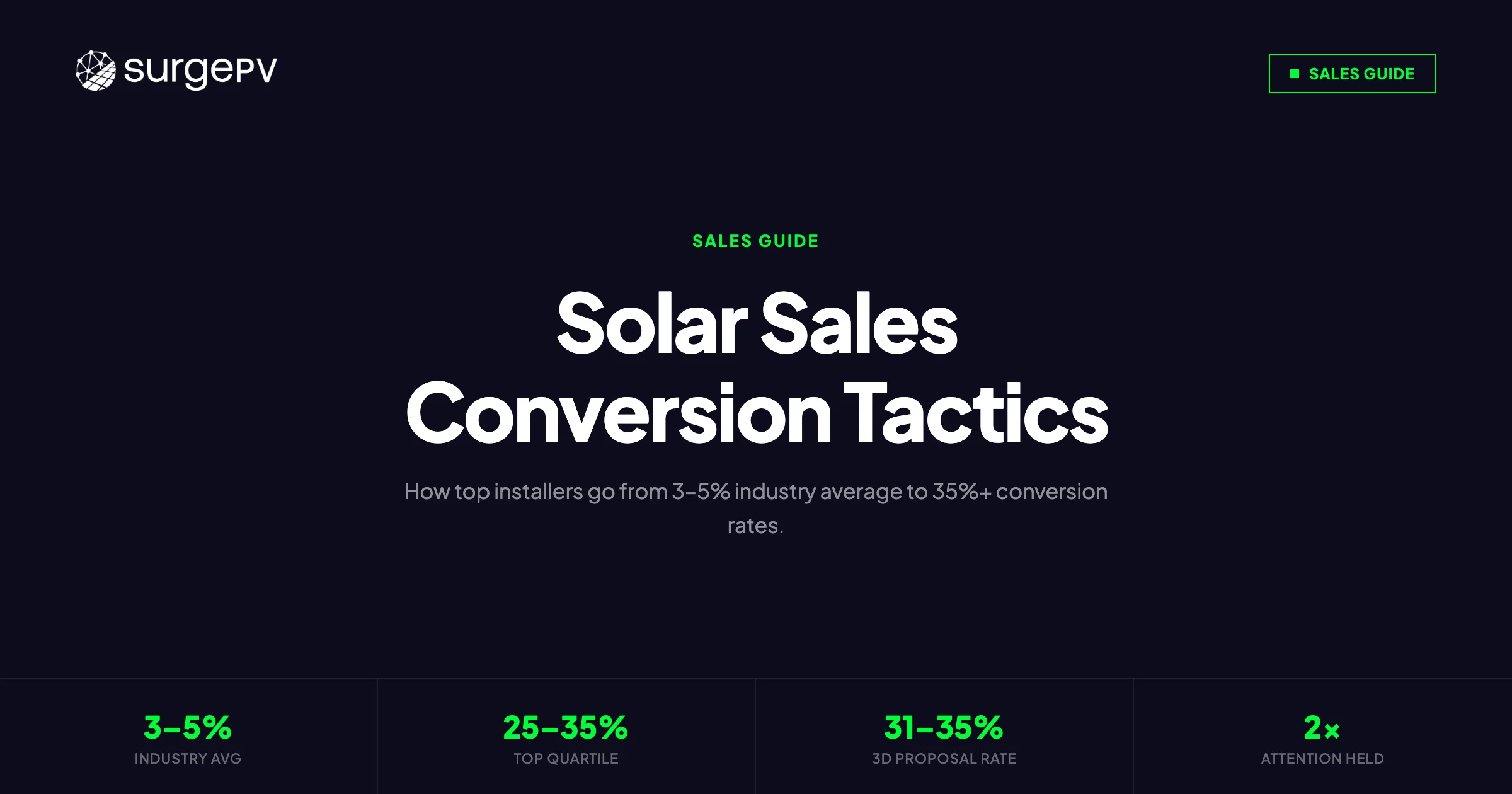
The average solar sales team closes somewhere between 3% and 5% of the leads it touches. The top quartile closes 25–35%. That gap is not talent. It is not territory. It is not even product. It is process: how fast you respond, how specific your proposal feels, and how deliberately you follow up after the first conversation.
This guide covers every stage of the solar sales conversion funnel, from the moment a lead walks in to the day they sign. It draws on 2024–2026 market data from EU, Indian, and US markets, real EPC case studies, and eight years of watching what actually works on the ground. If you run a solar sales operation and want a direct, no-filler breakdown of what moves the needle, this is it.
TL;DR
The biggest drivers of solar sales conversion are: (1) proposal turnaround under 24 hours, (2) site-specific 3D designs with shading analysis, (3) a structured 14-day follow-up cadence, and (4) objection handling that leads with ROI data, not emotion. Teams that fix all four routinely double their close rate within one quarter.
What you will learn in this guide:
- How to benchmark your current conversion rate and identify where deals are leaking
- Why proposal quality has a measurable, quantifiable impact on close rates
- The exact follow-up cadence used by top-performing installers
- How to handle every common solar objection with data rather than platitudes
- Which tools and workflows compress the design-to-proposal timeline from days to hours
- How to align your sales and design teams so they are not working against each other
- The metrics you should track to measure and improve your conversion engine over time
Latest Updates: Solar Sales Conversion 2026
The solar sales market shifted meaningfully between 2024 and 2026. Buyer expectations changed, incentive structures updated, and the tooling gap between fast-moving teams and everyone else widened. Here is where things stand now.
| Topic | 2024 Status | 2026 Update |
|---|---|---|
| Average industry conversion rate | 3–5% | Still 3–5%, but top quartile now at 30–35% |
| Proposal turnaround expectation | 2–3 days | Under 24 hours now standard for competitive markets |
| 3D proposal adoption | ~40% of installers | ~65% of installers, now baseline expectation in EU |
| Battery / storage bundling | Optional add-on | Standard inclusion in US proposals; growing in EU |
| AI-assisted shading analysis | Early adoption | Mainstream in platforms like SurgePV |
| Follow-up cadence (avg touches) | 2–3 attempts | Top teams average 6–8 touches over 14 days |
| Buyer research before first call | 1–2 sources | 3–5 sources; buyers arrive more informed |
| Subsidy/incentive complexity | Moderate | High; auto-mapping now required for accuracy |
The core conversion levers have not changed. Speed, specificity, and follow-up discipline still win deals. What has changed is the bar. Buyers in 2026 have seen more solar proposals than ever, which means generic templates and slow turnarounds lose faster than they used to.
Solar Sales Conversion Rate Benchmarks
Before you can improve your conversion rate, you need an honest read of where you currently sit. Most installers track leads in a CRM but never calculate conversion at each funnel stage. Here are the benchmarks to compare against.
| Funnel Stage | Low Performer | Industry Average | Top Quartile |
|---|---|---|---|
| Lead to first appointment | 15–20% | 25–35% | 45–55% |
| First appointment to proposal sent | 40–55% | 60–70% | 80–90% |
| Proposal sent to signed contract | 8–12% | 18–25% | 35–45% |
| Overall lead-to-close | 1–2% | 3–5% | 20–30% |
| Avg days from lead to close | 60–90 | 30–45 | 14–21 |
The biggest gap between average and top performers is not at the top of the funnel. It is at the proposal-to-close stage. Most teams send decent proposals but have no structured process for what happens after. The lead sits. Follow-up is sporadic. The deal dies not because the buyer said no, but because no one was present when they were ready to say yes.
Key Takeaway
Your overall conversion rate is almost always limited by your proposal-to-close rate, not your lead volume. Doubling your leads while keeping a 10% proposal close rate produces the same result as fixing your follow-up cadence and closing 25% of the proposals you already send.
Conversion by Proposal Type
The type of proposal you send has a direct, measurable impact on your close rate. This is not theoretical. The numbers below come from 2024 market analysis across EU, US, and Indian EPCs.
| Proposal Type | Close Rate |
|---|---|
| Text-based quote (PDF with numbers only) | 8–12% |
| Flat 2D layout with basic financial summary | 19% |
| 3D roof rendering with financial projections | 27% |
| 3D + shading simulation | 31–35% |
| 3D + shading + interactive / scrollable format | 36–42% |
A well-built 3D proposal with shading simulation closes at 3–4x the rate of a text quote. For a team sending 50 proposals a month, that is the difference between 5 deals and 15–20 deals from the same lead volume.
The Solar Sales Conversion Funnel: Where Deals Actually Die
Most solar sales post-mortems focus on the lost deal. The useful question is not “why did they say no” but “at which stage did we lose momentum.” The funnel has four pressure points.
Stage 1: Lead to First Appointment
The conversion problem here is almost always response time. A 2023 study across 40 US solar companies found that responding to a web inquiry within 5 minutes made a company 9x more likely to qualify that lead compared to waiting 30 minutes. In the solar context, the buyer who fills out a quote form is comparing at least 3–5 providers. If you call back in 3 hours, you are already third or fourth in line.
What top teams do differently:
- Auto-assign new leads to a rep within 2 minutes of form submission
- Use a text-first outreach (SMS open rates run 98% versus 20% for email)
- Lead with a specific hook rather than a generic “thanks for your interest” message. Something like: “I looked at your address on satellite and your south-facing roof is ideal — can I show you a quick estimate?”
What to fix if you are losing leads here:
Set up a lead response SLA of under 5 minutes during business hours. Use a CRM with auto-routing. Track your actual response time by pulling data from your CRM and compare it to your appointment conversion rate. You will find a direct correlation.
Stage 2: First Appointment to Proposal
This stage leaks deals when the sales rep either over-promises (creates a mismatch when design delivers) or under-delivers (leaves the appointment without capturing enough information to build a compelling proposal).
The best first appointments accomplish three things:
- Capture all the inputs design needs: utility bill, roof photos or drone data, shading context, and any specific financial constraints the buyer mentioned
- Set a clear expectation for when the proposal will arrive (and then beat that deadline)
- Plant one or two anchor points the buyer will remember: “Your roof faces south-southwest, which is close to ideal. I will show you exactly what that means for your annual production in the proposal.”
When you leave the first appointment without these three things, your proposal arrives cold. The buyer has moved on mentally. Your follow-up call feels like a sales call rather than the continuation of a conversation.
Stage 3: Proposal to Signed Contract
This is where most deals die, and it is the most fixable stage. The gap between sending a proposal and getting a signature is bridged by three things: proposal quality, follow-up cadence, and objection handling. Each gets its own section below.
Stage 4: Contract to Install (and Referral)
Conversion does not end at signature. A delayed install or poor communication between contract and install erodes the referral pipeline. Top-performing teams treat the post-signature experience as a conversion problem for their next deal. They keep the customer informed at every stage, which produces the word-of-mouth that feeds the top of the funnel.
Proposal Quality: The Single Biggest Lever
Eight years in solar sales has taught me one thing above everything else: your proposal is your sales rep when you are not in the room. After the first appointment, the buyer sits down with their spouse, their parents, their business partner. They look at your proposal together. If it is a flat PDF with numbers on a white background, they will not feel what you tried to communicate in the meeting. If it shows their actual roof, their actual shading, and their actual projected savings, the proposal does the selling for you.
Pro Tip
The moment a buyer sees their actual roof in a proposal — not a generic template — the conversation shifts from “is solar worth it” to “when can you install.” Site-specificity signals that you have done your homework, which is the fastest path to trust.
What a High-Converting Solar Proposal Contains
Based on close-rate data across hundreds of EPC deals, here are the elements that correlate most strongly with conversion:
Visual components:
- Real-roof 3D rendering (satellite overlay or drone-based)
- Panel layout showing exact placement, tilt, and orientation
- Shading simulation with seasonal timestamps (summer solstice, winter solstice, equinox)
- Fire setback zones marked (especially important in EU and California)
Technical components:
- Auto-generated SLD (single-line diagram) preview
- Accurate BOM with component-level detail
- String configuration showing optimized production
Financial components:
- Monthly bill comparison (current vs projected post-solar)
- Payback period calculation (specific to the buyer’s utility tariff)
- 25-year cumulative savings projection
- Applicable subsidies and incentives (auto-mapped to location)
- ROI percentage — SurgePV’s generation and financial tool calculates this from the buyer’s actual tariff data
Trust components:
- Permit-ready indicators (shows buyer the system is compliant from day one)
- Local code adherence callouts
- References or case studies from similar roofs or neighborhoods
Teams that include all of these elements see significantly fewer revision loops. The reason: every one of these components pre-answers an objection. Shading simulation addresses “will it actually produce enough.” BOM detail addresses “are you using quality components.” Financial breakdown addresses “is this actually worth it.”
The solar proposal software category has matured significantly. Tools like SurgePV generate all of these components from a single site design session, with auto-mapped fire setbacks, tariff sync, and BOM integration. The difference between a proposal built this way and one assembled manually from spreadsheets is visible to the buyer, even if they cannot articulate why.
The 9 Proposal Elements That Consistently Boost Close Rates
Prioritized by impact on conversion, based on cross-market EPC data:
- Real-roof layout (3D or high-res 2D with satellite base) — highest single impact
- Shading simulation with timestamps
- ROI breakdown and payback timeline specific to buyer’s tariff
- Fire setback and compliance indicators
- Auto-generated SLD preview
- Integrated BOM with component detail
- Utility tariff savings projection by month
- Local subsidy and incentive breakdown
- Optimized stringing diagram
Even implementing five of these nine elements can increase close rates by 20–30% over a quarter. You do not need perfection to see results. You need enough specificity that the buyer feels you built this for them.
Regional Proposal Customization
What matters in a proposal varies by market. Getting this wrong is a common reason proposals convert well in one region and poorly in another.
EU (Germany, France, Italy, UK): Compliance is the first filter. Buyers want proof that the design adheres to national and local codes, that fire setbacks are marked, and that the feed-in tariff calculation is accurate for their specific grid connection. Auto-mapped tariffs and code-compliant setbacks are not optional in these markets.
India: Financial clarity leads. ROI visuals, subsidy inclusion (PM Surya Ghar and state-level schemes), and layouts that work well in low-bandwidth environments (compressed file sizes, print-friendly formats) matter more than visual sophistication. A proposal that loads slowly or does not show the subsidy calculation will lose to a simpler one that does.
US: Utility-specific bill offsets, battery/storage integration, and peak-hour pricing breakdowns are the conversion drivers. In California, CPUC’s NEM tariff changes have made the financial calculation more complex, which means proposals that auto-calculate net billing tariff impacts stand out sharply against manual estimates.
The solar design software you use should support regional customization at the proposal level, not just the design level.
Speed Wins: Why Turnaround Time Is a Conversion Variable
In solar sales, the warm period after a first appointment or inquiry is short. Research consistently shows that buyers who receive a proposal within 24 hours are significantly more likely to close than those who wait 3–5 days. The mechanism is simple: momentum. When the proposal arrives fast, the buyer is still in the emotional state they were in during the first conversation. When it arrives three days later, they have rationalized, gotten cold feet, or talked themselves out of it.
Key Takeaway
A 2023 survey across 40 EU-based EPCs showed a 34% higher close rate for proposals delivered within 72 hours versus those delivered in 5+ days. In India, an EPC that switched from a 3–4 day design workflow to same-day delivery saw its close rate jump from 27% to 51% in under three months.
Why Teams Are Slow (and How to Fix It)
The most common causes of slow proposal turnaround:
Design team bottleneck: Sales captures leads faster than design can build proposals. The queue backs up. By the time design delivers, the lead is cold. Fix: implement a design SLA of 24–48 hours maximum, track it weekly, and add design capacity before it becomes a bottleneck rather than after.
Information gaps: Design cannot build a proposal because sales did not capture the utility bill, roof photos, or tariff information. The proposal waits for back-and-forth clarification. Fix: use a standardized intake form that sales completes before handing off to design. No form, no handoff.
Tool friction: Design is using a combination of CAD software, spreadsheets, and manual proposal templates. Each proposal takes 4–6 hours to assemble. Fix: implement solar design software that generates the full proposal output from the site design session automatically.
Revision loops: The first draft comes back to design for corrections 2–3 times per deal. Each loop adds half a day or more. Fix: higher-quality inputs at the design stage (accurate shading data, correct tariff parameters) produce proposals that require fewer revisions.
Turnaround Benchmarks by Tool and Workflow
| Tool/Workflow | Avg Time to Proposal | Fire Compliance | BOM Export | Language Options |
|---|---|---|---|---|
| SurgePV | 30 min – 1 hr | Auto-mapped | Included | 5+ languages |
| Aurora Solar | 2–3 hrs | Manual input | Extra step | Limited EU support |
| Helioscope | 3–5 hrs | None | Manual | English only |
| PV*Sol | 4–6 hrs | Manual input | Export available | Partial |
| Manual (CAD + spreadsheet) | 1–2 days | Error-prone | Decoupled | Language gaps |
Choosing the right solar software stack is not just a technology decision. It is a revenue decision. A team that delivers proposals in 1 hour versus 2 days will close more deals from the same lead volume, with the same sales talent.
See How Fast You Can Send Your Next Proposal
SurgePV generates site-specific proposals with shading simulation, auto-BOM, and tariff-mapped financials in under 30 minutes. Book a live walkthrough on your actual project.
Book a DemoNo commitment required · 20 minutes · Live project walkthrough
Objection Handling: The Real Conversations That Kill Deals
Every solar sale hits the same five objections. The installers who close consistently are the ones who have a data-backed, non-defensive response ready for each one. Here is what actually works.
”It’s Too Expensive”
This is the most common objection and the least useful one to take at face value. “Expensive” almost always means “I do not see enough value relative to cost” rather than “I genuinely cannot afford this.”
What does not work: Defending the price, justifying the cost of components, or offering a discount before understanding the real concern.
What works: Shift the frame from upfront cost to monthly cash flow.
Walk them through this: “Your current electricity bill is [X] per month. After solar, your projected bill is [Y] per month. The difference is [Z]. If you finance the system, your monthly payment is approximately [P]. So the net monthly difference is [Z minus P] — and that number grows every year as utility rates rise, while your loan payment stays fixed.”
When the conversation is about month-one cash flow rather than total system cost, “expensive” becomes a much harder argument to sustain.
For buyers who are genuinely cost-sensitive, lead with available subsidies and financing options. In India, the PM Surya Ghar scheme covers up to 60% of benchmark cost for systems up to 2kW, and state-level subsidies add on top of that. In the EU, feed-in tariff improvements and zero-rate VAT on solar make the financials attractive even at current panel prices. In the US, the 30% federal ITC plus state-level incentives often cut the net cost nearly in half.
”I Want to Wait and See If Prices Drop”
This objection has a short answer backed by data: waiting costs money.
Electricity rates have increased an average of 4–6% annually in most developed markets over the past decade. A buyer who waits 12 months to install solar is paying 12 more months of rising utility bills. In most cases, the cost of delay (additional utility bills paid) exceeds any realistic panel price reduction they might capture.
Show them the math in the proposal: “If you install today, your payback begins in month one. If you wait 12 months, you pay an additional [X] in utility bills before your savings clock starts. Panel prices would need to drop by [Y%] to break even on that delay — and IEA data shows price declines in that range are not projected."
"I Need to Think About It”
This is almost never about needing time. It is about a specific unresolved concern. The most effective response is a direct question: “What specifically is making you hesitant? If I can address that today, would you be ready to move forward?”
Listen carefully to what comes next. In most cases, the real concern is one of the following:
- Spouse or decision-maker has not been involved
- They do not fully trust the savings projections
- A competitor gave them a lower number and they want to understand the difference
- They are worried about the install process being disruptive
Each of these has a specific fix. A vague “I’ll follow up next week” does not.
”The Savings Numbers Don’t Look Right”
This objection is a signal that your proposal is not specific enough. Generic savings projections that use average production factors rather than actual shading data for that specific roof will always look suspicious to a technically literate buyer.
The fix is in the design. When your proposal shows actual shading loss by month, actual production estimates based on that roof’s orientation and tilt, and actual tariff rates for their utility provider, the savings numbers are defensible. The buyer can see where they come from.
This is why the solar proposal software you use matters for conversion, not just for design accuracy.
”My Neighbor Had Problems With Their Install”
Social proof works in both directions. A bad experience in the neighborhood is one of the hardest objections to overcome because it is specific and emotional.
What works here: lead with empathy, not defensiveness. “That is a real concern and I am glad you brought it up. Can you tell me what went wrong for them?” Listen. Then explain specifically what your process does differently — not what “we” do in general, but the specific safeguard that addresses the issue they described.
If the neighbor had a shading problem that the installer did not model accurately: “We use site-specific shading simulation, so your production estimates account for every tree and structure around your property. That is built into your proposal — you can see it on page 3.”
If the neighbor had a permitting delay: “We submit permit applications the day after contract signing and typically receive approval in [X] days. Our permit approval rate is [Y%] on first submission.”
Specificity is what rebuilds trust after a negative social proof story.
The Follow-Up Cadence That Closes Deals
Most solar deals do not close on the first proposal delivery. The buyer needs time, sometimes to consult family, sometimes to review the numbers, sometimes just to move solar up the priority list. The difference between a 15% close rate and a 35% close rate is almost entirely what happens between proposal delivery and signature.
Top-performing teams use a 14-day structured cadence. Here is what it looks like.
14-Day Follow-Up Sequence
Day 0 (proposal delivery): Send the proposal with a personal message. Not “please find attached.” Something specific: “I built this based on what you told me about wanting to cut your summer bills — you can see on page 2 how the system performs in peak summer. Let me know if anything looks off.”
Day 1: Send a text (not email). Something short: “Did the proposal come through okay? Happy to walk you through the shading simulation if that section has questions.”
Day 3: Call. Have a specific question ready. “I wanted to check in on the proposal — did you get a chance to look at the payback timeline? I can walk you through the tariff calculation if that would help.” If no answer, leave a voicemail and follow up with a text.
Day 7: Email with value-add. Send an update that is relevant to them specifically: a state incentive deadline, a utility rate increase announcement, or a comparable install in their neighborhood. This is not a “just checking in” email. It has a reason.
Day 10: Second call attempt. If you reach them, ask directly: “I want to make sure I am being helpful rather than persistent — is there something specific holding up the decision? I am happy to walk through anything in the proposal or adjust something if the numbers do not look right.”
Day 14: Final prompt. “I want to give you one last nudge before I close out this project slot. I have a crew available in [specific week] — if you want to move forward, that timing works well. If not, I completely understand and would be glad to reconnect when the timing is better.”
After day 14, move to a low-frequency nurture sequence: one touchpoint per month with relevant news or a utility rate update. Some solar buyers take 3–6 months to decide. The team that stays present without being annoying is often the one that gets the call.
Pro Tip
Track your follow-up attempts in your CRM against close rate by attempt number. Most teams discover that deals close most often on touchpoints 3 and 5, not on the first or second follow-up. This data alone often justifies extending the cadence beyond the typical 2–3 attempts most teams stop at.
How Many Touchpoints Before You Stop?
The data says more than most teams attempt. Salesforce research consistently shows that 80% of sales require five or more follow-up attempts, yet 44% of sales reps give up after one. In solar specifically, the purchase is large and the decision timeline is long. Six to eight touches over 14 days is not harassment — it is professional persistence.
The key is making each touch specific and valuable, not a repeat of the same “just checking in” message. Every outreach should give the buyer a reason to re-engage, not just a reminder that you exist.
Aligning Sales and Design: Why Internal Silos Kill Conversion
Even with the best tools and the most polished proposals, solar sales conversion breaks down when the sales team and the design team are not synchronized. This is one of the most common conversion killers that teams overlook because it does not show up clearly in any single deal.
The symptoms of a sales-design misalignment problem:
- Proposals take 3+ days because design is waiting on information from sales
- Sales reps promise specific system sizes or savings numbers that design cannot support
- Design builds proposals that do not address the specific concerns the buyer raised in the first appointment
- Revision loops run 2–3 rounds per deal because the first draft misses the mark
- Sales reps do not know what design needs, so intake is inconsistent
The fix is not complex, but it requires intentional process change.
Six Internal Workflows That Close the Gap
1. Standardized intake form. Sales completes a structured form before any handoff to design. The form captures: utility bill copy, roof photos (drone or satellite), utility provider and tariff, shading notes, buyer’s primary concern (financial ROI, environmental, energy independence), and any specific objections raised in the first appointment. No form, no design ticket.
2. Shared proposal folder. A shared folder (Google Drive, SharePoint, or inside your solar design software) where design stores all versions of the proposal and sales can see the latest draft at any time. No more “can you resend the proposal” emails.
3. Design SLA. A defined turnaround time (24–48 hours for standard residential, 48–72 for commercial or complex roofs) that design commits to and sales plans around. Track actual turnaround weekly. Address outliers in the weekly sync.
4. Design review loop before client delivery. The sales rep reviews the proposal before it goes to the client — not for technical correctness (that is design’s job) but for alignment with the conversation. “Does this proposal address the concern they raised about winter production? Did we include the subsidy they asked about?” This loop catches mismatches before the client sees them.
5. Common tool stack. When sales and design use the same solar software, both teams can see the design, pull up the proposal, and discuss changes in real time. The fastest-closing teams often have the sales rep and a designer on a call together with the client, building live adjustments as the conversation happens.
6. Shared success metric. Design teams are often measured on output volume (proposals per week) rather than downstream outcomes (close rate, revision loops per deal). Shift at least one metric that design owns to be conversion-adjacent. “Proposals with zero revision requests” or “proposals closed within 14 days” gives design a stake in sales outcomes.
Key Takeaway
The fastest-closing EPCs in every market have one thing in common: sales and design operate as one team, not two. When a sales rep can sit with a designer and build a live proposal during the first appointment, close rates jump significantly. The buyer sees their proposal take shape in real time, which creates a level of trust that no after-the-fact document can replicate.
Tools and Software: What High-Converting Teams Actually Use
The tooling conversation in solar sales is often framed as “which design software is best.” The more useful question is “which software produces the fastest, most accurate proposals with the fewest manual steps.” Conversion depends on speed and accuracy more than on any specific feature.
What the Tool Stack Needs to Do
For a solar sales team that wants to improve conversion, the design-to-proposal workflow needs to accomplish these things without manual intervention:
- Generate a 3D site model from satellite imagery or drone data
- Run shading simulation across seasonal timestamps
- Auto-map fire setback zones for the relevant jurisdiction
- Calculate production estimates based on actual orientation, tilt, and shading loss
- Pull in current utility tariff data for the buyer’s provider
- Generate a financial summary (monthly bill comparison, payback period, 25-year savings)
- Produce a BOM with component-level detail
- Export a client-facing proposal document in the preferred format
When any of these steps requires manual input or a separate tool, the workflow slows down and introduces errors. Both of those outcomes hurt conversion.
SurgePV’s Design-to-Proposal Engine
SurgePV handles the full workflow in one platform. The design session generates the shading simulation, the BOM, and the financial projections simultaneously. The proposal output includes all of the visual and technical components that correlate with higher close rates, and it is generated in under 30 minutes for a standard residential install.
The features that matter most for conversion:
- Real-time shading analysis: Buyers who see actual shading data for their specific roof cannot use “but what if there’s shade” as an objection, because the answer is already in the proposal.
- Auto-mapped fire setbacks: Removes the compliance question before it is asked.
- Tariff sync: Proposals reflect current utility rates rather than last quarter’s estimates.
- BOM integration: Every component is specified, which closes the “what equipment are you using” loop.
- Multi-language output: For teams operating across markets, proposals in the buyer’s language close faster.
This is what solar design software looks like when it is built around sales outcomes rather than just engineering outputs.
CRM Integration for Follow-Up
The follow-up cadence described above only works if it is tracked. A CRM that integrates with your proposal tool gives you the data to run the cadence without relying on individual reps to remember who needs a touchpoint today.
Useful CRM setups for solar teams:
- Proposal delivery triggers an automatic 14-day follow-up sequence
- Each touchpoint is logged with outcome (answered, voicemail, no response)
- Close rate is tracked by proposal type, rep, and turnaround time
- Deals stalled at 7+ days without a touchpoint surface in a daily dashboard
HubSpot, Zoho CRM, and Salesforce all support this configuration. The specific CRM matters less than whether you use it consistently.
Measuring What Matters: The Metrics That Reveal Your Conversion Problem
If you track only one number (total leads and total closed deals), you cannot diagnose where the funnel is leaking. High-converting teams track stage-by-stage conversion weekly. Here is the full metric set.
Core Conversion Metrics
| Metric | How to Calculate | Target |
|---|---|---|
| Lead-to-appointment rate | Appointments booked / total leads | 30–40% |
| Appointment-to-proposal rate | Proposals sent / appointments held | 70–85% |
| Proposal-to-close rate | Contracts signed / proposals sent | 25–35% |
| Overall conversion rate | Contracts signed / total leads | 8–15% |
| Avg time to proposal | Days from appointment to proposal delivery | Under 1 day |
| Proposal revision rate | Proposals requiring revisions / total proposals | Under 10% |
| Follow-up touches to close | Avg number of touchpoints before signature | 4–6 |
| Deal velocity | Days from first contact to signed contract | Under 21 days |
Before and After: Smart Design Impact
| Metric | Before Smart Design | After Smart Design |
|---|---|---|
| Avg time to proposal | 3.5 days | Under 1 hour |
| Revision loops per deal | 2–3 | 0–1 |
| Proposal close rate | 18–24% | 33–38% |
| Time spent per deal (sales) | 6.5 hrs | 3.2 hrs |
| Proposal abandon rate | 28–31% | 9–11% |
Monthly Design Loss Reviews
Once a month, pull every deal lost after proposal delivery and look for patterns. Was the shading simulation missing? Did the savings numbers look off? Did the proposal arrive late? Did follow-up stop after the first attempt?
This review is not about blame. It is about system improvement. The patterns you find in 10 lost deals will tell you more about your conversion problem than any theory.
Track the outcome of each loss review: what changed in the process, and did the change produce a measurable shift in the next month’s close rate. Over time, this iterative loop compounds into a significantly better conversion engine.
Pro Tip
Add a UTM parameter to every proposal link you send. When buyers open the proposal, you see the timestamp. If they open it 3 times in the first 24 hours, call immediately — they are active. If they open it once at day 5, they need a re-engagement touchpoint. Proposal engagement data is one of the most underused signals in solar sales.
Regional Deep Dive: Conversion Tactics by Market
The fundamentals of solar sales conversion are universal. The execution is regional. Here is what moves the needle in each major market.
India: Speed and Financial Clarity Win
The Indian residential and C&I solar market is growing fast, with over 10 GW of residential capacity added in 2024 alone. Competition among installers is increasing in Tier 1 cities, which means conversion has become a real differentiator.
What works:
- Proposals that include the PM Surya Ghar subsidy calculation prominently, often on the first page
- Financial summaries that show the net-of-subsidy cost and the post-EMI monthly savings simultaneously
- Fast proposal turnaround (under 24 hours is competitive; same-day is a significant differentiator)
- Print-friendly formats that work in low-connectivity environments
- ROI timelines that account for state-level net metering policies, which vary significantly by DISCOM
What does not work:
- Heavy 3D visuals that require high-bandwidth connections to load
- Generic savings projections that do not account for state-specific tariff structures
- Proposals that omit the subsidy or bury it in an appendix
An EPC based in Pune that moved from a Helioscope-plus-manual-spreadsheet workflow to a unified platform saw its close rate jump from 27% to 51% in under three months. The primary change was not the proposal quality — it was the turnaround time. Proposals that previously took 3–4 days now went out the same day.
EU: Compliance and Feed-In Accuracy Are Table Stakes
The EU solar market — particularly Germany, France, Italy, Netherlands, and UK — operates in a compliance-first environment. Buyers in these markets, particularly commercial, have seen enough solar installations to know what a good proposal looks like. A generic design will not survive a comparison against a compliant, site-specific proposal from a well-equipped competitor.
What works:
- Fire setback zones marked in the design (required in many EU jurisdictions)
- Feed-in tariff projections that are accurate to the buyer’s specific grid connection and metering arrangement
- Compliance callouts (“this design meets local setback requirements”)
- Language-matched proposals (German buyers close faster on proposals in German)
- Energy independence framing for buyers concerned about utility price volatility
What does not work:
- Proposals that estimate feed-in rates rather than calculating from actual tariff data
- Designs that do not mark fire pathways (raises immediate compliance concern)
- English-only proposals sent to non-English markets
US: Storage, Utility Specificity, and Speed
The US residential solar market has been reshaped by NEM tariff changes, rising electricity rates, and the growing role of battery storage. The buyers who are actively shopping for solar in 2026 are more informed than they were in 2022, which means proposals need to be more specific, not more persuasive.
What works:
- Utility-specific bill offset calculations (not generic “save up to X%”)
- Battery storage scenarios included alongside solar-only (especially in California, Texas, Florida)
- Peak-hour pricing breakdowns that show the value of time-of-use optimization
- Fast turnaround — US buyers get multiple quotes and often go with whoever responds fastest and most specifically
- Federal ITC (30%) and available state incentives calculated into the proposal financial summary
What does not work:
- Proposals that do not account for NEM 3.0 bill credit export rates (California)
- Battery storage omitted from proposals for markets where grid reliability concerns are high
- Generic savings projections that use national average electricity rates rather than the buyer’s actual utility rate
Referrals: The Underbuilt Conversion Channel
Every signed contract is a potential referral source. The referral channel is consistently the highest-converting lead source in solar (conversion rates of 40–60% versus 3–5% for cold leads), yet most installers treat it as an afterthought.
A referral program does not need to be complex. The highest-performing version is: tell every customer, at or shortly after install completion, exactly what to do to send you a referral and what they will receive for doing it. Be specific. “If you refer a neighbor who installs, you receive [X — bill credit, gift card, check]” is more effective than “we love referrals.”
The timing matters. The peak moment for a referral request is 2–4 weeks after install, when the customer has seen their first lower utility bill or received the first export credit. They are at their maximum satisfaction point. That is when you ask.
Pro Tip
Add a referral prompt to your post-install follow-up sequence in the CRM. Set it to trigger at 21 days after the install completion date. Include the customer’s name, the system size, and a note about their first projected bill. When you make it personal and timely, referral conversion rates improve significantly versus a generic “tell your friends” message.
Building a High-Conversion Sales Culture
Process and tools account for most of the conversion gap between average and top-performing teams. But the culture around sales — how reps are coached, how losses are reviewed, how wins are celebrated — also plays a role.
Weekly Pipeline Reviews That Actually Help
A useful pipeline review is not a status update. It is a diagnostic session. Go deal by deal through anything stuck in the proposal-to-close stage. Ask: what is the specific sticking point? What has been tried? What is the next specific action, and who owns it by when?
This format takes 30–45 minutes for a team of 4–6 reps and produces more conversion lift than a two-hour all-hands sales training.
Coaching on Objection Handling
The objection handling section earlier in this guide covers the five most common objections with specific responses. The way to make those responses work for your team is repetition — actual role-play, not lecture. Have reps practice the “it’s too expensive” response until it is second nature. Then track whether the “wait and see” objection is handled differently after coaching.
Celebrating the Right Wins
Most sales teams celebrate closed deals. The highest-converting teams also celebrate deal velocity (who closed the fastest), proposal quality (whose proposal required zero revisions), and follow-up discipline (who completed the full 14-day cadence). When you celebrate the behaviors that lead to conversion, not just the outcome, you reinforce the process.
Conclusion
Solar sales conversion comes down to three things: how fast you show up with something specific, how well your proposal answers objections before they are raised, and how consistently you follow up after delivery.
The installers hitting 30–35% close rates are not doing something magical. They are using solar design software that generates accurate, site-specific proposals in under an hour. They follow a structured 14-day cadence that most of their competitors stop after two touches. They have their sales and design teams working from the same intake process, the same tool, and the same success metric.
The gap between your current conversion rate and what is possible is almost entirely a process gap. The good news: process gaps are fixable, usually within one quarter of consistent execution.
Three actions to take this week:
- Calculate your actual proposal-to-close rate for the last 90 days. Compare it to the benchmarks in this guide and identify the stage where you are losing the most deals.
- Implement a 14-day follow-up sequence in your CRM for every proposal sent, starting with the next proposal you send out.
- Run a design loss review on the last five deals you lost after proposal delivery. Find the pattern.
Frequently Asked Questions
What is a good solar sales conversion rate?
The industry average sits between 3–5% of total leads. High-performing installers consistently hit 25–35% by combining fast proposal turnaround (under 24 hours), site-specific 3D designs, and structured follow-up sequences. The gap between average and top-quartile teams is almost entirely explained by process, not product.
How much does proposal quality affect solar close rates?
Significantly. Teams using 3D roof visuals with shading simulation close at 31–35% versus 19% for flat 2D layouts, based on 2024 market data across EU, India, and US markets. Interactive proposals hold buyer attention 2x longer than static PDFs, which directly correlates with higher conversion.
What is the ideal solar sales follow-up cadence?
Research shows the optimal cadence is: same-day proposal delivery, a check-in call at day 3, a value-add email at day 7 (send updated savings projection or a relevant incentive update), a final decision prompt at day 14. After 30 days with no response, move to a low-frequency nurture sequence. Most solar deals close within the first two weeks or not at all.
Which solar proposal tools help improve conversion?
Platforms like SurgePV generate site-specific proposals in under 30 minutes with auto-mapped fire setbacks, tariff sync, BOM integration, and shading simulation. These features address the top buyer objections before they are raised, which shortens the sales cycle and reduces revision loops.
How do you handle the “solar is too expensive” objection?
Stop talking about cost and start talking about the first bill after install. Walk the buyer through their current monthly bill versus projected post-solar bill, the payback period (typically 6–9 years in India, 7–10 in Europe, 5–8 in the US with incentives), and the 25-year savings figure. When buyers see the ROI in their own numbers, price becomes context rather than barrier.