
The difference between a solar rep who closes 12% of appointments and one who closes 28% is not product knowledge, pricing, or territory. Analysis of recorded solar sales calls consistently shows the gap comes down to one thing: what happens in the 30 seconds after the prospect says “it’s too expensive” — or “I need to think about it” — or “I just don’t trust solar companies.”
Every objection has a psychology behind it. Every psychology has a rebuttal. And every rebuttal, practiced enough times, becomes instinct. This guide gives you 15 of the most common solar sales objections encountered in residential and commercial settings in 2026, the cognitive reason each one arises, and word-for-word scripts you can use today. Whether you are a solar sales professional running in-home consultations, a door-to-door rep, or a commercial account manager closing six-figure deals, these frameworks apply.
TL;DR — What This Guide Covers
15 core solar objections grouped by category — cost, trust, timing, fit, and process — with word-for-word rebuttal scripts for each. Includes commercial-specific objections, a proposal strategy that prevents objections before they arise, and a team training framework for systematic improvement. Estimated read time: 20 minutes.
What you will learn:
- The psychology behind each objection (it is rarely about what the prospect says)
- Word-for-word rebuttal scripts for all 15 objections — residential and commercial
- How to handle “I need to think about it,” “what if I move,” and “my neighbor had problems”
- Why a professional visual proposal eliminates the top four objections before you speak
- A team training and objection-tracking framework that compounds over time
Why Solar Objections Happen
Before a single rebuttal script, you need to understand one foundational truth: most solar objections are not really about solar.
When a prospect says “it’s too expensive,” they are almost never doing a rational cost comparison. They are reacting to a large number without a reference frame. When they say “I need to think about it,” they are usually telling you that something in the presentation did not land clearly. When they say “I don’t trust solar companies,” they are expressing a general anxiety about a big, unfamiliar decision with a contractor they just met.
Objections are almost always one of three things:
- An information gap — the prospect does not have enough data to feel confident making a decision
- A trust gap — the prospect is not yet sure you or your company are the right choice
- A timing gap — the prospect is not emotionally ready, even if the financial case is clear
Understanding which gap you are dealing with changes everything about how you respond. An information gap needs data. A trust gap needs social proof and transparency. A timing gap needs urgency and a clear cost of waiting.
The reps who handle objections poorly treat them all as arguments to win. The reps who handle them well treat them as signals about what the prospect still needs in order to say yes. Your job is to remove the specific barrier blocking a decision the prospect often already wants to make.
Pro Tip: Validate Before You Reframe
Every rebuttal should begin with validation, not counter-argument. “That’s a fair concern” or “I hear that a lot, and it makes sense” signals that you are not threatened by the objection. It builds rapport and creates space for your reframe to land. Reps who skip validation sound defensive. Reps who validate sound confident.
The 5 Categories of Solar Objections
Solar objections cluster into five categories. Knowing the category tells you the emotional register the prospect is operating in — and that determines which type of rebuttal will work.
| Category | Core Emotion | Example Objections | Best Rebuttal Approach |
|---|---|---|---|
| Cost | Financial anxiety | ”It’s too expensive,” “I can’t afford it” | Monthly cash flow reframe, incentive stack |
| Timing | Indecision / FOMO | ”I’ll wait for prices to drop,” “I need to think about it” | Cost of delay, incentive urgency |
| Fit | Practical concern | ”My roof isn’t suitable,” “What if I move?” | Technical education, home value data |
| Trust | Skepticism / past experience | ”I don’t trust solar companies,” “My neighbor had problems” | Transparency, third-party validation |
| Process | Overwhelm / uncertainty | ”I don’t want to deal with maintenance,” “What about cloudy days?” | Simplicity, data-driven reassurance |
Commercial objections form a sixth category with their own dynamics — covered separately in the commercial section below.
Most prospects raise objections from multiple categories during a single presentation. Identify the primary category and address it first. Secondary objections often resolve themselves once the core barrier is removed.
Objection 1: “It’s Too Expensive”
Why They Really Say It
The cost objection is almost never a genuine affordability problem — it is a framing problem. The prospect hears “$22,000” and their brain anchors on a large number without a reference point. No context, no comparison, just a big number that triggers an instinctive “no.”
The underlying cause is almost always a presentation sequence error: the rep disclosed total system cost before establishing the monthly cash flow comparison. Fix the sequence, and the objection becomes rare.
The Core Strategy: Monthly Cash Flow Reframe
Stop selling the system. Sell the payment. A prospect who pays $185/month to the utility and can get solar for $145/month is cash flow positive from day one. That is not expensive — that is an immediate gain. The cost objection only exists when you have not made that comparison concrete.
Word-for-Word Rebuttal Scripts
Script A — The Monthly Comparison (best for in-home consultations)
“I totally hear you — $22,000 sounds like a lot. Can I show you something that reframes that? Right now you’re paying [utility bill] every month to the utility company, and that bill goes up 3–4% every year. With solar at this system size, your estimated monthly payment would be around [X]. So instead of paying [utility amount] to a company you own nothing from, you’d pay [solar amount] to actually own your power. Which of those two sounds more expensive over 25 years?”
Script B — The Investment Reframe (for ROI-minded prospects)
“Let’s look at it as an investment. If I told you there was an investment that paid a 10–12% annual return, tax-free, with a 25-year performance guarantee — would you call that expensive? That’s exactly what this system does on your roof. The upfront cost is the entry price to that return.”
Script C — The Incentive Stack (for prospects unaware of tax credits)
“Before we talk about total cost, let me show you what this actually costs after incentives. The federal tax credit alone takes 30% off the top. After that, your state has [state incentive]. The net cost on this system comes down to [net amount]. And with zero-down financing at [X]%, your out-of-pocket today is zero. Does [net monthly payment] sound more manageable?”
Script D — The “Compared to What?” Close
“Expensive compared to what, exactly? The utility bill you’ll pay every month for the next 25 years? That bill is going up. Solar locks in your energy cost today. Let me put together the exact numbers for your home so we’re comparing apples to apples.”
Pro Tip: Show the 25-Year Utility Bill
Pull up the prospect’s average monthly bill. Multiply it by 12, then by 25, then apply a 3.5% annual increase. Show them the total they will pay the utility over 25 years — often $65,000–$95,000. Next to that number, the solar system cost looks like an obvious choice. SurgePV’s generation and financial tool generates this comparison automatically in seconds.
Preventing the Cost Objection
The best version of this rebuttal is the one you never have to give. When you lead every presentation with a personalized monthly comparison rather than a total system price, the cost objection drops dramatically. The solar design software built into SurgePV generates a side-by-side monthly utility-versus-solar payment comparison automatically for every prospect — so reps never calculate on the fly under pressure.
Objection 2: “I’ll Wait Until Prices Drop Further”
Why They Really Say It
This objection is driven by the same cognitive pattern as waiting for a better time to buy a house: prices might be lower later, so why commit now? The flaw in that logic for solar is that the financial case is not driven by equipment price alone — it is driven by equipment cost, incentive availability, utility rates, and time in the market. All of those factors point strongly toward acting sooner.
Word-for-Word Rebuttal Scripts
Script A — The Incentive Cliff
“That’s a logical way to think about it. But here’s what surprises most people: solar economics are driven as much by incentives as by panel prices. The federal Investment Tax Credit has already been politically contested, and net metering terms are being revised in multiple states right now — often unfavorably for future installs. Panel prices have dropped 80%+ since 2010. The next big drops are incremental. The incentive environment is what’s not guaranteed to hold.”
Script B — The Opportunity Cost Math
“Let’s say you wait 18 months for prices to drop another 5%. In those 18 months, you’ll pay roughly [monthly bill × 18] to the utility. That money is gone. If a 5% improvement in equipment cost saves you $1,000 on the system but costs you $3,000 in utility payments, waiting costs you $2,000 net. Does that math make sense to run?”
Script C — The Rate Escalator
“Utility rates have risen an average of 3–4% annually for decades. Every month you wait, your energy cost goes up slightly. The system we’d install today captures your savings at today’s rate. The system you install in 18 months captures savings at a higher rate — but you’ve paid 18 months of bills you didn’t have to. Time in the market beats timing the market, even in solar.”
Key Takeaway
The “wait for prices to drop” objection treats solar as a consumer electronics purchase. Rebut it by shifting the frame to financial investment: the cost of waiting is not zero. Every month of delay is a month of utility payments that solar would have eliminated.
Objection 3: “I’m Not Sure My Roof Is Suitable”
Why They Really Say It
This is a genuine practical concern that often masks a deeper fear: the prospect has heard horror stories about installers who damaged roofs or installed systems that underperformed. The roof suitability question is often a proxy for “can I trust this process?”
Word-for-Word Rebuttal Scripts
Script A — The Free Assessment Offer
“That’s exactly the right question to ask, and I appreciate that you’re thinking about it. Here’s what I’d suggest: let me schedule a site assessment for your roof at no cost and no obligation. Our team will check orientation, pitch, structural integrity, and shading. If your roof isn’t a good candidate, I’ll tell you straight up — I’d rather lose a deal than put you in a situation that doesn’t work. If it is a good candidate, you’ll have the data to make a confident decision.”
Script B — The Design Preview
“I can actually pull up your roof right now using satellite imagery and show you, roughly, how a system would be designed for your specific layout. You can see the panel placement, the estimated production, and whether there are any shading issues — before we even talk numbers. Would that help?”
This is where solar design software makes a direct difference in the sales conversation. Being able to show a prospect their own roof with panels placed on it — in real time — eliminates the suitability objection on the spot.
Script C — The Technical Reassurance
“Great question — and the good news is that most modern roofs work well for solar. What we look at is: Is the roof facing roughly south, east, or west? Is there significant shading from trees or structures? And is the roof in reasonable structural condition? Most homes pass on at least two of those three. The ones that don’t, I tell you upfront. Let me take a look and we’ll know in minutes.”
Pro Tip: Show the Design, Don’t Just Describe It
Prospects who can see their actual roof in a proposal — not a generic graphic — convert at higher rates. SurgePV’s solar proposal software pulls satellite imagery, applies shading analysis, and places panels on the specific roof layout. Show it at the appointment and the suitability objection becomes a conversation, not a barrier.
Objection 4: “What If I Move?”
Why They Really Say It
This is a future-planning objection. The prospect is thinking responsibly about a major home decision: what happens to this investment if their life circumstances change? It is a legitimate question that deserves a direct, data-backed answer.
Word-for-Word Rebuttal Scripts
Script A — The Home Value Angle
“Great question — and the data here is actually really encouraging. Multiple studies, including research from Lawrence Berkeley National Laboratory, show that homes with solar sell for a premium over comparable non-solar homes. The figure they found was roughly $4 per watt of installed capacity — on a 7 kW system, that’s about $28,000 in added home value. In most markets, the equity gain offsets the system cost entirely. So if you sell, you’re not leaving money on the table — you’re capturing it.”
Script B — The Lease Transfer
“If you financed with a loan, the system is yours to sell with the home — and buyers actually like solar because it means lower utility bills from day one. If you’re concerned about timing, we also have options to transfer financing to the new buyer or pay off the system at closing from the sale proceeds. We’ve helped dozens of homeowners navigate this exactly.”
Script C — The Break-Even Reality Check
“Let’s talk about timeline. Where are you planning to be in the next five years? [Listen.] Even if you sell in five years, you’ll have collected five years of utility savings, potentially $8,000–$15,000 depending on your system size and local rates. Plus the home equity bump we talked about. Most homeowners who do the math realize that even a short horizon makes solar a net positive.”
Objection 5: “Solar Panels Will Damage My Roof”
Why They Really Say It
This fear usually comes from a neighbor story, a news article about a bad install, or a general wariness about contractors making holes in a roof. It is a valid concern that deserves a direct technical response rather than dismissal.
Word-for-Word Rebuttal Scripts
Script A — The Installation Process Explanation
“That’s a concern I take seriously, and I want to give you a direct answer. Modern solar installations use flashings and sealants that are engineered to be watertight — the same materials used in premium roofing. All of our mounting hardware is installed into the structural rafters, not just the sheathing, so the load is distributed properly. Every penetration is sealed with a roofing-grade sealant and covered with a flashing that overlaps the shingles. Our installs carry a workmanship warranty that explicitly covers any leak that could be attributed to the solar installation.”
Script B — The Protection Angle
“Here’s something that surprises most people: solar panels actually protect the roof sections they cover. They block UV radiation, reduce thermal cycling — the expansion and contraction that causes shingles to age — and shield that area from hail and wind. Roofing contractors who work on homes with solar consistently report that the shingles under the panels are in better condition than the exposed shingles when it’s time for a re-roof.”
Script C — The Credential Reassurance
“I understand the concern — a bad installation can absolutely cause problems. That’s why contractor credentials matter so much. Our installation team is licensed and insured specifically for roofing work, and every installation goes through a post-installation inspection. I can pull up our license number and insurance certificate right now if that would give you peace of mind.”
Key Takeaway
The roof damage objection is most commonly raised when the prospect has heard a neighbor story about a bad installer. Do not argue with the story. Acknowledge that bad installs happen, then differentiate your company on credentials, warranty terms, and process — and offer to show the paperwork on the spot.
Objection 6: “I Don’t Want To Deal With Maintenance”
Why They Really Say It
This is a low-maintenance-lifestyle objection. The prospect is imagining a future of climbing on the roof to clean panels, scheduling technician visits, monitoring complex equipment, and dealing with degrading components. The reality of solar maintenance is almost nothing like that fear — but they do not know that yet.
Word-for-Word Rebuttal Scripts
Script A — The Reality Reframe
“I completely understand not wanting another home system to manage — that makes total sense. Here’s the reality with solar: there are no moving parts. No filters to change. No annual tune-ups required. Most systems run for 25+ years with essentially zero hands-on maintenance. The only thing some homeowners do occasionally is rinse the panels during a dry spell — and in most climates, rain handles that automatically. It’s genuinely one of the most maintenance-free home upgrades you can make.”
Script B — The Monitoring Reassurance
“Modern solar systems come with remote monitoring that watches your production 24/7. If anything drops below expected output, the system flags it — and your installer gets notified before you do. You don’t need to check anything. In most cases, issues are identified and resolved before the homeowner even knows there was a problem.”
Script C — The Warranty Coverage
“If something does need attention in the first 25 years, it’s almost certainly covered under warranty — the panels themselves, the inverter, and the installation workmanship. The manufacturers have strong financial incentives to honor those warranties because the industry depends on reputation. In practice, homeowners rarely pay anything out of pocket for maintenance over the lifetime of a system.”
Objection 7: “My Neighbor Had Problems With Their System”
Why They Really Say It
This is the most powerful objection in residential solar because it is grounded in social proof — and social proof runs in both directions. A neighbor with a bad experience creates a strong prior that solar is risky. Your job is to acknowledge the reality of what happened and differentiate your company without dismissing the neighbor’s experience.
Word-for-Word Rebuttal Scripts
Script A — The Acknowledge and Separate
“I’m sorry to hear that — and I want to take that seriously rather than brush it off. Do you know which company installed their system? [Listen.] The solar industry has a wide range of installer quality. Some companies have cut corners on equipment, rushed installs, and then been unavailable when problems arose. That’s real, and it’s hurt a lot of homeowners. What I can do is walk you through exactly how we’re different — our equipment specs, our installation process, our warranty terms, and our local track record — and you can judge for yourself whether our approach addresses what went wrong next door.”
Script B — The Specific Problem Probe
“Can I ask what kind of problems they had? Was it the installation, the equipment, the savings not meeting expectations, or something else? The reason I ask is that each of those has a specific cause — and usually a specific solution — and I want to make sure we’re addressing the right one rather than making generic promises.”
Knowing the specific problem lets you tailor your differentiation. A neighbor who had leaks means you lead with installation credentials and workmanship warranty. A neighbor whose savings were overpromised means you lead with realistic SurgePV-generated production estimates based on actual irradiance data.
Script C — The Third-Party Validation
“Let me show you something. [Pull up Google reviews.] These are homeowners in your area who’ve installed with us. You can read their reviews, see their names, and get a sense of what working with our team looks like. This is the transparency I want you to hold us to — not just promises, but a track record you can verify.”
Objection 8: “I Don’t Trust Solar Companies”
Why They Really Say It
This is the most emotionally loaded objection because it often comes from real experience — either personal or second-hand. The solar industry has had high-profile bankruptcies, aggressive door-to-door tactics, opaque lease agreements, and overpromised savings figures. A prospect who has internalized these stories has legitimate reasons for skepticism, and trying to talk them out of that skepticism directly will backfire.
The only move that works here is radical transparency paired with verification.
Word-for-Word Rebuttal Scripts
Script A — The Validation Strategy
“I completely understand that, and honestly, I respect the skepticism. The solar industry has had real problems — companies that overpromised savings, did sloppy installations, and then went out of business when customers needed warranty support. That’s real, and it has hurt a lot of people. Can I tell you specifically what’s different about how we operate — and then you decide whether it passes your test?”
Then lead with:
- Your company’s years in business and total local installs completed
- Google and BBB review scores with live review access
- Transparent financing with no hidden dealer fees
- Specific warranty terms: panel, inverter, and workmanship
- Equipment brand reputation and manufacturer financial standing
Script B — The Documentation Offer
“I’d rather show you than tell you. Here’s our contractor license number, our insurance certificate, and our bonding documentation. Here’s our manufacturer warranty documentation for the panels we’re proposing. And here are our Google reviews — 47 reviews, 4.8 stars, from homeowners in your city. I’ll leave you with all of this so you can verify everything independently.”
Script C — The Contract Walk-Through
“One of the biggest complaints about solar companies is contracts full of confusing terms. I’m going to walk you through every line of our agreement before we move anywhere near a signature. If anything is unclear, we stop. If anything feels off to you, we address it. I won’t ask you to sign something you don’t fully understand.”
Pro Tip: Lead with Documentation
For prospects who raise trust objections, bring your credentials proactively — contractor license, insurance certificate, warranty documentation, and manufacturer spec sheets. Handing these over before being asked signals that you have nothing to hide. Most competitors never do this. It differentiates you immediately.
Objection 9: “What About Cloudy Days / My Climate?”
Why They Really Say It
This is a genuine knowledge gap — the prospect believes solar only works in sunny climates and has concluded that their geography makes solar nonviable. The factual rebuttal here is strong, but it needs to be grounded in local data, not generic claims.
Word-for-Word Rebuttal Scripts
Script A — The Daylight vs. Sunshine Clarification
“This is one of the most common misconceptions in solar, and it’s completely understandable. Solar panels generate electricity from daylight — not just direct sunshine. Even on an overcast day, diffuse light still reaches the panels and produces power. Germany is the world’s leading solar market on a per-capita basis, and Hamburg has about the same annual sunshine hours as Seattle. What matters far more than sunshine is your local utility rate — and high-rate markets often have the fastest solar payback regardless of climate.”
Script B — The Local Production Data
“Let me pull up the actual solar production data for your specific location. [Show SurgePV irradiance map.] This is based on 20-plus years of weather station data for your exact coordinates — not a regional average. You can see what an average system produces in your area month by month, including cloudy months. For a system this size, that works out to [X] kWh annually, which offsets roughly [Y]% of your current usage. Does that look meaningful to you?”
Script C — The System Sizing Answer
“In lower-irradiance climates, we size the system slightly larger to account for cloud cover — and the economics still work because your utility rate is what drives the payback, not just the raw sunshine. We have homeowners in [cloudy local city] who’ve installed and are very happy with their savings. I can connect you with one of them if you’d like to hear it firsthand.”
Objection 10: “I Need To Think About It” (The Stall)
Why They Really Say It
“I need to think about it” is the most common soft exit in all of sales — and in solar, it almost never means the prospect is actually going to think carefully and return with a decision. More often it signals one of three things:
- They are not yet convinced the investment makes sense for their home
- They feel overwhelmed by the volume of information presented
- They want a polite exit without saying “no” outright
Your goal is not to close on the spot — it is to identify the real barrier so you can address it before the lead goes cold.
Word-for-Word Rebuttal Scripts
Script A — The Isolation Technique
“Of course — this is a significant decision and I’d never want to rush you. Can I ask: is it specifically the cost, the timing, or something about the system itself that you’d want to think through? That way I can make sure I’ve answered everything completely before I go.”
This surfaces the hidden concern. If they say “the cost,” run the monthly comparison rebuttal. If they genuinely need to loop in a partner, move to Script B.
Script B — The Co-Decision Walkthrough
“Absolutely — I’d expect nothing less for a decision this size. What works really well for couples is a quick 20-minute call with both of you, so your partner can ask any questions directly. That way you’re not playing telephone with the details. Are there any evenings this week when you’d both be available?”
Script C — The Leave-Behind Proposal
“I completely understand. Before I go, can I leave you with a full written proposal? I’ll put together your specific roof layout, the estimated production numbers, the year-by-year savings, and the financing options — so you and your partner can review it together at your own pace. That makes the conversation a lot easier than trying to remember everything from today. Sound good?”
Then send a professional visual proposal that same evening. A well-designed proposal continues selling when you are not in the room.
The 48-Hour Follow-Up Script
If a prospect leaves with “I need to think about it,” your follow-up timing determines whether you close:
“Hi [Name], this is [Your Name] from [Company]. I wanted to follow up on our conversation. I put together the full proposal for your home with the updated numbers we discussed — it actually came out better than I expected. Your first-year savings projection is [X] and the monthly payment comes to [Y], which is [Z] less than your current utility bill. Can we schedule 20 minutes to walk through it together?”
The Qualification Fix
”I need to think about it” stalls are often a symptom of a qualification failure earlier in the process. During your initial discovery call or door approach, always ask: “Are you the primary decision-maker for home improvements, or would your partner be involved in a decision like this?” If both partners need to be involved, make sure both are present at the presentation. This one question eliminates the stall objection in a significant share of deals.
Objection 11: “Solar Will Hurt My Home’s Aesthetics”
Why They Really Say It
This objection appears most often with homeowners in HOA communities, historic neighborhoods, or properties with distinctive architecture. The underlying fear is depreciation — that panels will make the home look industrial or dated and reduce buyer appeal.
Word-for-Word Rebuttal Scripts
Script A — The Design Options
“That’s a real consideration, and I take it seriously. The industry has come a long way on aesthetics. We offer all-black panel configurations that are significantly more subtle than the traditional blue-silver look. Depending on your roof, we can also discuss panel placement that minimizes street visibility while still optimizing production. Let me show you a few examples of installations on similar homes — I think you’ll be surprised.”
Script B — The HOA Research Offer
“If your HOA has restrictions, that’s worth checking — but in most states, HOAs cannot legally prohibit solar installations, only regulate their placement to be consistent with community aesthetics. Many of our installs are in HOA communities and we have a lot of experience navigating those approvals. Would it help if I pulled up your HOA’s solar policy so we know exactly what we’re working with?”
Script C — The Value Data
“On the buyer-appeal side: the research actually shows that solar increases home desirability for the buyers who care most about energy costs — which is most buyers today. Homes with solar sell faster and at a premium in most markets. If aesthetics are a concern, we can design the layout to be as discreet as possible while still delivering strong production.”
Objection 12: “I Already Got a Cheaper Quote”
Why They Really Say It
This objection is often a price-shopping signal, but it can also be a negotiating tactic. The prospect may or may not have a competing quote, and the quality of that quote varies enormously. Do not compete on price alone.
Word-for-Word Rebuttal Scripts
Script A — The Quality Comparison
“Absolutely — and I’d encourage you to compare. When you do, make sure you’re looking at the same things: panel efficiency and degradation warranty, inverter brand, workmanship warranty duration, and whether the production estimates are based on your specific roof orientation or regional averages. A proposal built on your actual data will be different from one built on assumptions. What equipment are they proposing?”
Script B — The True Cost of Cheap
“A lower price upfront can easily cost more over 25 years if the panels degrade faster or the company isn’t around to honor the warranty. The cheapest solar company in the US went bankrupt a few years ago and left tens of thousands of customers with no warranty support. What’s the warranty structure on their proposal, and how long has that company been in business?”
Script C — The Side-by-Side Offer
“I’d love to do a direct comparison. If you send me their proposal, I’ll put together a side-by-side — same system size, same production assumptions, same financing terms — so you can see exactly what’s different and make an informed decision. I’m confident in our value, but I want you to be confident too.”
Objection 13: “The Payback Period Is Too Long”
Why They Really Say It
This objection usually means the prospect has heard “7–10 year payback” somewhere and anchored on that framing — or the rep presented a payback period without the monthly cash flow context. The payback period frame is actually harmful to solar sales. It makes prospects think in terms of “when do I break even?” rather than “am I saving money starting today?”
Word-for-Word Rebuttal Scripts
Script A — The Monthly Cash Flow Reframe
“Let me reframe how we’re thinking about payback. Right now, you’re already paying for electricity — you just don’t own anything at the end of each month. With solar at this payment, you’d pay [X] instead of [Y] starting next month. That’s a positive return from the very first payment. The payback period question assumes you’d otherwise be saving that money — but you’re not. You’re spending it to the utility, and you get nothing back.”
Script B — The Rate Escalator
“Let me show you why the payback window is shorter than it sounds. Your utility rate right now is [X cents/kWh]. Historically, utility rates rise about 3–4% per year. In 10 years, your bill would be approximately [Y]. In 20 years, [Z]. Solar locks in your rate today. The longer you wait, the shorter your actual payback becomes — and you’ve already lost another month.”
Script C — The Equity Angle
“Here’s another dimension: studies consistently show that homes with solar sell for a premium over comparable non-solar homes — often 3–4% of home value. On a $400,000 home, that’s $12,000–$16,000 in added equity, which alone can exceed the net cost of the system after incentives. So even if you sell in 5 years, you come out ahead.”
Pro Tip: Use the Generation and Financial Tool
Stop quoting payback periods from memory. SurgePV’s generation and financial tool calculates year-by-year savings projections using the prospect’s actual utility rate, local irradiance data, and system degradation curves. When a prospect sees a 25-year cash flow table with positive numbers in column one, the payback objection disappears immediately.
Objection 14: “I’m Not the Owner / I Rent”
Why They Really Say It
If the prospect genuinely rents, a standard solar installation is not viable for their current home — but handle this gracefully. Renters become homeowners. Referrals are always possible. And sometimes “I rent” is used as an easy exit by a homeowner who does not want to engage.
Word-for-Word Rebuttal Scripts
Script A — The Future Homeowner Pivot
“That makes sense — solar works best for homeowners because you’re locking in your energy cost for the home you own. Are you planning to buy in the next couple of years? Many of my clients today are people I first spoke with when they were renting. I’d love to stay in touch so when the time comes, you already have someone you trust.”
Script B — The Referral Ask
“Totally understood. Do you know the homeowner personally? Sometimes landlords are actually open to solar because it increases the property value and they can use it as a selling point. It’s not for everyone, but I’ve done a number of rentals where the landlord jumped at it. Would you be willing to pass along my information?”
Script C — The Gentle Reality Check
“I appreciate you letting me know. I did want to mention — I looked up the property records for this address before knocking and it shows [Name] as the owner. Is that not accurate? I want to make sure I’m not wasting your time if the situation has changed.”
This is a polite, factual way to surface the truth without being confrontational — and it works when the “I rent” is a polite exit rather than a fact.
Objection 15: “I’ve Already Talked to Too Many Solar Companies”
Why They Really Say It
Solar fatigue is real. Homeowners in high-density solar markets get multiple calls, door knocks, and mailers per week. This objection signals exhaustion more than rejection — the prospect is not opposed to solar, they are opposed to the process of evaluating it again.
Word-for-Word Rebuttal Scripts
Script A — The Differentiation-First Approach
“I completely understand — this process gets exhausting, and I’ll keep it brief. The main thing I want to show you is something most of those companies probably didn’t bring: a design built specifically for your roof, with your actual production numbers, rather than a generic quote. It takes about 15 minutes and gives you a real baseline to compare everything else against. If you’ve already got that from someone else, I’ll leave you alone. Did any of them build a proposal with your actual roof layout?”
Script B — The Five-Minute Ask
“You’ve been through enough presentations — I’m not going to run another one. Can I ask five questions to see if there’s anything you didn’t get answered from the others? If I can’t add something new in five minutes, I’ll be on my way.”
Script C — The Closing the Loop Offer
“If you’ve had multiple proposals and haven’t been able to make a decision, that usually means something hasn’t been answered clearly enough. What’s the thing that’s still uncertain for you? Let me see if I can address just that one thing.”
Commercial-Specific Objections
Commercial solar sales operate on a different decision-making timeline, with more stakeholders, larger financial thresholds, and more complex approval processes than residential. The emotional levers are different too: commercial buyers respond to financial ROI, operational risk, and regulatory compliance rather than personal savings stories.
Here are the most common commercial solar objections and how to handle them.
”We Lease the Building — We Can’t Install”
Rebuttal:
“That’s a real constraint — and it’s more common than you’d think. There are a couple of paths worth exploring. First, is your lease long enough to justify a landlord conversation? Many landlords are open to tenant-funded solar because it increases asset value and can be structured to stay with the property. Second, have you looked at offsite solar or a community solar subscription? You get the cost savings and the ESG credit without touching the building. Would either of those directions be worth exploring?"
"The CapEx Won’t Get Board Approval”
Rebuttal:
“That’s a common constraint for capital projects. The good news is that most commercial solar today is financed as an operating expense — a PPA or a solar lease — rather than a capital expenditure. That means no CapEx approval required. Your energy bill goes from a variable OpEx cost to a fixed, predictable one at a lower rate. I can structure the proposal specifically for OpEx treatment so it doesn’t need to go through the CapEx process. Would that make the path forward easier?"
"We Need to See the Business Case First”
Rebuttal:
“Absolutely — I wouldn’t expect a decision without a solid business case. Here’s what I’ll put together: your current energy cost versus a projected solar cost over 10 and 20 years, factoring in rate escalation, the incentive impact on net cost, and simple payback plus IRR. For a building your size and usage, initial projections put the payback at roughly [X] years and IRR at [Y]%. I’ll have the full model to you within [timeframe]. Who else should be looped in on the review?"
"We’re Not Sure the Roof Can Handle the Load”
Rebuttal:
“That’s the right question to ask before anyone commits to anything. A structural assessment is a standard part of our pre-proposal process — we don’t design a system for a roof until we’ve confirmed it can handle the load. In most cases, commercial roofs are well within tolerance for a standard installation. If there’s a structural concern, we identify it in the assessment and discuss solutions — sometimes ballasted mounting systems eliminate penetration requirements entirely. Can I schedule the structural assessment? There’s no charge and no commitment."
"What About Our Backup Power During Outages?”
Rebuttal:
“This is actually a conversation more commercial customers are having now than ever, especially post-storm-related outages. Solar alone doesn’t provide backup during a grid outage — but solar paired with battery storage does. It also changes your demand charge picture significantly, which for commercial facilities is often where the biggest savings are. Let me include a battery storage scenario in the proposal so you can see both the energy cost savings and the resilience value side by side.”
Key Takeaway for Commercial Sales
Commercial decisions take longer and involve more people. Your goal at the first meeting is rarely to close — it is to earn a second meeting with the right stakeholders. Always ask: “Who else will be involved in evaluating this?” and “What does the approval process look like for a decision of this size?” Map the stakeholders before you build the proposal.
Close More Solar Deals With Proposals That Answer Every Objection
SurgePV generates professional visual proposals in minutes — complete with satellite roof imagery, panel layout, shading analysis, year-by-year savings model, and financing comparison. See exactly what top-performing installers use to pre-empt the top objections before the conversation starts.
Book a DemoNo commitment required · 20 minutes · Live project walkthrough
How SurgePV Proposals Help Close Objections
The biggest difference between average solar closers and top performers is what they walk into the appointment with. Average reps bring a generic quote and handle objections reactively. Top performers bring a personalized visual proposal that has already answered every question the prospect would have asked.
Here is how a proposal built with solar proposal software addresses the top objections before they are voiced:
The Prospect’s Actual Roof With Panels Placed On It
Not a generic graphic. Their house. Their roof pitch. Their shading analysis. When a prospect sees their own home in the proposal, the conversation shifts immediately. The suitability objection (“I’m not sure my roof qualifies”) is answered visually. The aesthetics objection (“I don’t want panels everywhere”) is addressed by the specific layout. The trust objection (“did you actually do real work on my home?”) is answered by the obvious investment of design time.
SurgePV’s solar design software generates this satellite-based roof design with shading analysis automatically, in minutes, from any address.
A Year-by-Year Financial Model, Not Just a Total
Show month one: utility bill versus solar payment. Show month 12. Show year 5, year 10, year 25. When the prospect can trace a line from today to 25 years from now and see positive numbers throughout, the payback period objection becomes irrelevant. The cost objection loses its power when the comparison is explicit.
The generation and financial tool calculates these projections using the prospect’s actual utility rate, local irradiance data, system degradation curves, and chosen financing structure — not regional averages.
Transparent Financing on One Page
Total system price, tax credit applied, net cost, monthly payment, and effective interest rate — all on one clear page with no buried terms. This is the antidote to the trust objection. Transparency is the most powerful trust-builder available in solar sales, and the proposal is where it lives.
Side-by-Side Financing Scenarios
When a prospect sees a cash purchase scenario, a solar loan scenario, and a PPA scenario on the same page — with 25-year total costs compared — the “I’ll wait and think about it” objection becomes harder to maintain. The numbers make the decision visible. For more context on structuring financing conversations, see our complete solar financing options guide.
Pro Tip: Send the Proposal Before the Appointment
Top performers send a draft proposal — or at minimum a roof design preview — before the appointment. When the prospect has seen their roof and initial production numbers before you arrive, you are walking into a closing conversation, not a cold pitch. The proposal has already done the first stage of objection handling.
Objection Tracking and Team Training Framework
Individual rebuttal skills compound over time — but only if you track which objections are killing your deals and which responses are actually working. Without data, you are guessing. With data and the right solar software, you are improving systematically.
What to Track at the Rep Level
Log every objection at the deal level in your CRM. At minimum:
- Which objection was raised
- At what stage of the process it appeared (first door knock, appointment, follow-up)
- Which rebuttal you used
- Whether the rebuttal moved the prospect forward or ended the conversation
- Final deal outcome
After 30–50 deals, patterns emerge. You might find that “I need to think about it” at the first appointment closes 38% of the time with a strong proposal follow-up, but only 9% of the time with a generic check-in message. That data tells you exactly where to invest your energy.
The Monthly Lost-Deal Audit
Once a month, pull every lost deal from the previous 30 days. For each one, answer:
- What was the primary objection?
- What did I say in response?
- What was the prospect’s reaction?
- What would I do differently now?
This is the fastest improvement loop available to a solo rep. Most reps make the same objection-handling mistakes repeatedly because they never examine lost deals in structured detail.
Team-Level Objection Library
If you manage a solar sales team, build a shared objection log. When a rep encounters an objection they struggled with, they log it with full context. A senior rep or manager contributes a tested rebuttal. Every solar sales professional on the team benefits immediately.
The best teams treat their objection scripts as living documents — updated quarterly with new scenarios, new market conditions (changing incentive structures, rising utility rates, new competitors entering the market), and newly validated rebuttals from the field.
| Objection Category | Track At | Key Metric | Improvement Lever |
|---|---|---|---|
| Cost | First appointment | % converted after monthly reframe | Lead with payment, not system price |
| Stall | Follow-up | % that close within 7 days | Same-day proposal delivery |
| Trust | All stages | % that reference third-party proof | Proactive credential sharing |
| Fit | Site assessment | % that proceed after assessment | Free assessment as first step |
| Commercial | Second meeting | % that reach full proposal stage | Stakeholder mapping at first meeting |
Role-Play as a Training System
The gap between a rep who delivers rebuttals smoothly and one who stumbles is almost entirely a function of rehearsal. Reading a script is not the same as internalizing it. Here is a structured role-play protocol used by high-performing solar teams:
- Weekly sessions: 30 minutes, every sales team meeting
- Rotating prospect role: Managers and senior reps play the toughest possible version of each objection
- Live recording: Record the role-play and review it afterward — reps almost always hear things they missed in real time
- Debrief with three questions: What landed? What sounded uncertain? What would you change?
Discomfort in training is comfort in the field. The rep who has fielded “I don’t trust solar companies” 50 times in training handles it in a live appointment without hesitation.
Pro Tip: Build a “First Day Script” for New Reps
New reps should not be improvising objection responses in their first week. Give every new hire a laminated one-page rebuttal cheat sheet — one line per objection — and require them to memorize it before their first appointment. Being prepared is not the same as being robotic. Having the right words ready means they can focus on listening rather than searching for a response.
Conclusion: Three Action Items for This Week
Handling solar objections well comes down to understanding why each one arises, having a prepared response ready before the conversation starts, and building a sales process that structurally prevents the most common objections from coming up in the first place.
The solar installers and sales teams with the highest close rates in 2026 are not better at arguing. They are better at listening, better prepared, and they walk into every appointment with a personalized proposal that has already answered most of the questions a prospect would ask.
Three things to do immediately:
-
Lead with the monthly comparison on every deal. Never open with total system cost. Always lead with the monthly utility payment versus the solar payment, side by side. This eliminates the number one objection before it is voiced — and it changes the frame for every other part of the conversation.
-
Build a personalized visual proposal for every prospect, before or during the appointment. Generic quotes invite skepticism and invite objections. Personalized proposals with actual roof layouts, real irradiance-based production data, and transparent financing terms build the trust that no rebuttal can replicate on its own. If your current process does not include this, solar proposal software that generates it automatically is the highest-leverage investment your team can make.
-
Start tracking every objection you hear, starting today. Log the objection, your response, and the outcome. After 30 deals, you will know exactly which objections are killing your close rate and which rebuttals are working in your specific market. The reps who close 25%+ are not born with a gift for persuasion — they have studied their data and iterated faster than their competition.
Frequently Asked Questions
What is the most common solar sales objection?
The most common solar sales objection is cost — specifically the perceived high upfront price. The most effective rebuttal reframes the conversation from total system cost to monthly cash flow, showing the prospect that going solar often costs less per month than their current utility bill when financed correctly.
How do you handle “I need to think about it” in solar sales?
The best rebuttal is to isolate the real objection: “I completely understand — this is a big decision. Is it the cost, the timing, or something about the system itself?” This surfaces the hidden concern. Follow up by offering a co-decision walkthrough that includes the spouse or partner, and send a professional visual proposal the same evening.
What are the best word-for-word solar rebuttal scripts?
The most effective solar rebuttal scripts validate first, then reframe. For cost: “Right now you’re paying [utility bill] every month and getting nothing back. With solar, you’d pay [solar payment] and own your power.” For payback: “You’re already paying for electricity — you just don’t own anything at the end. With solar, you’re cash flow positive from payment one.” For trust: “The solar industry has had real problems — can I tell you specifically what’s different about how we operate?”
How do you overcome the “solar panels will damage my roof” objection?
Acknowledge the concern, then reframe with technical specifics: modern solar installations use flashings and sealants warrantied against leaks, mounted into structural rafters. Solar panels actually protect the roof sections they cover by blocking UV and reducing thermal cycling — often extending the life of the shingle underneath. Always offer to show the workmanship warranty documentation on the spot.
What are common commercial solar sales objections?
The most common commercial solar objections are: “We lease the building, so we can’t install,” “The capital expenditure won’t get board approval,” “We’re not sure the roof can handle the load,” “We need to see a business case first,” and “What about our backup power during outages?” Each requires a response tailored to business decision-making context rather than personal finances.
How can solar proposals help close objections before they arise?
A professional solar proposal answers the top four objections — cost, payback, trust, and roof suitability — before the prospect voices them. When a prospect sees their actual roof with panels placed on it, a year-by-year savings model, transparent financing terms, and production estimates tied to their specific location, they have context for price. Price becomes a line item in a financial analysis they already agree with, not a sticker shock number.
What is a good close rate for solar sales?
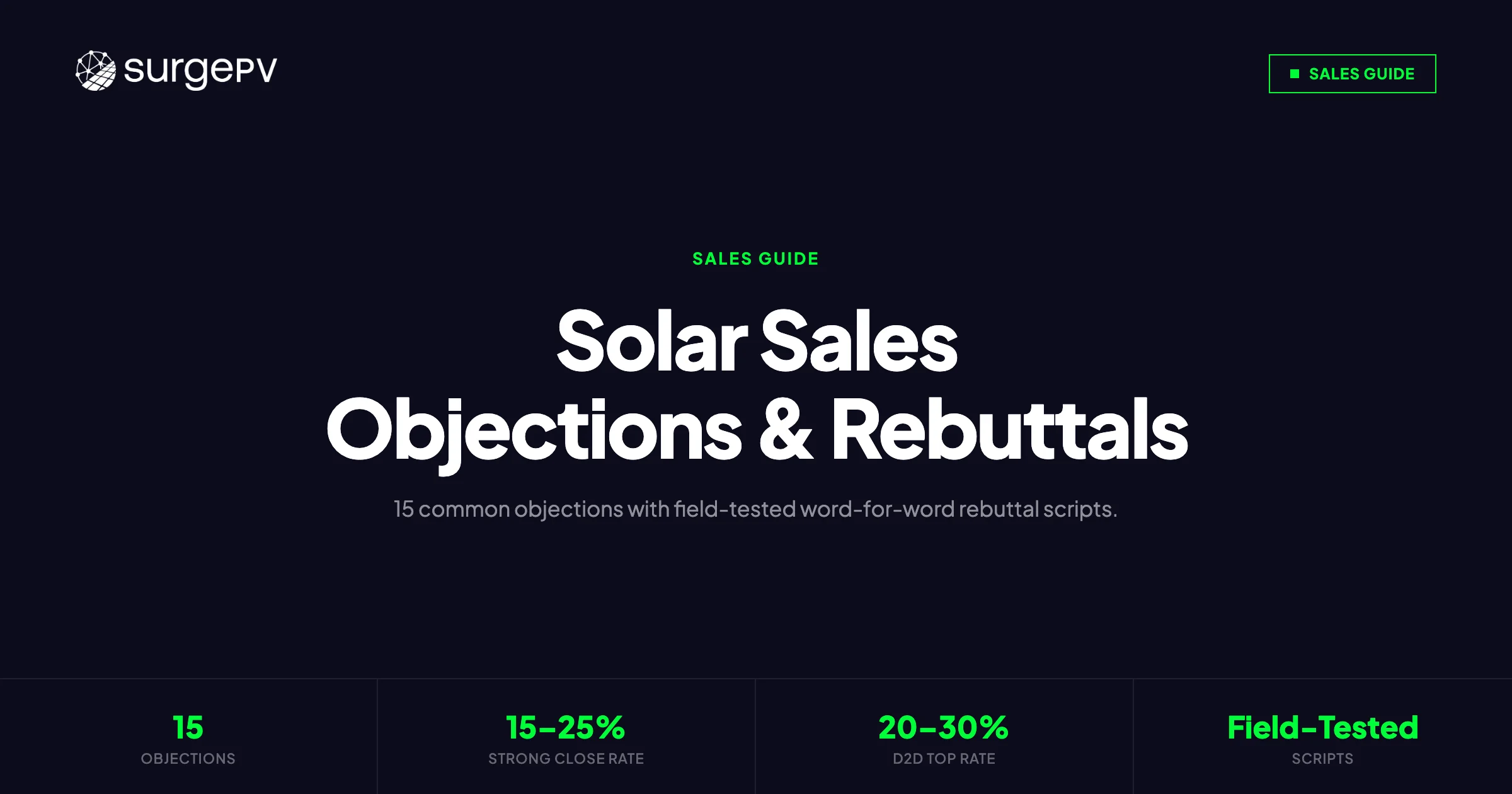
A strong residential solar close rate is 15–25% of qualified leads. Top performers in door-to-door channels close 20–30%. The biggest levers are: (1) qualifying better before pitching, (2) involving all decision-makers at the first appointment, (3) using a personalized visual proposal, and (4) having a prepared rebuttal for every common objection before the conversation starts.