

TL;DR: SurgePV is the only all-in-one platform covering Chile’s complete solar workflow — design, electrical engineering (automated SLD for SEC compliance), bankable simulation (P50/P75/P90), and proposals in one system. Aurora + AutoCAD leads in residential proposals but costs $6,800/year per user and requires tool-switching. PVCase + AutoCAD offers the deepest CAD control for large Atacama utility-scale projects. OpenSolar is the lowest-cost option for small Santiago residential installers. HelioScope suits PMGD (3–9 MW) design and simulation.
Chilean EPCs are running four tools and paying for it. Aurora or HelioScope for design. AutoCAD for SEC-compliant electrical documentation. PVsyst for bankability validation. Excel or OpenSolar for proposals.
Four tools. Four licenses. Four learning curves. And 2–3 hours wasted per project transferring data between them. That’s $20,000+ per year for a 3-person team, before counting the productivity lost to tool-switching.
Chile’s solar software market spans three fundamentally different segments. Atacama utility-scale (92.9% of capacity) needs tracker optimization and high-irradiance modeling. PMGD distributed generation (3,539 MW) requires 3–9 MW sizing and SEC interconnection documentation. Santiago net billing (383 MW) demands fast residential proposals with Net Billing Law 20,571 calculations. No single-purpose tool covers all three.
In this guide, you’ll find:
- Which platforms handle Chile’s complete workflow (design + electrical + simulation + proposals)
- How each tool covers Atacama utility-scale, PMGD, and residential segments
- Which software eliminates AutoCAD dependency for SEC compliance
- Total cost of ownership versus multi-tool workflows
- Detailed comparisons of SurgePV, Aurora Solar, PVCase, OpenSolar, and HelioScope
Quick Summary: Our Top Picks for Chile
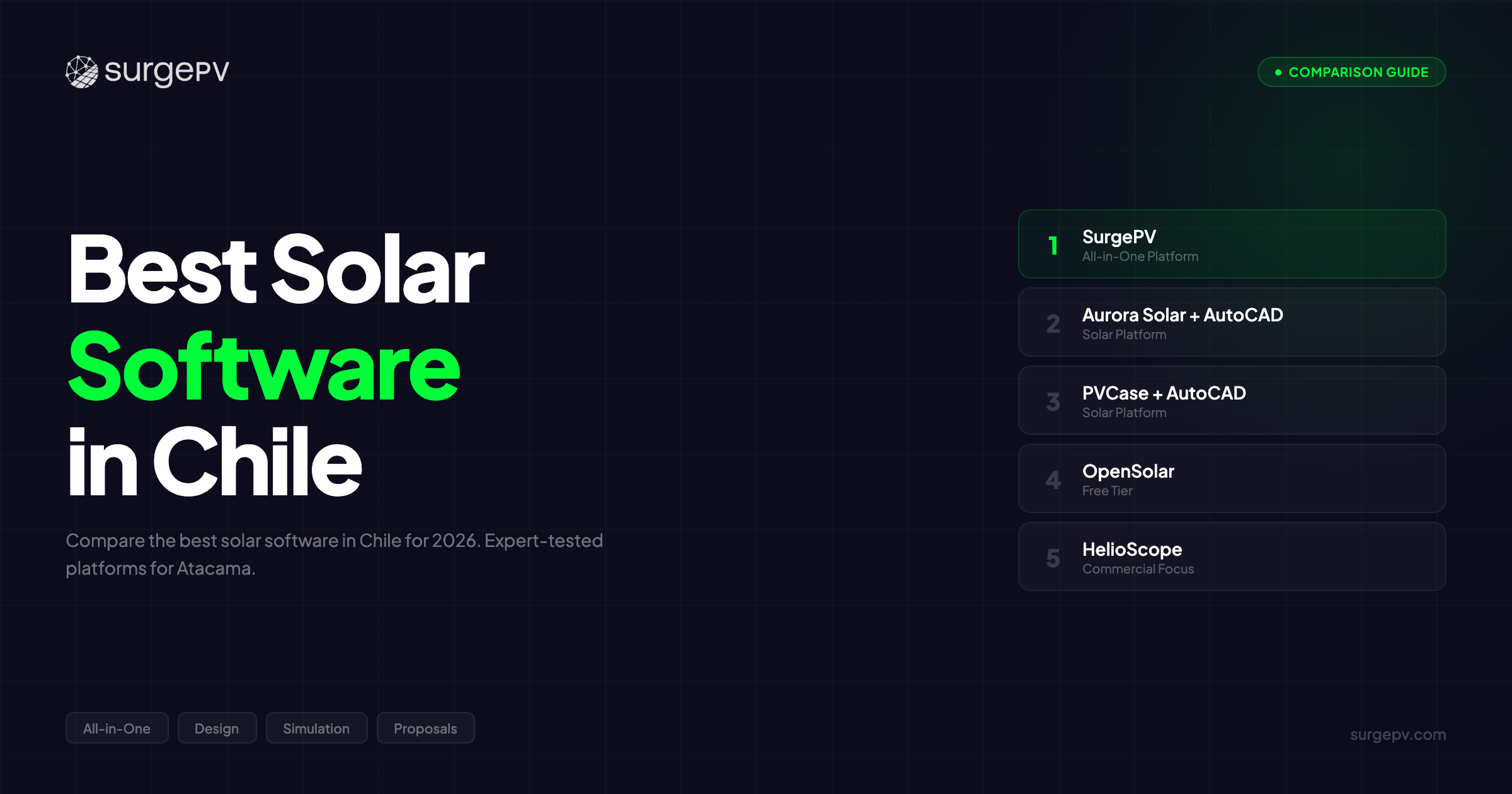
After testing 5 platforms with EPCs and installers across Chile (Atacama, Santiago, Valparaíso), here are our recommendations:
- SurgePV — Complete design, electrical engineering, simulation, and proposals (Best for EPCs and PMGD developers needing full workflow)
- Aurora Solar + AutoCAD — Residential design with separate electrical tools (Best for Santiago net billing with a dedicated electrical team)
- PVCase + AutoCAD — CAD-level utility-scale design (Best for large Atacama projects 100+ MW requiring deepest control)
- OpenSolar — Affordable residential design and proposals (Best for small Santiago installers under 20 projects/month)
- HelioScope — Cloud-based mid-tier design and simulation (Best for PMGD projects 3–9 MW)
Each tool evaluated on workflow completeness, Chilean market coverage, SEC compliance, cost, and ease of use.
Quick Comparison Table
| Software | Best For | Pricing | Chile Fit |
|---|---|---|---|
| SurgePV | Integrated platform | ~$1,899/yr (3 users) | Excellent |
| Aurora Solar + AutoCAD | Net billing residential | Contact for pricing | Good |
| PVCase + AutoCAD | Utility-scale (100+ MW) | Contact for pricing | Good |
| OpenSolar | Free tier / residential | Free tier available | Good |
| HelioScope | PMGD, C&I design | ~$2,400–4,800/yr | Good |
Best Solar Software in Chile (Detailed Reviews)
SurgePV — Best All-in-One Solar Platform for Chile
SurgePV is the only cloud-based platform combining the complete solar workflow: design, electrical engineering, simulation, and proposals in one integrated system.
For Chilean EPCs, that means handling all three market segments without tool-switching. Atacama utility-scale (92.9% of market) gets tracker design and 8760-hour shading analysis. PMGD distributed generation (3,539 MW) gets 3–9 MW financial optimization and SEC interconnection documentation. Santiago net billing gets fast residential proposals with Law 20,571 calculations. And automated SLD generation covers SEC compliance across all segments — no AutoCAD required.
Pro Tip
Ask yourself this before choosing software: “Can I complete a project from satellite imagery to SEC-ready documentation without switching tools?” If the answer is no, you’re paying for complexity. SurgePV is the only platform where the answer is yes.
Key Features for Chile
Complete Workflow (Design to Proposal)
- Design: AI-powered modeling, tracker design (single/dual-axis with 15–35% production gain), East-West racking (20–40% higher density), carport solar (Santiago commercial)
- Electrical Engineering: Automated SLD generation in 5–10 minutes, wire sizing, SEC-ready documentation adaptable to NCh Elec 4/2003
- Simulation: 8760-hour shading analysis (±3% vs PVsyst), P50/P75/P90 bankability metrics
- Proposals: Chilean tariff modeling (BT1, AT, Alta Tensión), PMGD financial optimization, web-based proposals with CLP currency
Chilean Market Coverage
Atacama utility-scale: tracker optimization for 2,500+ kWh/m² irradiance, P75/P90 for USD 600–750/kW financing. PMGD segment: 3–9 MW sizing, distributed generation pricing, SEC interconnection documentation. Net billing residential: Law 20,571 credit calculations, BT1 tariff modeling, fast proposals. Commercial solar: carport design for Santiago and Valparaíso, rooftop optimization.
Cost Efficiency
SurgePV at $1,499/user/year (3-user plan) replaces Aurora + AutoCAD at $6,800/year per user. That’s $5,301/year per user in savings — 78% cost reduction. The complete workflow runs 30–45 minutes versus 2.5–3 hours with tool-switching. For a 3-user Chilean EPC team, that’s $15,903/year saved.
Pros and Cons
Pros:
- Only all-in-one platform eliminating tool-switching (design + electrical + simulation + proposals)
- Automated SLD generation eliminates AutoCAD ($2,000/year savings + 2–3 hours/project)
- Atacama optimization with tracker design and 8760-hour shading analysis
- PMGD financial modeling for 3,539 MW distributed generation segment
- Chilean tariff modeling (BT1, AT, Alta Tensión) with CLP currency
- P50/P75/P90 bankability for utility-scale PPA financing
- Cloud collaboration for multi-market Chilean EPCs
- $5,301/year savings per user vs Aurora + AutoCAD
Cons:
- Learning curve for complete platform (2–3 weeks vs 1 week for single-purpose tools)
- Newer to Chilean market than Aurora and PVsyst (less local brand awareness)
- Not specialized for any single use case (trade-off for all-in-one capability)
Pricing
| Plan | Price | Users |
|---|---|---|
| Individual | $1,899/year | 3 users |
| For 3 Users | $1,499/user/year ($4,497/year total) | 3 users |
| For 5 Users | $1,299/user/year ($6,495/year total) | 5 users |
| Enterprise | Custom pricing | Multiple |
All features included on every plan. See full pricing.
Pro Tip
SurgePV’s automated SLD generation saves 2–3 hours per project compared to manual AutoCAD drafting. For Chile EPCs handling 10+ projects per month, that’s 20–30 hours recovered. Book a demo to see it in action.
Related Guides
Best Solar Software (2026) — Complete platform comparison | Aurora Solar Review — Full feature deep-dive
Real-World Example
A growing EPC team in Chile was spending 2.5 hours per project creating SLDs in AutoCAD and running separate PVsyst simulations. After switching to SurgePV, SLD generation dropped to under 10 minutes. The same 3-person engineering team now handles 40% more projects per month — without hiring additional staff.
Aurora Solar + AutoCAD — Established Residential, with Tool-Switching
Aurora Solar leads in residential design and polished proposals, but Chilean EPCs need AutoCAD ($2,000/year) for SEC-compliant electrical documentation. Total cost: $6,800/year per user. Good for Santiago net billing (383 MW segment) if you have a separate electrical engineering team.
Poor for Atacama utility-scale — no tracker design, no P75/P90 bankability. No PMGD-specific features.
Best For: Residential-focused Santiago installers with dedicated CAD engineers for electrical documentation.
Read our full Aurora Solar review.
Did You Know?
Chile’s solar irradiance ranges from 1,600–2,500 kWh/m²/year, making accurate simulation software essential for bankable energy yield predictions. Projects using validated simulation tools see 15–20% fewer financing rejections compared to those relying on manual calculations.
PVCase + AutoCAD — CAD-Level Utility-Scale Control
PVCase provides the deepest CAD customization for large Atacama utility-scale projects (100+ MW), used by Iberdrola and Enel. Requires AutoCAD expertise (6–8 week learning curve), desktop-only (not cloud), and no proposal features. Total cost: approximately $5,000/year plus CAD training investment.
Strong for ground-mount terrain modeling at 3,500–5,000 meter Atacama elevation. But it’s design-only — no proposals, no financial modeling, no SEC electrical documentation without additional tools.
Best For: Large utility-scale EPCs in Atacama with existing AutoCAD expertise and a separate workflow for proposals and electrical docs.
Read our full PVCase review.
OpenSolar — Budget-Friendly Residential Platform
OpenSolar at $199/month offers affordable residential design and proposals for small Santiago net billing installers handling under 20 projects per month. Fastest learning curve (1–2 weeks). Clean proposals.
No utility-scale features, no SLD generation for SEC compliance, no PMGD optimization, no tracker design. Limited to the 383 MW residential segment.
Best For: Small residential-only Santiago installers on tight budgets who don’t need engineering-grade electrical documentation.
Read our full OpenSolar review.
HelioScope — Cloud-Based PMGD Platform
HelioScope offers cloud-based design and simulation for PMGD projects (3–9 MW) and mid-tier commercial (50–500 kW). Good simulation accuracy and multi-user collaboration. No SLD generation (still need AutoCAD for SEC electrical documentation), no carport design for Santiago commercial, and limited utility-scale features. At approximately $4,788/year, you still need additional tools for electrical compliance.
Best For: PMGD developers and mid-tier commercial installers who accept separate AutoCAD for electrical documentation.
Read our full HelioScope review.
Full Feature Comparison: Best Solar Software for Chile
| Feature | SurgePV | Aurora + AutoCAD | PVCase + AutoCAD | OpenSolar | HelioScope |
|---|---|---|---|---|---|
| Workflow | Complete (all-in-one) | Partial (needs AutoCAD) | Design only | Partial (no electrical) | Partial (no electrical) |
| Chile Market Fit | All segments | Net billing only | Utility-scale only | Residential only | PMGD, mid-tier |
| SEC Compliance | Automated SLD | Manual (AutoCAD) | Manual (AutoCAD) | No SLD | No SLD |
| Atacama Utility-Scale | Yes (trackers, 8760-hr) | No trackers | Yes (CAD-level) | No | Limited |
| PMGD (3–9 MW) | Yes | No | Overkill | No | Good |
| Net Billing | Yes (Law 20,571) | Yes | No | Yes | Limited |
| Proposals | Professional | Beautiful | No | Good | Basic |
| Cloud-Based | Yes | Yes | No (desktop) | Yes | Yes |
| Pricing (3 users/yr) | $4,497 | ~$20,400 | ~$15,000 | ~$7,164 | ~$14,364+ |
| AutoCAD Required | No | Yes | Yes | No | Yes (for SLD) |
| Feature | SurgePV | Aurora Solar | PVCase | OpenSolar | HelioScope |
|---|---|---|---|---|---|
| SLD generation | Yes (automated) | No | No | No | No |
| P50/P90 reports | Yes | P50 only | Yes | No | Limited |
| Carport design | Yes (only platform) | No | Limited | No | No |
| Cloud-based | Yes | Yes | Desktop + plugin | Yes | Yes |
| Wire sizing | Yes (automated) | No | No | No | No |
What Makes the Best Solar Software for Chile
Four factors determine whether a platform works for the Chilean market.
1. Complete Workflow (No Tool-Switching)
Chilean EPCs waste 2–3 hours per project switching between design platforms, AutoCAD for SLDs, and separate proposal tools. The best solar design software integrates design, electrical engineering, simulation, and proposals in one platform — saving time, reducing errors, and cutting licensing costs.
2. Chilean Market Coverage (All Three Segments)
Chile is 92.9% utility-scale (Atacama), 3,539 MW PMGD (3–9 MW), and 383 MW net billing (Santiago). Software must support tracker design for Atacama, PMGD financial optimization, and residential proposals for net billing. Most tools specialize in one segment only.
3. SEC Compliance (Automated SLD Generation)
SEC requires complete electrical documentation — SLDs, wire sizing per NCh Elec 4/2003, conduit fill calculations. Most software lacks SLD generation, forcing Chilean EPCs to purchase AutoCAD ($2,000/year) and spend 2–3 hours per project. Integrated SLD generation saves both time and money.
4. Cost Efficiency (Total Cost of Ownership)
SurgePV ($1,499/user/year) costs 78% less than Aurora + AutoCAD ($6,800/year per user) while providing a complete workflow. Chilean EPCs save $5,301/year per user by eliminating tool-switching and AutoCAD licensing. See SurgePV pricing.
Which Software Fits Your Situation?
| Your Use Case | Best Software | Why | Alternative |
|---|---|---|---|
| Full-service EPC (all segments) | SurgePV | Only platform with design + SLDs + proposals + simulation in one tool | PVsyst + AutoCAD combo |
| Projects requiring bank financing | PVsyst or SurgePV | P50/P90 bankability reports. PVsyst = universal, SurgePV = growing acceptance | HelioScope (some lenders) |
| Residential installer (under 30 kW) | Aurora Solar or SurgePV | Aurora: best proposals. SurgePV: proposals + engineering depth | OpenSolar (free tier) |
| Utility-scale developer (over 1 MW) in Chile | HelioScope or PVCase | Fast ground-mount design. Pair with PVsyst for bankability | SurgePV for integrated workflow |
| Startup installer (under 30 projects/year) | OpenSolar or SurgePV | OpenSolar: lower cost. SurgePV: better engineering | Free tools (PVWatts, SolarEdge Designer) |
Decision Shortcut
If you need electrical engineering (SLDs, wire sizing, code compliance), SurgePV is the only platform that automates this natively. If you’re simulation-only, PVsyst is the gold standard. If you’re residential-focused, Aurora’s proposals are unmatched — but expensive.
Replace 4 Tools with One Platform
End-to-end solar workflows from design to proposal — Atacama utility-scale, PMGD, and net billing in one system.
Book a DemoNo commitment required · 20 minutes · Live project walkthrough
Bottom Line: Best Solar Software for Chile
The question isn’t whether you need software — it’s how many tools you’re willing to pay for and manage.
- For Chilean EPCs (utility-scale, PMGD, commercial): SurgePV is the only all-in-one solar software eliminating tool-switching. Complete design-to-proposal workflow with Atacama optimization, PMGD financial modeling, automated SLD generation for SEC compliance, and $5,301/year cost savings per user versus Aurora + AutoCAD.
- For Santiago residential net billing (with electrical team): Aurora Solar + AutoCAD provides leading proposals and AI roof modeling, though expensive ($6,800/year per user) and requires tool-switching.
- For large Atacama utility-scale (100+ MW): PVCase + AutoCAD offers deepest customization and civil engineering integration for complex terrain modeling.
- For small Santiago residential (under 20 projects/month): OpenSolar provides affordable ($199/month) residential design and proposals for the net billing segment.
- For PMGD projects (3–9 MW): HelioScope offers cloud-based design and simulation, though lacking SLD generation for SEC documentation.
Further Reading
For a broader design tool comparison, see our guide to the best solar design software globally. For proposal-specific tools, see solar proposal software.
Frequently Asked Questions
What is the best solar software in Chile?
SurgePV is the best all-in-one solar software for Chile, combining Atacama design (tracker optimization, 8760-hour shading), electrical engineering (automated SLD for SEC), simulation (P50/P75/P90 bankability), and proposals (Chilean tariff modeling) in one platform. It eliminates tool-switching that wastes 2–3 hours per project and costs $5,301/year less per user than Aurora + AutoCAD. Book a demo to see it in action.
What software do Chilean EPCs use for utility-scale projects?
Chilean EPCs use SurgePV, PVCase, and HelioScope for utility-scale projects. SurgePV provides complete workflow (design + electrical + simulation + proposals). PVCase offers deepest CAD control for large Atacama projects (100+ MW). HelioScope focuses on simulation and mid-tier commercial. Atacama utility-scale (92.9% of Chilean market) requires tracker design, high-irradiance modeling, and P75/P90 bankability.
Does all-in-one solar software support SEC compliance for Chile?
Yes. SurgePV includes automated SLD generation for SEC (Superintendencia de Electricidad y Combustibles) compliance, generating electrical documentation in 5–10 minutes versus 2–3 hours of manual AutoCAD work. Aurora, OpenSolar, HelioScope, and PVCase (without AutoCAD) lack integrated SLD generation. SEC requires complete electrical documentation per NCh Elec 4/2003 for project approval.
Can one platform handle Chilean utility-scale, PMGD, and net billing?
Yes. SurgePV covers all Chilean market segments: utility-scale (Atacama tracker design, P75/P90 bankability), PMGD (3–9 MW distributed generation optimization), and net billing (Law 20,571 residential proposals). Competitors specialize in single segments: Aurora (residential), PVCase (utility-scale only), OpenSolar (residential only). Chile’s diverse market demands workflow flexibility that only all-in-one platforms provide.
How much does all-in-one solar software cost in Chile?
SurgePV costs $1,499/user/year (3-user plan) for the complete platform. Aurora + AutoCAD costs $6,800/year per user. PVCase + AutoCAD runs approximately $5,000/year. OpenSolar $2,388/year (residential only). HelioScope $4,788+/year (no electrical or proposals). SurgePV saves $5,301/year per user versus Aurora + AutoCAD while eliminating tool-switching. See SurgePV pricing.
What software supports PMGD projects in Chile?
SurgePV and HelioScope both support PMGD (3–9 MW distributed generation) design. SurgePV handles the complete workflow — design, PMGD financial optimization, SEC interconnection documentation, and proposals. HelioScope provides cloud-based simulation but lacks SLD generation for SEC electrical docs. Chile’s PMGD segment hit 3,539 MW capacity (August 2025) with 500 MW targeted by March 2026.
Do Chilean EPCs need AutoCAD for solar projects?
SEC requires SLDs for project approval. Most solar software (Aurora, HelioScope, OpenSolar) lacks SLD generation, forcing Chilean EPCs to buy AutoCAD ($2,000/year per user) and spend 2–3 hours per project on manual electrical drafting. SurgePV generates automated SLDs — no AutoCAD needed. That saves $2,000/year per user plus 2–3 hours per project.
Which solar software works for Chilean EPCs across LATAM markets?
SurgePV’s cloud-based platform supports Chilean EPCs working across Chile, Argentina, Peru, and Colombia. Multi-user collaboration lets teams in Santiago, Atacama, and other LATAM offices share projects in real time. Desktop tools (PVCase, PVsyst) limit collaboration to single workstations.
Sources
- Chile Energy Ministry — 16.5 GW capacity, 41.5 GW by 2030 (accessed February 2026)
- CNE (Comisión Nacional de Energía) — PMGD data, 3,539 MW (accessed February 2026)
- Ministerio de Energía Chile — Net billing, 383 MW, 33,247 installations (accessed February 2026)
- SEC (Superintendencia de Electricidad y Combustibles) — Electrical requirements (accessed February 2026)
- SurgePV Official Documentation — Product features and pricing (accessed February 2026)
- Aurora Solar, PVCase, OpenSolar, HelioScope — Official vendor documentation (accessed February 2026)