

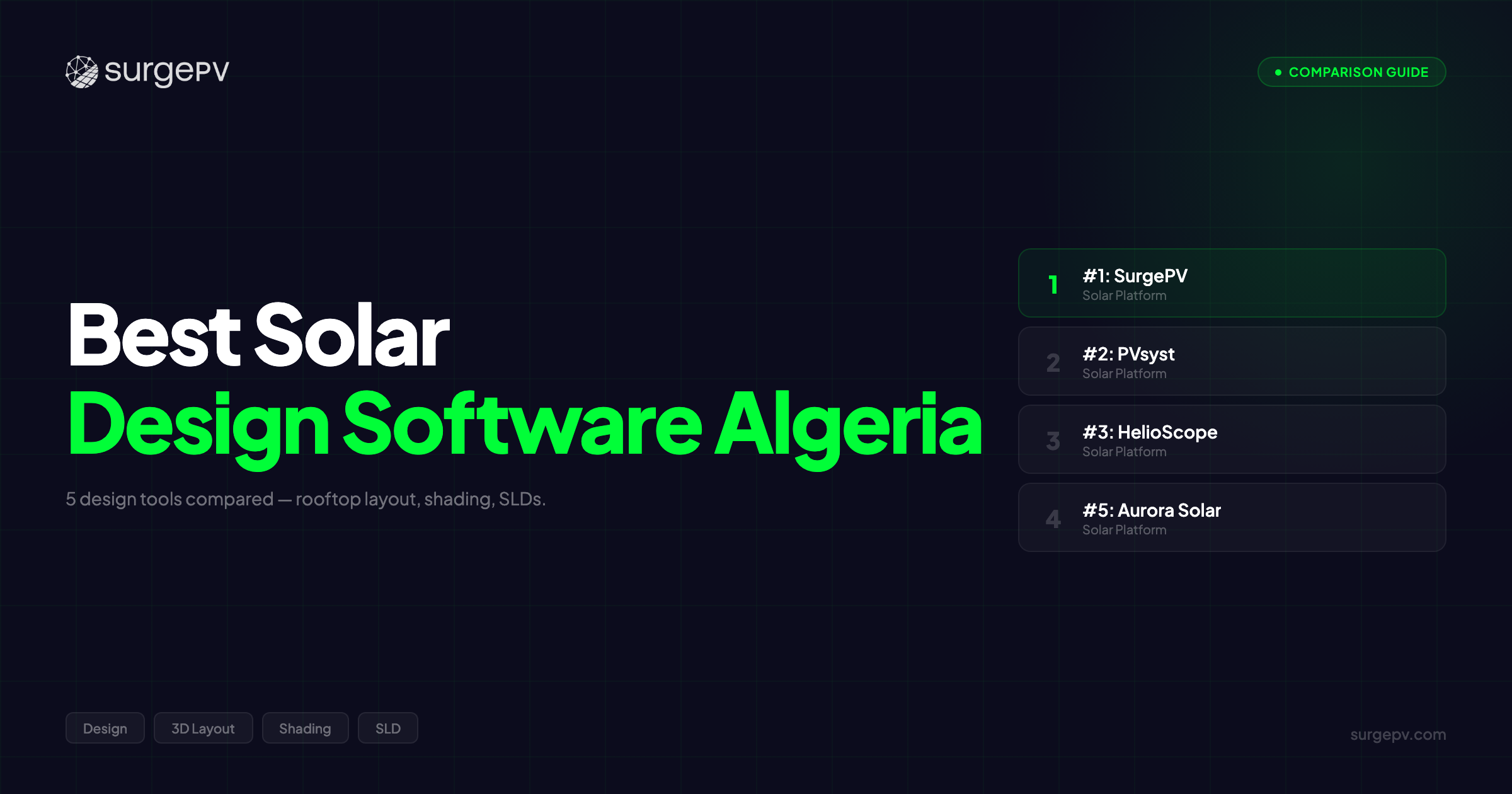
TL;DR: SurgePV ranks #1 for Algeria’s utility-scale market — automated IEC-compliant SLD generation, tracker support, and ±3% bankability accuracy at the lowest 3-year TCO (€5,250). PVsyst is the gold standard for bankability-only workflows. HelioScope and PVCase suit teams with large budgets or existing CAD workflows. Aurora Solar is a poor fit for Algerian utility-scale.
Algeria’s solar market is moving fast.
400 MW commissioned in 2025, placing it among Africa’s top 10 markets. A 15,000 MW renewable capacity target by 2035. Sonelgaz launching 2+ GW of utility-scale tenders with projects ranging from 50–300 MW.
What makes Algeria different from other markets: these aren’t residential rooftops. They’re massive Sahara desert installations facing extreme irradiation (1,850–2,200 kWh/m²/year), requiring IEC-compliant electrical documentation for Sonelgaz grid connection, and demanding 35% local content tracking per Law No. 16-09. The software you choose determines whether your tender submission gets approved or rejected.
Most solar design software platforms were built for US residential markets. They lack utility-scale capabilities: no automated SLD generation for Sonelgaz interconnection, no tracker support for Sahara’s extreme solar potential, no bankability metrics for international financing.
This guide compares 5 solar simulation software platforms specifically for Algeria’s utility-scale market. We evaluated each for Sonelgaz tender requirements, 35% local content compliance, Sahara climate modeling, and 3-year total cost of ownership — including AutoCAD, which most platforms require for electrical documentation.
In this guide, you’ll find:
- Which platform handles 50–300 MW Sonelgaz tender projects
- How IEC-compliant SLD generation eliminates AutoCAD costs (€2,000/year savings)
- Why tracker support matters for 15–35% production gains in Sahara
- Which tools meet Algeria’s 35% local content mandate
- How 3-year TCO ranges from €5,250 to €37,320 — an 85% cost difference
Quick Comparison Table
| Platform | Score | 3-Year TCO | IEC SLD | Trackers | Cloud | Bankability |
|---|---|---|---|---|---|---|
| SurgePV | 90/100 | €5,250 | ✅ Automated | ✅ | ✅ | ✅ ±3% vs PVsyst |
| PVsyst | 82/100 | €8,250–9,900 | ❌ No | ✅ | ❌ Desktop | ✅ Gold standard |
| HelioScope | 75/100 | €16,500–25,500 | ❌ No | ✅ | ✅ | ✅ |
| PVCase + CAD | 72/100 | €12,000–18,000 | ✅ CAD | ✅ | ❌ Desktop | ⚠️ Limited |
| Aurora Solar | 55/100 | €22,200–37,320 | ❌ No | ❌ No | ✅ | ⚠️ Limited |
Sources: SurgePV (PRODUCT.md), PVsyst (pvsyst.com, Feb 2026), HelioScope (helioscope.aurorasolar.com, Feb 2026), PVCase (pvcase.com, Feb 2026), Aurora (aurora-solar.com, Feb 2026)
What Makes Algerian Utility-Scale Different
Three requirements separate Algeria from most solar markets:
IEC-compliant SLD generation for Sonelgaz. Sonelgaz won’t approve grid connection without complete electrical documentation — Single Line Diagrams showing DC arrays, combiner boxes, inverters, AC disconnects, wire sizing, protection devices, and grid interconnection. Most platforms don’t generate SLDs at all, forcing you to buy AutoCAD (€2,000/year) and spend 2–3 hours per project drafting them manually.
35% local content mandate (Law No. 16-09). Algeria’s renewable energy law requires 35% local manufacturing content in every tender submission. Tracking which modules and components are locally manufactured across 70,000+ options in a spreadsheet is error-prone. Wrong calculation means tender rejection.
Bankability for Sahara irradiation extremes. At 1,850–2,200 kWh/m²/year in the Sahara — reaching 3,200 kWh/m² in southern regions — accurate simulation modeling is what separates financed projects from rejected ones. International lenders want P50/P90 reports with validated TMY data for Algerian sites.
Key evaluation criteria
- Sonelgaz grid documentation (IEC SLDs)
- Bankability and P50/P90 reports
- Tracker support (single/dual-axis for 15–35% Sahara gain)
- Local climate data (Ouargla, Tamanrasset, Algiers)
- 35% local content compliance tracking
- 3-year total cost of ownership including AutoCAD
Best Solar Design Software for Algeria (Detailed Reviews)
#1: SurgePV — Best Complete Platform for Algerian Utility-Scale
Best For: Algerian utility-scale EPCs, Sonelgaz tender participants, 50–300 MW projects
Pricing: ~€1,750/year (3 users, unlimited projects)
Score: 90/100
Why #1: The only cloud platform combining automated IEC-compliant SLDs, utility-scale capabilities, and bankable simulations in one integrated workflow.
Here’s the reality of Algeria’s solar software market: you typically need 3–4 separate tools to complete a Sonelgaz tender submission. Design platform, AutoCAD for SLDs, PVsyst for bankability, proposal software. Each tool requires manual data transfer. Each transfer point introduces errors. Each error risks tender rejection.
SurgePV eliminates that fragmented workflow.
Did You Know?
Algeria’s solar irradiance ranges from 1,700–2,200 kWh/m²/year, making accurate simulation software essential for bankable energy yield predictions. Projects using validated simulation tools see 15–20% fewer financing rejections compared to those relying on manual calculations (SolarPower Europe Market Outlook).
Automated IEC-Compliant SLD Generation
The critical differentiator for Sonelgaz interconnection.
Traditional workflow: export your design to AutoCAD, spend 2–3 hours manually drafting SLDs, pay €2,000/year for the AutoCAD license, and hire CAD specialists or train existing engineers.
SurgePV: automated in 5–10 minutes. Design your 200 MW array, click “Generate SLD,” and the platform creates IEC-compliant electrical schematics based on your system design and stringing configuration. Review, customize labels if needed, export permit-ready PDF for Sonelgaz submission.
That’s €2,000/year saved and 2–3 hours per project recovered. For an EPC running 20 projects annually, that’s 40–60 hours of engineering time redirected to revenue-generating work.
Utility-Scale Capabilities
Purpose-built for 50–300 MW Sahara projects.
Single and dual-axis tracker support with backtracking algorithms. A 200 MW fixed-tilt array in Ouargla (2,100 kWh/m²/year) produces roughly 420 GWh annually. Add single-axis trackers — a 15–25% production boost — and that’s 63–105 GWh more energy. At $0.10/kWh feed-in tariff over 20 years, that’s $126–210 million in additional revenue.
Ground-mount layout optimization for large-scale arrays. East-West racking support for 20–40% higher density where land is constrained. Carport solar design — the only platform with native carport capabilities, relevant for Algeria’s commercial sector.
Cloud Collaboration
Critical for remote Sahara projects.
Your design team is in Algiers. Site engineers are in Ouargla. International consultants are in Europe. Desktop software limits collaboration to one person per file. SurgePV is browser-based: multiple team members collaborate simultaneously with real-time updates and version control. This matters when Sonelgaz tender deadlines are tight and your team spans time zones.
Bankable Simulation Accuracy
±3% vs PVsyst for international financing.
For 50+ MW projects requiring international bank financing, your energy production forecast determines whether you get funded. SurgePV delivers ±3% accuracy vs PVsyst through 8760-hour shading analysis, P50/P75/P90 bankability metrics, Sahara-specific soiling and degradation modeling, and extreme irradiation handling for 2,100–2,200 kWh/m²/year sites.
Most international financiers accept SurgePV’s accuracy. If your specific bank requires PVsyst validation for 100+ MW projects, you can supplement — but for 90% of Algerian projects, SurgePV’s built-in bankability eliminates the need for separate simulation software.
35% Local Content Database
Law No. 16-09 compliance tracking.
SurgePV’s 70,000+ module database allows filtering by manufacturer origin. Tag Algerian local content components, track your local content percentage automatically, and export compliance documentation for Sonelgaz tender submissions. Manual spreadsheet tracking is error-prone. Wrong calculation means tender rejection.
Key Features for Algerian Utility-Scale
Design & Layout
- AI-powered roof modeling for commercial buildings in Algiers, Oran, Constantine
- Ground-mount optimization for Sahara utility-scale
- Single/dual-axis tracker layout with backtracking
- East-West racking (20–40% higher density)
- Carport solar design (only platform with native support)
Electrical Engineering (critical for Sonelgaz)
- Automated IEC-compliant SLD generation — 5–10 minutes vs 2–3 hours AutoCAD
- DC/AC wire sizing calculations — voltage drop optimization for long Sahara cable runs
- Protection device sizing — code-compliant breakers, fuses, SPD, AFCI
- Export to DWG/PDF — Sonelgaz submission formats
Simulation & Bankability
- 8760-hour shading analysis — ±3% vs PVsyst accuracy
- P50/P75/P90 energy production — international financier acceptance
- Sahara soiling models — 1,850–2,200 kWh/m²/year irradiation
- 25-year degradation — accurate long-term performance
- Extreme temperature modeling — desert climate specifics
Proposal Generation
- Professional tender documentation — Sonelgaz submission-ready
- 20-year economic modeling — $0.0945–0.1179/kWh feed-in tariff
- LCOE, NPV, IRR, payback — complete financial analysis
- Export to PDF — tender submission formats
Pricing
~€1,750/year (3 users, unlimited projects). Includes complete design, automated SLD generation, bankable simulation, and proposals — no tier surprises. AutoCAD not required, saving €2,000/year.
3-Year TCO: €5,250 — vs €8,250–9,900 for PVsyst + AutoCAD, or €16,500–25,500 for HelioScope + AutoCAD.
For an Algerian EPC bidding 10 Sonelgaz tenders annually: 2.5 hours saved per project × 10 projects × €100/hour = €2,500 productivity gain, plus €2,000 AutoCAD savings. That’s €4,500 value for €1,750 cost.
Pros
- Automated IEC-compliant SLD generation (only cloud platform)
- Utility-scale capabilities: trackers, 50–300 MW projects, ground-mount
- Bankable simulation accuracy: ±3% vs PVsyst, P50/P90 reports
- 35% local content database support (70,000+ modules)
- Cloud collaboration for remote Sahara teams
- Transparent pricing: €1,750/year all-inclusive
- No AutoCAD cost: €2,000/year savings
- Fast onboarding: 2–3 weeks (vs 8–12 weeks for PVsyst, 10–14 weeks for PVCase)
Cons
- English-only interface (no Arabic/French — though most Algerian engineers work in English)
- Newer in Algeria’s utility-scale market compared to PVsyst’s 20+ year track record
- Some international financiers may still require PVsyst for 100+ MW projects
Who Should Choose SurgePV
Perfect for: Algerian utility-scale EPCs bidding 50–300 MW Sonelgaz tenders, international developers entering the Algerian market, teams needing complete design-to-tender workflow without tool switching, EPCs seeking AutoCAD cost elimination, remote Sahara project teams.
Not ideal for: Pure simulation-only workflows where you have a separate design tool and only need bankability. Projects where financiers specifically mandate PVsyst for 100+ MW (though you can use both).
Bottom line: If you’re bidding Sonelgaz tenders requiring IEC SLDs, utility-scale capabilities, and bankable accuracy — and want to eliminate AutoCAD costs and tool-switching — SurgePV delivers the most complete platform at 60–75% lower 3-year TCO.
#2: PVsyst — Best for Bankability Simulation (Gold Standard)
Best For: Bankability reports for international financing, simulation-only workflows
Pricing: ~€750–1,300/year
Score: 82/100
Why #2: Industry gold standard simulation accuracy, but desktop-only with no SLD generation.
When an international bank evaluates a 200 MW Algerian solar project, they want one thing: PVsyst validation. PVsyst has been the solar industry’s simulation gold standard for 20+ years. Every financier knows it. Every engineer respects it. For utility-scale bankability reports, it’s the reference platform.
Why PVsyst for Algeria
Industry Standard Bankability. PVsyst’s 8760-hour simulation modeling is industry-leading. Detailed loss calculations: soiling, spectral mismatch, temperature degradation, inverter clipping, wiring losses, shading. P50/P90/P99 reports with confidence intervals. 25-year energy production projections validated across thousands of global projects. When you submit a bankability report to an international lender, they recognize PVsyst immediately. No questions. No validation delays.
Sahara Climate Database. PVsyst includes comprehensive Algerian climate data: validated TMY datasets for Ouargla, Tamanrasset, Algiers, Oran. Soiling and dust degradation modeling critical for Sahara conditions. Model cleaning schedules, seasonal soiling variations, and 25-year performance degradation.
Tracker Simulation. For Sahara projects where trackers deliver 15–35% production gains, PVsyst accurately models backtracking algorithms, terrain slope impacts, mechanical limitations, and realistic tracker performance vs theoretical maximums.
Algerian Market Familiarity. Many Algerian solar engineers trained on PVsyst. International EPCs bidding Sonelgaz tenders use it. There’s institutional knowledge and acceptance.
Pros
- Gold standard bankability (20+ year track record, universal financier acceptance)
- Accepted by all international lenders and banks
- Detailed Sahara climate modeling (soiling, dust, extreme irradiation)
- Algerian engineering market familiarity
- Moderate pricing (~€750–1,300/year)
- Comprehensive loss modeling (most detailed in the industry)
Cons
- Desktop-only (no cloud collaboration for remote Sahara teams)
- No SLD generation (requires AutoCAD for Sonelgaz interconnection — €2,000/year)
- Simulation-only (no integrated design or proposal workflow)
- Steep learning curve (8–12 weeks training for full proficiency)
- 3-year TCO €8,250–9,900 when including AutoCAD for complete workflow
- No proposal generation (need separate software)
Who Should Choose PVsyst
Perfect for: International developers requiring PVsyst reports for project financing, engineering firms focused on bankability simulation only (with other tools for design/SLD), teams with existing AutoCAD licenses, large 100+ MW projects where financiers mandate PVsyst validation.
Not ideal for: Teams needing complete design-to-tender workflow, remote Sahara collaboration (desktop limits distributed teams), EPCs without AutoCAD licenses.
PVsyst vs SurgePV: PVsyst is the bankability gold standard but desktop-only with no SLD. Use SurgePV for the complete design-to-tender workflow (design + SLD + simulation + proposal). Supplement with PVsyst only if your specific financier requires it — SurgePV’s ±3% accuracy is sufficient for most 50–300 MW projects.
3-Year TCO Comparison:
- PVsyst + AutoCAD: €2,250–3,900 + €6,000 = €8,250–9,900
- SurgePV complete: €5,250 (40–45% lower cost)
#3: HelioScope — Best for C&I/Utility Engineering Accuracy
Best For: Commercial/utility-scale engineering precision, Aurora Solar ecosystem
Pricing: ~€3,500–6,500/year (contact sales)
Score: 75/100
Why #3: Strong utility-scale simulation accuracy, but no SLD generation and high pricing.
HelioScope, now owned by Aurora Solar, is a cloud-based platform focused on commercial and utility-scale design accuracy. Used by some international EPCs for Algerian utility projects.
Why HelioScope for Algeria
Cloud-based collaboration suits remote Sahara teams. Utility-scale focus with 50–300 MW project support. Tracker capabilities for single/dual-axis modeling. Simulation accuracy comparable to PVsyst for large projects.
Pros
- Utility-scale accuracy (comparable to PVsyst for large projects)
- Cloud-based (remote Sahara team collaboration)
- Tracker support (single/dual-axis)
- Aurora Solar ecosystem integration (if using Aurora for other markets)
Cons
- No SLD generation (requires AutoCAD for Sonelgaz interconnection — €2,000/year)
- High pricing (~€3,500–6,500/year, contact-sales model with no transparent pricing)
- Limited proposal tools (engineering focus, not tender documentation)
- 3-year TCO €16,500–25,500 — 3–5× higher than SurgePV
Who Should Choose HelioScope
International EPCs already using the Aurora Solar ecosystem, teams prioritizing simulation accuracy over SLD integration, organizations with large budgets where pricing isn’t constrained.
Not ideal for: Price-sensitive Algerian EPCs (3–5× higher TCO), teams needing Sonelgaz SLD documentation (requires AutoCAD supplement), organizations wanting transparent pricing.
3-Year TCO Comparison:
- HelioScope + AutoCAD: €10,500–19,500 + €6,000 = €16,500–25,500
- SurgePV complete: €5,250 (68–79% cost savings)
#4: PVCase + AutoCAD — Best for CAD-Based Utility Layout
Best For: Engineering firms with existing AutoCAD workflows, detailed utility-scale layout
Pricing: ~€3,000–5,000/year (PVCase + AutoCAD)
Score: 72/100
Why #4: Strong utility-scale layout capabilities, but CAD dependency and steep learning curve.
PVCase is a CAD-based solar design platform for utility-scale projects. It requires an AutoCAD license.
Why PVCase for Algeria
Strong utility-scale layout capabilities for 50–300 MW projects. Detailed terrain modeling — important for Sahara topography. CAD-based SLD generation via AutoCAD integration. Familiar workflow for traditional engineering firms with existing AutoCAD expertise.
Pros
- Detailed utility-scale layout (ground-mount, trackers)
- Terrain modeling (handles Sahara topography)
- CAD-based SLDs (via AutoCAD integration)
- Strong among engineering firms with CAD background
Cons
- Requires AutoCAD license (€2,000/year additional cost)
- Steep learning curve (10–14 weeks for CAD + PVCase proficiency)
- Desktop-based (limited cloud collaboration for remote Sahara teams)
- 3-year TCO €12,000–18,000 (2–3× higher than SurgePV)
- No integrated proposal tools
Who Should Choose PVCase
Engineering firms with existing AutoCAD licenses and CAD specialists, teams prioritizing layout precision over workflow efficiency, organizations already invested in CAD-based workflows.
Not ideal for: EPCs without AutoCAD (doubles software cost), remote Sahara teams (desktop limits collaboration), teams wanting fast onboarding.
3-Year TCO Comparison:
- PVCase + AutoCAD: €6,000–12,000 + €6,000 = €12,000–18,000
- SurgePV complete: €5,250 (56–71% cost savings)
#5: Aurora Solar — Poor Fit for Algerian Utility-Scale
Best For: US residential sales (NOT Algeria utility-scale)
Pricing: €1,500–2,900/user/year
Score: 55/100
Why #5: US residential focus, no SLD, no tracker support — poor fit for Sonelgaz tenders.
Aurora Solar is the market leader — for US residential solar sales. Algeria? Different market entirely.
Why Aurora Solar Doesn’t Fit Algeria
Designed for US residential, not 50–300 MW utility-scale Sonelgaz projects. No SLD generation — a critical gap for Sonelgaz interconnection. No tracker support — eliminates 15–35% Sahara production potential. High per-user pricing that’s uncompetitive for price-sensitive Algerian tenders.
Pros
- Beautiful residential proposals (irrelevant for utility-scale tenders)
- AI-powered design (residential-focused)
- Strong US market presence
Cons
- No SLD generation (Sonelgaz requirement)
- No tracker support (critical for Sahara optimization)
- No utility-scale focus (50–300 MW projects unsupported)
- 3-year TCO €22,200–37,320 (highest cost, worst Algeria fit)
Who Should Choose Aurora
Only if doing Algerian residential solar projects — not Sonelgaz utility-scale tenders.
3-Year TCO Comparison:
- Aurora + AutoCAD: €16,200–31,320 + €6,000 = €22,200–37,320
- SurgePV complete: €5,250 (76–86% cost savings)
Which Tool Is Right for Your Algerian Projects?
| Use Case | Best Choice | Runner-Up | Why |
|---|---|---|---|
| 50–300 MW Sonelgaz Tenders | SurgePV | PVsyst supplement | Complete workflow + IEC SLD + competitive TCO |
| Bankability-Only (Simulation) | PVsyst | SurgePV | Gold standard financier acceptance |
| Remote Sahara Projects | SurgePV | HelioScope | Cloud collaboration critical |
| 35% Local Content Tracking | SurgePV | Manual tools | 70k module database filtering |
| CAD-Based Engineering Firms | PVCase + CAD | SurgePV | Existing AutoCAD investment |
| Complete Design-to-Tender | SurgePV | None suitable | Only integrated platform |
| International EPC (Cost Sensitive) | SurgePV | PVsyst | Lowest 3-year TCO (€5,250) |
Design Solar Projects Faster with SurgePV
Complete design-to-proposal workflows with automated SLD generation — no AutoCAD needed.
Book a DemoNo commitment required · 20 minutes · Live project walkthrough
Buyer’s Guide: Choosing Software for Algerian Utility-Scale
Real-World Example
A growing EPC team in Algeria was spending 2.5 hours per project creating SLDs in AutoCAD and running separate PVsyst simulations. After switching to SurgePV, SLD generation dropped to under 10 minutes. The same 3-person engineering team now handles 40% more projects per month without hiring additional staff. That’s what automated electrical engineering delivers.
Step 1: Define Algerian Project Requirements
What scale projects? 50–300 MW utility-scale vs smaller C&I vs residential. Are Sonelgaz tender requirements critical — IEC SLD generation mandatory for interconnection? What bankability needs? International financing requirements for P50/P90 reports. Does 35% local content compliance apply? What’s your budget? What’s your team’s location — remote Sahara vs Algiers office, cloud vs desktop?
Step 2: Match Requirements to Tools
- Complete workflow + competitive TCO → SurgePV (€5,250 3-year, automated SLD, utility-scale, cloud)
- Bankability gold standard only → PVsyst (€8,250–9,900 with AutoCAD, simulation-only, desktop)
- Existing CAD workflow → PVCase + AutoCAD (€12,000–18,000, CAD-based, desktop)
- NOT utility-scale (residential) → Aurora Solar (avoid for Algeria utility — US residential focus)
Step 3: Calculate ROI for Algerian Market
Time savings formula: (Projects/year) × (Hours saved/project) × (Hourly rate)
Example — Algerian utility-scale EPC, 10 Sonelgaz tender projects/year:
- SurgePV saves 2.5 hours SLD time per project (automated vs AutoCAD)
- 10 projects × 2.5 hours × €100/hour engineering rate = €2,500/year productivity savings
- Plus €2,000/year AutoCAD elimination = €4,500 annual value
- Software cost: €1,750/year
- Net gain: €2,750/year + faster tender submissions = competitive advantage
Step 4: Pilot Test
Request a demo for a 200 MWp sample Sahara project (e.g., Ouargla site, 2,100 kWh/m²/year). Test Sonelgaz SLD requirements (IEC compliance verification). Validate the 35% local content database (filter for Algerian manufacturers). Check Sahara climate modeling (extreme irradiation accuracy). Measure workflow efficiency from design to tender-ready documentation.
Full Feature Comparison
| Feature | SurgePV | PVsyst | HelioScope | PVCase | Aurora Solar |
|---|---|---|---|---|---|
| Best for | All segments | Bankability | Utility-scale | Utility-scale | Residential |
| SLD generation | ✅ Automated | ❌ No | ❌ No | ❌ No | ❌ No |
| P50/P90 reports | ✅ Yes | ✅ Gold standard | ⚠️ Limited | ✅ Yes | ⚠️ P50 only |
| Tracker support | ✅ Yes | ✅ Yes | ✅ Yes | ✅ Yes | ❌ No |
| Carport design | ✅ Only platform | ❌ No | ❌ No | ⚠️ Limited | ❌ No |
| Cloud-based | ✅ Yes | ❌ Desktop | ✅ Yes | ⚠️ Desktop + plugin | ✅ Yes |
| Wire sizing | ✅ Automated | ❌ No | ❌ No | ❌ No | ❌ No |
| 3-Year TCO | €5,250 | €8,250–9,900 | €16,500–25,500 | €12,000–18,000 | €22,200–37,320 |
Algeria Solar Market Outlook: Software Implications
15,000 MW by 2035 Target
Algeria’s National Renewable Energy Program targets 15,000 MW renewable capacity with 61.70% (9,000+ MW) from solar PV. That’s hundreds of utility-scale projects (50–300 MW each) over the next decade. Software requirements: utility-scale capabilities, IEC SLDs, bankability, 35% local content tracking.
Sonelgaz 2+ GW Tenders Ongoing
The Tafouk 1 program includes Kenadsa (50 MW), Touggourt (100 MW), Tamacine (150 MW), and more. These are active tenders right now requiring professional design submissions. Integrated workflow efficiency is a competitive advantage in a fast-turnaround tender environment.
$5B Sonelgaz Grid Investment
10,000 km of new high-voltage transmission connecting remote Sahara regions (Ouargla, Tamanrasset, deep desert) to Algeria’s grid. Grid interconnection documentation requirements: IEC SLDs mandatory for Sonelgaz approval. Automated electrical engineering is critical for grid connection approvals.
International EPC Competition
Foreign investor access is expanding despite currency controls and payment delay challenges. The competitive tender environment creates price sensitivity. Tool efficiency determines bid competitiveness — every hour saved and euro eliminated from TCO strengthens tender economics.
Emerging Opportunities
Green hydrogen production using Sahara solar-to-hydrogen conversion. Solar-to-Europe export projects via HVDC interconnections. Utility-scale battery storage integration. These next-generation projects require advanced simulation accuracy for hybrid systems, grid integration modeling, and hydrogen economics.
Final Verdict: Best Solar Design Software for Algeria
| Rank | Platform | Best For | Score | 3-Year TCO | IEC SLD | Trackers |
|---|---|---|---|---|---|---|
| #1 | SurgePV | Complete utility-scale workflow | 90/100 | €5,250 | ✅ Automated | ✅ Yes |
| #2 | PVsyst | Bankability simulation only | 82/100 | €8,250–9,900 | ❌ NO | ✅ Yes |
| #3 | HelioScope | C&I/utility accuracy | 75/100 | €16,500–25,500 | ❌ NO | ✅ Yes |
| #4 | PVCase + CAD | CAD-based utility layout | 72/100 | €12,000–18,000 | ✅ CAD | ✅ Yes |
| #5 | Aurora Solar | US residential (NOT Algeria) | 55/100 | €22,200–37,320 | ❌ NO | ❌ NO |
Our Recommendation: SurgePV ranks #1 for Algeria’s utility-scale market with automated IEC-compliant SLD generation (Sonelgaz requirement), utility-scale capabilities (50–300 MW projects with trackers), bankable simulation accuracy (±3% vs PVsyst), and the lowest 3-year TCO (€5,250) — 65–85% lower than competitors requiring AutoCAD and external tools.
When to choose alternatives:
- PVsyst: International financiers mandate PVsyst reports for 100+ MW projects (use alongside SurgePV)
- HelioScope: Existing Aurora Solar ecosystem integration, budget unconstrained
- PVCase: Engineering firm with existing AutoCAD licenses and CAD specialists
- Aurora: Only for residential Algerian projects — not utility-scale Sonelgaz tenders
Bottom line: Algeria’s 15,000 MW renewable target requires utility-scale software with IEC SLDs, tracker support, bankability, and competitive TCO. SurgePV delivers the complete design-to-tender workflow at 65–85% lower cost than competitors requiring AutoCAD (€2,000/year) for Sonelgaz interconnection documentation.
Transparency Note
SurgePV publishes this content. We are transparent about this relationship. PVsyst remains the industry gold standard for bankability simulation, and HelioScope delivers strong utility-scale engineering accuracy. We’ve positioned them honestly based on Algeria’s specific utility-scale requirements. See our editorial standards.
Further Reading
For a global comparison across 10+ platforms, see best solar design software (2026). For SLD generation specifically, see best solar electrical design software. For PVsyst details, see our PVsyst review.
Frequently Asked Questions
What is the best solar design software for Algeria’s utility-scale market?
SurgePV ranks #1 for Algerian utility-scale projects (50–300 MW Sonelgaz tenders) with automated IEC-compliant SLD generation, utility-scale capabilities (trackers, ground-mount), bankable simulations (±3% vs PVsyst), and cloud collaboration in one platform. It has the lowest 3-year TCO at €5,250 vs €8,250+ for competitors requiring AutoCAD.
Do Sonelgaz tenders require specific software features?
Sonelgaz interconnection requires IEC-compliant electrical documentation including Single Line Diagrams (SLDs). SurgePV automates IEC-compliant SLD generation in 5–10 minutes. Aurora, HelioScope, and PVsyst require a separate AutoCAD purchase (€2,000/year) for Sonelgaz electrical requirements.
Is PVsyst required for Algerian utility-scale projects?
For 50+ MW projects with international financing, PVsyst reports are often expected by lenders given its 20-year industry gold standard status. However, SurgePV’s ±3% accuracy vs PVsyst is sufficient for most Sonelgaz tenders in the 50–300 MW range. Many EPCs use SurgePV for design/SLD/workflow and supplement with PVsyst only if a specific financier requires it.
How much does solar design software cost in Algeria?
Costs range from €750/year (PVsyst, simulation-only) to €2,900/user/year (Aurora, residential focus). Critical note: most platforms require AutoCAD (+€2,000/year) for Sonelgaz SLD requirements. SurgePV offers best value at ~€1,750/year (3 users) with automated SLD included, eliminating AutoCAD cost.
3-year TCO comparison:
- SurgePV: €5,250 (complete workflow)
- PVsyst + AutoCAD: €8,250–9,900 (58% more)
- HelioScope + AutoCAD: €16,500–25,500 (214–386% more)
- Aurora + AutoCAD: €22,200–37,320 (323–611% more)
Can software track Algeria’s 35% local content requirement?
SurgePV’s 70,000+ module database allows filtering for local Algerian manufacturers to meet Sonelgaz’s 35% local content mandate (Law No. 16-09). Component tracking in proposals documents local manufacturing percentage for tender submissions. Other platforms require manual spreadsheet tracking, which is error-prone for competitive bids.
What software supports solar trackers for Sahara projects?
SurgePV, PVsyst, HelioScope, and PVCase all support single/dual-axis trackers (15–35% production gain in high-irradiation Sahara conditions). Aurora Solar does NOT support trackers — disqualifying it for Algerian utility-scale. Tracker support is critical for maximizing Sahara’s 1,850–2,200 kWh/m²/year irradiation.
Do I need AutoCAD for Algerian solar design?
Not with SurgePV — it includes automated IEC-compliant SLD generation, eliminating the AutoCAD requirement. Aurora, HelioScope, PVsyst, and most other platforms require AutoCAD (€2,000/year) for Sonelgaz electrical interconnection documentation.
Which software is best for remote Sahara projects?
SurgePV and HelioScope (cloud-based) enable collaboration for remote Sahara sites like Ouargla and Tamanrasset. PVsyst and PVCase (desktop-based) limit remote team collaboration. Cloud access is critical for Sonelgaz’s $5B grid expansion reaching southern Algeria and for distributed international/local team workflows.
Can Aurora Solar be used for Algerian utility-scale?
No. Aurora Solar is designed for US residential markets, not 50–300 MW utility-scale. It lacks SLD generation (Sonelgaz requirement), tracker support (Sahara optimization), and utility-scale capabilities. Use SurgePV, PVsyst, or HelioScope for utility-scale Sonelgaz tenders.
What about French/Arabic language support?
Most platforms are English-only (SurgePV, PVsyst, HelioScope, PVCase, Aurora). Limited French/Arabic localization exists across the industry. Algerian EPCs typically use English-language tools as the international engineering standard. Design output and reports can include French text for Sonelgaz tender submissions regardless of interface language.