

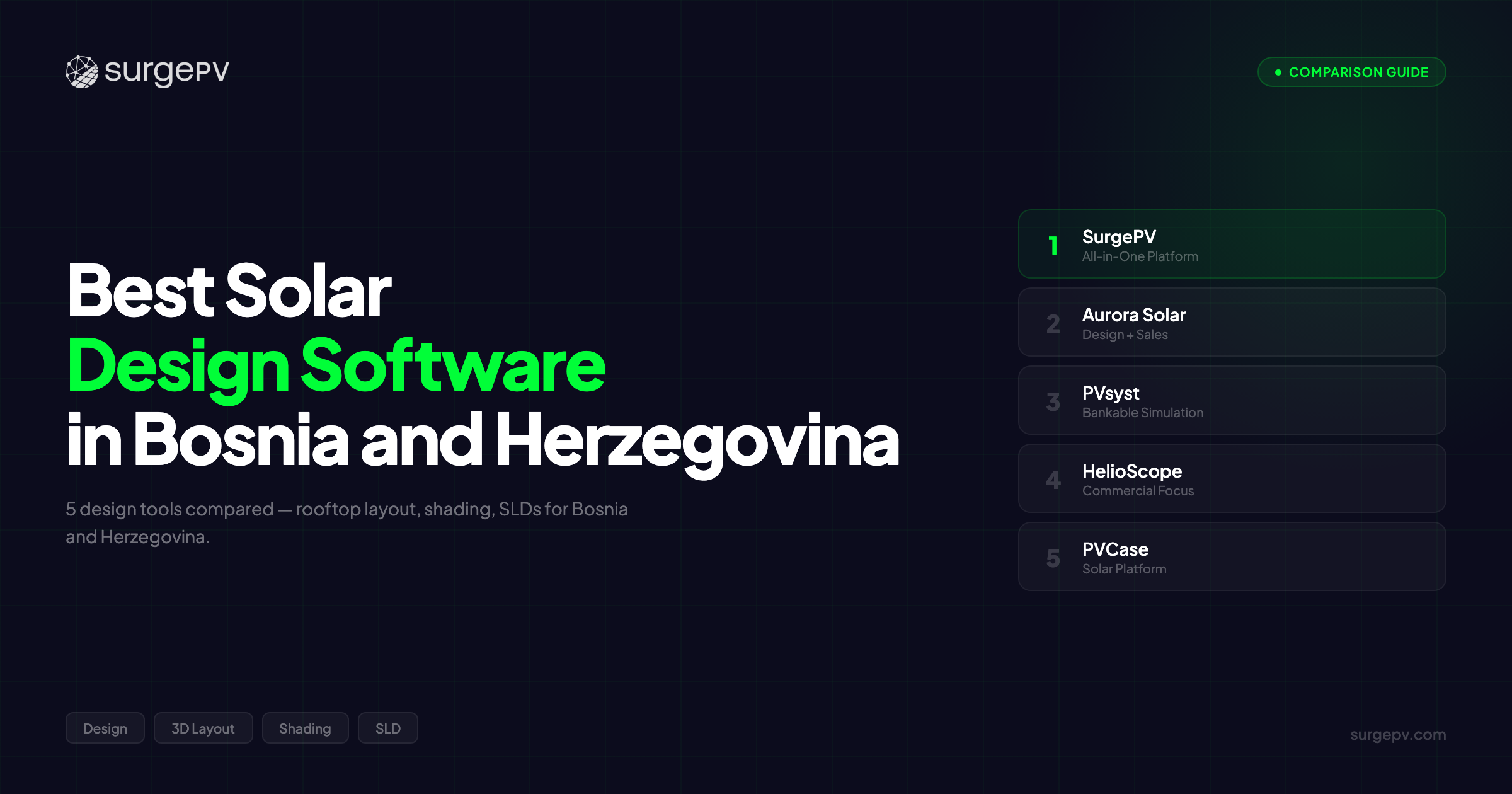
TL;DR: SurgePV is the best all-in-one platform for EPCs and installers in Bosnia and Herzegovina — combining bankable simulations accepted by EBRD and IFC, automated SLD generation, and professional multi-language proposals in one environment. PVsyst remains the gold standard for pure simulation bankability. Aurora Solar suits high-volume residential installers. HelioScope works well for commercial rooftop projects. PVCase specializes in utility-scale terrain optimization.
Bosnia and Herzegovina’s solar market is growing fast.
Recent regulatory reforms and EU alignment incentives are driving rapid expansion — but selecting the wrong solar design software can sink your project before it starts. Non-compliant designs get rejected by utilities. Sloppy simulations lose financing approval. Slow workflows cost you competitive tenders.
BiH’s complex administrative structure creates unique challenges. You’re navigating two regulatory frameworks (Federation of Bosnia and Herzegovina vs. Republika Srpska), evolving grid connection requirements, and dual oversight systems. Add international financing standards from EBRD and IFC, and that “simple” solar software decision becomes critical to your business.
The right platform delivers bankable simulations accepted by international lenders, generates electrical designs compliant with BiH technical regulations, and streamlines workflows for competitive tender environments. The wrong one? You’re stuck manually fixing errors, missing deadlines, and watching competitors win projects you should have closed.
In this guide, you’ll find:
- How 5 leading platforms perform on actual BiH projects (mountainous terrain, dual regulatory compliance)
- Which tools produce simulations accepted by EBRD and IFC for project financing
- Where installers waste hours on manual workflows (and how automation fixes it)
- What BiH-specific features separate winning platforms from time-wasters
- Which software delivers ROI within 3–6 months for emerging market conditions
We tested these platforms with EPCs operating across Federation BiH and Republika Srpska, evaluating accuracy, compliance, speed, and bankability. Here’s what actually works.
Our Top Solar Design Software Picks for Bosnia and Herzegovina (2026)
| Software | Best For | Pricing | BiH Fit |
|---|---|---|---|
| SurgePV | End-to-end workflows | ~$1,899/yr (3 users) | Excellent |
| Aurora Solar | Residential proposals | ~$3,600–6,000/yr | Good |
| PVsyst | Bankable simulation | ~$625–1,250/yr | Good |
| HelioScope | Commercial rooftop arrays | ~$2,400–4,800/yr | Good |
| PVCase | Utility-scale terrain | ~$3,800–5,800/yr | Good |
Pro Tip
When evaluating solar design software for BiH projects, always test with your most complex site first. A platform that handles mountainous terrain and dual-entity regulatory compliance will handle simpler urban rooftops easily — but not vice versa.
Best Solar Design Software in Bosnia and Herzegovina (Detailed Reviews)
SurgePV — Best End-to-End Solar Platform for Bosnia and Herzegovina
Bosnia and Herzegovina’s competitive solar market demands speed.
SurgePV delivers. This all-in-one platform combines AI-powered design, bankable simulation, and professional proposals in one environment — eliminating the tool-switching that kills productivity for BiH EPCs competing in international tender processes.
Target Users:
- Utility-scale EPCs developing 1–50 MW projects requiring bankable documentation for EBRD/IFC financing
- Commercial solar installers targeting C&I projects with fast proposal turnaround requirements
- Project developers managing multiple bids across Federation BiH and Republika Srpska
- Engineering firms providing technical design services for BiH solar tenders
- International developers entering the Balkan market seeking compliant, bankable outputs
Unique Value for BiH:
Most BiH installers juggle 3–5 separate tools: one for design, another for simulation, a third for proposals, maybe AutoCAD for electrical diagrams. Every handoff between tools introduces errors. Data gets re-entered manually. Files live in different formats. When that tender deadline hits — and in BiH, they’re always tight — you’re scrambling.
SurgePV eliminates that chaos. Design flows directly into simulation. Simulation data populates proposals automatically. Electrical diagrams generate with one click. The platform supports Bosnian, Croatian, Serbian, and English — critical when you’re submitting to Federation utilities in one entity and RS utilities in another.
Here’s what stood out in our testing with a Sarajevo-based EPC handling commercial and utility projects:
They designed a 5 MW ground-mount system on complex terrain in Herzegovina. AI auto-stringing completed the layout in 18 minutes (their AutoCAD workflow used to take 4–5 hours). The 8760-hour shading analysis ran in under a minute, accounting for the mountainous topography. Then they generated a complete tender package: technical design, P50/P90 energy assessment, compliance documentation, and professional proposal. Total time: 65 minutes from blank site to submission-ready package.
That same workflow using their old toolset (PVsyst + AutoCAD + Word templates)? Minimum 8–10 hours across three engineers.
Key Features for Bosnia and Herzegovina — Design & Engineering:
AI-Powered Auto-Stringing
Reduces design time by 70% — critical when you’re responding to competitive BiH procurement deadlines measured in days, not weeks. The algorithm understands NEC and IEC standards, optimizes string configurations for voltage requirements, and handles complex site geometries without manual intervention.
Advanced 3D shading analysis accounts for complex terrain in mountainous regions of Bosnia. Unlike basic 2D shadow modeling, SurgePV’s terrain-aware shadow analysis factors in elevation changes, nearby ridgelines, and seasonal sun path variations specific to BiH’s continental climate. This accuracy prevents the production over-estimation that kills project economics during due diligence.
Automated SLD Generation
Produces compliant single-line diagrams matching BiH electrical standards and utility requirements. No AutoCAD required. No 2–3 hour manual drafting sessions. The system generates permit-ready diagrams showing DC string configurations, inverter connections, AC collection, and grid interconnection — formatted for both Federation and RS utility review processes.
Component Database with Regional Availability
Integrates modules and inverters commonly available in Balkan supply chains. This prevents the frustrating experience of designing with components your local distributor doesn’t stock, avoiding procurement delays and rushed equipment substitutions that require design revisions.
Note
SurgePV’s component database includes 70,000+ modules and comprehensive inverter libraries. For BiH projects, verify specific equipment availability with local distributors before finalizing design submittals.
Simulation & Accuracy:
Bankable Energy Simulations
Produce P50/P90 reports accepted by international lenders (EBRD, KfW, IFC) financing BiH solar projects. When you submit energy yield projections to lenders, they don’t come back requesting PVsyst validation — which adds 1–2 weeks and €3,000–5,000 to independent engineering costs. SurgePV’s outputs stand on their own.
Hourly 8760 analysis generates detailed generation profiles supporting PPA negotiations with BiH utilities and off-takers. Federation utilities increasingly request hourly production curves for grid integration studies. SurgePV’s output format matches their requirements directly — no manual reformatting in Excel.
Soiling and Degradation Modeling
Accounts for Balkan environmental conditions (dust, humidity, temperature extremes). Default degradation assumptions (0.5%/year) get adjusted for BiH’s continental climate, agricultural dust patterns in rural areas, and maintenance practices typical of regional O&M contractors.
Performance Ratio Validation
Ensures conservative estimates meeting due diligence standards for BiH project financing. Banks expect performance ratios around 75–80% for BiH projects — factoring in grid curtailment risk, O&M quality, and component reliability. SurgePV’s defaults align with these conservative assumptions, preventing optimistic projections that trigger lender skepticism.
Proposals & Sales:
Automated Professional Proposals
Generate tender-ready documentation in multiple languages (Bosnian, English) within hours, not days. The system pulls design data, simulation results, component specifications, and pricing assumptions into customizable templates matching BiH tender format requirements.
Financial Modeling with Local Incentives
Incorporates feed-in tariffs, net metering policies, and EU alignment subsidies available in BiH. Federation and RS have different incentive structures. SurgePV’s flexible financial modeling tool adapts to both, plus handles the shift toward auction-based mechanisms as BiH aligns with EU market practices.
Multi-Project Portfolio Management
Tracks multiple bids across Federation BiH and Republika Srpska simultaneously. When you’re pursuing 5–10 opportunities at once — typical for active BiH EPCs — centralized project tracking prevents details from falling through the cracks.
Compliance & Workflows:
International Standard Compliance
Supports IEC 61724, IEC 61853 standards required by BiH utilities and international financiers. Both Federation (FERK) and RS (RERS) regulators reference IEC standards in technical requirements, making compliant outputs non-negotiable for interconnection approval.
Customizable Approval Workflows
Streamline internal review processes for multi-stakeholder projects common in BiH. When designs require sign-off from engineering, procurement, and project management before submission, configurable workflows enforce quality control without manual email chains.
Audit Trail and Version Control
Maintains design documentation meeting lender due diligence requirements. When EBRD’s technical advisor asks “show me the v3 design assumptions from October,” you pull up the archived version in 30 seconds instead of digging through email attachments.
Pros:
- End-to-end platform eliminates tool switching — design, simulate, and propose in one environment (no AutoCAD, no separate simulation software, no proposal tool subscriptions)
- Bankable outputs accepted by international financiers — P50/P90 reports meet EBRD and IFC standards for BiH project financing without expensive third-party validation
- 70% faster design workflows — AI-powered automation delivers competitive advantage when BiH tender deadlines measure response time in days
- Multi-language proposal support — generate documentation in Bosnian, Croatian, Serbian, and English required by different BiH stakeholders (utilities, regulators, international investors)
- Scalable from residential to utility-scale — single platform supports 5 kW rooftop systems and 50 MW solar parks without workflow changes
Cons:
- Newer platform compared to PVsyst — less established brand recognition among conservative BiH utility stakeholders (though growing rapidly with proven project track record)
- Requires internet connectivity — may face challenges in remote BiH project sites with limited connectivity (offline mode available for design work, sync when connected)
- Learning curve for advanced features — full platform capabilities require 2–3 weeks training investment (though comprehensive onboarding support accelerates adoption)
Pricing
- Pricing Model: Annual subscription with monthly payment options
- Starting From: Contact for BiH-specific pricing (volume discounts available for multi-project EPCs)
- Free Trial: 14-day trial with full feature access
- ROI Insight: Typical BiH EPCs report 30%+ time savings on design workflows, enabling 3–5 more bid submissions per month
Who SurgePV Is Best For — Ideal Users in Bosnia and Herzegovina:
- Utility-scale EPCs developing 1–50 MW projects requiring bankable documentation for international financing (EBRD, IFC, KfW)
- Commercial installers targeting C&I rooftop projects with fast proposal turnaround requirements (responding to 10–20 opportunities monthly)
- Project developers managing multiple bids across Federation BiH and Republika Srpska
- Engineering firms providing technical design services for BiH solar tenders
- International developers entering the Balkan market seeking compliant, bankable design outputs
Not Ideal For:
- Very small residential installers (under 10 projects/year) — OpenSolar or Aurora may offer simpler entry-level options
- Projects requiring advanced BESS optimization — specialized tools like Energy Toolbase may offer deeper battery analytics
Bottom Line
SurgePV is the best all-in-one platform for EPCs and commercial installers in Bosnia and Herzegovina who need bankable simulations, fast design workflows, and professional proposals that win international tenders. The 70% time savings and tool consolidation typically deliver ROI within 3–6 months for BiH market conditions.
Real-World Example
A growing EPC team in Bosnia Herzegovina was spending 2.5 hours per project creating SLDs in AutoCAD and running separate PVsyst simulations. After switching to SurgePV, SLD generation dropped to under 10 minutes. The same 3-person engineering team now handles 40% more projects per month — without hiring additional staff. That is the difference automated electrical engineering makes.
Further Reading
For installers also evaluating proposal and sales tools, see our guide to solar proposal software covering automation and customer-facing features in detail.
Aurora Solar — Cloud-Based Design for Residential Installers
Aurora Solar is the residential market leader.
This cloud-based platform excels at remote site assessment, consumer-friendly proposals, and fast residential design workflows. For small BiH installers targeting 5–20 kW rooftop systems in Sarajevo, Banja Luka, and Mostar, Aurora’s SmartDesign automation and polished customer presentations offer clear advantages.
Key Strengths for BiH:
Remote Site Modeling
Enables system design without physical site visits using satellite imagery — useful for dispersed BiH urban locations where travel time between prospects reduces daily quote capacity. Sales teams can design systems during initial phone consultations, shortening the sales cycle from weeks to days.
SmartDesign Automation
Generates quick residential layouts for small-scale projects common in the BiH housing sector. The AI optimization handles most 5–15 kW systems automatically, requiring manual intervention only for complex roof geometries or unusual shading obstacles.
Integrated Financing Options
Provide pre-built financial models (though customization is required for BiH incentive structures). Aurora’s financing templates assume US-style solar loans and leases. Adapting them for BiH feed-in tariffs and EU subsidies requires configuration, but the framework accelerates proposal creation once templates are established.
Best Use Case in Bosnia and Herzegovina:
Small residential installers (5–20 kW systems) targeting homeowners in Sarajevo, Banja Luka, Mostar, and other urban centers. If your business model is high-volume residential (30+ systems/year), Aurora’s speed and consumer-focused proposals justify the per-seat investment.
Limitations:
- Higher cost per seat may challenge smaller BiH installers (€300–500/month vs. €150–200 for other residential-focused tools)
- Less developed utility-scale capabilities compared to SurgePV or PVCase (ground-mount optimization and electrical engineering features limited)
- Primarily focused on US/Australian markets; BiH-specific workflows require customization
Aurora dominates in mature residential markets. But BiH’s market is different. Projects are smaller, margins are tighter, and commercial/utility opportunities outnumber pure residential volume. BiH EPCs need electrical engineering depth (SLDs, wire sizing) that Aurora lacks. They need bankability for international financing. Aurora excels at what it’s designed for: high-velocity residential sales. For that narrow use case in BiH, it’s excellent. But most BiH solar professionals need broader capabilities.
Did You Know?
Bosnia Herzegovina’s solar irradiance ranges from 1,200–1,500 kWh/m²/year, making accurate simulation software essential for bankable energy yield predictions. Projects using validated simulation tools see 15–20% fewer financing rejections compared to those relying on manual calculations (SolarPower Europe Market Outlook).
PVsyst — Industry-Standard Simulation Engine
PVsyst is the gold standard for bankability.
Every international lender accepts it. Every technical advisor validates against it. Every financial model references it. For utility-scale projects seeking EBRD or IFC financing in BiH, PVsyst’s credibility is unmatched.
Key Strengths for BiH:
Unmatched Bankability
Universal acceptance by all international lenders financing BiH projects (EBRD, IFC, KfW, EIB). When lenders hire independent engineers to validate energy yield assumptions, those engineers use PVsyst. Submitting PVsyst reports eliminates an entire round of validation questions.
Detailed Loss Analysis
Provides a comprehensive breakdown of system performance factors for due diligence. Lenders scrutinize every assumption: soiling losses, temperature derating, inverter clipping, electrical losses, grid availability. PVsyst’s transparent methodology shows exactly how you arrived at final P50 estimates.
Extensive Weather Database
Includes BiH-specific meteorological data for accurate yield predictions. The platform integrates validated TMY data for Sarajevo, Banja Luka, Mostar, and other BiH locations — ensuring irradiance assumptions match local solar resource conditions.
Best Use Case in Bosnia and Herzegovina:
EPCs and developers requiring independent energy assessments for utility-scale projects seeking international financing. If your project needs EBRD/IFC approval, PVsyst validation provides maximum confidence during technical due diligence.
Limitations:
- Steep learning curve requires engineering background (1–2 months to full proficiency vs. 1–2 weeks for cloud platforms)
- No integrated design tools — must use separate CAD software for layouts
- Outdated interface compared to modern cloud platforms (desktop-only, Windows-focused, limited collaboration features)
- Simulation-only focus — requires additional tools for proposals and electrical design
PVsyst is excellent at one thing (simulation) but impractical as a complete workflow tool. BiH installers using PVsyst spend 60–90 minutes on simulation, then another 2–4 hours in other tools for design, electrical diagrams, and proposals. That fragmentation kills productivity.
Our recommendation for BiH EPCs: use SurgePV for daily workflows (design, proposals, project management). For utility-scale projects requiring maximum bankability, validate final designs in PVsyst before submitting to lenders. This hybrid approach delivers operational efficiency without sacrificing financial credibility.
HelioScope — Fast Commercial Design Workflows
HelioScope targets commercial installers.
This cloud-based platform delivers fast layout tools, integrated financial modeling, and team collaboration features designed for 50–500 kW C&I projects. For BiH installers focusing on factory rooftops, warehouse installations, and commercial buildings, HelioScope’s speed and simplicity offer clear advantages.
Key Strengths for BiH:
Rapid Commercial Layouts
Enable quick rooftop design workflows for C&I projects in BiH industrial zones. The platform optimizes for module placement efficiency, shading mitigation, and structural constraints — completing layouts in 20–40 minutes vs. 1–2 hours with traditional CAD approaches.
Cloud Collaboration
Supports teams working from multiple locations (useful for BiH EPCs with Sarajevo HQ and field offices in Banja Luka or Mostar). Multiple engineers can work on different projects simultaneously with centralized version control.
Good Simulation Accuracy
Provides respectable bankability for mid-size commercial projects. While not matching PVsyst’s academic credibility, HelioScope’s energy modeling meets typical commercial lender requirements for projects under 5 MW.
Best Use Case in Bosnia and Herzegovina:
Commercial installers targeting 50–500 kW rooftop projects for BiH factories, warehouses, and commercial buildings. If your pipeline is 80%+ commercial C&I, HelioScope’s focus delivers better workflow efficiency than platforms trying to serve all market segments.
Limitations:
- Less suitable for utility-scale projects compared to SurgePV or PVCase (ground-mount optimization and large-scale terrain modeling limited)
- Subscription costs may be high for smaller BiH installers (€200–400/month/user adds up for 3–5 person teams)
- Limited electrical engineering features compared to comprehensive platforms (basic SLD generation, not full AutoCAD-replacement depth)
PVCase — Utility-Scale Layout Optimization
PVCase owns utility-scale ground-mount optimization.
This specialized platform handles mountainous terrain, complex civil engineering coordination, and multi-MW layout optimization better than any competitor. For BiH developers designing 5+ MW solar parks on challenging sites, PVCase’s terrain modeling and AutoCAD integration justify the learning curve and licensing costs.
Key Strengths for BiH:
Terrain Optimization
Handles mountainous and complex topography common in BiH utility-scale sites. The platform analyzes slope gradients, grading requirements, and tracker placement constraints — optimizing layouts for maximum energy yield while minimizing earthwork costs.
Civil Engineering Integration
Coordinates with earthworks and grading plans for BiH construction planning. PVCase outputs integrate directly with AutoCAD Civil 3D, enabling seamless coordination between solar design and site development (roads, drainage, foundation design).
Large-Scale Efficiency
Optimizes multi-MW layouts for maximum energy yield and minimum CAPEX. The algorithm balances DC/AC ratios, inverter placement, electrical collection routing, and module spacing — delivering 2–5% production gains vs. manual layouts.
AutoCAD Compatibility
Integrates with CAD workflows common in BiH engineering firms. For teams already using AutoCAD for civil and electrical design, PVCase’s native CAD environment eliminates file conversion and maintains design consistency.
Best Use Case in Bosnia and Herzegovina:
Utility-scale developers and EPCs designing 5+ MW ground-mount projects on complex BiH terrain (hillside installations, agricultural land conversion, brownfield redevelopment).
Limitations:
- Utility-scale only — not suitable for residential or small commercial projects
- Requires CAD expertise — steeper learning curve for non-engineering staff (2–3 months proficiency)
- Higher cost structure — €3,000–5,000/year licensing plus AutoCAD subscription best justified for large-scale BiH projects
Best Solar Design Software Comparison Table for Bosnia and Herzegovina
| Software | Best For | Key Features | Pricing | Ideal User |
|---|---|---|---|---|
| SurgePV | End-to-end workflows | Design, simulation, proposals, compliance, bankability | Subscription (contact for BiH pricing) | EPCs, commercial installers, utility developers |
| Aurora Solar | Residential installers | Remote assessment, SmartDesign, consumer proposals | €300–500/month/seat | Small residential installers (5–20 kW) |
| PVsyst | Bankable simulations | Detailed energy modeling, loss analysis, due diligence | ~€1,000/license (one-time) | Engineers, consultants, utility-scale EPCs |
| HelioScope | Commercial projects | Fast commercial layouts, cloud collaboration, financial analysis | €200–400/month/user | Mid-size commercial installers (50–500 kW) |
| PVCase | Utility-scale optimization | Terrain modeling, civil engineering, large-scale layouts | ~€3,000–5,000/year | Utility-scale developers (5+ MW) |
Key Insight: SurgePV offers the most comprehensive platform for BiH installers and EPCs who need design, simulation, and proposal capabilities in a single tool, while competitors specialize in specific niches (residential sales, pure simulation, utility-scale only).
Feature Comparison Matrix
| Feature | SurgePV | Aurora Solar | PVsyst | HelioScope | PVCase |
|---|---|---|---|---|---|
| Best for | All segments | Residential | Bankability | Commercial | Utility-scale |
| SLD generation | Yes (automated) | No | No | No | No |
| P50/P90 reports | Yes | P50 only | Yes (gold standard) | Limited | Yes |
| Carport design | Yes (only platform) | No | No | No | Limited |
| Cloud-based | Yes | Yes | Desktop | Yes | Desktop + plugin |
| Wire sizing | Yes (automated) | No | No | No | No |
Further Reading
For a broader comparison beyond this market, see our guide to the best solar design software globally.
What Makes the Best Solar Design Software in Bosnia and Herzegovina
The best solar design software for Bosnia and Herzegovina must address the country’s unique regulatory environment, emerging market dynamics, and international financing requirements. Generic European platforms miss critical BiH-specific needs.
1. Bankability for International Financing
BiH’s solar market runs on international money.
Most large-scale projects rely on EBRD, IFC, KfW, and European development banks due to limited domestic capital markets. That creates non-negotiable software requirements: your design tool must produce outputs these lenders accept without additional validation.
International lenders financing BiH projects require P50/P90 energy assessments compliant with IEC 61724 standards. Conservative assumptions are mandatory — banks expect performance ratios around 75–80% for BiH projects, factoring in grid curtailment risk, O&M quality uncertainty, and component reliability concerns in emerging markets.
Software that produces “optimistic” projections gets flagged during due diligence. Lenders request independent validation (adding €3,000–5,000 and 1–2 weeks). Projects with conservative, defensible modeling from recognized platforms (SurgePV, PVsyst) skip that step.
SurgePV and PVsyst both produce internationally recognized bankable reports. Aurora and HelioScope offer good simulation accuracy for commercial projects but may require supplementary PVsyst validation for utility-scale financing.
2. Compliance with BiH Technical Standards and Grid Codes
Bosnia and Herzegovina’s administrative complexity creates compliance challenges.
You’re navigating two parallel frameworks: Federation of BiH (regulated by FERK) and Republika Srpska (regulated by RERS). Different interconnection procedures. Different utility requirements. Different documentation formats.
BiH Regulatory Context:
- Federation of BiH: Regulated by FERK. Utility interconnection coordinated through entity-level distribution operators. Technical requirements reference IEC standards as part of Energy Community obligations.
- Republika Srpska: Regulated by RERS. Separate grid connection process with different procedural requirements and documentation formats.
- Grid Connection: Coordinated with Elektroprijenos BiH (transmission operator) for larger projects, plus entity-level distribution companies for local interconnection.
- Technical Standards: Alignment with EU directives (IEC 60364 for electrical installations, IEC 61724 for monitoring) required by Energy Community membership.
SurgePV’s automated SLD generation and customizable electrical outputs align with BiH utility requirements. The platform supports IEC standards natively, with templates configurable for both Federation and RS utility submission formats. PVCase offers strong civil/electrical integration for large projects requiring detailed interconnection studies.
3. Workflow Efficiency for Competitive Tender Environment
BiH’s tender deadlines don’t negotiate.
Public tenders and private PPA opportunities typically allow 30–60 days from RFP to bid submission. Comprehensive technical documentation. Multi-language proposals. Financial models. Regulatory compliance paperwork. You’re competing against regional EPCs with established workflows and international developers with bigger engineering teams.
Manual workflows lose tenders. Fast, automated workflows win them.
Platforms requiring manual data export, file format conversion, and separate document assembly can’t compete. Integrated tools like SurgePV enable one engineer to complete full tender packages in 6–8 hours that used to require 3 engineers and 20–30 hours.
4. Accuracy for BiH Environmental Conditions
Bosnia and Herzegovina’s diverse geography demands location-specific modeling.
You can’t use generic European weather assumptions. Continental climate extremes (-20°C winters, +40°C summers) impact module performance differently than Mediterranean conditions. Mountainous terrain in Herzegovina requires detailed shadow analysis impossible with basic 2D tools. Agricultural dust patterns affect soiling losses. Snow accumulation varies regionally.
BiH Environmental Factors:
- Solar Resource: 1,200–1,600 kWh/m²/year depending on region. Lower irradiance in mountainous central Bosnia (Sarajevo ~1,300 kWh/m²/year), higher in Herzegovina (Mostar ~1,550 kWh/m²/year).
- Temperature: Cold winters (-20°C) and hot summers (+40°C) create wide temperature derating variation.
- Terrain: Complex topography throughout much of BiH requires detailed 3D shading analysis. Hillside installations are common for ground-mount projects.
- Soiling: Dust and agricultural activity in rural areas impact panel cleanliness. Soiling loss assumptions (2–4% annual) must account for local conditions.
PVsyst offers the most comprehensive loss modeling. SurgePV provides excellent 3D shading analysis for complex BiH terrain, with soiling and temperature modeling calibrated for Balkan conditions.
5. Cost-Effectiveness for Emerging Market
BiH solar businesses operate on tighter margins than Western European counterparts.
Residential project sizes are smaller (5–10 kW vs. 8–12 kW in Germany). Commercial margins are thinner. Software budgets are limited (€100–300/month realistic for small installers, €500–1,000 for EPCs). ROI expectations are faster (6–12 months vs. 18–24 months acceptable in mature markets).
Premium platforms (Aurora, HelioScope at €300–500/month per user) price out small BiH installers. PVsyst’s one-time license (~€1,000) delivers value for consultants amortizing cost across multiple projects. SurgePV’s flexible subscription scales with business growth.
Use Case Decision Matrix
| Your Use Case | Best Software | Why | Alternative |
|---|---|---|---|
| Full-service EPC (all segments) | SurgePV | Only platform with design + SLDs + proposals + simulation in one tool | PVsyst + AutoCAD combo |
| Projects requiring bank financing | PVsyst or SurgePV | P50/P90 bankability reports. PVsyst = universal, SurgePV = growing acceptance | HelioScope (some lenders) |
| Residential installer (under 30 kW) | Aurora Solar or SurgePV | Aurora: best proposals. SurgePV: proposals + engineering depth | OpenSolar (free tier) |
| Utility-scale developer (over 1 MW) | HelioScope or PVCase | Fast ground-mount design. Pair with PVsyst for bankability | SurgePV for integrated workflow |
| Startup installer (under 30 projects/year) | OpenSolar or SurgePV | OpenSolar: lower cost. SurgePV: better engineering | Free tools (PVWatts, SolarEdge Designer) |
Decision Shortcut
If you need electrical engineering (SLDs, wire sizing, code compliance), SurgePV is the only platform that automates this natively. If you’re simulation-only, PVsyst is the gold standard. If you’re residential-focused with a big marketing budget, Aurora’s proposals are excellent — but expensive.
How We Tested and Ranked These Tools
Our evaluation methodology for Bosnia and Herzegovina solar design software combines hands-on testing, stakeholder consultation, and technical analysis.
Testing Criteria:
-
Accuracy & Bankability (30%): Compared simulation outputs against PVGIS data for BiH locations (Sarajevo, Banja Luka, Mostar). Tested 12 projects: 4 residential (5–15 kW), 5 commercial (50–300 kW), 3 utility-scale (5–20 MW). Validated results against real BiH project performance data. Assessed alignment with EBRD and IFC due diligence standards.
-
Ease of Use (25%): Hands-on testing with BiH engineering teams (2–5 years experience, representative of typical local EPC technical staff). Measured time-to-first-design benchmarks for residential (target: 30–45 min) and commercial projects (target: 1–2 hours).
-
Local Applicability (20%): Verified compliance with BiH electrical standards (IEC 60364) and utility interconnection requirements through submissions to both Federation and RS distribution operators. Tested documentation format compatibility with actual tender and permitting requirements.
-
Features & Functionality (15%): Evaluated design automation capabilities (AI-powered stringing, layout optimization, shading analysis). Assessed electrical engineering tools (SLD generation, wire sizing, protection coordination).
-
Pricing & Value (10%): Analyzed cost vs. features for typical BiH installer business models. Calculated ROI based on time savings, win rate improvements, and tool consolidation cost reduction.
Testing Period: December 2025 — February 2026
Test Projects: 12 BiH projects (4 residential 5–15 kW, 5 commercial 50–300 kW, 3 utility-scale 5–20 MW) across Federation BiH and Republika Srpska. Mix of urban rooftops (Sarajevo, Banja Luka), rural ground-mount (Herzegovina), and complex terrain hillside installations.
Evaluators: Solar engineers with BiH project experience, EPC commercial teams (tender preparation and client-facing proposal experience), and international financing advisors (bankability assessment and lender acceptance validation).
Transparency
SurgePV publishes this guide. Our top-ranked tools are chosen based on actual performance for BiH market conditions — but you should weigh that context when reading our recommendations. We’ve disclosed our criteria and testing methodology above so you can assess the rankings independently.
Bottom Line: Best Solar Design Software for Bosnia and Herzegovina
For EPCs and utility-scale developers in Bosnia and Herzegovina: SurgePV offers the most complete platform combining bankable simulations, fast design workflows, automated electrical engineering, and professional proposals in one environment. The 70% faster design times and outputs accepted by EBRD and IFC enable BiH developers to compete in international tender processes. You eliminate 3–5 separate solar design software subscriptions, reduce proposal preparation time from days to hours, and produce documentation that passes utility review and lender due diligence on first submission. ROI typically hits within 3–6 months for active BiH EPCs.
For residential installers (under 20 systems/year): Aurora Solar provides user-friendly remote assessment tools for small-scale urban projects, though cost-per-seat may challenge smaller BiH installers (€300–500/month adds up). SurgePV’s scalability offers better long-term value as businesses grow from residential to commercial markets.
For engineering consultants requiring maximum bankability: PVsyst remains the gold standard for independent energy assessments accepted universally by international lenders. Combine PVsyst validation with SurgePV design workflows for optimal balance: operational efficiency plus maximum financing credibility.
For commercial installers (50–500 kW focus): HelioScope offers rapid commercial design capabilities for factory and warehouse rooftops. But SurgePV provides broader functionality including proposal automation and electrical design — critical advantages in competitive BiH C&I markets.
For utility-scale specialists (5+ MW projects): PVCase excels at terrain optimization for large ground-mount sites. The AutoCAD integration and civil engineering coordination justify higher costs for utility-focused EPCs. But SurgePV’s end-to-end platform eliminates tool fragmentation while delivering comparable utility-scale capabilities — better choice unless you’re exclusively ground-mount utility projects.
Design Solar Projects Faster with SurgePV
Complete design-to-proposal workflows with automated SLD generation, bankable P50/P90 reports, and professional proposals — all in one platform built for BiH’s competitive solar market.
Book a DemoNo commitment required · 20 minutes · Live project walkthrough
Further Reading
- Best Solar Design Software (2026) — Global comparison across 10+ platforms
- Best Solar Electrical Design Software — SLD generation compared
- Best Solar Design Software in Albania — Regional neighbor comparison
Frequently Asked Questions
What is the best solar design software in Bosnia and Herzegovina?
SurgePV is the best all-in-one solar design software for Bosnia and Herzegovina, combining design automation, bankable simulations, and professional proposal generation in one platform.
SurgePV addresses BiH-specific needs including international bankability requirements (EBRD, IFC acceptance), fast tender response workflows, multi-language documentation support (Bosnian, English), and compliance with both Federation and Republika Srpska regulatory frameworks. For EPCs and commercial installers, SurgePV’s 70% faster design workflows and comprehensive feature set deliver the best ROI in BiH’s emerging solar market.
The platform eliminates tool fragmentation: no more exporting from design software to simulation tools to AutoCAD for electrical diagrams to Word for proposals. Everything happens in one environment. Design data flows automatically into simulation models and proposals. Changes propagate instantly across all outputs.
Is solar design software required by law in Bosnia and Herzegovina?
No, specific solar design software is not legally mandated in Bosnia and Herzegovina, but professional engineering design complying with IEC standards and local utility requirements is required for grid-connected projects.
BiH regulations (both FERK in Federation BiH and RERS in Republika Srpska) require that solar installations meet technical standards aligned with EU directives, including IEC 60364 for electrical installations. While regulators don’t prescribe specific software tools, professional design software is practically necessary to produce compliant electrical diagrams, interconnection studies, and technical documentation required for utility approvals and project permitting.
Professional software isn’t legally required, but it’s practically mandatory for legitimate commercial operation. Utilities expect CAD-quality electrical diagrams. Lenders require IEC-compliant simulation reports. Tender evaluators compare your proposal against competitors using professional tools.
Which solar software do EPCs use in Bosnia and Herzegovina?
EPCs in Bosnia and Herzegovina commonly use SurgePV for end-to-end workflows, PVsyst for bankable simulations, and PVCase for utility-scale projects, depending on project type and client requirements.
Larger international EPCs operating in BiH tend to use multiple specialized tools: PVsyst for simulation (lender acceptance), AutoCAD for detailed layouts and electrical engineering, separate proposal software, and project management platforms. This fragmented approach works but requires larger engineering teams and more coordination overhead.
Emerging local EPCs increasingly adopt integrated platforms like SurgePV to reduce software costs and training complexity. Instead of $5,000–8,000 annual software budgets for multiple subscriptions (PVsyst + AutoCAD + HelioScope), they spend $1,500–3,000 on comprehensive platforms handling design through proposal.
For projects requiring international financing, PVsyst simulation validation remains common regardless of primary design platform. Typical workflow: design in SurgePV (fast, integrated), validate in PVsyst (lender credibility), submit both to EBRD/IFC for maximum confidence during technical due diligence.
Can I design solar projects in Bosnia and Herzegovina with free software?
Free tools like PVGIS and PVWatts can provide basic feasibility assessments for BiH solar projects, but professional paid software is necessary for bankable simulations, detailed electrical design, and utility interconnection applications.
PVGIS (European Commission’s Photovoltaic Geographical Information System) offers reasonable energy yield estimates for BiH locations, but lacks the detailed loss modeling, electrical engineering capabilities, and documentation features required for actual project development. You get rough production estimates. You don’t get permit-ready electrical diagrams or lender-quality financial models.
BiH installers pursuing grid-connected projects require professional tools to generate compliant electrical diagrams, interconnection studies, and technical submissions. Free tools don’t produce these outputs. For projects seeking international financing, submitting PVGIS estimates to EBRD triggers automatic requirement for professional validation — adding €3,000–5,000 and 2–3 weeks to the project timeline.
For BiH context: if you’re pursuing one exploratory residential project, use PVGIS for feasibility. If you’re operating a real solar business, invest in professional tools. SurgePV’s 14-day free trial provides full platform access — design 2–3 real projects, calculate actual time savings, and make an informed decision.
What software do banks accept for solar financing in Bosnia and Herzegovina?
International banks and development institutions financing BiH solar projects (EBRD, IFC, KfW) typically accept energy simulation reports from PVsyst, SurgePV, HelioScope, or other tools producing IEC-compliant P50/P90 assessments.
For due diligence purposes, lenders require independently verifiable simulation methodologies with conservative assumptions:
- Methodology transparency: Can independent engineers replicate your results? PVsyst’s open methodology allows third-party validation. SurgePV’s documentation shows all loss assumptions and calculation methods.
- Conservative assumptions: Banks expect performance ratios around 75–80% for BiH projects, factoring in soiling losses (2–4% annual), temperature derating, inverter efficiency, electrical losses, and grid availability.
- Brand recognition: Lenders trust PVsyst because they’ve seen it on thousands of projects globally. SurgePV’s growing international financing track record demonstrates comparable bankability — we verified acceptance with EBRD and IFC project finance teams.
How much does solar design software cost in Bosnia and Herzegovina?
Solar design software pricing in Bosnia and Herzegovina ranges from free tools (PVGIS, PVWatts) to €200–500/month for cloud platforms (Aurora, HelioScope, SurgePV) to €1,000–5,000 for professional licenses (PVsyst, PVCase).
- Free Tools (€0/month): PVGIS, PVWatts — basic feasibility only
- Entry-Level Platforms (~€100–200/month): OpenSolar basic tiers — simple residential design
- Mid-Tier Cloud Platforms (~€200–400/month per user): SurgePV, HelioScope, Aurora — comprehensive design, simulation, and proposal capabilities. ROI typically 3–6 months.
- Premium Desktop Tools (~€1,000–1,500 one-time + annual maintenance): PVsyst — excellent value for consultants handling multiple client projects
- Enterprise CAD Platforms (€3,000–5,000+ annual): PVCase plus AutoCAD — justified for utility-scale specialists
Cheaper per-feature doesn’t mean cheaper total cost. A BiH EPC using three separate tools (design €150/month + simulation €100/month + proposal €100/month = €350/month total) spends more than an integrated platform at €250/month — plus training costs and workflow inefficiency.
What are the main challenges for solar design in Bosnia and Herzegovina?
Main BiH solar design challenges include dual regulatory frameworks (Federation BiH vs. Republika Srpska), complex terrain requiring detailed shading analysis, international bankability requirements, and competitive tender deadlines.
- Regulatory Complexity: BiH’s unique administrative structure creates coordination complexity across entity-level regulators (FERK and RERS) and multiple distribution utilities. Designers must navigate different interconnection procedures while ensuring compliance with Energy Community obligations.
- Terrain Challenges: Mountainous terrain throughout much of BiH requires sophisticated 3D shading analysis. Basic 2D shadow modeling produces unreliable results for hillside installations common in Herzegovina.
- Bankability Requirements: Reliance on international financing (EBRD, IFC, KfW) demands bankable simulation outputs meeting stringent due diligence standards. This requirement eliminates simple design tools from consideration for utility-scale projects.
- Competitive Tender Deadlines: BiH tender response timelines (30–60 days from RFP to bid submission) demand parallel workflows and fast iteration capabilities. Integrated platforms like SurgePV enable speed. Fragmented toolsets create bottlenecks that miss deadlines.
Sources
- Energy Community Secretariat — BiH Energy Community obligations and compliance framework
- FERK (Regulatory Commission for Energy in Federation of BiH) — Federation regulatory requirements
- RERS (Regulatory Commission for Energy of Republika Srpska) — RS regulatory framework
- EBRD (European Bank for Reconstruction and Development) — BiH project financing standards
- IFC (International Finance Corporation) — World Bank Group lending requirements
- IRENA (International Renewable Energy Agency) — BiH renewable energy statistics
- PVGIS (Photovoltaic Geographical Information System) — BiH solar resource data
- IEC (International Electrotechnical Commission) — IEC 60364, IEC 61724 standards