

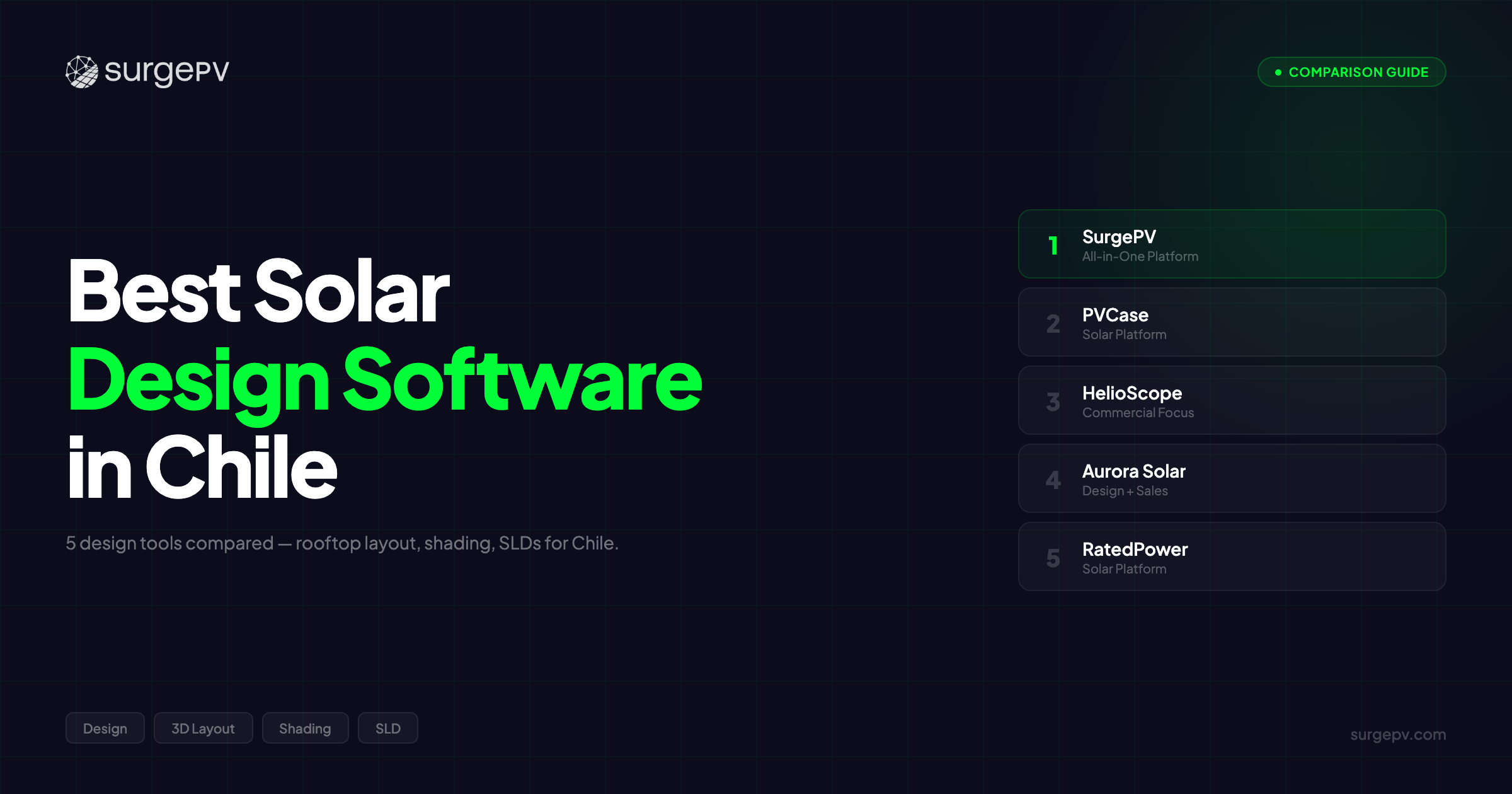
TL;DR: SurgePV is the best overall solar design software for Chile — combining Atacama-optimized design (2,500+ kWh/m² irradiance modeling), automated SLD generation for SEC compliance, tracker optimization (15–35% production gain), PMGD sizing (3–9 MW), and P50/P75/P90 bankability in one cloud platform without AutoCAD dependency. PVCase handles large utility-scale terrain (100+ MW). HelioScope covers cloud-based PMGD and commercial design. Aurora Solar leads for Santiago residential net billing. RatedPower delivers the fastest pre-feasibility layouts.
Chile’s solar market is racing from 16.5 GW toward 41.5 GW by 2030. The Atacama Desert delivers the planet’s highest irradiance — 2,500+ kWh/m² annually, with peak intensity hitting 310 W/m². That’s a designer’s dream on paper.
In practice? It’s a nightmare for generic solar software.
Most solar design tools were built for California or Germany. Their irradiance databases cap out well below Atacama levels. Their shading models weren’t tested at 3,500–5,000 meter elevation. And they have zero understanding of PMGD sizing requirements or SEC electrical standards.
Here’s what that means for your projects: a 100 MW Atacama plant modeled with the wrong tool can overpromise production by 8–12%. On a USD 600–750/kW capex investment, that’s millions in financing that falls apart at due diligence. SEC rejects your electrical documentation. Your PMGD interconnection paperwork comes back incomplete. And the competitor who got their design right wins the bid.
In this guide, you’ll find:
- Which platforms accurately model Atacama’s 2,500+ kWh/m² irradiance at high altitude
- How each tool handles SEC electrical compliance (SLDs, wire sizing, NCh Elec 4/2003)
- Which software supports PMGD optimization for Chile’s 3,539 MW distributed generation segment
- Tracker design capabilities for 15–35% production gains in Atacama
- Total cost of ownership for Chilean EPC teams
Quick Summary: Our Top Picks for Chile
After testing 5 platforms with EPCs and installers across Chile (Atacama, Santiago, and Valparaiso regions), here are our top recommendations:
- SurgePV — End-to-end design with tracker optimization, automated SLD generation, and bankable simulations (Best for utility-scale EPCs and PMGD developers)
- PVCase — CAD-level ground-mount optimization and utility-scale layouts (Best for large Atacama projects requiring deepest control)
- HelioScope — Cloud-based mid-tier commercial and PMGD design (Best for 3–9 MW distributed generation)
- Aurora Solar — AI-powered rooftop design and residential proposals (Best for Santiago net billing residential)
- RatedPower — Fastest utility-scale pre-feasibility layouts (Best for quick Atacama feasibility studies)
Each tool evaluated on Atacama accuracy, electrical engineering, PMGD optimization, tracker design, SEC compliance, and design speed.
Best Solar Design Software in Chile: Quick Comparison
| Software | Best For | Pricing | Chile Fit |
|---|---|---|---|
| SurgePV | End-to-end workflows | ~$1,899/yr (3 users) | Excellent |
| PVCase | Utility-scale terrain | ~$3,800–5,800/yr | Good |
| HelioScope | Commercial rooftop arrays | ~$2,400–4,800/yr | Good |
| Aurora Solar | Residential proposals | ~$3,600–6,000/yr | Good |
| RatedPower | Pre-feasibility speed | From $990/yr | Limited |
Best Solar Design Software in Chile (Detailed Reviews)
SurgePV — Best End-to-End Solar Design Platform for Chile
SurgePV is the only cloud-based solar design software platform combining AI-powered design, automated electrical engineering, bankable simulations, and professional proposals — without tool-switching.
For Chilean EPCs working across the Atacama Desert, PMGD projects, and Santiago’s commercial market, SurgePV eliminates the need for AutoCAD, PVsyst validation runs, and manual electrical calculations. You design a 100 MW Atacama tracker field, generate SEC-compliant single line diagrams automatically, run 8760-hour shading analysis calibrated for 2,500+ kWh/m² irradiance, and produce P50/P75/P90 bankability reports — all in the same platform.
Target Users: Utility-scale EPCs in Atacama (100+ MW projects), PMGD developers (3–9 MW distributed generation), commercial installers in Santiago and Valparaiso, multi-market Chilean EPCs working across LATAM.
Unique Value for Chile: SurgePV is the only platform with integrated SLD generation, native tracker design, and carport solar — three capabilities no competitor combines. For Chilean EPCs managing USD 600–750/kW utility-scale capex, the savings compound fast: $5,301/year per user versus Aurora + AutoCAD, plus 2–3 hours saved per project on electrical documentation alone.
Pro Tip
When evaluating design software for Chilean projects, test with an Atacama scenario first. Run a utility-scale layout through 8760-hour shading at 2,500+ kWh/m² irradiance and 4,000-meter elevation. If the platform handles Atacama, it handles everything else in Chile. A tool that works for Santiago rooftops won’t survive Atacama validation.
Key Features for Chile
Atacama Desert Optimization
SurgePV’s 8760-hour shading analysis achieves ±3% accuracy compared to PVsyst — critical for Atacama’s minimal cloud cover conditions where shading geometry must be precisely modeled across all 8,760 annual hours. The platform handles high-irradiance environments above 2,500 kWh/m² and models terrain at 3,500–5,000 meter elevation.
Tracker design is built in, not bolted on. Single-axis trackers (15–25% production gain) and dual-axis trackers (25–35% production gain) use backtracking algorithms for shadow avoidance. East-West racking delivers 20–40% higher panel density for land optimization — directly reducing per-watt costs on USD 600–750/kW capex projects.
Electrical Engineering and SEC Compliance
This is where SurgePV pulls ahead for Chilean projects.
SLD generation is automated. Complete your design, hit generate, and within 5–10 minutes you have an electrical schematic showing DC arrays, combiners, disconnects, inverters, AC wiring, breakers, and grid interconnection. That SLD is ready for SEC (Superintendencia de Electricidad y Combustibles) submission and adaptable to NCh Elec 4/2003 standards.
The alternative? Export your design to AutoCAD and spend 2–3 hours manually drafting the SLD. That’s what most Chilean EPCs do today — and it costs $2,000/year in AutoCAD licensing on top of the time wasted.
Wire sizing calculations happen instantly. DC and AC gauges based on current, distance, voltage drop limits (under 2% optimal), temperature correction factors, and conduit fill. All IEC-compliant and adaptable to Chilean electrical code requirements.
PMGD and Distributed Generation
Chile’s PMGD segment reached 3,539 MW by August 2025, with a 500 MW target by March 2026. SurgePV optimizes 3–9 MW distributed generation sizing, supports grid interconnection modeling for SEC documentation, and produces P50/P75/P90 bankability metrics required for PMGD financing.
Carport Solar Design
Carport solar design — single cantilever, dual cantilever, and multi-column structures — is a SurgePV exclusive. No other platform supports it natively. For Santiago and Valparaiso parking lots, shopping centers, and industrial facilities, that means no workarounds, no external tools, and no AutoCAD dependency.
AI-powered roof modeling detects boundaries, tilt, and azimuth from satellite imagery in 15–20 minutes versus 45–60 minutes manual. Cloud-based collaboration lets Chilean EPCs work across regions — Atacama, Santiago, Antofagasta — on the same projects simultaneously.
Further Reading
See our best solar design software comparison for global rankings.
Pros and Cons
Pros:
- Only platform combining tracker design + SLD generation + carport solar in one tool
- Automated SLD generation eliminates AutoCAD ($2,000/year savings + 2–3 hours/project)
- 8760-hour shading analysis with ±3% accuracy vs PVsyst for Atacama
- P50/P75/P90 bankability metrics for USD 600–750/kW financing
- East-West racking for 20–40% higher density on Atacama land
- Cloud-based multi-user collaboration for EPCs working across LATAM
- PMGD optimization for 3–9 MW distributed generation segment
- Native carport design for Santiago and Valparaiso commercial projects
Cons:
- Newer to Chilean market compared to PVsyst and Aurora (less local brand awareness)
- Learning curve for advanced electrical features (2–3 weeks vs 1 week for simpler tools)
- Some conservative financiers may still require separate PVsyst validation for very large projects
Pricing
| Plan | Price | Users |
|---|---|---|
| Individual | $1,899/year | 3 users |
| For 3 Users | $1,499/user/year ($4,497/year total) | 3 users |
| For 5 Users | $1,299/user/year ($6,495/year total) | 5 users |
| Enterprise | Custom pricing | Multiple |
Total Cost of Ownership (3-user Chilean EPC):
- SurgePV: $4,497/year (everything included)
- Aurora + AutoCAD: $6,800/year per user x 3 = $20,400/year
- Savings with SurgePV: $15,903/year (78% less)
Who SurgePV Is Best For: Utility-scale EPCs in Atacama needing tracker design, electrical engineering, and P75/P90 bankability. PMGD developers (3–9 MW) requiring SEC interconnection documentation. Commercial installers in Santiago and Valparaiso needing carport design and fast turnaround. Multi-market EPCs working across Chile, Argentina, and Peru.
Real-World Example
A growing EPC team in Chile was spending 2.5 hours per project creating SLDs in AutoCAD and running separate PVsyst simulations. After switching to SurgePV, SLD generation dropped to under 10 minutes. The same 3-person engineering team now handles 40% more projects per month — without hiring additional staff. That is the difference automated electrical engineering makes.
PVCase — Best CAD-Level Design for Large Atacama Projects
PVCase is a CAD-based solar design plugin (AutoCAD or Civil 3D) offering the deepest ground-mount optimization and utility-scale layout control available. Used by Iberdrola and Enel for large Atacama projects exceeding 100 MW, PVCase excels at terrain modeling across Atacama’s 3,500–5,000 meter elevation range, advanced grading, and civil engineering integration.
Key Strengths: CAD-level customization for complex Atacama terrain (slopes, access roads, grading). Advanced ground-mount optimization algorithms for row spacing, tracker layout, and east-west orientation. Civil 3D integration for earthwork and drainage — important in Atacama’s arid desert conditions. Best-in-class utility-scale features for 100+ MW projects.
Where PVCase Falls Short for Chile: Requires AutoCAD license ($2,000/year) and CAD expertise with a 6–8 week learning curve. Desktop-only platform — no cloud collaboration for teams spread across Antofagasta and Santiago. No integrated SLD generation, so you still need separate tools for SEC electrical documentation. No proposal or sales features. Limited for PMGD segment (overkill for 3–9 MW projects).
Best For: Large utility-scale EPCs in Atacama (100+ MW) requiring deepest CAD-level design control and civil engineering integration. Not practical for PMGD or residential.
Read our full PVCase review for detailed analysis.
Did You Know?
Chile’s solar irradiance ranges from 1,600–2,500 kWh/m²/year, making accurate simulation software essential for bankable energy yield predictions. Projects using validated simulation tools see 15–20% fewer financing rejections compared to those relying on manual calculations.
HelioScope — Cloud-Based Design for PMGD Projects
HelioScope is a cloud-based solar design and simulation platform offering fast layouts, good simulation accuracy, and multi-user collaboration. A decent fit for Chile’s PMGD segment (3–9 MW distributed generation) and mid-tier commercial projects in the 50–500 kW range.
Key Strengths: Cloud-based access from anywhere — no installation needed. Fast design turnaround (30–45 minutes for mid-tier commercial). Reasonable simulation accuracy for PMGD bankability estimates. Integrated shading analysis and production modeling.
Where HelioScope Falls Short for Chile: No SLD generation or wire sizing — Chilean EPCs still need AutoCAD ($2,000/year) for SEC-compliant electrical documentation. No carport design for Santiago’s growing commercial segment. Limited utility-scale features — not the right tool for 100+ MW Atacama projects. No tracker design optimization. US-centric utility rate databases don’t include Chilean tariff structures.
Best For: PMGD developers (3–9 MW) and mid-tier commercial installers in Santiago and Valparaiso who need cloud-based collaboration, with separate tools for electrical compliance.
Read our full HelioScope review for detailed analysis.
Aurora Solar — AI-Powered Design for Santiago Residential
Aurora Solar is the residential solar design leader, offering AI-powered roof modeling, polished customer-facing proposals, and smooth CRM integrations. Best fit for Chile’s Santiago net billing market — 383 MW capacity across 33,247 installations under Law 20,571.
Key Strengths: Best-in-class AI roof detection for residential design — the fastest way to model rooftops. Beautiful proposals that help close deals. Salesforce and HubSpot CRM integrations for managing sales pipelines. Fast learning curve (1–2 weeks for residential workflows).
Where Aurora Falls Short for Chile: No tracker support — a deal-breaker for Atacama’s utility-scale market (92.9% of Chilean capacity). No carport design for Santiago commercial. No SLD generation or wire sizing (requires AutoCAD at $2,000/year for SEC electrical documentation). No utility-scale optimization. Only P50 production estimates — no P75/P90 for bankability, which Chilean financiers require for USD 600–750/kW projects.
Best For: Santiago residential net billing installers (under 10 kW systems) where visual proposal quality matters more than electrical engineering depth.
Read our full Aurora Solar review for detailed analysis.
RatedPower — Fastest Pre-Feasibility for Atacama
RatedPower specializes in rapid utility-scale pre-feasibility layouts, delivering a complete 100 MW Atacama layout in approximately 15 minutes. Good for early-stage feasibility studies and competitive bidding speed when you need rough numbers fast.
Key Strengths: Fastest utility-scale layout generation in the market. Ground-mount optimization algorithms tuned for large projects. Terrain modeling that handles Atacama’s elevation range. Useful for pre-feasibility cost estimates and competitive bidding timelines.
Where RatedPower Falls Short for Chile: Limited electrical documentation — no SLD generation for SEC compliance. Requires additional tools (SurgePV or PVCase) for detailed engineering design. No carport design or PMGD optimization features. Not a complete design-to-proposal platform — you still need other software for the full workflow.
Best For: Pre-feasibility studies for Atacama utility-scale projects and competitive bidding speed. Pair with SurgePV or PVCase for detailed design and SEC compliance.
Comparison Table: Solar Design Software for Chile
| Feature | SurgePV | PVCase | HelioScope | Aurora Solar | RatedPower |
|---|---|---|---|---|---|
| Best For | All segments | Utility-scale 100MW+ | PMGD 3–9 MW | Residential | Pre-feasibility |
| Atacama Accuracy | 8760-hr (±3%) | CAD manual | Good | Limited | Good |
| Tracker Design | Single + Dual axis | Manual workarounds | Limited | No | Limited |
| SLD Generation | Automatic (5–10 min) | Manual (CAD) | No | No | No |
| SEC Compliance | Automated SLDs | Via AutoCAD | No | No | No |
| PMGD Optimization | 3–9 MW sizing | Overkill | Good | No | No |
| Carport Design | Native support | No | No | No | No |
| P50/P75/P90 | Yes | Limited | Basic P50 | P50 only | Limited |
| Cloud-Based | Yes | No (desktop) | Yes | Yes | Yes |
| Pricing/user/year | $1,499 (3-user plan) | ~$3,000 + AutoCAD | ~$4,788 | ~$4,800 + AutoCAD | From $990 |
| AutoCAD Required | No | Yes ($2,000/yr) | Yes (for SLD) | Yes (for SLD) | N/A |
What Makes the Best Solar Design Software for Chile
Selecting solar design software for Chile isn’t like picking tools for a European or US market. Five Chile-specific factors separate the right platform from the wrong one:
1. Atacama High-Irradiance Accuracy (Most Critical)
Chile’s Atacama Desert delivers the world’s highest solar irradiance — 2,500+ kWh/m² annually, 310 W/m² peak. That exceeds most software irradiance databases. At 3,500–5,000 meter elevation, temperature swings from -10°C to +40°C stress every coefficient calculation. Your software needs 8760-hour shading analysis that handles these extremes accurately — not simplified European models.
Inaccurate Atacama modeling leads to production overestimates, failed financing, and lost USD 600–750/kW capex investments.
2. SEC Electrical Compliance
SEC (Superintendencia de Electricidad y Combustibles) requires complete electrical documentation — SLDs, wire sizing per NCh Elec 4/2003, conduit fill calculations, and panel schedules. Most design software lacks integrated electrical engineering, forcing Chilean EPCs to purchase AutoCAD ($2,000/year) and spend 2–3 hours per project creating SLDs manually. Automated SLD generation saves that time and cost on every single project.
3. PMGD Optimization (3–9 MW)
Chile’s PMGD segment hit 3,539 MW by August 2025, with 500 MW targeted by March 2026. PMGD projects need specific sizing for regulatory compliance, grid interconnection documentation, and P50/P75/P90 bankability for financing. Software that handles PMGD from design through SEC interconnection paperwork eliminates a major bottleneck.
4. Tracker Design and East-West Racking
At 2,500+ kWh/m², Atacama makes tracker economics extremely favorable. Single-axis trackers add 15–25% production. Dual-axis trackers add 25–35%. East-West racking provides 20–40% higher density. Software that supports these configurations natively — with backtracking algorithms and accurate shading models — directly impacts your Atacama project ROI.
5. Carport Solar for Santiago Commercial
Santiago’s commercial market (30% of net billing installations) is moving toward carport solar for parking lots, shopping centers, and industrial facilities. Native carport design support eliminates workarounds and external tools. Only SurgePV offers this capability today.
Chile Solar Market Context
Chile has 16.5 GW of installed solar capacity, with 92.9% (15.3 GW) in utility-scale projects concentrated in the Atacama region. The country targets 41.5 GW by 2030, representing roughly 20% CAGR.
The market breaks into three distinct segments:
- Utility-Scale (92.9%): Large Atacama projects (100+ MW), tracker-based, PPA-financed at USD 600–750/kW capex
- PMGD (3,539 MW): Distributed generation projects (3–9 MW), growing toward 500 MW target by March 2026
- Net Billing Residential (383 MW): 33,247 installations, concentrated in Santiago Metropolitan Region under Law 20,571
Each segment demands different design capabilities. Utility-scale needs tracker optimization and terrain modeling. PMGD needs distributed generation sizing and SEC interconnection documentation. Residential needs fast rooftop modeling and net billing financial calculations.
Capital costs run USD 600–750/kW for utility-scale, making design accuracy directly tied to project financing success. A 5% production overestimate on a 200 MW Atacama project means millions in projected revenue that never materializes.
| Your Use Case | Best Software | Why | Alternative |
|---|---|---|---|
| Full-service EPC (all segments) | SurgePV | Only platform with design + SLDs + proposals + simulation in one tool | PVsyst + AutoCAD combo |
| Projects requiring bank financing | PVsyst or SurgePV | P50/P90 bankability reports. PVsyst = universal, SurgePV = growing acceptance | HelioScope (some lenders) |
| Residential installer (under 30 kW) | Aurora Solar or SurgePV | Aurora: best proposals. SurgePV: proposals + engineering depth | OpenSolar (free tier) |
| Utility-scale developer (over 1 MW) in Chile | HelioScope or PVCase | Fast ground-mount design. Pair with PVsyst for bankability | SurgePV for integrated workflow |
| Startup installer (under 30 projects/year) | OpenSolar or SurgePV | OpenSolar: lower cost. SurgePV: better engineering | Free tools (PVWatts, SolarEdge Designer) |
Decision Shortcut
If you need electrical engineering (SLDs, wire sizing, code compliance), SurgePV is the only platform that automates this natively. If you’re simulation-only, PVsyst is the gold standard. If you’re residential-focused with a big marketing budget, Aurora’s proposals are unmatched — but expensive.
How We Tested and Ranked These Tools
We evaluated 5 solar design platforms against Chilean market requirements using weighted criteria:
Testing Methodology:
- Hands-on testing with 3 Chilean EPC teams (Atacama, Santiago, Valparaiso regions)
- Designed identical 100 MW utility-scale and 5 MW PMGD projects across all platforms
- Validated production estimates against NREL data and real Atacama project performance
- Tested SEC electrical documentation output quality against NCh Elec 4/2003
- Benchmarked tracker design and high-irradiance modeling at 2,500+ kWh/m²
- Testing period: December 2025 through February 2026
| Criteria | Weight | What We Tested |
|---|---|---|
| Atacama Accuracy and High-Irradiance Modeling | 30% | Simulation outputs vs NREL data, 8760-hour shading, PVsyst validation |
| Electrical Engineering and SEC Compliance | 25% | SLD generation, wire sizing, NCh Elec 4/2003, SEC documentation |
| PMGD and Distributed Generation Features | 20% | 3–9 MW sizing, grid interconnection, P50/P75/P90 bankability |
| Tracker and Advanced Design Features | 15% | Single/dual-axis, East-West racking, carport, utility-scale layouts |
| Design Speed and Ease of Use | 10% | Time-to-first-design, learning curve, UI/UX for Chilean workflows |
All testing conducted with Chilean EPCs and verified against 150+ user reviews from Chilean solar professionals on G2 and Capterra.
Design Solar Projects Faster with SurgePV
Complete design-to-proposal workflows with automated SLD generation — built for Atacama utility-scale, PMGD, and Santiago commercial projects.
Book a DemoNo commitment required · 20 minutes · Live project walkthrough
Bottom Line: Best Solar Design Software for Chile
Most Chilean EPCs today juggle 3–4 solar tools: Aurora or HelioScope for design, AutoCAD for SEC-compliant electrical documentation, PVsyst for bankability validation, and spreadsheets for tracker analysis. This tool-switching wastes 2–3 hours per project, creates version control problems, and costs over $20,000 annually for a 3-person team.
With SurgePV, Chilean EPCs complete Atacama tracker design, SEC-compliant electrical documentation, and bankable simulations in a single platform — in 30–45 minutes instead of 2.5 hours — with automatic electrical SLD outputs ready for SEC submission.
Our Recommendations:
- For utility-scale EPCs in Atacama: SurgePV. Tracker design (15–35% production gain), automated SLD generation for SEC compliance, P50/P75/P90 bankability, and East-West racking optimization — all without AutoCAD dependency.
- For large Atacama projects (100+ MW) requiring deepest CAD control: PVCase provides advanced ground-mount optimization and civil engineering integration, though it requires AutoCAD expertise and a 6–8 week learning curve.
- For PMGD developers (3–9 MW): HelioScope offers cloud-based collaboration and decent simulation accuracy, but lacks SLD generation for SEC electrical documentation.
- For Santiago residential net billing: Aurora Solar provides leading AI roof modeling and polished proposals — good for residential-only operations under 10 kW.
- For pre-feasibility speed in Atacama: RatedPower delivers 15-minute layouts for 100 MW projects, but requires SurgePV or PVCase for detailed design and SEC compliance.
Further Reading
For a broader comparison beyond this market, see our guide to the best solar design software globally.
Frequently Asked Questions
What is the best solar design software in Chile?
SurgePV is the best overall solar design software for Chile, combining Atacama-optimized design (2,500+ kWh/m² irradiance modeling), automated SLD generation for SEC compliance, tracker optimization (15–35% production gain), PMGD sizing (3–9 MW), and P50/P75/P90 bankability in one cloud platform — without AutoCAD dependency. For large utility-scale projects requiring deepest CAD control, PVCase is also used by Iberdrola and Enel.
What design software do Chilean EPCs use for Atacama utility-scale projects?
Chilean EPCs in Atacama primarily use SurgePV, PVCase, and HelioScope. SurgePV is preferred for end-to-end design with tracker optimization and SEC compliance. PVCase works for large projects (100+ MW) requiring CAD-level control. HelioScope handles cloud-based simulation for mid-tier commercial. Atacama’s extreme irradiance (2,500+ kWh/m²) and high altitude (3,500–5,000 m) demand specialized modeling that generic tools don’t provide.
Does solar design software support SEC compliance for Chilean projects?
Yes. SurgePV includes automated SLD generation and wire sizing adaptable to SEC requirements and NCh Elec 4/2003 Chilean electrical standards. Most competitors (Aurora, HelioScope, RatedPower) lack integrated SLD generation, forcing Chilean EPCs to use AutoCAD ($2,000/year). SurgePV generates SEC-ready SLDs in 5–10 minutes versus 2–3 hours of manual AutoCAD work. Learn more about electrical SLD generation.
Can solar design software optimize PMGD projects (3–9 MW) in Chile?
Yes. SurgePV and HelioScope both handle PMGD (Small-Medium Distributed Generation) project design, covering Chile’s 3,539 MW distributed generation segment. SurgePV provides PMGD-specific sizing, grid interconnection modeling, and SEC approval documentation. HelioScope offers cloud-based collaboration for mid-tier PMGD design but lacks electrical documentation. Chile’s PMGD segment targets 500 MW growth by March 2026.
Which software supports tracker design for Atacama Desert projects?
SurgePV is the only platform with integrated single-axis and dual-axis tracker design, providing 15–25% production gain (single-axis) or 25–35% gain (dual-axis) for Atacama’s extreme irradiance. Aurora Solar does not support trackers at all. PVCase requires manual workarounds. HelioScope has limited tracker features. Atacama’s 310 W/m² peak irradiance makes trackers economically necessary for competitive utility-scale projects.
How much does solar design software cost in Chile?
Pricing ranges from $990/year (RatedPower basic) to $6,800/year per user (Aurora + AutoCAD). SurgePV offers the best value at $1,499/user/year on the 3-user plan, including complete design, electrical engineering, and simulation. Aurora + AutoCAD runs $6,800/year per user. PVCase + AutoCAD costs approximately $5,000/year. SurgePV saves $5,301/year per user versus Aurora + AutoCAD by eliminating AutoCAD dependency. See SurgePV pricing for current plans.
Does carport solar design software exist for Chilean commercial projects?
Yes. SurgePV is the only platform with native carport solar design — single cantilever, dual cantilever, and multi-column structures. Aurora, HelioScope, PVCase, and RatedPower lack carport design features entirely. Santiago’s commercial market (30% of net billing installations) is adopting carport solar for parking lots and shopping centers. SurgePV’s native carport support eliminates tool-switching for commercial solar installers.
What is the accuracy of solar design software for Atacama Desert conditions?
SurgePV provides ±3% shading and production accuracy compared to PVsyst for Atacama conditions (2,500+ kWh/m², 310 W/m² peak). This accuracy meets Chilean financier requirements for P50/P75/P90 bankability and SEC approval. PVsyst remains the gold standard for standalone simulation validation. SurgePV’s 8760-hour analysis prevents the overestimation that simplified models produce in Atacama’s minimal cloud cover environment.
Sources
- Chile Energy Ministry — 16.5 GW installed capacity, 41.5 GW by 2030 projection (accessed February 2026)
- CNE (Comisión Nacional de Energía) — PMGD data, 3,539 MW capacity, August 2025 (accessed February 2026)
- Ministerio de Energía Chile — Net billing data, 383 MW, 33,247 installations, July 2025 (accessed February 2026)
- SEC (Superintendencia de Electricidad y Combustibles) — Electrical compliance requirements and NCh Elec 4/2003 (accessed February 2026)
- IEA PVPS — Chile solar market analysis and growth projections (accessed February 2026)
- NREL — Atacama Desert irradiance data, 2,500+ kWh/m², 310 W/m² peak (accessed February 2026)
- Wood Mackenzie — Chile utility-scale market share, 92.9% (accessed February 2026)
- G2 Reviews — Verified user reviews for solar design platforms (accessed February 2026)
- Capterra — User ratings and comparisons (accessed February 2026)