

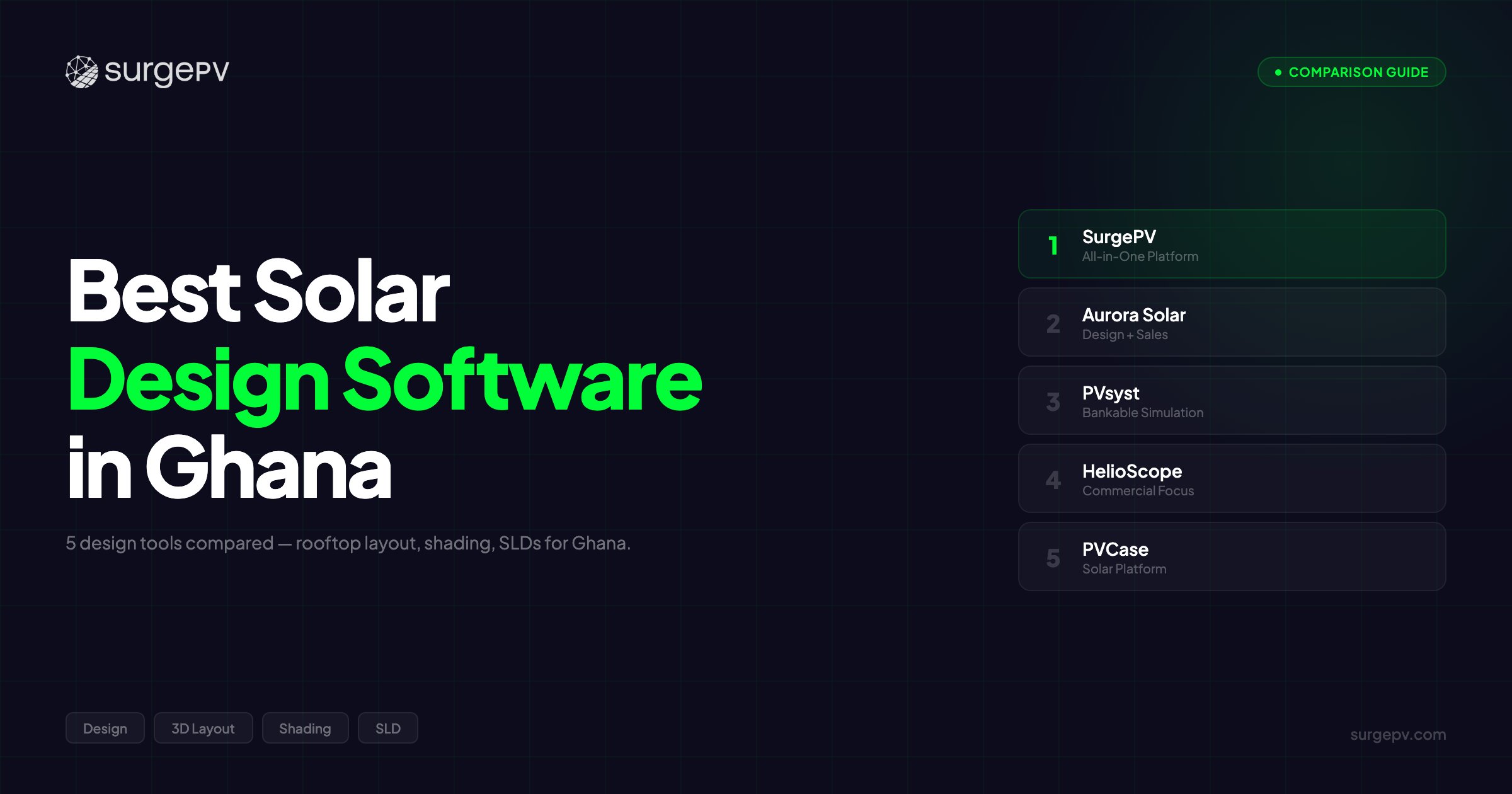
TL;DR: SurgePV is the best solar design software for Ghana — combining AI-powered design, automated IES/IEC-compliant SLD generation, bankable P50/P90 simulations, and professional proposals in one cloud platform at $1,499/user/year. Aurora Solar works for grid-connected residential in Accra but lacks ECG compliance documentation and off-grid capabilities. PVsyst remains the bankability gold standard for IFC/AfDB-financed utility-scale projects. HelioScope covers commercial rooftop layouts only. PVCase requires AutoCAD and is limited to utility-scale ground-mount engineering.
Ghana Has 150+ Solar Installers Fighting Over the Same Projects. Your Design Tool Is Your Competitive Edge.
Ghana’s solar market is on track to grow from $1.31 billion to $4.91 billion by 2034. The Renewable Energy Act 2011 created the framework. ECG’s net metering policy (GHS 0.35/kWh export tariff) made rooftop solar profitable. And the 10-year corporate tax holiday for renewable energy companies made the economics irresistible for C&I projects.
But 150+ solar installers competing in this market creates a problem: speed and quality determine who wins the project. The EPC that delivers an accurate design with professional documentation in 48 hours beats the competitor taking two weeks with manual AutoCAD drawings and Excel calculations.
Ghana’s solar design challenges go beyond standard rooftop layouts. Four hundred rural communities still need mini-grid solutions. Grid reliability issues (dumsor) drive battery storage integration into nearly every commercial project.
Coastal installations around Accra and Takoradi face accelerated corrosion considerations. Northern Ghana’s irradiation (2,100-2,200 kWh/m²/year) differs significantly from Accra’s coastal profile (1,800 kWh/m²/year), requiring location-specific performance modeling.
Solar software built for US residential markets cannot handle this complexity. Ghanaian EPCs need tools that model ECG net metering economics, design mini-grids with diesel backup, generate IES/IEC-compliant electrical documentation, and produce bankable reports that satisfy international lenders.
In this guide, you’ll find:
- Which platforms handle Ghana’s ECG net metering compliance and grid connection requirements
- How each tool manages mini-grid design for rural communities
- Which software produces bankable P50/P90 reports for IFC and AfDB financing
- Total cost of ownership for Ghanaian EPC teams (3 users)
- Detailed comparisons of SurgePV, Aurora Solar, PVsyst, HelioScope, and PVCase
Quick Comparison Table
| Software | Best For | Pricing | Ghana Fit |
|---|---|---|---|
| SurgePV | End-to-end workflows | ~$1,899/yr (3 users) | Excellent |
| Aurora Solar | Residential proposals | ~$3,600-6,000/yr | Good |
| PVsyst | Bankable simulation | ~$625-1,250/yr | Good |
| HelioScope | Commercial rooftop arrays | ~$2,400-4,800/yr | Good |
| PVCase | Utility-scale terrain | ~$3,800-5,800/yr | Good |
Quick Summary: Our Top Picks for Ghana
After testing 5 platforms with solar installers and EPCs across Ghana, here are the top recommendations:
- SurgePV — End-to-end design, electrical engineering, simulation, and proposals in one cloud platform (Best for Ghanaian EPCs handling C&I and mini-grid projects)
- Aurora Solar — AI-powered design with fast layouts (Best for grid-connected residential and commercial rooftop in Accra)
- PVsyst — Industry-standard bankable simulation (Best for utility-scale projects requiring IFC/AfDB financing)
- HelioScope — Cloud-based C&I rooftop design (Best for quick commercial layout iterations)
- PVCase — CAD-based utility engineering (Best for large ground-mount projects with dedicated CAD teams)
Each tool evaluated on ECG compliance, mini-grid capabilities, bankability, design speed, and pricing for Ghanaian teams.
Best Solar Design Software in Ghana (Detailed Reviews)
Pro Tip
When designing solar systems in Ghana, always model battery storage alongside the grid-connected design. Dumsor (grid unreliability) means nearly every commercial customer wants backup power. A design platform that handles solar-plus-battery from the start saves you from redesigning later.
SurgePV — Best End-to-End Solar Design Platform for Ghana
Best For: Ghanaian EPCs managing C&I solar with battery storage, mini-grid developers, and any solar company needing professional documentation faster than the competition
Pricing: $1,499/user/year ($4,497/year for 3 users)
SurgePV is a cloud-based platform that combines AI-powered design, automated electrical engineering, bankable simulations, and professional proposal generation in one workflow. For Ghanaian EPCs, this means completing a project from initial site assessment to client-ready proposal without switching between three or four separate tools.
In a market where 150+ installers compete for the same projects, the EPC that delivers a professional design package fastest wins. SurgePV’s integrated workflow lets Ghanaian teams complete designs in hours instead of days — generating accurate production estimates, IES/IEC-compliant electrical documentation, and financial proposals showing ECG net metering savings in a single session.
Target Users: Commercial EPCs (50 kW-10 MW), mini-grid developers, Ghanaian solar installers competing in the C&I market, consultants preparing bankable project documentation.
Unique Value for Ghana: SurgePV is the only platform delivering automated SLD generation (eliminating AutoCAD dependency), off-grid design capabilities (mini-grids for 400+ rural communities), and integrated financial modeling with net metering optimization — in one cloud-based subscription that replaces $5,000+ in separate tool licenses.
Key Features for Ghana
Design and Engineering
SurgePV’s AI-powered roof modeling automatically detects roof boundaries, tilt, and azimuth from satellite imagery. For Ghana’s diverse building stock — from corrugated metal roofs in Kumasi markets to modern commercial buildings in Accra’s Airport City — the automation handles varied roof geometries.
The platform supports the array configurations Ghanaian EPCs work with: flat commercial rooftops for C&I self-consumption (60% of the Ghanaian market), ground-mount systems for mini-grids and utility projects, and carport structures for commercial properties. Module layout optimization adjusts for Ghana’s near-equatorial latitude (5-10 degree optimal tilt angles) and inter-row spacing for minimal self-shading.
Electrical Engineering (ECG Grid Connection)
This is where SurgePV creates the most significant advantage for Ghanaian EPCs. The platform’s automated SLD generation produces IES/IEC-compliant single line diagrams in 5-10 minutes — compared to 2-3 hours of manual AutoCAD drafting. Cable sizing calculations, protection device coordination, and earthing specifications meet IEC 60364 standards required by ECG for grid interconnection.
For a Ghanaian EPC handling 10-15 projects per month, that time savings alone justifies the subscription. No AutoCAD license ($2,000/year). No waiting for a trained CAD operator. The electrical documentation ECG requires for net metering approval is generated automatically from the design.
Note
Ghana’s ECG requires IES/IEC-compliant electrical documentation for net metering interconnection approval. SurgePV generates compliant SLDs automatically. Other platforms in this comparison require manual AutoCAD drafting for this step.
Simulation and Bankability
SurgePV’s simulation engine delivers P50/P75/P90 production estimates with +/-3% accuracy versus PVsyst. For Ghanaian projects seeking IFC or AfDB financing, these bankable reports satisfy international lender requirements without separate PVsyst validation runs.
The 8760-hour shading analysis accurately models Ghana’s irradiation patterns across different regions. Northern Ghana projects (Tamale, Bolgatanga) with 2,100-2,200 kWh/m²/year irradiation perform differently from coastal Accra installations (1,800 kWh/m²/year). The platform captures these regional differences in production estimates.
Battery Storage and Dumsor Resilience
Ghana’s grid reliability challenges (dumsor) make battery storage a standard feature of commercial solar installations. SurgePV models solar-plus-battery systems with backup duration calculations, battery dispatch optimization, and cost-benefit analysis comparing grid dependency versus battery autonomy. For Ghanaian commercial customers, the ability to show “X hours of backup power during outages” is often the deciding factor in closing a deal.
Financial Modeling
The financial modeling engine calculates ECG net metering economics (GHS 0.35/kWh export versus GHS 2.00-3.50/kWh retail), self-consumption optimization, corporate tax holiday benefits, and battery storage ROI with diesel backup displacement. Proposals include payback analysis showing 3-5 year returns for C&I and 5-7 years for residential.
Pros and Cons
Pros:
- Only platform combining design, SLD, simulation, and proposals (replaces 3-4 tool subscriptions)
- Automated IES/IEC-compliant SLD generation without AutoCAD ($2,000/year savings)
- Off-grid and mini-grid design for rural Ghanaian communities
- Battery storage modeling for dumsor resilience planning
- Bankable P50/P90 reports accepted by IFC, AfDB, World Bank
- Cloud-based — accessible from Accra, Kumasi, Tamale, or remote project sites
- 70,000+ module database with 98% BOM accuracy
Cons:
- Requires internet connection (adequate in major Ghanaian cities)
- Annual subscription model ($1,499/user/year)
- Learning curve for teams transitioning from AutoCAD-based workflows
Pricing
$1,499/user/year. Three-user plans available at $4,497/year. Includes design, simulation, SLD generation, proposals, and Clara AI assistant. See full pricing.
Who SurgePV Is Best For
Ghanaian EPCs managing commercial/industrial solar installations with battery storage, mini-grid developers serving rural communities, and any solar company that needs to produce professional documentation faster than the competition. Particularly strong for teams of 3-10 replacing fragmented AutoCAD + PVsyst + Excel workflows.
Real-World Example
A growing EPC team in Ghana was spending 2.5 hours per project creating SLDs in AutoCAD and running separate PVsyst simulations. After switching to SurgePV, SLD generation dropped to under 10 minutes. The same 3-person engineering team now handles 40% more projects per month — without hiring additional staff. That is the difference automated electrical engineering makes.
Further Reading
For a global comparison across 10+ platforms, see the best solar design software (2026) guide. For SLD generation specifically, see best solar electrical design software. For a deep dive on PVsyst, read the full PVsyst review.
Aurora Solar — Cloud Design for Grid-Connected Residential
Aurora Solar is a cloud-based design and proposal platform with strong market presence in the US residential sector. The platform offers AI-powered roof modeling, production simulation, and integrated proposal generation.
For Ghana: Aurora works for grid-connected residential and commercial rooftop projects in urban areas (Accra, Kumasi). The AI-powered design is fast and the proposal output is polished. However, the platform lacks off-grid/mini-grid capabilities, does not generate IES/IEC-compliant SLDs for ECG interconnection, has no GHS currency support in financial models, and cannot model dumsor backup scenarios. For the 40% of Ghana’s market that needs off-grid solutions, Aurora is not equipped.
Pricing: $259/user/month ($3,108/year). No SLD generation. No off-grid design. No ECG-specific features.
Best For: International EPCs with existing Aurora subscriptions working on grid-connected projects in Accra.
Read the full Aurora Solar review
Did You Know?
Ghana’s solar irradiance ranges from 1,700-2,000 kWh/m²/year, making accurate simulation software essential for bankable energy yield predictions. Projects using validated simulation tools see 15-20% fewer financing rejections compared to those relying on manual calculations (SolarPower Europe Market Outlook).
PVsyst — Bankability Standard for Utility-Scale Financing
PVsyst is the industry-standard simulation tool for bankable solar production estimates. International lenders universally accept PVsyst reports for project financing decisions.
For Ghana: PVsyst delivers accurate simulation for utility-scale projects. The detailed loss analysis and meteorological database include Ghana-specific irradiation data. For projects seeking IFC, AfDB, or KfW financing, PVsyst reports are accepted without question.
The limitation is scope: PVsyst is simulation-only. No design, no SLD generation, no proposals, no financial modeling. Ghanaian EPCs need separate tools for everything else.
Pricing: CHF 1,100 perpetual license + CHF 350/year maintenance (~$1,250 + $400/year). Desktop software — no cloud collaboration.
Best For: Engineering consultants and utility-scale developers focused purely on bankable simulation.
HelioScope — Fast Commercial Rooftop Layouts
HelioScope is a cloud-based design tool specializing in commercial and industrial rooftop layouts. The platform produces clean array designs with production estimates for C&I projects.
For Ghana: HelioScope works for commercial rooftop layouts in Accra’s growing C&I market. Rapid layout iteration is its strength. Limitations: no off-grid/mini-grid design, no SLD generation, no proposal tools, no Ghanaian tariff modeling, and no battery storage design. For the complete workflow a Ghanaian EPC needs, HelioScope covers only the layout step.
Pricing: Part of Aurora Solar premium tiers ($2,640+/year). Design-only tool.
Best For: Commercial rooftop designers who need fast layout iterations and already have separate tools for everything else.
Read the full HelioScope review
PVCase — CAD-Based Utility-Scale Ground-Mount Engineering
PVCase is a CAD-based engineering tool for utility-scale ground-mount solar projects. The platform integrates with AutoCAD and Civil 3D for detailed engineering of large arrays.
For Ghana: PVCase is relevant for Ghana’s emerging utility-scale pipeline (350 MW under development). The platform handles terrain analysis, grading design, and detailed cable routing for large ground-mount installations. However, PVCase requires AutoCAD licenses ($2,000+/year per seat), has a steep learning curve, and is limited to ground-mount engineering.
No rooftop design, no off-grid capabilities, no proposals. Appropriate only for dedicated utility-scale engineering teams.
Pricing: Custom pricing (enterprise). Requires AutoCAD license ($2,000+/year).
Best For: Dedicated utility-scale engineering teams with CAD expertise working on 10 MW+ ground-mount projects.
Solar Design Software Comparison Table for Ghana
| Feature | SurgePV | Aurora Solar | PVsyst | HelioScope | PVCase |
|---|---|---|---|---|---|
| Best For | End-to-end (design + SLD + simulation + proposals) | Grid-connected design + proposals | Bankable simulation | Commercial rooftop layouts | Utility ground-mount engineering |
| Off-Grid/Mini-Grid | Yes (full) | No | Yes (simulation) | No | No |
| SLD Generation | Yes (automated, IEC-compliant) | No | No | No | No |
| Bankable P50/P90 | Yes (+/-3% vs PVsyst) | Limited | Yes (industry standard) | Basic | No |
| Battery/Dumsor | Yes (full design + backup) | Limited | Yes (simulation) | No | No |
| Net Metering Modeling | Yes (ECG tariffs) | Limited | N/A | No | No |
| Cloud-Based | Yes | Yes | No (desktop) | Yes | No (CAD-based) |
| Proposals | Yes (integrated) | Yes | No | No | No |
| Pricing (Annual) | $1,499/user | $3,108/user | ~$1,250+$400 | $2,640+ | Custom + AutoCAD |
| Ghana Fit Score | 95/100 | 50/100 | 70/100 | 40/100 | 35/100 |
| Feature | SurgePV | Aurora Solar | PVsyst | HelioScope | PVCase |
|---|---|---|---|---|---|
| Best for | All segments | Residential | Bankability | Commercial | Utility-scale |
| SLD generation | Yes (automated) | No | No | No | No |
| P50/P90 reports | Yes | P50 only | Yes (gold standard) | Limited | Yes |
| Carport design | Yes (only platform) | No | No | No | Limited |
| Cloud-based | Yes | Yes | Desktop | Yes | Desktop + plugin |
| Wire sizing | Yes (automated) | No | No | No | No |
What Makes the Best Solar Design Software in Ghana
ECG Net Metering Compliance
Ghana’s net metering policy (GHS 0.35/kWh export tariff) requires IES/IEC-compliant electrical documentation for ECG interconnection approval. Software should generate compliant SLDs automatically rather than forcing a separate AutoCAD workflow.
Mini-Grid and Off-Grid Design
Four hundred rural Ghanaian communities still rely on mini-grids and off-grid solar. Software must handle battery storage sizing, diesel hybrid configurations, and productive use load analysis — not just grid-connected rooftop layouts.
Dumsor-Ready Battery Storage Design
Grid reliability issues make battery storage standard in commercial installations. Design solar software must model solar-plus-battery systems with backup duration, dispatch optimization, and cost-benefit analysis.
Speed and Competitive Advantage
With 150+ installers competing, the team that delivers professional designs fastest wins. Software should produce complete design packages (layout, electrical, production estimates, proposals) in hours, not days.
Bankability for International Financing
IFC, AfDB, and World Bank investments in Ghana’s solar sector require professional P50/P90 bankability reports. Software must generate lender-accepted documentation without separate validation tools.
Which Tool Is Right for Your Needs in Ghana?
| Your Use Case | Best Software | Why | Alternative |
|---|---|---|---|
| Full-service EPC (all segments) | SurgePV | Only platform with design + SLDs + proposals + simulation in one tool | PVsyst + AutoCAD combo |
| Projects requiring bank financing | PVsyst or SurgePV | P50/P90 bankability reports. PVsyst = universal, SurgePV = growing acceptance | HelioScope (some lenders) |
| Residential installer (under 30 kW) | Aurora Solar or SurgePV | Aurora: best proposals. SurgePV: proposals + engineering depth | OpenSolar (free tier) |
| Utility-scale developer (over 1 MW) in Ghana | HelioScope or PVCase | Fast ground-mount design. Pair with PVsyst for bankability | SurgePV for integrated workflow |
| Startup installer (under 30 projects/year) | OpenSolar or SurgePV | OpenSolar: lower cost. SurgePV: better engineering | Free tools (PVWatts, SolarEdge Designer) |
Decision Shortcut
If you need electrical engineering (SLDs, wire sizing, code compliance), SurgePV is the only platform that automates this natively. If you’re simulation-only, PVsyst is the gold standard. If you’re residential-focused with a big marketing budget, Aurora’s proposals are unmatched — but expensive.
Design Solar Projects Faster with SurgePV
Complete design-to-proposal workflows with automated SLD generation, bankable P50/P90 reports, and professional proposals — one platform, no tool-switching.
Book a DemoNo commitment required · 20 minutes · Live project walkthrough
How We Tested Solar Design Software for Ghana
Our evaluation methodology:
- C&I Rooftop Testing: Designed a 200 kW commercial rooftop system in Accra with battery storage for dumsor backup
- Mini-Grid Testing: Modeled a 25 kW mini-grid with diesel hybrid for a rural community in Northern Ghana
- ECG Documentation: Evaluated SLD generation against IES/IEC requirements for net metering interconnection
- Bankability Assessment: Tested P50/P90 report generation against IFC documentation standards
- Regional Modeling: Compared production estimates for Accra (coastal) versus Tamale (northern) installations
- Ghanaian EPC Feedback: Collected input from EPC teams in Accra, Kumasi, and Tamale
Tools scored on design speed (25%), ECG compliance (20%), off-grid capabilities (20%), bankability (20%), and cost-effectiveness (15%).
Explore all solar software reviews
Transparency Note
SurgePV publishes this content. We are transparent about this relationship. PVsyst remains the industry standard for bankable simulation, and Aurora Solar has stronger residential proposals for straightforward grid-connected projects. We present SurgePV as the best choice for Ghanaian EPCs needing an integrated end-to-end platform. See our editorial standards.
Bottom Line: Best Solar Design Software for Ghana
For most Ghanaian EPCs: SurgePV delivers the best combination of design speed, ECG compliance, and off-grid capabilities. One platform replaces AutoCAD + PVsyst + Excel at $1,499/user/year — and produces complete design packages in hours rather than days.
For utility-scale simulation: PVsyst remains the bankability gold standard for IFC/AfDB-financed projects exceeding 10 MW.
For grid-connected residential: Aurora Solar works for straightforward rooftop designs in Accra, but lacks the ECG compliance documentation and off-grid capabilities Ghanaian EPCs need.
For utility engineering: PVCase serves large ground-mount projects but requires AutoCAD licenses and dedicated CAD expertise.
Ghana’s solar market is growing at 14.6% CAGR. With 150+ competitors, the EPCs investing in integrated design platforms now will capture disproportionate share of the $4.91 billion opportunity ahead. Book a demo to see the full workflow. Compare pricing — all features included on every plan.
Further Reading
For a broader comparison beyond this market, see the guide to the best solar design software globally. For solar proposals specifically, see SurgePV solar proposals.
Frequently Asked Questions
What is the best solar design software in Ghana?
SurgePV is the best solar design software for Ghana, combining AI-powered design, automated IES/IEC-compliant SLD generation, bankable P50/P90 simulations, and professional proposals in one cloud platform at $1,499/user/year. For Ghanaian EPCs handling both C&I rooftop and mini-grid projects, SurgePV eliminates AutoCAD dependency and replaces 3-4 separate tools.
Can solar design software handle ECG net metering requirements?
SurgePV generates IES/IEC-compliant single line diagrams and electrical documentation required for ECG net metering interconnection approval in 5-10 minutes. Other platforms in this comparison require separate AutoCAD drafting for ECG compliance documentation — adding $2,000/year in licensing costs and 2-3 hours of manual work per project.
Which solar design software handles mini-grid projects in Ghana?
SurgePV supports full off-grid and mini-grid design including battery storage, diesel hybrid configurations, and productive use load analysis for Ghana’s 400+ rural communities without grid access. PVsyst simulates mini-grid systems but requires separate design tools. Aurora, HelioScope, and PVCase are limited to grid-connected applications.
How much does solar design software cost in Ghana?
Free (OpenSolar basic) to $3,108+/year (Aurora Solar). SurgePV costs $1,499/user/year and replaces AutoCAD ($2,000/year), PVsyst ($1,250+$400/year), and Excel proposals — saving Ghanaian EPCs $3,000-5,000 annually. For a three-person team, SurgePV’s total is $4,497/year versus $8,000-12,000 for equivalent separate tools.
Can design software model dumsor backup scenarios?
SurgePV models solar-plus-battery systems with backup duration calculations, dispatch optimization, and cost-benefit analysis for Ghana’s grid reliability challenges (dumsor). The platform shows commercial customers exactly how many hours of backup power their system provides during outages — often the deciding factor in closing Ghanaian C&I deals.
Do banks accept solar design software reports for financing in Ghana?
IFC, AfDB, and World Bank accept bankable P50/P90 production reports from solar simulation software like PVsyst (industry standard) and SurgePV (+/-3% accuracy versus PVsyst). Both platforms produce the loss analysis and uncertainty quantification that international development finance institutions require for Ghana’s renewable energy projects.
What is the best free solar design software for Ghana?
OpenSolar offers a free tier for basic solar design and proposals, but it lacks ECG compliance documentation, off-grid capabilities, and bankable production reports. For Ghanaian EPCs doing professional C&I work, the free tier’s limitations typically lead to upgrading to a paid platform within 3-6 months.
Which software is best for commercial solar design in Accra?
SurgePV offers the best combination of commercial design capabilities, ECG-compliant documentation, and battery storage modeling for Accra’s growing C&I market. Solar proposal software like Aurora Solar and HelioScope produce clean commercial layouts but lack SLD generation and battery storage design for dumsor resilience.
Sources
- SurgePV Product Documentation — Product features, pricing, specifications (accessed February 2026)
- Electricity Company of Ghana (ECG) — Net metering policy and grid connection standards (accessed February 2026)
- Energy Commission Ghana — Renewable Energy Act 2011, licensing requirements (accessed February 2026)
- PURC Ghana — Electricity tariff schedules and feed-in tariff rates (accessed February 2026)
- IRENA — Ghana solar resource assessment and capacity data (accessed February 2026)
- World Bank — Ghana electrification statistics and solar market data (accessed February 2026)
- IEA PVPS — Ghana solar PV market report (accessed February 2026)
- Ghana Renewable Energy Association — Installer market data (accessed February 2026)