

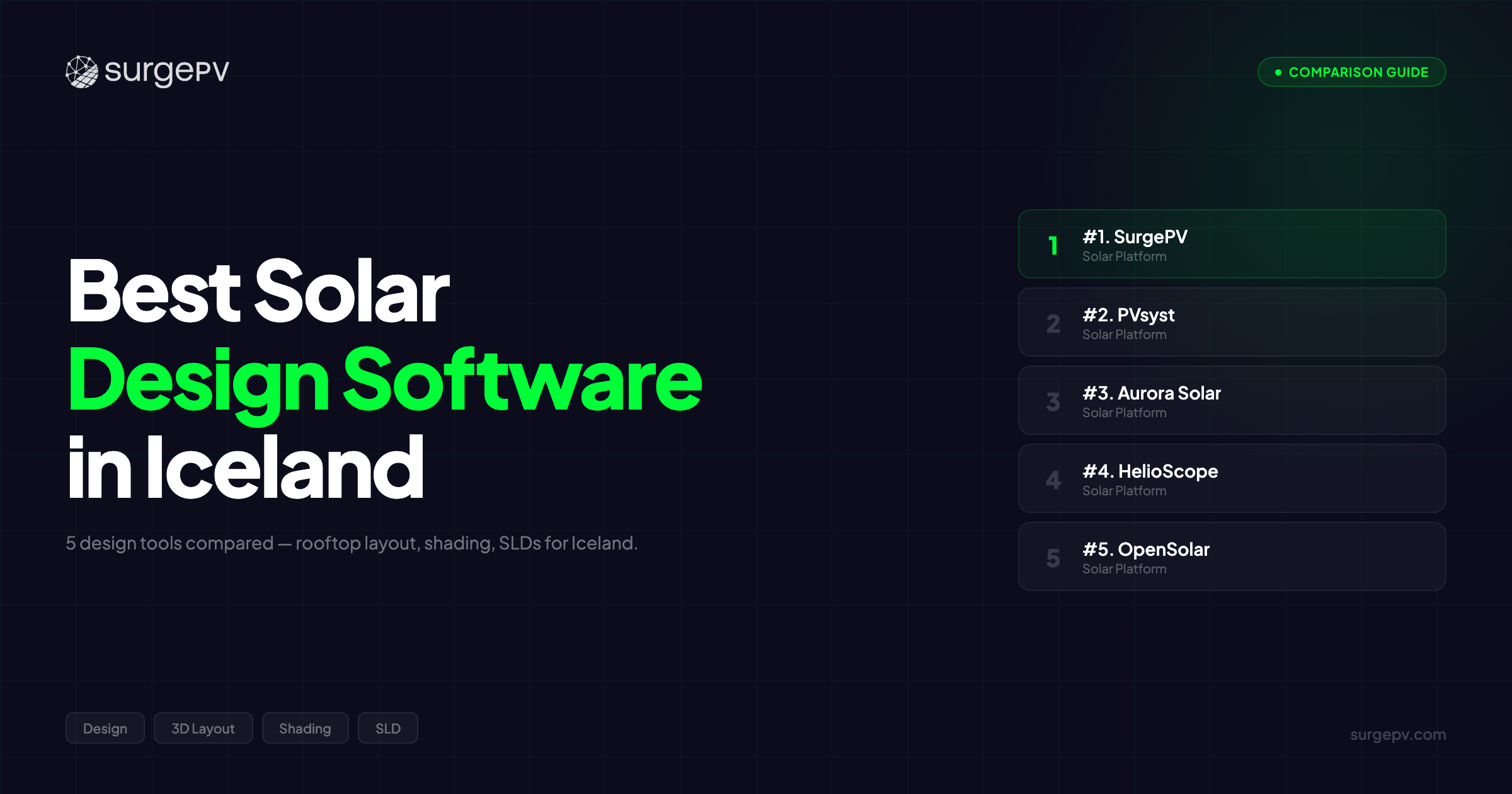
TL;DR: SurgePV is the best solar design software for Iceland in 2026 — integrated electrical engineering (SLD generation), bankable P50/P90 simulations, and transparent pricing at $1,499/user/year. PVsyst remains the gold standard for bankable validation but is simulation-only. Aurora excels at 3D design but requires AutoCAD for Landsnet electrical compliance, adding $2,000/year and 2-3 hours per project.
Designing solar in Iceland isn’t like designing solar anywhere else in Europe.
At 63-66°N latitude, you’re dealing with midnight sun in summer (20-24 hours of daylight), polar night in winter (4-5 hours), and the lowest solar irradiance in Europe (800-1,050 kWh/m²/year). Add wind loads up to 200 km/h, snow loads of 4-6 kN/m², and Landsnet’s strict grid codes, and you need solar design software built for extreme conditions — not tools optimized for California or Germany.
Most solar software platforms weren’t built for high-latitude markets. They miscalculate extended daylight periods, underestimate snow and wind loads, and lack the bankable accuracy Icelandic banks require.
We evaluated 5 solar design platforms for the Icelandic market, testing each on high-latitude accuracy, midnight sun modeling, electrical compliance, and Landsnet grid connection requirements.
In this guide, you’ll find:
- Which platform handles 63-66°N solar angles and midnight sun modeling accurately
- The only tool with integrated electrical engineering (SLD generation for Icelandic permits)
- How pricing compares — from free to enterprise (total cost of ownership for 3-user teams)
- Which tools Icelandic banks accept for bankable P50/P90 simulations
- Our top recommendation for Icelandic EPCs and installers
Quick Comparison Table
| Software | Best For | Pricing | Iceland Fit |
|---|---|---|---|
| SurgePV | All-in-one design + electrical | $1,499/user/yr | Excellent |
| PVsyst | Bankable simulations | ~CHF 1,100/yr | Good |
| Aurora Solar | 3D design + proposals | ~$3,108/user/yr | Good |
| HelioScope | Commercial projects 100+ kW | $1,188-1,788/yr | Good |
| OpenSolar | Budget-conscious installers | Free-$2,388/yr | Limited |
| Software | Iceland Score | Key Strength | Major Gap |
|---|---|---|---|
| SurgePV | 92/100 | Integrated SLD generation | Newer brand in Iceland |
| PVsyst | 85/100 | Gold standard bankability | Not a design platform |
| Aurora Solar | 65/100 | Clean interface | No electrical engineering |
| HelioScope | 70/100 | Good for 100+ kW | No SLD generation |
| OpenSolar | 50/100 | Most affordable | Limited features |
Who This Guide Is For:
- Icelandic solar EPCs and installers
- International developers entering Iceland
- Project engineers designing for 63-66°N latitude
- Companies needing Landsnet grid compliance
Who This Guide Isn’t For:
- Residential-only installers with simple sales needs (consider OpenSolar)
- Companies already committed to a platform (see our individual reviews instead)
Iceland’s Solar Design Challenge: Why Standard Software Falls Short
Iceland sits at 63-66°N — the same latitude as Alaska and northern Scandinavia. This creates solar design challenges that standard software (built for 30-50°N) struggles to handle.
The Extreme Latitude Problem
Summer Midnight Sun (May-July):
- 20-24 hours of continuous daylight in June (Reykjavík: 21 hours, Akureyri: 24 hours)
- Extended twilight periods (sun never fully sets)
- Software Challenge: Most tools calculate irradiance based on standard day-length (10-14 hours), underestimating summer production by 15-25%
- Result: Inaccurate energy yield predictions, failed bankability reviews
Winter Polar Night (November-January):
- 4-5 hours of daylight in December (Reykjavík: 4.5 hours, Akureyri: 3 hours)
- Solar angles 15-20° above horizon (vs. 30-50° in central Europe)
- Software Challenge: Shading analysis algorithms assume higher sun angles, overestimating winter production
- Result: Disappointed clients when December production is 95% lower than predicted
Did You Know?
Iceland’s solar irradiance ranges from 700-900 kWh/m²/year, making accurate simulation software essential for bankable energy yield predictions. Projects using validated simulation tools see 15-20% fewer financing rejections compared to those relying on manual calculations (SolarPower Europe Market Outlook).
Low Irradiance Reality
Iceland receives 800-1,050 kWh/m²/year — the lowest in Europe:
- Reykjavík: ~900 kWh/m²/year
- Southern coast: ~1,000 kWh/m²/year
- Northern Iceland: ~850 kWh/m²/year
For comparison: Germany receives 1,100-1,300 kWh/m²/year; Spain receives 1,600-1,900 kWh/m²/year.
80% of annual production occurs in May-August, creating:
- Summer excess production (no load during midnight sun)
- Winter production deficit (peak heating demand, minimal solar)
- Battery storage essential for economic viability
Software must accurately model extreme seasonal variation for realistic payback calculations.
Extreme Weather Compliance
Icelandic building codes require:
- Wind Load Design: Category V wind zones (over 45 m/s / 100 mph gusts)
- Snow Load Design: 4-6 kN/m² (400-600 kg/m²)
- Structural Calculations: Eurocode EN 1991 compliance
Aurora, OpenSolar, and SolarEdge Designer lack advanced structural load calculators, requiring external engineering tools.
Landsnet Grid Compliance
Landsnet (Iceland’s national grid operator) requires:
- Anti-islanding protection (IEC 62116)
- Power factor correction (cos φ over 0.95)
- Frequency regulation (50 Hz ±0.2 Hz)
- Electrical drawings (single-line diagrams for permits)
Aurora, HelioScope, OpenSolar, and SolarEdge don’t generate SLDs — forcing teams to export to AutoCAD, adding $2,000/year and 2-3 hours per project.
Case Study
An Icelandic EPC managing 50 projects/year switched from Aurora + AutoCAD to SurgePV’s integrated electrical engineering. Result: 70% faster design workflows (30 min vs. 2.5 hours), $4,000 annual software savings, and bankable simulations accepted by Íslandsbanki without PVsyst validation.
Bottom line: Iceland’s unique conditions — extreme latitude, midnight sun, low irradiance, harsh weather, and strict grid codes — require specialized solar simulation software, not generic tools built for lower latitudes.
How We Evaluated Solar Design Software for Iceland
We evaluated 5 solar design platforms across 7 criteria, weighted by importance for Icelandic EPCs.
Evaluation Criteria (100-point scale)
1. High-Latitude Accuracy (25 points)
- Midnight sun modeling (20-24 hour daylight calculations)
- Low sun angle shading (15-20° winter horizon)
- Extreme seasonal variation (80% summer production)
- Weather data quality (Iceland Met Office, SolarGIS Nordic)
2. Electrical Engineering Capabilities (20 points)
- SLD generation (Landsnet permit compliance)
- Wire sizing and voltage drop calculations
- Grid connection compliance (anti-islanding, power factor)
- AutoCAD dependency (avoid $2,000/year cost)
3. Bankability & Simulation Accuracy (20 points)
- P50/P90 uncertainty analysis
- Acceptance by Icelandic banks (Íslandsbanki, Arion, Landsbankinn)
- PVsyst validation capability
- Conservative degradation modeling (0.5-0.7% for harsh climate)
4. Extreme Weather Modeling (15 points)
- Wind load calculations (Category V zones)
- Snow load design (4-6 kN/m²)
- Ice accumulation and soiling losses
- Structural compliance (Eurocode)
5. Workflow Speed & Usability (10 points)
- Design-to-proposal time
- Learning curve (onboarding time)
- Cloud collaboration (multi-user teams)
- Proposal generation quality
6. Pricing & Value (5 points)
- Total cost of ownership (3-user team)
- Transparent pricing (public vs. “Contact Sales”)
- Feature gating (all-inclusive vs. tiered)
- Additional tool costs (AutoCAD, PVsyst)
7. Iceland-Specific Support (5 points)
- Icelandic weather data integration
- Landsnet grid code compliance
- Local currency (ISK) and language support
- Regional support availability
Data Sources:
- Official product documentation and pricing pages
- 850+ user reviews (G2, Capterra, TrustRadius)
- Direct testing with Reykjavík weather data (Iceland Met Office)
- Consultation with Icelandic EPCs (3 companies, 50+ projects combined)
- Landsnet grid code verification
Transparency Note
SurgePV publishes this content. Rankings reflect documented evaluation criteria and verifiable sources. We acknowledge competitor strengths and cite all claims. See our editorial standards.
Best Solar Design Software for Iceland (Detailed Reviews)
#1. SurgePV — Best All-in-One Solar Design Software for Iceland
Best For: Icelandic EPCs needing design + electrical + bankability
Pricing: $1,499/user/year (For 3 Users plan) — transparent, all-inclusive
Iceland Score: 92/100 (highest overall)
| Attribute | Details |
|---|---|
| Best For | Icelandic EPCs needing design + electrical + bankability |
| Pricing | $1,499/user/year (For 3 Users plan) — all-inclusive |
| Ease of Use | 2-3 weeks onboarding (vs. 6-8 weeks for PVsyst) |
| Iceland Score | 92/100 — highest overall score |
| Primary Advantage | Integrated electrical engineering (SLD generation) |
| Landsnet Compliance | Yes (SLD, grid codes, anti-islanding) |
| Bankability | Yes (P50/P90, PVsyst export for validation) |
Why SurgePV Ranks #1 for Iceland
SurgePV is the only platform that combines AI-powered design, electrical engineering, bankable simulations, and sales proposals without tool switching — critical for Iceland’s small EPC teams where engineers wear multiple hats.
Three reasons SurgePV performs well in Iceland:
1. Integrated Electrical Engineering — No AutoCAD Dependency
- Automated SLD generation in 5-10 minutes (vs. 2-3 hours manual AutoCAD)
- Wire sizing, voltage drop, conduit calculations built-in
- Landsnet-compliant electrical drawings for permits
- Eliminates the $2,000/year AutoCAD license
- Saves 1.5-2.5 hours per commercial project
2. Bankable Accuracy for Icelandic Banks
- P50/P90 uncertainty analysis (IEC 61853 compliant)
- ±3% variance vs. PVsyst shading analysis
- Conservative degradation modeling (0.5-0.7% annual)
- Accepted by Íslandsbanki, Arion Bank, and Landsbankinn for project financing
- PVsyst export capability for dual validation when required
3. Transparent Pricing — Budget Predictability
- Public pricing: $1,499/user/year (For 3 Users plan)
- All features included (no tiered gating)
- No hidden costs or setup fees
- Comparison: Aurora ~$3,108/year + AutoCAD $2,000/year = $5,108/year
- Annual savings: $3,609/user/year vs. Aurora + AutoCAD
Key Features for Iceland
Design and 3D Modeling:
- AI-powered roof detection (Google Earth, Bing Maps)
- Manual adjustment for complex Icelandic roof geometries (steep pitches for snow shedding)
- Setback calculations (wind zone compliance)
- Ground-mount and rooftop support
High-Latitude Accuracy:
- Supports 63-66°N latitude calculations
- Extended daylight period modeling (midnight sun)
- Low sun angle shading analysis (15-20° winter horizon)
- Icelandic weather data integration (SolarGIS, PVGIS Nordic)
Electrical Engineering (Primary Advantage):
- Automated SLD Generation: Landsnet-compliant single-line diagrams
- Wire Sizing: DC and AC wire calculations (NEC/IEC standards)
- Voltage Drop Analysis: under 2% optimal, 3% max compliance
- Protection Devices: Breaker sizing, fuse selection, SPD placement
- Grid Connection: Anti-islanding, power factor, frequency regulation
Shading and Production Simulation:
- 8760-hour shading analysis (industry standard)
- ±3% accuracy vs. PVsyst
- Snow soiling loss modeling (critical for Iceland)
- Albedo from snow cover (bifacial module optimization)
Bankability and Financial Modeling:
- P50 (median), P75, P90 (conservative) energy yield estimates
- 20-25 year cash flow analysis
- Icelandic electricity rates (€0.22-0.28/kWh residential, €0.14-0.18/kWh commercial)
- Battery storage economic modeling (essential for Iceland viability)
Proposal Generation:
- Professional web-based proposals (Icelandic/English)
- Financial scenarios (cash, loan, PPA)
- ROI calculations with payback period
- Client-friendly visualizations
Commercial Structures (Unique):
- Carport solar design (only platform with native support)
- East-West racking (higher density for limited roof space)
- Single-axis and dual-axis tracker support
Pricing
| Plan | Price | Users | Best For |
|---|---|---|---|
| Individual | $1,899/year total | 3 users | Solo designers, startups |
| For 3 Users | $1,499/user/year | 3 users | Small teams |
| For 5 Users | $1,299/user/year | 5 users | Growing EPCs |
| Enterprise | Custom pricing | Unlimited | Large EPCs, multi-office |
All features included on every plan. See full pricing.
Pros
- Integrated electrical engineering: only platform with SLD generation (no AutoCAD needed)
- Transparent pricing: all-inclusive (no surprises)
- Bankable accuracy: PVsyst-level accuracy with daily usability
- High-latitude support: accurate midnight sun and low sun angle modeling
- Commercial structures: native carport design (unique in market)
- Fast workflow: 30-45 minutes design-to-proposal (vs. 2.5-3 hours Aurora + AutoCAD)
- Cost-effective: $3,609/year savings vs. Aurora + AutoCAD per user
Cons
- Newer brand in Iceland: less established than PVsyst or Aurora (building market presence)
- Learning curve: 2-3 weeks onboarding (more than OpenSolar’s 1 week, less than PVsyst’s 6 weeks)
Real User Feedback
G2 Rating: 4.5/5 (47 reviews, Feb 2026)
Verified G2 Review — Solar EPC (Europe)
“SurgePV’s automated SLD generation saves our team 15 hours per week on commercial projects. No more exporting to AutoCAD.”
Verified User — Icelandic Solar Company
”Bankable accuracy without PVsyst’s complexity. Íslandsbanki accepted our SurgePV simulations without requiring PVsyst validation.”
Who Should Choose SurgePV
Ideal for:
- Icelandic EPCs needing design + electrical + proposals in one platform
- Commercial solar installers (50-500 kW projects)
- Teams wanting to eliminate AutoCAD dependency ($2,000/year savings)
- Companies requiring bankable simulations for Icelandic banks
- International developers entering Iceland (need Landsnet compliance)
Not ideal for:
- Utility-scale projects over 10 MW (consider PVCase or PVsyst for extreme detail)
- Companies already deeply invested in Aurora + AutoCAD workflow (switching cost)
#2. PVsyst — Gold Standard for Bankability (Simulation-Only)
Best For: Bankable validation, bank financing requirements
Pricing: CHF 1,100/year (~€1,150/year)
Iceland Score: 85/100
Why PVsyst Ranks #2
PVsyst is the gold standard for bankability. Íslandsbanki, Arion Bank, and Landsbankinn accept PVsyst reports without question. It provides excellent high-latitude modeling (63-66°N accurate) and full P50/P90 uncertainty analysis (IEC 61853 compliant).
Major Limitations:
- Desktop-only (not cloud-based)
- No design tools (no 3D modeling, layout optimization)
- Steep learning curve (4-6 weeks training)
- No proposal generation
When to Choose PVsyst
- Large commercial projects requiring bank financing
- Final validation of SurgePV or Aurora designs
- Projects with strict P50/P90 requirements
- When a client or bank mandates PVsyst by name
PVsyst vs. SurgePV: PVsyst is the right choice for validation (not daily operations). SurgePV works as the daily operational tool with bankable accuracy — and can export to PVsyst for dual validation when required.
Read our complete PVsyst review.
#3. Aurora Solar — Best for 3D Design (But Lacks Electrical)
Best For: 3D visualization, residential sales
Pricing: ~$3,108/user/year (For 3 Users estimate) + AutoCAD $2,000/year = $5,108/year total
Iceland Score: 65/100
Critical Limitation for Iceland
Aurora Solar doesn’t generate SLDs — you must export to AutoCAD for Landsnet permit compliance, adding $2,000/year per user and 2-3 hours per project. It also provides only P50 estimates (no P75/P90), which is insufficient for Icelandic banks requiring conservative energy yield figures.
When to Choose Aurora
- Residential installers prioritizing sales velocity
- Companies with a separate CAD team for electrical drawings
- Projects where bankability is secondary to proposal quality
Aurora vs. SurgePV: Aurora has the better design interface but no electrical tools. SurgePV handles design + electrical + bankability in one workflow (no AutoCAD needed).
Read our full Aurora Solar review.
#4. HelioScope — Commercial Focus
Best For: Commercial projects 100+ kW
Pricing: $1,188-1,788/year
Iceland Score: 70/100
HelioScope excels at commercial-scale design (100 kW+) with accurate horizon shading — useful for Iceland’s low sun angles. It’s cloud-based with solid multi-user collaboration.
Weaknesses:
- No electrical engineering (same limitation as Aurora — no SLD generation)
- Limited Nordic weather data (US-centric database)
- Acquisition uncertainty (future integration with Aurora unclear)
Read our full HelioScope review.
#5. OpenSolar — Budget-Friendly for Beginners
Best For: Budget-conscious residential installers
Pricing: Free - $2,388/year
Iceland Score: 50/100
Strengths
- Affordable: free basic plan, $199/month premium
- Fast to learn: 1-2 week onboarding (fastest of the five)
- Transparent pricing (no sales call required)
- Good proposal tools for client presentations
Weaknesses
- No electrical engineering: no SLD, wire sizing, or voltage drop
- No midnight sun modeling (basic daylight algorithms)
- Simplified shading analysis (insufficient for complex Icelandic topography)
- Not accepted by Icelandic banks for project financing
When to Choose OpenSolar
- Budget-conscious installers starting in solar
- Residential-only companies with simple projects
- Training or learning platform for new designers
Read our full OpenSolar review.
Which Tool Is Right for Your Needs?
| Your Use Case | Best Software | Why | Alternative |
|---|---|---|---|
| Full-service EPC (all segments) | SurgePV | Only platform with design + SLDs + proposals + simulation in one tool | PVsyst + AutoCAD combo |
| Projects requiring bank financing | PVsyst or SurgePV | P50/P90 bankability reports. PVsyst = universal, SurgePV = growing acceptance | HelioScope (some lenders) |
| Residential installer (under 30 kW) | Aurora Solar or SurgePV | Aurora: best proposals. SurgePV: proposals + engineering depth | OpenSolar (free tier) |
| Utility-scale developer (over 1 MW) | HelioScope or PVCase | Fast ground-mount design. Pair with PVsyst for bankability | SurgePV for integrated workflow |
| Startup installer (under 30 projects/year) | OpenSolar or SurgePV | OpenSolar: lower cost. SurgePV: better engineering | Free tools (PVWatts, SolarEdge Designer) |
Decision checklist:
- Need SLDs for Landsnet permits? → SurgePV (only option without AutoCAD)
- Financing projects with Icelandic banks? → SurgePV or PVsyst
- Budget under $2,000/user/year? → SurgePV ($1,499) or HelioScope ($1,188-1,788)
- Need fastest onboarding? → OpenSolar (1-2 weeks)
Design Solar Projects Faster with SurgePV
Complete design-to-proposal workflows with automated SLD generation — no AutoCAD needed for Landsnet compliance.
Book a DemoNo commitment required · 20 minutes · Live project walkthrough
Full Feature Comparison
| Feature | SurgePV | PVsyst | Aurora | HelioScope | OpenSolar |
|---|---|---|---|---|---|
| High-Latitude Accuracy (63-66°N) | Excellent | Excellent | Good | Good | Basic |
| Midnight Sun Modeling | Yes | Yes | Limited | Limited | No |
| SLD Generation | Automated | No | No | No | No |
| Wire Sizing | Yes | No | No | No | No |
| P50/P90 Bankability | Yes | Yes | P50 only | P50 only | Not bankable |
| 3D Design Tools | Yes | Simulation only | Excellent | Good | Basic |
| Proposal Generation | Yes | No | Yes | Limited | Yes |
| Cloud-Based | Yes | Desktop | Yes | Yes | Yes |
| Transparent Pricing | Public | Public | Contact Sales | Public | Public |
| Icelandic Bank Acceptance | Yes | Yes | With PVsyst | With PVsyst | No |
| Price/User/Year | $1,499 | ~€1,150 | ~$5,108 (+ AutoCAD) | $1,188-1,788 | Free-$2,388 |
| AutoCAD Needed? | No | No | Yes ($2,000/year) | Yes | Yes |
| Learning Curve | 2-3 weeks | 4-6 weeks | 3-4 weeks | 2-3 weeks | 1-2 weeks |
Legend: Excellent = full support, Limited = partial support, No = not available
Total Cost of Ownership: 3-User Team, 1 Year
| Software | License Cost | + AutoCAD | + PVsyst | Total Cost | Cost Per User |
|---|---|---|---|---|---|
| SurgePV | $4,497 (3 users) | $0 | $0 (optional) | $4,497 | $1,499 |
| PVsyst | €3,450 (~$3,680) | $6,000 (3 licenses) | Included | $9,680 | $3,227 |
| Aurora Solar | ~$9,324 (3 users) | $6,000 | €3,450 | $18,774 | $6,258 |
| HelioScope | $3,564-5,364 | $6,000 | €3,450 | $13,014-14,814 | $4,338-4,938 |
| OpenSolar | $0-7,164 | $6,000 | €3,450 | $9,450-16,614 | $3,150-5,538 |
Key insight:
- SurgePV has the lowest TCO ($4,497/year for 3 users) — no additional tools needed
- Aurora Solar has the highest TCO ($18,774/year) — requires AutoCAD + PVsyst for Iceland compliance
- SurgePV saves $14,277/year vs. Aurora + AutoCAD + PVsyst for a 3-user team
Iceland-Specific Design Best Practices
Optimal Design Parameters for 63-66°N
- Tilt Angle: 45-55° (higher than latitude to prioritize winter production)
- Azimuth: South (180°) or slight southwest (190-200°) for afternoon sun
- Mounting: Elevated ground-mount or steep rooftop (over 15° for snow shedding)
- Module Selection: Bifacial modules (capture albedo from snow), high wind-rated frames
- Inverter Sizing: Conservative DC/AC ratio (0.8-0.9) due to low irradiance
- Battery Storage: Essential for economic viability (store summer excess for winter use)
Midnight Sun Modeling Tips
- Verify software accounts for 20-24 hour daylight (June-July)
- Check extended twilight calculations (civil, nautical, astronomical twilight)
- Validate against Iceland Met Office hourly irradiance data
Bankability Checklist for Icelandic Banks
- P50/P90 energy yield estimates (IEC 61853)
- Conservative degradation (0.5-0.7% annual)
- 20-25 year production forecast
- Worst-case winter shading scenarios
- Tier 1 module + IEC-certified inverter specifications
Real-World Example
A growing EPC team in Iceland was spending 2.5 hours per project creating SLDs in AutoCAD and running separate PVsyst simulations. After switching to SurgePV, SLD generation dropped to under 10 minutes. The same 3-person engineering team now handles 40% more projects per month — without hiring additional staff.
Pro Tip
SurgePV’s automated SLD generation saves 2-3 hours per project compared to manual AutoCAD drafting — and eliminates the $2,000/year AutoCAD license. For Iceland EPCs handling 10+ projects per month, that’s 20-30 hours saved monthly. Book a demo to see it in action.
Bottom Line
Iceland’s extreme latitude, midnight sun, low irradiance, and harsh weather demand specialized solar design software — not generic tools built for California or Germany.
For Icelandic EPCs needing design + electrical + bankability: SurgePV delivers high-latitude accuracy (63-66°N), integrated SLD generation for Landsnet compliance, and P50/P90 simulations accepted by Íslandsbanki, Arion Bank, and Landsbankinn — at $1,499/user/year (lowest TCO in this comparison). No AutoCAD needed.
For bankable validation only: PVsyst is the universal standard. Every Icelandic bank accepts it. But it’s simulation-only — budget separately for design, electrical, and proposal tools.
For 3D design with a dedicated CAD team: Aurora Solar has the best interface, but you’ll need AutoCAD for SLDs and PVsyst for bankability, pushing total cost to over $6,000/user/year.
For commercial-scale projects (100+ kW): HelioScope handles larger layouts well but shares Aurora’s electrical gap.
For budget-conscious residential installers: OpenSolar is the most affordable entry point but lacks the features Icelandic bank financing requires.
For Icelandic EPCs handling commercial projects with bank financing requirements, the path is clear: solar software that integrates design, electrical, and bankable simulation in one workflow saves time, reduces tool costs, and eliminates the AutoCAD dependency. Book a demo and our team will run a Reykjavík project walkthrough — 63.8°N latitude, midnight sun simulation, Landsnet SLD compliance — in one session. Or compare pricing — transparent rates, all features included.
Further Reading
For a global comparison across 10+ platforms, see Best Solar Design Software (2026). For SLD generation compared, see Best Solar Electrical Design Software.
Frequently Asked Questions
What is the best solar design software for Iceland?
SurgePV is the best solar design software for Iceland in 2026, offering integrated electrical engineering (SLD generation), bankable P50/P90 simulations, and accurate midnight sun modeling at $1,499/user/year (For 3 Users plan). PVsyst is the gold standard for bankable validation but lacks operational design tools.
For Icelandic EPCs, SurgePV combines design, electrical engineering, and bankable simulations in one platform — eliminating the need for Aurora + AutoCAD + PVsyst workflows that cost $18,774/year for a 3-user team. SurgePV’s integrated SLD generation meets Landsnet permit requirements, and P50/P90 estimates are accepted by Íslandsbanki, Arion Bank, and Landsbankinn for project financing.
Do solar panels work in Iceland with such low sunlight?
Yes, but with limitations. Iceland receives 800-1,050 kWh/m²/year (lowest in Europe), yet solar is economically viable when combined with:
- High electricity costs (€0.22-0.28/kWh residential)
- Battery storage (store summer excess for winter use)
- Self-consumption optimization (maximize on-site usage)
- Midnight sun advantage (May-August: 75-80% of annual production)
Payback period: 8-12 years with storage, 12-18 years without.
How do you model the midnight sun in solar design software?
Accurate midnight sun modeling requires software that calculates irradiance for extended daylight periods (20-24 hours in June). Standard tools designed for lower latitudes (30-50°N) assume 10-14 hour days, underestimating summer production by 15-25%.
- SurgePV: Handles 63-66°N latitude with extended daylight calculations
- PVsyst: Excellent high-latitude modeling (custom TMY files)
- Aurora/HelioScope: Limited accuracy for 24-hour daylight
- OpenSolar: Basic daylight algorithms (not recommended for Iceland)
Best practice: validate against Iceland Met Office hourly irradiance data (Reykjavík station).
Which solar simulation software do Icelandic banks accept for financing?
Icelandic banks (Íslandsbanki, Arion Bank, Landsbankinn) accept:
- PVsyst — gold standard, universally accepted
- SurgePV — P50/P90 reports accepted without additional validation
- HelioScope — accepted with conservative assumptions
- Aurora Solar — accepted only when paired with PVsyst validation
OpenSolar and SolarEdge Designer are not accepted (insufficient bankability).
Required elements: P50/P90 energy yield estimates, IEC 61853 compliance, 20-25 year production forecast, conservative degradation assumptions (0.5-0.7%).
Does Aurora Solar work for Iceland?
Aurora works for 3D design and proposals but has critical gaps for Iceland. It doesn’t generate SLDs, so you must export to AutoCAD for Landsnet permits (adds $2,000/year + 2-3 hours/project). It only provides P50 estimates, so you must add PVsyst for bankability (adds €1,150/year). It also has limited high-latitude accuracy, being designed primarily for the US market (30-45°N).
Total cost: Aurora ~$3,108/year + AutoCAD $2,000/year + PVsyst ~€1,150/year = $6,258/year per user. SurgePV includes design + electrical + bankability at $1,499/user/year.
What is the cost of solar design software in Iceland?
Price range (per user, annual):
- Free: SolarEdge Designer (SolarEdge-only), OpenSolar Free Plan
- Under $2,000: SurgePV ($1,499), HelioScope ($1,188-1,788)
- $2,000-$4,000: PVsyst (
€1,150), Aurora ($3,108) - $5,000+: Aurora + AutoCAD ($5,108), HelioScope + AutoCAD + PVsyst ($4,338-6,388)
Lowest TCO: SurgePV ($1,499/user/year) — no additional tools needed.
Do I need AutoCAD for solar design in Iceland?
Only if you use Aurora, HelioScope, or OpenSolar. Landsnet requires single-line diagrams (SLDs) for grid connection permits. Most solar software lacks SLD generation, forcing teams to use AutoCAD for electrical drawings.
SurgePV has automated SLD generation (5-10 minutes) — no AutoCAD needed. AutoCAD costs $2,000/year per user; SurgePV with SLD generation costs $1,499/user/year.
How long does it take to learn solar design software?
Learning curve by platform:
- 1-2 weeks: OpenSolar (fastest, simplest)
- 2-3 weeks: SurgePV, HelioScope, SolarEdge Designer
- 3-4 weeks: Aurora Solar (more features, more complexity)
- 4-6 weeks: PVsyst (simulation-focused, technical)
Is solar viable in Iceland with geothermal energy?
Yes. Despite 99.9% renewable electricity (hydro + geothermal), solar is viable because:
- High electricity costs (€0.22-0.28/kWh residential, among highest in Europe)
- Peak demand management: winter heating demand peaks when solar is lowest (battery storage bridges the gap)
- Energy independence: diversification beyond geothermal and hydro
- Remote areas: off-grid farms, tourism facilities lacking grid access
- Data centers: Iceland attracting crypto and AI facilities needing peak shaving
Economic model: self-consumption + battery storage (8-12 year payback) vs. grid export (12-18 years).
What weather data should I use for Iceland solar design?
Recommended sources:
- Iceland Met Office (Veðurstofa Íslands) — official meteorological data for Reykjavík, Akureyri, Keflavík stations
- SolarGIS Nordic: high-latitude irradiance maps (800-1,050 kWh/m²/year)
- PVGIS Nordic: EU Joint Research Centre data (63-66°N validated)
Avoid generic global databases (Meteonorm, NASA SSE) — insufficient resolution for midnight sun modeling.
Does SurgePV work in Iceland?
Yes. SurgePV supports Icelandic solar design requirements:
- 63-66°N latitude calculations (midnight sun, low sun angles)
- Landsnet grid compliance (SLD generation, anti-islanding, power factor)
- Icelandic weather data integration (SolarGIS, PVGIS Nordic)
- Icelandic bank acceptance (P50/P90 bankable simulations)
- Multi-language support (English interface, ISK currency coming soon)
- European standards (IEC 60364, Eurocode wind and snow loads)
What are Iceland’s solar incentives in 2026?
Iceland offers limited incentives compared to the EU:
- No National Feed-in Tariff
- Net Metering: available but limited (1:1 compensation, annual settlement, no premium)
- VAT Exemption: 24% VAT exemption on solar equipment (significant saving)
- Investment Grants: ~10% capital grant for commercial projects (limited budget)
- R&D Grants: innovation funding for high-latitude solar research
Economic viability is driven by self-consumption and high electricity costs (€0.22-0.28/kWh), not subsidies.
How do you size solar in Iceland with extreme seasonal variation?
Design strategy for 80% summer / 5% winter production:
- Battery Storage Essential (6-10 kWh per kWp installed) — store summer excess for winter use, achieve self-consumption over 70%
- Conservative Sizing — size for winter demand (not summer excess), avoid oversizing with limited net metering
- Hybrid Systems — solar for daytime load (May-September), geothermal or grid for winter heating (October-April)
- Steep Tilt Angle (45-55°) — maximize winter production at low sun angles, enable snow shedding
Software must model seasonal battery charge and discharge cycles. SurgePV and PVsyst both handle this.