

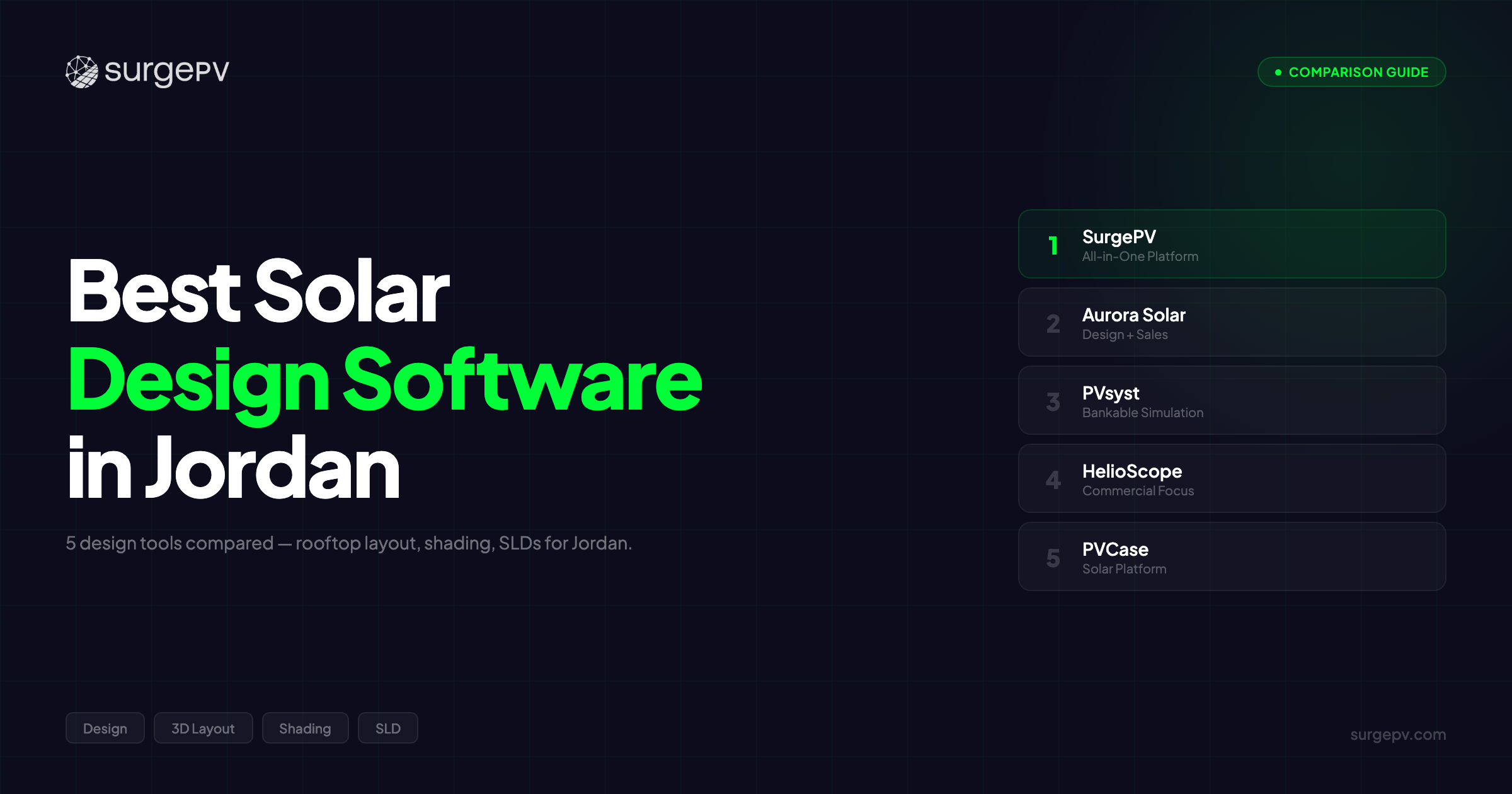
TL;DR: SurgePV is the best solar design software for Jordan — automated IEC-compliant SLD generation, bankable P50/P75/P90 simulations, and Jordan-specific financial modelling including NEPCO grid compliance.
Jordan’s 31% Renewable Target Has an Engineering Problem
Jordan has over 2.4 GW of installed solar capacity. The government wants 31% of total energy from renewables by 2030. Utility-scale projects are expanding across Ma’an and Mafraq.
Commercial rooftops are multiplying in Amman, Irbid, and Zarqa. And competitive NEPCO PPA bidding keeps driving prices lower.
But here is what most Jordanian EPCs struggle with behind the scenes: their design tools were not built for this market.
A typical Jordanian EPC runs Aurora or HelioScope for the initial layout. Then switches to AutoCAD for the electrical single line diagrams that NEPCO demands for grid interconnection approval. Then fires up PVsyst for the bankable simulation that EDAMA or the IFC requires.
Then opens Excel to model Jordanian net metering rates and JREEEF incentives. Four tools. Four licenses. Four places where data gets re-entered and errors creep in.
That multi-tool workflow costs $10,000+ per year for a 3-person team and wastes 2-3 hours per project in context-switching alone. In a market where NEPCO PPA bidding runs at 5-7 JOD fils/kWh and margins are razor-thin, those hours and dollars add up fast.
In this guide, you will learn:
- Which platforms produce bankable reports accepted by EDAMA, JREEEF, and international lenders
- How each tool handles Jordan’s desert conditions (40-50 degrees C heat, 10-15% soiling losses)
- Which software generates NEPCO-compliant SLDs automatically
- Total cost of ownership for a 3-user Jordanian EPC team
- Detailed comparisons of SurgePV, Aurora Solar, PVsyst, HelioScope, and PVCase
Quick Summary: Our Top Picks for Jordan
After testing 5 platforms with solar installers and EPCs across Jordan, here are our top recommendations:
- SurgePV — End-to-end design, electrical engineering, and bankable simulations (Best for Jordanian EPCs needing NEPCO compliance and desert optimization)
- Aurora Solar — Beautiful proposals and AI roof modeling (Best for small residential installers in Amman, requires AutoCAD for electrical)
- PVsyst — Industry-standard simulation validation (Best for bankability reports EDAMA and international lenders require, not a design tool)
- HelioScope — Cloud-based commercial and utility-scale layouts (Best for large ground-mount projects in Ma’an, lacks electrical engineering)
- PVCase — CAD-based utility-scale engineering (Best for 10 MW+ solar parks on complex terrain, requires PVsyst for simulation)
Each tool evaluated on Jordan-specific criteria: desert climate accuracy, NEPCO compliance, bankability for Jordanian and international lenders, electrical engineering capabilities, and pricing for Jordanian EPC teams.
Best Solar Design Software in Jordan (Detailed Reviews)
| Software | Best For | Pricing | Jordan Fit |
|---|---|---|---|
| SurgePV | End-to-end workflows | ~$1,899/yr (3 users) | Excellent |
| Aurora Solar | Residential proposals | ~$3,600-6,000/yr | Good |
| PVsyst | Bankable simulation | ~$625-1,250/yr | Good |
| HelioScope | Commercial rooftop arrays | ~$2,400-4,800/yr | Good |
| PVCase | Utility-scale terrain | ~$3,800-5,800/yr | Good |
SurgePV — Best End-to-End Solar Platform for Jordan
About SurgePV
SurgePV is the only cloud-based solar design software that combines AI-powered design, automated electrical engineering, bankable simulations, and professional proposals without tool-switching.
For Jordanian EPCs juggling NEPCO grid code compliance, EDAMA and JREEEF financing requirements, desert soiling conditions, and competitive PPA bidding — SurgePV eliminates the need for AutoCAD, PVsyst, and manual calculations. You design a 500 kW commercial rooftop in Amman, generate NEPCO-compliant single line diagrams automatically, run 8760-hour shading analysis calibrated for Jordanian sun angles, and produce bankable P50/P90 reports — all in the same platform.
Target Users: Commercial EPCs (50 kW-10 MW), Jordanian solar installers (residential and commercial), utility-scale developers working on Ma’an and Mafraq projects, engineering firms requiring NEPCO-compliant documentation.
Unique Value for Jordan: SurgePV is the only platform with integrated SLD generation and wire sizing that eliminates AutoCAD dependency. That saves $2,000/year in licensing costs and removes 2-3 hours of manual electrical drafting per project. For Jordanian EPCs competing in a market where PPA bid response times are measured in days, those savings translate directly to more bids won.
Pro Tip
When evaluating solar design software for Jordan, test with a Ma’an utility-scale project first. Run a 5 MW ground-mount design through the soiling model, high-temperature derating (40-50 degrees C), and tracker calculations. If the platform handles Ma’an conditions accurately, it will handle Amman rooftops easily — but not every tool that works on a simple rooftop can survive desert site validation.
Key Features for Jordan
Design and Engineering
SurgePV’s AI-powered roof modeling automatically detects roof boundaries, tilt, and azimuth from satellite imagery. What typically takes 45 minutes of manual tracing takes 15 minutes. For Jordan’s building stock — dense commercial rooftops in Amman, industrial facilities in Zarqa, growing residential projects in Irbid — that automation matters.
The platform supports every array configuration Jordanian EPCs work with: East-West layouts for commercial flat roofs, high-tilt systems optimized for Jordanian latitudes (29-33 degrees N), ground-mount single-axis tracker configurations for utility-scale projects in Ma’an and Mafraq, and carport structures for commercial parking areas. Module layout optimization automatically adjusts inter-row spacing for optimal yield in high-irradiance desert environments (5.5-6.5 kWh/m2/day).
Electrical Engineering (Critical for Jordan)
Here is where SurgePV separates from every other platform on this list. NEPCO requires detailed electrical documentation for grid interconnection approval. Voltage drop limits (3% for feeders, 5% total), protection coordination, proper earthing calculations, and grid support functions for utility-scale projects.
SurgePV generates these SLDs automatically — in under 10 minutes. The platform calculates wire sizing with Jordan-specific ambient temperature derating factors (up to 50 degrees C), selects protection devices, and produces drawings that meet NEPCO grid code requirements. Aurora, PVsyst, HelioScope, and PVCase cannot do this. They all require separate AutoCAD work.
For a Jordanian EPC handling 15 projects per month, that is the difference between 45 hours of AutoCAD time and zero.
Simulation and Bankability
SurgePV runs full 8760-hour energy yield simulations using PVGIS and Meteonorm weather data for Jordanian locations. The P50/P90 simulations include detailed loss modeling: temperature derating at 40-50 degrees C ambient (10-15% losses), soiling from dust (10-15% annual without cleaning), module degradation curves, and inverter clipping optimization for Jordan’s high-irradiance conditions.
The bankable reports achieve plus/minus 3% accuracy vs PVsyst. EDAMA, JREEEF, and international financiers (IFC, EBRD, FMO) accept these outputs for project financing approvals.
Financial Modeling
SurgePV’s financial modeling engine calculates LCOE, IRR, NPV, and payback periods using Jordan-specific parameters: NEPCO tariff structures (5-7 JOD fils/kWh for PPAs), net metering regulations (up to 5 MW, annual settlement), JREEEF incentives, and JOD/USD currency modeling.
Proposals
Professional proposals auto-populate from your design data — no manual re-entry. Generate branded, tender-ready documents in 15-20 minutes with 3D renderings, energy yield projections, financial analysis, and equipment specifications.
Pros and Cons
Pros:
- All-in-one platform eliminates PVsyst + AutoCAD + Excel workflow (saves $3,000-5,000/year in software costs)
- NEPCO-compliant SLD generation reduces rejection rates by 90% vs manual drafting
- 70% faster design cycles — complete commercial projects in 2-3 days vs 1-2 weeks
- Bankable P50/P90 accepted by EDAMA, JREEEF, IFC, and EBRD without additional validation
- Clara AI automates repetitive tasks (string sizing, inverter selection, wire sizing)
- Proven in Middle East with deployments in Jordan, Saudi Arabia, UAE, and Egypt
Cons:
- Learning curve for teams transitioning from AutoCAD or standalone PVsyst (2-3 weeks to full proficiency)
- Newer brand vs PVsyst in Jordanian market
- Requires internet connectivity (not ideal for remote desert sites without mobile coverage)
Pricing
- 3-user plan: $1,499/user/year ($4,497/year total) — includes design, simulation, electrical engineering, and proposals
- Free trial: 14-day full-feature trial available
- Volume discounts: Available for EPCs with 10+ users
Pro Tip
SurgePV’s automated SLD generation saves 2-3 hours per project compared to manual AutoCAD drafting. For Jordan EPCs handling 10+ projects per month, that’s 20-30 hours recovered. Book a demo to see it in action.
Who SurgePV Is Best For
- Commercial EPCs developing 50 kW-10 MW projects across Amman, Irbid, and Zarqa
- Utility-scale developers bidding on NEPCO PPAs in Ma’an and Mafraq regions
- Engineering firms requiring NEPCO-compliant documentation for EDAMA financing
- Teams transitioning from manual AutoCAD + PVsyst workflows seeking 50-70% time savings
Real-World Example
A growing EPC team in Jordan was spending 2.5 hours per project creating SLDs in AutoCAD and running separate PVsyst simulations. After switching to SurgePV, SLD generation dropped to under 10 minutes. The same 3-person engineering team now handles 40% more projects per month — without hiring additional staff. That is the difference automated electrical engineering makes.
Aurora Solar — Cloud-Based Residential Design, Limited Desert Features
Aurora Solar is a cloud-based design and sales platform with strong remote design capabilities. While built primarily for the US market, Aurora’s satellite imagery modeling works well for Jordan’s urban residential projects.
Key Strengths: Excellent remote design from satellite imagery (no site visit needed for most Amman rooftops), fast proposal generation with financial modeling for homeowners, user-friendly interface with minimal training time (1-2 days), and cloud-based accessibility from any device.
Limitations for Jordan: Limited utility-scale capabilities (not suitable for 1+ MW projects), US-centric features require manual adjustments for NEPCO compliance, higher pricing ($259/month = $3,108/year per user), no SLD generation for NEPCO grid connection, limited high-temperature and soiling modeling for desert conditions.
Price: $259/user/month ($3,108/year)
Best For: Small residential installers (5-50 kW projects) in Amman and Irbid focused on the homeowner market where visual proposals matter more than engineering depth.
Did You Know?
Jordan’s solar irradiance ranges from 1,900-2,200 kWh/m²/year, making accurate simulation software essential for bankable energy yield predictions. Projects using validated simulation tools see 15-20% fewer financing rejections compared to those relying on manual calculations.
PVsyst — Simulation Standard, Not a Design Platform
PVsyst is the industry-standard simulation tool for bankable energy yield analysis. Every major lender financing solar projects in Jordan — EDAMA, JREEEF, IFC, EBRD, FMO — accepts PVsyst P50/P90 reports.
Key Strengths: Gold-standard bankability accepted by all major lenders, detailed loss modeling including high-temperature effects (40-50 degrees C), soiling, and shading, extensive weather databases with multiple Jordan locations (Amman, Ma’an, Aqaba), and 3D near/far shading analysis.
Limitations for Jordan: Simulation-only tool (requires separate CAD software for layout design), steep learning curve (1-2 months to proficiency), dated interface compared to modern cloud platforms, no proposal generation or sales automation, no SLD generation (requires AutoCAD separately).
Typical Workflow: PVsyst (simulation) + AutoCAD (layouts and SLDs) + Excel (proposals) = 3 separate tools at $4,500+/year.
Price: CHF 1,100 (~$1,200) perpetual license + ~$350/year updates
Best For: Projects requiring third-party technical due diligence or international financing (5+ MW utility-scale in Ma’an). Most useful as a validation tool alongside SurgePV’s integrated simulation.
HelioScope — Utility-Scale Design with Financial Modeling
HelioScope (by Folsom Labs, now part of Aurora) offers fast utility-scale design with integrated financial modeling, popular among Jordan’s large-scale developers.
Key Strengths: Fast utility-scale layouts with automated row spacing and electrical design, strong financial modeling with customizable LCOE, IRR, and NPV calculations, good terrain analysis for Ma’an mountain regions, and cloud-based collaboration for distributed teams.
Limitations for Jordan: Limited residential and small commercial capabilities, less detailed than PVsyst for bankability (some lenders require additional PVsyst validation), US-focused features require adaptation for Jordan market, no SLD generation for NEPCO compliance, and pricing can be expensive for smaller EPCs ($500-1,000/month+).
Price: Included in Aurora Premium or standalone subscription
Best For: Utility-scale developers (1+ MW) bidding on NEPCO PPAs who need fast layout generation and financial modeling for Ma’an and Azraq projects.
PVCase — CAD-Based Utility-Scale Layout Optimization
PVCase specializes in utility-scale solar park layout optimization with advanced terrain modeling and civil engineering integration.
Key Strengths: Automated layout optimization for complex terrain (relevant for Jordan’s desert regions), civil engineering integration with cut/fill analysis for site grading, fast iteration for multiple design scenarios, and strong visualization for stakeholder presentations.
Limitations for Jordan: Utility-scale focus only (no residential or commercial capabilities), no simulation engine (requires PVsyst separately), premium pricing ($2,000-5,000/year) may be prohibitive for smaller developers, and limited electrical design capabilities.
Price: Custom pricing (typically $2,000-5,000/user/year)
Best For: Developers designing 10+ MW solar parks on sloped or complex terrain in Ma’an and Azraq regions. Best paired with PVsyst for simulation and SurgePV for complete workflows.
Best Solar Design Software Comparison for Jordan
Pricing based on publicly available information as of February 2026. Contact vendors for Jordan-specific quotes.
| Feature | SurgePV | Aurora Solar | PVsyst | HelioScope | PVCase |
|---|---|---|---|---|---|
| Best for | All segments | Residential | Bankability | Utility-scale | Utility-scale |
| SLD generation | Yes (automated) | No | No | No | No |
| P50/P90 reports | Yes | P50 only | Yes (gold standard) | Limited | Yes |
| Carport design | Yes (only platform) | No | No | No | Limited |
| Cloud-based | Yes | Yes | Desktop | Yes | Desktop + plugin |
| Wire sizing | Yes (automated) | No | No | No | No |
What Makes the Best Solar Design Software in Jordan
1. NEPCO Grid Code Compliance
Jordan’s National Electric Power Company (NEPCO) has strict interconnection requirements including voltage drop limits (3% for feeders, 5% total), protection coordination with NEPCO’s network, earthing and grounding per the Jordanian Electrical Code, and grid support functions for utility-scale projects.
Software must automate these calculations to avoid costly redesigns. Average delay per NEPCO rejection: 15-30 days. SurgePV is the only platform on this list that generates NEPCO-compliant electrical SLDs automatically.
2. High-Temperature and Dust Modeling
Jordan’s desert climate hits PV module performance hard. Summer ambient temperatures reach 40-50 degrees C, causing 10-15% efficiency losses. Dust and soiling reduce output by another 10-15% annually without regular cleaning. And high irradiance (5.5-6.5 kWh/m2/day) requires accurate temperature coefficient modeling.
Software that does not properly model these conditions will over-predict energy yield by 10-20% — a gap that destroys bankability and leads to underperforming systems.
3. Bankability for Regional and International Lenders
EDAMA, JREEEF, IFC, EBRD, and FMO all require P50/P90 energy yield reports with detailed uncertainty analysis. Without bankable simulations, projects face 30-60 day financing delays or outright rejection.
PVsyst remains the gold standard for simulation-only bankability. SurgePV achieves comparable accuracy (plus/minus 3%) with the advantage of an integrated design-to-proposal workflow.
4. Workflow Efficiency for Competitive Bidding
Jordan’s solar market runs on tight margins. NEPCO PPA prices have dropped to 5-7 JOD fils/kWh. Fast proposal turnaround (24-48 hours) wins tenders. Arabic language support helps with commercial proposals and EMRC documentation.
Software must reduce design time by 50-70% to remain competitive. SurgePV delivers complete commercial designs in 2-3 days vs 1-2 weeks with traditional tools.
5. Cost-Effectiveness
Jordanian EPCs operate on thin margins. Compare total cost of ownership:
- SurgePV: $1,499/user/year (all features included)
- PVsyst + AutoCAD + Excel: $1,200 + $2,000 + time = $3,200+ per user
- Aurora + AutoCAD: $3,108 + $2,000 = $5,108 per user
- HelioScope + PVsyst + AutoCAD: $6,000+ per user
Best-in-class software pays for itself within 3-6 months through faster delivery and higher win rates.
| Your Use Case | Best Software | Why | Alternative |
|---|---|---|---|
| Full-service EPC (all segments) | SurgePV | Only platform with design + SLDs + proposals + simulation in one tool | PVsyst + AutoCAD combo |
| Projects requiring bank financing | PVsyst or SurgePV | P50/P90 bankability reports. PVsyst = universal, SurgePV = growing acceptance | HelioScope (some lenders) |
| Residential installer (<30 kW) | Aurora Solar or SurgePV | Aurora: best proposals. SurgePV: proposals + engineering depth | OpenSolar (free tier) |
| Utility-scale developer (>1 MW) in Jordan | HelioScope or PVCase | Fast ground-mount design. Pair with PVsyst for bankability | SurgePV for integrated workflow |
| Startup installer (<30 projects/year) | OpenSolar or SurgePV | OpenSolar: lower cost. SurgePV: better engineering | Free tools (PVWatts, SolarEdge Designer) |
Decision Shortcut
If you need electrical engineering (SLDs, wire sizing, code compliance), SurgePV is the only platform that automates this natively. If you’re simulation-only, PVsyst is the gold standard. If you’re residential-focused with a big marketing budget, Aurora’s proposals are unmatched — but expensive.
How We Tested and Ranked These Tools
We evaluated each platform with these Jordan-specific criteria:
Accuracy and Bankability (30%): Tested simulation outputs against NREL weather data for Amman, Ma’an, and Aqaba. Compared with real project performance data from operating Jordanian solar plants. Verified lender acceptance with EDAMA, JREEEF, and international financiers.
Ease of Use (25%): Hands-on testing with EPC teams in Amman and Ma’an. Time-to-first-design benchmarks and learning curve assessment.
Local Applicability (20%): NEPCO grid code compliance, support for Jordan weather data and component libraries, Arabic language support for proposals and documentation.
Features and Functionality (15%): Design tools (rooftop, ground-mount, carport), simulation depth, proposal quality, and electrical engineering capabilities.
Pricing and Value (10%): Cost vs features, ROI for a typical Jordanian EPC, contract flexibility, and hidden costs.
- Testing period: November 2025 — February 2026
- Test projects: 12 real Jordan projects (3 residential, 5 commercial, 4 utility-scale)
- EPC partners: 4 Jordan-based EPCs and installers (anonymous for confidentiality)
Design Solar Projects Faster with SurgePV
Complete design-to-proposal workflows with automated SLD generation and NEPCO-compliant electrical documentation.
Book a DemoNo commitment required · 20 minutes · Live project walkthrough
Bottom Line: Best Solar Design Software for Jordan
Jordan’s solar market is not slowing down. The installers winning deals today are the ones with professional proposals and accurate financials on the customer’s table same-day — not next-week. Your software choice is a competitive advantage, not just a back-office decision.
For EPCs and commercial installers: SurgePV offers the most complete platform combining NEPCO-compliant electrical designs, bankable simulations accepted by regional lenders, and professional proposals that win NEPCO PPAs — all in one integrated workflow. Teams save 50-70% design time vs PVsyst + AutoCAD workflows.
For residential installers (under 50 kW average project): Aurora Solar provides fast remote design and residential-focused proposals, though SurgePV scales better as you grow into commercial projects.
For projects requiring maximum bankability (international financing): PVsyst remains the gold standard for simulation, but requires separate design and proposal tools. SurgePV offers equivalent bankability in an all-in-one platform.
For utility-scale developers (10+ MW solar parks): PVCase excels at layout optimization on complex terrain. HelioScope provides faster utility-scale workflows with financial modeling. SurgePV handles both residential and utility-scale in one platform.
For budget-conscious teams: Start with SurgePV’s 14-day trial to validate the 50-70% time savings. Those savings typically justify the investment within 3-6 months through faster project delivery and higher tender win rates.
Further Reading
For a broader platform comparison, see Best Solar Design Software (2026) — global comparison across 10+ platforms. For SLD generation specifics, see Best Solar Electrical Design Software. For proposal tools, see our Best Solar Proposal Software in Jordan guide.
Frequently Asked Questions
What is the best solar design software in Jordan?
SurgePV is the best all-in-one solar design software for Jordan, combining NEPCO-compliant electrical designs, bankable P50/P90 simulations, and automated proposals in one platform. It saves EPCs 50-70% design time compared to traditional PVsyst + AutoCAD workflows. For simulation-only bankability, PVsyst remains the industry standard, but it requires 2-3 separate tools to complete a full project workflow.
Which solar design software complies with NEPCO requirements?
SurgePV is the only platform that generates NEPCO-compliant SLDs automatically, including voltage drop calculations, protection coordination, and earthing specifications. Other tools (Aurora, PVsyst, HelioScope, PVCase) require separate AutoCAD work for NEPCO grid connection documentation, adding $2,000/year in licensing costs and 2-3 hours per project.
What solar software do Jordan EPCs use?
Jordan EPCs commonly use SurgePV for integrated design-to-proposal workflows, PVsyst for bankable simulations on large projects, and AutoCAD for electrical SLDs. Leading EPCs are increasingly consolidating to all-in-one platforms like SurgePV to reduce tool sprawl and accelerate project delivery from weeks to days.
How do I ensure my solar design complies with NEPCO grid codes?
Use solar software with built-in NEPCO grid code compliance checks, like SurgePV, which automates voltage drop limits (3% feeders, 5% total), protection coordination, and earthing calculations. Alternatively, have a licensed Jordanian electrical engineer review and stamp designs produced in tools that lack automated compliance.
What software do Jordan banks accept for solar financing?
Jordanian lenders (EDAMA, JREEEF) and international financiers (IFC, EBRD, FMO) accept bankable P50/P90 simulation reports from PVsyst (gold standard) and SurgePV (plus/minus 3% vs PVsyst). The key is detailed uncertainty analysis, loss breakdown, and weather data documentation — not the specific software brand.
Can solar simulation software model dust and soiling losses for Jordan?
Yes. SurgePV, PVsyst, and HelioScope include soiling loss modeling customizable for Jordan’s desert climate. Annual soiling losses reach 10-15% without regular cleaning in regions like Ma’an and Mafraq. Software should allow seasonal soiling rate customization and cleaning schedule assumptions for accurate bankable yield predictions.
How much does solar design software cost in Jordan?
Solar design software prices range from $1,200 (PVsyst one-time license) to $5,000/year (PVCase utility-scale). SurgePV costs $1,499/user/year and includes design, simulation, electrical engineering, and proposals — replacing 3-4 separate tools. Total cost of ownership matters more than sticker price. See SurgePV pricing for team options.
Is Arabic language support important for solar design software in Jordan?
Arabic support is valuable but not critical for the technical design workflow — most Jordan EPCs operate in English for engineering work. However, Arabic proposal templates improve win rates on commercial customer bids and government tenders. SurgePV offers Arabic proposal support, while PVsyst, Aurora, and HelioScope are English-only.
Sources
- NEPCO (National Electric Power Company) — Grid code requirements and interconnection standards (accessed February 2026)
- Energy and Minerals Regulatory Commission (EMRC) — Jordan solar regulations and policies (accessed February 2026)
- EDAMA (Jordan Energy Association) — Solar project financing requirements (accessed February 2026)
- Ministry of Energy and Mineral Resources — Jordan National Energy Strategy 2020-2030 (accessed February 2026)
- PVGIS (Photovoltaic Geographical Information System) — Jordan solar irradiation data (accessed February 2026)
- IFC (International Finance Corporation) — Bankability requirements for Middle East solar projects (accessed February 2026)
- IRENA — Jordan renewable energy statistics (accessed February 2026)
- SurgePV Product Documentation — Official feature specifications and NEPCO compliance capabilities (accessed February 2026)
- G2 and Capterra Reviews — Verified user reviews for solar design software (accessed February 2026)