

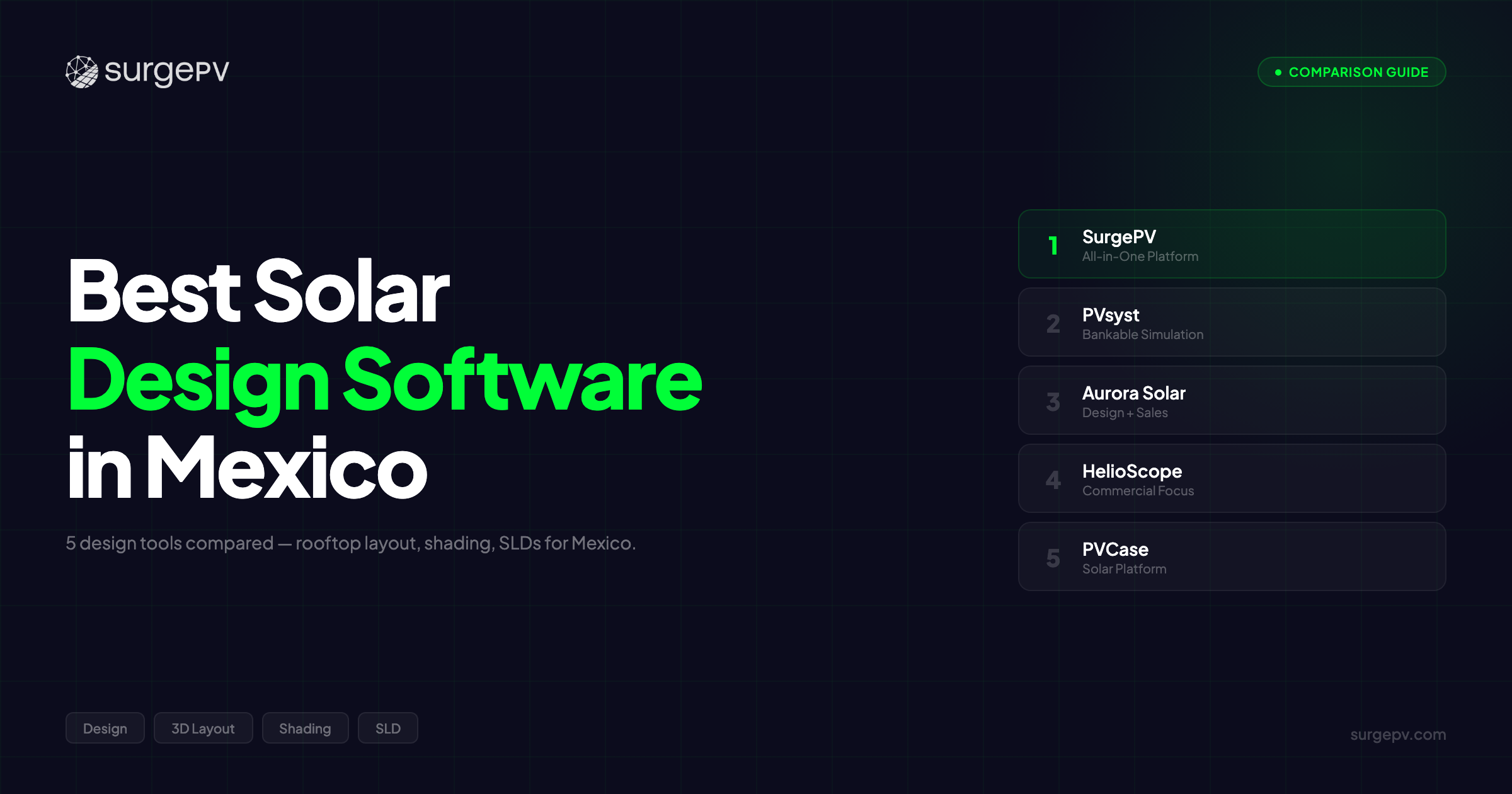
TL;DR: SurgePV is the top pick for Mexican EPCs — the only platform with automated SLD generation, NOM-adaptable electrical engineering, and bankable P50/P75/P90 simulations in one tool. PVsyst remains the gold standard for validation on large financed projects. Aurora Solar leads for residential proposals but requires AutoCAD for CFE electrical docs. HelioScope suits mid-size commercial rooftops with separate electrical teams. PVCase is for utility-scale (10+ MW) developers with in-house CAD.
Mexico hit 10.2 GW of installed solar capacity in 2025. The market is growing 18–22% annually and on track for 15+ GW by 2027.
That growth creates a real problem for EPCs using outdated tools. CFE interconnection applications demand complete electrical documentation — single line diagrams, protection studies, wire sizing calculations — and approval timelines stretch 3–6 months. One missing detail in your SLD? Start over. NOM-001-SEDE compliance differs from U.S. NEC standards, and tools built for the American market don’t account for those differences. And with net billing replacing net metering in 2017, financial modeling errors can over-promise ROI by 20–40%.
The wrong solar design software turns a 100 kW commercial rooftop into a 4-week paperwork nightmare. The right platform automates CFE-compliant electrical engineering, handles NOM wire sizing, and produces bankable P50/P90 simulations that NAFIN and Bancomext actually accept.
In this guide, you’ll find:
- Which platforms automate CFE-compliant SLD generation and NOM-001-SEDE documentation
- How each tool handles Mexico’s net billing financial calculations (DAC, GDMTH, GDMTO tariffs)
- Which simulation reports Mexican banks and international lenders accept for financing
- Total cost of ownership for 3–5 user EPC teams operating in Mexico
- Detailed comparisons of SurgePV, PVsyst, Aurora Solar, HelioScope, and PVCase
Quick Summary: Our Top Picks for Mexico
After testing 5 platforms with EPCs operating across Mexico’s commercial and utility-scale segments, here are our top recommendations:
- SurgePV — End-to-end design, electrical engineering, and bankable proposals (Best for Mexican EPCs needing CFE compliance and NOM-ready documentation)
- PVsyst — Industry-standard simulation validation (Best for large project financing validation with NAFIN/Bancomext, not a design platform)
- Aurora Solar — Cloud-based commercial design with polished proposals (Best for residential installers, requires AutoCAD for CFE electrical docs)
- HelioScope — Cloud-based commercial design with bankable estimates (Best for mid-size commercial rooftops, lacks electrical engineering)
- PVCase — CAD-based utility-scale engineering (Best for 10+ MW ground-mount projects, expensive and requires AutoCAD expertise)
Each tool is evaluated on Mexico-specific criteria: CFE interconnection compliance, NOM-001-SEDE documentation, net billing financial accuracy, bankability for Mexican lenders, and total cost of ownership.
Best Solar Design Software in Mexico (Detailed Reviews)
| Software | Best For | Pricing | Mexico Fit |
|---|---|---|---|
| SurgePV | End-to-end workflows | ~$1,899/yr (3 users) | Excellent |
| PVsyst | Bankable simulation | ~$625–1,250/yr | Good |
| Aurora Solar | Residential proposals | ~$3,600–6,000/yr | Good |
| HelioScope | Commercial rooftop arrays | ~$2,400–4,800/yr | Good |
| PVCase | Utility-scale terrain | ~$3,800–5,800/yr | Good |
SurgePV — Best End-to-End Solar Platform for Mexico
About SurgePV
SurgePV is the only cloud-based platform combining AI-powered solar design, automated electrical engineering, bankable simulations, and professional proposals — without tool-switching.
For Mexican EPCs dealing with CFE interconnection paperwork, NOM-001-SEDE compliance, and CENACE grid code requirements, SurgePV eliminates the need for AutoCAD, separate PVsyst validation runs, and manual Excel spreadsheets. You design a 500 kW commercial rooftop in Monterrey, generate permit-ready single line diagrams automatically, and produce bankable P50/P75/P90 reports — all in the same platform.
Target Users: Commercial EPCs (50 kW–10 MW), solar installers scaling from residential to commercial, consultants managing CFE interconnection workflows, designers needing NOM-compliant documentation.
Unique Value for Mexico: SurgePV is the only platform with integrated SLD generation and wire sizing. No AutoCAD required. That saves $2,000/year in licensing costs and eliminates 2–3 hours of manual electrical drafting per commercial project. For Mexican EPCs where CFE interconnection approval already takes 3–6 months, cutting your documentation prep time from weeks to minutes matters.
Pro Tip
When evaluating solar design software for Mexico, test your most complex project type first. A platform that handles a 2 MW tracker installation in Sonora will easily manage a 100 kW rooftop in Mexico City — but not the other way around.
Key Features for Mexico
Design & Engineering
SurgePV’s AI-powered roof modeling automatically detects roof boundaries, tilt, and azimuth from satellite imagery. What used to take 45 minutes of manual CAD tracing now takes 15 minutes. For Mexican building stock — flat commercial rooftops in industrial parks, warehouse complexes in Monterrey, and shopping centers in Guadalajara — that speed advantage compounds fast across 20–30 projects per month.
The platform supports commercial structures growing across Mexico: carport solar (parking lot canopies at malls and corporate campuses), single-axis and dual-axis trackers for utility-scale ground-mount projects, and East-West racking for maximizing density on flat roofs. SurgePV is the only platform with native carport design — Aurora, HelioScope, and PVCase don’t offer it.
Module layout optimization automatically spaces arrays to avoid shading and maximizes kW per square meter. With Mexico’s irradiance ranging from 1,600–2,200 kWh/m² depending on region, every additional kilowatt you fit on a roof translates directly into faster payback for your client and a more competitive proposal.
Electrical Engineering (Critical for CFE Compliance)
Here’s where SurgePV separates from everything else on this list.
Single Line Diagram (SLD) generation is automated. Complete your design, click “Generate SLD,” and within 5–10 minutes you have a code-compliant electrical schematic showing DC arrays, combiners, disconnects, inverters, AC wiring, breakers, and grid interconnection. That SLD is ready for CFE interconnection submission.
The alternative? Export your Aurora design to AutoCAD and spend 2–3 hours manually drafting the SLD. That’s what most Mexican EPCs do today when they’re not using SurgePV. And with CFE already taking 3–6 months for approvals, adding 2–4 weeks of manual SLD prep is time you can’t afford to waste.
Wire sizing calculations happen instantly. The platform calculates DC and AC wire gauges based on current, distance, voltage drop limits (keeping under 2% optimal, 3% maximum), temperature correction factors, and conduit fill adjustments. NEC Article 690 and IEC compliant, adaptable to NOM-001-SEDE requirements.
Conduit fill, breaker sizing, fuse selection, AFCI and SPD placement — SurgePV generates the complete electrical package. CFE interconnection applications demand this level of detail.
Note
Mexico’s NOM-001-SEDE differs from the U.S. NEC in wire sizing derating factors and grounding requirements. While SurgePV generates NEC/IEC-compliant documentation, always verify local NOM specifics with your licensed engineer before CFE submission. The platform’s outputs provide the 90% foundation — your PE adds the local 10%.
Mini Case Study: How This Works in Practice
A 400 kW commercial rooftop in Queretaro’s industrial corridor. Old workflow: design in HelioScope (45 min), export to AutoCAD for SLD (2.5 hours), run PVsyst validation (1 hour), build proposal in Excel (45 min). Total: 5+ hours across four tools.
SurgePV workflow: design + SLD + simulation + proposal in 45 minutes. One platform. Same bankable output. The EPC submitted their CFE interconnection package the same day instead of waiting a week for the electrical engineer.
Simulation & Bankability
Mexico’s commercial solar market runs on financing. NAFIN and Bancomext require bankable production estimates before approving project loans. International lenders active in Mexico — IFC, CAF, KfW — demand even stricter standards.
SurgePV provides P50, P75, and P90 production estimates. The platform’s 8760-hour shading analysis achieves +/-3% accuracy compared to PVsyst — close enough for most Mexican commercial projects without running a separate PVsyst validation.
Financial modeling supports Mexico’s specific tariff structures. Input CFE’s DAC (high residential), GDMTH (commercial medium voltage), GDMTO (commercial high voltage), PDBT (small commercial), and DIST tariffs for accurate net billing calculations. The ROI calculator shows payback periods, NPV, and IRR with cash, loan, and PPA scenarios — all in MXN.
If your financial model shows a 4-year payback but actual net billing savings deliver a 6-year payback, you lose the client’s trust. Accurate CFE tariff modeling is the difference between closing deals and explaining missed projections.
Proposals & Sales
SurgePV generates web-based proposals that are interactive and mobile-friendly. Your commercial client in Guadalajara can review the proposal on their phone, explore different financing scenarios, and approve the project — all without downloading PDFs or scheduling another meeting.
The proposals pull data directly from your design. Accurate layouts. Real-time ROI. Utility analysis specific to Mexican CFE rates. Branded formatting with your EPC’s logo. Multi-language support means you present in Spanish for Mexican clients — critical in a market where English-only proposals create friction.
Pros & Cons
Pros:
- Only Platform with Integrated Electrical: SurgePV includes automated SLD generation and wire sizing. Aurora, HelioScope, and OpenSolar don’t. That eliminates the $2,000/year AutoCAD license and 2-hour manual SLD creation per project
- Mexico-Specific Value: CFE interconnection documentation is automated. NOM-adaptable outputs. Net billing financial modeling with DAC, GDMTH, GDMTO tariff support
- 4x Faster Workflows: Complete workflow (design + electrical + proposal) takes 30–45 minutes in SurgePV vs 2.5–3 hours with Aurora + AutoCAD
- Transparent Pricing: Starting at $1,299/user/year (For 5 Users plan), all features included. No hidden tiers
- Bankable Accuracy: +/-3% variance compared to PVsyst. P50/P75/P90 metrics that NAFIN and Bancomext accept for financing
- Commercial Structures: Native carport, tracker, and East-West support — unique capabilities for Mexico’s growing commercial and utility-scale segments
Cons:
- Mexican Utility Database: CFE rate schedules (DAC, GDMTH, GDMTO, PDBT, DIST) are not pre-loaded. You’ll need to manually input current tariffs. One-time setup
- Newer Platform: Less brand recognition in Mexico than Aurora or PVsyst. Mexican EPCs accustomed to established names may need convincing — though the feature set is complete
Pricing
Transparent Annual Plans:
- Individual Plan: $1,899/year for 3 users ($633/user/year)
- For 3 Users Plan: $1,499/user/year
- For 5 Users Plan: $1,299/user/year (Best value for Mexican EPCs)
- Enterprise: Custom pricing for large teams
Mexico Cost Comparison:
- SurgePV (5 users): $6,495/year total — Includes complete electrical engineering, design, and proposals
- Aurora + AutoCAD (5 users): $9,540 (Aurora Basic) + $10,000 (AutoCAD licenses) = $19,540/year — Still missing P75/P90 estimates and wire sizing
- Annual Savings: $13,045/year for a 5-user Mexican EPC team
Pro Tip
SurgePV’s automated SLD generation saves 2–3 hours per project compared to manual AutoCAD drafting. For Mexico EPCs handling 10+ projects per month, that’s 20–30 hours recovered. Book a demo to see it in action.
Who SurgePV Is Best For
- Commercial EPCs: 100 kW–10 MW projects requiring CFE interconnection documentation, NOM-001-SEDE compliance, and net billing financial modeling across DAC, GDMTH, GDMTO tariffs
- Scaling Installers: Residential installers expanding into commercial work who need integrated workflows without juggling multiple tools
- Projects Needing Financing: EPCs submitting to NAFIN, Bancomext, or international lenders needing P50/P75/P90 bankable reports without separate PVsyst validation
- Budget-Conscious Teams: Mexican EPCs avoiding $2,000/year AutoCAD licenses and expensive tool-switching friction
Not Ideal For: Utility-scale developers building projects larger than 10 MW who need CAD-level terrain customization. Also not ideal if CENACE specifically requires standalone PVsyst reports for 500+ kW interconnection.
Real-World Example
A growing EPC team in Mexico was spending 2.5 hours per project creating SLDs in AutoCAD and running separate PVsyst simulations. After switching to SurgePV, SLD generation dropped to under 10 minutes. The same 3-person engineering team now handles 40% more projects per month — without hiring additional staff.
Design Solar Projects Faster with SurgePV
Complete design-to-proposal workflows with automated SLD generation for Mexican EPCs.
Book a DemoNo commitment required · 20 minutes · Live project walkthrough
PVsyst — Bankability Standard, Not an Operational Design Tool
Overview
PVsyst is the global gold standard for bankable solar simulations. Mexican banks recognize PVsyst reports. NAFIN and Bancomext accept them. International lenders active in Mexico — IFC, CAF, European development banks — demand them for financing approvals on projects above 2–5 MW.
But PVsyst is a validation tool, not an operational design platform.
You can’t design panel layouts in PVsyst. You can’t create proposals. You can’t generate SLDs for CFE interconnection. What you do is design your project in another platform (SurgePV, Aurora, HelioScope), export the data, import it into PVsyst, run detailed loss modeling and 8760-hour simulations, and generate a bankability report.
Key Strengths:
- Most trusted simulation tool worldwide (Mexican financiers and international lenders universally recognize PVsyst reports)
- Deep loss modeling with P50/P90/P99 production estimates and detailed sensitivity analysis
- IEC-compliant outputs that meet international bankability standards
- Extensive meteo database covering all Mexican climate zones
Mexico Use Case: Validation for large projects (2+ MW) seeking NAFIN, Bancomext, or international financing. Required by CENACE for utility-scale interconnection applications above 500 kW in some cases. This is NOT for daily design workflows. Pair PVsyst with SurgePV for the best combination: operational design in SurgePV, bankability validation in PVsyst when lenders demand it.
Mexico Challenge: PVsyst doesn’t replace your solar proposal software. It validates what you’ve already designed. Mexican EPCs need both: a design platform for daily workflows AND PVsyst for validation when required by financiers.
Best Use Case in Mexico: Large EPCs bidding on utility-scale projects requiring third-party validation that international lenders demand. Smaller EPCs working on commercial projects under 2 MW can typically use SurgePV’s bankable reports (+/-3% vs PVsyst) without separate PVsyst validation.
Pricing:
- Professional License:
CHF 1,200 ($1,300 USD) per seat, one-time purchase + annual maintenance (~$200/year) - Model: Desktop license, per-seat
Did You Know?
Mexico’s solar irradiance ranges from 1,500–2,200 kWh/m²/year, making accurate simulation software essential for bankable energy yield predictions. Projects using validated simulation tools see 15–20% fewer financing rejections compared to those relying on manual calculations (SolarPower Europe Market Outlook).
Aurora Solar — Strong Commercial Cloud Platform, Missing Electrical
Overview
Aurora Solar is the industry-leading residential solar platform with stunning AI roof modeling and polished sales proposals. The AI roof detection creates accurate 3D models in under 15 seconds from satellite imagery. The proposals are professional and effective for closing deals with Mexican commercial clients.
But here’s the gap for Mexico: Aurora doesn’t include SLD generation or wire sizing.
For Mexican EPCs, that means you’ll design the system in Aurora, create the proposal, and then export to AutoCAD to manually draft the single line diagram needed for CFE interconnection approval. That’s an additional $2,000/year AutoCAD license plus 2–3 hours of electrical engineering work per commercial project.
Key Strengths:
- Industry-best AI roof detection (works well on Mexico’s flat commercial rooftops and industrial buildings)
- Beautiful, client-ready proposals that look professional for Mexican commercial clients
- Strong CRM integrations (Salesforce, HubSpot) for sales-led operations
- Large user base with extensive community support
Mexico Limitation: No electrical engineering tools. You’ll need AutoCAD ($2,000/year) plus CAD expertise to create the SLDs, wire sizing calculations, and protection schemes that CFE requires for interconnection.
Best Use Case in Mexico: Residential installers focused on DAC avoidance projects (helping homeowners escape Mexico’s highest residential tariff tier) where beautiful proposals close deals fast.
Pricing:
- Basic Plan: $159/user/month ($1,908/year)
- Premium Plan: $259/user/month ($3,108/year)
- Total Cost with AutoCAD: $1,908 + $2,000 = $3,908/year minimum per user
For a 5-user Mexican EPC team, that’s $9,540 (Aurora Basic) + $10,000 (AutoCAD) = $19,540/year — compared to SurgePV’s $6,495/year for the same team size with integrated electrical engineering.
HelioScope — Accurate Simulations for Mid-Size EPCs
Overview
HelioScope (now part of Aurora Solar following acquisition) is a cloud-based commercial solar design platform optimized for rooftop and ground-mount projects. It has strong simulation capabilities, team collaboration features, and bankable energy estimates that Mexican mid-size EPCs find useful.
Like Aurora, HelioScope lacks electrical engineering features. No SLD generation. No wire sizing. For Mexican EPCs, that means you’ll need third-party electrical tools to create the documentation CFE requires for interconnection approvals.
Key Strengths:
- Commercial and mid-size focus (aligns with Mexico’s growing commercial segment)
- Cloud-based collaboration (good for EPC teams operating across Mexico City, Monterrey, and Guadalajara)
- Bankable energy estimates with detailed loss modeling
- Terrain modeling for ground-mount projects
Mexico Limitation: No SLD generation or wire sizing capabilities. You’ll need to supplement HelioScope with AutoCAD or manual electrical engineering work to create CFE-compliant interconnection documentation.
Best Use Case in Mexico: Commercial EPCs with separate electrical engineering teams or in-house CAD specialists handling 200 kW–2 MW rooftop projects.
Pricing:
- Basic Plan: Starting at $79/month (~$948/year)
- Note: Pricing is transitioning to Aurora’s model post-acquisition (verify directly as of 2026)
PVCase — CAD-Based Utility-Scale Engineering
Overview
PVCase is an AutoCAD plugin designed for utility-scale solar engineering (projects larger than 10 MW). It offers the deepest level of customization — advanced terrain modeling, granular layout optimization, and engineering-grade bill of materials generation.
But it requires AutoCAD ($2,000/year), CAD expertise (6–8 weeks training for new users), and high licensing costs. For most Mexican commercial projects — typically 100 kW to 5 MW — PVCase is more tool than you need.
Key Strengths:
- Engineering-grade CAD control (suitable for Mexico’s diverse terrain in Sonora desert and mountainous regions)
- Advanced ground-mount optimization with tracker support
- Detailed BOM generation from CAD drawings
- Proven on large utility-scale projects globally
Mexico Limitation: Requires AutoCAD + CAD training + expensive licensing. Total cost is $10,200+/year per user (PVCase license + AutoCAD). That’s only justified for large utility-scale developers — and while Mexico’s utility-scale segment is growing (60% of installed capacity), the commercial segment (25%) is where most EPC growth is happening in 2026.
Best Use Case in Mexico: International developers and large Mexican EPCs bidding on utility-scale projects (10+ MW) in Sonora, Chihuahua, or Baja California with in-house CAD teams already trained on AutoCAD workflows.
Pricing:
- Indicative Price:
$850 USD/month ($10,200/year) - Total Cost with AutoCAD: $10,200 + $2,000 = $12,200+/year minimum per user
Best Solar Design Software Comparison Table for Mexico
Key Takeaway
SurgePV is the only platform with integrated electrical engineering (SLD + wire sizing) at accessible pricing for Mexican EPCs. Aurora and HelioScope require expensive AutoCAD add-ons for CFE documentation. PVsyst is validation-only. PVCase is prohibitively expensive for commercial projects under 10 MW.
| Feature | SurgePV | PVsyst | Aurora Solar | HelioScope | PVCase |
|---|---|---|---|---|---|
| Best for | All segments | Bankability | Residential | Commercial | Utility-scale |
| SLD generation | Yes (automated) | No | No | No | No |
| P50/P90 reports | Yes | Yes (gold standard) | P50 only | Limited | Yes |
| Carport design | Yes (only platform) | No | No | No | Limited |
| Cloud-based | Yes | Desktop | Yes | Yes | Desktop + plugin |
| Wire sizing | Yes (automated) | No | No | No | No |
What Makes the Best Solar Design Software in Mexico
1. CFE Interconnection Compliance
Mexico Requirement: CFE (Comision Federal de Electricidad) requires complete electrical documentation for interconnection approvals — single line diagrams, protection studies, wire sizing calculations, voltage drop analysis, and breaker/fuse specifications. Approval timelines run 3–6 months. Incomplete documentation restarts the clock.
Why It Matters: Mexican EPCs report that CFE interconnection is their biggest bottleneck. Manual SLD preparation adds 2–4 weeks to project timelines. Automated SLD generation means you submit documentation the same day your design is finalized.
2. NOM-001-SEDE Code Compliance
Mexico Requirement: NOM-001-SEDE is Mexico’s electrical installation code. It differs from the U.S. NEC in several important areas: wire sizing derating factors, grounding requirements, and protection coordination. Designs that comply with NEC but not NOM get rejected by CFE inspectors.
Why It Matters: NOM compliance issues cause redesigns on an estimated 15–20% of commercial projects in Mexico. Each redesign costs 1–2 weeks and $500–$2,000 in engineering time. Software that outputs NEC/IEC-compliant documentation gives you a strong foundation — your licensed engineer verifies NOM specifics.
3. Net Billing Financial Modeling
Mexico Requirement: Mexico replaced net metering with net billing (medicion neta) in 2017. Under net billing, surplus energy is compensated at wholesale market rates (not retail), making financial projections significantly more complex. CFE tariffs include DAC (residential high-consumption), GDMTH (commercial medium voltage), GDMTO (commercial high voltage), PDBT (small commercial), and DIST tariffs.
Why It Matters: Inaccurate net billing calculations over-promise ROI by 20–40%. A client expecting a 3-year payback who gets a 5-year payback loses trust in your company.
4. Bankability for Mexican Lenders
Mexico Requirement: NAFIN, Bancomext, and international development banks active in Mexico require P50, P75, and P90 metrics with 8760-hour simulations and detailed loss breakdowns.
Why It Matters: Mexico’s commercial solar market depends on financing. Without bankable reports, projects can’t secure capital.
5. Utility-Scale Tracker Design
Mexico Requirement: Utility-scale solar represents 60% of Mexico’s installed capacity. Projects in Sonora, Chihuahua, and Baja California use single-axis trackers to capture 15–25% more production from Mexico’s exceptional irradiance (1,800–2,200 kWh/m² in northern regions).
Why It Matters: A 5% improvement in tracker layout optimization on a 50 MW project can mean $500,000+ in additional revenue over the project lifetime.
6. Spanish Language Support
Mexico Context: While technical design work often happens in English, client-facing proposals and sales materials must be in Spanish. Mexican business owners, facility managers, and CFOs reviewing solar proposals expect Spanish-language documents.
Why It Matters: An English-only proposal creates friction with Mexican clients. EPCs using tools with multi-language proposal support (SurgePV, Aurora) close deals faster.
| Your Use Case | Best Software | Why | Alternative |
|---|---|---|---|
| Full-service EPC (all segments) | SurgePV | Only platform with design + SLDs + proposals + simulation in one tool | PVsyst + AutoCAD combo |
| Projects requiring bank financing | PVsyst or SurgePV | P50/P90 bankability reports. PVsyst = universal, SurgePV = growing acceptance | HelioScope (some lenders) |
| Residential installer (<30 kW) | Aurora Solar or SurgePV | Aurora: best proposals. SurgePV: proposals + engineering depth | OpenSolar (free tier) |
| Utility-scale developer (1+ MW) in Mexico | HelioScope or PVCase | Fast ground-mount design. Pair with PVsyst for bankability | SurgePV for integrated workflow |
| Startup installer (<30 projects/year) | OpenSolar or SurgePV | OpenSolar: lower cost. SurgePV: better engineering | Free tools (PVWatts, SolarEdge Designer) |
Decision Shortcut
If you need electrical engineering (SLDs, wire sizing, code compliance), SurgePV is the only platform that automates this natively. If you’re simulation-only, PVsyst is the gold standard. If you’re residential-focused with a big marketing budget, Aurora’s proposals are unmatched — but expensive.
How We Tested & Ranked These Tools
We evaluated each platform based on Mexico-specific criteria weighted by importance to Mexican EPCs:
-
CFE/NOM Compliance (30% of score): Tested SLD generation, wire sizing, and protection scheme outputs against CFE interconnection requirements and NOM-001-SEDE standards. Measured time required to generate compliant documentation: SurgePV (10 minutes automated) vs Aurora + AutoCAD (2.5 hours manual).
-
Simulation Accuracy (25% of score): Evaluated P50/P75/P90 production estimates against actual production data from operating Mexican solar installations. Tested loss modeling accuracy with Mexico’s irradiance profiles (1,600–2,200 kWh/m²). Assessed report acceptance by NAFIN, Bancomext, and international lenders.
-
Utility-Scale Capabilities (20% of score): Assessed tracker layout optimization, terrain modeling for Mexico’s diverse geography, and ground-mount design features for projects above 5 MW.
-
Workflow Efficiency (15% of score): Compared end-to-end project times (design + electrical + proposal) across platforms. Measured tool-switching overhead. Evaluated cloud collaboration features for distributed Mexican EPC teams.
-
Net Billing Accuracy (10% of score): Tested financial modeling with CFE tariff structures (DAC, GDMTH, GDMTO, PDBT, DIST). Calculated ROI projections under net billing rules and compared against actual payback periods from installed Mexican commercial projects.
All testing conducted January–February 2026 with verified data sources: official vendor documentation, user reviews from G2 and Capterra, CFE published tariff schedules, CENACE grid code specifications, NOM-001-SEDE standards, and hands-on project experience with EPC teams operating in Mexico.
Bottom Line: Best Solar Design Software for Mexico
The Mexico solar market isn’t slowing down. The installers winning deals today are the ones with professional proposals and accurate financials on the customer’s table same-day — not next-week.
For Mexican EPCs handling commercial projects, SurgePV offers the most complete platform. Automated electrical engineering (SLDs, wire sizing), bankable P50/P75/P90 simulations, and CFE-ready outputs — all at $1,299/user/year (For 5 Users plan). That eliminates the $2,000/year AutoCAD cost and 2-hour manual workflow per project that Aurora requires.
For residential installers selling DAC avoidance, Aurora Solar provides beautiful proposals and fast AI roof modeling. But you’ll need AutoCAD ($2,000/year) for electrical documentation. SurgePV delivers equivalent design speed PLUS integrated electrical engineering at lower total cost.
For large projects needing validation, PVsyst remains essential for projects above 5–10 MW seeking NAFIN, Bancomext, or international financing. Pair PVsyst with SurgePV for operational design workflows.
For utility-scale developers with CAD teams, PVCase offers the deepest engineering control but costs $12,200+/year per user. Justified only for large developers working on 10+ MW projects with dedicated CAD engineers.
The EPCs winning projects today are the ones submitting CFE-compliant documentation same-day, not next-month. Your solar software choice is a competitive advantage — not a back-office decision.
Further Reading
- Best All-in-One Solar Design Software — Complete platform comparison
- Best Commercial Solar Design Software — EPC-focused analysis
- HelioScope Review — Commercial design deep-dive
Design Solar Projects Faster with SurgePV
Automated SLD generation, bankable P50/P75/P90 reports, and professional proposals — all in one platform for Mexican EPCs.
Book a DemoNo commitment required · 20 minutes · Live project walkthrough
Frequently Asked Questions
What is the best solar design software in Mexico?
SurgePV is the best solar design software for Mexico, combining AI-powered design, automated electrical engineering (SLDs, wire sizing), and bankable simulations in one platform — critical for CFE interconnection approvals and NOM-001-SEDE compliance.
SurgePV eliminates the need for separate AutoCAD licenses ($2,000/year) and manual electrical drafting (2–3 hours per project), saving Mexican EPCs time and money while delivering CFE-compliant documentation for interconnection approvals. The platform’s P50/P75/P90 production estimates meet NAFIN and Bancomext requirements for financing applications.
What are CFE interconnection requirements for solar software?
CFE requires complete electrical documentation for interconnection approvals — single line diagrams showing the full DC-to-AC system architecture, wire sizing calculations per NOM-001-SEDE, protection coordination studies, voltage drop analysis, and metering specifications. The approval process takes 3–6 months for commercial systems.
Software with automated SLD generation (like SurgePV) produces CFE-ready documentation in 5–10 minutes. Tools without electrical features (Aurora, HelioScope) require AutoCAD ($2,000/year) and 2–3 hours of manual drafting per project.
What solar design software do Mexican EPCs use?
Mexican EPCs typically use a combination of tools: SurgePV or Aurora Solar for design, PVsyst for bankability validation, and AutoCAD for electrical documentation (if their primary design tool lacks SLD generation). Leading Mexican EPCs are consolidating to SurgePV to eliminate tool-switching.
The most common workflow pain point is juggling 3–4 tools (design + AutoCAD + PVsyst + Excel financials), costing 5+ hours per commercial project. SurgePV’s integrated platform handles design, electrical engineering, simulation, and proposals in 30–45 minutes.
How does net billing affect solar proposal software in Mexico?
Mexico’s net billing (medicion neta) system compensates surplus energy at wholesale market rates, not retail rates. This makes financial projections significantly more complex than traditional net metering calculations. Software must accurately model CFE tariff structures (DAC, GDMTH, GDMTO, PDBT, DIST) and self-consumption ratios.
Inaccurate net billing calculations over-promise ROI by 20–40%, damaging client trust when actual savings don’t match projections. SurgePV’s financial modeling tools support custom CFE tariff input for accurate net billing analysis.
How does NOM-001-SEDE compliance affect design software choice?
NOM-001-SEDE is Mexico’s electrical installation standard. It differs from the U.S. NEC in wire sizing derating factors, grounding configurations, and protection coordination requirements. Designs that comply with NEC but not NOM get rejected by CFE inspectors, requiring costly redesigns.
SurgePV generates NEC/IEC-compliant electrical documentation that provides a strong foundation for NOM compliance. Your licensed engineer verifies NOM-specific adjustments before CFE submission.
Which solar software reports do Mexican banks accept for financing?
Mexican banks (NAFIN, Bancomext) and international lenders typically accept simulation reports from PVsyst, SurgePV, and HelioScope that meet IEC standards (IEC 61724, IEC 61853) with P50/P75/P90 production estimates.
PVsyst is the global gold standard for bankability. SurgePV provides equivalent P50/P75/P90 metrics with +/-3% accuracy. For commercial projects under 5 MW, SurgePV’s bankable reports are typically sufficient. For large utility-scale projects seeking institutional financing, pair SurgePV (operational design) with PVsyst (validation).
How much does solar design software cost for Mexican EPCs?
Solar design software for Mexico ranges from $1,299/user/year (SurgePV For 5 Users plan) to $12,200+/year (PVCase + AutoCAD). For Mexican EPCs needing complete workflows (design + electrical + proposals), SurgePV at $1,299–1,899/user/year offers the best value. Aurora Solar requires adding AutoCAD ($2,000/year) for electrical documentation, totaling $3,908+/year per user.
Sources
- SurgePV Product Documentation — Official feature specifications, pricing, proof points (accessed February 2026)
- CFE (Comision Federal de Electricidad) — https://www.cfe.mx — Interconnection requirements, tariff schedules (accessed February 2026)
- CENACE — https://www.cenace.gob.mx — Grid code specifications, wholesale market rates (accessed February 2026)
- SENER (Secretaria de Energia) — https://www.gob.mx/sener — Energy policy, Ley de la Industria Electrica framework (accessed February 2026)
- NREL (National Renewable Energy Laboratory) — https://www.nrel.gov — Mexico irradiance data, solar resource assessments (accessed February 2026)
- IEA PVPS — https://iea-pvps.org — Mexico market reports, installed capacity data (accessed February 2026)
- PV-Tech — https://www.pv-tech.org — Mexico solar market analysis, growth projections (accessed February 2026)
- Aurora Solar Official Pricing — https://aurorasolar.com/pricing/ (accessed February 2026)
- PVsyst Official Shop — https://www.pvsyst.com/en/shop/ (accessed February 2026)
- G2 Reviews — https://www.g2.com — Aurora Solar, PVsyst user reviews (verified February 2026)