

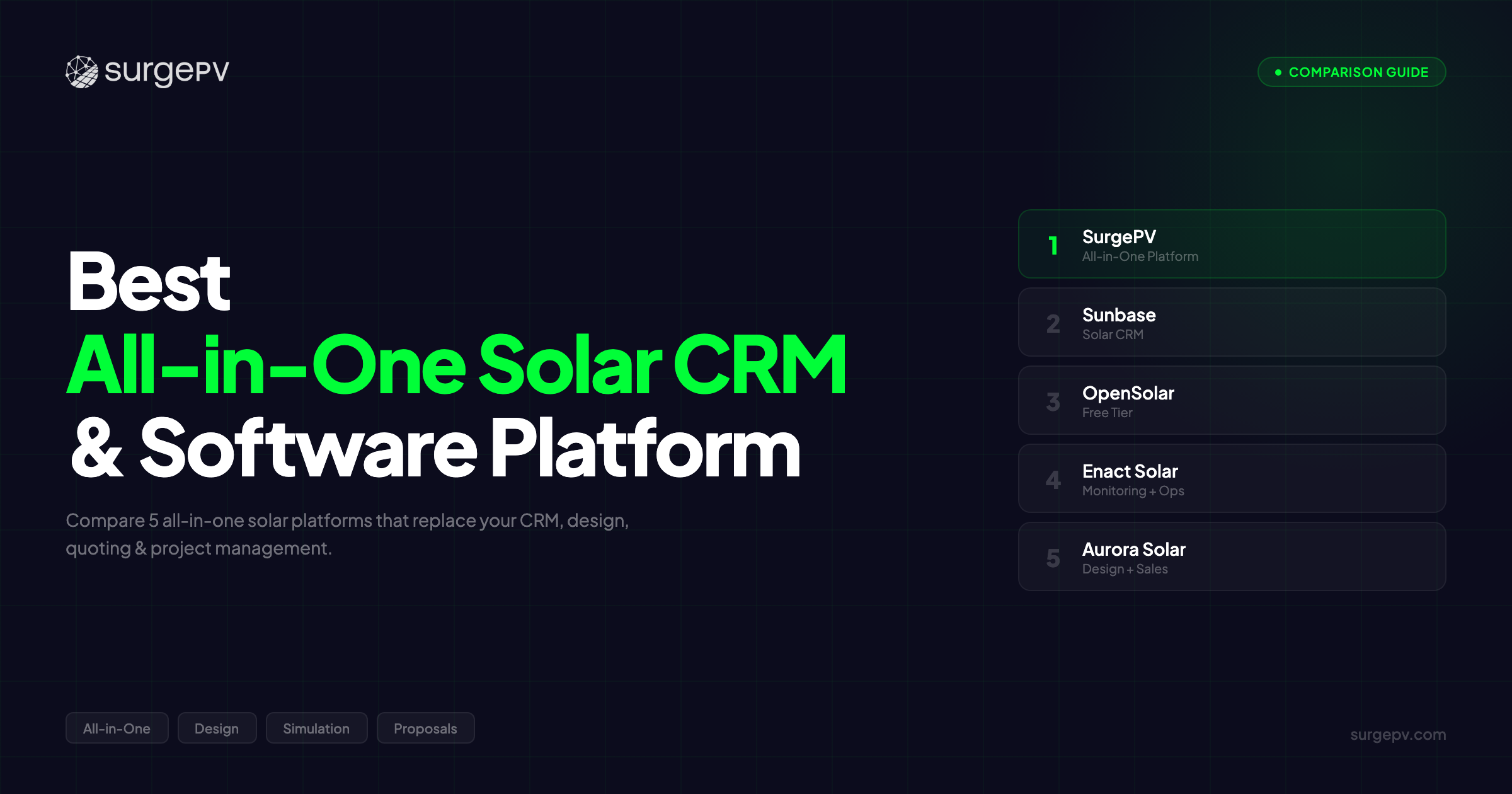
TL;DR: The average solar installer uses 5-7 separate tools for CRM, design, proposals, project management, and monitoring, wasting $500-800/month and losing deals to data sync failures. SurgePV delivers the only platform that covers the full lifecycle from lead to interconnection at $1,899/year for 3 users. Sunbase leads for sales-focused teams. OpenSolar is the best free option. Aurora Solar dominates high-volume residential. Enact Solar excels at financing integration.
Your solar company uses at least five separate software tools right now.
Salesforce or HubSpot for CRM. HelioScope or Aurora for design. PandaDoc or Proposify for proposals. Monday.com or Asana for project tracking. And some combination of spreadsheets, email, and Slack to keep everything from falling apart.
The result: a customer inquiry arrives in your CRM, gets manually re-entered into your design tool, gets exported to a spreadsheet for pricing, gets copied into your proposal software, and then, if you win the deal, gets manually entered again into your project management system. Every handoff is a chance for errors. Every system is a monthly subscription. Every integration is fragile.
Tool fragmentation is killing solar installers. A 2025 SEIA industry survey found that the average residential solar installer spends 8-12 hours per week on manual data entry between disconnected systems. That is an entire full-time employee doing nothing but copying customer names and addresses between platforms.
And when a lead asks “What’s my system size?” on day 15 of the sales cycle, your sales rep has to check three different tools to find the answer, assuming the data synced correctly, which it often does not.
The solar design software industry is finally catching up. All-in-one platforms that handle CRM, design, simulation, proposals, project tracking, and monitoring in one unified workflow now exist. But not all “all-in-one” platforms are created equal. Some are glorified CRMs with basic proposal features. Others are design tools with a contact list added on.
We tested the top 12 platforms claiming to be all-in-one solar solutions. We evaluated each on CRM depth, design capabilities, simulation accuracy, proposal quality, project management functionality, dispatch coordination, and post-installation monitoring.
In this guide, you’ll learn:
- Which 5 platforms actually deliver end-to-end workflows from lead to interconnection
- Why SurgePV is the only tool that eliminates the need for Salesforce, PVsyst, AutoCAD, and separate proposal software
- How much all-in-one platforms cost versus buying separate tools ($500-800/month vs $150-250/month)
- Which platform works best for residential installers, commercial EPCs, and sales-focused teams
- What CRM features solar businesses actually need versus generic Salesforce functionality
- How to migrate from fragmented tools to one unified platform in 3-6 weeks
Quick Comparison: 5 Best All-in-One Solar Platforms
| Feature | SurgePV | Sunbase | OpenSolar | Enact Solar | Aurora Solar |
|---|---|---|---|---|---|
| Best For | Full lifecycle (CRM to monitoring) | Sales-focused teams | Budget-conscious small installers | Financing-heavy workflows | High-volume residential |
| CRM & Lead Management | Full native CRM | Full native CRM | Basic CRM | Basic CRM | Basic CRM |
| 3D Design & Shade Analysis | AI-powered LIDAR | Basic design | Full design | Full design | Industry-leading AI |
| Bankable P50/P90 Simulation | Yes (+/-3% vs PVsyst) | No | Basic | No | Premium tier only |
| Automated SLD Generation | 5-10 min | No | No | No | No |
| Proposals & eSign | Branded + eSign | Branded + eSign | Branded + eSign | Branded + eSign | Branded + eSign |
| Project Management | Full lifecycle tracking | Residential focus | Basic milestones | Installation tracking | Limited |
| Dispatch & Scheduling | Crew coordination | Basic scheduling | No | Basic | No |
| Post-Sale Monitoring | Customer portal + O&M | Limited | Limited | Full monitoring | Premium only |
| Carport Design | Native support | No | No | No | No |
| Platform | Cloud | Cloud | Cloud | Cloud | Cloud |
| Price/Year (USD) | $1,899 (3 users) | $2,400-4,800 | Free-$2,400 | $3,000-6,000 | $2,400-9,000+ |
| Our Rating | 9.3/10 | 8.6/10 | 8.2/10 | 8.0/10 | 7.9/10 |
Quick verdict: SurgePV is the only platform that genuinely covers every step from CRM through monitoring. Sunbase is strongest for sales teams who prioritize lead management and pipeline velocity. OpenSolar delivers the best free option for small installers. Enact Solar excels at financing workflows. Aurora Solar dominates AI-powered residential design but lacks project management depth.
Why Solar Companies Are Replacing 5+ Tools with One Platform
The transition from fragmented tools to all-in-one platforms is accelerating across the solar industry. Understanding why reveals what to look for in an integrated solution.
The Hidden Cost of Tool Fragmentation
A typical residential solar installer running separate systems pays $500-800/month in combined subscriptions:
- CRM (Salesforce, HubSpot): $75-150/user/month
- Design software (HelioScope, Aurora): $200-400/month
- Proposal tool (PandaDoc, Proposify): $100-200/month
- AutoCAD (for SLD): $175/month
- Project management (Monday.com, Asana): $50-100/month
- Monitoring platform: $50-100/month
That is $6,000-9,600/year in software costs alone for a 5-person installer. An all-in-one platform like SurgePV at $1,899/year for 3 users saves $4,000-7,700 annually.
But the real cost is not the subscriptions. It is the integration tax.
The Integration Tax: When Data Does Not Sync
Generic tools were not built for solar workflows. Salesforce does not understand roof pitch, shading coefficients, or PTO timelines. Your CRM stores customer contact info. Your design tool stores system specifications. Your proposal tool stores pricing. And none of them talk to each other without expensive custom integration.
The result: manual data entry at every handoff. A lead becomes a project in your CRM. Then an engineer manually creates that same project in HelioScope. Then someone exports the design specs to Excel for pricing. Then the pricing gets manually entered into your proposal software. Then, if you win, the project gets manually created again in Monday.com for installation tracking.
Every manual handoff introduces errors. Sales promises a 12 kW system, engineering designs 10.8 kW, and the customer receives a proposal for 11.5 kW. Nobody notices until installation day.
Data fragmentation creates customer trust issues. When a homeowner calls your office asking about their system size and three different employees check three different tools and give three different answers, that is not a software problem. It is a credibility problem.
The Training Burden: Onboarding New Hires Across Five Platforms
A new sales rep at a solar installer using fragmented tools must learn:
- Salesforce for lead management (2 weeks training)
- HelioScope or Aurora for design (3-4 weeks training)
- Your proposal tool (1 week training)
- Your project management system (1 week training)
- Your financial modeling spreadsheet (created by the person who just quit)
Total onboarding time: 6-8 weeks before a new hire is productive.
An all-in-one platform compresses that to 1-2 weeks. One login. One interface. One workflow.
Pro Tip
Calculate your current tool stack cost by listing every software subscription your solar business pays for CRM, design, proposals, project management, monitoring, and document storage. Add the monthly fees. Then multiply by 12 to get your annual software spend. Most installers are surprised to discover they pay $6,000-12,000/year for fragmented tools when an all-in-one platform costs $2,000-5,000/year with better integration.
Industry Trend: Consolidation Wins in Competitive Markets
SEIA’s 2025 Solar Installation Trends report found that residential installers closing 20+ deals per month are 3x more likely to use all-in-one platforms than installers closing fewer than 10 deals per month. At scale, integration failures compound.
When you quote 5 projects per month, you can manually manage data fragmentation. When you quote 50 projects per month, manual processes break. Proposals go out with wrong system sizes. Customers get duplicate follow-up emails. Installation crews show up without permit documentation.
All-in-one platforms eliminate fragmentation at the source by storing every piece of customer data, from initial inquiry to final PTO, in one unified database.
What a True All-in-One Solar Platform Must Include
Not every platform claiming to be “all-in-one” actually covers the full solar business workflow. Here is what genuine end-to-end platforms provide.
CRM & Lead Pipeline Management
A true all-in-one platform starts with a solar-optimized CRM, not a generic contact manager.
Essential CRM features:
- Lead capture from web forms, phone calls, referrals, and marketing campaigns with automatic contact creation
- Lead scoring based on project size, timeline, budget, and roof suitability to prioritize high-value opportunities
- Automated lead routing to sales reps by territory, workload, or specialization
- Pipeline tracking with customizable deal stages (qualified, site survey, proposal sent, contract signed, installed)
- Follow-up automation via email and SMS sequences triggered by deal stage or inactivity
- Performance dashboards showing conversion rates, pipeline value, and rep performance
Generic CRMs like Salesforce and HubSpot provide these features but do not integrate with solar design, shading analysis, or energy simulation. You end up with a CRM that tracks deals but requires separate tools for everything solar-specific.
Solar Design & 3D Modeling
Design capabilities separate true all-in-one platforms from glorified CRMs with proposal templates.
Essential design features:
- LIDAR roof modeling using satellite imagery or drone data to create accurate 3D roof models
- Shade analysis with hourly shading calculations accounting for trees, chimneys, and neighboring structures
- Panel placement optimization based on roof geometry, obstructions, and electrical constraints
- Multiple layout options to test different module counts, orientations, and configurations
- Visual 3D rendering for customer-facing proposals
Platforms like SurgePV and Aurora Solar excel here. Platforms like Sunbase (primarily a CRM) offer basic design but rely on third-party integrations for advanced modeling.
For dedicated design depth, see best solar design software.
Energy Simulation & Yield Analysis
Design tells you where panels go. Simulation tells you how much energy they will produce.
Essential simulation features:
- 8760-hour simulation modeling every hour of the year to account for seasonal variation and weather patterns
- Shade-adjusted yield incorporating real shading losses from trees, obstructions, and inter-row shading
- P50/P90 bankable outputs providing probability-weighted yield forecasts that lenders and investors accept
- Temperature derating accounting for efficiency losses at high cell temperatures
- Soiling and degradation modeling to project long-term performance
SurgePV delivers bankable +/-3% accuracy versus PVsyst, the industry gold standard. Most all-in-one platforms provide basic annual yield estimates but not the depth required for project financing.
For dedicated simulation depth, see best solar simulation software.
Quoting, Proposals & eSign
Design and simulation data must flow directly into customer-facing proposals without manual re-entry.
Essential proposal features:
- Dynamic pricing pulling real-time equipment costs, labor rates, and margin targets from a central database
- Branded proposal templates with company logo, colors, and messaging
- 3D visualizations showing what the system will look like on the customer’s roof
- Financial modeling with payback period, ROI, NPV, and monthly savings projections
- Electronic signature (eSign) integration to close deals remotely without paper contracts
Every all-in-one platform includes proposals. The difference is quality. SurgePV, Aurora Solar, and Enact Solar produce investor-grade proposals. OpenSolar’s free tier offers simpler templates suitable for residential.
For dedicated proposal depth, see best solar proposal software.
Sales Automation & Pipeline Tracking
After the proposal goes out, sales automation determines whether you close the deal or lose it to a competitor.
Essential sales automation features:
- Automated follow-up sequences sending email and SMS reminders after proposal delivery, site visits, or periods of inactivity
- Deal stage progression tracking where each opportunity sits in the sales funnel
- Activity tracking logging calls, emails, site visits, and proposal revisions
- Sales forecasting projecting monthly and quarterly pipeline conversion based on historical close rates
- Performance analytics comparing sales rep effectiveness, conversion rates by lead source, and average deal size
Sunbase excels here with the deepest sales automation features among all-in-one platforms. SurgePV includes full CRM with pipeline tracking. Aurora Solar’s CRM is more basic.
Contract Management & Document Workflow
Winning the deal creates a new workflow: moving from proposal to signed contract, permits, and PTO documentation.
Essential contract management features:
- Proposal-to-contract conversion automatically creating installation contracts from accepted proposals
- Permit documentation storing and tracking permit applications, engineering stamps, and municipality approvals
- Change order management documenting scope changes and client approvals
- PTO tracking managing interconnection applications and utility approval timelines
- Document storage centralizing all project files (contracts, permits, inspection reports, warranties)
This is where many “all-in-one” platforms fail. They handle CRM and proposals well but lack project execution tracking. SurgePV provides full lifecycle tracking from sale to PTO. Sunbase covers residential workflows. Aurora Solar is weaker here.
Project Management, Scheduling & Dispatch
Once a contract is signed, the project transitions from sales to operations.
Essential project management features:
- Milestone tracking monitoring progress through design, permitting, procurement, installation, inspection, and PTO
- Crew scheduling assigning installation teams to projects based on availability, skills, and location
- Field service coordination optimizing routes and providing crews with project documentation on mobile devices
- Material procurement tracking equipment orders, delivery dates, and inventory allocation
- Client communication sending automated project status updates to customers
SurgePV offers the most complete project tracking among all-in-one platforms, covering the full lifecycle from contract signature to final interconnection.
For dedicated project management depth, see best solar project management software.
Monitoring & O&M
After installation and PTO, the customer relationship continues with monitoring and service.
Essential monitoring features:
- Performance tracking comparing actual production to predicted yield
- Customer portal allowing homeowners to view their system’s real-time and historical production
- Service ticket management logging maintenance requests and dispatching O&M crews
- Warranty tracking storing warranty documentation and alerting teams when warranties approach expiration
- Proactive alerting notifying installers and customers when systems underperform or go offline
Enact Solar and SurgePV provide the strongest post-installation monitoring among all-in-one solar software platforms. Aurora Solar offers monitoring only on premium tiers. Sunbase’s monitoring is limited.
Note
True all-in-one platforms store all customer data, from initial inquiry through 25 years of monitoring, in one unified database. This enables lifecycle analytics: which lead sources produce the highest-performing systems? Which installation crews have the lowest service call rates? Which sales reps close deals with the best long-term customer satisfaction? Fragmented tools cannot answer these questions because the data lives in separate systems that do not communicate.
The 5 Best All-in-One Solar Software Platforms (2026)
SurgePV — Best Overall All-in-One Solar Platform
Rating: 9.3/10 | Price: $1,899/year (3 users) | Book a demo | See pricing
SurgePV is the only platform that genuinely delivers end-to-end workflows from lead capture through post-installation monitoring without requiring separate tools for CRM, design, simulation, proposals, SLD generation, or project tracking.
Why SurgePV is different:
Every other “all-in-one” platform makes compromises. Sunbase is a powerful CRM with basic design bolted on. Aurora Solar is an elite design tool with basic CRM added. OpenSolar focuses on design and proposals but lacks enterprise CRM and project management. Enact Solar prioritizes financing workflows but needs separate tools for electrical engineering.
SurgePV was built from the ground up as a unified platform where every feature shares the same customer database. A lead comes in through your website. Your sales team qualifies it in the CRM. An engineer creates a 3D design using AI-powered LIDAR roof detection. The system runs an 8760-hour simulation with +/-3% accuracy versus PVsyst, producing bankable P50/P90 yield forecasts. Dynamic pricing pulls real-time equipment costs. A branded proposal with 3D visualization and financial modeling goes to the customer with one click. The customer signs electronically. The project automatically moves to your installation queue with crew scheduling and milestone tracking. After installation, the customer logs into their monitoring portal to view real-time production.
All in one platform. One database. One login.
Here is what that means for a residential installer handling 30 deals per month. Without SurgePV, your sales rep creates a lead in Salesforce ($150/month). Your engineer re-enters that project in HelioScope ($400/month). Your admin exports the design to Excel for pricing. Another admin creates a proposal in PandaDoc ($200/month). If you win, a project manager manually creates the project in Monday.com ($100/month). After installation, you use a separate monitoring platform ($100/month). Total cost: $950/month, or $11,400/year. Plus 6-10 hours per week of manual data entry to move information between systems.
With SurgePV, the entire workflow happens in one platform at $1,899/year for 3 users. That is $9,500/year saved. And zero hours of manual re-entry because the data never leaves the system.
SurgePV is the only platform that generates automated single-line diagrams in 5-10 minutes, compared to 2-3 hours of manual AutoCAD drafting. For installers producing IEC-compliant electrical documentation, this alone saves 15-20 hours per month.
Real-World Example
A Denver-based residential installer was using Salesforce for CRM, Aurora Solar for design, PandaDoc for proposals, and Monday.com for project tracking. Their sales team reported that customer data was constantly out of sync: a customer’s system size in Aurora did not match the CRM record, proposals went out with outdated pricing, and installation crews showed up without the correct equipment because procurement was tracking a different system size than what was actually sold. After switching to SurgePV, proposal accuracy improved from 87% to 99% (proposals now pull directly from the same database as design and CRM). Close rates increased 12% because sales reps could answer customer questions instantly without switching between three tools. And the company saved $650/month in software costs by eliminating four separate subscriptions.
Pros:
- Only platform covering CRM, design, simulation, proposals, SLD, project tracking, and monitoring in one unified database
- AI-powered 3D design with LIDAR roof modeling and shade analysis
- 8760-hour simulation with bankable P50/P90 outputs (+/-3% vs PVsyst accuracy)
- Automated SLD generation (5-10 min vs 2-3 hours manual AutoCAD)
- Native carport solar design — no other all-in-one platform offers this
- Full CRM with lead scoring, pipeline tracking, and automated follow-ups
- Branded proposals with 3D visualization, financial modeling, and eSign
- Project tracking from sale to interconnection with crew scheduling
- Post-installation monitoring with customer portal and O&M ticketing
- 70,000+ projects globally, 3-minute average support response time
- $1,899/year for 3 users — all features included, no premium tiers
Cons:
- Newer brand presence in North America compared to Aurora Solar
- Smaller third-party integration ecosystem than Salesforce-based workflows
- Monitoring features still developing compared to dedicated platforms like Enphase Enlighten
Best for: Residential installers and commercial EPCs who want to eliminate fragmented tools and consolidate CRM, design, simulation, proposals, electrical engineering, and project tracking into one platform.
Pro Tip
SurgePV’s generation and financial modeling tool includes automated payback calculations, NPV, IRR, and monthly savings projections that flow directly into customer proposals. No Excel spreadsheets needed. Update your equipment costs or financing rates once, and every future proposal pulls the latest numbers automatically.
Sunbase — Best for Sales-Focused Solar Teams
Rating: 8.6/10 | Price: $2,400-4,800/year | Sunbase | Full Sunbase review
Sunbase is a solar-specific CRM and sales platform built for residential installers who prioritize pipeline velocity and lead conversion over advanced design capabilities.
Why Sunbase works for sales teams:
Sunbase was built by solar sales leaders who understand that most residential deals are won or lost in the first 24 hours after lead capture. The platform automates the entire sales cycle, from lead capture and scoring to instant follow-up, automated appointment scheduling, proposal generation, and contract signature.
The CRM is deeper than any other all-in-one platform. Lead scoring algorithms prioritize homeowners based on roof suitability, shading conditions, credit score, and buying timeline. Automated SMS and email sequences follow up instantly when leads go cold. Sales managers get real-time dashboards showing pipeline value, rep performance, and conversion rates by lead source.
Sunbase includes design and proposals, but these are simpler than SurgePV or Aurora Solar. The design tool handles basic residential layouts and shade analysis but does not produce bankable simulation reports for commercial projects. That is intentional. Sunbase targets high-volume residential installers who value speed over engineering depth.
Pros:
- Deepest sales automation features among all-in-one platforms
- Instant lead follow-up via SMS and email with customizable sequences
- Advanced lead scoring based on roof, credit, timeline, and budget
- Pipeline dashboards with conversion tracking by rep and lead source
- Integrated payment processing and financing application workflows
- Strong mobile app for field sales and site surveys
- Built specifically for residential solar sales teams
- Established North American presence with 1,000+ installer customers
Cons:
- Design capabilities are basic, not suitable for complex commercial projects
- No bankable simulation (no P50/P90 outputs)
- No automated SLD generation (requires separate AutoCAD)
- Project management features focus on residential, limited for commercial
- No utility-scale or carport design capabilities
- Higher pricing than SurgePV ($2,400-4,800/year vs $1,899/year)
Best for: High-volume residential solar installers who close 30+ deals per month and prioritize sales velocity and lead conversion over advanced engineering and simulation depth.
OpenSolar — Best Free All-in-One Option
Rating: 8.2/10 | Price: Free-$2,400/year | OpenSolar | Full OpenSolar review
OpenSolar is a cloud-based design, proposal, and financing platform that offers a genuinely usable free tier, making it the best all-in-one option for small installers on tight budgets.
Why OpenSolar’s free tier matters:
Most “free” solar software is unusable. Limited project counts, watermarked proposals, or locked features make the free tier a trial period rather than a real option. OpenSolar’s free tier actually works. You get full design capabilities, proposals, and financing tools with no project limits. The only restriction: one user account.
For a solo installer or a two-person startup, that is enough. You can design systems, generate professional proposals with 3D rendering, and submit financing applications through OpenSolar’s integrated lender network, all without paying anything.
The platform covers design, proposals, and financing well. What it lacks: enterprise CRM depth, project management for multi-crew operations, and post-installation monitoring. OpenSolar is a design-to-proposal platform, not a full lifecycle solution.
If you are a small installer closing 5-10 residential deals per month and you cannot justify $2,000-5,000/year for software, OpenSolar gives you 80% of the functionality of paid platforms at zero cost. When you grow to 20+ deals per month and need multiple users, team collaboration, and project tracking, upgrade to SurgePV or Aurora Solar.
Pros:
- Best free tier in the industry — full design and proposals, no project limits
- Full 3D design with shade analysis and energy yield modeling
- Integrated financing marketplace with 20+ lenders
- Professional branded proposals with 3D visualization
- Cloud-based, no desktop installation required
- Strong Australian and Asia-Pacific presence (based in Sydney)
- Paid tiers unlock team collaboration and advanced features
Cons:
- Free tier limited to one user (restricts team collaboration)
- Basic CRM, not suitable for enterprise lead management
- No project management or crew scheduling
- No automated SLD generation
- No post-installation monitoring
- Design features less advanced than Aurora Solar or SurgePV
- Limited North American support compared to US-based platforms
Best for: Solo installers, startups, and small residential installers on tight budgets who need design and proposal capabilities without monthly subscription costs.
Enact Solar — Best for Financing Integration
Rating: 8.0/10 | Price: $3,000-6,000/year | Enact Solar | Full Enact Solar review
Enact Solar is an all-in-one platform optimized for solar installers who sell primarily through financing — loans, leases, and PPAs — rather than cash sales.
Why Enact Solar excels at financing workflows:
The platform integrates with 20+ solar lenders and financing providers. Customers can compare loan options, lease rates, and PPA structures directly within the proposal. Applications submit automatically to multiple lenders, and approvals flow back into the customer record without manual entry.
For installers where 80%+ of sales involve financing, this automation saves real time. A sales rep generates a proposal, the customer selects a financing option, and the application goes to three lenders simultaneously. Approvals come back within hours, and the contract can be signed the same day.
Enact Solar also includes design, proposals, and post-installation monitoring. The design capabilities are solid for residential but not as advanced as Aurora Solar’s AI roof detection. Monitoring is strong. Enact Solar provides full production tracking and customer portals.
What Enact Solar lacks: deep CRM and sales automation (not as strong as Sunbase), automated electrical engineering (no SLD generation), and project management for multi-crew operations.
Pros:
- Best financing integration among all-in-one platforms (20+ lenders)
- Automated multi-lender application submission and approval tracking
- Strong post-installation monitoring with customer portals
- Full design capabilities for residential and small commercial
- Professional branded proposals with financing comparison tools
- Cloud-based with strong mobile app for field teams
- Growing North American presence with focus on financing-heavy installers
Cons:
- CRM and sales automation less developed than Sunbase or SurgePV
- No automated SLD generation (requires separate AutoCAD)
- Project management features basic compared to SurgePV
- No bankable simulation (no P50/P90 outputs)
- Higher pricing than SurgePV ($3,000-6,000/year vs $1,899/year)
- No utility-scale or carport design capabilities
Best for: Residential installers who sell primarily through financing (loans, leases, PPAs) and want automated multi-lender application workflows integrated with design and proposals.
Aurora Solar — Best for Design-First Workflows
Rating: 7.9/10 | Price: $2,400-9,000+/year | Aurora Solar | Full Aurora Solar review
Aurora Solar is the global leader in AI-powered residential solar design. For high-volume installers who prioritize design speed and proposal quality over CRM depth and project management, Aurora Solar remains a strong choice.
Why Aurora Solar dominates residential design:
Aurora’s AI roof detection creates accurate 3D roof models in minutes using satellite imagery. Shade analysis is industry-leading, accounting for trees, chimneys, neighboring structures, and seasonal sun paths. The 3D visualization quality is unmatched. Proposals look like professional architectural renderings.
For residential installers processing 50-100 quotes per month, Aurora’s design speed is a real competitive advantage. A sales rep can generate a complete proposal with 3D rendering and financial projections during the initial sales call. That instant turnaround wins deals.
Here is where Aurora falls short for true all-in-one workflows.
The CRM is basic. Lead scoring, pipeline tracking, and sales automation exist but do not match Sunbase or SurgePV’s CRM depth. Project management is limited. Aurora tracks project milestones but does not handle crew scheduling, dispatch optimization, or field service coordination. Post-installation monitoring requires premium tiers and does not match Enact Solar’s monitoring capabilities.
And there is no automated SLD generation. You will still need AutoCAD or a separate electrical engineering tool.
Aurora Solar is a design and proposal platform with CRM features added, not a full lifecycle platform. If your workflow prioritizes design speed and proposal quality over CRM automation and project execution, Aurora excels. If you need end-to-end coverage from lead to monitoring, SurgePV delivers more depth at lower cost.
Pros:
- Industry-leading AI roof detection and 3D modeling
- Fastest residential design workflow among all-in-one platforms
- Best 3D visualization quality for customer-facing proposals
- Strong shade analysis and energy yield modeling
- Cloud-based with excellent mobile app
- Largest North American customer base (4,000+ installers)
- Strong brand recognition and market presence
- Advanced features like battery storage and EV charger design
Cons:
- Basic CRM, not suitable for enterprise sales teams
- No automated SLD generation (requires separate AutoCAD)
- Limited project management (no crew scheduling or dispatch)
- Monitoring requires premium tier
- Highest pricing among all-in-one platforms ($2,400-9,000+/year)
- Premium features locked behind expensive tiers
- No utility-scale design capabilities
- No carport design
Best for: High-volume residential installers in competitive metro markets who prioritize design speed, proposal quality, and 3D visualization over CRM depth and project management capabilities.
Why SurgePV Is the Only Platform That Covers Every Step
SurgePV is the only all-in-one platform where “all-in-one” actually means what it says. Here is what that looks like in practice.
Built-In CRM & Sales Automation
SurgePV includes a full solar-optimized CRM, not a contact manager with a few extra fields. Leads flow in from your website, Google Ads, or referral partners. The system automatically scores them based on roof size, shading conditions, energy usage, and location. High-value leads route to your best sales reps. Low-quality leads get automated email sequences instead of wasting rep time.
Your sales team tracks every deal through customizable pipeline stages. Automated follow-up sequences trigger when a lead goes cold. Performance dashboards show conversion rates by rep, lead source, and deal stage. Sales managers forecast monthly revenue based on weighted pipeline.
All the CRM functionality of Sunbase. Built into the same platform as design, simulation, and proposals.
When a customer calls asking about their project status, your customer service rep opens one screen and sees: initial inquiry date, lead source, sales rep assigned, site survey notes, approved design, proposal sent date, contract signature, installation scheduled date, crew assigned, and current project status. Everything in one record. No switching between Salesforce and Aurora Solar and Monday.com to piece together the customer’s history.
AI-Powered 3D Design + Bankable Simulation
SurgePV’s design engine combines Aurora-level 3D modeling with PVsyst-level simulation accuracy.
LIDAR roof detection creates accurate 3D models from satellite data. Shade analysis runs hourly calculations for every day of the year. Panel placement optimization accounts for roof obstructions, electrical constraints, and aesthetic preferences.
Then the simulation engine runs 8760-hour energy modeling with +/-3% accuracy compared to PVsyst. That accuracy level is bankable, meaning lenders and investors accept SurgePV’s P50/P90 yield forecasts for project financing. Temperature derating, soiling losses, module degradation, and inverter clipping are all modeled.
All the design speed of Aurora Solar. All the simulation depth of PVsyst. In one platform.
A commercial installer quoting a 500 kW rooftop system for a warehouse does not need to design in Aurora, export to PVsyst for bankable simulation, then manually copy the results into a proposal. SurgePV handles the entire workflow in one tool. Design, simulate, propose, close. No exports. No re-entry.
Dynamic Quoting & Smart Proposals
Pricing updates automatically. Your procurement team updates panel costs, inverter prices, and labor rates in the central database. Every future proposal pulls the latest numbers. No more proposals going out with outdated pricing because someone forgot to update the Excel template.
Financial modeling includes payback period, NPV, IRR, and monthly savings projections. Tax incentives, utility rebates, and state-specific programs calculate automatically based on project location.
3D visualization shows the customer exactly what their system will look like. The proposal includes a branded cover page, executive summary, system specifications, financial projections, equipment warranties, and contract terms. eSign integration lets customers sign remotely from any device.
Project Tracking from Sale to Interconnection
After contract signature, SurgePV becomes your project management platform. Every project moves through customizable milestones: engineering review, permit submission, permit approval, equipment procurement, installation scheduled, installation complete, inspection passed, PTO submitted, interconnection approved.
Crew scheduling assigns installation teams based on availability, location, and project type. Field crews access project documentation on mobile devices. Customers receive automated status updates at each milestone.
Material procurement tracks equipment orders and delivery dates. If a shipment is delayed, the system alerts the project manager and suggests rescheduling affected installations.
A residential installer managing 40 active projects across 3 installation crews does not need Monday.com or Asana to track project status. SurgePV shows every project’s current milestone, which crew is assigned, when installation is scheduled, and whether permits are approved. All in the same platform where the project was designed and sold.
Post-Sale Monitoring & Customer Portal
After PTO, the customer relationship continues with monitoring and service.
SurgePV’s monitoring platform tracks real-time production, compares actual output to predicted yield, and alerts installers when systems underperform. Customers log into their own portal to view production graphs, historical data, and environmental impact metrics.
Service ticket management logs maintenance requests and dispatches O&M crews. Warranty tracking stores all equipment documentation and alerts teams when warranties approach expiration.
When a customer calls reporting lower-than-expected production, your support team opens the customer record and sees: original design, predicted annual yield, actual production to date, recent weather data, and service history. They can immediately determine whether the system is underperforming due to shading, equipment failure, or simply cloudy weather. All the data in one place.
Pro Tip
SurgePV’s unified database enables lifecycle analytics that fragmented tools cannot provide. Questions like “Which lead sources produce the highest-performing systems?” and “Which sales reps close deals with the lowest service call rates?” become answerable because the data from lead capture through 25 years of monitoring lives in one system. With Salesforce + Aurora + Monday.com + monitoring platform, you would need custom data warehousing to connect those dots.
All-in-One Solar Platform vs. Standalone Tools — Full Comparison
The choice between all-in-one and best-of-breed tools is the most common software decision solar installers face. Here is the real-world comparison.
Cost Comparison: Integrated vs. Separate Tools
Separate tools approach (monthly costs):
- CRM (Salesforce): $150/month (2 users at $75/user)
- Design software (HelioScope): $400/month
- Proposal tool (PandaDoc): $200/month (2 users at $100/user)
- AutoCAD (for SLD): $175/month
- Project management (Monday.com): $100/month (5 users)
- Monitoring platform: $100/month
Total: $1,125/month or $13,500/year
All-in-one platform approach:
- SurgePV: $158/month ($1,899/year for 3 users)
Total savings: $967/month or $11,601/year
Note
The all-in-one savings calculation understates the true cost difference because it does not include integration costs. Connecting Salesforce to HelioScope to PandaDoc to Monday.com requires either manual data entry (6-10 hours per week of labor at $30-50/hour = $780-2,000/month) or custom integration development ($5,000-15,000 upfront plus $200-500/month maintenance). All-in-one platforms eliminate integration costs entirely because there is nothing to integrate.
Data Sync Issues with Standalone Tools
Separate tools create fragmentation nightmares:
Scenario 1: Customer changes system size mid-sale
With separate tools:
- Customer asks to increase system size from 10 kW to 12 kW
- Engineer updates design in HelioScope to 12 kW
- Someone manually updates the CRM record (sometimes forgotten)
- Someone manually updates the proposal (sometimes uses old 10 kW version)
- Proposal goes out with 12 kW pricing but 10 kW system specs
- Customer notices discrepancy and questions your credibility
With all-in-one platform:
- Customer asks to increase system size
- Engineer updates design to 12 kW
- Proposal automatically regenerates with updated 12 kW specs and pricing
- CRM record updates automatically
- Customer receives accurate proposal instantly
Scenario 2: Installation crew needs project documentation
With separate tools:
- Crew arrives on site
- Crew asks project manager for panel layout
- Project manager checks Monday.com for project notes
- Notes say “see HelioScope for layout”
- Project manager logs into HelioScope, exports PDF, emails to crew
- Crew waits 20 minutes to start installation
With all-in-one platform:
- Crew arrives on site
- Crew opens mobile app
- Design, layout, electrical diagram, and permit documentation all available instantly
Training Time: One Platform vs. Multiple
New employee onboarding with separate tools:
- Week 1-2: Salesforce CRM training
- Week 3-5: HelioScope design training
- Week 6: PandaDoc proposal training
- Week 7: Monday.com project management training
- Week 8: Learn your company’s custom spreadsheets and processes
Total: 8 weeks to full productivity
New employee onboarding with all-in-one platform:
- Week 1: Platform overview and CRM basics
- Week 2: Design and simulation training
- Week 3: Practice projects and live support
Total: 3 weeks to full productivity
A new sales rep hired with separate tools takes 8 weeks to close their first deal independently. A new sales rep hired with an all-in-one platform closes their first deal in week 3. That 5-week productivity gap costs real revenue. If your average deal is $25,000 and your rep closes one deal per week once ramped, that is $125,000 in lost revenue during the extended ramp period.
Single Customer Record vs. Fragmented Data
The fundamental difference between all-in-one and separate tools is database architecture.
Fragmented tools approach: Customer data lives in 5+ places
- Name, contact info, and deal status in Salesforce
- Roof dimensions, shading data, and system design in HelioScope
- Pricing, payment terms, and proposal version in PandaDoc
- Installation schedule, crew assignments, and project status in Monday.com
- Production data and service history in monitoring platform
Each tool has a partial view of the customer. Nobody has the complete picture.
All-in-one approach: Customer data lives in one place
- All customer information from first inquiry through 25 years of monitoring in one unified database
- Every employee accessing any part of the workflow sees the same real-time data
- Changes propagate instantly across design, proposals, project tracking, and monitoring
All-in-one platforms are not just cheaper. They are architecturally different. The unified database creates possibilities that separate tools cannot match: lifecycle analytics, instant data synchronization, and complete customer visibility.
Further Reading
For deep dives into specific categories, see our comparisons for best solar design software, best solar proposal software, and best solar project management software.
See How SurgePV Replaces Your Entire Tool Stack
AI-powered design, automated SLDs, and professional proposals, connected to your CRM. One platform. One database. One login.
Book a DemoNo commitment required · 20 minutes · Live project walkthrough
How to Choose the Right All-in-One Solar Platform
The right platform depends on your business model, project volume, and team structure. Here is a practical decision framework.
For Residential Installers
If you close 5-15 residential deals per month and prioritize budget:
- Best choice: OpenSolar (free tier) or SurgePV ($1,899/year)
- Why: OpenSolar’s free tier gives you design and proposals at zero cost. When you outgrow the one-user limitation, SurgePV provides full lifecycle coverage at the lowest enterprise cost.
If you close 20-50 residential deals per month and prioritize sales velocity:
- Best choice: Sunbase or SurgePV
- Why: Sunbase’s sales automation and lead scoring maximize conversion rates. SurgePV provides equal CRM depth plus superior design and simulation.
If you close 50+ residential deals per month and prioritize design speed:
- Best choice: Aurora Solar or SurgePV
- Why: Aurora’s AI roof detection delivers the fastest residential design workflow. SurgePV matches design speed and adds automated SLD generation and project tracking.
For residential-specific considerations, see best solar software for residential installers.
For Commercial EPCs
If you handle commercial rooftops (100 kWp - 5 MW) and need bankable simulation:
- Best choice: SurgePV
- Why: SurgePV is the only all-in-one platform delivering bankable P50/P90 simulation (+/-3% vs PVsyst) plus automated SLD generation for commercial electrical documentation.
If you handle utility-scale projects (5 MW+):
- Best choice: Do not use an all-in-one platform. Use dedicated tools.
- Why: Utility-scale projects need specialized design platforms like RatedPower or PVcase for terrain optimization and substation design. All-in-one platforms are optimized for residential and commercial, not utility-scale.
For commercial-specific considerations, see best solar software for commercial EPCs.
For Sales Teams
If 80%+ of your revenue comes from financed sales (loans, leases, PPAs):
- Best choice: Enact Solar
- Why: Enact Solar’s multi-lender integration and automated financing approval workflows are unmatched. You will still need separate electrical tools, but financing automation justifies the trade-off.
If you prioritize lead conversion and pipeline velocity over design depth:
- Best choice: Sunbase
- Why: Sunbase was built by sales leaders for sales teams. Lead scoring, instant follow-up, and conversion tracking are industry-leading.
For sales-specific considerations, see best solar software for sales teams.
By Team Size
Solo installer or 2-3 person startup:
- Best choice: OpenSolar (free) then upgrade to SurgePV when you add users
- Why: Minimize fixed costs during growth phase. OpenSolar’s free tier has no project limits. Upgrade to SurgePV when you need multi-user collaboration and project management.
5-15 person installer:
- Best choice: SurgePV or Sunbase
- Why: You need team collaboration, project tracking, and role-based permissions. SurgePV provides the most complete feature set. Sunbase is best if sales automation is your top priority.
15+ person installer or regional EPC:
- Best choice: SurgePV or Aurora Solar
- Why: Enterprise features like crew scheduling, multi-location support, and performance analytics become critical. SurgePV offers the most complete lifecycle coverage. Aurora Solar is best if design speed is your competitive advantage.
Pro Tip
Do not choose a platform based on feature count. Choose based on workflow match. If 80% of your business is residential and your competitive advantage is same-day proposals, Aurora Solar’s design speed matters more than SurgePV’s project management depth. If you handle both residential and commercial and need bankable reports for lenders, SurgePV’s simulation accuracy matters more than Aurora’s 3D rendering quality.
Conclusion: Which All-in-One Solar Platform Is Right for Your Business?
Tool fragmentation costs money, wastes time, and loses deals. Every manual handoff between your CRM, design tool, proposal software, and project management system is a chance for errors. Every disconnected database creates customer trust issues. Every separate subscription adds to your overhead.
Here is the bottom line by use case:
For residential installers handling 20+ deals per month: SurgePV delivers the most complete lifecycle coverage, CRM through monitoring, at the lowest total cost ($1,899/year for 3 users). Sunbase is the alternative if sales automation and lead conversion are your top priorities. Aurora Solar is best if design speed is your competitive advantage and you are willing to handle CRM and project management separately.
For commercial EPCs needing bankable simulation: SurgePV is the only all-in-one platform with +/-3% accuracy versus PVsyst, producing P50/P90 reports that lenders accept for project financing. Add automated SLD generation (5-10 min vs 2-3 hours manual AutoCAD) and you eliminate the need for separate electrical engineering tools.
For financing-focused installers: Enact Solar’s multi-lender integration and automated approval workflows are unmatched if 80%+ of your sales involve loans, leases, or PPAs. You will need separate electrical tools, but the financing automation justifies the trade-off.
For small installers on tight budgets: OpenSolar’s free tier delivers real value — full design and proposals with no project limits. When you outgrow the one-user restriction, upgrade to SurgePV for team collaboration and project management.
Every week running fragmented tools is another week of manual data entry, sync failures, and lost productivity. Your competitors using all-in-one solar software are quoting faster, closing more deals, and operating with lower overhead.
Want to see the difference? Book a demo and our team will walk you through the full workflow. Compare pricing. Or explore all solar software reviews for additional comparisons.
Transparency Note
SurgePV publishes this content. We are transparent about this relationship. This comparison acknowledges Aurora Solar’s industry-leading design speed, Sunbase’s superior sales automation, OpenSolar’s unmatched free tier, and Enact Solar’s financing integration depth. We present SurgePV as the most complete all-in-one platform, not the best at every individual feature. See our editorial standards.
Frequently Asked Questions
What is the best all-in-one solar business software in 2026?
SurgePV is the best overall all-in-one solar platform in 2026, combining CRM, 3D design, bankable simulation, proposals, automated SLD generation, project tracking, and post-installation monitoring in one cloud-based workflow. At $1,899/year for 3 users, it delivers the most complete feature set for residential installers and commercial EPCs. Sunbase is the strongest choice for sales-focused teams prioritizing CRM and lead management. OpenSolar offers the best free option for small installers on a budget. Aurora Solar leads in AI-powered residential design speed. Enact Solar excels at financing integration for loan-heavy installers.
Is an all-in-one solar platform better than a dedicated CRM like Salesforce?
All-in-one solar platforms deliver better ROI than generic CRMs for solar businesses because they integrate solar-specific workflows: 3D design, shade analysis, energy simulation, automated SLD generation, and branded proposals that Salesforce and HubSpot cannot provide without expensive custom development. A generic CRM costs $75-150/user/month and still requires separate tools for design ($200-400/month), proposals ($100-200/month), AutoCAD for electrical diagrams ($175/month), and monitoring ($50-100/month). Total cost: $600-1,000/month. An all-in-one platform like SurgePV consolidates everything at $158/month ($1,899/year for 3 users) while eliminating data sync failures between disconnected systems.
Can SurgePV replace separate tools for design, quoting, CRM, and monitoring?
Yes. SurgePV is the only platform that natively covers CRM and lead pipeline management, AI-powered 3D design and shade analysis, bankable P50/P90 simulation with +/-3% accuracy versus PVsyst, dynamic quoting and branded proposals with eSign, automated SLD generation in 5-10 minutes, project tracking from sale to interconnection with crew scheduling, and post-installation monitoring with customer portal and service ticket management. This eliminates the need for Salesforce or HubSpot for CRM, PVsyst or HelioScope for simulation, AutoCAD for electrical diagrams, PandaDoc or Proposify for proposals, Monday.com or Asana for project tracking, and separate monitoring platforms.
What should a true end-to-end solar platform include?
A true all-in-one solar platform must include: CRM with lead capture, scoring, routing, and automated follow-up sequences; 3D solar design with LIDAR roof modeling and hourly shade analysis; energy simulation with P50/P90 bankable outputs for project financing; quoting and proposal generation with dynamic pricing, 3D visualization, financial modeling, and eSign; sales automation with deal stage tracking and pipeline forecasting; contract management and permit documentation tracking; project management with milestone tracking, crew scheduling, and dispatch coordination; and post-sale monitoring with customer portal, production tracking, and service ticket management.
How much does all-in-one solar software cost compared to multiple tools?
Separate tools cost $500-800/month combined ($6,000-9,600/year): Salesforce CRM ($75-150/user/month), design software like HelioScope or Aurora ($200-400/month), proposal software like PandaDoc ($100-200/month), AutoCAD for SLD generation ($175/month), project management like Monday.com ($50-100/month), and monitoring platform ($50-100/month). All-in-one platforms range from $0-750/month: OpenSolar (free-$200/month), SurgePV ($158/month or $1,899/year for 3 users), Sunbase ($200-400/month), Enact Solar ($250-500/month), Aurora Solar ($200-750+/month). An all-in-one platform saves 40-60% versus separate tools while eliminating data sync failures, training complexity, and integration costs.
Do all-in-one solar platforms work for both residential and commercial?
Most all-in-one platforms are optimized for either residential or commercial, not both equally. SurgePV handles residential (3-100 kWp) and commercial (100 kWp-50 MW) with the same platform, including bankable simulation accuracy (+/-3% vs PVsyst) required for commercial project financing and automated SLD generation for commercial electrical documentation. Aurora Solar is strongest for high-volume residential with AI-powered design speed but lacks commercial project management and bankable simulation depth. Sunbase is residential-focused with basic commercial support. Enact Solar handles residential financing workflows well. For utility-scale projects above 50 MW, dedicated platforms like RatedPower, PVcase, or PVsyst are better choices.
What CRM features should solar installers look for in an all-in-one platform?
Essential CRM features for solar installers include: lead capture from web forms, phone calls, referrals, and marketing campaigns with automatic contact creation; lead scoring based on project size, roof suitability, shading conditions, timeline, and budget to prioritize high-value opportunities; automated lead routing to sales reps by territory, workload, or specialization; pipeline tracking with customizable deal stages; automated follow-up sequences via email and SMS triggered by deal stage or days of inactivity; sales forecasting and pipeline value projections based on weighted deal stages; performance dashboards showing conversion rates by rep and lead source; and solar-specific fields for roof type, shading, utility, system size, and financing preference. Generic CRMs like Salesforce provide these features but do not integrate natively with solar design, shade analysis, or simulation.
Can all-in-one solar software handle dispatch and installation scheduling?
Yes, advanced all-in-one platforms include dispatch and field service coordination. SurgePV provides full project tracking from sale to interconnection with crew scheduling, milestone tracking, and field coordination. Installation managers assign crews based on availability, project type, and location. Crews access project documentation (design, electrical diagrams, permits, installation notes) via mobile app. Sunbase includes basic scheduling for residential installations with crew calendar views. For dedicated dispatch optimization with route planning and real-time crew tracking, specialized field service platforms like ServiceTitan or Jobber integrate with all-in-one solar software.
What is the best solar project management software for streamlining PV installations?
For residential and commercial solar installers, SurgePV delivers the best integrated project management, tracking projects from initial sale through design, permitting, procurement, installation scheduling, inspection, and interconnection. The platform provides milestone tracking with customizable stages, crew scheduling with calendar views, document management for permits and contracts, customer communication with automated status updates, and installation coordination with mobile field access to project documentation. This eliminates the need for separate project management tools like Monday.com, Asana, or Procore.
How do I migrate from multiple tools to one all-in-one solar platform?
Migration to an all-in-one platform follows four phases over 3-6 weeks. Phase 1 (week 1): Data export — export customer lists, project history, and pipeline data from your existing CRM, design tools, and proposal software in CSV format. Phase 2 (week 1-2): Data import — use the new platform’s CSV import wizard to bring customer records, project data, and historical proposals into the unified system. Phase 3 (weeks 2-4): Parallel operation — run both old and new systems simultaneously, start all new projects in the all-in-one platform while finishing legacy projects in old tools. Phase 4 (week 5+): Full cutover — once your team is trained, disable legacy tool subscriptions and operate exclusively on the all-in-one platform.
Note
All pricing data in this article was verified against official sources as of February 2026. Prices may have changed since publication.