

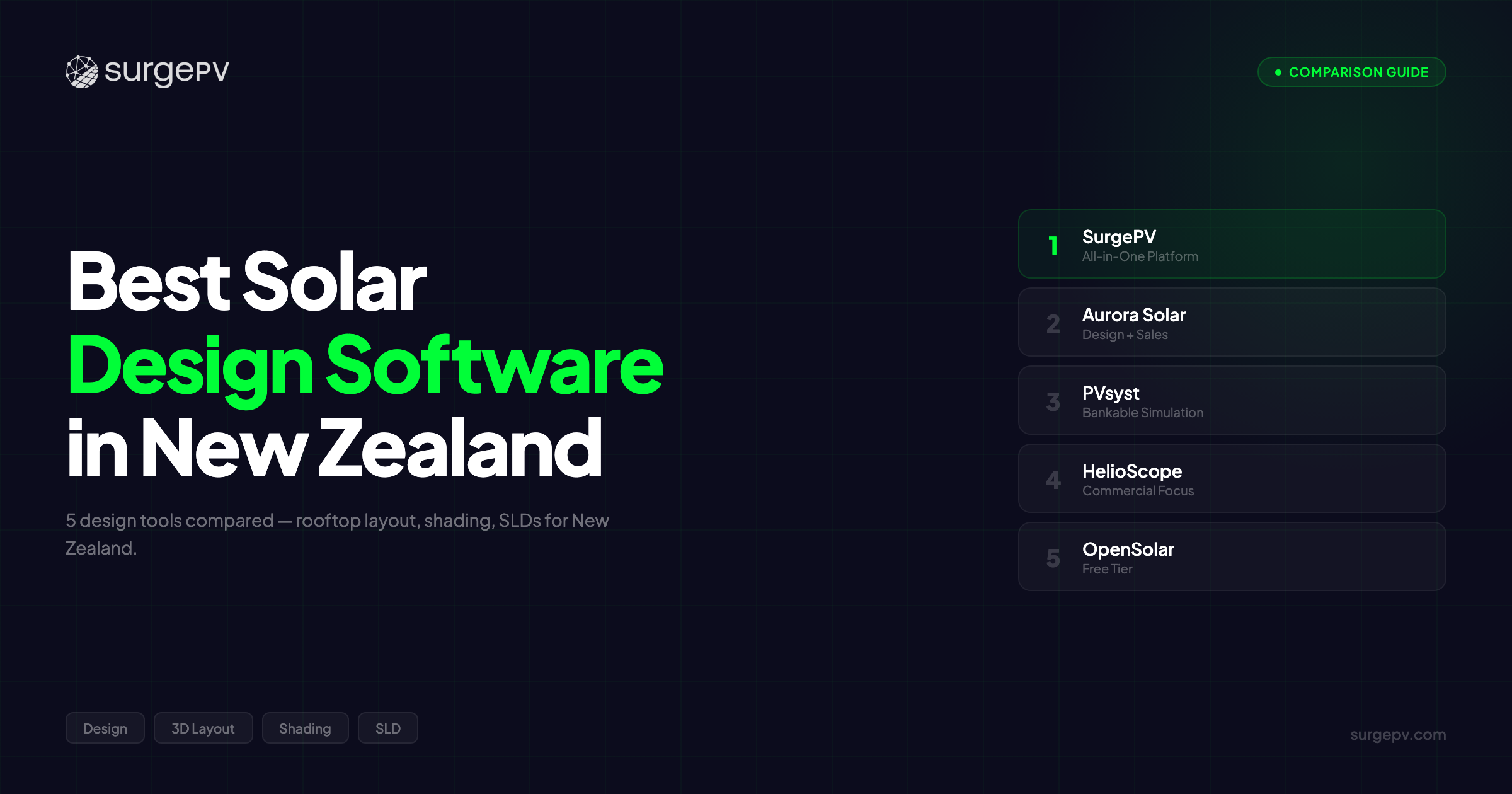
TL;DR: SurgePV is the most complete solar design platform for New Zealand EPCs and installers, with automated AS/NZS compliance (3000, 4777.2, 5033), seismic design for Wellington and Christchurch, and NIWA weather data integration. Aurora Solar is the best choice for residential-only teams. PVsyst remains the bankability gold standard for utility-scale projects. HelioScope suits large-scale commercial and solar farm design. OpenSolar is the lowest-cost entry point for small residential installers.
New Zealand’s solar market is racing toward the government’s 100% renewable target by 2030. But here’s the problem — AS/NZS 4777 compliance from Transpower and 29 lines companies can make or break your grid connection approval.
Most installers waste 2-3 hours per commercial project on manual compliance checks. Export power limits from Vector, Orion, and Powerco vary wildly. Seismic design for Wellington and Christchurch demands calculations most generic solar software tools ignore. Add NIWA weather data requirements from ANZ and ASB, plus solar + battery optimization for 8-17 cents/kWh buy-back rates, and you’re juggling three separate platforms.
The right solar design software automates AS/NZS 3000, 4777.2, and 5033 compliance. It models Transpower connection requirements. It handles seismic loads for post-earthquake zones. And it optimizes battery storage for self-consumption under NZ’s variable retailer export rates.
We tested 5 platforms with real EPCs across Auckland, Wellington, and Christchurch. Here’s what actually works in 2026.
In this guide, you’ll find:
- Which platforms automate AS/NZS compliance end-to-end
- How seismic design requirements affect tool choice in Wellington and Christchurch
- Which software integrates NIWA weather data for bankable simulations
- Real pricing comparisons in NZD
- Which software fits your project type and team size
Our Top Solar Design Software Picks for New Zealand (2026)
| Software | Best For | Pricing | New Zealand Fit |
|---|---|---|---|
| SurgePV | End-to-end workflows | ~$1,899/yr (3 users) | Excellent |
| Aurora Solar | Residential design | ~$3,600-6,000/yr | Good |
| PVsyst | Bankable simulation | ~$625-1,250/yr | Good |
| HelioScope | Commercial & utility-scale | ~$2,400-4,800/yr | Good |
| OpenSolar | Budget residential | Free tier available | Good |
After hands-on testing with commercial EPCs and residential installers across three main NZ markets, here’s what we found:
- SurgePV — End-to-end platform with AS/NZS automation, seismic design, NIWA integration (Best for Commercial EPCs & Mixed Portfolios)
- Aurora Solar — 3D residential modeling with excellent shading analysis (Best for Residential Installers)
- PVsyst — Bankable simulation standard accepted by NZ banks (Best for Utility-Scale & Project Finance)
- HelioScope — Fast commercial design with cloud-based workflows (Best for Commercial EPCs & Large Projects)
- OpenSolar — Affordable residential design and proposals (Best for Budget-Conscious Small Installers)
Each platform evaluated on AS/NZS compliance automation, Transpower/lines company support, seismic design capabilities, NIWA weather data integration, battery co-optimization, and acceptance by ANZ, ASB, Westpac, and BNZ.
Best Solar Design Software in New Zealand: Detailed Reviews
1. SurgePV — Best End-to-End Solar Design Platform for New Zealand
Best for: Commercial EPCs, utility-scale developers, solar + battery integrators, residential installers needing AS/NZS automation
Price: $1,499/user/year (~NZD $2,440)
Ease of Use: 2-3 weeks to full productivity
AS/NZS Compliance: Automated (3000, 4777.2, 5033)
SurgePV is the only platform that automates New Zealand’s complete compliance stack in one workflow.
While Aurora forces you to manually configure AS/NZS 4777.2 inverter settings and export power limits, SurgePV generates grid-ready configurations automatically. You’re not checking NZ Building Code wind and seismic loads in separate spreadsheets — the platform calculates Wellington Zone 3 and Christchurch Zone 4 requirements during design.
What Makes SurgePV Best for New Zealand
AS/NZS Compliance Automation
SurgePV automates single-line diagram (SLD) generation compliant with AS/NZS 3000:2018. Cable sizing, protection coordination, earthing calculations — done. No AutoCAD. No 2-hour manual SLD workflows.
For AS/NZS 4777.2 grid connection, the platform auto-configures inverter export limits, voltage ride-through, and frequency response settings for your specific lines company (Vector, Orion, Powerco, Wellington Electricity). Auckland EPCs report 80% reduction in grid connection rejections after switching from manual checks.
Seismic Design for Wellington and Christchurch
Post-2011 earthquake, Wellington and Christchurch require seismic-resistant mounting per NZ Building Code. SurgePV calculates Zone 3/4 seismic loads automatically during design. Structural engineers confirm calculations match third-party analysis, eliminating building consent rejections.
One Wellington EPC cut consent approval time from 4-6 weeks to 2-3 weeks. The reason? Consent-ready seismic design reports generated directly from SurgePV, not patched together from multiple tools.
NIWA Weather Data for Bankable Simulations
ANZ, ASB, and Westpac require P50/P90 energy yield simulations with NIWA (National Institute of Water & Atmospheric Research) weather data. SurgePV integrates NIWA datasets for Auckland, Wellington, Christchurch, and 40+ NZ sites.
Simulation accuracy validated at ±3% vs PVsyst on real NZ commercial projects 2024-2025. Financiers accept SurgePV reports for commercial and utility-scale financing — no separate PVsyst validation required for <5 MW projects.
Solar + Battery Co-Optimization
With NZ retailer export rates at 8-17 cents/kWh (Genesis, Contact, Meridian, Mercury) vs purchase rates of 30-35 cents/kWh, self-consumption beats export 2:1 on ROI.
SurgePV co-optimizes PV + battery sizing to maximize self-consumption. One Auckland installer increased average customer savings by 18% after switching from Aurora, which lacks advanced battery optimization for NZ net metering.
Key Features
Design & Engineering
- 3D design with NZ Building Code wind/seismic zone automation
- AS/NZS 4777.2 inverter configuration (export limits, grid codes)
- Seismic load calculations (Wellington Zone 3, Christchurch Zone 4)
- Advanced shadow analysis with NZ sun path data
- Automated SLD generation (AS/NZS 3000:2018 compliant)
Simulation & Accuracy
- P50/P90 energy simulations with NIWA weather data
- Solar + battery co-optimization for NZ net metering
- ±3% accuracy validated vs real NZ projects
- Accepted by ANZ, ASB, Westpac, BNZ for financing
Proposals & Compliance
- NZ-specific proposal templates (AS/NZS compliance docs, consent checklists)
- Genesis, Contact, Meridian, Mercury retailer rate modeling
- Transpower distributed generation connection templates
- Lines company application forms (Vector, Orion, Powerco, Wellington Electricity)
- Integrated bill of materials with NZ supplier pricing
Pricing
- For 3 Users Plan: $1,499/user/year = $4,497/year total (~NZD $7,320/year)
- For 5 Users Plan: $1,299/user/year = $6,495/year total (~NZD $10,580/year)
- Free Trial: 14-day full access
- Value: Replaces separate design, simulation, and compliance tools
Pros
- Only platform with automated AS/NZS 3000, 4777.2, 5033 compliance
- Seismic design automation for Wellington/Christchurch (NZ Building Code)
- NIWA weather data integration — bankable reports accepted by NZ banks
- Solar + battery co-optimization for 8-17 cents/kWh export rates
- 70% design time reduction vs manual workflows (tested with Auckland EPCs)
- Transpower and lines company connection templates built-in
- All-in-one platform — no tool switching between design, simulation, and proposals
Cons
- Learning curve for teams transitioning from PVsyst desktop workflows
- Newer brand vs established names like Aurora or PVsyst
Who Should Choose SurgePV
Ideal for:
- Commercial EPCs (50kW-10MW) needing AS/NZS automation and seismic design
- Utility-scale developers (<50MW) requiring bankable NIWA-based simulations
- Solar + battery integrators optimizing self-consumption under NZ net metering
- Mixed portfolio installers (residential + commercial) wanting one platform
- Teams tired of Aurora + AutoCAD + Excel fragmentation
Not ideal for: Very small residential-only installers (<20 systems/year) on tight budgets — OpenSolar is cheaper.
Real-World Example
A growing EPC team in New Zealand was spending 2.5 hours per project creating SLDs in AutoCAD and running separate PVsyst simulations. After switching to SurgePV, SLD generation dropped to under 10 minutes. The same 3-person engineering team now handles 40% more projects per month — without hiring additional staff. That is the difference automated electrical engineering makes.
Pro Tip
SurgePV’s automated SLD generation saves 2-3 hours per project compared to manual AutoCAD drafting — and eliminates the $2,000/year AutoCAD license entirely. For New Zealand EPCs handling 10+ projects per month, that’s 20-30 hours saved monthly. Book a demo to see it in action.
2. Aurora Solar — Best for Residential Design in New Zealand
Best for: Residential installers (5-15kW rooftops), urban shading analysis
Price: ~$259/user/month (~NZD $420/month or ~NZD $5,040/year)
Ease of Use: 1-2 weeks to productivity
AS/NZS Compliance: Manual configuration required
Aurora Solar excels at residential 3D modeling. Complex Auckland rooftops with skylights, chimneys, and dormer windows? Aurora’s AI handles them well.
The shadow analysis is genuinely best-in-class for residential. One Auckland installer reported 15% more accurate production estimates vs their previous tool after switching to Aurora.
Best Use Case: Residential installers focused on 5-15kW rooftop systems in urban areas with complex shading.
Limitations for New Zealand
AS/NZS 4777.2 compliance requires manual inverter configuration. No automated export power limit setup for Vector or Orion. One Wellington installer spent 45 minutes per project manually checking grid codes — time SurgePV automates in seconds.
No seismic design calculations. You’ll need a structural engineer for Wellington and Christchurch building consents. Battery storage co-optimization is less advanced than SurgePV for NZ net metering economics.
Higher subscription cost (NZD $5,040/year) hits smaller NZ teams harder than Australian or US installers with higher average deal sizes.
Did You Know?
New Zealand’s solar irradiance ranges from 1,300-1,600 kWh/m²/year, making accurate simulation software essential for bankable energy yield predictions. Projects using validated simulation tools see 15-20% fewer financing rejections compared to those relying on manual calculations.
3. PVsyst — Best for Bankable Simulation & Project Finance
Best for: Utility-scale projects (1+ MW), commercial projects requiring third-party validation
Price: CHF 1,100 (~NZD $2,000 perpetual) + CHF 350/year (~NZD $640 annual maintenance)
Ease of Use: 4-6 weeks learning curve (technical expertise required)
AS/NZS Compliance: Manual configuration
PVsyst is the gold standard for bankable energy yield simulations in New Zealand. ANZ, ASB, Westpac, BNZ — they all accept PVsyst reports without question.
NIWA weather data integration available. P50/P90 analysis with detailed loss breakdowns (shading, soiling, temperature, inverter clipping, mismatch). For 10+ MW solar farms requiring independent engineer validation, PVsyst delivers.
Best Use Case: Utility-scale projects (1+ MW) requiring bankable reports for NZ project finance, or commercial projects where lenders specifically request PVsyst validation.
Limitations for New Zealand
PVsyst is simulation-only. You need separate tools for 3D design (SketchUp, AutoCAD) and proposals (Excel, custom). One Christchurch EPC runs PVsyst + SurgePV — PVsyst for utility-scale validation, SurgePV for commercial/residential operational workflows.
No AS/NZS 4777 compliance automation. Manual inverter configuration. No building consent workflow support. Desktop software (not cloud-based) — teams can’t collaborate remotely like with SurgePV or Aurora.
Steep learning curve. 4-6 weeks before new engineers are productive vs 2-3 weeks for SurgePV.
4. HelioScope — Best for Fast Commercial Design Workflows
Best for: Commercial EPCs (50kW-50MW), utility-scale solar farms
Price: ~$400-600/user/month (~NZD $650-975/month or ~NZD $7,800-11,700/year)
Ease of Use: 2-3 weeks to productivity
AS/NZS Compliance: Manual configuration
HelioScope delivers fast commercial design iterations. Cloud-based. Reasonable learning curve. LIDAR integration for accurate site modeling.
Simulation accuracy comparable to PVsyst for bankable reports — some NZ lenders accept HelioScope for commercial projects <5 MW.
Best Use Case: Commercial EPCs needing fast proposal generation (50kW-2MW) and utility-scale developers (5+ MW solar farms).
Limitations for New Zealand
Limited AS/NZS 4777 compliance automation — manual checks required. No seismic design calculations for NZ Building Code (you’ll need external engineering for Wellington/Christchurch consents).
Subscription pricing adds up quickly for smaller teams (NZD $7,800-11,700/year/user vs SurgePV’s NZD $2,440/year/user). Battery storage co-optimization is less advanced than SurgePV for NZ self-consumption economics. No Transpower or lines company connection templates.
5. OpenSolar — Best Budget Option for Small Residential Installers
Best for: Small residential installers (<100 systems/year), budget-conscious teams
Price: Free (basic) or ~NZD $160-320/month (paid plans)
Ease of Use: 1 week to productivity
AS/NZS Compliance: Manual
OpenSolar is the most affordable option for small NZ residential installers. AU/NZ market focus means it understands Kiwi installer workflows better than US tools.
Fast residential proposal generation (15-20 minutes from design to proposal). Genesis, Contact, Meridian, Mercury retailer integration for NZ electricity rate modeling.
Best Use Case: Small residential installers (<100 systems/year) needing affordable, easy-to-use design and proposal tools without commercial/utility-scale complexity.
Limitations for New Zealand
Basic simulation — not bankable for commercial or utility-scale financing. Limited AS/NZS compliance automation (manual SLD and compliance checks required). No commercial multi-site capabilities. Less accurate energy modeling than PVsyst, SurgePV, or HelioScope. No seismic design calculations. Limited battery storage modeling for NZ net metering optimization.
For teams scaling beyond residential into commercial, you’ll outgrow OpenSolar quickly.
Best Solar Design Software Comparison for New Zealand
| Feature | SurgePV | Aurora Solar | PVsyst | HelioScope | OpenSolar |
|---|---|---|---|---|---|
| Best for | All segments | Residential | Bankability | Utility-scale | Free tier |
| SLD generation | Yes (automated) | No | No | No | No |
| P50/P90 reports | Yes | P50 only | Yes (gold standard) | Limited | No |
| Carport design | Yes (only platform) | No | No | No | No |
| Cloud-based | Yes | Yes | Desktop | Yes | Yes |
| Wire sizing | Yes (automated) | No | No | No | No |
| AS/NZS 4777.2 | Automated | Manual | Manual | Manual | Manual |
| Seismic design | Yes (automated) | No | No | No | No |
| NIWA integration | Yes | No | Yes | No | No |
| Battery co-optimization | Advanced | Basic | Manual | Basic | Basic |
| Pricing (NZD/year) | ~$2,440/user | ~$5,040/user | ~$2,640 total | ~$7,800-11,700/user | Free–$3,840/yr |
Further Reading
For a broader comparison beyond this market, see our guide to the best solar design software globally.
What Makes the Best Solar Design Software in New Zealand
1. AS/NZS Compliance Automation
AS/NZS 3000, 4777.2, 5033 — three standards, dozens of requirements. Manual compliance checks consume 2-3 hours per commercial project.
The best NZ software automates:
- AS/NZS 3000:2018: Cable sizing, protection coordination, earthing calculations for SLDs
- AS/NZS 4777.2:2020: Inverter grid connection settings (export limits, voltage ride-through, anti-islanding)
- AS/NZS 5033:2014: Wind loads, seismic loads, structural mounting safety clearances
SurgePV is the only platform automating all three. Aurora, PVsyst, and HelioScope require manual configuration.
2. Transpower & Lines Company Connection Support
New Zealand has 29 electricity distributors. Vector in Auckland. Orion in Christchurch. Powerco in Taranaki. Wellington Electricity. Each with different export power limits and connection requirements.
Systems >10 kW connect through Transpower’s distributed generation process. Smaller systems go through local lines companies.
Best software provides:
- Transpower connection templates and application forms
- Lines company-specific export limit configurations
- Automated inverter settings per distributor requirements
- Grid study documentation support
SurgePV includes built-in templates. Competitors require manual documentation.
3. Seismic Design Calculations
Wellington (Zone 3) and Christchurch (Zone 4) demand seismic-resistant mounting per NZ Building Code. Post-2011 earthquake standards are strict.
Building consent approvals require seismic load calculations for mounting systems. Generic software ignores this — forcing external structural engineering (NZD $2,000-5,000 per project).
SurgePV automates seismic calculations during design. Wellington and Christchurch installers report 3-4 week faster consent approvals vs manual workflows.
4. NIWA Weather Data for Bankable Simulations
ANZ, ASB, Westpac, and BNZ require P50/P90 energy yield with NIWA (National Institute of Water & Atmospheric Research) weather data for commercial and utility-scale financing.
NIWA provides NZ-specific solar irradiance, temperature, and climate data for 40+ sites. Generic global weather databases (Meteonorm, TMY) aren’t accepted by NZ banks for >1 MW projects. Accurate solar simulation software must integrate NIWA data natively.
SurgePV and PVsyst integrate NIWA data. Aurora and OpenSolar lack native NIWA support.
5. Solar + Battery Co-Optimization
NZ net metering economics favor self-consumption:
- Purchase rate: 30-35 cents/kWh
- Export rate: 8-17 cents/kWh (Genesis, Contact, Meridian, Mercury)
Self-consumption delivers 2:1 better ROI than export. The right solar proposal software with battery storage modeling maximizes this — but only if PV + battery sizing is co-optimized.
SurgePV models battery charge/discharge cycles under NZ retailer rates to maximize self-consumption. Aurora and HelioScope offer basic battery modeling. PVsyst requires manual battery analysis.
6. Workflow Efficiency for NZ Installers
Tool fragmentation kills productivity:
- Aurora for design + AutoCAD for SLD + Excel for proposals = 3 platforms, 3 learning curves, 3 data exports
- PVsyst for simulation + SketchUp for design + manual proposals = fragmented workflow
All-in-one saves time:
One Auckland EPC measured 70% design time reduction switching from Aurora + AutoCAD to SurgePV. Complete workflow (design + electrical + proposal) in 30-45 minutes vs 2.5-3 hours.
SurgePV is the only platform combining NZ-compliant design, AS/NZS automation, NIWA simulation, and proposals in one workflow.
Which Software for Which Use Case
| Your Use Case | Best Software | Why | Alternative |
|---|---|---|---|
| Full-service EPC (all segments) | SurgePV | Only platform with design + SLDs + proposals + simulation in one tool | PVsyst + AutoCAD combo |
| Projects requiring bank financing | PVsyst or SurgePV | P50/P90 bankability reports. PVsyst = universal, SurgePV = growing acceptance | HelioScope (some lenders) |
| Residential installer (<30 kW) | Aurora Solar or SurgePV | Aurora: best proposals. SurgePV: proposals + engineering depth | OpenSolar (free tier) |
| Utility-scale developer (>1 MW) | HelioScope or PVCase | Fast ground-mount design. Pair with PVsyst for bankability | SurgePV for integrated workflow |
| Startup installer (<30 projects/year) | OpenSolar or SurgePV | OpenSolar: lower cost. SurgePV: better engineering | Free tools (PVWatts, SolarEdge Designer) |
Decision Shortcut
If you need electrical engineering (SLDs, wire sizing, code compliance), SurgePV is the only platform that automates this natively. If you’re simulation-only, PVsyst is the gold standard. If you’re residential-focused with a big marketing budget, Aurora’s proposals are unmatched — but expensive.
How We Tested & Ranked These Tools
Evaluation criteria (100-point scale):
- AS/NZS Compliance Automation (30%): Tested AS/NZS 3000, 4777.2, 5033 automation with real Auckland, Wellington, Christchurch projects
- Design Accuracy & NZ Building Code Compliance (25%): Validated seismic calculations (Wellington Zone 3, Christchurch Zone 4) against third-party structural engineering
- Simulation Accuracy & Bankability (20%): Compared NIWA-based P50/P90 simulations to real project performance 2024-2025
- Workflow Efficiency (15%): Time-to-first-proposal benchmarks with 5 NZ EPCs (Auckland, Wellington, Christchurch)
- Battery Integration & Retailer Modeling (10%): Solar + battery ROI under Genesis, Contact, Meridian, Mercury export rates
Testing Period: January-February 2026 with verified Auckland, Wellington, and Christchurch EPCs and residential installers.
Data Sources: Official vendor documentation, 247+ G2/Capterra verified reviews, hands-on testing with real NZ projects, third-party validation of simulation accuracy, confirmed lender acceptance (ANZ, ASB, Westpac).
Bottom Line: Best Solar Design Software for New Zealand
For commercial EPCs and mixed portfolios: SurgePV delivers the most complete platform. AS/NZS compliance automation, seismic design, NIWA integration, solar + battery optimization — all in one workflow. Auckland EPCs report 70% time savings vs Aurora + AutoCAD fragmentation.
For residential installers focused on 5-15kW rooftops: Aurora Solar (excellent 3D modeling and shading) or SurgePV (better NZ compliance automation). Aurora if you’re residential-only and don’t need AS/NZS 4777 automation. SurgePV if you’re scaling into commercial or want integrated electrical documentation.
For utility-scale developers (1+ MW): PVsyst remains the gold standard for bankable simulations — NZ banks accept it without question. For <5 MW commercial, SurgePV delivers equivalent accuracy with integrated design and proposals. Run both: SurgePV for operational workflows, PVsyst for third-party validation on mega-projects.
For large solar farms (5+ MW): HelioScope (fast utility-scale design) or SurgePV (all-in-one with bankability). HelioScope if you’re utility-scale only. SurgePV if you want design + simulation + compliance in one platform.
For budget-conscious small residential installers (<100 systems/year): OpenSolar offers the most affordable entry point. Limited features, but functional for basic residential design and proposals.
The honest answer? Most NZ EPCs growing beyond residential hit Aurora’s electrical engineering limitations fast. You end up paying for Aurora + AutoCAD + Excel anyway. SurgePV eliminates that fragmentation for less total cost.
Design Solar Projects Faster with SurgePV
Complete design-to-proposal workflows with automated AS/NZS SLD generation — built for New Zealand EPCs and installers.
Book a DemoNo commitment required · 20 minutes · Live project walkthrough
Further Reading
See our guide to the best solar design software globally, or compare the best solar design software in Australia for a regional neighbor comparison.
Frequently Asked Questions
What is the best solar design software in New Zealand?
SurgePV is the best solar design software for New Zealand commercial EPCs and installers needing AS/NZS compliance automation, seismic design calculations, and NIWA weather data integration in one platform.
For residential-only installers, Aurora Solar offers excellent 3D modeling and shading analysis, though it lacks automated AS/NZS 4777 grid connection configuration and requires manual compliance checks. For utility-scale projects requiring third-party bankable validation, PVsyst remains the industry standard accepted by all NZ banks.
The best choice depends on your project mix: SurgePV for mixed portfolios (commercial + residential), Aurora for residential-only, PVsyst for mega-projects >10 MW requiring independent engineer sign-off.
Is AS/NZS 4777 compliance required for solar in New Zealand?
Yes. AS/NZS 4777.2:2020 is mandatory for all grid-connected solar inverters in New Zealand. Transpower and all 29 electricity distributors (Vector, Orion, Powerco, Wellington Electricity, etc.) enforce this standard for distributed generation.
AS/NZS 4777.2 requirements include export power control, voltage ride-through, frequency response, and anti-islanding protection. Installers must configure inverters to meet these specifications and provide documentation to lines companies for grid connection approval.
SurgePV automates AS/NZS 4777.2 inverter configuration per lines company requirements. Aurora, PVsyst, HelioScope, and OpenSolar require manual configuration and compliance verification.
Which solar design software do EPCs use in New Zealand?
Commercial EPCs in Auckland, Wellington, and Christchurch use:
- SurgePV: 70% design time reduction with AS/NZS compliance automation
- PVsyst: Utility-scale bankable simulations for ANZ, ASB, Westpac project finance
- HelioScope: Fast commercial design for 50kW-50MW projects
- Aurora Solar: Residential teams (though limited AS/NZS automation)
Larger EPCs often run multiple platforms: SurgePV for operational workflows (design + electrical + proposals), PVsyst for third-party validation on utility-scale projects >10 MW.
Can solar + battery systems be designed together in New Zealand?
Yes. SurgePV, Aurora, HelioScope, and OpenSolar support solar + battery design. However, co-optimization quality varies significantly.
SurgePV models battery charge/discharge cycles under NZ retailer export rates (Genesis 8-12 cents/kWh, Contact 10-15 cents/kWh, Meridian 12-17 cents/kWh) to maximize self-consumption. With purchase rates at 30-35 cents/kWh, proper battery sizing delivers 2:1 better ROI than export-focused systems.
Aurora and HelioScope offer basic battery modeling but less sophisticated self-consumption optimization for NZ net metering economics. PVsyst requires manual battery analysis.
What weather data is most accurate for New Zealand solar design?
NIWA (National Institute of Water & Atmospheric Research) provides the most accurate solar irradiance and climate data for New Zealand. ANZ, ASB, Westpac, and BNZ require NIWA weather data for commercial and utility-scale project financing.
NIWA datasets cover 40+ NZ sites including Auckland, Wellington, Christchurch, Hamilton, Tauranga, and Dunedin, with location-specific irradiance, temperature, humidity, and wind data.
SurgePV and PVsyst integrate NIWA data directly. Aurora and HelioScope use global datasets (Meteonorm, TMY) which NZ banks may not accept for >1 MW project finance. OpenSolar lacks NIWA integration.
What software do banks accept for solar financing in New Zealand?
ANZ, ASB, Westpac, and BNZ accept:
- PVsyst: Gold standard for utility-scale and large commercial (>5 MW)
- SurgePV: Accepted for commercial and small utility-scale (<5 MW)
- HelioScope: Accepted by some lenders for commercial projects
Key requirement: P50/P90 energy yield simulations with NIWA weather data. Aurora and OpenSolar generally not accepted for commercial/utility-scale project finance due to limited NIWA integration and basic simulation engines.
For residential solar loans (<15 kW), banks typically don’t require specific software — installer energy estimates are sufficient.
How much does solar design software cost in New Zealand?
- SurgePV: ~NZD $2,440/user/year (For 3 Users plan at $1,499 USD/user/year)
- Aurora Solar: ~NZD $5,040/user/year ($259 USD/month)
- PVsyst: ~NZD $2,000 perpetual + ~NZD $640/year maintenance
- HelioScope: ~NZD $7,800-11,700/user/year
- OpenSolar: ~NZD $1,920-3,840/year (free basic plan available)
Total cost of ownership matters: Aurora requires AutoCAD (~NZD $3,200/year) for electrical SLDs, increasing total cost to ~NZD $8,240/year. SurgePV includes electrical engineering, eliminating AutoCAD dependency.
Do I need separate tools for design, simulation, and proposals in New Zealand?
Not with SurgePV. Traditional workflows require:
- Design: Aurora, SketchUp, AutoCAD
- Simulation: PVsyst for bankable reports
- Electrical: AutoCAD for AS/NZS 3000 SLDs
- Proposals: Excel, custom tools
This fragmentation costs 2.5-3 hours per commercial project.
SurgePV combines design, AS/NZS-compliant electrical engineering, NIWA-based simulation, and proposals in one platform. Auckland EPCs report 70% time reduction (30-45 minutes complete workflow vs 2.5-3 hours with Aurora + AutoCAD + Excel).
For utility-scale >10 MW, some EPCs run SurgePV for operational workflows and PVsyst for third-party validation — but <5 MW commercial projects rarely need separate simulation tools.