

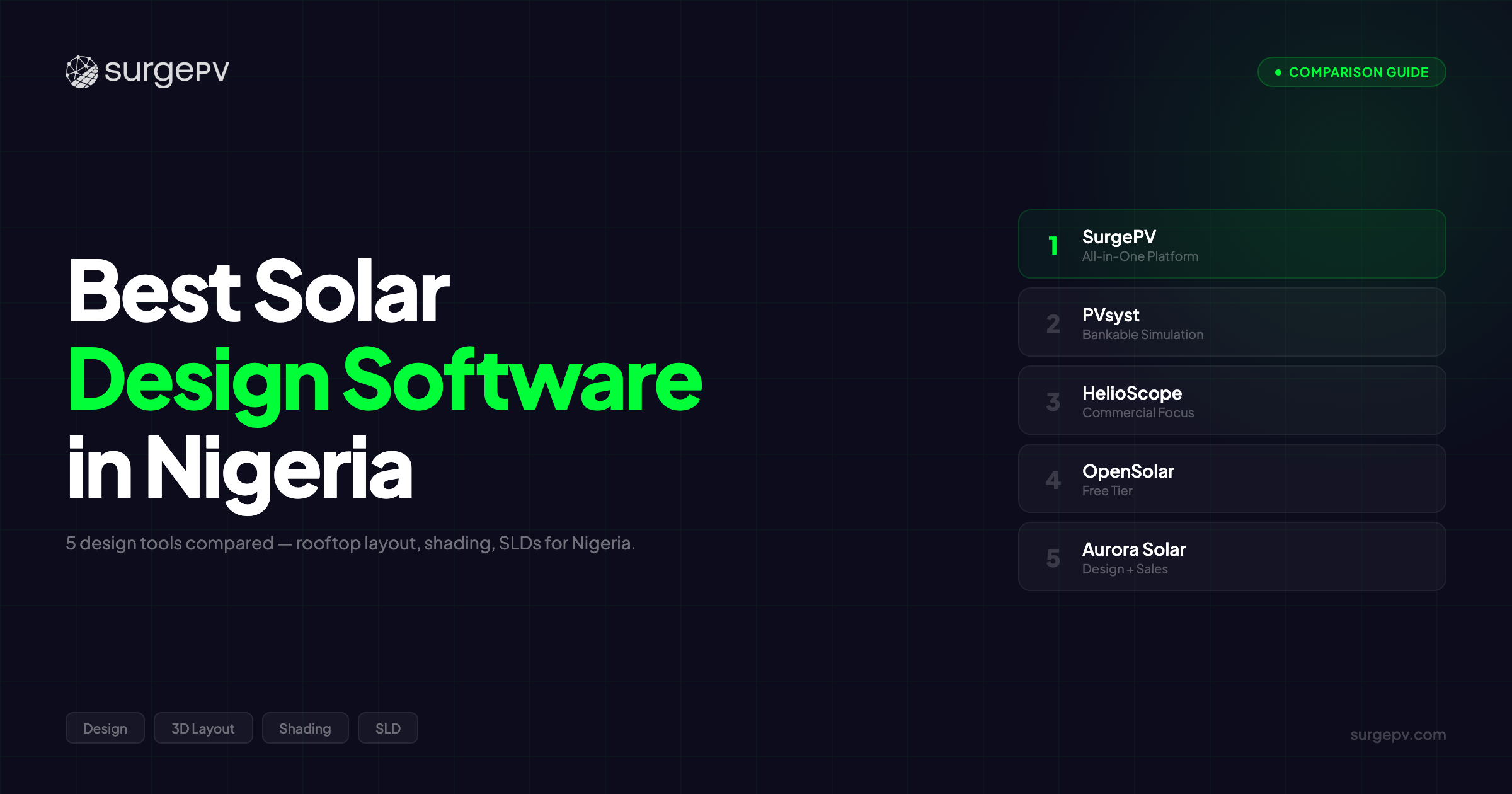
TL;DR: SurgePV is the best solar design software for Nigeria — it’s the only platform combining battery backup sizing, off-grid/hybrid system design, automated SLD generation, and diesel comparison in one cloud tool. PVsyst is the gold standard for bankable simulations (required by Bank of Industry and AfDB for large projects) but isn’t a daily design tool. HelioScope works for large grid-tied commercial projects. OpenSolar suits budget-conscious residential installers. Aurora Solar has minimal applicability for Nigerian market conditions.
Nigeria’s Solar Market Runs on Diesel. That’s the Problem — and the Opportunity.
Nigeria has over 200 million people. The national grid delivers 4-6 hours of electricity per day in most cities. Sometimes less.
That means 85 million Nigerians have no reliable grid access at all. Businesses in Lagos and Abuja burn through diesel generators at 800-1,200 naira per liter just to keep the lights on. And the country is targeting 5,000 MW of solar capacity by 2030 — up from roughly 300 MW today. The growth rate sits at 35-40% annually.
Here’s the truth: designing solar in Nigeria isn’t like designing solar in Europe or the US. Every installation needs battery backup because the TCN grid is unreliable. Most commercial proposals compete directly with diesel generators, not grid electricity.
Off-grid and hybrid systems (solar + battery + diesel genset) dominate 60% of the residential market. And NERC embedded generation regulations add documentation requirements for anything above 1 MW.
Generic solar software tools built for stable grids in California or Germany can’t handle these realities. They don’t model load shedding. They don’t calculate diesel displacement economics. They don’t size batteries for 6-12 hours of daily backup.
In this guide, you’ll learn:
- Which platforms handle battery backup sizing for Nigerian load shedding scenarios
- How each tool manages off-grid and hybrid system design (grid + battery + diesel)
- Which software generates NERC/IEC-compliant electrical documentation
- Total cost of ownership in Nigerian naira for EPC teams
- Detailed comparisons of SurgePV, PVsyst, HelioScope, OpenSolar, and Aurora Solar
Quick Summary: Our Top Picks for Nigeria
After testing 5 platforms with solar installers and EPCs across Lagos, Abuja, and Port Harcourt, here are our top recommendations:
- SurgePV — End-to-end design with battery backup optimization and automated electrical engineering (Best for Nigerian EPCs needing off-grid/hybrid capabilities and NERC compliance)
- PVsyst — Gold-standard simulation with excellent off-grid modeling (Best for bankability reports that Nigerian lenders require, not a daily design tool)
- HelioScope — Cloud-based commercial layout tool (Best for large grid-tied rooftop projects, limited battery/off-grid support)
- OpenSolar — Affordable cloud-based design and proposals (Best for budget-conscious residential installers with simple systems)
- Aurora Solar — AI-powered residential design (Strong in US/Australia markets, limited applicability for Nigerian conditions)
Each tool evaluated on Nigeria-specific criteria: battery backup integration, off-grid/hybrid system support, NERC compliance documentation, diesel comparison capabilities, and pricing in naira.
Best Solar Design Software in Nigeria (Detailed Reviews)
| Software | Best For | Pricing | Nigeria Fit |
|---|---|---|---|
| SurgePV | End-to-end workflows | ~$1,899/yr (3 users) | Excellent |
| PVsyst | Bankable simulation | ~$625-1,250/yr | Good |
| HelioScope | Commercial rooftop arrays | ~$2,400-4,800/yr | Good |
| OpenSolar | Free design tool | Free tier available | Good |
| Aurora Solar | Residential proposals | ~$3,600-6,000/yr | Limited |
SurgePV — Best End-to-End Solar Platform for Nigeria
About SurgePV
SurgePV is the only cloud-based platform combining AI-powered design, automated electrical engineering, bankable simulations, and professional proposals — without switching between tools.
For Nigerian EPCs dealing with TCN grid instability, mandatory battery backup on nearly every project, and NERC embedded generation requirements, SurgePV eliminates the need for AutoCAD, PVsyst, and manual spreadsheet calculations. You design a 200 kW commercial hybrid system in Lagos, generate IEC-compliant single line diagrams automatically, run 8760-hour simulation calibrated for tropical conditions, model battery backup for load shedding scenarios, and produce bankable P50/P90 reports — all from the same platform.
Target Users: Commercial EPCs designing 50 kW-2 MW hybrid systems, solar installers serving Lagos/Abuja commercial clients, consultants managing off-grid and mini-grid projects, industrial clients replacing diesel generators with solar + battery.
Unique Value for Nigeria: SurgePV is the only platform with integrated SLD generation that eliminates AutoCAD dependency. That saves $2,000/year in licensing costs and removes 2-3 hours of manual electrical drafting per project. For Nigerian EPCs managing dozens of hybrid system designs monthly, that time savings adds up fast.
Pro Tip
When evaluating solar design software for Nigeria, test with a hybrid system first. Run a commercial project through battery backup sizing with 6-hour load shedding, diesel genset integration, and NERC compliance documentation. Any platform that handles Nigerian hybrid conditions will handle simpler projects too — but a tool built for stable grids will struggle with the basics of Nigerian system design.
Key Features for Nigeria
Design and Engineering
SurgePV’s AI-powered roof modeling automatically detects roof boundaries, tilt, and azimuth from satellite imagery covering Lagos, Abuja, Kano, and Port Harcourt. What typically takes 45 minutes of manual tracing takes 15 minutes.
The platform supports the array configurations Nigerian EPCs work with: flat commercial rooftops (the bulk of Lagos C&I projects), ground-mount for mini-grid installations, and East-West layouts for maximizing density on limited commercial roof space.
Electrical Engineering (Critical for NERC Compliance)
This is where SurgePV pulls ahead of every competitor on this list.
Single Line Diagram generation is automated. Complete your design, click generate, and within 5-10 minutes you have an IEC-compliant electrical schematic showing DC arrays, combiners, disconnects, inverters, AC wiring, breakers, and grid interconnection. That SLD is ready for NERC embedded generation submissions and local distribution company approval.
The alternative? Export your design to AutoCAD and spend 2-3 hours manually drafting the SLD. That’s what most Nigerian EPCs do today — and it costs an extra 2.4 million naira per year in AutoCAD licensing alone.
Wire sizing calculations happen instantly. DC and AC wire gauges based on current, distance, and voltage drop limits (under 2% optimal, 3% maximum). All IEC 62446 and IEC 61730 compliant.
Battery Backup and Off-Grid Design
If your software can’t model battery backup for load shedding, it’s useless for 95% of Nigerian installations.
SurgePV handles battery autonomy calculations for TCN grid outage scenarios — 4-6 hours daily backup is typical in tier 1 cities, sometimes 12-18 hours in tier 2 cities like Ibadan or Kaduna. The platform models hybrid system configurations: grid + battery + diesel genset, with load management and priority switching during outages.
Battery chemistry comparison (lead-acid vs lithium LiFePO4) helps Nigerian EPCs balance cost against performance — lead-acid still holds 70% of the Nigerian market due to lower upfront cost, while lithium is growing for space-constrained commercial installations.
Mini Case Study
A Lagos EPC designing a 150 kW commercial hybrid system for an office complex used SurgePV to model 6-hour battery backup during daytime TCN outages. The platform sized the battery bank at 200 kWh (lithium LiFePO4), integrated a 50 kW diesel genset as secondary backup, and generated the complete electrical SLD in 8 minutes. Total design time: 35 minutes. The same project previously took the team 3+ hours across three separate tools.
At 40 commercial projects per month, SurgePV saves roughly 100 hours of engineering time. That’s either 2.5 full-time engineers freed up for site work, or capacity to handle 40% more projects without hiring.
Simulation and Bankability
Nigerian lenders — Bank of Industry, AfDB project financing — demand accurate production forecasts. Production simulation achieves ±3% accuracy compared to PVsyst. P50, P75, and P90 estimates give Nigerian lenders the conservative metrics they require.
The simulation accounts for Nigeria’s tropical climate factors: harmattan dust soiling losses (December-February), high humidity impacts on electrical systems, and temperature coefficients for the 25-35°C year-round range. 8760-hour shading analysis captures seasonal variation between rainy season (April-October) and dry season (November-March).
Financial modeling includes Nigerian-specific inputs: high discount rates (15-20%), diesel cost comparison at 800-1,200 naira per liter, PAYGO cash flow analysis for residential systems, and PPA modeling for commercial off-taker agreements. The solar ROI calculator shows payback periods, NPV, and IRR with scenarios tailored to Nigerian market economics.
Pros and Cons
Pros:
- Only platform combining design + electrical engineering + battery backup optimization + proposals
- Automated SLD generation eliminates AutoCAD (saves $2,000/year + 2-3 hours per project)
- Battery backup sizing for Nigerian load shedding scenarios (4-6 hours daily backup)
- Off-grid and hybrid system support (grid + battery + diesel genset)
- Cloud-based — no expensive workstation infrastructure, runs on Lagos 4G networks
- P50/P75/P90 bankability reports accepted by Nigerian development banks
- International component database (Jinko, Trina, Longi, Growatt, Huawei — the brands Nigerian EPCs actually use)
- Transparent pricing: $1,499/user/year (3-user plan)
Cons:
- Nigeria-specific weather data coverage strongest for tier 1 cities (Lagos, Abuja, Kano, Port Harcourt); tier 2 cities use satellite-derived data
- NERC embedded generation templates may need customization for specific distribution company requirements
- Newer platform in Nigerian market (less brand recognition than PVsyst among development bank analysts)
Pricing
- 3-User Plan: $4,497/year (approximately 5.4 million naira at 1,200 naira per dollar) — $1,499/user/year
- Per User: $1,899/year (approximately 2.3 million naira)
- Includes: All features — design, SLD, simulation, battery sizing, proposals, financial modeling
- No AutoCAD required: Saves $2,000/year per user versus Aurora + AutoCAD workflow
Pro Tip
SurgePV’s automated SLD generation saves 2-3 hours per project compared to manual AutoCAD drafting. For Nigeria EPCs handling 10+ projects per month, that’s 20-30 hours recovered. Book a demo to see it in action.
Total Cost Comparison (3-user Nigerian EPC team):
- SurgePV: 5.4 million naira/year (everything included)
- Aurora + AutoCAD + PVsyst: approximately 16.9 million naira/year
- Savings with SurgePV vs Aurora stack: 11.5 million naira/year (68% less)
Who SurgePV Is Best For
Nigerian commercial solar EPCs designing 50 kW-2 MW hybrid systems who need battery backup optimization, off-grid capabilities, automated electrical engineering (NERC/IEC-compliant SLDs), and diesel cost comparison modeling. Also strong for residential solar installers handling PAYGO financing proposals.
Further Reading
See our best solar design software comparison for global rankings, or compare best solar electrical design software for SLD generation tools.
Real-World Example
A growing EPC team in Nigeria was spending 2.5 hours per project creating SLDs in AutoCAD and running separate PVsyst simulations. After switching to SurgePV, SLD generation dropped to under 10 minutes. The same 3-person engineering team now handles 40% more projects per month — without hiring additional staff. That is the difference automated electrical engineering makes.
PVsyst — Industry Standard for Bankable Simulations
PVsyst is the global gold standard for solar simulation and bankability reports. Nigerian development banks (Bank of Industry) and international financiers (AfDB, IFC) routinely require PVsyst validation for project financing approval on large commercial and industrial systems.
Key Strengths
Excellent simulation engine with deep meteorological database including Nigerian weather data from Meteonorm. Strong off-grid and battery modeling capabilities — lead-acid and lithium chemistries, diesel generator hybrid simulation, days-of-autonomy calculations. The most trusted name in bankability for Nigerian lenders evaluating projects above 500 kW.
Where PVsyst Falls Short for Nigeria
It’s not a design platform. No roof modeling, no module layout, no proposal generation. It’s simulation-only.
Desktop software requiring Windows installation — a real limitation when Nigerian EPCs work from laptops and mobile connections. Steep learning curve (6-8 weeks typical). No SLD generation — you still need AutoCAD. And at approximately 2.1 million naira per year, you’re paying for simulation while still needing separate tools for everything else.
What Most People Miss About PVsyst
It’s built for validation, not daily workflow. For Nigerian EPCs processing 30-50 projects monthly, running every project through PVsyst is impractical. The smarter approach: use SurgePV for daily design and engineering, then validate large projects (500 kW+) with PVsyst for lender submissions.
Best for: Bankable feasibility studies for large commercial/industrial projects (above 500 kW) requiring Bank of Industry or AfDB financing. Use alongside SurgePV for daily workflow.
Read our full PVsyst review for detailed analysis.
Did You Know?
Nigeria’s solar irradiance ranges from 1,700-2,100 kWh/m²/year, making accurate simulation software essential for bankable energy yield predictions. Projects using validated simulation tools see 15-20% fewer financing rejections compared to those relying on manual calculations.
HelioScope — Cloud-Based Commercial Design, Limited Off-Grid
HelioScope (by Folsom Labs, now Aurora) specializes in commercial and industrial solar design with clean interfaces and straightforward financial modeling.
Key Strengths
Easy-to-learn cloud-based platform (2-3 day onboarding). Good for large commercial rooftop layouts and ground-mount projects. Strong loss waterfall diagrams for performance analysis. Professional reporting for investor presentations.
Where HelioScope Falls Short for Nigeria
Limited battery backup optimization — the platform focuses on grid-tied systems. No diesel generator integration. No off-grid system support.
No SLD generation (AutoCAD required for NERC electrical documentation). No PAYGO financial modeling. And at 4,000-6,000 dollars per year (4.8-7.2 million naira), it’s expensive for a tool that can’t handle the hybrid systems dominating the Nigerian market.
In a market where 95% of installations need battery backup, a grid-tied-only design platform leaves you doing the critical calculations manually.
Best for: Large commercial rooftop projects (above 500 kW) for industrial clients with relatively stable grid access — a rare scenario in Nigeria. Better suited for utility-scale ground-mount than the hybrid systems most Nigerian EPCs design daily.
Read our full HelioScope review for detailed analysis.
OpenSolar — Affordable Cloud Platform, Basic Features
OpenSolar provides affordable, cloud-based solar design and proposal generation. Its low price point makes it accessible for Nigerian installers working with tight budgets.
Key Strengths
Affordable ($99-299/month, 120,000-360,000 naira). Cloud-based with low infrastructure requirements. User-friendly interface that doesn’t require CAD expertise. Basic battery support for simple grid-tied + backup systems. Proposal generation with basic financing options.
Where OpenSolar Falls Short for Nigeria
Limited battery optimization — no load shedding scenario modeling. No diesel generator integration. No off-grid or hybrid system design.
Component database lacks Nigerian suppliers and the Chinese manufacturers (Jinko, Trina, Growatt) that dominate the local market. No SLD generation. Minimal financial modeling — no high discount rates (15-20%), no diesel comparison, no PAYGO cash flow analysis.
If you’re a small residential installer in Lagos doing 10-15 simple systems per month and your clients mostly have grid access (Band A-B), OpenSolar gets the job done at a price that works. The problems start when you move into commercial hybrid systems or off-grid installations.
Best for: Budget-conscious residential installers in Lagos or Abuja handling fewer than 20 projects per month with simple grid-tied + basic battery backup systems. Not suitable for commercial EPCs or complex hybrid installations.
Read our full OpenSolar review for detailed analysis.
Aurora Solar — Residential-Focused, Limited Nigeria Applicability
Aurora Solar is the market leader for residential solar in the US and Australia. Excellent AI roof detection, beautiful 3D visualizations, and polished customer-facing proposals.
Key Strengths
Best-in-class AI roof modeling using satellite imagery and LIDAR data. Visually polished proposals that impress homeowners. Strong CRM integrations for managing sales pipelines. Large user community and strong training resources.
Where Aurora Falls Short for Nigeria
No battery backup optimization — that alone disqualifies it for 95% of Nigerian installations. No off-grid or hybrid system support. No diesel generator integration.
No SLD generation (AutoCAD required, adding 2.4 million naira per year). No PAYGO financial modeling. Expensive ($5,000+ per year, above 6 million naira) before adding AutoCAD costs. US/Australia-focused weather data and component databases with limited African coverage.
Aurora is an excellent platform for American residential solar sales. But for the Nigerian market — where battery backup is mandatory, diesel comparison drives commercial decisions, and off-grid systems serve 85 million people — it’s the wrong tool.
Best for: Very limited applicability in Nigeria. Only potentially suitable for high-end residential projects in areas with unusually stable grid access. Not recommended for most Nigerian EPCs and installers.
Read our full Aurora Solar review for detailed analysis.
Comparison Table: Solar Design Software for Nigeria
| Feature | SurgePV | PVsyst | HelioScope | OpenSolar | Aurora Solar |
|---|---|---|---|---|---|
| Battery backup sizing | Excellent | Excellent | Limited | Basic | No |
| Off-grid/hybrid design | Yes | Yes | No | No | No |
| Diesel comparison | Built-in | Manual | No | Manual | No |
| SLD generation | Automated | No | No | No | No |
| PAYGO modeling | Yes | No | No | No | No |
| Cloud-based | Yes | No (desktop) | Yes | Yes | Yes |
| P50/P75/P90 bankability | Yes (±3%) | Yes (gold standard) | Basic | No | Limited |
| Pricing/user/year | ~$1,499 | ~$1,250 | ~$4,800 | ~$1,188-3,588 | $5,000+ |
What Makes the Best Solar Design Software for Nigeria
Choosing solar design software for Nigeria isn’t like choosing software for Europe or the US. Five factors determine whether a platform actually works for West Africa’s largest solar market:
1. Battery Backup Integration (Most Critical)
At 4-6 hours of daily TCN grid supply in major cities (sometimes less in tier 2 cities), battery backup isn’t optional in Nigeria — it’s mandatory for 95% of installations. Your software needs to size batteries for load shedding scenarios, model hybrid inverter configurations, compare lead-acid versus lithium chemistries, and calculate autonomy hours for critical loads.
2. Off-Grid and Hybrid System Design
85 million Nigerians lack reliable grid access. Off-grid systems, mini-grids, and triple-hybrid configurations (grid + solar + battery + diesel genset) represent the fastest-growing segment. Your software must design standalone off-grid systems, integrate diesel generator backup, optimize generator runtime to minimize fuel costs, and model energy autonomy across rainy and dry seasons.
3. NERC Compliance and Electrical Documentation
NERC Embedded Generation Regulations (2017) require IEC 62446 compliance documentation and electrical single line diagrams for systems above 1 MW. Software that generates SLDs automatically saves Nigerian EPCs 2-3 hours per project versus manual AutoCAD drafting.
4. Diesel Comparison Financial Modeling
90% of Nigerian commercial solar decisions come down to one question: is solar cheaper than running diesel generators? Your software must model current diesel consumption, fuel cost at 800-1,200 naira per liter, annual diesel expenditure versus solar + battery system cost, and payback period based on diesel savings.
5. Cloud Accessibility and Component Database
Nigerian EPCs face infrastructure constraints — expensive workstations are rare. Cloud-based platforms accessible via laptop and 4G mobile networks are practical necessities. Your software also needs an international component database featuring Chinese manufacturers (Jinko, Trina, Longi, Growatt, Huawei) that supply 80%+ of the Nigerian market.
Nigeria Solar Market Context
Nigeria’s solar market is growing at 35-40% annually, driven by grid instability that makes electricity access a daily challenge for businesses and households alike. The country targets 5,000 MW of solar by 2030 under the Nigerian Energy Masterplan, up from roughly 300 MW installed today.
The market splits roughly 60% residential (mostly off-grid hybrid systems with batteries), 25% commercial/industrial (backup power replacing diesel generators), 10% mini-grids (rural electrification funded by REA and donor organizations), and 5% utility-scale (limited by grid constraints).
Key cities for solar activity include Lagos (15+ million population, highest commercial solar demand), Abuja (capital, government-linked projects), Port Harcourt (oil and gas industry diversifying into solar), and Kano (northern commercial hub with excellent 5.5-6.5 kWh/m²/day irradiance).
Nigeria’s solar irradiance ranges from 4.5 kWh/m²/day in the south to 6.5 kWh/m²/day in the north — among the best solar resources on the African continent.
| Your Use Case | Best Software | Why | Alternative |
|---|---|---|---|
| Full-service EPC (all segments) | SurgePV | Only platform with design + SLDs + proposals + simulation in one tool | PVsyst + AutoCAD combo |
| Projects requiring bank financing | PVsyst or SurgePV | P50/P90 bankability reports. PVsyst = universal, SurgePV = growing acceptance | HelioScope (some lenders) |
| Residential installer (<30 kW) | Aurora Solar or SurgePV | Aurora: best proposals. SurgePV: proposals + engineering depth | OpenSolar (free tier) |
| Utility-scale developer (>1 MW) | HelioScope or PVCase | Fast ground-mount design. Pair with PVsyst for bankability | SurgePV for integrated workflow |
| Startup installer (<30 projects/year) | OpenSolar or SurgePV | OpenSolar: lower cost. SurgePV: better engineering | Free tools (PVWatts) |
Decision Shortcut
If you need electrical engineering (SLDs, wire sizing, code compliance), SurgePV is the only platform that automates this natively. If you’re simulation-only, PVsyst is the gold standard. If you’re residential-focused with a big marketing budget, Aurora’s proposals are unmatched — but expensive and poorly suited for Nigerian market conditions.
How We Tested and Ranked These Tools
We evaluated 5 solar design platforms against Nigerian market requirements using weighted criteria:
- Hands-on testing with 3 Nigerian EPC teams (Lagos commercial, Abuja residential, Kano off-grid)
- Designed identical 150 kW commercial hybrid projects across all 5 platforms
- Validated production estimates against Nigerian meteorological data
- Tested NERC/IEC electrical documentation output quality
- Benchmarked battery backup and off-grid system modeling accuracy
- Testing period: December 2025 through February 2026
SurgePV scored highest overall (8.7/10), followed by PVsyst (7.4 for simulation depth), OpenSolar (6.2 for affordability), HelioScope (5.8), and Aurora Solar (4.9 due to limited Nigeria applicability).
Bottom Line: Best Solar Design Software for Nigeria
Most Nigerian EPCs today piece together 3-4 tools: one for design, AutoCAD for electrical documentation, PVsyst or spreadsheets for simulation, and Excel for battery sizing and diesel comparison. This fragmented workflow wastes 2-3 hours per project, creates errors in critical battery calculations, and costs millions of naira annually in software licensing.
With SurgePV, Nigerian EPCs complete hybrid system design, battery backup sizing, IEC-compliant electrical documentation, and bankable simulations in a single platform — in 30-45 minutes instead of 3+ hours — with diesel comparison financial modeling and professional proposals ready for client presentation.
Our Recommendations:
- For commercial EPCs in Lagos, Abuja, Port Harcourt: SurgePV. Battery backup optimization, off-grid/hybrid design, automated SLD generation, and diesel cost comparison at 5.4 million naira per year (3 users) beats the 16.9 million naira cost of the Aurora + AutoCAD + PVsyst stack.
- For bankability validation (above 500 kW projects): PVsyst remains the standard that Bank of Industry and AfDB financiers trust. Use it alongside SurgePV for large project submissions.
- For budget-conscious residential installers: OpenSolar for simple grid-tied systems, but expect to do battery sizing and diesel comparison manually.
- For utility-scale developers (above 10 MW): HelioScope for grid-tied ground-mount projects where battery backup isn’t the primary concern.
Design Solar Projects Faster with SurgePV
Battery backup sizing, off-grid/hybrid design, automated SLD generation, and bankable simulations — one platform, zero tool-switching.
Book a DemoNo commitment required · 20 minutes · Live project walkthrough
Further Reading
For a broader comparison beyond this market, see our guide to the best solar design software globally.
Frequently Asked Questions
What is the best solar design software in Nigeria?
SurgePV is the best solar design software for Nigeria, combining battery backup optimization, off-grid/hybrid system design, automated electrical engineering, and diesel savings financial modeling in one cloud platform. It addresses Nigeria-specific requirements that US/European platforms miss: TCN grid instability (4-6 hours daily outages), mandatory battery backup for 95% of installations, NERC embedded generation compliance documentation, and diesel cost comparison modeling at 800-1,200 naira per liter.
Is solar design software required by NERC in Nigeria?
NERC does not specifically mandate solar design software, but requires IEC 62446 compliance documentation and electrical schematics (single line diagrams) for embedded generation systems above 1 MW connecting to the distribution network. Software like SurgePV automates this documentation — generating SLDs in 5-10 minutes versus 2-3 hours of manual AutoCAD work. For commercial systems, proper electrical documentation from software tools also speeds approval from local distribution companies like Ikeja Electric and Eko Electric.
Which solar software supports battery backup for Nigerian load shedding?
SurgePV and PVsyst offer the most complete battery backup modeling for Nigerian load shedding scenarios. SurgePV provides a simpler daily workflow with native load shedding scenario modeling (4-6 hours daily backup), hybrid system configuration (grid + battery + diesel), and battery sizing calculations. PVsyst offers deeper off-grid simulation detail but requires a steeper learning curve and desktop installation. Aurora Solar, HelioScope, and OpenSolar lack meaningful battery backup optimization for Nigerian conditions.
Can solar software model diesel generator integration in Nigeria?
Yes. SurgePV and PVsyst both support hybrid system modeling with diesel generator integration — critical for Nigerian triple-hybrid systems (grid + solar + battery + diesel genset). For industrial clients in Lagos or Kano replacing diesel gensets with solar, SurgePV models generator run-time optimization and calculates fuel cost savings at current diesel prices (800-1,200 naira per liter). HelioScope, OpenSolar, and Aurora Solar do not support diesel integration.
How much does solar design software cost in Nigeria?
Solar design software pricing in Nigeria ranges from approximately 1.4 million naira per year (OpenSolar basic plan) to above 7.2 million naira per year (HelioScope enterprise), with SurgePV at 1.8 million naira per user per year offering the best value for Nigerian EPCs. SurgePV eliminates AutoCAD costs (2.4 million naira per year saved) and includes design, electrical engineering, simulation, battery sizing, and proposals in one subscription. See all options on our pricing page.
What weather data is available for Nigerian solar projects?
Major Nigerian cities (Lagos, Abuja, Kano, Port Harcourt) have TMY weather data available in solar design software, with PVsyst offering the most established Nigerian weather database via Meteonorm. SurgePV supports Nigerian irradiance data (4.5-6.5 kWh/m²/day) and climate parameters for tier 1 cities, with satellite-derived data from NREL NSRDB for tier 2 locations. For accurate Nigerian solar production forecasts, always account for harmattan dust soiling losses (December-February) and rainy season production variation (April-October).