

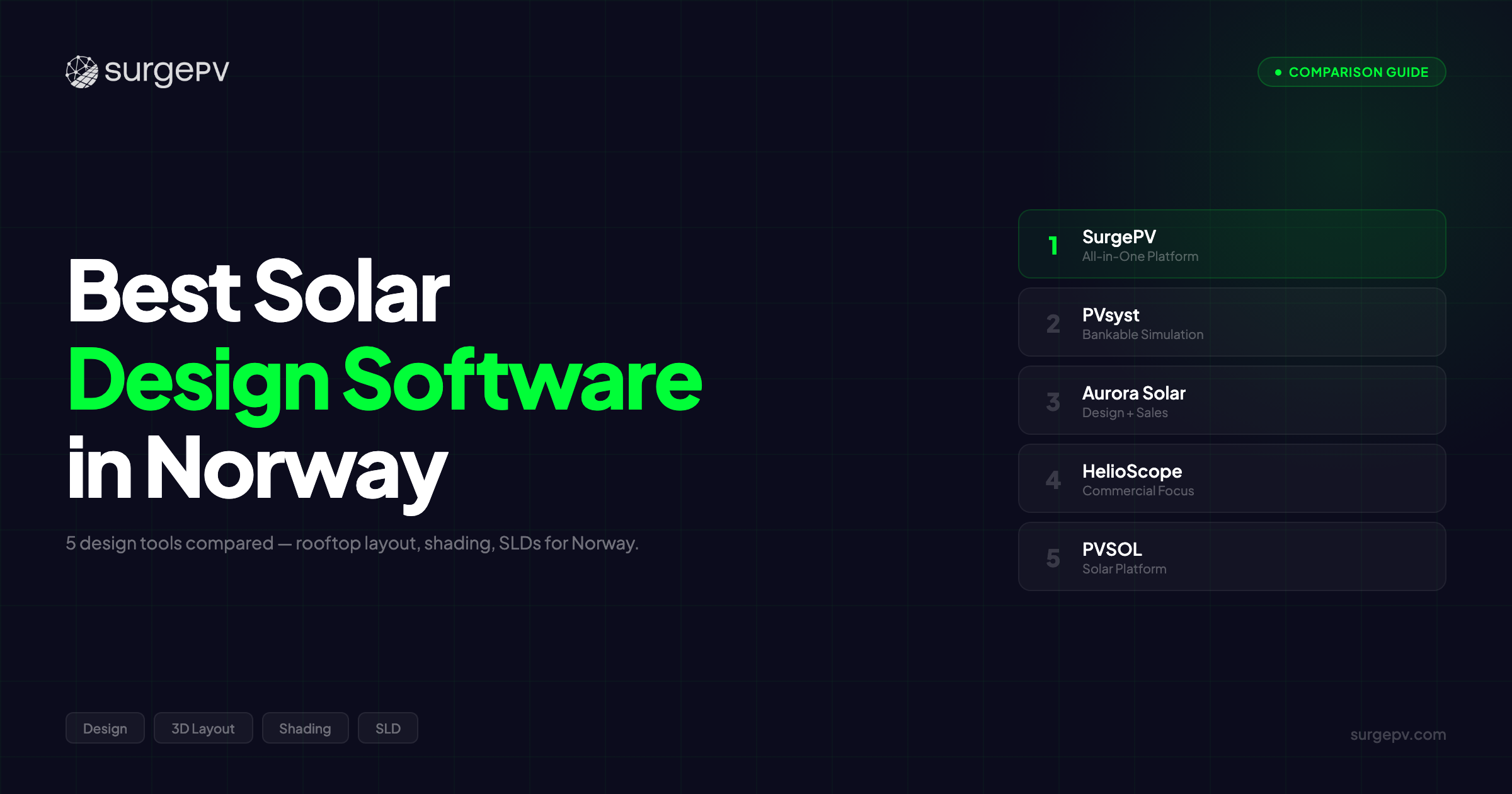
TL;DR: SurgePV is the best overall solar design platform for Norway — combining automated NEK 400-compliant SLD generation, P50/P90 bankable simulations, and professional proposals in one cloud-based tool at $1,899/year for 3 users. PVsyst remains the bankability gold standard for utility-scale projects requiring Norwegian lender acceptance. Aurora Solar leads for residential remote design across Norway’s vast geography. HelioScope works well for commercial C&I team collaboration. PVSOL handles complex urban shading in Oslo, Bergen, and Trondheim.
Norway’s solar market is growing at 15-20% annually — even with some of the lowest irradiance in Europe. That might sound counterintuitive, but record electricity prices (NOK 1.50-2.50/kWh) and strong energy independence goals are pushing installers across the country to scale fast (NVE — Norwegian Water Resources and Energy Directorate).
But designing solar systems in Norway? That is where most software falls apart. Annual irradiance of just 800-1,100 kWh/m² — 30-40% lower than Southern Europe. Midnight sun in summer, near-zero daylight in winter. Snow loads up to 400 kg/m² in inland regions. Statnett grid connection rules. NEK 400 electrical standards. Most solar design software tools were built for sunnier, simpler markets — and they do not account for any of this.
If you are designing solar systems in Norway, you need a platform that handles accurate low irradiance modeling, produces bankable P50/P90 reports, and generates Statnett-compliant documentation without forcing you through three separate tools.
We tested and compared the top 5 solar design platforms for the Norwegian market, evaluating each on Nordic climate accuracy, regulatory compliance, simulation depth, and pricing.
In this guide, you’ll learn:
- Which platform handles Statnett grid connection and NEK 400 documentation best
- How pricing compares across tools (from $625/year to over $5,800/year)
- Which software produces bankable reports accepted by Norwegian lenders (DNB, Nordea, SpareBank 1)
- Our recommendation based on 500+ commercial projects across Europe
Quick Comparison Table
| Software | Best For | Pricing/Year | SLD Generation | P50/P90 |
|---|---|---|---|---|
| SurgePV | All segments (end-to-end) | $1,899 (3 users) | Yes (automated) | Yes |
| PVsyst | Bankable simulations | $625-1,250 | No | Yes (gold standard) |
| Aurora Solar | Residential remote design | $3,600-6,000 | No | P50 only |
| HelioScope | Commercial C&I design | $2,400-4,800 | No | Limited |
| PVSOL | Complex urban shading | $850-1,600 | Basic | Limited |
Best Solar Design Software in Norway (Detailed Reviews)
SurgePV — Best End-to-End Solar Design Platform for Norway
Best For: EPCs and installers across all segments
Pricing: $1,899/year (3 users); $1,499/user/year (For 3 Users plan)
Onboarding: 2-3 weeks
SurgePV is an end-to-end solar design and engineering platform that combines layout design, electrical engineering, bankable simulations, and proposal generation in a single cloud-based tool.
For the Norwegian market, that matters more than you might expect.
Here is why: most competing platforms force you to switch between 2-3 separate tools for a complete commercial project. Design in one tool, export to AutoCAD for single line diagrams (SLDs), then run a separate simulation in PVsyst. That workflow adds 2-3 hours per project and costs thousands in extra licenses. With Norwegian labor rates running NOK 600-1,000/hour for skilled technicians, those extra hours are expensive.
SurgePV eliminates that entirely.
Key Features for Norway
- Automated SLD generation — Creates NEK 400-compliant electrical schematics in 5-10 minutes, meeting Statnett and DSO documentation requirements. Manual AutoCAD drafting takes 2-3 hours for the same output.
- P50/P75/P90 bankability metrics — Produces the production estimates Norwegian banks (DNB, Nordea, SpareBank 1) and Enova subsidy evaluators require. Accuracy within +/-3% of PVsyst. That means your financing applications include the bankability data lenders actually require — not just optimistic P50 estimates that get rejected.
- 8760-hour shading analysis — Hour-by-hour simulation across the full year. Critical for Norway’s extreme seasonal variation — from midnight sun to near-zero winter daylight — and the low sun angles that create long shadows across Nordic rooftops.
- Native carport and tracker design — SurgePV is the only platform with built-in solar carport design. Single-axis and dual-axis tracker support included. As Norway’s commercial carport and ground-mount installations grow, this is a competitive edge other platforms simply do not offer.
- Financial modeling — Supports custom utility rate input, enabling accurate ROI calculations with Norwegian electricity prices (NOK 1.50-2.50/kWh) and seasonal production curves that account for midnight sun summers and dark winters.
- Wire sizing and voltage drop calculations — Instant automated calculations per IEC and NEK 400 standards, eliminating manual spreadsheet work. No more cross-referencing code tables — and zero risk of undersized cables failing inspection.
Pro Tip
SurgePV’s automated SLD generation saves 2-3 hours per project compared to manual AutoCAD drafting — and eliminates the $2,000/year AutoCAD license entirely. Book a demo to see it in action.
Pricing
| Plan | Price | Users |
|---|---|---|
| Individual | $1,899/year | 3 users |
| For 3 Users | $1,499/user/year | 3 users |
| For 5 Users | $1,299/user/year | 5 users |
| Enterprise | Custom | Multiple |
All features included on every plan. No hidden fees, no feature gating. See full pricing.
Who SurgePV Is Best for in Norway
- Commercial EPCs handling 50 kW-10 MW projects needing Statnett-compliant SLDs
- Residential installers who want design, engineering, and proposals in one tool
- Companies applying for Enova subsidies needing bankable P50/P90 reports
- Teams looking to eliminate AutoCAD dependency and reduce per-project costs
Limitations
- Newer platform compared to PVsyst (established since the 1990s)
- Some Norwegian lenders may still prefer PVsyst reports for utility-scale bankability
Real-World Example
A mid-size EPC team in Oslo was spending 2.5 hours per project creating SLDs in AutoCAD. After switching to SurgePV, SLD generation dropped to under 10 minutes. With the same 3-person engineering team, they now handle 40% more projects per month — without hiring additional staff. At NOK 800/hour labor costs, that is a significant impact on the bottom line.
Further Reading
See our global comparison of the best solar design software (2026) across 10+ platforms, and our full PVsyst review for simulation analysis and pricing.
You might be wondering: if SurgePV does all this, why haven’t I heard of it? Fair question. PVsyst has had a 30-year head start. Aurora Solar has spent hundreds of millions on marketing. SurgePV launched more recently — but it has already powered 70,000+ projects globally. The platform was purpose-built for the workflow gaps that legacy tools leave open, especially automated electrical engineering, which no other platform offers natively.
PVsyst — Simulation Gold Standard for Norwegian Lenders
Best For: Engineers and developers focused on utility-scale projects requiring maximum bankability
Pricing: CHF 600-1,200/year (~$625-1,250/year) plus AutoCAD ~$2,000/year for complete workflow
PVsyst is the industry reference for bankable energy production estimates. If you are seeking project financing from DNB, Nordea, or SpareBank 1, or applying for Enova commercial subsidies, PVsyst reports carry unmatched credibility with Norwegian evaluators.
What Works for Norway
- Universally accepted by Norwegian commercial lenders and Enova subsidy programs
- Comprehensive Meteonorm database with accurate Norwegian weather station data
- Excellent low irradiance modeling for 800-1,100 kWh/m²/year conditions
- P50/P90 reports are the gold standard for project financing
- Advanced bifacial simulation captures high-albedo snow reflection gains (0.8-0.9 coefficient)
Where It Falls Short in Norway
- Not a design platform — PVsyst is simulation-only. You will need a separate tool for layout design
- No SLD generation — Electrical documentation requires external CAD tools
- No proposal generation — Cannot produce client-facing sales documents
- Desktop-only — No cloud collaboration, limiting team workflows for geographically dispersed Norwegian installers
Best for: Engineers and developers focused on utility-scale projects where bankable simulations are the primary requirement.
Read our full PVsyst review for a detailed breakdown.
Did You Know?
Norway’s annual solar irradiance ranges from 800 kWh/m² in the north to 1,100 kWh/m² in the south. Despite this, cold temperatures actually improve panel efficiency by 15-20% — partially offsetting the lower irradiance (PVGIS — European Commission).
Aurora Solar — Best for Norwegian Residential Remote Design
Best For: Residential installers focused on remote site assessment across Norway’s dispersed geography
Pricing: $3,600-6,000/year
Aurora Solar is best known for its AI-powered roof modeling and polished sales proposals. Its remote design capabilities are genuinely valuable in Norway — where driving from Oslo to a customer site in Bergen takes 7 hours, and northern installations can be hundreds of kilometers apart.
What Works for Norway
- Industry-leading automatic 3D roof detection speeds up residential design without site visits
- Beautiful, client-facing proposals help close deals in the quality-focused Norwegian residential market
- Cloud-based access works for teams spread across Norway’s large geography
- Meteonorm integration includes Norwegian weather data
Where It Falls Short in Norway
- No integrated SLD generation — Commercial EPCs needing Statnett/DSO electrical documentation will need AutoCAD ($2,000/year) as a separate tool
- No carport or tracker design — Limited for Norway’s growing commercial ground-mount segment
- US-centric pricing — $3,600-6,000/year is steep for Norwegian installer teams
- P50 only — No P75/P90 metrics, which Norwegian banks typically expect for commercial financing
Best for: Residential installers focused on remote design across Norway who prioritize sales proposals over engineering depth.
For a deeper analysis, read our full Aurora Solar review.
HelioScope — Cloud-Based Commercial Solar Design for Norway
Best For: Commercial EPCs designing 50 kW-1 MW rooftop systems
Pricing: $2,400-4,800/year
HelioScope is a cloud-based design platform focused on commercial and industrial (C&I) solar projects. Its browser-based CAD tools and team collaboration features make it well suited for Norwegian EPCs managing multiple stakeholders on commercial installations.
What Works for Norway
- Fast commercial rooftop design in a browser-based interface
- Strong shading analysis for complex Nordic sun angles
- Cloud collaboration lets multiple team members work on the same project — valuable for dispersed Norwegian teams
- Growing acceptance among Norwegian commercial lenders for mid-sized projects
Where It Falls Short in Norway
- No SLD generation — Like Aurora, commercial projects requiring Statnett/DSO electrical documentation need external tools
- Limited residential features — Not optimized for the high-volume Norwegian residential segment
- Contact-for-pricing model — Typically $2,400-4,800/year, but not transparent
Best for: Commercial EPCs designing 50 kW-1 MW rooftop systems in Norway who prioritize team collaboration over electrical engineering depth.
See our full HelioScope review for more details.
PVSOL — European-Focused Design for Complex Norwegian Urban Sites
Best For: Norwegian installers working on complex urban rooftop projects with significant shading
Pricing: ~$850-1,600/year
PVSOL, developed by Germany’s Valentin Software, is a European-focused solar design tool with particular strength in detailed 3D shading analysis. For Norwegian installations in dense urban areas — Oslo, Bergen, Trondheim — where buildings, mountains, and low Nordic sun angles create complex shading patterns, PVSOL delivers the visualization depth that matters.
What Works for Norway
- Excellent 3D modeling for complex urban Norwegian environments
- Hourly shading simulation handles low Nordic sun angles accurately
- Extensive European component database with panels and inverters common in the Norwegian market
- Strong battery storage modeling for Norway’s growing storage segment
Where It Falls Short in Norway
- Less bankability acceptance — Norwegian lenders prefer PVsyst for utility-scale financing
- Windows-only — No cloud version limits collaboration for dispersed Norwegian teams
- No integrated proposal generation — Separate tool needed for client-facing documents
- Steeper learning curve for advanced features
Best for: Norwegian installers handling complex urban rooftop projects in cities where detailed 3D shading analysis is the priority.
Read our full PVSOL review for a detailed analysis.
Solar Design Software Comparison Table for Norway
| Feature | SurgePV | PVsyst | Aurora Solar | HelioScope | PVSOL |
|---|---|---|---|---|---|
| Best for | All segments | Simulation | Residential | Commercial | Urban shading |
| SLD generation | Yes (automated) | No | No | No | Basic |
| P50/P90 reports | Yes | Yes (gold standard) | P50 only | Limited | Limited |
| Carport design | Yes (only platform) | No | No | No | No |
| Tracker support | Yes | Simulation only | No | Limited | Limited |
| Proposal generation | Yes | No | Yes | Basic | No |
| Cloud-based | Yes | No (desktop) | Yes | Yes | No (desktop) |
| Wire sizing | Yes (automated) | No | No | No | Basic |
| Pricing/year | $1,899 (3 users) | $625-1,250 | $3,600-6,000 | $2,400-4,800 | $850-1,600 |
| Onboarding | 2-3 weeks | 4-6 weeks | 4-6 weeks | 2-3 weeks | 3-5 weeks |
Further Reading
For a broader comparison beyond the Norwegian market, see our guide to the best solar design software globally.
Why Most Solar Design Tools Fail in Norway
Statnett Grid Connection and NEK 400 Compliance
Every solar installation in Norway connects through either Statnett (the TSO, for larger systems) or a regional DSO. Grid connection applications require technical documentation — including single line diagrams, protection schemes, and inverter specifications. NEK 400 (based on IEC 60364) governs all electrical installations.
Software that generates SLDs automatically — like SurgePV — saves 2-3 hours per project compared to manual AutoCAD drafting. Statnett interconnection approval can take 3-6 months, so getting documentation right the first time matters.
Low Irradiance Accuracy is Non-Negotiable
Norway averages 800-1,100 kWh/m²/year — 30-40% lower than Southern Europe. That means every percentage point of simulation accuracy has an outsized impact on ROI projections. Solar simulation software built for sunnier markets often overestimates Norwegian production by 15-25%.
Your design tool needs Norwegian weather station data (Meteonorm, PVGIS) and proper low-light performance modeling. Tools like PVsyst and SurgePV (+/-3% accuracy versus PVsyst) deliver the bankable precision Norwegian lenders require.
Bankability for Norwegian Lenders and Enova Subsidies
Norwegian banks — including DNB, Nordea, and SpareBank 1 — expect P50/P90 production estimates for financing approvals. Enova commercial subsidy applications require detailed technical and financial documentation. PVsyst is universally accepted. SurgePV’s simulations achieve +/-3% accuracy compared to PVsyst and are gaining acceptance for mid-sized commercial projects.
Snow and Wind Load Structural Engineering
Norway’s inland and mountainous regions see snow loads of 200-400 kg/m². Coastal areas face wind gusts up to 50 m/s. TEK17 Building Code compliance is mandatory. Your design software should produce accurate bill of materials with structural load specifications, and optimize tilt angles for snow shedding (typically 40-50 degrees in Norwegian conditions).
Midnight Sun and Winter Darkness Modeling
Norway’s extreme seasonal variation — 24-hour daylight in summer, near-zero production in northern winter — creates modeling challenges that generic software handles poorly. Your simulation tool needs hourly resolution across the full year to capture summer’s extended daylight (18-24 hours) and winter’s limited sun (2-6 hours in Southern Norway, near-zero in Northern Norway).
Premium Market Proposal Quality
Norwegian customers expect detailed, professional proposals that match market expectations. High electricity prices (NOK 1.50-2.50/kWh) make ROI compelling, but Norwegian buyers are detail-oriented and skeptical of unrealistic projections. Software with integrated proposal generation and accurate Norwegian pricing delivers the professionalism this market demands.
Our Testing Methodology
We evaluated each platform against five weighted criteria specific to the Norwegian market:
- Nordic climate accuracy (30%) — Low irradiance modeling precision, seasonal variation handling, snow loss estimation, bifacial gain for high-albedo snow conditions
- Ease of use (25%) — Onboarding time, interface design, remote design capabilities for Norway’s dispersed geography
- Norway applicability (20%) — Statnett/DSO compliance, NEK 400 support, TEK17 structural calculations, Enova documentation
- Feature depth (15%) — SLD generation, wire sizing, carport/tracker design, proposal tools
- Pricing value (10%) — Annual cost relative to feature set, team size scalability
Testing was conducted between January and February 2026, using real Norwegian project data and regulatory documentation from NVE, Statnett, and NEK.
Design Solar Projects Faster with SurgePV
Complete design-to-proposal workflows with automated electrical engineering and bankable simulations for Norwegian projects.
Book a DemoAutomated SLD generation · ±3% vs PVsyst · P50/P75/P90 reports
Bottom Line: Best Solar Design Software for Norway
Norway’s solar market is growing fast — but the combination of low irradiance, extreme weather, and strict regulatory requirements (Statnett, NEK 400, TEK17) makes software selection more important than in simpler markets.
Here is how to choose:
For commercial EPCs and multi-segment teams: SurgePV delivers the most complete workflow. Automated SLD generation for Statnett compliance, P50/P90 simulations for Norwegian lenders, and integrated proposals for residential projects — all in one platform at $1,899/year for 3 users.
For simulation-only needs: PVsyst remains the bankability gold standard, especially for utility-scale projects seeking financing from DNB, Nordea, or SpareBank 1. Pair it with SurgePV or AutoCAD for the complete design workflow.
For residential-only installers: Aurora Solar offers the best remote design capabilities for covering Norway’s vast geography, but budget-conscious teams should weigh the $3,600-6,000/year cost against alternatives.
For commercial team collaboration: HelioScope provides the best cloud-based teamwork for multi-stakeholder 500 kW+ projects with growing Norwegian lender acceptance.
For complex urban installations: PVSOL excels in detailed 3D shading analysis for Norwegian city environments (Oslo, Bergen, Trondheim), offering the visualization quality and European component focus that resonate with Norway’s quality-conscious market.
The Norwegian solar market is not slowing down. High electricity prices and energy independence goals are driving adoption faster than ever. The EPCs winning projects today are the ones producing Statnett-compliant documentation and bankable simulations faster than their competitors — not the ones still drafting SLDs by hand in AutoCAD. Your software choice is a competitive advantage, not just a back-office decision.
Want to see how SurgePV handles Norwegian project workflows? Book a demo and our team will walk you through a project using your actual site data.
Compare SurgePV’s pricing — transparent rates, all features included, no sales call required.
Further Reading
- Best Solar Design Software (2026) — Global comparison across 10+ platforms
- Best Solar Proposal Software in Norway — Proposal-focused comparison
- Best Solar Software in Norway — All-in-one platform comparison
Which Software Is Right for Your Use Case?
| Your Business Profile | Recommended Software | Why This Choice |
|---|---|---|
| Multi-segment EPC (residential + commercial) | SurgePV | Handles all project types in one platform. Automated SLD generation eliminates AutoCAD dependency. Bankable P50/P90 simulations for commercial financing. |
| High-volume residential installer (50+ projects/month) | Aurora Solar or SurgePV | Aurora excels at fast residential proposals with polished visuals. SurgePV offers similar quality plus electrical engineering at lower cost. |
| Utility-scale developer (financing required) | PVsyst + SurgePV | PVsyst delivers gold-standard bankable reports universally accepted by lenders. Use SurgePV for initial design and electrical documentation. |
| Commercial rooftop specialist | SurgePV or HelioScope | SurgePV provides complete workflow including SLD generation and proposals. HelioScope offers fast commercial layout tools for pure design speed. |
| Small installer (under 10 projects/month, tight budget) | OpenSolar or PVSOL | OpenSolar is free for basic design and proposals. PVSOL offers European-focused residential design at accessible cost. |
| Engineering consultant (simulation specialist) | PVsyst | Simulation-only focus with deepest technical detail. Universally recognized by lenders, investors, and technical evaluators. |
When You May Not Need Advanced Solar Software
Not every solar project in Norway requires a full-featured design platform.
Small residential installers (under 10 projects/month): If you’re handling fewer than 10 residential installations per month with straightforward roof layouts, free tools like OpenSolar or basic spreadsheet calculations may meet your needs. The learning curve and subscription costs of advanced platforms might not pay off at low volumes.
Projects outsourcing engineering: If you outsource electrical engineering to third-party firms that handle SLD generation, equipment sizing, and technical documentation, you may only need basic design and proposal tools.
Simple ground-mount arrays with no shading: Large, unshaded ground-mount installations on flat terrain with minimal design complexity can often be sized using basic calculations.
Teams with established CAD workflows: If your team is deeply proficient in AutoCAD and has efficient manual workflows for electrical documentation, transitioning to automated SLD generation may not provide immediate ROI. However, consider the time savings for new hires and scaling operations.
Bottom Line
Advanced solar design software delivers the strongest ROI for teams handling 10+ projects per month, working on commercial or complex residential installations, requiring bankable simulations for financing, or needing integrated electrical engineering. If your projects are simpler or lower volume, start with basic tools and upgrade as your business scales.
Frequently Asked Questions
What is the best solar design software in Norway?
SurgePV is the best overall solar design software for Norway in 2026. It combines design, automated SLD generation (meeting Statnett/DSO requirements), P50/P90 bankable simulations, and proposal tools in one cloud-based platform at $1,899/year for 3 users. For simulation-only needs, PVsyst remains the bankability standard.
Is solar design software required by Norwegian law?
Not explicitly. However, Statnett and regional DSOs require detailed technical documentation — including single line diagrams, protection schemes, and inverter specifications — for grid connection approval. NEK 400 electrical compliance is mandatory. Design software that generates these outputs automatically streamlines the permitting process significantly.
Which solar software do Norwegian EPCs use?
Norwegian EPCs use a mix of tools depending on project scale. SurgePV covers all segments (residential, commercial, utility-scale). PVsyst is standard for bankable simulations on large projects. HelioScope is popular for commercial C&I design. PVSOL handles complex urban shading scenarios in cities like Oslo and Bergen.
How accurate is solar software for Norwegian climate conditions?
Modern solar software achieves 5-10% accuracy for Norwegian conditions when using local weather station data (Meteonorm, PVGIS) and proper low irradiance modeling. Norway averages 800-1,100 kWh/m²/year — 30-40% lower than Southern Europe — so accurate modeling is critical. Tools using Norwegian weather stations (PVsyst, SurgePV, HelioScope) deliver bankable accuracy, while generic calculators can overestimate production by 15-25%.
How much does solar design software cost in Norway?
Costs range from $625/year (PVsyst standalone) to $6,000/year (Aurora Solar premium). SurgePV starts at $1,899/year for 3 users with all features included. Aurora Solar costs $3,600-6,000/year. Consider total cost of ownership — tools without SLD generation often require an additional $2,000/year AutoCAD license.
What software do Norwegian banks accept for solar financing?
Norwegian commercial lenders (DNB, Nordea, SpareBank 1) primarily accept PVsyst P50/P90 reports for project financing. SurgePV simulations (+/-3% accuracy versus PVsyst) are gaining acceptance for mid-sized commercial projects. HelioScope reports are accepted by some lenders. Residential projects typically do not require bankable simulations for consumer financing.
Can solar design software handle Norwegian snow loads?
Yes. Professional solar design software includes Norwegian snow load calculations based on regional zones (200-400 kg/m² in inland regions). SurgePV and PVSOL automate structural calculations. PVsyst models snow loss impact on energy production (5-15% typical in Southern Norway) but requires separate structural engineering for mounting systems.
Can solar software model Norway’s midnight sun and winter darkness?
Yes. All professional solar software accurately models Norway’s extreme seasonal variations, including midnight sun (24-hour daylight in summer) and near-zero winter production in Northern Norway. Tools like PVsyst, SurgePV, and HelioScope use Norwegian weather station data that captures the full seasonal irradiance range. Hourly modeling accounts for summer’s extended daylight (18-24 hours) and winter’s limited sun (2-6 hours in Southern Norway).
Sources
- NVE (Norwegian Water Resources and Energy Directorate) — Solar market statistics and energy regulations
- Statnett (Norwegian Grid Operator) — Grid interconnection requirements and technical standards
- NEK (Norsk Elektroteknisk Komite) — NEK 400 electrical installation standards
- Norwegian Building Authority — TEK17 Building Code requirements for solar installations
- Enova — Energy efficiency subsidy programs and documentation requirements
- PVGIS (European Commission) — Solar radiation database for Norway
- IEA PVPS Norway National Survey Report — Installed capacity and policy data
- SurgePV Product Documentation — Official feature specifications (accessed February 2026)