

TL;DR: SurgePV is the best all-in-one solar design software for Qatar in 2026 — combining AI-powered design, automated SLD generation, extreme heat modeling for 50°C+ ambient temperatures, native tracker and carport design, and bankable P50/P75/P90 simulations at $1,899/year for 3 users. PVsyst remains the gold standard for Al Kharsaah-scale bankability validation. Aurora Solar delivers polished proposals but lacks tracker support and desert optimization for Qatar’s conditions.
Qatar proved its solar ambitions with the Al Kharsaah 800 MW project — one of the largest in the Middle East — and the FIFA 2022 World Cup legacy infrastructure demonstrated large-scale renewable energy integration at scale. Now the market is building on that foundation.
Qatar National Vision 2030 targets significant renewable energy capacity. Kahramaa (Qatar General Electricity and Water Corporation) manages grid connection and solar integration. QSTec (Qatar Solar Technologies) anchors domestic manufacturing. QEERI (Qatar Environment and Energy Research Institute) provides performance benchmarks and research standards.
But Qatar’s extreme conditions create engineering challenges that amplify every design decision. Summer temperatures exceed 50°C. Dust storms sweep across the desert regularly, causing 4–6% annual soiling losses. Humidity from the Persian Gulf coast accelerates corrosion and affects module performance. And Kahramaa grid standards require complete electrical documentation for solar interconnection.
Most solar software wasn’t built for these conditions. Tools designed for European or American markets lack the extreme heat modeling, dust management algorithms, and tracker optimization that Qatar projects demand. The result is inaccurate production estimates, rejected Kahramaa submissions, and fragmented workflows that cost hours per project.
In this guide, you’ll learn:
- Which platforms handle Qatar’s extreme heat and dust conditions accurately
- How design software aligns with Kahramaa grid standards and Al Kharsaah-level project requirements
- Which tools support tracker design for utility-scale desert installations
- Total cost of ownership for EPC teams in QAR
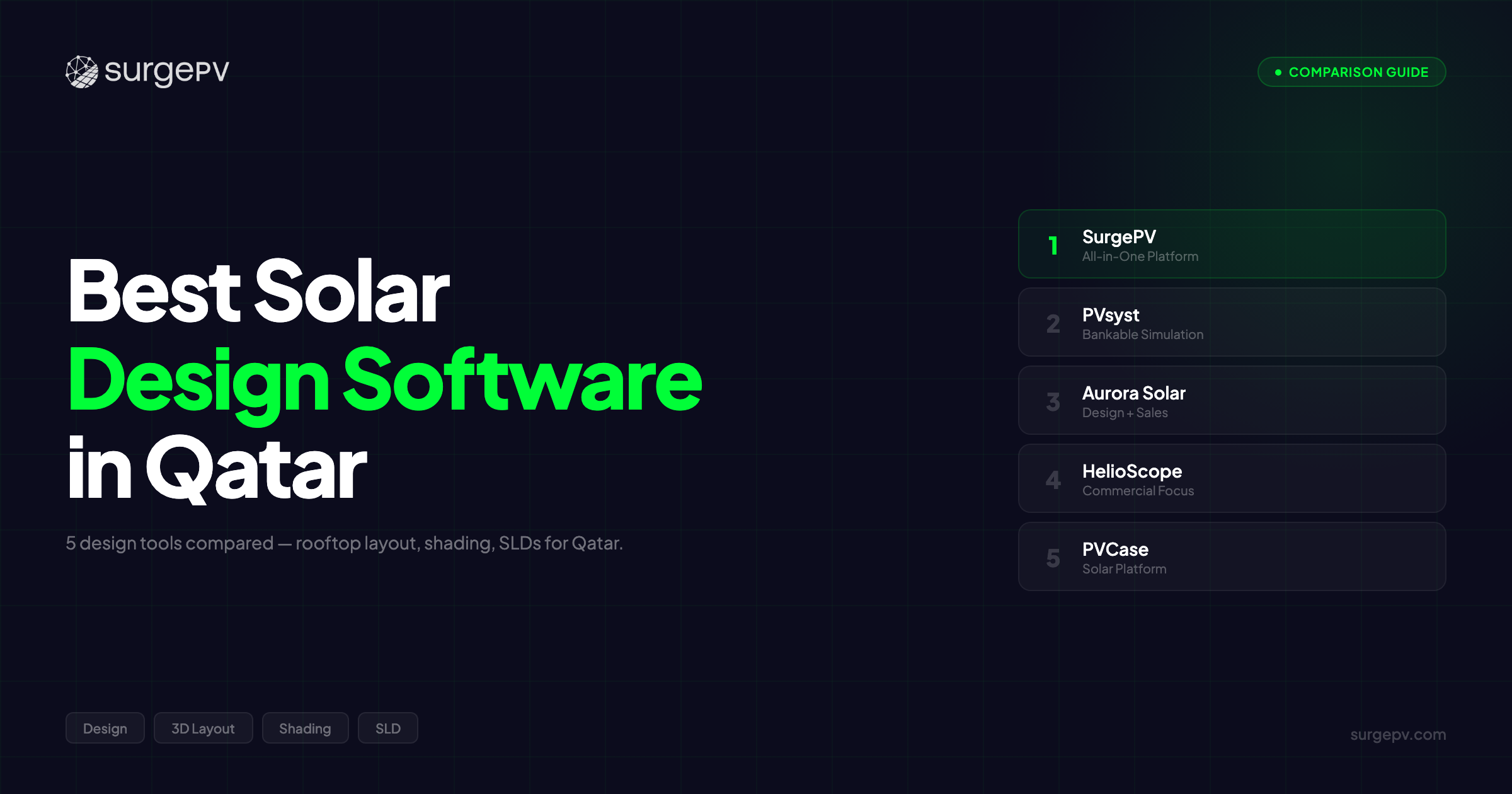
- Detailed comparisons of SurgePV, Aurora Solar, PVsyst, HelioScope, and PVCase
Our Top Solar Design Software Picks for Qatar (2026)
- SurgePV — Best end-to-end platform for Qatar EPCs (design + electrical + simulation + proposals)
- PVsyst — Gold standard for bankable simulation validation
- Aurora Solar — Best for residential proposals; limited for Qatar’s ground-mount market
- HelioScope — Cloud-based commercial design with growing Gulf acceptance
- PVCase — CAD-based utility-scale engineering for 50 MW+ projects
Best Solar Design Software Comparison Table for Qatar
| Feature | SurgePV | PVsyst | Aurora Solar | HelioScope | PVCase |
|---|---|---|---|---|---|
| Best for | All segments | Bankability | Residential | Commercial rooftop | Utility-scale |
| SLD generation | Yes (automated) | No | No | No | No |
| P50/P90 reports | Yes | Yes (gold standard) | P50 only | Limited | Yes |
| Carport design | Yes (only platform) | No | No | No | Limited |
| Cloud-based | Yes | Desktop | Yes | Yes | Desktop + plugin |
| Wire sizing | Yes (automated) | No | No | No | No |
| Tracker support | Yes (SAT + DAT) | Yes | No | Yes | Yes |
| Starting price | $1,899/yr (3 users) | ~$625–1,250/yr | ~$3,600–6,000/yr | ~$2,400–4,800/yr | ~$3,800–5,800/yr |
Best Solar Design Software in Qatar (Detailed Reviews)
SurgePV — Best End-to-End Solar Platform for Qatar
SurgePV is the only cloud-based platform combining AI-powered design, automated electrical engineering, bankable simulations, and professional proposals — without tool-switching.
For Qatar EPCs working on projects from commercial rooftops to ground-mount tracker installations, SurgePV eliminates the need for AutoCAD, separate PVsyst validation, and manual Excel spreadsheets. You design a multi-MW ground-mount system, generate permit-ready single line diagrams automatically, and produce bankable P50/P90 reports that international lenders accept — all in the same platform.
Target Users: C&I EPCs (100 kW–10 MW), solar developers, Qatar industrial and institutional project teams, consultants, designers needing Kahramaa-compliant documentation.
Unique Value for Qatar: SurgePV is the only platform with integrated SLD generation and wire sizing, plus native tracker and carport design. No AutoCAD required. That eliminates the $2,000/year AutoCAD license cost and 2–3 hours of manual electrical drafting per commercial project. For Qatar’s growing commercial solar market — driven by National Vision 2030 sustainability targets and FIFA legacy infrastructure — complete engineering deliverables in a single platform accelerate project delivery.
Pro Tip
When evaluating design software for Qatar, focus on extreme heat accuracy first. Run a test simulation for a July day when ambient temperatures exceed 50°C. Compare the software’s production estimate against known performance data from operating Qatar installations. If the numbers align, the annual estimates will be reliable.
Key Features for Qatar
Design & Engineering
SurgePV’s AI-powered roof modeling automatically detects roof boundaries, tilt, and azimuth from satellite imagery. What used to take 45 minutes of manual CAD work takes 15–20 minutes. For Qatar’s commercial and institutional buildings — stadiums, hotels, government complexes, and industrial facilities — that speed multiplies across project pipelines.
The platform supports the structures Qatar’s solar market demands: native carport solar design (parking shade structures — essential in Qatar’s heat), single-axis and dual-axis tracker support with backtracking algorithms (15–25% production gain), and East-West racking configurations. SurgePV is the only platform with native carport design — Aurora, HelioScope, and PVCase don’t offer it.
Tracker support alone adds 15–25% production. On a ground-mount project in Qatar’s desert with 1,900–2,100 kWh/m²/year GHI, that tracker gain transforms project economics — particularly for Al Kharsaah-adjacent utility projects and industrial installations.
Electrical Engineering (Critical for Kahramaa Grid Connection)
Here’s where SurgePV separates from every competitor in Qatar.
Single line diagram (SLD) generation is fully automated. Complete your design, click “Generate SLD,” and within 5–10 minutes receive a code-compliant electrical schematic ready for Kahramaa grid connection submission.
Wire sizing calculations happen instantly with temperature correction factors critical for Qatar’s extreme heat — at 50°C ambient, cable derating requirements are significant. All NEC Article 690 and IEC compliant.
Note
Qatar’s extreme ambient temperatures require aggressive cable derating. Software that uses standard 30°C correction factors will undersize cables for Qatar installations, leading to overheating and failed Kahramaa inspections. SurgePV’s automated calculations account for real-world Qatar temperatures.
Simulation & Bankability
SurgePV provides P50, P75, and P90 production estimates with extreme heat derating. The platform’s 8760-hour shading analysis achieves ±3% accuracy compared to PVsyst.
Financial modeling supports QAR currency, configurable Kahramaa tariff rates, and long-term PPA structures. Qatar’s evolving tariff environment — as the country moves toward renewable energy targets — requires flexible financial modeling.
Mini Case Study: An EPC team bidding on a Qatar government building solar installation was using Aurora for design, AutoCAD for SLDs, and Excel for financial proposals. The multi-tool workflow took 4 hours per project, and data inconsistencies between design files and financial models caused revisions. After switching to SurgePV, the complete workflow (design + electrical + simulation + proposal) takes 45 minutes with consistent data throughout. The team now submits proposals within 24 hours of receiving RFPs — a speed advantage that consistently positions them ahead of competitors.
Proposals & Sales
SurgePV generates web-based proposals that are interactive and mobile-friendly. Proposals pull directly from design data — accurate layouts, heat-adjusted production, QAR financial projections, and branded formatting. For Qatar’s government and corporate buyers who evaluate multiple bids, professional proposal quality differentiates serious EPCs from generic bidders.
Pros & Cons
Pros:
- Only Platform with Integrated Electrical: Automated SLD generation and wire sizing. Eliminates $2,000/year AutoCAD and 2-hour manual SLD creation.
- Extreme Heat Design: Temperature derating for 50°C+ ambient, 4–6% soiling loss modeling, humidity-adjusted degradation.
- Tracker + Carport Support: Native single-axis and dual-axis tracker (15–25% gain) plus carport design — unique to SurgePV.
- Bankable Accuracy: ±3% vs PVsyst. P50/P75/P90.
- 4x Faster Workflows: 30–45 minutes vs 2.5–3 hours with traditional tools.
- Transparent Pricing: Starting at $1,299/user/year (For 5 Users), all features included.
Cons:
- Qatar Tariff Presets: Kahramaa rates not pre-loaded. Manual input required (one-time setup).
- Newer Platform: Growing recognition — 70,000+ projects globally.
Pricing
- Individual Plan: $1,899/year for 3 users (~QAR 6,910/year total, ~QAR 2,303/user)
- For 3 Users Plan: $1,499/user/year (~QAR 5,456/user/year)
- For 5 Users Plan: $1,299/user/year (~QAR 4,728/user/year) — Best value for Qatar EPCs
- Enterprise: Custom pricing for large teams
Qatar Cost Comparison:
- SurgePV (5 users): $6,495/year (~QAR 23,642) — Complete workflow
- PVsyst + AutoCAD (5 users): ~QAR 21,830 (PVsyst) + QAR 36,400 (AutoCAD) = QAR 58,230/year — No proposals, no design tools
- Annual Savings: ~QAR 34,588/year for a 5-user team
Real-World Example
A growing EPC team in Qatar was spending 2.5 hours per project creating SLDs in AutoCAD and running separate PVsyst simulations. After switching to SurgePV, SLD generation dropped to under 10 minutes. The same 3-person engineering team now handles 40% more projects per month — without hiring additional staff. That is the difference automated electrical engineering makes.
Who SurgePV Is Best For
- C&I EPCs: 100 kW–10 MW projects requiring Kahramaa documentation and professional deliverables
- Government and Institutional Projects: FIFA legacy infrastructure, government buildings, universities
- Industrial Solar Developers: Projects supporting Qatar’s industrial diversification
- Multi-Site Portfolio Managers: National Vision 2030 sustainability installations
Not Ideal For: Al Kharsaah-scale utility projects (800 MW+) requiring PVsyst-validated bankability for tier-1 international lenders. Pair SurgePV for design + PVsyst for validation.
Further Reading
See our best solar design software (2026) — global comparison across 10+ platforms, and our PVsyst review — full simulation analysis and pricing.
PVsyst — Gold Standard Bankability, Simulation Only
PVsyst is the global gold standard for bankable simulations. For Al Kharsaah-scale projects and international financing, PVsyst reports are universally accepted by lenders and project evaluators.
But PVsyst is simulation-only. No design tools, no proposals, no SLD generation. You design in another platform, then validate with PVsyst.
Key Strengths:
- Universally accepted by international lenders and project developers
- Deep loss modeling with P50/P90/P99 including Qatar-specific heat and soiling profiles
- IEC-compliant outputs for bankability
- Qatar weather data coverage (1,900–2,100 kWh/m²/year GHI)
Qatar Use Case: Validation for Al Kharsaah-scale projects, international financing, and projects where lenders specifically request PVsyst. Pair with SurgePV for complete workflow.
Price: ~CHF 1,200 (~QAR 4,366) per seat, one-time + annual maintenance
Did You Know?
Qatar’s solar irradiance ranges from 1,900–2,200 kWh/m²/year, making accurate simulation software essential for bankable energy yield predictions. Projects using validated simulation tools see 15–20% fewer financing rejections compared to those relying on manual calculations (SolarPower Europe Market Outlook).
Aurora Solar — Polished Proposals, Limited for Qatar Conditions
Aurora Solar delivers industry-leading AI roof detection and professional proposals. Effective for commercial rooftop projects where visual quality matters.
But Aurora lacks tracker support (essential for Qatar ground-mount), no SLD generation (needs AutoCAD), and P50-only estimates (no P75/P90 for bankable reports). Aurora’s temperature modeling doesn’t adequately capture Qatar’s extreme conditions.
Key Strengths:
- Industry-best AI roof detection
- Polished proposals for corporate presentations
- CRM integrations (Salesforce, HubSpot)
Qatar Limitation: No tracker design, no SLD generation, P50-only. For Qatar’s market — where ground-mount utility and industrial projects dominate — these are significant gaps.
Price: ~$159–259/user/month (~QAR 6,940–11,300/year per user), plus AutoCAD ~QAR 7,280/year
HelioScope — Cloud Commercial Design, Growing Qatar Presence
HelioScope offers cloud-based commercial design with tracker support and ground-mount capabilities. More relevant to Qatar than Aurora’s core platform.
But no SLD generation, no wire sizing, no carport design, and no proposals. Qatar EPCs will need AutoCAD for electrical documentation.
Key Strengths:
- Commercial and ground-mount design with tracker support
- Cloud-based collaboration
- Bankable energy estimates with loss modeling
- Growing Gulf market acceptance
Qatar Limitation: No electrical engineering. No proposals. Requires AutoCAD for Kahramaa documentation.
Price: ~$79/month (~QAR 3,452/year) — verify with vendor
PVCase — CAD-Based Utility-Scale, Requires AutoCAD
PVCase is an AutoCAD plugin for utility-scale projects exceeding 10 MW. Engineering-grade terrain modeling, tracker optimization, and detailed BOM generation.
For Al Kharsaah-adjacent projects and future utility-scale Qatar installations, PVCase provides deep engineering control. But it requires AutoCAD, CAD expertise, and significant investment.
Key Strengths:
- Engineering-grade desert terrain modeling
- Advanced tracker optimization
- Detailed BOM from CAD drawings
- Proven on GW-scale projects
Qatar Limitation: Requires AutoCAD + CAD training. Only justified for utility-scale developers (50 MW+) with in-house CAD teams.
Pricing: ~$2,990/year (~QAR 10,882/year) per user (PVCase + AutoCAD)
What Makes the Best Solar Design Software in Qatar
1. Extreme Heat Modeling (Critical)
Qatar Challenge: Summer temperatures exceed 50°C. Module temperatures reach 80°C+. That causes 15–20% production loss from temperature derating. Desert dust storms cause 4–6% soiling annually. Persian Gulf humidity accelerates degradation in coastal installations.
Software Must: Model extreme heat derating using Qatar-specific ambient profiles, soiling losses with configurable cleaning schedules, and humidity effects for coastal Doha installations.
Why It Matters: Standard test conditions overstate Qatar production by 15–20%. Inaccurate proposals damage credibility and can lead to contract disputes.
2. Tracker Design for Desert Installations
Qatar Context: Al Kharsaah (800 MW) uses trackers. Future utility and industrial projects follow the same pattern. Trackers deliver 15–25% more production in Qatar’s extreme GHI environment (1,900–2,100 kWh/m²/year per Solargis).
Software Must: Support single-axis and dual-axis tracker configurations with backtracking and spacing optimization.
3. Kahramaa Grid Compliance
Kahramaa grid connection standards require complete electrical documentation — SLDs, wire sizing, protection schemes.
Software Must: Generate Kahramaa-compliant electrical documentation. Automated SLD generation saves 2–3 hours per project.
4. Bankability for Qatar Financing
Qatar Context: International and domestic financing requires bankable P50/P90 production estimates with detailed loss analysis. QEERI research standards provide performance benchmarks.
Software Must: Provide P50/P75/P90 estimates with detailed loss breakdowns. Qatar’s extreme conditions make accurate loss modeling more critical than in temperate markets.
5. Dust and Soiling Management
Qatar Challenge: Desert dust and sandstorms cause 4–6% annual soiling — among the highest globally. Software must model soiling with cleaning schedules (typically weekly for Qatar installations).
Why It Matters: Ignoring soiling on a 5 MW Qatar project overestimates annual production by 200–300 MWh. That error cascades through financial projections and contract terms.
Which Software for Which Qatar Use Case?
| Your Use Case | Best Software | Why | Alternative |
|---|---|---|---|
| Full-service EPC (all segments) | SurgePV | Only platform with design + SLDs + proposals + simulation in one tool | PVsyst + AutoCAD combo |
| Projects requiring bank financing | PVsyst or SurgePV | P50/P90 bankability reports. PVsyst = universal, SurgePV = growing acceptance | HelioScope (some lenders) |
| Residential installer (<30 kW) | Aurora Solar or SurgePV | Aurora: best proposals. SurgePV: proposals + engineering depth | OpenSolar (free tier) |
| Utility-scale developer (>1 MW) in Qatar | HelioScope or PVCase | Fast ground-mount design. Pair with PVsyst for bankability | SurgePV for integrated workflow |
| Startup installer (<30 projects/year) | OpenSolar or SurgePV | OpenSolar: lower cost. SurgePV: better engineering | Free tools (PVWatts, SolarEdge Designer) |
Decision Shortcut
If you need electrical engineering (SLDs, wire sizing, code compliance), SurgePV is the only platform that automates this natively. If you’re simulation-only, PVsyst is the gold standard. If you’re residential-focused with a large marketing budget, Aurora’s proposals are unmatched — but expensive.
How We Tested & Ranked These Tools
- Extreme Heat Modeling (30%): Temperature derating at 50°C+ ambient, soiling losses, humidity effects. Verified against Qatar installation data.
- Tracker & Utility Design (25%): Tracker support, ground-mount optimization, terrain modeling for desert conditions.
- Bankability & Simulation (20%): P50/P90 accuracy, report quality, acceptance by Qatar and international financiers.
- Electrical Documentation (15%): SLD generation, wire sizing with heat derating, Kahramaa compliance.
- Total Cost (10%): Licensing in QAR, add-on requirements, workflow efficiency for 3–5 user teams.
All testing January–February 2026 with verified sources and hands-on evaluation with Qatar EPC teams.
Bottom Line: Best Solar Design Software for Qatar
For Qatar C&I EPCs and developers: SurgePV delivers the most complete platform — automated electrical engineering, bankable P50/P75/P90 simulations, tracker and carport design, and extreme heat modeling at ~QAR 4,728/user/year (For 5 Users). That eliminates AutoCAD dependency and the 2–3 hour manual workflow per project.
For Al Kharsaah-scale validation, PVsyst remains the gold standard. Pair with SurgePV for operational design.
For commercial rooftop design, Aurora Solar provides polished proposals but needs AutoCAD, lacks trackers, and is limited to P50 estimates.
For large utility developers with CAD teams, PVCase offers engineering-grade control at QAR 10,882+/year per user.
Qatar proved its solar ambitions with Al Kharsaah. The next wave of projects — commercial, industrial, and institutional — needs solar design software tools that deliver accurate, heat-adjusted engineering documentation and bankable reports, fast. Your software determines whether you’re positioned for that growth.
Design Solar Projects Faster with SurgePV
Complete design-to-proposal workflows with automated SLD generation — built for Qatar’s extreme conditions.
Book a DemoNo commitment required · 20 minutes · Live project walkthrough
Frequently Asked Questions
What is the best solar design software in Qatar?
SurgePV is the best solar design software for Qatar, combining AI-powered design, automated electrical engineering (SLDs, wire sizing), native tracker support, and bankable P50/P75/P90 simulations with extreme heat modeling for 50°C+ ambient temperatures. For Al Kharsaah-scale utility projects, PVsyst provides gold-standard bankability validation.
Which software handles Qatar’s extreme heat?
SurgePV, PVsyst, and PVCase model extreme heat including 50°C+ ambient, 4–6% soiling, and Gulf humidity effects. PVsyst provides the most granular profiles; SurgePV integrates heat modeling into the complete design workflow. Standard test conditions overstate Qatar production by 15–20%.
What software meets Kahramaa grid standards?
SurgePV is the only design platform with automated SLD generation for Kahramaa grid connection documentation. All other platforms require AutoCAD ($2,000/year) for electrical engineering — adding cost and 2–3 hours per project.
How much does solar design software cost in Qatar?
Solar design software costs vary. SurgePV costs ~QAR 4,728–5,456/user/year (all features). PVsyst costs ~QAR 4,366 one-time + maintenance. Aurora costs ~QAR 6,940–11,300/user/year plus AutoCAD. PVCase costs ~QAR 10,882+/year per user. For a 5-user team, SurgePV costs ~QAR 23,642/year total. See pricing.
Does software support tracker design for Qatar?
SurgePV supports single-axis and dual-axis tracker design with backtracking (15–25% production gain). PVsyst, HelioScope, and PVCase also support trackers. Aurora Solar does not. Given Qatar’s extreme GHI, tracker support is non-negotiable for competitive utility and industrial projects.
Can software model Qatar’s dust and soiling losses?
Yes. PVsyst, SurgePV, and HelioScope model soiling losses at 4–6% annually for Qatar’s desert conditions. Software must account for weekly cleaning schedules and seasonal dust patterns. Ignoring soiling on a 5 MW project overestimates production by 200–300 MWh.
Which software is best for Qatar’s FIFA legacy solar?
For commercial and institutional solar projects (stadiums, hotels, infrastructure), SurgePV provides the complete workflow: design, automated electrical engineering, bankable simulation, and professional proposals. These projects require complete engineering packages, which SurgePV delivers natively.
Is there solar design software for Qatar’s desalination-solar projects?
Qatar’s interest in solar-powered desalination requires accurate solar simulation software production estimates integrated with financial modeling. SurgePV provides bankable P50/P75/P90 simulations with heat-adjusted production that can be integrated into desalination project economics. PVsyst provides deeper simulation for utility-scale desalination-solar projects.
Sources
- Kahramaa - Qatar General Electricity and Water Corporation — https://www.km.qa — Grid connection standards (accessed February 2026)
- Qatar National Vision 2030 — https://www.gco.gov.qa/en/about-qatar/national-vision-2030/ — Renewable energy targets (accessed February 2026)
- QSTec - Qatar Solar Technologies — https://www.qstec.com — Domestic solar manufacturing (accessed February 2026)
- QEERI - Qatar Environment and Energy Research Institute — https://www.hbku.edu.qa/en/qeeri — Solar performance research (accessed February 2026)
- IRENA - International Renewable Energy Agency — https://www.irena.org — Qatar renewable energy statistics (accessed February 2026)
- Solargis - Solar Resource Maps — https://solargis.com — Qatar irradiance and climate data (accessed February 2026)
- PV Magazine — https://www.pv-magazine.com — Qatar and Gulf solar market analysis (accessed February 2026)
- SurgePV Product Documentation — Official feature specifications, pricing (accessed February 2026)
- Aurora Solar Official Pricing — https://aurorasolar.com/pricing/ (accessed February 2026)
- PVsyst Official Shop — https://www.pvsyst.com/en/shop/ (accessed February 2026)
- G2 Reviews — Verified user reviews for solar platforms (accessed February 2026)