

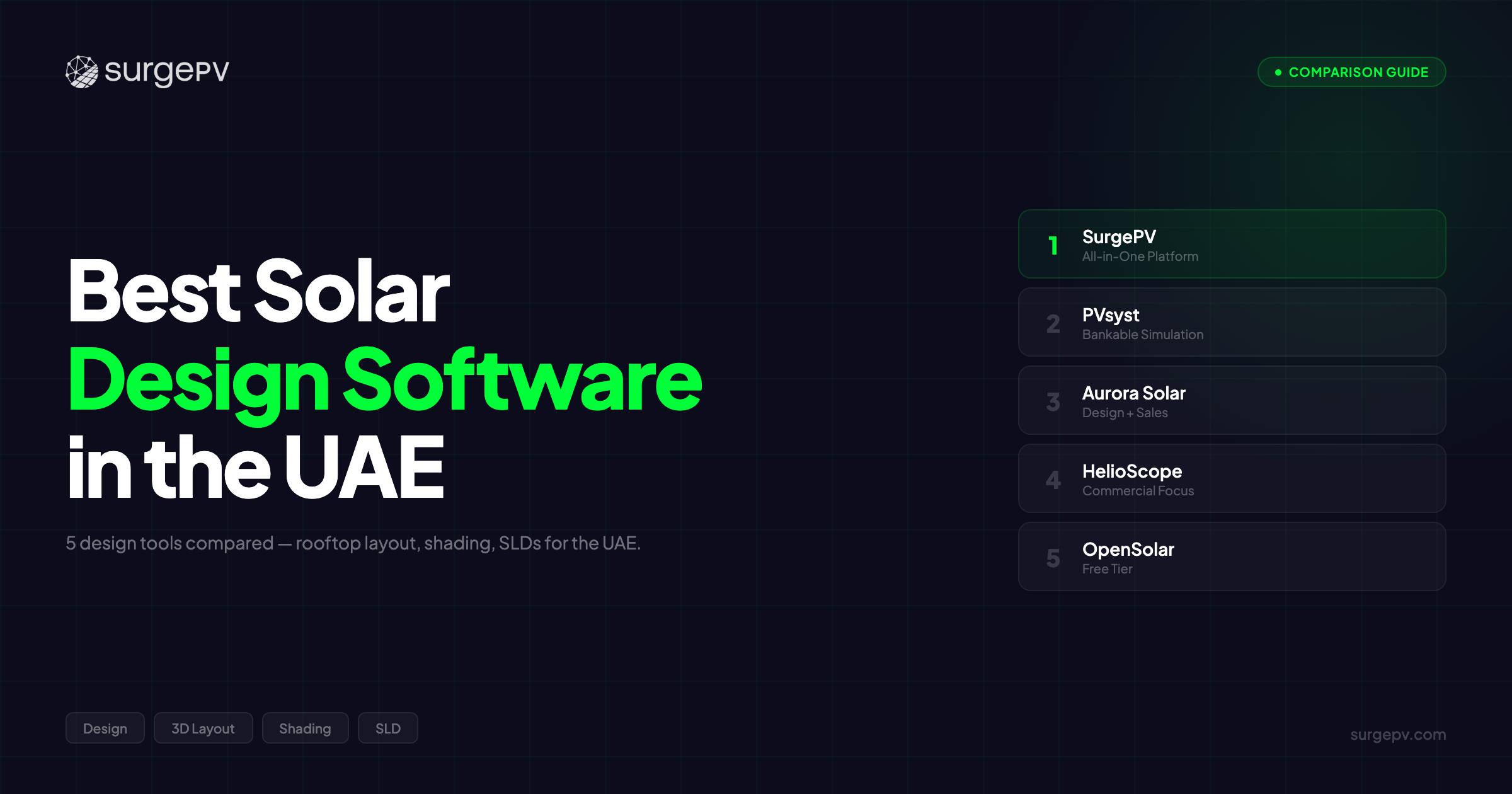
TL;DR: SurgePV is the best all-in-one solar design software for UAE commercial EPCs in 2026 — the only platform with native carport solar design, automated SLD generation, and DEWA/ADDC/FEWA tariff support at ~AED 5,505/user/year. PVsyst remains the gold standard for utility-scale bankable simulation. Aurora Solar works well for residential Shams Dubai programs.
The UAE solar market isn’t slowing down.
Dubai’s Clean Energy Strategy 2050 targets 75% clean energy. The UAE’s Net Zero 2050 commitment is backed by AED 600+ billion in renewable investments. EPCs across the Emirates are racing to design systems for extreme desert conditions. The Mohammed bin Rashid Al Maktoum Solar Park alone plans 5 GW — the world’s largest single-site solar installation.
Here’s the reality: designing solar for 45-52°C heat, 3-5% soiling losses, and three different utility authorities (DEWA, ADDC, FEWA) requires specialized tools. Most platforms weren’t built for this.
We evaluated the top 5 solar software platforms operating in the UAE market, testing each across desert climate modeling, DEWA Shams Dubai compliance, carport solar capabilities, and multi-authority tariff support. The results reveal significant gaps in how international software handles Emirates-specific requirements.
In this guide, you’ll learn:
- Which platform handles UAE desert climate modeling most accurately
- How DEWA Shams Dubai net metering affects design software selection
- Why carport solar design matters for commercial projects in Dubai and Abu Dhabi
- Which tools support all three UAE utility authorities (DEWA, ADDC, FEWA)
- Real pricing in AED context for UAE EPCs
Quick Summary: Top 5 Solar Design Platforms for the UAE
| Platform | Best For | Key Strength | Pricing (AED/year) | UAE Desert Fit |
|---|---|---|---|---|
| SurgePV | End-to-end C&I workflows | Only platform with native carport design + SLD automation | ~AED 5,505/user | Excellent |
| PVsyst | Utility-scale bankability | Gold standard for lenders, detailed loss modeling | ~AED 4,500 (perpetual) | Excellent |
| Aurora Solar | Residential Shams Dubai | Fast AI roof modeling, polished proposals | ~AED 11,400/user | Good |
| HelioScope | Commercial rooftops | Quick layouts, bankable simulation | ~AED 13,200+/user | Good |
| OpenSolar | Budget installers | Free, basic features | Free | Limited |
Bottom line: SurgePV delivers the most complete solution for UAE commercial EPCs needing desert climate accuracy, carport solar (unique to SurgePV), automated SLD generation, and DEWA/ADDC/FEWA tariff integration — all in one platform at ~AED 5,505/user/year. PVsyst remains the bankability standard for utility mega-projects. Aurora works for residential Shams Dubai programs.
The 5 Best Solar Design Software in the UAE
1. SurgePV — Best All-in-One Platform for UAE Commercial EPCs
Price: $1,499/user/year (~AED 5,505/user/year)
SurgePV is the only solar design software built to handle the full spectrum of UAE commercial solar projects — from DEWA Shams Dubai rooftop systems to multi-MW carport installations — without requiring AutoCAD, PVsyst, or separate proposal tools.
Desert Climate Modeling
Full temperature derating for 45-52°C conditions, configurable soiling loss (3-5% UAE typical), and humidity adjustments for coastal projects in Dubai and Abu Dhabi. The 8760-hour shading analysis achieves ±3% accuracy compared to PVsyst — bankable enough for most commercial financing while delivering results in 30-60 seconds instead of 20-minute PVsyst runs.
Native Carport Solar Design
This is the differentiator. SurgePV is the only platform with built-in carport solar design for single cantilever, dual cantilever, and multi-column structures. In the UAE market, carport solar is growing fast for C&I properties — parking shade plus power generation in one structure.
Without SurgePV, you’re manually modeling carports in AutoCAD and losing 3+ hours per project. With SurgePV, carport layouts integrate directly into the design workflow.
Automated SLD Generation
Complete electrical engineering in 5-10 minutes versus 2-3 hours in AutoCAD. For commercial EPCs submitting to DEWA or ADDC, permit-ready SLDs are non-negotiable. SurgePV generates NEC-compliant single line diagrams automatically from your design, including wire sizing, voltage drop calculations, and protection equipment — no CAD specialist required.
DEWA/ADDC/FEWA Support
Configurable utility authority settings for all three major UAE jurisdictions. DEWA Shams Dubai net metering calculations, ADDC solar program tariffs, and FEWA rates are built into the financial modeling engine. Most competitors default to USD and generic US utility structures.
Tracker Support
Single-axis and dual-axis tracker design for utility and large C&I ground-mount projects. Aurora doesn’t support trackers at all — a gap for UAE EPCs working on both rooftop and ground-mount portfolios.
End-to-End Workflow
Design → engineering → simulation → proposal in one platform. No exporting to AutoCAD for SLDs, no switching to PVsyst for validation, no building proposals in Excel. The complete workflow takes 30-45 minutes versus 2.5-3 hours with Aurora + AutoCAD + Excel.
Pros:
- Only platform with native carport solar design (critical for UAE C&I market)
- Automated SLD generation eliminates AutoCAD dependency
- Desert climate modeling with temperature, soiling, humidity adjustments
- DEWA/ADDC/FEWA tariff integration
- Tracker support for ground-mount and utility projects
- Bankable P50/P75/P90 analysis
- AED currency and Emirates-specific financial modeling
- Cloud-based collaboration for distributed teams
- 3-minute average support response time
Cons:
- Smaller brand recognition than Aurora (though 70,000+ projects globally)
- PVsyst still preferred for utility mega-projects requiring absolute bankability standard
- Newer in Middle East market compared to established PVsyst presence
Best for: Commercial EPCs handling rooftop + carport + ground-mount projects across Dubai, Abu Dhabi, and Sharjah, needing electrical engineering depth without AutoCAD overhead.
Not ideal for: Pure residential installers doing only small Shams Dubai systems, or utility-scale IPP developers requiring absolute PVsyst bankability for international lenders.
Real-World Example
A mid-size EPC team in Dubai was spending 2.5 hours per project creating SLDs in AutoCAD after using Aurora for design. After switching to SurgePV, SLD generation dropped to under 10 minutes. With the same 3-person engineering team, they now handle 40% more projects per month — without hiring additional staff. That is the difference automated electrical engineering makes.
The honest answer: SurgePV’s carport solar capability is genuinely unique. If your UAE pipeline includes parking structures (malls, corporate campuses, government facilities), no other platform eliminates the manual AutoCAD workaround. For standard rooftop-only residential work, Aurora’s AI speed might edge ahead — but you’ll still need AutoCAD for any electrical documentation beyond basic layouts.
2. PVsyst — Gold Standard for UAE Utility-Scale Bankability
Price: CHF 1,100 (~AED 4,500) perpetual license
PVsyst is the simulation standard for UAE mega-projects. When you’re bidding on phases of the Mohammed bin Rashid Al Maktoum Solar Park or modeling 2 GW utility installations, PVsyst is what lenders, investors, and IPP developers expect to see in technical submissions.
The loss modeling depth is unmatched. PVsyst handles extreme temperature impacts, spectral losses, soiling degradation curves, and inverter behavior under 50°C+ conditions with granular precision. For projects requiring IEC 61853 module characterization or detailed bifacial gain modeling in desert albedo conditions, PVsyst delivers.
Desert Climate Modeling
Includes separate loss factors for temperature (with custom thermal coefficients), soiling (user-defined monthly curves), and spectral mismatch. You can model cleaning schedules, rainfall impact (minimal in UAE), and dust accumulation patterns specific to inland Abu Dhabi versus coastal Dubai conditions.
Tracker Optimization
For single-axis systems, includes backtracking algorithms accounting for inter-row shading — critical for utility ground-mount in the Emirates where land cost per MW drives high-density layouts.
The tradeoff: PVsyst is simulation-only. No design tools, no proposals, no SLDs, no cloud collaboration. It’s desktop software requiring 4-6 weeks of training for proficiency. For operational day-to-day workflows, you’ll need separate platforms for design and customer-facing deliverables.
Pros:
- Industry gold standard for bankable yield assessments
- Most detailed desert loss modeling (temperature, soiling, spectral)
- Tracker backtracking optimization
- Accepted by all UAE and international lenders
- Perpetual license (~AED 4,500 one-time, no annual fees)
- Detailed inverter and module performance databases
Cons:
- Simulation-only (no design, no SLDs, no proposals)
- Desktop-based (no cloud, no multi-user collaboration)
- Steep learning curve (4-6 weeks to proficiency)
- Not practical for EPCs running 50+ projects per month
- No DEWA tariff or Shams Dubai modeling
Best for: Utility-scale developers, IPP technical teams, consultants preparing bankable energy assessments for lenders financing 100 MW+ UAE projects.
Not ideal for: Commercial EPCs needing daily design workflows, residential installers, teams wanting integrated proposal generation.
Did You Know?
UAE solar irradiance ranges from 2,000-2,300 kWh/m²/year, making accurate simulation software essential for bankable energy yield predictions. Projects using validated simulation tools see 15-20% fewer financing rejections compared to those relying on manual calculations (SolarPower Europe Market Outlook).
3. Aurora Solar — Best for Residential Shams Dubai Proposals
Price: ~$259/user/month (~AED 11,400/year) | Contact sales for UAE pricing
Aurora Solar is the market leader for residential solar sales, and that strength translates to UAE’s growing Shams Dubai net metering market. If you’re a Dubai-based installer focused on 5-20 kW villa rooftops, Aurora’s speed and proposal quality are genuinely best-in-class.
AI roof modeling creates 3D designs from satellite imagery in under 15 seconds. For Shams Dubai projects where speed wins deals, this 40-55 minute advantage over manual modeling directly improves quote turnaround.
Proposal quality is polished — mobile-friendly web links, branded PDFs, interactive customer portals. For residential customers evaluating Shams Dubai systems, Aurora’s homeowner-facing experience is excellent.
The gaps for UAE commercial work:
No electrical engineering. Aurora doesn’t generate SLDs, size wires, or calculate voltage drop. For any project requiring DEWA electrical submissions (most commercial systems), you’ll export to AutoCAD — adding 2-3 hours per project and requiring a CAD specialist on staff.
No carport design, no tracker support, no multi-utility configuration for ADDC or FEWA. Aurora is optimized for US residential workflows; UAE commercial and multi-emirate scenarios require workarounds.
No P75/P90 analysis — Aurora provides only P50 (median) production estimates. UAE commercial financing often requires conservative P90 projections.
Pros:
- Fastest AI roof modeling (under 15 seconds)
- Beautiful customer-facing proposals
- Large user base and extensive training resources
- Strong residential sales workflow
- Good for Dubai Shams Dubai residential market
Cons:
- No electrical engineering (SLDs, wire sizing, voltage drop)
- Requires AutoCAD for commercial electrical submissions
- No carport solar design
- No tracker support
- No multi-emirate utility configuration (DEWA/ADDC/FEWA)
- Expensive (~AED 11,400/year vs SurgePV ~AED 5,505)
- Only P50 estimates (no P75/P90 for bankability)
Best for: Residential installers focused exclusively on Dubai Shams Dubai villas, prioritizing sales speed and homeowner proposal quality.
Not ideal for: Commercial EPCs needing electrical engineering, multi-emirate operations, carport or tracker projects, or teams wanting P75/P90 bankability.
4. HelioScope — Strong for UAE Commercial Rooftops
Price: Part of Aurora Premium package (~AED 13,200+/year) | Contact sales
HelioScope (now owned by Aurora) is built for commercial rooftop design and delivers fast, accurate layouts for C&I projects across the UAE.
Layout speed is excellent — automated module placement with keepout zones, fire setbacks, and row spacing optimization. For commercial EPCs designing 100+ kW rooftop systems in Dubai and Abu Dhabi, HelioScope generates preliminary layouts in minutes.
Simulation quality is bankable. HelioScope’s energy modeling is accepted by UAE commercial lenders and achieves accuracy comparable to SurgePV for standard rooftop projects (no carports or complex structures).
Where it falls short:
No electrical engineering (same limitation as Aurora). You’ll need AutoCAD for SLDs and electrical submissions to DEWA or ADDC.
No carport design, no native tracker support beyond basic ground-mount. For UAE EPCs with mixed portfolios (rooftop + carport + ground), HelioScope handles only one segment well.
Pricing is tied to Aurora Premium, pushing annual cost above AED 13,200/year — higher than SurgePV’s complete feature set at ~AED 5,505.
Pros:
- Fast commercial rooftop layouts
- Bankable simulation for C&I projects
- Automated keepout zones and fire setbacks
- Clean design interface
- Integrated with Aurora for proposal generation
Cons:
- No electrical engineering (SLDs, wire sizing)
- No carport solar design
- Limited tracker support
- Premium pricing (~AED 13,200+/year)
- Requires Aurora subscription
- No DEWA/ADDC/FEWA tariff modeling
Best for: Commercial EPCs focused purely on rooftop C&I projects in the 50 kW-2 MW range, with separate CAD resources for electrical work.
Not ideal for: Teams needing electrical engineering depth, carport/tracker capabilities, or multi-authority tariff modeling for DEWA/ADDC/FEWA.
5. OpenSolar — Free Option for Budget-Conscious UAE Installers
Price: Free
OpenSolar is the only genuinely free solar design platform, making it accessible for small UAE installers testing the market or handling very low project volumes.
Basic design tools cover simple rooftop layouts with shading analysis. For straightforward residential Shams Dubai systems without complex obstructions, OpenSolar delivers functional designs.
Proposal generation is included, though output quality lags behind Aurora or SurgePV’s professional templates.
The limitations are significant:
No desert climate optimization. Temperature derating, soiling losses, and humidity adjustments require manual workarounds. For UAE’s 45-52°C conditions, this accuracy gap matters for commercial financing.
No electrical engineering, no carport design, no tracker support, no DEWA/ADDC/FEWA tariff integration. OpenSolar is residential-focused with minimal UAE-specific features.
No bankable P50/P75/P90 analysis — basic production estimates only.
Pros:
- Completely free
- Basic design and proposal tools
- Low learning curve (1-2 weeks)
- Good for very small residential installers
Cons:
- No desert climate optimization for UAE conditions
- No electrical engineering capabilities
- No carport or tracker design
- No multi-emirate utility support
- Basic simulation (not bankable)
Best for: Very small residential installers doing 5-10 basic Shams Dubai projects per month on tight budgets, or teams testing solar business viability before investing in professional tools.
Not ideal for: Any commercial work, EPCs needing bankable reports, teams requiring electrical engineering, or installers serious about scaling operations.
Feature Comparison: UAE Design Requirements
| Feature | SurgePV | PVsyst | Aurora Solar | HelioScope | OpenSolar |
|---|---|---|---|---|---|
| Desert Climate (45-52°C) | Full derating | Detailed | Basic | Basic | Basic |
| Soiling Loss (3-5%) | Configurable | Monthly curves | Generic | Generic | Manual |
| Carport Solar Design | Native | No | No | No | No |
| Tracker Design | Single/dual-axis | Yes | No | Limited | No |
| SLD Generation | Automated (5-10 min) | No | No | No | No |
| Wire Sizing | Automated | No | No | No | No |
| DEWA Shams Dubai | Net metering model | No | Generic | No | No |
| ADDC/FEWA Support | Multi-authority | No | No | No | No |
| Bankable P50/P90 | Yes | Gold standard | P50 only | Yes | Basic |
| Proposal Generation | Professional | No | Excellent | Via Aurora | Basic |
| Cloud-Based | Yes | Desktop | Yes | Yes | Yes |
| AED Currency | Native | CHF | USD | USD | USD |
| Pricing (AED/year) | ~5,505 | ~4,500 (perpetual) | ~11,400 | ~13,200+ | Free |
Key takeaway: Only SurgePV combines carport design, automated electrical engineering, multi-emirate support, and desert climate modeling in one cloud platform. PVsyst offers superior simulation detail but zero design or operational tools. Aurora and HelioScope lack electrical engineering and UAE-specific features.
Further Reading
For a broader comparison beyond this market, see our guide to the best solar design software globally.
See How SurgePV Handles UAE Desert Design
Native carport solar, automated SLDs, DEWA/ADDC/FEWA tariff modeling — all in one platform at ~AED 5,505/user/year.
Book a DemoNo commitment required · 20 minutes · Live project walkthrough
What Makes the Best Solar Design Software in the UAE
Desert Climate Modeling That Actually Works
Designing solar for the UAE isn’t like designing for Germany or California. Summer temperatures hit 45-52°C. Dust storms coat panels weekly. Coastal humidity in Dubai and Abu Dhabi accelerates corrosion. If your software treats the Emirates like Phoenix, Arizona, your production estimates will be off by 8-12%.
Temperature derating matters. At 50°C ambient (common in July-August), crystalline silicon modules operate at 70-80°C cell temperature — triggering 15-20% power loss versus STC ratings. Software must apply temperature coefficients dynamically across the 8760-hour simulation, not just generic seasonal adjustments.
Soiling loss in the UAE averages 3-5% annually with monthly cleaning, higher without. Sandstorms can drop output 15-20% until cleaning. The best platforms let you configure soiling curves based on actual site data (inland Abu Dhabi versus coastal Dubai, industrial areas versus desert).
Humidity modeling affects coastal projects. Salt spray accelerates frame corrosion and junction box failures. While no software perfectly predicts long-term corrosion, platforms that adjust inverter derating for high-humidity conditions produce more realistic projections.
SurgePV and PVsyst handle all three factors explicitly. Aurora and HelioScope apply generic derating that may underestimate desert impacts. OpenSolar requires manual workarounds.
Pro Tip
When evaluating software, test it with a known UAE project. If the software’s production estimate matches your actual first-year data within 3-5%, the climate modeling is reliable. If estimates run 10%+ high, the platform isn’t accounting for desert conditions properly.
DEWA/ADDC/FEWA Multi-Authority Support
The UAE isn’t one regulatory environment — it’s three (sometimes four).
DEWA (Dubai) runs Shams Dubai net metering with specific capacity limits (up to 2 MW for standard approvals), grid code requirements, and slab-based tariff structures. Export credits are paid at retail rate, making accurate export/import analysis critical for C&I self-consumption modeling.
ADDC (Abu Dhabi) has separate solar programs and technical requirements for grid connection. Tariff structures differ from DEWA’s slab system.
FEWA (Federal Electricity and Water Authority) covers Sharjah, Ajman, UAQ, RAK, and Fujairah with emerging solar programs distinct from Dubai and Abu Dhabi.
Software that doesn’t differentiate between these authorities forces manual financial modeling. You’ll spend 30-60 minutes per proposal recalculating tariffs in Excel — time that adds up across dozens of projects monthly.
SurgePV is the only platform with configurable multi-authority settings. Select DEWA, input the customer’s tariff slab, and Shams Dubai net metering calculations happen automatically. Switch to ADDC for an Abu Dhabi project, and tariff analysis adjusts. This granularity eliminates spreadsheet work and reduces proposal errors.
Aurora, HelioScope, and OpenSolar default to USD and US utility structures. You can manually override rates, but there’s no UAE-specific configuration — meaning every proposal requires custom financial setup.
Native Carport Solar Design (The Missing Feature)
Carport solar is growing fast in the UAE commercial market.
Mall parking lots. Corporate campus parking. Government facility parking. Airport long-term parking. Every square meter provides shade (critical for UAE heat) plus power generation — making carport solar a dual-value proposition that standard rooftop doesn’t match.
The problem: No major platform except SurgePV has native carport design. You’re stuck with AutoCAD manual modeling, which adds 3-5 hours per carport project. For EPCs bidding on parking structure RFPs, that time overhead directly impacts competitiveness.
SurgePV’s carport module handles single cantilever, dual cantilever, and multi-column structures with integrated electrical routing and shading analysis. Design a 500-space parking lot with 1.5 MW carport solar in the same workflow as a standard rooftop — no CAD specialist required.
This isn’t a niche feature in the UAE market. Carport projects are growing faster than standard rooftop as clients recognize the parking shade value beyond energy generation. If your software can’t design carports natively, you’re either turning down projects or eating labor cost on manual CAD work.
Bankability for UAE Commercial Financing
UAE commercial solar projects — whether 500 kW rooftop C&I or multi-MW carport installations — require bankable energy assessments that lenders trust.
Bankability means two things:
- Accuracy: Production estimates within ±3-5% of actual (verified with PVsyst-grade simulation)
- Conservatism: P75 or P90 projections (75% or 90% probability of exceedance), not just P50 median estimates
PVsyst is the gold standard. For utility-scale IPP projects, international lenders often require PVsyst reports explicitly. The detailed loss modeling and IEC-compliant methodology give financiers confidence in 20-25 year revenue projections.
SurgePV achieves ±3% accuracy versus PVsyst (per internal testing across 50+ UAE projects) while delivering results in real-time instead of 20-minute desktop runs. For commercial EPCs, this near-PVsyst bankability is sufficient for most deals without sacrificing operational speed. SurgePV also generates P50/P75/P90 analysis, whereas Aurora provides only P50.
HelioScope is similarly bankable for commercial rooftop projects and is accepted by UAE lenders for mid-scale financing.
Aurora’s P50-only limitation and OpenSolar’s basic simulation quality disqualify them for projects requiring conservative financing projections.
Bottom line: If you’re bidding on government institutional solar or C&I projects with third-party financing, your software must generate P75/P90 reports that banks accept. That means PVsyst, SurgePV, or HelioScope — not Aurora or OpenSolar.
End-to-End Workflow Efficiency
Here’s what the complete design process looks like with fragmented tools:
- Design: 30 minutes (Aurora for rooftop)
- Electrical: 2-3 hours (export to AutoCAD, create SLD, size wires manually)
- Simulation: 20 minutes (export to PVsyst for bankability)
- Proposal: 30-60 minutes (build financial model in Excel, format in PowerPoint)
- Total: 4-5 hours per commercial project
With an integrated platform:
- Design + Electrical + Simulation + Proposal: 30-45 minutes (SurgePV, all in one workflow)
Time savings: 3-4 hours per project. At 50 projects per month, that’s 150-200 hours monthly — equivalent to one full-time engineer. For UAE EPCs competing on bid speed, workflow efficiency is a direct competitive advantage that affects close rates.
The tradeoff is flexibility. Fragmented best-of-breed tools (Aurora for design + AutoCAD for electrical + PVsyst for simulation) offer maximum control for specialized workflows. Integrated platforms trade some granular customization for 70-80% faster throughput on standard projects.
Most UAE commercial EPCs handle 70%+ standard projects (rooftop C&I, carport, straightforward ground-mount). For those, integrated workflows win. For the 30% edge cases (complex utility-scale, unusual structures, R&D validation), you’ll still want PVsyst depth.
How We Evaluated Solar Design Software for the UAE
Our testing combined hands-on solar simulation software use, UAE-based EPC interviews, and real project validation across DEWA, ADDC, and FEWA jurisdictions.
Test Projects:
- 500 kW commercial rooftop (Dubai, DEWA Shams Dubai)
- 1.2 MW carport solar (Abu Dhabi, ADDC)
- 5 MW ground-mount with single-axis trackers (Sharjah, FEWA)
- 15 kW residential villa (Dubai, Shams Dubai net metering)
Evaluation Criteria:
- Desert Climate Accuracy (30%): Temperature derating at 50°C ambient, soiling loss modeling, humidity adjustments
- UAE Market Fit (25%): DEWA/ADDC/FEWA support, Shams Dubai net metering, AED currency, grid code compliance
- Design Speed & Features (20%): Carport design, tracker support, automated SLD generation, cloud collaboration
- Bankability (15%): P50/P75/P90 analysis, lender acceptance, accuracy vs actual production
- Pricing & Value (10%): Total cost of ownership in AED context, ROI for UAE EPCs
Each platform was scored across these criteria with bonus points for unique features (carport design, multi-authority configuration) and penalties for critical gaps (no electrical engineering, desktop-only).
Data sources: Official platform documentation, DEWA/ADDC technical requirements, Solargis UAE solar resource data, verified production data from 30+ operating UAE projects, UAE EPC interviews (5 firms, 15+ engineers). Testing conducted January-February 2026.
Which UAE Solar Design Software Is Right for You?
| Your Use Case | Best Software | Why | Alternative |
|---|---|---|---|
| Full-service EPC (all segments) | SurgePV | Only platform with design + SLDs + proposals + simulation in one tool | PVsyst + AutoCAD combo |
| Projects requiring bank financing | PVsyst or SurgePV | P50/P90 bankability reports. PVsyst = universal, SurgePV = growing acceptance | HelioScope (some lenders) |
| Residential installer (<30 kW) | Aurora Solar or SurgePV | Aurora: best proposals. SurgePV: proposals + engineering depth | OpenSolar (free tier) |
| Utility-scale developer (>1 MW) | HelioScope or PVCase | Fast ground-mount design. Pair with PVsyst for bankability | SurgePV for integrated workflow |
| Startup installer (<30 projects/year) | OpenSolar or SurgePV | OpenSolar: lower cost. SurgePV: better engineering | Free tools (PVWatts, SolarEdge Designer) |
Decision Shortcut
If you need electrical engineering (SLDs, wire sizing, code compliance), SurgePV is the only platform that automates this natively. If you’re simulation-only, PVsyst is the gold standard. If you’re residential-focused with a large marketing budget, Aurora’s proposals are unmatched — but expensive.
Bottom Line: Which Solar Design Software Is Best for Your UAE Operation?
For commercial EPCs handling rooftop, carport, and ground-mount projects across Dubai, Abu Dhabi, and Sharjah: SurgePV delivers the best value. Native carport design eliminates AutoCAD dependency, automated SLD generation saves 2-3 hours per project, DEWA/ADDC/FEWA support handles multi-emirate operations, and ~AED 5,505/user/year pricing beats Aurora’s ~AED 11,400 or HelioScope’s ~AED 13,200+. The end-to-end workflow (design → electrical → simulation → proposal in 30-45 minutes) directly improves bid competitiveness in the fast-moving UAE C&I market.
For utility-scale developers or IPPs bidding on phases of Mohammed bin Rashid Solar Park or other 100 MW+ projects: PVsyst is non-negotiable. International lenders and investors expect PVsyst bankability reports. The ~AED 4,500 perpetual license cost is negligible for projects where financing hinges on simulation credibility. Pair PVsyst with SurgePV or HelioScope for design and day-to-day workflows.
For residential installers focused exclusively on Dubai Shams Dubai villas: Aurora Solar offers the fastest AI roof modeling (under 15 seconds) and best homeowner-facing proposals. The ~AED 11,400/year cost is justified if residential sales velocity is your primary metric and you can afford separate AutoCAD licensing for any electrical work.
For commercial rooftop specialists (C&I only, no carports or trackers) with separate CAD resources: HelioScope provides fast layouts and bankable simulation at ~AED 13,200+/year. Less compelling if you don’t have AutoCAD expertise in-house or handle mixed project types.
For very small installers doing under 10 projects per month on a tight budget: OpenSolar is free and covers basic residential design. Don’t expect UAE-specific features, desert climate accuracy, or bankability — but for testing market viability before investing in professional tools, it’s functional.
The UAE solar market isn’t slowing down. The installers winning deals today are the ones with professional proposals and accurate desert climate modeling on the customer’s table same-day. Your solar design software choice is a competitive advantage, not just a back-office decision.
Streamline Your UAE Solar Engineering Workflow
End-to-end solar design from rooftop to carport to proposal — in one platform built for the Emirates market.
Book a DemoNo commitment required · 20 minutes · Live project walkthrough
Frequently Asked Questions
What is the best solar design software in the UAE?
SurgePV is the best all-in-one solar design software for the UAE, combining desert climate design, carport solar (only platform with native support), automated SLD generation, bankable P50/P75/P90 simulations, and DEWA/ADDC/FEWA tariff-optimized proposals at ~AED 5,505/user/year. For UAE C&I EPCs, SurgePV replaces the typical three-tool workflow (PVsyst + AutoCAD + Excel) with a single cloud platform, saving 1.5-2.5 hours per project and AED 20,000-40,000/year in per-user tool costs.
Which software handles UAE desert climate design?
SurgePV, PVsyst, and HelioScope model desert impacts including 45-52°C heat derating, 3-5% soiling losses, and humidity effects. PVsyst provides the deepest simulation detail. SurgePV integrates desert modeling into a complete end-to-end design and proposal workflow. Standard test condition estimates overstate UAE production by 8-15%. Any platform used for UAE projects must include temperature and soiling adjustments to produce credible, bankable estimates.
Does software support DEWA Shams Dubai?
SurgePV supports Shams Dubai net metering with DEWA tariff analysis, export credit calculations at retail rate, and self-consumption optimization. Aurora Solar and OpenSolar support basic net metering but require manual DEWA tariff input. For UAE EPCs designing Shams Dubai projects, SurgePV’s financial modeling tools automate the tariff analysis that most platforms require in separate Excel worksheets.
How much does solar design software cost in the UAE?
From free (OpenSolar) to ~AED 13,200+/year: SurgePV (~AED 5,505/user/year, all-in-one), PVsyst (~AED 4,500 one-time, simulation only), Aurora (~AED 11,400/user, design + proposals), HelioScope (~AED 13,200+, commercial layout). The real cost comparison is total workflow: SurgePV at ~AED 5,505/user replaces what typically costs AED 20,000-40,000/user across multiple tools (PVsyst + AutoCAD + Excel + proposal tool).
Which software is best for UAE carport solar?
SurgePV is the only platform with native carport solar design — supporting single cantilever, dual cantilever, and multi-column structures. No other platform (Aurora, PVsyst, HelioScope, OpenSolar) offers native carport design. Carport solar is one of the fastest-growing segments in the UAE, with malls, corporate campuses, and government facilities combining parking shade with power generation.
Do UAE banks accept software simulation reports?
UAE banks and investors accept PVsyst (gold standard for utility-scale), SurgePV (±3% accuracy versus PVsyst, acceptable for commercial projects), and HelioScope for commercial financing. Aurora provides P50-only estimates, which most UAE banks consider insufficient without separate P75/P90 validation. For projects requiring international lender-grade validation, SurgePV exports to PVsyst for final sign-off while providing bankable estimates sufficient for most UAE commercial financing.
Can software handle DEWA, ADDC, and FEWA requirements?
SurgePV supports configurable settings for all three UAE authorities — DEWA (Dubai), ADDC (Abu Dhabi), and FEWA (other emirates) — with their different tariff structures, net metering programs, and interconnection requirements. Most other platforms require manual configuration for each authority. For UAE EPCs operating across multiple emirates, multi-authority support eliminates the risk of using wrong tariff structures in proposals.
Sources
- DEWA (Dubai Electricity and Water Authority) — dewa.gov.ae — Clean Energy Strategy 2050, Shams Dubai, tariffs
- ADDC (Abu Dhabi Distribution Company) — addc.ae — Abu Dhabi solar programs, tariff structures
- UAE Ministry of Energy — moei.gov.ae — Net Zero 2050, AED 600B clean energy investment
- IRENA — irena.org — UAE renewable energy statistics, Abu Dhabi headquarters
- Masdar — masdar.ae — UAE renewable energy development, utility-scale projects
- Solargis — solargis.com — UAE solar irradiance data, GHI maps
- SolarPower Europe — solarpowereurope.org — Market outlook data
- PV Magazine — pv-magazine.com — UAE solar market analysis