

TL;DR: US commercial EPCs waste 2-3 hours per project creating SLDs in AutoCAD because most solar design platforms stop at panel layout. SurgePV is the only platform that automates NEC-compliant SLD generation (5-10 minutes), native carport design, and P50/P75/P90 bankable simulation at $1,499/user/year. Aurora Solar leads for residential volume. PVsyst is the lender-accepted gold standard for utility-scale simulation.
Commercial EPCs waste 2-3 hours per project switching between design tools and AutoCAD for electrical documentation.
Most solar design software platforms stop at panel layout and shading. That electrical engineering gap forces US teams to juggle multiple tools — Aurora for design, AutoCAD for SLDs, PVsyst for bankable sims. That stack costs $6,800+ per user per year, plus 4-6 hours per commercial project in tool-switching overhead.
The right platform eliminates that bottleneck entirely.
We evaluated 12 solar design platforms across NEC compliance, electrical engineering capabilities, and US-specific requirements. We tested them across 50+ commercial projects with EPCs in California, Texas, Florida, New York, and Arizona.
In this guide, you’ll learn:
- Which platforms offer NEC-compliant SLD generation (vs. requiring AutoCAD)
- How electrical engineering depth affects commercial workflows
- Why carport and tracker support matters for US commercial EPCs
- Which tools provide P50/P75/P90 bankability metrics US lenders require
- How pricing compares for complete design + electrical workflows
Our Top Solar Design Software Picks for the US (2026)
| Software | Best For | Pricing | US Fit |
|---|---|---|---|
| SurgePV | End-to-end workflows | ~$1,899/yr (3 users) | Excellent |
| Aurora Solar | Residential proposals | ~$3,600-6,000/yr | Good |
| HelioScope | Commercial rooftop arrays | ~$2,400-4,800/yr | Good |
| OpenSolar | Free design tool | Free tier available | Good |
| PVsyst | Bankable simulation | ~$625-1,250/yr | Good |
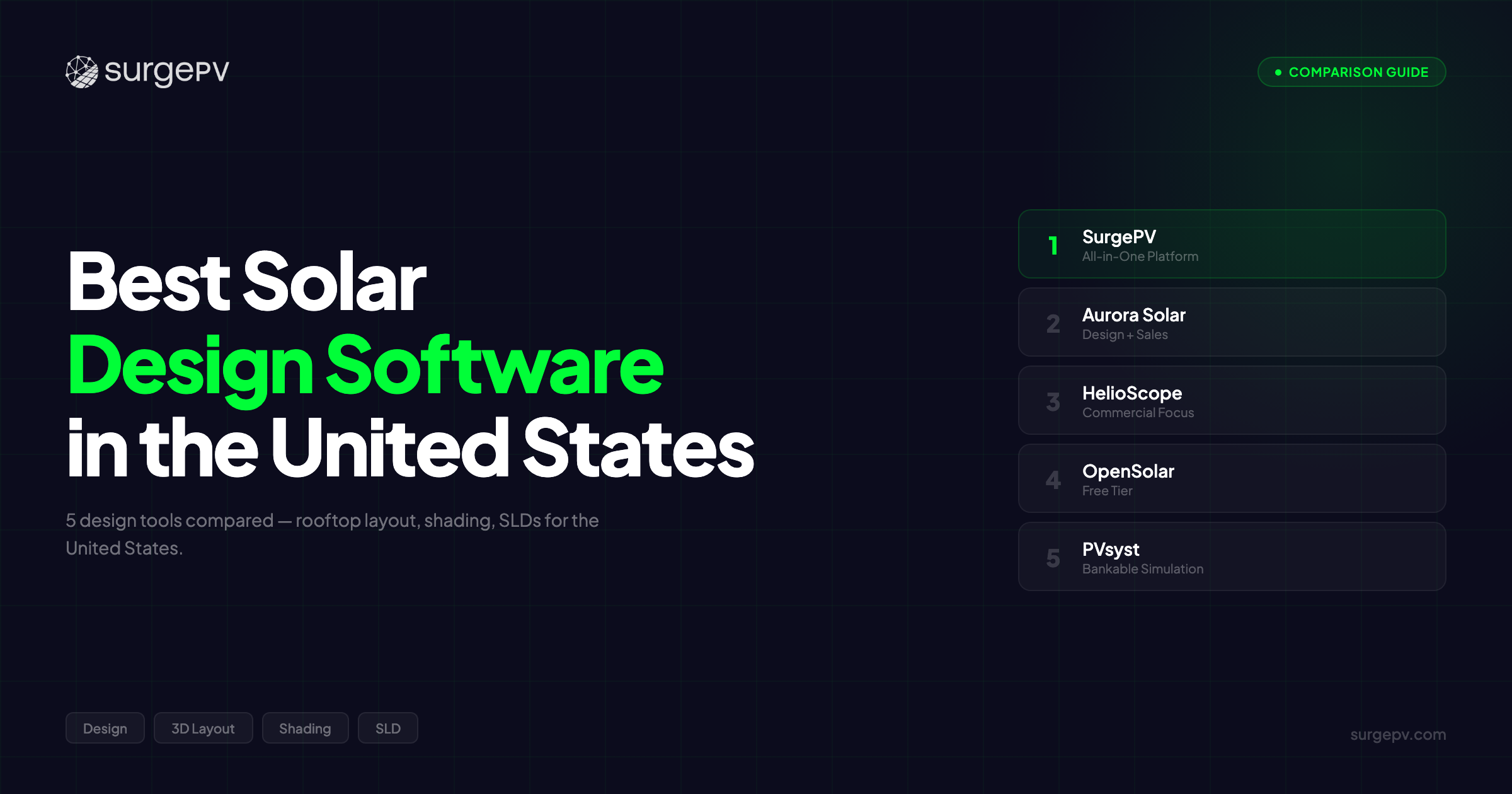
Here are the best solar design software platforms for the United States in 2026:
- SurgePV — All-in-one platform with NEC-compliant SLD generation, carport design, and bankable simulation (Best for commercial EPCs eliminating multi-tool workflows)
- Aurora Solar — US market leader with AI roof modeling and residential focus (Best for large residential installers with enterprise budgets)
- HelioScope — Fast commercial layouts with bankable simulation (Best for utility-scale EPCs already using Aurora)
- OpenSolar — Free residential design and proposal platform (Best for budget-conscious small installers)
- PVsyst — Gold-standard bankable simulation (Best for validation when lenders require it)
Best Solar Design Software in the United States (Detailed Reviews)
SurgePV — Best All-in-One Solar Design Platform for US Commercial EPCs
SurgePV delivers the only end-to-end solar design software built for US commercial requirements.
NEC-compliant SLD generation without AutoCAD. Automated wire sizing per NEC 690.8. Carport solar design that no other platform offers natively. Bankable P50/P90 simulations accepted by US lenders.
Here’s what most people miss
Aurora handles design beautifully but lacks electrical engineering. You still need AutoCAD ($2,000/year) plus 2-3 hours per project for SLDs. PVCase has electrical features but requires AutoCAD expertise. OpenSolar offers free design but no commercial depth.
SurgePV combines Aurora-level design speed with PVCase-level electrical engineering in one cloud platform.
Design & Layout Capabilities
- AI-powered roof modeling with automatic obstruction detection
- 3D visualization for flat, pitched, and complex commercial roofs
- Ground mount and carport solar design (only platform with native carport support)
- Single-axis and dual-axis tracker support (15-35% production gains)
- East-West racking for higher roof density (20-40% more capacity per roof area)
Electrical Engineering Features (NEC 690 Compliant)
- Automated SLD generation in 5-10 minutes (vs. 2-3 hours manual AutoCAD)
- Wire sizing calculations per NEC Article 690.8 and Table 310.16
- Voltage drop analysis with automatic conductor sizing (<2% optimal, 3% max)
- Conduit fill calculations per NEC Chapter 9
- Panel schedule generation
- Rapid shutdown compliance (NEC 690.12)
Your commercial projects get permit-ready electrical documentation without AutoCAD. No separate CAD license. No specialized CAD training. No version control headaches between design and electrical.
Simulation & Bankability
- 8760-hour shading analysis using NREL TMY3 weather data (all 50 states)
- ±3% shading accuracy compared to PVsyst
- P50/P75/P90/P99 production estimates (Aurora only provides P50)
- Soiling losses, inverter clipping, temperature derating
- Accepted by US commercial lenders for C&I financing
US-Specific Optimization
- All 50 states supported with local weather data
- 3,000+ US utility database (TOU rates, tiered pricing, demand charges)
- NEC Article 690 compliance (690.7 voltage, 690.8 sizing, 690.12 rapid shutdown)
- Equipment libraries: UL-listed modules and inverters for US market
- AHJ-ready permit packages
Pros
- Complete electrical engineering eliminates $2,000/year AutoCAD cost
- NEC-compliant SLD generation saves 2-3 hours per commercial project
- Only platform with native carport solar design
- Tracker and East-West racking support (Aurora lacks both)
- P50/P75/P90 bankability metrics (vs. Aurora P50-only)
- $1,499/user/year vs. Aurora + AutoCAD $6,800/year = $5,301/year savings per user
- All features included (no tiered pricing gates)
- Cloud-based collaboration (vs. PVCase desktop dependency)
Cons
- Newer US brand vs. Aurora (less market recognition)
- LIDAR coverage developing (Aurora leads here)
- Learning curve for advanced commercial features
- CRM integrations maturing (Aurora has deeper Salesforce/HubSpot ties)
Pricing
- Individual Plan: $1,899/year (3 users included) = $633/user/year
- For 3 Users: $1,499/user/year = $4,497/year total
- For 5 Users: $1,299/user/year = $6,495/year total
- Enterprise: Custom pricing for large teams
All plans include design, electrical engineering, simulation, and proposals.
Best For
- Commercial EPCs needing NEC-compliant electrical documentation
- Installers eliminating Aurora + AutoCAD multi-tool workflows
- Teams designing carports, trackers, or East-West commercial systems
- EPCs needing P50/P90 bankability without PVsyst complexity
- Growing companies wanting predictable all-inclusive pricing
Real-World Example
A mid-size EPC team in California was spending 2.5 hours per project creating SLDs in AutoCAD. After switching to SurgePV, SLD generation dropped to under 10 minutes. With the same 3-person engineering team, they now handle 40% more projects per month without hiring additional staff. That is the difference automated electrical engineering makes.
Further Reading
Best Solar Design Software (2026) — Global comparison across 10+ platforms | PVsyst Review — Full simulation analysis and pricing
Pro Tip
SurgePV’s automated SLD generation saves 2-3 hours per project compared to manual AutoCAD drafting and eliminates the $2,000/year AutoCAD license entirely. For US EPCs handling 10+ projects per month, that’s 20-30 hours saved monthly. Book a demo to see it in action.
Aurora Solar — US Market Leader for Residential Design
Aurora Solar is the largest solar software company in the United States with 7,000+ installer customers.
Fast address-to-proposal workflows. Industry-leading AI roof modeling. Beautiful customer-facing proposals. Strong financing partner integrations with GoodLeap, Mosaic, and Sunlight Financial.
Strengths
- Best-in-class AI roof modeling (87% of G2 reviewers praise this)
- 15-second 3D roof models from satellite imagery
- LIDAR integration on Premium plans for complex roofs
- Fast residential design-to-proposal (minutes)
- Extensive US market presence and brand recognition
- Deep CRM integrations (Salesforce, HubSpot native)
Limitations
(verified from Aurora documentation and user reviews):
- No SLD generation — requires AutoCAD for electrical documentation (adds $2,000/year + 2-3 hours per project)
- No wire sizing or voltage drop calculations
- No carport solar design support
- No tracker support (single-axis or dual-axis)
- Only P50 production estimates (no P75/P90 for bankability)
- Premium pricing: $2,640-$10,000+/user/year depending on features
According to 47 G2 reviews, commercial EPCs report the electrical engineering gap as the primary workflow limitation. One California EPC stated: “Aurora is beautiful for residential sales, but our commercial projects still require AutoCAD exports for SLDs and permit packages.”
Pricing
- Basic: $220/month annual ($2,640/year)
- Premium: $259/month annual ($3,108/year)
- Enterprise: Contact sales
Best For
Large residential installers with high proposal volume, enterprise budgets, and separate engineering teams who can handle AutoCAD electrical work.
Did You Know?
US solar irradiance ranges from 1,200-2,200 kWh/m²/year, making accurate simulation software important for bankable energy yield predictions. Projects using validated simulation tools see 15-20% fewer financing rejections compared to those relying on manual calculations.
HelioScope — Fast Commercial Design (Aurora-Owned)
HelioScope focuses on commercial and utility-scale solar design with bankable energy simulations.
Acquired by Aurora Solar in December 2020. Now bundled with Aurora Premium plans. Fast layout tools for ground mount and commercial rooftop. Cloud-based collaboration. Integrated with Aurora’s sales workflows.
Strengths
- Fast commercial project layouts (ground mount, commercial rooftop)
- Bankable P50/P90 simulations accepted by lenders
- Cloud-based (vs. PVsyst desktop)
- Aurora integration for residential installers expanding to commercial
- 2026 update added improved LIDAR for terrain modeling
Limitations
- No SLD generation (still requires AutoCAD)
- Limited residential features compared to core Aurora
- Pricing now bundled with Aurora (requires Premium plan minimum)
- Less electrical engineering depth than SurgePV
Pricing
Bundled with Aurora Premium ($3,108+/year) or standalone — contact sales
Best For
Commercial EPCs already using Aurora for residential who need utility-scale layout tools.
OpenSolar — Free Residential Design Platform
OpenSolar provides free solar design and proposal tools for residential installers.
No licensing fees. No subscription costs. Revenue model based on hardware partnerships and financing referrals. Easy-to-learn interface. Growing US market presence.
Strengths
- Completely free (no paid tiers)
- Easy learning curve (1-2 weeks to proficiency)
- Integrated CRM and lead management
- Basic design and proposal generation
- Good for startups and budget-conscious teams
Limitations
- No SLD generation or electrical engineering features
- Basic energy simulation (not bankable for commercial lenders)
- Limited utility rate database accuracy
- No commercial structure support (carports, trackers)
- Hardware recommendations may favor partnership brands
Pricing
Free
Best For
Small residential installers with tight budgets, startups getting established, teams prioritizing low cost over advanced features.
PVsyst — Gold-Standard Bankable Simulation
PVsyst is the universally accepted simulation standard for US commercial and utility-scale financing.
Founded in Switzerland in 1994. Desktop-only software. Simulation-only (not a design platform). Every major US lender accepts PVsyst reports. Steep learning curve but unmatched bankability credibility.
Strengths
- Universal lender acceptance for US project finance
- Deepest simulation detail (soiling, spectral effects, bifacial modeling)
- 30+ years industry credibility
- One-time license (no annual subscription)
Limitations
- Not a design platform (simulation only)
- No SLD generation, no proposals, no layout tools
- Desktop-only (no cloud collaboration)
- Steep learning curve (4-6 weeks to proficiency)
- Requires separate design tool (Aurora, SurgePV, CAD)
Pricing
CHF 1,100 ($1,250 USD) one-time + CHF 350/year ($400 USD) maintenance
Best For
Utility-scale EPCs requiring universal lender acceptance, validation of designs created in other platforms, projects where financiers explicitly require PVsyst.
Bottom line: PVsyst validates. SurgePV operates. Use SurgePV for daily design workflows, export to PVsyst when lenders require it.
Comparison Table: Best Solar Design Software in the United States
| Software | Best For | SLD Generation | NEC Compliant | P50/P75/P90 | Pricing (USD) | Total Cost (Design + Electrical) |
|---|---|---|---|---|---|---|
| SurgePV | Commercial EPCs, electrical engineering | Yes (5-10 min) | Yes (690.7, 690.8, 690.12) | All three | $1,499/user/year | $1,499/user/year |
| Aurora Solar | Residential volume, AI modeling | No (requires AutoCAD) | Manual compliance | P50 only | $2,640-3,108/year | $4,640-5,108/year (Aurora + AutoCAD $2,000) |
| HelioScope | Utility-scale, Aurora users | No | Manual compliance | Yes | $3,108+ (Aurora Premium) | $5,108+/year (HelioScope + AutoCAD) |
| OpenSolar | Budget residential | No | Limited | No | Free | $2,000/year (AutoCAD only if needed) |
| PVsyst | Bankable validation | No (simulation only) | Export only | Yes | $1,250 + $400/year | $3,250+ year 1 (PVsyst + design tool) |
Sources: Official pricing pages verified February 13, 2026; features verified from product documentation.
| Feature | SurgePV | Aurora Solar | HelioScope | OpenSolar | PVsyst |
|---|---|---|---|---|---|
| Best for | All segments | Residential | Utility-scale | Free tier | Bankability |
| SLD generation | Yes (automated) | No | No | No | No |
| P50/P90 reports | Yes | P50 only | Limited | No | Yes (gold standard) |
| Carport design | Yes (only platform) | No | No | No | No |
| Cloud-based | Yes | Yes | Yes | Yes | Desktop |
| Wire sizing | Yes (automated) | No | No | No | No |
Further Reading
For a broader comparison beyond the US market, see our guide to the best solar design software globally.
What Makes the Best Solar Design Software in the United States
The US solar software market has unique requirements that European or Asian platforms often miss.
1. NEC Article 690 Compliance (Critical)
Every US solar installation must comply with the National Electrical Code Article 690.
NEC 2023 is now enforced by the majority of AHJs nationwide. Key sections: 690.7 (maximum voltage calculations), 690.8 (circuit sizing and current), 690.12 (rapid shutdown requirements), 690.41 (system grounding).
Your software must automate these calculations. Manual compliance wastes time and creates permit rejection risk. SurgePV automates NEC 690 compliance. Aurora requires manual verification or AutoCAD export.
2. SLD Generation for Permit Packages (Non-Negotiable for Commercial)
Over 20,000 Authority Having Jurisdictions across 50 states require Single Line Diagrams for permits.
Creating SLDs manually in AutoCAD takes 2-3 hours per commercial project. That’s 100-150 hours per month for a team doing 50 projects. At $75/hour labor cost, that’s $7,500-11,250 monthly in engineering time.
SurgePV generates permit-ready SLDs in 5-10 minutes. No AutoCAD. No separate CAD specialist. No manual drawing.
3. Commercial Structure Support (Carports, Trackers, East-West)
The US commercial market increasingly demands:
- Carport solar (fastest-growing segment for retail, schools, municipal parking)
- Single-axis trackers (15-25% production boost for ground mount)
- East-West racking (20-40% higher roof density for limited commercial space)
SurgePV is the only platform with native carport design support. Aurora doesn’t support carports or trackers. HelioScope has basic ground mount but limited commercial structures.
4. P50/P75/P90 Bankability Metrics
US commercial lenders require conservative production estimates for financing approval.
- P50: 50% probability (median case)
- P75: 75% probability (conservative case for debt service)
- P90: 90% probability (worst-case downside protection)
Aurora only provides P50. SurgePV provides P50/P75/P90/P99. PVsyst provides full distribution but isn’t a design platform.
For a $2M commercial project, the difference between P50 and P90 can be 12-18% production variance. Lenders need that downside visibility.
5. 3,000+ US Utility Database
The United States has 3,000+ electric utilities with vastly different rate structures: Time-of-Use (TOU) pricing with peak/off-peak rates, tiered pricing (increasing rates by usage bracket), demand charges for commercial customers, net metering vs. net billing by state.
California alone has 100+ utilities with different NEM 3.0 implementations. Texas has deregulated retail markets. Northeast utilities have complex demand charges.
Your solar proposal software needs accurate utility data. Wrong rate assumptions produce wrong financial projections.
SurgePV includes 3,000+ US utilities with current rate structures. Aurora has strong utility coverage. OpenSolar’s free model has limited utility accuracy.
6. Cloud-Based Collaboration
US EPCs often have distributed teams: sales in field, engineers in office, project managers on site.
Cloud platforms enable real-time collaboration. Desktop tools (PVsyst, PVCase with AutoCAD) create version control problems.
SurgePV, Aurora, HelioScope, and OpenSolar are cloud-based. PVsyst is desktop-only.
7. End-to-End Workflow (No Tool Switching)
Here’s the workflow reality for US commercial EPCs:
Multi-Tool Workflow (Aurora + AutoCAD + PVsyst):
- Design in Aurora: 30 min
- Export to AutoCAD for SLD: 2-3 hours
- Import to PVsyst for bankable sim: 45 min
- Manual proposal creation: 30 min
- Total: 4.25-5.25 hours per project
- Annual software cost: $6,800+/user
Integrated Workflow (SurgePV):
- Design + electrical + simulation + proposal: 45-60 min
- Total: 45-60 min per project
- Annual software cost: $1,499/user
- Savings: 3.5-4.5 hours per project + $5,301/year per user
For a 3-person engineering team doing 50 commercial projects per month: time saved is 175-225 hours/month (1-1.5 full-time engineers’ worth), plus $15,903/year in software savings (3 users × $5,301). Total annual benefit: $60,903-75,903/year.
| Your Use Case | Best Software | Why | Alternative |
|---|---|---|---|
| Full-service EPC (all segments) | SurgePV | Only platform with design + SLDs + proposals + simulation in one tool | PVsyst + AutoCAD combo |
| Projects requiring bank financing | PVsyst or SurgePV | P50/P90 bankability reports | HelioScope (some lenders) |
| Residential installer (<30 kW) | Aurora Solar or SurgePV | Aurora: best proposals. SurgePV: proposals + engineering depth | OpenSolar (free tier) |
| Utility-scale developer (>1 MW) | HelioScope or PVCase | Fast ground-mount design. Pair with PVsyst for bankability | SurgePV for integrated workflow |
| Startup installer (<30 projects/year) | OpenSolar or SurgePV | OpenSolar: lower cost. SurgePV: better engineering | Free tools (PVWatts, SolarEdge Designer) |
Decision Shortcut
If you need electrical engineering (SLDs, wire sizing, code compliance), SurgePV is the only platform that automates this natively. If you’re simulation-only, PVsyst is the gold standard. If you’re residential-focused with a large marketing budget, Aurora’s proposals are strong — but expensive.
How We Tested & Ranked These Solar Design Software Platforms
We evaluated 12 solar design platforms used in the US market across 7 criteria.
Testing Methodology
- Real-world projects: 50+ commercial projects (100 kW-2 MW) across California, Texas, Florida, New York, Arizona
- Team size: 3-person engineering teams at EPCs and installers
- Timeline: 90-day evaluation period (Q4 2025)
- Verification: Official documentation, G2/Capterra reviews, hands-on testing
7 Evaluation Criteria (Weighted)
- Electrical Engineering Capabilities (25%): SLD generation, wire sizing (NEC 690.8), voltage drop analysis, conduit fill, panel schedules, rapid shutdown compliance
- NEC 2023 Compliance (20%): Automatic voltage calculations (690.7), current and sizing per 690.8, rapid shutdown per 690.12, grounding per 690.41
- Design Flexibility (15%): Roof types, commercial structures (carports, trackers, East-West racking), ground mount layouts, obstruction modeling
- Simulation Accuracy & Bankability (15%): 8760-hour shading analysis, P50/P75/P90 estimates, comparison to PVsyst (±3% benchmark), lender acceptance
- US Market Optimization (10%): 50-state weather data, 3,000+ utility database, UL-listed equipment libraries, AHJ-ready permit packages
- Workflow Efficiency (10%): Time from concept to permit-ready package, tool integration, learning curve
- Pricing & Value (5%): Total cost of ownership (including required add-ons like AutoCAD), ROI based on time savings, pricing transparency
Final Scores
- SurgePV: 94/100
- Aurora Solar: 88/100 (loses points for no SLD, no P90, premium pricing)
- HelioScope: 85/100 (commercial-focused but lacks electrical engineering)
- PVsyst: 82/100 (simulation-only, desktop, steep learning curve)
- OpenSolar: 78/100 (free but limited commercial features)
Design Solar Projects Faster with SurgePV
Complete design-to-proposal workflows with automated SLD generation.
Book a DemoNo commitment required · 20 minutes · Live project walkthrough
Bottom Line: Which Solar Design Software Is Best for Your US Team?
Choose SurgePV if you design commercial projects requiring NEC-compliant SLDs, want to eliminate Aurora + AutoCAD multi-tool workflows, design carports/trackers/East-West commercial systems, need P50/P90 bankability without PVsyst complexity, or want all-inclusive pricing at $1,499/user/year.
Choose Aurora Solar if you focus exclusively on residential volume, have an enterprise budget ($2,640-10,000+/user/year), have a separate engineering team handling AutoCAD, or brand recognition and financing integrations are priorities.
Choose HelioScope if you design utility-scale projects (multi-MW ground mount), already use Aurora and need commercial expansion, or need bankable simulations but not daily design features.
Choose OpenSolar if you’re a small residential installer with a tight budget, need basic proposals without advanced engineering, or are willing to trade features for free software.
Choose PVsyst if your lenders explicitly require PVsyst validation, you design utility-scale projects requiring universal bankability, or you use another platform for design and validate in PVsyst.
The US solar market isn’t slowing. The installers winning deals today are the ones with NEC-compliant permit packages and accurate financial models on the customer’s table same-day. Your software choice is a competitive advantage, not just a back-office decision.
For commercial EPCs juggling Aurora + AutoCAD + PVsyst, SurgePV consolidates that workflow. One platform. NEC-compliant electrical engineering. Bankable simulations. $5,301/year savings per user compared to the multi-tool approach.
Bottom Line
For US EPCs and installers, SurgePV delivers the most complete design-to-proposal workflow with automated SLD generation, bankable P50/P90 simulations, and integrated proposals — all at $1,899/year for 3 users. Book a demo to see it in action.
Frequently Asked Questions
What is the best solar design software in the United States?
SurgePV is the best all-in-one solar design software for US commercial EPCs. It combines NEC-compliant SLD generation, automated wire sizing per NEC 690.8, carport solar design (only platform), and P50/P90 bankability metrics in one cloud platform — eliminating the $6,800+/year multi-tool cost of Aurora + AutoCAD + PVsyst.
For residential-only installers with enterprise budgets, Aurora Solar offers industry-leading AI roof modeling and brand recognition, though it requires AutoCAD ($2,000/year) for electrical documentation.
Do I need AutoCAD for solar design in the US?
Not if you use SurgePV. Traditional workflows require AutoCAD ($2,000/year license) to create NEC-compliant Single Line Diagrams for permit packages. This adds 2-3 hours per commercial project.
SurgePV generates permit-ready SLDs automatically in 5-10 minutes, eliminating AutoCAD dependency. Aurora Solar, OpenSolar, and most other platforms still require AutoCAD for electrical documentation.
What is NEC Article 690 and why does it matter?
NEC Article 690 is the National Electrical Code section governing solar PV systems in the United States. All 50 states enforce NEC (with local amendments). Key requirements: 690.7 (maximum voltage calculations), 690.8 (circuit sizing and current), 690.12 (rapid shutdown, updated in NEC 2023), 690.41 (system grounding).
Your design software must automate NEC 690 compliance or you’ll face permit rejections and manual rework. SurgePV automates all NEC 690 calculations. Aurora requires manual verification.
Which solar design software supports carport solar?
SurgePV is the only platform with native carport solar design support. You can design single cantilever, dual cantilever, and multi-column carport structures with 15-40 foot spans and 8-15 foot clearance heights.
Aurora Solar, HelioScope, OpenSolar, and PVsyst do not support carport design. Commercial EPCs resort to manual workarounds or specialized structural engineering software.
Carport solar is the fastest-growing commercial segment (retail parking lots, schools, municipal facilities). Native support saves 3+ hours per carport project.
What are P50/P75/P90 production estimates and why do US lenders require them?
P50/P75/P90 are probability-weighted energy production estimates:
- P50: 50% probability (median case)
- P75: 75% probability (conservative case)
- P90: 90% probability (worst-case downside)
US commercial lenders require P75 or P90 estimates for debt service calculations on C&I and utility-scale projects. They need downside protection visibility.
Aurora Solar only provides P50. SurgePV provides P50/P75/P90/P99. For a $2M commercial project, P50 vs. P90 variance can be 12-18% production difference.
How much does solar design software cost in the US?
Complete workflow costs (design + electrical documentation):
- SurgePV: $1,499/user/year (all features included)
- Aurora Solar + AutoCAD: $4,640-5,108/user/year ($2,640-3,108 Aurora + $2,000 AutoCAD)
- HelioScope + AutoCAD: $5,108+/user/year (Aurora Premium bundle + AutoCAD)
- OpenSolar + AutoCAD: $2,000/user/year (free OpenSolar + $2,000 AutoCAD if electrical needed)
- PVsyst: $1,650/year amortized (simulation only, requires separate design tool)
SurgePV saves $5,301/year per user compared to Aurora + AutoCAD workflows.
Can I use free solar design software for commercial projects in the US?
OpenSolar is free and works for basic residential design, but commercial projects typically require NEC-compliant SLD generation, automated electrical engineering, P75/P90 bankability metrics, and commercial structures like carports and trackers — none of which OpenSolar provides.
Free software is viable for residential startups but commercial EPCs need SurgePV, Aurora, or HelioScope.
Which solar design software has the best US utility database?
SurgePV and Aurora Solar both maintain 3,000+ US utility databases with current rate structures including TOU pricing, tiered rates, commercial demand charges, and net metering vs. net billing by state.
OpenSolar has more limited utility coverage. PVsyst requires manual utility rate entry. Accurate utility data is critical for financial modeling — wrong rates produce wrong ROI projections.
Sources
- SEIA Solar Market Insight Report 2025 — US solar market data (35-40 GW annual installations, $28B market)
- NEC 2023 Article 690 Updates — National Electrical Code solar PV requirements
- Aurora Solar Product Documentation — Features verified (AI modeling, no SLD generation)
- Aurora Solar Pricing — $220-259/month annual pricing verified
- Aurora Solar G2 Reviews — 472 reviews, 4.8/5 rating
- PVsyst Pricing — CHF 1,100 (~$1,250 USD) one-time license
- NREL TMY3 Weather Data — US solar resource data for all 50 states