

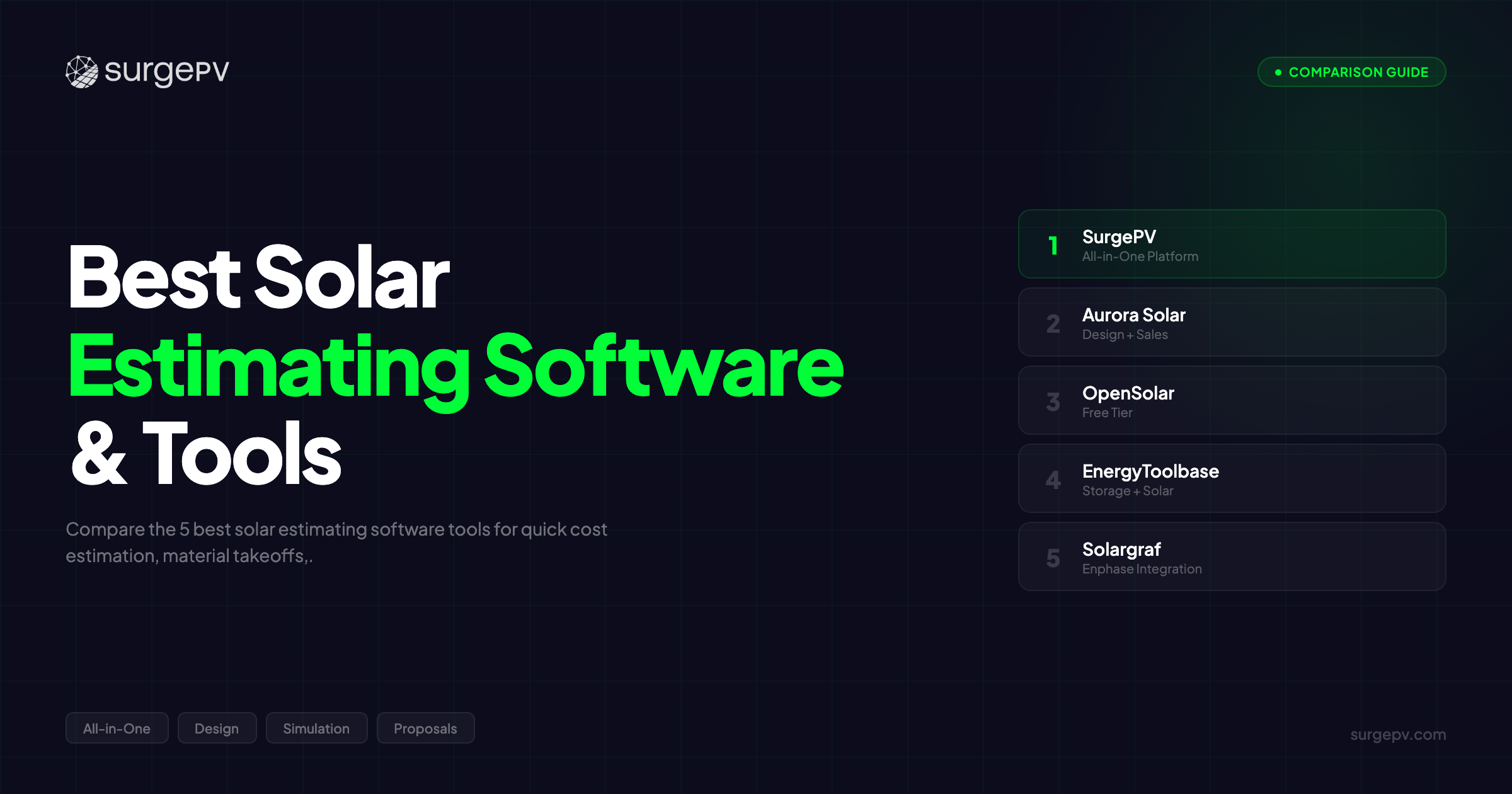
TL;DR: A solar estimate that takes 3 hours to prepare loses the deal to a competitor who delivers one in 30 minutes. The best solar estimating tools in 2026 combine satellite-based design with automated material takeoffs, labor calculation, and pricing. SurgePV generates estimates with bankable production data and automated BOMs at $1,899/year for 3 users. Aurora Solar delivers fast residential estimates with polished proposals. OpenSolar offers free basic estimating for budget-conscious installers. EnergyToolbase leads battery storage and energy arbitrage modeling. Solargraf provides quick Enphase-ecosystem estimates.
Most Solar Estimates Are Built on Guesswork
A homeowner requests three quotes for a rooftop solar system. Installer A sends a detailed estimate within 2 hours, complete with system design, production forecast, equipment specs, and financing options. Installer B sends a rough ballpark the same day and promises a detailed proposal next week. Installer C never follows up because their estimating process takes two days per quote, and they are already behind on five other proposals.
Installer A wins the deal. Every time.
Speed and accuracy in solar estimating directly determine close rates. Residential installers who deliver detailed estimates within 24 hours close at two to three times the rate of companies that take a week. For commercial EPCs, the difference between winning and losing a bid often comes down to who delivered the most credible cost breakdown fastest.
The problem is that solar estimating is genuinely complex. A proper estimate requires roof or site measurement, panel layout optimization, shading assessment, energy production modeling, equipment selection and pricing, labor hour calculation, permit and inspection costs, financing terms, and utility rate analysis for savings projections. Do that manually and you are looking at 2-4 hours per residential system and 6-10 hours per commercial project.
Modern solar software estimating tools automate most of that process. Upload a satellite image, let AI detect the roof geometry, place panels automatically, run shading simulation, auto-generate the BOM with current pricing, calculate labor based on system size and roof complexity, and output a customer-ready estimate with production forecasts and financing options.
We tested the top solar estimating platforms for accuracy, speed, integration with design workflows, and total cost of ownership. We evaluated how each tool handles the full estimating lifecycle from initial site assessment through customer-ready cost proposals.
In this guide, you will learn:
- Which 5 estimating platforms deliver the fastest, most accurate solar cost estimates
- How automated material takeoffs eliminate manual BOM errors that cost installers thousands
- Why production-based estimates (not just cost) win more deals
- What separates residential estimating from commercial bid preparation
- How battery storage estimating adds complexity most tools cannot handle
- Our recommendation by company type and project volume
Quick Comparison: 5 Best Solar Estimating Software Tools
| Feature | SurgePV | Aurora Solar | OpenSolar | EnergyToolbase | Solargraf |
|---|---|---|---|---|---|
| Best For | Detailed estimates with electrical engineering | Fast residential estimates | Free basic estimating | Battery + storage modeling | Enphase ecosystem estimates |
| Site Assessment | AI satellite + 3D modeling | AI satellite (best-in-class) | Satellite-based | Manual input | Satellite-based |
| Production Estimate | P50/P75/P90 bankable | P50 only | Basic annual | Detailed with storage | Basic annual |
| Material Takeoff | Automated BOM from design | Automated BOM | Basic BOM | Equipment lists | Automated BOM |
| Labor Calculation | BOM-based estimation | Template-based | Basic | Not included | Template-based |
| Pricing Database | Current equipment pricing | Equipment pricing | Basic pricing | Battery + inverter pricing | Enphase-focused |
| Financing Options | Integrated calculator | Full financing suite | Basic financing | Storage economics | Financing partnerships |
| Price/Year | $1,899 (3 users) | $4,800+ (contact sales) | Free | $2,400+/year | Included with Enphase |
| Our Rating | 9.1/10 | 8.7/10 | 7.8/10 | 8.4/10 | 7.9/10 |
Quick verdict: For solar companies needing estimates that include electrical engineering documentation alongside cost calculations, SurgePV produces the most complete project estimates. For high-volume residential teams prioritizing speed above all else, Aurora Solar’s AI roof detection generates estimates fastest. For installers on a tight budget, OpenSolar provides free basic functionality. For battery storage projects where energy economics drive the sale, EnergyToolbase models time-of-use arbitrage that standard tools cannot. For Enphase-exclusive installers, Solargraf integrates tightly with Enphase equipment and pricing.
See how SurgePV generates complete estimates with automated BOMs. Book a free demo.
What Makes a Solar Estimate Accurate and Credible
Before comparing tools, understand the five components that separate professional estimates from back-of-napkin quotes.
Site Assessment and Roof Measurement
Every estimate starts with understanding the site. How large is the usable roof area? What is the tilt and azimuth? Where are obstructions (vents, chimneys, HVAC units)? What are the setback requirements?
Modern tools use satellite imagery and AI to detect roof geometry automatically. The best platforms achieve +/-2-3 degree accuracy on tilt and orientation, which translates to +/-2-3% accuracy on production estimates. Manual measurement errors of 5-10 degrees can swing production estimates by 5-10%, enough to change the system economics from attractive to marginal.
Energy Production Modeling
An estimate without production data is just a price tag. Customers compare solar proposals based on cost per kWh produced, not just total system cost. A $25,000 system producing 12,000 kWh/year is a better deal than a $22,000 system producing 9,000 kWh/year.
Professional estimating tools calculate production using location-specific irradiance data, 8760-hour shading analysis, temperature derating, inverter efficiency curves, and degradation assumptions. The output should include annual production, monthly breakdown, and confidence intervals.
Tools that provide P50/P75/P90 metrics give customers and financiers the confidence that production estimates are realistic, not optimistic marketing numbers.
Material Takeoff and BOM Generation
A material takeoff lists every component needed to install the system: panels, inverters, racking, wiring, disconnects, conduit, grounding, monitoring equipment, and mounting hardware. Quantities must match the specific design, not generic per-kW assumptions.
The difference matters. A generic BOM template assumes standard racking for every installation. But a hip roof needs different mounting hardware than a gable roof. A flat commercial roof needs ballast trays. A ground mount needs pier foundations. Automated BOM generation from the actual design catches these differences. Manual BOM preparation using templates introduces errors that cost $500-2,000 per project in over-ordering or emergency trips to the distributor.
Labor Estimation
Labor is typically 15-25% of total residential solar project cost and 10-20% of commercial project cost. Accurate labor estimation requires accounting for system size, roof complexity (pitch, material, access), electrical work, trenching, and local labor rates.
Most estimating tools use formula-based labor calculations: base hours per kW installed, adjusted by roof difficulty multipliers. A 10 kW system on a simple gable roof might take 16 labor-hours. The same system on a steep tile roof with limited access could take 28 labor-hours. Tools that adjust automatically for these factors produce more profitable bids than those using flat per-kW labor rates.
Financial Modeling and Incentive Calculation
The estimate must translate system cost into customer economics: monthly savings, payback period, ROI, NPV, and IRR. That requires modeling utility rates (current and escalating), available incentives (federal ITC, state rebates, SRECs), financing terms (loan, lease, PPA), and net metering policy.
Incentive programs change frequently. The federal Investment Tax Credit, state-level rebates, and utility incentive programs have different eligibility requirements, application deadlines, and benefit calculations. Estimating tools with current incentive databases reduce the risk of quoting incentives that have expired or calculating benefits incorrectly.
Top 5 Solar Estimating Software Platforms for 2026
SurgePV — Best for Complete Project Estimates with Electrical Engineering
Rating: 9.1/10 | Price: $1,899/year (3 users) | Book a demo | See pricing
SurgePV is a cloud-based solar design software platform that produces estimates going beyond cost calculations to include electrical engineering documentation, bankable production forecasts, and automated BOMs from the actual system design.
Why SurgePV produces the most complete estimates:
Most estimating tools stop at “here is what the system costs and here is what it will produce.” SurgePV continues to “here is the complete electrical documentation, wire sizing, conduit specifications, and permit-ready plan set.” For commercial projects where the estimate becomes the basis for a fixed-price bid, that completeness matters.
The platform’s AI-powered 3D modeling detects roof geometry from satellite imagery, places panels with optimized spacing and setbacks, and runs 8760-hour shading simulation to calculate production. From that design, SurgePV auto-generates the BOM with exact quantities for panels, inverters, racking, wiring, disconnects, and mounting hardware specific to the designed layout.
The generation and financial tool calculates P50/P75/P90 production estimates with uncertainty analysis. For commercial bids where production guarantees carry financial penalties, P90 estimates provide the conservative baseline that protects your margins.
SurgePV’s automated SLD generation adds electrical engineering to the estimate in 5-10 minutes. When a commercial client asks “can you show me the electrical design?”, you have a code-compliant single line diagram ready, not just a panel layout and cost sheet.
Where SurgePV estimating differs from quoting tools:
SurgePV is a design platform with estimating capabilities, not a quick-quoting tool. The first estimate for a new roof takes 20-30 minutes (residential) or 40-60 minutes (commercial) because you are building a real design, not a placeholder. For high-volume residential teams doing 50+ estimates per day where speed matters more than engineering depth, Aurora Solar’s lighter workflow is faster for initial quotes.
But for companies where the estimate needs to hold up as a project specification, SurgePV’s design-based approach produces estimates that convert to construction documents without rework.
Pros:
- Automated BOM generation from actual system design (not templates)
- P50/P75/P90 bankable production estimates with uncertainty analysis
- Automated SLD and electrical engineering included in estimates
- 8760-hour shading analysis (+/-3% accuracy vs PVsyst)
- Solar proposals generated directly from estimates
- Cloud-based collaboration for design and sales teams
- Transparent pricing: $1,899/year for 3 users, all features included
- Wire sizing, conduit calculations, and NEC compliance automated
Cons:
- Not the fastest tool for quick residential ballpark quotes (design-based approach takes 20-30 min)
- CRM integrations developing (API available, not native Salesforce)
- Better suited for detailed estimates than high-volume initial lead screening
- Learning curve for full platform (2-3 weeks vs 1 week for simpler tools)
Best for: Solar installers and EPCs producing detailed estimates for residential and commercial projects where the estimate needs to include electrical engineering, accurate BOMs, and bankable production forecasts, not just a price tag.
Compare SurgePV’s estimate completeness to your current tools. Schedule a demo.
Aurora Solar — Best for Fast Residential Estimating
Rating: 8.7/10 | Price: $4,800+/year (contact sales) | Aurora Solar | Aurora review
Aurora Solar delivers the fastest residential solar estimates in the industry. For high-volume installers where speed-to-quote determines close rates and sales teams need to generate 20+ estimates per day, Aurora’s AI-powered workflow produces customer-ready proposals in under 15 minutes.
Why Aurora leads residential estimating speed:
Aurora’s AI roof detection is the fastest available. Upload a satellite image, and Aurora returns a complete roof model with tilt, azimuth, and obstructions detected in 30-60 seconds. For simple gable roofs, the AI is accurate enough to skip manual adjustment entirely.
The platform auto-places panels, calculates production using 8760-hour shading simulation, generates the BOM, and produces a customer-facing estimate with financing options, utility savings projections, and interactive ROI calculators. The entire process: under 15 minutes for a straightforward residential system.
Aurora’s proposal builder is designed for sales conversion. The estimates are visually polished with 3D renderings, street-level views, and interactive sliders that let homeowners adjust system size, financing terms, and assumptions in real time during the sales pitch.
Where Aurora estimating falls short for commercial:
Aurora does not generate electrical engineering documentation. For commercial estimates that need SLDs, wire sizing, and conduit calculations, Aurora produces only the design and cost portion. The electrical estimate must come from a separate tool or manual engineering.
Production estimates are P50 only. For commercial bids requiring P75/P90 conservative estimates for production guarantees, Aurora’s single-metric output requires supplemental validation from PVsyst or similar tools.
Per-user pricing at $4,800+/year (contact sales for actual pricing) scales quickly for larger teams.
Pros:
- Fastest residential estimating workflow (under 15 minutes per system)
- Industry-leading AI roof detection
- Polished customer-facing estimates with 3D visualization
- Full financing suite (cash, loan, lease, PPA)
- Native Salesforce and HubSpot CRM integration
- Strong equipment pricing database
Cons:
- No electrical engineering in estimates (no SLD, wire sizing)
- P50 only production estimates (no P75/P90 for commercial finance)
- Tiered pricing, not transparent (contact sales)
- Total cost with AutoCAD for commercial: $6,800+/year per user
- Not optimized for commercial estimating depth
Best for: High-volume residential installers with dedicated sales teams generating 20+ estimates per day where speed-to-quote and visual proposal quality drive close rates.
OpenSolar — Best Free Solar Estimating Tool
Rating: 7.8/10 | Price: Free (with limitations) | OpenSolar | OpenSolar review
OpenSolar provides free solar estimating for residential installers who need basic functionality without software costs. For small teams doing 5-15 estimates per month or new companies testing the solar business, OpenSolar delivers adequate estimating at zero cost.
What OpenSolar provides for free:
Basic roof modeling from satellite imagery. Simple residential roofs work well. Complex roofs (multiple hips, dormers, valleys) require manual adjustments that slow the process.
Annual production estimates using location-based irradiance data. Not 8760-hour simulation. Monthly averages with +/-10-15% accuracy, adequate for residential quotes but insufficient for commercial guarantees.
Basic BOM generation with standard equipment lists. Equipment databases are limited compared to paid tools. Custom equipment or non-standard configurations may not be available.
Simple proposals with system specs, production estimate, cost breakdown, and basic financing options. PDF export for delivery to homeowners.
Where free OpenSolar limits estimating quality:
No electrical engineering. No SLD generation. No wire sizing or conduit calculations. For jurisdictions requiring electrical documentation with permit applications, additional tools are necessary.
No advanced shading analysis. Monthly averages miss the seasonal and hourly variations that 8760-hour simulation captures. For sites with significant shading, OpenSolar’s production estimates may be 10-20% optimistic.
No battery storage modeling. As storage becomes part of many residential estimates, OpenSolar’s solar-only estimating misses a growing market segment.
Limited customization of proposals and estimates. Templates are basic compared to Aurora’s polished output or SurgePV’s engineering depth.
Pros:
- Free (no cost, no credit card)
- Quick onboarding (1-2 weeks)
- Adequate for simple residential estimates
- Cloud-based, accessible from any browser
- Good starting point for new solar companies
Cons:
- No electrical engineering documentation
- Annual shading averages only (+/-10-15% accuracy)
- No P75/P90 bankable metrics
- No battery storage modeling
- Limited equipment database
- Basic proposal templates
- Not suitable for commercial estimating
Best for: Budget-conscious residential installers, solar startups, and small teams doing fewer than 15 estimates per month on straightforward residential rooftops.
EnergyToolbase — Best for Battery Storage and Energy Economics
Rating: 8.4/10 | Price: $2,400+/year | EnergyToolbase
EnergyToolbase is a specialized estimating platform focused on solar-plus-storage economics. For installers and EPCs selling battery storage alongside solar where the economic justification depends on time-of-use rate arbitrage, demand charge reduction, and backup value quantification, EnergyToolbase models the financial case that standard solar estimating tools cannot.
Why EnergyToolbase leads storage estimating:
The platform models energy economics at 15-minute intervals against actual utility rate schedules. It calculates how much a battery saves by charging during low-rate periods and discharging during high-rate periods (time-of-use arbitrage), how much a commercial customer saves by reducing peak demand charges, and how solar-plus-storage economics change under different rate structures and future rate escalation scenarios.
For commercial projects where battery storage investment depends on complex rate analysis, EnergyToolbase’s modeling depth gives customers the confidence to invest. Standard solar estimating tools use simple annual savings calculations that miss the time-dependent value of storage.
EnergyToolbase maintains one of the most comprehensive utility rate databases available, covering rate schedules across major US utilities. Rate structures change frequently, and having current rate data is essential for accurate savings estimates.
The platform also models demand response program participation, providing additional revenue streams for commercial storage installations that standard estimating tools ignore.
Where EnergyToolbase needs complementary tools:
EnergyToolbase is not a solar design software platform. It does not model roof geometry, run shading analysis, or generate panel layouts. Solar production data must be imported from design tools like SurgePV, Aurora Solar, or HelioScope.
It does not generate construction-ready BOMs, electrical documentation, or permit packages. It is a financial modeling layer that sits on top of a design platform.
For solar-only estimates without storage, EnergyToolbase’s capabilities exceed what is needed. Its value proposition centers on the storage economics complexity that simpler tools cannot model.
Pros:
- 15-minute interval energy economics modeling (best available)
- Comprehensive utility rate database (major US utilities)
- Time-of-use arbitrage and demand charge reduction modeling
- Demand response revenue modeling
- Multiple storage dispatch strategies (peak shaving, self-consumption, arbitrage)
- Scenario comparison (different rate structures, escalation assumptions)
Cons:
- Not a solar design tool (no roof modeling, shading, or panel layout)
- Requires complementary design platform for solar production data
- No BOM generation or electrical engineering
- Focused on US market utility rates (limited international coverage)
- Learning curve for advanced rate modeling (2-3 weeks)
- Higher value for storage projects than solar-only
Best for: Solar installers and EPCs selling battery storage where time-of-use arbitrage, demand charge reduction, and complex energy economics drive the customer’s investment decision.
Solargraf — Best for Enphase Ecosystem Estimates
Rating: 7.9/10 | Price: Included with Enphase partnership | Solargraf | Solargraf review
Solargraf is a solar design and estimating tool tightly integrated with the Enphase microinverter ecosystem. For installers who exclusively use Enphase equipment and want streamlined estimating with automatic Enphase product selection and pricing, Solargraf provides the fastest path from roof to estimate within the Enphase ecosystem.
Why Solargraf works for Enphase-exclusive installers:
The platform integrates directly with Enphase’s product catalog and pricing. When you design a system in Solargraf, it automatically selects the appropriate Enphase microinverters based on your panel selection, calculates the required number of units, and applies current Enphase pricing. That integration eliminates manual product selection and reduces BOM errors.
Solargraf’s satellite-based design tools are adequate for residential rooftops. The platform detects roof geometry, allows panel placement, and calculates basic production estimates. The workflow is simpler than Aurora Solar or SurgePV, making it fast for straightforward residential estimates.
Proposals include Enphase-branded templates, financing options through Enphase financing partners, and production estimates. For installers selling the Enphase brand as a premium differentiator, these branded proposals reinforce the value proposition.
Where Solargraf limits non-Enphase installers:
Solargraf is designed around Enphase equipment. Installers using SolarEdge, SMA, Fronius, or Huawei inverters find the platform less useful because product integration and pricing databases favor Enphase products.
No electrical engineering capabilities. No SLD generation or wire sizing. For projects requiring electrical documentation, additional tools are needed.
Production estimates are basic, comparable to OpenSolar. No P75/P90 bankable metrics for commercial project finance.
Commercial estimating capabilities are limited. The platform is optimized for residential Enphase installations, not large commercial or utility-scale projects.
Pros:
- Tight Enphase product and pricing integration
- Fast residential estimating workflow
- Enphase-branded proposal templates
- Financing partnerships through Enphase ecosystem
- Included with Enphase installer partnership (no additional cost)
- Simple learning curve (1-2 weeks)
Cons:
- Enphase-centric (limited value for non-Enphase installers)
- No electrical engineering (SLD, wire sizing)
- Basic production estimates (no P75/P90)
- Not suited for commercial or utility-scale estimating
- Limited equipment database outside Enphase products
- Dependent on Enphase partnership status
Best for: Residential solar installers exclusively using Enphase microinverters who want streamlined estimating with automatic product selection, Enphase pricing, and branded proposals.
Solar Estimating Software Comparison Table
| Feature | SurgePV | Aurora Solar | OpenSolar | EnergyToolbase | Solargraf |
|---|---|---|---|---|---|
| Roof Detection | AI satellite + 3D | AI satellite (best) | Satellite | None (import data) | Satellite |
| Shading Analysis | 8760-hour (+/-3%) | 8760-hour | Annual averages | None | Basic |
| Production | P50/P75/P90 | P50 only | Basic annual | 15-min interval (storage) | Basic annual |
| Auto BOM | From design (exact) | From design | Basic template | Equipment lists | Enphase auto-select |
| Labor Calc | BOM-based | Template-based | Basic | Not included | Template-based |
| SLD/Electrical | Automated | No | No | No | No |
| Storage Modeling | Basic | Basic | No | Best available | Enphase battery |
| Financing | Integrated | Full suite | Basic | Storage economics | Enphase partners |
| CRM Integration | API | Salesforce, HubSpot | Basic | API | Enphase ecosystem |
| Price/Year | $1,899 (3 users) | $4,800+ | Free | $2,400+ | Included |
| Best For | Complete estimates | Speed (residential) | Budget | Storage economics | Enphase installers |
Decision Shortcut: Which Solar Estimating Tool Should You Choose?
| Your Situation | Recommended Tool | Why |
|---|---|---|
| Need complete estimates with electrical engineering | SurgePV | Only tool with automated SLD, wire sizing, and bankable P50/P90 in the estimate |
| High-volume residential (20+ estimates/day) | Aurora Solar | Fastest AI roof detection and polished customer-facing proposals |
| Budget-conscious or just starting out | OpenSolar | Free basic estimating adequate for simple residential projects |
| Selling solar-plus-storage (commercial) | EnergyToolbase | 15-minute interval storage economics modeling no other tool matches |
| Enphase-exclusive residential installer | Solargraf | Tight Enphase integration with automatic product selection and pricing |
| Commercial EPCs needing bid-ready estimates | SurgePV | Design-based estimates that convert to construction documents without rework |
Our Testing Methodology
We evaluated each platform across six criteria weighted by importance to solar estimating workflows:
- Estimate accuracy (25%): How close are production estimates and cost calculations to actual project outcomes? We compared production estimates against PVsyst benchmarks and cost estimates against actual project costs.
- Speed (20%): How long from satellite image to customer-ready estimate? We timed the full workflow for a standard 10 kW residential system and a 250 kW commercial rooftop.
- BOM completeness (20%): Does the BOM include all components needed for installation, or just major equipment? We checked for racking hardware, wiring, disconnects, and mounting details.
- Financial modeling (15%): Does the estimate include accurate utility rate analysis, incentive calculations, and financing options? We verified incentive data currency and rate schedule accuracy.
- Integration (10%): Does the estimate flow into proposals, project management, and procurement without manual re-entry?
- Total cost of ownership (10%): What is the all-in annual cost including per-user fees and required complementary tools?
Bottom Line
The best solar estimating tool depends on what your estimate needs to accomplish.
For commercial EPCs where the estimate becomes the construction specification: SurgePV’s design-based approach with automated electrical engineering, P50/P75/P90 production data, and exact BOMs produces estimates that convert directly to project documents at $1,899/year for 3 users.
For high-volume residential teams where speed-to-quote determines close rates: Aurora Solar’s sub-15-minute estimating workflow with polished proposals optimizes for sales velocity.
For budget-conscious installers testing the market: OpenSolar provides free basic estimating adequate for simple residential projects.
For battery storage projects where energy economics justify the investment: EnergyToolbase’s 15-minute interval modeling quantifies the value of storage in ways standard tools cannot.
For Enphase-exclusive installers wanting seamless equipment integration: Solargraf automates Enphase product selection and pricing within a streamlined estimating workflow.
The common mistake is optimizing for speed at the expense of accuracy. A fast estimate that underestimates costs by 10% wins the deal but loses money. A thorough estimate that takes 30 minutes but includes exact BOMs, bankable production data, and electrical engineering wins the deal and protects your margins. For related comparisons, see our solar software comparison for a broader platform overview and our solar ERP software guide for project management after the estimate is signed.
Start producing estimates with bankable accuracy. Book your SurgePV demo.
Estimates That Convert to Construction Documents
SurgePV generates estimates with automated BOMs, electrical engineering, and P50/P90 production forecasts in one workflow.
Book a DemoNo commitment required · 20 minutes · Live project walkthrough
Frequently Asked Questions About Solar Estimating Software
What is solar estimating software?
Solar estimating software automates the process of calculating system costs, material quantities, labor requirements, and energy production for solar installations. Professional tools combine satellite-based site assessment, automated panel layout, shading analysis, BOM generation, labor calculation, and financial modeling into a single workflow. The output is a customer-ready estimate that includes system specifications, production forecasts, cost breakdown, incentive calculations, and financing options. Solar software platforms like SurgePV add electrical engineering documentation to estimates, while simpler tools focus on speed and visual proposal quality.
How accurate are solar estimating tools?
Accuracy varies significantly by platform. SurgePV and HelioScope achieve +/-3-5% accuracy on production estimates using 8760-hour shading simulation with P50/P75/P90 metrics. Aurora Solar delivers +/-3-5% accuracy with 8760-hour simulation but provides P50 estimates only. OpenSolar and Solargraf use annual or monthly averages with +/-10-15% accuracy, adequate for residential quotes but insufficient for commercial guarantees. Cost accuracy depends on BOM completeness and equipment pricing currency. Tools that auto-generate BOMs from actual designs (SurgePV, Aurora Solar) are more accurate than template-based approaches.
Can solar estimating software generate permit-ready documents?
Most estimating tools do not generate permit-ready electrical documentation. SurgePV is the exception, producing automated single line diagrams, wire sizing calculations, and conduit specifications as part of the estimating workflow. Aurora Solar, OpenSolar, EnergyToolbase, and Solargraf produce design layouts and proposals but not electrical engineering documents. For jurisdictions requiring SLDs and electrical calculations with permit applications, companies using non-SurgePV tools need separate electrical engineering workflows, typically AutoCAD at $2,000/year per user plus 2-3 hours of manual drafting per project.
How long does it take to create a solar estimate?
Time varies by tool and project complexity. Aurora Solar produces residential estimates in under 15 minutes for simple rooftops. SurgePV takes 20-30 minutes for residential and 40-60 minutes for commercial, but the estimate includes electrical engineering documentation that other tools cannot produce. OpenSolar and Solargraf take 15-25 minutes for basic residential estimates. EnergyToolbase’s storage modeling adds 30-60 minutes for complex rate analysis. The trade-off is speed vs completeness: faster estimates require rework when they become project specifications, while thorough estimates convert directly to construction documents.
Do I need separate tools for estimating and proposals?
Some platforms combine both. SurgePV and Aurora Solar generate customer-facing solar proposals directly from estimates without data re-entry. OpenSolar and Solargraf produce basic proposals within their estimating workflow. EnergyToolbase focuses on financial modeling and requires a separate proposal tool for customer delivery. For companies using separate estimating and proposal tools, the data handoff introduces errors and delays. Integrated platforms eliminate that gap. Book a demo to see how SurgePV connects estimating to proposals to project execution.