

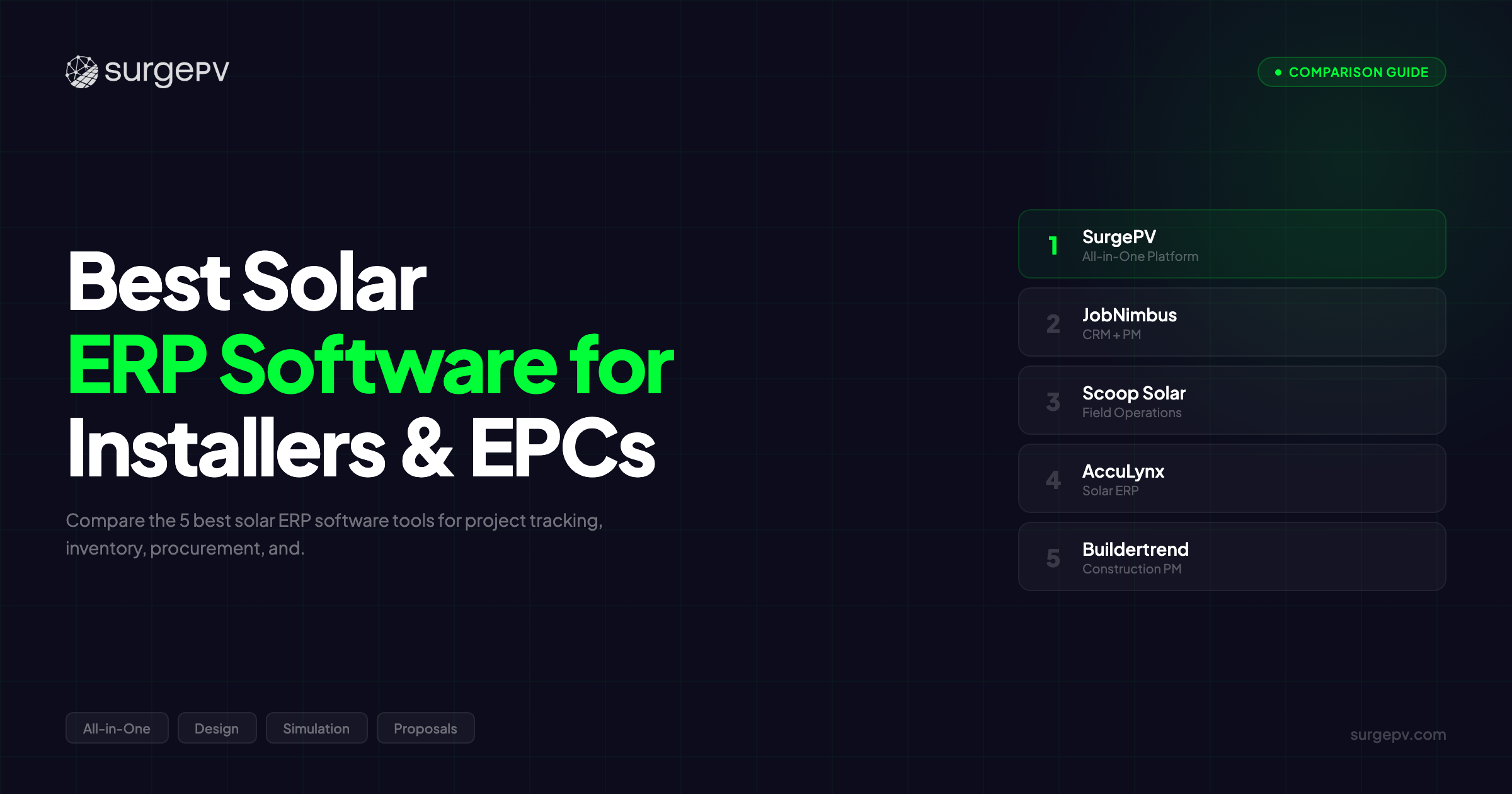
TL;DR: Solar installers juggling spreadsheets for project tracking, inventory, and accounting lose 10-15 hours per week on administrative tasks that ERP software automates. SurgePV combines design and project management in one platform at $1,899/year for 3 users. JobNimbus leads for residential roofing-to-solar workflow integration. Scoop Solar delivers field operations management for commercial EPCs. AccuLynx dominates roofing contractor workflow with strong solar add-ons. Buildertrend provides general contractor ERP with solar project support.
Solar Companies Are Drowning in Administrative Chaos
A mid-size solar installer with 200 projects per year touches 15-20 different tools to manage their business. One platform for design. Another for proposals. A third for project management. Spreadsheets for inventory. QuickBooks for accounting. Email threads for scheduling. WhatsApp groups for field communication.
The result: data lives in silos. When a project manager needs to check whether panels arrived for Thursday’s install, they open the inventory spreadsheet. When accounting needs to invoice a completed job, they email the project manager for completion status. When the CEO wants to know monthly revenue, the office manager spends half a day pulling data from five sources into a dashboard that is already outdated by the time it is finished.
Enterprise Resource Planning (ERP) software solves this by centralizing project tracking, inventory management, procurement, scheduling, accounting integration, and reporting in one system. For solar software companies scaling past 100 installations per year, ERP is not optional. It is the difference between growing profitably and growing into chaos.
The challenge for solar businesses is that most ERP platforms were built for general construction, manufacturing, or enterprise companies. They require months of customization to handle solar-specific workflows: permit tracking, AHJ compliance, interconnection applications, equipment procurement cycles, and design-to-install handoff. Solar-specific ERP tools eliminate that customization by building industry workflows into the platform.
We tested the top ERP and project management platforms used by solar installers and EPCs. We evaluated project tracking capabilities, inventory management, procurement workflows, accounting integration, field team coordination, and total cost of ownership.
In this guide, you will learn:
- Which 5 ERP platforms work best for solar installation companies
- How solar-specific ERP differs from generic construction management tools
- Why design-to-project integration eliminates the biggest handoff bottleneck
- What to look for in inventory management for solar equipment procurement
- How accounting integration reduces month-end close from days to hours
- Our recommendation by company size and project volume
Quick Comparison: 5 Best Solar ERP Software Tools
| Feature | SurgePV | JobNimbus | Scoop Solar | AccuLynx | Buildertrend |
|---|---|---|---|---|---|
| Best For | Design + project management | Residential roofing-solar | Commercial field operations | Roofing contractors adding solar | General contractor ERP |
| Solar-Specific | Yes (design-native) | Partial (solar add-on) | Yes (solar workflows) | Partial (roofing-first) | No (general construction) |
| Project Tracking | Design-to-install pipeline | Board + list views | Field workflow automation | Stage-based pipeline | Gantt + calendar |
| Inventory | BOM-integrated | Basic materials | Equipment tracking | Material ordering | Purchase orders |
| Accounting | QuickBooks integration | QuickBooks, Xero | QuickBooks | QuickBooks | QuickBooks, Xero |
| Proposals | Integrated design-to-proposal | Basic templates | No | Templates | Estimates + change orders |
| Field App | Cloud access | Mobile app | Mobile-first | Mobile app | Mobile app |
| Price/Year | $1,899 (3 users) | $2,400+ (per user) | Custom pricing | Custom pricing | $4,788+ (3 users) |
| Our Rating | 9.0/10 | 8.5/10 | 8.3/10 | 8.0/10 | 7.6/10 |
Quick verdict: For solar companies wanting design and project management in one workflow, SurgePV eliminates the handoff gap between design teams and operations. For residential roofing companies expanding into solar, JobNimbus provides the smoothest transition. For commercial EPCs needing field operations control, Scoop Solar delivers. For roofing contractors adding solar as a product line, AccuLynx integrates both trades. For general contractors with solar as one division among many, Buildertrend covers the full business.
See how SurgePV connects design to project execution. Book a free demo.
What to Look for in Solar ERP Software
Before comparing platforms, understand the six capabilities that separate solar-specific ERP from generic project management tools.
Project Pipeline and Tracking
Solar projects follow a unique lifecycle: lead qualification, site survey, design, proposal, contract, permitting, procurement, installation, inspection, interconnection, and monitoring. Generic project management tools track tasks. Solar ERP tracks the full lifecycle with stage-specific workflows.
The best platforms visualize your pipeline from lead to interconnection. You should see how many projects are in design, how many are waiting for permits, how many are scheduled for install, and how many are stuck in inspection. That visibility prevents bottlenecks before they stall revenue.
Inventory and Procurement Management
Solar equipment procurement has unique challenges. Panels, inverters, and racking ship on different timelines. Tariff changes affect pricing overnight. Warehouse space for staging projects requires careful coordination.
Solar ERP connects your bill of materials (BOM) from design directly to procurement. When a designer finalizes a 10 kW residential system, the BOM auto-populates with panels, inverters, racking, wiring, and disconnects. Procurement knows exactly what to order before the design review meeting ends.
Accounting Integration
Most solar installers run QuickBooks or Xero for bookkeeping. ERP platforms that sync project milestones with accounting automate invoice generation: deposit at contract signing, progress payment at rough-in, final payment at inspection pass.
Without integration, your office manager manually creates invoices in QuickBooks by cross-referencing project status in your project management tool. With integration, the system triggers invoices automatically when projects hit billing milestones.
Scheduling and Resource Allocation
Installation crews are your most expensive resource. A 4-person crew costs $2,000-3,000 per day in labor. If they show up to a site and materials have not arrived, you lose a full day of productive time.
Solar ERP coordinates crew schedules with material delivery timelines, permit approvals, and inspection windows. The best platforms flag scheduling conflicts: “Crew A is assigned to two jobs on Thursday” or “Materials for Project #247 will not arrive until Monday but install is scheduled Friday.”
Permitting and Compliance Tracking
Solar permitting involves AHJ-specific requirements, inspection scheduling, interconnection applications, and utility coordination. Each jurisdiction has different forms, timelines, and approval processes.
ERP platforms with permitting modules track which permits are submitted, which are approved, which need corrections, and which inspections are scheduled. That tracking prevents the most common solar project delay: a permit correction that sits in someone’s inbox for two weeks because nobody tracked it.
Reporting and Business Intelligence
At scale, solar companies need visibility into operational metrics: average days from contract to install, permit approval rates by jurisdiction, crew productivity by team, material cost trends, and revenue per project.
Solar ERP platforms with built-in reporting generate these metrics without requiring manual data export to Excel. The best dashboards update in real time, showing project pipeline value, monthly installation capacity, and cash flow projections.
Top 5 Solar ERP Software Platforms for 2026
SurgePV — Best for Design-to-Project Integration
Rating: 9.0/10 | Price: $1,899/year (3 users) | Book a demo | See pricing
SurgePV is a cloud-based solar design software platform that extends beyond design into project management, making it the only tool where a project starts in design and flows into operations without switching platforms.
Why SurgePV works as solar ERP:
The platform’s core strength is eliminating the handoff gap between design and operations. When a designer completes a system in SurgePV, the project data, including BOM, system specs, simulation results, and proposal details, carries forward into project tracking. No re-entry. No data silos. No “which version of the BOM is correct?” arguments between design and procurement.
SurgePV’s project dashboard shows every active project with its current stage, assigned team members, and key dates. The design-to-install pipeline gives operations managers visibility into what is coming: how many designs are awaiting customer approval, how many contracts are signed and ready for permitting, and how many projects are install-ready.
The platform generates automated BOMs from designs. When a designer finalizes a 250 kW commercial rooftop, SurgePV outputs the complete equipment list with quantities, specifications, and manufacturer part numbers. Procurement teams use this directly for ordering, eliminating the spreadsheet-based BOM process that introduces errors and delays.
SurgePV integrates with QuickBooks for accounting synchronization. Project milestone completions trigger financial events, keeping your books aligned with operational reality.
What SurgePV does not do (yet):
SurgePV is not a full-featured ERP in the traditional sense. It does not replace dedicated inventory warehouse management systems for companies with complex multi-warehouse operations. It does not offer HR or payroll modules. And its field scheduling capabilities, while functional, are simpler than purpose-built field service tools like Scoop Solar.
For solar companies where the design-to-operations handoff is the biggest bottleneck, SurgePV eliminates that gap better than any other platform. For companies needing deep warehouse management or complex multi-trade scheduling, pair SurgePV with a dedicated operations tool.
Pros:
- Design, simulation, and project management in one platform
- Automated BOM generation from designs (eliminates manual data entry)
- P50/P75/P90 bankable reports carry forward into project documentation
- Automated SLD generation reduces electrical engineering time
- Cloud-based collaboration across design and operations teams
- QuickBooks integration for accounting synchronization
- Transparent pricing: $1,899/year for 3 users, all features included
- 2-3 week onboarding for full platform
Cons:
- Not a traditional full-featured ERP (no HR, payroll, complex warehouse management)
- Field scheduling simpler than dedicated field service platforms
- CRM integrations still developing (API available but not native Salesforce)
- Best suited for companies where design-to-operations flow is the primary need
Best for: Solar installers and EPCs (50-500 projects/year) wanting to eliminate the design-to-operations handoff gap with integrated BOM generation, project tracking, and accounting synchronization in one platform.
Compare SurgePV’s integrated workflow to your current tools. Schedule a demo.
JobNimbus — Best for Residential Roofing-to-Solar Workflow
Rating: 8.5/10 | Price: $2,400+/year (per user) | JobNimbus
JobNimbus is a project management and CRM platform popular with roofing contractors that has expanded into solar workflow support. For residential roofing companies adding solar as a product line, JobNimbus provides familiar project management with solar-specific workflow additions.
Why JobNimbus works for roofing-solar companies:
The platform’s board and list views let teams visualize projects across customizable stages. A roofing-solar company can set up separate pipelines for roof replacements and solar installations, or combine them into a single roof-plus-solar pipeline where the roofing phase feeds directly into the solar phase.
JobNimbus handles contact management, lead tracking, and sales pipeline alongside project execution. When a roofing lead mentions solar interest, the sales team creates a combined project that tracks both scopes through to completion.
The mobile app is well-designed for field teams. Crews upload completion photos, update project status, and capture signatures from the job site. Office staff see real-time updates without calling or texting crews for status checks.
JobNimbus integrates with QuickBooks and Xero for accounting. Invoice templates map to project milestones, automating the billing cycle for completed work.
Where JobNimbus falls short for pure solar companies:
JobNimbus was built for roofing first. Solar-specific features like permit tracking, AHJ compliance workflows, interconnection management, and equipment-specific BOM generation are either basic or require manual customization.
There is no design integration. Solar designs created in Aurora Solar, SurgePV, or any design tool must be manually linked to JobNimbus projects. BOM data does not flow automatically, it is re-entered manually or attached as documents.
Pricing is per-user, which scales quickly. A 10-person team at $200/month per user costs $24,000/year, significantly more than SurgePV’s $1,899/year for 3 users.
Pros:
- Strong project management with board and list views
- Excellent mobile app for field crews
- CRM and sales pipeline built in
- QuickBooks and Xero integration
- Well-suited for roofing companies adding solar
- Customizable workflow stages
- Good customer support and onboarding
Cons:
- Not solar-native (roofing-first platform)
- No design integration (manual BOM transfer from design tools)
- Per-user pricing scales quickly ($2,400+/year per user)
- Solar permitting and interconnection tracking is basic
- No automated SLD or electrical documentation
- No energy simulation or production estimates
Best for: Residential roofing companies expanding into solar installations who want one platform for both trades with strong CRM, project management, and field team coordination.
Scoop Solar — Best for Commercial Field Operations
Rating: 8.3/10 | Price: Custom pricing (contact sales) | Scoop Solar
Scoop Solar is a field operations management platform built specifically for solar and clean energy companies. For commercial EPCs managing multiple crews across multiple job sites with complex installation workflows, Scoop provides the operational depth that generic project management tools lack.
Why Scoop Solar works for commercial EPCs:
The platform is built around “Scoops,” which are customizable digital work orders that capture every detail a field crew needs: site information, equipment lists, installation procedures, safety checklists, photo documentation requirements, and quality assurance steps.
For a commercial EPC running 50-100 installations per year with 5-10 field crews, Scoop coordinates who goes where, with what equipment, following which procedures. When a crew arrives at a job site, they open their Scoop and have everything needed: site access instructions, equipment delivery confirmation, installation sequence, and inspection requirements.
Scoop’s workflow automation triggers actions based on project status changes. When a crew marks rough-in complete, the system automatically schedules the electrical inspection and notifies the office team to prepare inspection documents.
The platform tracks field team productivity: time on site, tasks completed, rework rates, and completion quality scores. Operations managers can identify which crews consistently finish ahead of schedule and which need additional training or support.
Where Scoop Solar needs complementary tools:
Scoop does not do solar design. It does not generate proposals. It does not handle accounting. It is a field operations layer that sits between your design platform and your accounting system.
For solar companies, the typical stack is: design in SurgePV or Aurora Solar, manage field operations in Scoop, handle accounting in QuickBooks. Scoop connects those pieces but does not replace them.
Pricing is custom and requires a sales conversation, which makes cost comparison difficult for smaller companies evaluating options.
Pros:
- Purpose-built for solar field operations (not adapted from another industry)
- Customizable digital work orders with photo documentation
- Workflow automation reduces manual coordination
- Field team productivity tracking and quality scoring
- Good for multi-crew, multi-site commercial operations
- Integration with design and accounting tools via API
Cons:
- Not a complete ERP (no design, proposals, or accounting)
- Custom pricing (not transparent for evaluation)
- Requires complementary tools for full business management
- Better suited for commercial scale (overkill for small residential installers)
- Learning curve for workflow customization (2-4 weeks)
Best for: Commercial solar EPCs managing 50+ installations per year with multiple field crews who need operational coordination, quality control, and field productivity tracking beyond what generic project management tools provide.
AccuLynx — Best for Roofing Contractors Adding Solar
Rating: 8.0/10 | Price: Custom pricing (contact sales) | AccuLynx
AccuLynx is a business management platform built for roofing contractors with solar workflow extensions. For roofing companies where solar represents 20-40% of revenue alongside traditional roofing work, AccuLynx manages both trades in one system.
Why AccuLynx works for roofing-solar contractors:
The platform handles the full roofing business lifecycle: lead management, aerial measurements (integrated with EagleView and SRS), material ordering, crew scheduling, production tracking, and job costing. Solar workflows layer on top, adding permit tracking, equipment ordering, and solar-specific project stages.
AccuLynx’s material ordering integration is particularly strong. The platform connects directly to ABC Supply, SRS Distribution, and other major roofing distributors for automated ordering. For solar equipment, ordering workflows can be customized to match distributor processes.
Job costing tracks profitability by project, showing material costs, labor costs, subcontractor costs, and overhead allocation. For roofing-solar companies running thin margins, knowing which jobs make money and which do not is essential for pricing future bids.
The platform includes basic CRM, estimating, and contract management. Sales teams manage leads, create estimates, and generate contracts without switching platforms.
Where AccuLynx limits solar-specific companies:
AccuLynx is roofing-first. Solar features are additions to a roofing platform, not native solar workflows. Permit tracking for solar AHJs, interconnection application management, and solar-specific inspection scheduling are basic compared to solar-native tools.
No design integration exists. Solar designs from external tools are attached as documents, not integrated into the project workflow. BOM generation is manual.
The platform does not generate solar proposals with energy production estimates, ROI calculations, or financing options. Solar sales teams need a separate proposal tool.
Pros:
- Strong roofing + solar dual-trade management
- Material ordering integrated with major distributors
- Job costing and profitability tracking by project
- CRM, estimating, and contract management included
- Good mobile app for field crews
- Established platform with strong customer base
Cons:
- Roofing-first platform (solar is an add-on, not native)
- No solar design integration
- No energy production estimates or solar proposals
- Solar permitting and interconnection tracking is basic
- Custom pricing (not transparent)
- Less relevant for pure solar companies
Best for: Roofing contractors where solar is a growing product line (20-40% of revenue) who need one platform managing both roofing and solar operations, material ordering, and job costing.
Buildertrend — Best General Contractor ERP with Solar Support
Rating: 7.6/10 | Price: $4,788+/year (3 users) | Buildertrend
Buildertrend is a construction management platform serving general contractors, home builders, remodelers, and specialty contractors including solar installers. For companies where solar installation is one service among general construction, roofing, electrical, and HVAC, Buildertrend provides broad construction ERP with solar project support.
Why Buildertrend works for general contractors with solar divisions:
The platform covers construction management end to end: pre-construction (estimates, proposals, contracts), project management (scheduling, daily logs, to-dos, change orders), financial management (budgets, purchase orders, invoices), and customer management (client portal, selections, warranty tracking).
Buildertrend’s Gantt chart scheduling is among the best in construction software. For solar projects with multiple phases (design approval, permitting, procurement, installation, inspection, interconnection), Gantt views show dependencies and critical path items clearly.
The customer portal lets homeowners track project progress, approve change orders, make selections, and view documents without calling your office. For residential solar, this reduces the “when is my install happening?” phone calls that consume staff time.
Buildertrend integrates with QuickBooks and Xero. Purchase orders flow from project budgets to accounting. Invoice generation aligns with project milestones.
Where Buildertrend misses for solar-focused companies:
Buildertrend was built for general construction. It knows nothing about solar-specific workflows: AHJ permitting requirements, interconnection applications, utility coordination, NEC compliance, equipment-specific BOM generation, or energy production estimation.
Solar companies using Buildertrend must customize the platform extensively to match solar project lifecycles. That customization takes 4-8 weeks and requires ongoing maintenance as solar workflows evolve.
Pricing starts at $399/month for 3 users ($4,788/year), more than double SurgePV’s pricing. Additional users increase the cost further. For solar companies with 5-10 office staff, Buildertrend costs $8,000-15,000/year.
No design integration. No solar proposals with production estimates. No solar-specific reporting (permit approval rates, interconnection timelines, production per installed kW).
Pros:
- Comprehensive construction management (pre-con through warranty)
- Strong Gantt scheduling with dependency tracking
- Customer portal reduces homeowner communication overhead
- QuickBooks and Xero accounting integration
- Good for multi-trade general contractors
- Established platform with large user base
Cons:
- Not solar-specific (requires extensive customization for solar workflows)
- No solar design integration
- No energy production estimates or solar-specific proposals
- Expensive ($4,788+/year for 3 users, scales higher with more users)
- 4-8 week customization for solar workflow setup
- Solar permitting, interconnection, and compliance tracking absent by default
Best for: General contractors or multi-trade companies where solar is one division among many (roofing, electrical, HVAC) who need a single construction ERP platform covering all trades with customizable workflows.
Solar ERP Software Comparison Table
| Feature | SurgePV | JobNimbus | Scoop Solar | AccuLynx | Buildertrend |
|---|---|---|---|---|---|
| Solar-Specific | Yes (design-native) | Partial | Yes | Partial | No |
| Design Integration | Native | None | None | None | None |
| BOM from Design | Automated | Manual | Manual | Manual | Manual |
| Project Pipeline | Design-to-install | Board + list | Work orders | Stage pipeline | Gantt + calendar |
| Inventory | BOM-integrated | Basic | Equipment | Distributor ordering | Purchase orders |
| Permitting | Supported | Basic | Workflow-based | Basic | Manual customization |
| Accounting | QuickBooks | QuickBooks, Xero | QuickBooks | QuickBooks | QuickBooks, Xero |
| Proposals | Integrated | Templates | No | Templates | Estimates |
| Mobile App | Cloud browser | Native app | Native app | Native app | Native app |
| Crew Scheduling | Basic | Good | Strong | Good | Strong (Gantt) |
| Job Costing | BOM-based | Yes | Yes | Yes (strong) | Yes |
| Price/Year | $1,899 (3 users) | $2,400+ per user | Custom | Custom | $4,788+ (3 users) |
| Best For | Design + operations | Roofing-solar | Commercial field ops | Roofing + solar | Multi-trade GC |
Pricing notes: SurgePV includes design, simulation, proposals, and project management at $1,899/year for 3 users. JobNimbus charges per user ($200+/month). Buildertrend starts at $399/month for 3 users. AccuLynx and Scoop Solar require sales conversations for pricing.
Decision Shortcut: Which Solar ERP Should You Choose?
| Your Situation | Recommended Tool | Why |
|---|---|---|
| Solar company wanting design + project management in one platform | SurgePV | Only tool with native design-to-operations workflow and automated BOM |
| Roofing company adding solar as a product line | JobNimbus | Best roofing-to-solar transition with strong CRM and field app |
| Commercial EPC with multiple field crews | Scoop Solar | Purpose-built field operations management for solar at scale |
| Roofing contractor where solar is 20-40% of revenue | AccuLynx | Dual-trade management with material ordering integration |
| General contractor with solar as one division | Buildertrend | Broad construction ERP covering all trades |
| Small residential installer (under 50 projects/year) | SurgePV | All-in-one design and project management at lowest total cost |
Our Testing Methodology
We evaluated each platform across six criteria weighted by importance to solar installation businesses:
- Solar-specific functionality (25%): Does the platform understand solar project lifecycles, permitting, interconnection, and equipment management natively?
- Design integration (20%): Does the platform connect to solar design tools, auto-generate BOMs, and carry project data from design through installation?
- Project tracking (20%): Can operations managers see pipeline status, crew schedules, and bottlenecks in real time?
- Accounting integration (15%): Does the platform sync with QuickBooks or Xero for automated invoicing and financial reporting?
- Ease of use (10%): How long does it take to onboard a team and reach productive use?
- Total cost of ownership (10%): What is the all-in annual cost including per-user fees, add-ons, and required complementary tools?
We ran test projects through each platform simulating a residential solar install (10 kW rooftop) and a commercial project (250 kW flat roof) to evaluate workflow completeness, data handoff quality, and time savings compared to spreadsheet-based management.
Bottom Line
Solar ERP is about eliminating the administrative overhead that scales linearly with project volume. At 50 projects per year, spreadsheets are painful but survivable. At 200 projects per year, they break.
The right ERP depends on where your business sits:
For solar-focused companies wanting design and operations in one platform: SurgePV’s integrated workflow eliminates the design-to-operations handoff, automated BOM generation, and project tracking at $1,899/year for 3 users.
For roofing companies adding solar: JobNimbus and AccuLynx provide dual-trade management without forcing a platform switch from your existing roofing workflow.
For commercial EPCs at scale: Scoop Solar’s field operations management coordinates multiple crews, tracks quality, and automates work order workflows that generic tools cannot match.
For multi-trade general contractors: Buildertrend covers the full construction business, though solar-specific customization takes effort and the platform costs more than solar-native alternatives.
The bottom line: choose a platform that matches your primary business model. If solar is your business, choose a solar-native platform. If solar is one product line among many, choose a platform that handles all your trades. For related workflow comparisons, see our guides to the best solar O&M software and best solar estimating software.
Start managing solar projects from design to install. Book your SurgePV demo.
Design, Simulate, and Manage Projects in One Platform
SurgePV connects solar design to project execution, eliminating handoff gaps and manual data entry.
Book a DemoNo commitment required · 20 minutes · Live project walkthrough
Frequently Asked Questions About Solar ERP Software
What is ERP software for solar companies?
ERP (Enterprise Resource Planning) software for solar companies centralizes project tracking, inventory management, procurement, crew scheduling, accounting integration, and business reporting in one platform. Solar-specific ERP includes workflows for AHJ permitting, interconnection applications, equipment-specific BOM management, and design-to-install project pipelines. The goal is eliminating spreadsheet-based management that breaks at scale. Solar software platforms like SurgePV combine design capabilities with project management, while dedicated ERP tools like JobNimbus and Scoop Solar focus on operations and field management.
Do solar installers need ERP software or is project management enough?
Project management tools like Trello or Asana track tasks but do not understand solar-specific workflows. Solar ERP adds industry-specific capabilities: permit tracking with AHJ-specific requirements, equipment procurement with BOM integration, crew scheduling aligned with material delivery and inspection windows, and accounting integration triggered by project milestones. If you manage fewer than 50 projects per year, basic project management tools may suffice. Above 100 projects per year, solar-specific ERP saves 10-15 hours per week in administrative time by automating handoffs that manual processes cannot scale.
Can SurgePV replace a standalone ERP system?
SurgePV combines solar design software with project management, automated BOM generation, and accounting integration. For solar companies where the design-to-operations handoff is the primary bottleneck, SurgePV replaces the need for a separate ERP by keeping project data in one platform from design through installation. Companies with complex multi-warehouse inventory, HR and payroll needs, or multi-trade operations beyond solar may still need complementary tools. Book a demo to evaluate whether SurgePV covers your specific operational requirements.
How much does solar ERP software cost?
Pricing varies by platform and company size. SurgePV costs $1,899/year for 3 users with design and project management included. JobNimbus charges $200+/month per user ($2,400+/year per user). Buildertrend starts at $399/month for 3 users ($4,788/year). AccuLynx and Scoop Solar require custom quotes. Total cost of ownership should include per-user fees, required add-ons, integration costs, and onboarding time. SurgePV offers the lowest total cost for solar companies needing both design and project management capabilities.
What accounting software integrates with solar ERP?
Most solar ERP platforms integrate with QuickBooks, the most common accounting tool for solar installers. JobNimbus and Buildertrend also integrate with Xero. Integration depth varies: some platforms sync invoice data only, while others synchronize project milestones, purchase orders, and payment schedules. SurgePV’s QuickBooks integration connects project completion events with invoice generation, reducing manual bookkeeping. For companies using enterprise accounting systems (NetSuite, Sage), API access or middleware tools like Zapier can bridge the gap.