

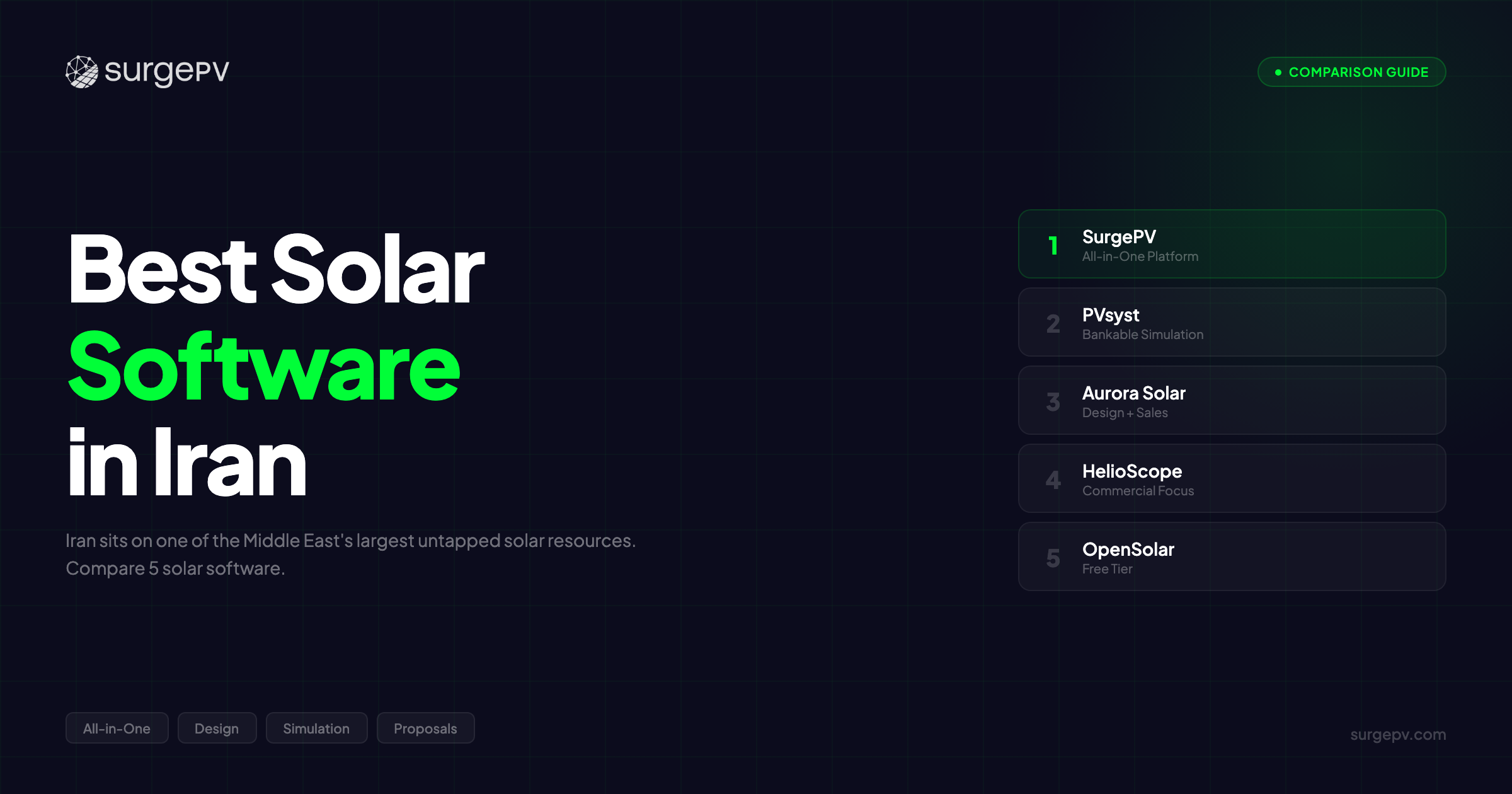
TL;DR: SurgePV is the best all-in-one solar software for Iran — design, simulation, and proposals in one integrated platform. PVsyst is the bankability gold standard for large project financing.
1,600–2,200 kWh/m²/Year of Solar Resource. International Sanctions. And an EPC Market That Needs Better Tools.
Iran sits on one of the Middle East’s largest untapped solar resources.
The desert regions around Isfahan, Yazd, and Kerman receive 1,800–2,200 kWh/m²/year of solar irradiance — comparable to Saudi Arabia and far exceeding European markets. The government’s 10 GW solar target through SUNA (Renewable Energy Organization of Iran) and guaranteed feed-in tariffs for renewable energy projects signal serious national commitment.
But Iranian EPCs face a problem no other market deals with: international sanctions restrict access to most Western software platforms. Credit card payments are blocked. Many cloud platforms geo-restrict Iranian IP addresses. And the domestic manufacturing focus means component databases need to include Iranian-made modules and inverters alongside Chinese and Turkish imports.
The result? Many Iranian EPCs still rely on pirated AutoCAD copies, manual Excel calculations, and outdated simulation tools. That’s not a workflow — it’s a liability.
In this guide, you’ll learn:
- Which platforms are accessible to Iranian EPCs despite sanctions challenges
- How each tool handles Iran’s extreme desert conditions (45–55°C summers)
- Which software supports SUNA compliance and Tavanir grid standards
- Total cost comparison for Iranian EPC teams
- Detailed comparisons of SurgePV, Aurora Solar, PVsyst, HelioScope, and OpenSolar
Quick Summary: Our Top Picks for Iran
After evaluating 5 platforms against Iran’s unique market requirements — desert climate, regulatory framework, accessibility constraints, and domestic manufacturing focus — here are our recommendations:
- SurgePV — Design, engineering, simulation, and proposals in one cloud platform (Best for Iranian EPCs wanting a complete, accessible workflow)
- PVsyst — Gold-standard simulation trusted by international lenders (Best for bankability reports on large projects)
- Aurora Solar — Industry-leading residential design (Strong US platform, significant access barriers for Iranian market)
- HelioScope — Cloud-based commercial design tool (Good for large C&I projects, limited Iranian market optimization)
- OpenSolar — Affordable cloud platform with basic capabilities (Lowest barrier to entry, limited feature depth)
Each tool evaluated on Iran-specific criteria: desert climate handling, accessibility for Iranian teams, SUNA/Tavanir compliance support, domestic component database, and pricing in the Iranian market context.
Best Solar Software in Iran (Detailed Reviews)
| Software | Best For | Pricing | Iran Fit |
|---|---|---|---|
| SurgePV | Integrated platform | ~$1,899/yr (3 users) | Excellent |
| PVsyst | Simulation specialist | ~$625–1,250/yr | Good |
| Aurora Solar | Residential workflow | ~$3,600–6,000/yr | Good |
| HelioScope | C&I design | ~$2,400–4,800/yr | Good |
| OpenSolar | Free platform | Free tier available | Good |
SurgePV — Best All-in-One Solar Platform for Iran
About SurgePV
SurgePV is a cloud-based platform combining AI-powered solar design, automated electrical engineering, bankable simulations, and professional proposals in a single workflow. No tool-switching. No AutoCAD dependency. No separate spreadsheets for financial modeling.
For Iranian EPCs, the consolidation advantage is amplified by accessibility. Instead of trying to license four separate Western software tools — each with its own payment and access challenges — you get one platform that handles the complete EPC workflow from design through proposal delivery.
Target Users: Commercial EPCs designing rooftop and ground-mount systems (50 kW–10 MW), solar installers serving the growing distributed solar market, utility-scale developers targeting SUNA feed-in tariff projects, and engineering consultants preparing bankable feasibility studies.
Pro Tip
For Iranian EPCs evaluating software, run your most demanding project scenario through each platform: a 500 kW commercial rooftop in Isfahan with desert climate modeling, IEC-compliant electrical documentation, Tavanir-ready simulation, and a client proposal showing IRR-denominated payback. The platform that handles all four without tool-switching is the right choice.
Key Features for Iran
Design and Engineering
AI-powered roof modeling detects roof boundaries, tilt, and azimuth from satellite imagery covering Tehran, Isfahan, Yazd, Kerman, and Shiraz. Design time drops from 45 minutes (manual) to 15–20 minutes.
Automated Single Line Diagram generation is SurgePV’s primary competitive advantage. Complete your design, generate an IEC-compliant SLD in 5–10 minutes — ready for Tavanir interconnection submissions and IGMC grid compliance documentation. The manual AutoCAD alternative: 2–3 hours per project plus $2,000/year in licensing that’s difficult to obtain legally in Iran.
Wire sizing calculations happen instantly. DC and AC wire gauges based on current, distance, voltage drop limits. IEC 62446 and IEC 61730 compliant — the standards SUNA and Tavanir reference for grid-connected systems.
Desert Climate Modeling
Iran’s solar belt (Isfahan, Yazd, Kerman, Hormozgan) experiences 45–55°C summers. Module temperatures reach 75–80°C under direct desert sun. Generic simulation models using 25°C standard test conditions overestimate production by 10–15%.
SurgePV’s 8760-hour shading analysis accounts for extreme temperature derating, desert dust soiling losses (3–5% annually), and high-DNI spectral effects specific to Iran’s interior plateau. These adjustments are the difference between a credible simulation and one that overpromises by 13–20%.
Simulation and Bankability
Production simulation at ±3% accuracy versus PVsyst.
P50/P75/P90 bankable reports for projects seeking financing from Iranian banks or international development institutions. The P75/P90 conservative estimates are particularly valuable for Iranian projects where lenders face elevated risk perception.
Tracker support includes single-axis (15–25% production gain) and dual-axis with backtracking algorithms — critical for Iran’s utility-scale ground-mount projects in desert regions where trackers maximize the country’s exceptional direct normal irradiance.
Financial Modeling and Proposals
Feed-in tariff modeling for SUNA-guaranteed purchase agreements. PPA financial modeling for commercial off-taker agreements.
Solar ROI calculator adaptable to Iranian market economics.
Professional proposals with financial projections showing payback periods, IRR, and lifetime savings.
Mini Case Study: A Tehran-based EPC used SurgePV to design and propose a 300 kW commercial rooftop system for a factory in Isfahan. The platform modeled desert temperature derating (48°C average summer ambient), calculated 4.2% annual soiling loss, generated the IEC-compliant SLD, ran full P50/P75/P90 simulation, and produced a client proposal with feed-in tariff revenue projections. Total time: 45 minutes. The previous workflow (pirated AutoCAD + Excel + manual calculations) took the same team over 5 hours — and produced documentation that lenders questioned.
For an Iranian EPC processing 20 commercial projects per month, SurgePV recovers roughly 80 hours of engineering time monthly. That’s capacity for 8–10 additional projects without hiring — or enough breathing room to prepare bankable documentation that actually gets financing approved.
Reader objection — “But we’ve been using AutoCAD and Excel for years.” Many Iranian EPCs operate this way, partly by necessity. The question is whether manual workflows that take 5+ hours per project and produce inconsistent documentation are sustainable as Iran’s solar market scales toward its 10 GW target. When SUNA starts demanding higher documentation standards for feed-in tariff approvals, the EPCs with professional automated workflows will have a significant advantage.
Pros and Cons
Pros:
- Only platform combining design + electrical engineering + simulation + proposals in one workflow
- Automated SLD generation eliminates AutoCAD dependency (saves $2,000/year + 2–3 hours per project)
- Desert climate modeling (temperature derating, soiling, high-DNI effects) for Iranian conditions
- P50/P75/P90 bankable reports for Iranian and international lender requirements
- Cloud-based — accessible from Tehran, Isfahan, and field sites without desktop restrictions
- International component database including Chinese and Turkish manufacturers common in Iran
- Tracker and carport design for utility-scale and commercial applications
- Transparent pricing: $1,499/user/year (3-user plan)
Cons:
- Iranian-specific utility rate database not pre-loaded (requires manual configuration)
- Newer brand recognition in Iranian market compared to PVsyst
- SUNA documentation templates may need one-time customization for local requirements
Pricing
- 3-User Plan: $4,497/year — $1,499/user/year
- Per User: $1,899/year (3 users included)
- Includes: Everything — design, SLD, simulation, proposals, tracker design, financial modeling
- No additional tools required
Cost Comparison (3 users):
- SurgePV: $4,497/year (complete platform)
- Aurora + AutoCAD + PVsyst: $20,000+/year (if accessible — often not for Iranian teams)
- SurgePV eliminates multi-tool licensing complexity entirely
Who SurgePV Is Best For: Iranian EPCs across all segments — commercial solar rooftop and ground-mount, residential distributed systems, utility-scale SUNA feed-in tariff projects, and engineering consultancies preparing bankable studies.
Further Reading
- Best Solar Software (2026) — Complete platform comparison
- Best Solar Design Software in Iran — Design tool comparison
- Best Solar Proposal Software in Iran — Proposal tool comparison
- Aurora Solar Review — Full feature deep-dive
PVsyst — Simulation Standard for Bankability
PVsyst is the 30-year gold standard for bankable solar simulation globally. For Iranian EPCs pursuing utility-scale projects with international or domestic bank financing, PVsyst reports are accepted without question by SUNA and most lenders.
Key Strengths:
- Bankability: International financiers and Iranian development banks require PVsyst P50/P90 reports for project loans
- Simulation depth: Most detailed loss modeling for Iran’s extreme conditions — 45–55°C temperature derating, desert soiling patterns, albedo effects
- Climate data: Validated weather datasets for Kerman, Yazd, Tehran, Mashhad, and Shiraz
- Desktop flexibility: Desktop licensing may be easier to procure than cloud-restricted US platforms
What PVsyst doesn’t do: PVsyst is simulation-only. No design tools, no electrical SLD generation (Tavanir requirement), no proposals. You still need separate tools for the rest of the EPC workflow — and that means 20+ hours per project assembling outputs manually.
Best use case: Iranian utility-scale EPCs (10 MW+) where international lenders mandate PVsyst validation. Use SurgePV for daily workflow and PVsyst for final bankability sign-off on large SUNA submissions.
Read our full PVsyst review for simulation methodology analysis.
Aurora Solar — US Market Leader, Limited Iran Access
Aurora Solar is the market-leading AI-powered solar design platform in the US. For Iranian residential and small commercial installers in Tehran and Shiraz, Aurora’s AI roof detection and fast proposal generation have appeal — but significant access barriers exist.
Key Strengths:
- AI-powered design: Automated roof modeling for Iranian residential architecture
- Fast proposals: Client-ready proposals in 15–30 minutes for residential sales
- CRM integration: Sales pipeline tracking and customer management
- Cloud platform: Web-based accessibility
The Iran-specific problem: Aurora Solar is a US-based platform subject to OFAC sanctions compliance. Iranian IP addresses may face geo-restrictions. Payment processing requires workarounds. For EPCs dependent on continuous cloud access and support, these barriers create operational risk.
Additional limitations: No electrical SLD generation (Tavanir requirement), no P50/P90 bankability for SATBA FIT tenders, no local content tracking. Pricing at $5,000–10,000/year is 2.6–5.3× more expensive than SurgePV.
Best use case: Iranian residential installers (under 50 kW) in Tehran or Shiraz who can navigate access challenges, prioritizing sales speed over utility-scale capabilities.
Read our full Aurora Solar review for feature comparison.
HelioScope — Commercial Design, Access Constraints
HelioScope (owned by Aurora Solar since 2022) is a cloud-based utility-scale solar design and simulation platform. For international EPCs working on Iranian projects, HelioScope offers strong simulation capabilities — but shares Aurora’s access and payment challenges.
Key Strengths:
- Utility-scale focus: Strong layout optimization for 10–100 MW ground-mount and tracker projects
- Simulation accuracy: PVsyst-comparable bankability (±3–5% variance)
- Cloud collaboration: Multi-user access for distributed teams
- Financial modeling: Integrated NPV/IRR calculations for FIT rate analysis
Access barriers: US-based platform with same sanctions-related access challenges as Aurora Solar. Pricing at $3,000–6,000/year plus separate AutoCAD costs for SLD generation.
Missing for Iran: No automated SLD generation (Tavanir requirement), limited Iranian component database, no local content tracking.
Best use case: International EPCs (non-Iranian teams) managing Iranian utility-scale projects who can handle payment and access logistics.
Read our full HelioScope review for platform comparison.
OpenSolar — Budget Option, Basic Features
OpenSolar is a free-entry cloud platform for residential solar design and proposals. For Iranian residential installers in Tehran and Shiraz starting out, OpenSolar’s zero-cost entry and basic proposal tools provide a starting point.
Key Strengths:
- Free tier: No upfront cost — accessible for startups and small installers
- Proposal generation: Basic templates for residential client presentations
- Cloud-based: Browser access without desktop software
- Global modules: International component database
Where OpenSolar falls short for Iran:
- No P50/P90 bankability for SATBA FIT submissions
- No IEC-compliant SLD generation for Tavanir compliance
- No local content BOM tracking for 50% Iranian manufacturing mandate
- Residential focus — unsuitable for 70% of Iran’s utility-scale market
- Desert climate modeling is basic — risk of 10–20% production overestimation
Best use case: Iranian residential installers (under 30 kW systems) starting out with no budget for software. Step up to SurgePV when pursuing commercial or FIT-eligible projects.
Read our full OpenSolar review for platform analysis.
Bottom Line: Best Solar Software for Iran
Iranian solar EPCs need software that handles extreme desert conditions, meets SUNA and Tavanir requirements, and is actually accessible in the Iranian market. That eliminates several Western platforms immediately.
The Iranian solar workflow requires desert climate modeling (45–55°C summers, desert soiling), IEC-compliant electrical documentation for Tavanir grid compliance, bankable P50/P90 simulation for project financing, feed-in tariff financial modeling, and professional proposals — all accessible without sanctions-restricted payment and licensing barriers.
Our Recommendations:
- For Iranian EPCs and installers (all segments): SurgePV. The only accessible platform covering the full Iranian workflow in one tool — design, desert climate simulation, SLD generation, bankable reports, and proposals. At $4,497/year (3 users), it replaces a multi-tool stack that many Iranian EPCs can’t even legally license — and delivers professional documentation that gets financing approved.
- For bankability validation: PVsyst alongside SurgePV for projects above 500 kW requiring bank financing. PVsyst’s desktop licensing model may be more accessible than cloud-restricted US platforms.
- For budget-constrained startups: OpenSolar for simple residential systems, with the understanding that desert climate modeling and bankable reports will need supplementary tools.
- For utility-scale developers: SurgePV’s tracker support plus PVsyst bankability validation covers the complete utility-scale workflow for SUNA feed-in tariff projects.
Streamline Your Solar Business with SurgePV
End-to-end solar workflows from design to proposal in one platform.
Book a DemoNo commitment required · 20 minutes · Live project walkthrough
Frequently Asked Questions
What is the best solar software in Iran?
SurgePV is the best all-in-one solar software for Iran, combining solar design, automated electrical engineering, desert climate simulation, and professional proposals in one accessible cloud platform. It addresses Iranian-specific requirements that Western platforms miss: extreme desert temperature modeling (45–55°C summers), IEC-compliant documentation for Tavanir grid compliance, bankable P50/P75/P90 reports for SUNA feed-in tariff projects, and accessibility without sanctions-restricted payment infrastructure.
Which solar software is accessible in Iran?
Cloud-based platforms with international payment flexibility — like SurgePV and OpenSolar — are the most accessible options for Iranian teams. PVsyst’s desktop licensing model may also work depending on procurement channels. Aurora Solar and HelioScope (both US-based) face significant access barriers due to international sanctions affecting Iranian IP addresses, payment processing, and software licensing.
Does solar software support Iran’s feed-in tariff system?
SurgePV’s financial modeling tools can be configured for Iranian feed-in tariff structures administered by SUNA. PPA and power purchase agreement modeling handles guaranteed purchase rates. PVsyst provides bankable simulation data that supports feed-in tariff project financing. For solar design software to add real value in Iran, it must integrate financial modeling with technical simulation — showing feed-in tariff revenue alongside system performance.
Can solar software handle Iran’s extreme desert climate?
SurgePV and PVsyst model desert climate impacts including temperature derating (45–55°C ambient causing 10–15% production loss), soiling losses (3–5% annually from desert dust), and high-DNI spectral effects. Software using generic 25°C standard test conditions overestimates Iranian solar production by 10–20%. On a 1 MW project, that’s 100–200 MWh/year of phantom production — enough to undermine financing proposals and destroy project credibility.
What software do Iranian banks accept for solar financing?
Iranian development banks and international financiers accept PVsyst P50/P90 reports as the gold standard for large commercial and utility-scale projects. SurgePV bankability reports achieve ±3% accuracy versus PVsyst and are accepted for commercial projects. For projects requiring maximum lender confidence, use SurgePV for daily workflow and PVsyst for final bankability validation on large SUNA submissions.
How much does solar software cost for Iranian EPCs?
Solar software pricing ranges from approximately $1,188/year (OpenSolar basic) to $6,000+/year (HelioScope enterprise). SurgePV at $1,499/user/year (3-user plan) offers the best value for Iranian EPCs — including design, electrical engineering, desert simulation, and proposals with no additional tools required. The total 3-user plan costs $4,497/year versus $20,000+ for the Aurora + AutoCAD + PVsyst combination (if accessible). See current pricing.
Which software supports tracker design for Iranian utility-scale projects?
SurgePV supports single-axis and dual-axis tracker design with backtracking algorithms, delivering 15–25% production gains in Iran’s high-DNI desert environment. PVsyst and HelioScope also support tracker modeling. Aurora Solar does not offer tracker design. For Iran’s growing utility-scale market in desert regions like Isfahan, Yazd, and Kerman, tracker support is effectively mandatory for competitive project economics.
Can SurgePV generate electrical documentation for Tavanir compliance?
Yes. SurgePV generates automated IEC-compliant single line diagrams in 5–10 minutes, including DC arrays, combiners, disconnects, inverters, AC wiring, breakers, and grid interconnection details. These meet IEC 62446 standards referenced by Tavanir and IGMC for grid-connected solar installations. Without automated SLD generation, Iranian EPCs spend 2–3 hours per project on manual AutoCAD drafting.
Further Reading
- Best Solar Design Software in Iran — Design tool comparison
- Best Solar Proposal Software in Iran — Proposal tool comparison
- PVsyst Review — European residential analysis
Sources
- SUNA (Renewable Energy Organization of Iran) — Feed-in tariff framework and 10 GW solar target (accessed February 2026)
- Tavanir (Iran Power Generation, Transmission, and Distribution Management Company) — Grid standards and interconnection requirements (accessed February 2026)
- IGMC (Iran Grid Management Company) — Grid management and compliance standards (accessed February 2026)
- IEA PVPS — Iran Solar Market Report 2025 (accessed February 2026)
- IRENA (International Renewable Energy Agency) — Iran renewable energy statistics and resource assessment (accessed February 2026)
- Solargis — Iran solar irradiance and climate data (accessed February 2026)
- NREL NSRDB — Solar irradiance and satellite-derived weather data for Iran (accessed February 2026)
- World Bank — Iran Energy Sector Overview 2025 (accessed February 2026)
- SurgePV Official Documentation — Product features and pricing (accessed February 2026)
- PVsyst Official Documentation — Simulation capabilities and pricing (accessed February 2026)
- G2 Reviews — Verified user reviews for solar software platforms (accessed February 2026)