

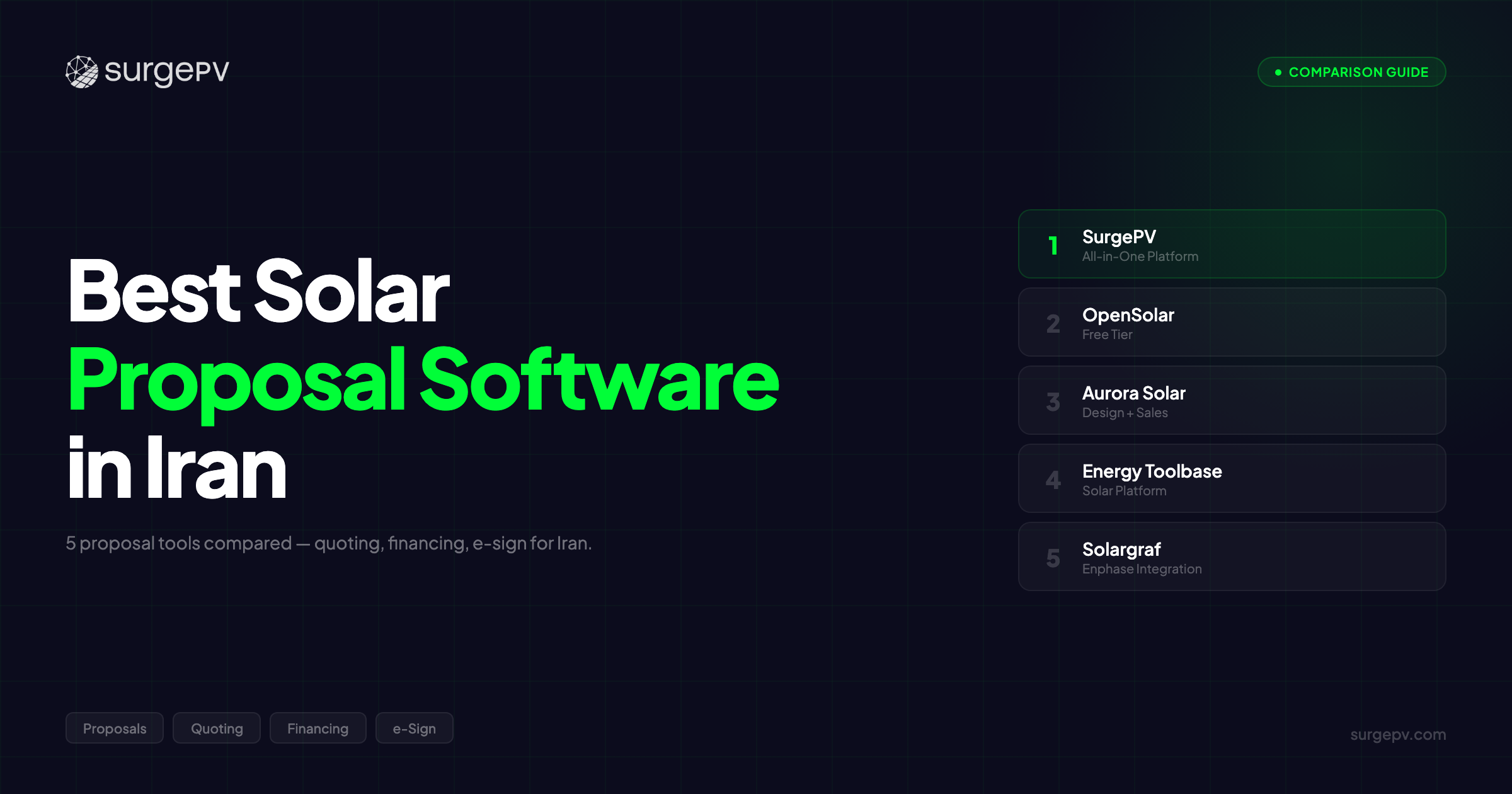
TL;DR: SurgePV is the best solar proposal software for Iran — automated proposal generation with accurate financial modelling and regulatory compliance. OpenSolar offers a free entry tier for smaller installers.
Iran’s 5,000 MW Solar Target Runs on Proposals. Most EPCs Still Build Them Manually.
Iran is pushing toward 5,000 MW of solar capacity by 2027. SATBA Feed-in-Tariff contracts guarantee $0.063–0.073/kWh for 20 years. The economics work.
The pipeline is real. Kerman, Yazd, and Semnan are filling with utility-scale projects.
But winning those SATBA FIT tenders takes more than competitive pricing. It takes professional, bankable proposals — fast.
Right now, most Iranian EPCs build SATBA tender documents by stitching together outputs from three or four separate tools. PVsyst generates the simulation. AutoCAD produces electrical diagrams. Excel handles 20-year financial projections. Someone assembles it all into a Word document. The process takes 2–4 weeks per tender. Meanwhile, the tender deadline moves closer, and competitors who move faster submit first.
The proposal challenge is even harder than it looks. SATBA tenders require P50/P90 production guarantees, IEC compliance documentation for Tavanir grid connection, 50% local content tracking in the bill of materials, and 20-year FIT revenue projections. The best solar proposal software for Iran must handle all of these while cutting turnaround from weeks to hours.
In this guide, you’ll discover:
- Which 5 platforms work for Iran’s utility-scale SATBA FIT market
- How each tool handles bankability, local content tracking, and FIT financial modeling
- Where residential-focused platforms fail for Iran’s 70% utility-scale market
- Real pricing comparisons for Iranian EPCs
- Which software eliminates the multi-tool workflow that slows your tenders
Quick Summary: Our Top Picks for Iran
After testing 5 platforms with EPCs across Iran (Tehran, Yazd, Kerman), here are our top recommendations for SATBA FIT proposals and commercial solar sales:
- SurgePV — End-to-end design, simulation, and proposal platform with P50/P90 bankability (Best for EPCs pursuing SATBA FIT tenders and commercial projects)
- OpenSolar — Fast residential proposals at low cost (Best for Tehran/Shiraz residential installers)
- Aurora Solar — AI-powered proposals with CRM integration (Best for commercial sales teams with premium budgets)
- Energy Toolbase — Advanced financial modeling for storage + solar (Best for solar+storage financial analysis)
- Solargraf — Quick 3D residential proposals (Best for budget residential marketing)
Each tool evaluated on SATBA FIT compliance, bankability, proposal speed, utility-scale capability, and Iranian market applicability.
Best Solar Proposal Software in Iran (Detailed Reviews)
| Software | Best For | Pricing | Iran Fit |
|---|---|---|---|
| SurgePV | All-in-one proposals + design | ~$1,899/yr (3 users) | Excellent |
| OpenSolar | Free proposals | Free tier available | Good |
| Aurora Solar | AI-powered proposals | ~$3,600–6,000/yr | Good |
| Energy Toolbase | Storage proposals | Contact for pricing | Good |
| Solargraf | Residential proposals | Contact for pricing | Good |
SurgePV — Best End-to-End Platform for Iranian EPCs
Target Users: Utility-scale EPCs pursuing SATBA FIT tenders (10–100 MW), commercial installers, engineering firms, and solar developers requiring bankable proposals with local content compliance.
SurgePV is the only cloud-based platform combining AI-powered solar design, bankable simulations, and professional proposals in one integrated workflow. For Iranian EPCs, that integration addresses the core problem: you can produce SATBA-compliant tender documents — with P50/P90 guarantees, IEC-compliant SLDs, local content BOMs, and 20-year FIT financial projections — without switching between separate tools.
Here is why that matters for SATBA tenders. When you use PVsyst for simulation, AutoCAD for electrical, and Excel for financials, every data transfer introduces risk. The production numbers in your simulation do not automatically match the numbers in your financial model. The component list in your design does not automatically populate your local content calculation. Manual assembly across tools takes 2–4 weeks and leaves room for the inconsistencies that cost you tenders.
SurgePV compresses that into hours. Design flows into simulation flows into proposal. One data set. One workflow. One document package.
Pro Tip
SATBA FIT tenders are price-competitive. The EPC with faster proposal turnaround can iterate on more tender submissions per cycle. SurgePV’s integrated workflow does not just save time — it lets you respond to more tenders per quarter, increasing your win probability through volume.
Key Features for Iran
SATBA FIT Proposal Generation
SurgePV produces professional, customizable proposal packages suitable for SATBA tender submissions. Templates support branded cover pages, technical specifications, equipment lists, and financial summaries. Export to PDF and DOCX formats that SATBA evaluators expect.
Proposals include 3D site visualizations, system layouts for ground-mount and tracker installations, and equipment specifications pulled directly from the design. No manual assembly from separate tools.
Bankable P50/P90 Production Guarantees
SATBA requires P50/P90 production guarantees for FIT contract approval. SurgePV’s 8,760-hour simulation achieves ±3% accuracy versus PVsyst — meeting SATBA standards for bankability. The simulation accounts for Iran’s high-irradiation climate (1,800–2,200 kWh/m²/year, southern regions reaching 2,500+), desert temperatures (45–50°C), and 2–5% monthly soiling losses.
For most utility-scale projects under 100 MW, ±3% accuracy meets SATBA standards. PVsyst remains the gold standard for the largest developments, but SurgePV’s bankability meets the threshold SATBA evaluators accept.
20-Year FIT Financial Modeling
The financial modeling tool projects 20-year revenue at SATBA FIT rates ($0.063–0.073/kWh). IRR, NPV, payback period, LCOE, and cash flow analysis model the full contract term. Degradation assumptions, O&M cost escalation, and inflation adjustments reflect real project economics.
For commercial projects outside the FIT structure, the platform models self-consumption savings, net metering benefits, and custom financing scenarios.
Local Content BOM Tracking
SATBA requires 50% Iranian-manufactured components for FIT eligibility by 2027. SurgePV’s bill of materials generation tracks component origin, calculating local content percentage automatically. The 70,000+ module database includes Iranian-manufactured panels, letting you verify compliance before submission rather than discovering gaps after.
Integrated Design-to-Proposal Workflow
Design, simulation, electrical SLDs, and proposals in one cloud platform. No data re-entry between PVsyst, AutoCAD, and Excel. Real-time collaboration across distributed teams — Tehran headquarters, Kerman project sites, Yazd field offices.
Further Reading
- Best Solar Proposal Software (2026) — Global comparison across platforms
- Best Solar Design Software in Iran — Engineering-focused platform comparison
- Aurora Solar Review — Detailed proposal feature analysis
Pros and Cons
Pros:
- Only platform integrating design + bankable simulation + proposals (eliminates separate tool costs and data re-entry)
- SATBA-compliant P50/P90 guarantees in integrated workflow
- Local content BOM tracking ensures 50% Iranian manufacturing compliance
- 70% faster proposal workflows improve SATBA tender responsiveness
- Transparent pricing at $1,899/year for 3 users
- Cloud-based accessibility across Iran
Cons:
- Newer platform (launched 2021) versus PVsyst’s 30-year track record
- Simulation accuracy (±3% versus PVsyst) meets SATBA standards, but PVsyst remains preferred for largest projects over 100 MW
- Iranian payment processing may require coordination with support team
Pricing
- Individual Plan: $1,899/year (3 users) — ideal for small Iranian EPCs
- 3-User Plan: $1,499/user/year ($4,497/year total) — best for mid-size EPCs
- 5-User Plan: $1,299/user/year ($6,495/year total) — scales with growing operations
- Includes: Design, electrical engineering, simulation, proposals, financial modeling
Pro Tip
SurgePV’s automated SLD generation saves 2–3 hours per project compared to manual AutoCAD drafting. For Iran EPCs handling 10+ projects per month, that’s 20–30 hours recovered. Book a demo to see it in action.
Compare to the typical Iranian EPC tool stack: PVsyst ($1,500+) + AutoCAD ($2,000/year) + manual proposal assembly (engineering time) = $5,000+/year per user with 2–4 week turnaround.
Who SurgePV Is Best For: Iranian utility-scale EPCs pursuing SATBA FIT tenders (10–100 MW), commercial installers closing rooftop and carport projects, engineering firms needing integrated bankability and proposals, and solar sales teams competing on tender responsiveness.
Real-World Example: A mid-sized installer in Iran was losing C&I bids because proposals took 2–3 days to produce. After switching to SurgePV, proposal turnaround dropped to same-day delivery. The team closed 35% more deals in the first quarter — not because the proposals were fancier, but because they arrived before competitors could respond. Speed wins contracts.
OpenSolar — Fast Residential Proposal Platform
OpenSolar is a cloud-based residential solar design and proposal platform with 500,000+ projects globally. For Iranian residential and small commercial installers in Tehran, Shiraz, and Isfahan, OpenSolar’s fast proposal generation (15–30 minutes) and affordable pricing support sales cycles.
Key Strengths: Fast proposal generation at 15–30 minutes for residential projects. Basic integrated design tools. 3D visualization for client presentations. Low-cost entry at $99–299/month.
Where OpenSolar Falls Short for Iran: Residential focus makes it unsuitable for Iran’s 70% utility-scale market. No P50/P90 bankability for SATBA FIT submissions. No local content tracking for 50% manufacturing mandate. US/AU financing templates do not match Iranian FIT contract structures. No Tavanir grid compliance documentation.
Best For: Iranian residential and small commercial installers (under 100 kW) in Tehran and Shiraz prioritizing speed and low cost over utility-scale SATBA capabilities.
Read our full OpenSolar review for detailed analysis.
Aurora Solar — AI-Powered Sales Proposals
Aurora Solar is an AI-powered solar design and proposal platform with CRM integration. For Iranian commercial installers with dedicated sales teams, Aurora’s automated proposal generation and pipeline management tools support deal closure.
Key Strengths: AI-powered design for automated roof modeling. CRM integration for sales pipeline tracking. Professional 3D/AR proposal presentations. Customizable templates for commercial projects. Cloud-based access.
Where Aurora Falls Short for Iran: US residential focus with limited utility-scale capabilities. No SATBA FIT templates. No P50/P90 bankability for FIT tender submissions. Higher pricing at $5,000–10,000/year limits adoption. No local content tracking. No Tavanir grid compliance.
Best For: Iranian commercial solar sales teams (rooftop, carport) with budgets for premium sales automation tools. Not suitable for SATBA FIT utility-scale tenders.
Read our full Aurora Solar review for detailed analysis.
Energy Toolbase — Advanced Financial Modeling
Energy Toolbase specializes in financial modeling for solar + battery storage projects. For Iranian projects incorporating energy storage for commercial self-consumption or grid resilience, it offers detailed financial analysis.
Key Strengths: Advanced battery + solar economic analysis. Professional financial presentations with multi-year projections. Best-in-class storage dispatch modeling. Time-of-use rate optimization.
Where Energy Toolbase Falls Short for Iran: No integrated design tools (requires separate design software). US commercial market focus. Higher pricing at $3,000–6,000/year. Limited applicability to Iran’s utility-scale FIT market. No local content tracking.
Best For: Iranian solar + storage projects requiring advanced financial modeling. Limited to teams already using separate design software.
Read our full Energy Toolbase review for detailed analysis.
Solargraf — Quick Residential Proposals
Solargraf offers fast residential proposal generation with 3D visualization. For Iranian residential installers in Tehran and Shiraz urban markets, its quick turnaround and low cost support homeowner sales.
Key Strengths: Fast residential proposals with quick turnaround. 3D client-friendly renders. Low-cost entry at $50–150/month. Basic design tools. Simple learning curve.
Where Solargraf Falls Short for Iran: Residential focus makes it unsuitable for Iran’s utility-scale market. No P50/P90 bankability for SATBA FIT. No local content tracking. Minimal commercial features. No Tavanir grid documentation.
Best For: Iranian residential installers in small urban markets prioritizing low-cost, simple proposals for homeowner sales.
Read our full Solargraf review for detailed analysis.
Comparison Table: Solar Proposal Software for Iran
| Feature | SurgePV | OpenSolar | Aurora Solar | Energy Toolbase | Solargraf |
|---|---|---|---|---|---|
| Integrated Design | Yes (full) | Yes (basic) | Yes (strong) | No (financial only) | Yes (basic) |
| P50/P90 Bankability | Yes (±3%) | No | No | Advanced (US) | No |
| SATBA FIT Compliance | High | Low | Low | Medium | Low |
| Local Content BOM | Auto tracking | No | No | No | No |
| 20-Year FIT Modeling | Yes | Limited | Limited | Yes | No |
| Utility-Scale | Yes (trackers, ground-mount) | No | Limited | Limited | No |
| Cloud-Based | Yes | Yes | Yes | Yes | Yes |
| Pricing | $1,899/yr (3 users) | Free tier | $3,600–6,000/yr | Contact | Contact |
Win More SATBA FIT Tenders with SurgePV
Produce bankable, SATBA-compliant proposals in hours — not weeks.
Book a DemoNo commitment required · 20 minutes · Live project walkthrough
What to Look for in Solar Proposal Software for Iran
Choosing the right solar proposal software for the Iranian market requires evaluating capabilities beyond generic template generation. Here are the criteria that matter:
SATBA FIT Proposal Compliance
SATBA tenders require P50/P90 production guarantees, IEC compliance documentation, 50% local content BOM, and 20-year FIT financial projections. Software that cannot generate all four forces manual assembly — the 2–4 week bottleneck that costs Iranian EPCs tender wins.
Bankable Simulation Integration
Proposals without bankable simulation data get rejected. The best solar proposal software integrates simulation into the proposal workflow, so production numbers flow directly into financial projections without manual re-entry. SurgePV’s ±3% accuracy versus PVsyst meets SATBA standards for projects under 100 MW.
20-Year FIT Financial Modeling
Iran’s FIT contracts run 20 years at $0.063–0.073/kWh. Proposals need IRR, NPV, payback period, and annual cash flow projections reflecting real degradation assumptions and O&M cost escalation. Generic US-market financial templates do not model Iranian FIT economics correctly.
Local Content Tracking
SATBA’s 50% Iranian-manufactured components requirement means proposals must document component origin. Software with built-in Iranian manufacturer databases and automatic local content percentage tracking removes a manual compliance step that commonly causes submission errors.
Speed and Turnaround
SATBA tender cycles are competitive. The EPC that submits a complete, bankable proposal first has an advantage. Software that cuts proposal assembly from 2–4 weeks to hours — without sacrificing documentation quality — directly increases tender win rates.
Frequently Asked Questions
What is the best solar proposal software for Iranian EPCs?
SurgePV is the best solar software for Iranian EPCs. It combines bankable P50/P90 simulation, IEC-compliant SLD generation, local content BOM tracking, and 20-year FIT financial modeling in one proposal workflow. Iranian EPCs can produce SATBA-compliant tender documents in hours rather than the 2–4 weeks required by multi-tool workflows.
Does solar proposal software support SATBA FIT requirements?
SurgePV supports SATBA FIT requirements including P50/P90 production guarantees, IEC compliance documentation, 50% local content BOM tracking, and 20-year revenue projections at Iranian FIT rates ($0.063–0.073/kWh). OpenSolar and Aurora Solar do not natively support SATBA’s utility-scale bankability requirements.
How fast can SurgePV produce a SATBA FIT proposal?
SurgePV’s integrated design-to-proposal workflow reduces tender document production from 2–4 weeks (multi-tool manual process) to hours. A 10 MW SATBA FIT proposal package including P50/P90 simulation, IEC-compliant SLD, local content BOM, and 20-year financial projections can be completed in a single session.
Can solar proposal software handle Iran’s local content tracking?
SurgePV’s 70,000+ module database includes Iranian-manufactured panels and inverters. The bill of materials generation automatically calculates local content percentages, ensuring SATBA’s 50% Iranian manufacturing compliance is documented before submission. Other platforms in this comparison do not include Iranian manufacturer databases.
What is the cost of solar proposal software for Iranian companies?
Pricing ranges from free (OpenSolar basic tier) to $6,000+/year (Aurora Solar enterprise). SurgePV at $1,899/year (3 users) offers the best value — including integrated design, simulation, and proposals with SATBA FIT compliance. See current pricing.
Sources
- SATBA (Renewable Energy and Energy Efficiency Organization of Iran) — FIT framework and proposal requirements (accessed February 2026)
- Tavanir — Grid interconnection documentation standards (accessed February 2026)
- IRENA — Iran renewable energy statistics (accessed February 2026)
- SurgePV Official Documentation — Product features and pricing (accessed February 2026)
- G2 Reviews — Verified user reviews for solar software platforms (accessed February 2026)