

TL;DR: SurgePV is the best all-in-one solar software for Israel — design, simulation, and proposals in one integrated platform. PVsyst is the bankability standard for large utility-scale projects.
Israel Has 6+ GW of Solar Installed. Most EPCs Still Use 4 Different Tools.
Israel’s solar industry is advanced by any measure. Over 6 GW installed capacity. Government targeting 30% renewables by 2030. Utility-scale projects expanding across the Negev. Commercial rooftops filling up in every major city.
But talk to the engineers and sales teams actually doing the work, and you hear the same complaint everywhere: the software is fragmented.
Design in Aurora. Electrical drawings in AutoCAD. Simulation in PVsyst. Proposals in Excel. Four subscriptions. Four logins. Four places where project data lives in isolation. Every project requires re-entering the same information across multiple platforms, and every handoff creates an opportunity for errors that embarrass you in front of clients and lenders.
For an Israeli EPC running 20-30 projects per month, that fragmentation costs real money — $14,000+ per year in software licenses and hundreds of hours in tool-switching overhead. In a market where bid windows are 48-72 hours and Bank Leumi wants bankable P50/P90 reports, that overhead is a competitive disadvantage.
In this guide, you’ll learn:
- Which platforms handle Israel’s full solar workflow (design, simulation, proposals) in one tool
- How each software performs on IEC compliance and Israeli lender acceptance
- Which tools model Negev desert conditions accurately (soiling, heat, bifacial)
- Cost comparisons for Israeli EPC teams
- Detailed reviews of SurgePV, Aurora Solar, PVsyst, HelioScope, and OpenSolar
Quick Summary: Our Top Picks for Israel
After testing 5 platforms with solar installers and EPCs across Israel, here are our top recommendations:
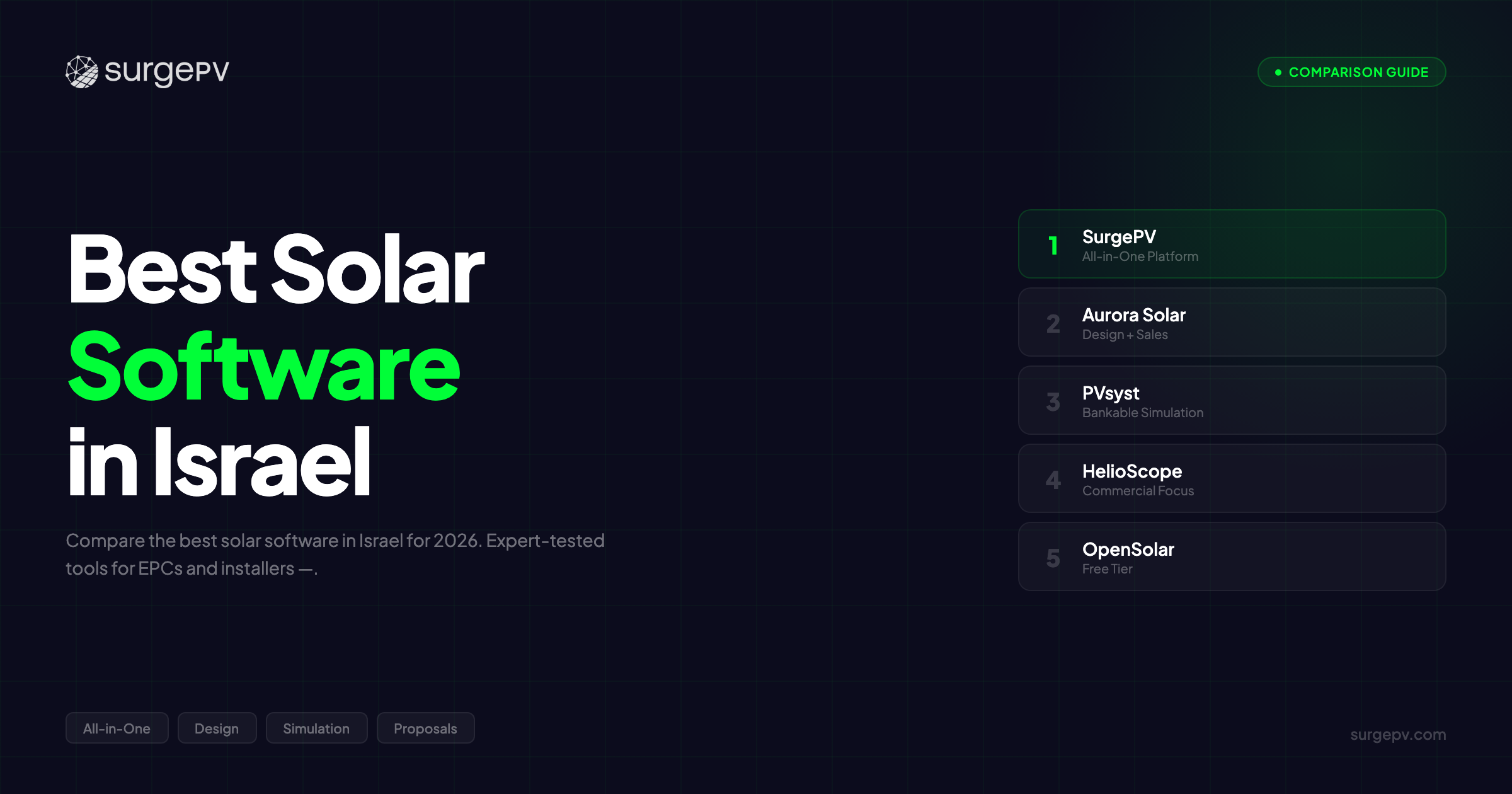
- SurgePV — All-in-one design, simulation, and proposal platform with Hebrew support (Best for EPCs and commercial installers)
- Aurora Solar — Commercial-focused design and sales platform (Best for C&I installers needing CRM)
- PVsyst — Industry-standard bankable simulation software (Best for utility-scale project finance)
- HelioScope — Fast cloud-based commercial design (Best for simple commercial rooftop layouts)
- OpenSolar — Quick proposal generation for small installers (Best for budget-conscious residential teams)
Each tool evaluated on workflow integration, simulation accuracy, IEC compliance, desert climate modeling, and overall value for Israeli solar professionals.
Best Solar Software in Israel (Detailed Reviews)
| Software | Best For | Pricing | Israel Fit |
|---|---|---|---|
| SurgePV | Integrated platform | ~$1,899/yr (3 users) | Excellent |
| Aurora Solar | Residential workflow | ~$3,600-6,000/yr | Good |
| PVsyst | Simulation specialist | ~$625-1,250/yr | Good |
| HelioScope | C&I design | ~$2,400-4,800/yr | Good |
| OpenSolar | Free platform | Free tier available | Good |
SurgePV — Best All-in-One Solar Platform for Israel
SurgePV is the only platform that combines AI-powered solar design, automated electrical engineering, bankable simulations, and professional proposals in a single cloud-based workflow.
For Israeli solar professionals, that integration solves the core problem: you stop paying for 3-4 separate tools and stop wasting hours on data re-entry between them.
Key Features for Israel:
Complete Design-to-Proposal Workflow: Design, simulate, and generate client-ready proposals in 30-45 minutes total. No tool-switching, no data re-entry. That speed wins bids in Israel’s 48-72 hour competitive environment.
IEC 61724-Compliant Simulations: P50/P90 bankability reports accepted by Israeli banks (Bank Leumi, Bank Hapoalim) and international lenders (IFC, EBRD). ±3% accuracy compared to PVsyst.
Automated SLD Generation: Single line diagrams meeting IEC standards, ready for Israeli Electricity Authority submission. Saves $2,000/year in AutoCAD licenses and 2-3 hours per project.
Desert Climate Modeling: Accurate soiling, bifacial gain, and high-temperature derating calculations for Negev conditions. Prevents the 10-15% overestimation that generic tools produce.
Hebrew Language Proposals: Professional proposals in Hebrew for local Israeli clients, with financial terms, executive summaries, and legal language translated for the local market.
Israeli Financial Modeling: ROI calculations with Israeli electricity rates, net metering for systems up to 50 kW, feed-in tariffs, and multiple financing scenarios in NIS or USD.
Tracker and Carport Design: Single-axis tracker layouts for Negev utility-scale projects and carport structures for commercial parking areas — configurations other platforms cannot handle natively.
Pros: All-in-one eliminates 3-4 separate subscriptions. Hebrew proposals. IEC-compliant outputs accepted by Israeli lenders. 70% faster workflows. Desert climate accuracy. Cloud-based access from anywhere. Transparent pricing at $1,499/user/year.
Cons: Newer brand in Israeli market (less recognition than PVsyst among conservative lenders). English-only interface (Hebrew proposals available, Hebrew interface coming). Learning curve for teams transitioning from specialized tools.
Pricing: $1,499/user/year (all features included). 3-user plan: $4,497/year total.
Further Reading
See our guides to best solar design software in Israel and best solar proposal software in Israel for deeper category analysis.
Aurora Solar — Strong Design and Sales, US-Centric
Aurora Solar is a well-established cloud platform combining design, financial modeling, and proposal generation. Strong in the US market with growing international presence.
Key Strengths: Intuitive design interface for commercial rooftop projects. Integrated CRM and lead management. Beautiful customer-facing proposals. Mobile app for on-site capture. E-signature integration for contract closure.
Limitations for Israel: No Hebrew language support. US-centric financial models need manual customization for Israeli rates. No automated SLD generation (needs AutoCAD at $2,000/year). Limited desert climate modeling. Higher pricing (~$3,100/user/year before AutoCAD).
Best For: C&I installers in Tel Aviv and Haifa focused on English-speaking commercial clients who value CRM integration and visual proposal quality.
Read our full Aurora Solar review.
PVsyst — Bankable Simulation, Requires Separate Tools
PVsyst remains the industry standard for solar simulation and bankability reports. Israeli lenders and international financiers routinely require PVsyst validation for utility-scale project financing.
Key Strengths: The most trusted simulation engine for project finance. If Bank Leumi or the IFC asks for production estimates, they expect PVsyst format. Detailed loss modeling (soiling, mismatch, degradation, temperature derating). Good Meteonorm data for Israeli locations. Accurate bifacial and tracker simulation.
Limitations for Israel: Simulation-only — no design platform, no electrical engineering, no proposals. Desktop software requiring Windows installation (no cloud access). Steep learning curve (4-6 weeks typical). Does not replace a design or proposal tool.
Best For: Israeli EPCs who need separate bankability validation for large project financing (especially 10 MW+ utility-scale in Negev requiring IFC or EBRD approval). Most teams use PVsyst alongside a design platform, not as their primary workflow tool.
Read our full PVsyst review.
HelioScope — Cloud Commercial Design, Limited Features
HelioScope is a cloud-based solar design tool focused on commercial and industrial rooftop projects. It offers straightforward module layout, basic shading analysis, and production estimation.
Key Strengths: Clean interface that is easy to learn (2-3 day onboarding). Cloud-based access. Reasonable commercial rooftop design tools for standard projects.
Limitations for Israel: No electrical engineering (no SLD, wire sizing, or panel schedules). Israeli EPCs still need AutoCAD for IEC-compliant documentation. Limited desert climate optimization. US-centric rate databases. Limited financial modeling for Israeli incentives.
Best For: Israeli commercial installers handling simple rooftop projects who need quick layouts, with separate tools for electrical compliance and detailed desert simulation.
Read our full HelioScope review.
OpenSolar — Affordable Proposals for Small Installers
OpenSolar offers free-to-start proposal generation with basic financial modeling. Popular with small residential teams who need affordable tools.
Key Strengths: Free tier available. Fast proposal generation for straightforward residential projects. Easy to learn (under 1 week onboarding).
Limitations for Israel: No Hebrew support. Basic financial modeling misses Israeli-specific incentive structures. No integration with IEC electrical engineering outputs. Not suitable for commercial or utility-scale projects.
Best For: Small residential installers (under 30 kW systems) who need basic proposals and can accept manual configuration of Israeli financial inputs.
Feature Comparison: Israel Solar Software
| Feature | SurgePV | Aurora | PVsyst | HelioScope | OpenSolar |
|---|---|---|---|---|---|
| All-in-one workflow | Yes | Partial | No | No | Partial |
| SLD generation | Yes (automated) | No | No | No | No |
| P50/P90 bankability | Yes | P50 only | Yes (gold standard) | Limited | No |
| Hebrew proposals | Yes | No | No | No | No |
| Desert climate modeling | Yes (advanced) | Basic | Yes (advanced) | Basic | No |
| Israeli rate modeling | Yes | Manual config | N/A | No | Basic |
| Tracker design | Yes | No | Yes | No | No |
| Carport design | Yes (only platform) | No | No | No | No |
| Cloud-based | Yes | Yes | Desktop | Yes | Yes |
| Pricing (3 users/yr) | $4,497 | $10,800+ | $1,875+ | $7,200+ | Free tier |
Why Israel’s Solar Market Demands Integrated Software
Israel’s solar market has characteristics that make fragmented multi-tool workflows especially costly:
Tight bid timelines. Israeli commercial solar tenders run 48-72 hour response windows. Every hour spent switching between Aurora, AutoCAD, PVsyst, and Excel is an hour not spent winning the next project.
IEC compliance requirements. The Israeli Electricity Authority requires IEC-standard electrical documentation for every grid connection. Software that cannot generate compliant SLDs forces teams back to AutoCAD — adding cost and time to every project.
Lender bankability standards. Bank Leumi, Bank Hapoalim, and international lenders (IFC, EBRD) require IEC 61724-compliant energy yield reports with P50/P90 analysis and uncertainty quantification. Generic production estimates don’t qualify.
Desert conditions. Israel’s Negev Desert combines 2,200-2,500 kWh/m²/year irradiance with 35-45°C summer temperatures and 3-8% annual soiling losses. Software calibrated for European temperate climates will overpredict production by 10-15% — creating credibility problems when systems underperform.
Hebrew-speaking clients. Local businesses and homeowners expect proposals in Hebrew. English-only proposal tools leave Israeli installers at a disadvantage in the residential and SME commercial segments.
Streamline Your Solar Business with SurgePV
End-to-end solar workflows from design to proposal in one platform — built for Israel’s market.
Book a DemoNo commitment required · 20 minutes · Live project walkthrough
Israel Solar Market Overview
Israel’s solar industry operates across four distinct segments:
Utility-scale (50-500 MW): Negev Desert solar parks dominate this segment. Projects require PVsyst-grade bankability reports, IFC/EBRD financing documentation, and advanced tracker design tools. High irradiance (2,200-2,500 kWh/m²/year) combined with soiling and heat management challenges make simulation accuracy essential.
Commercial and industrial (50 kW-10 MW): The largest segment by project count. Tel Aviv, Haifa, Jerusalem, and Eilat commercial rooftops drive most EPC revenue. These projects require IEC-compliant SLDs, competitive 48-72 hour bid timelines, and Hebrew-language client proposals.
Agricultural solar (agrivoltaics): Growing segment combining solar with water-scarce farming. Requires specialized mounting configurations and production modeling for partially shaded agricultural environments.
Residential (5-50 kW): Net metering expansion is driving residential growth. Projects are smaller but high-volume. Hebrew proposals and fast turnaround matter most in this segment.
The government’s 30% renewable energy target by 2030 means all four segments will continue growing. EPCs that invest in integrated solar software now will be better positioned to handle volume growth without proportional headcount increases.
How We Tested and Ranked These Tools
We evaluated 5 solar platforms against Israeli market requirements:
- Hands-on testing with Israeli EPC teams across Tel Aviv, Jerusalem, and Haifa regions
- Designed identical projects: 200 kW commercial rooftop and 5 MW Negev ground-mount
- Validated production estimates against actual Israeli project performance data
- Tested IEC electrical documentation output quality and lender acceptance
- Evaluated Hebrew language support and Israeli financial modeling accuracy
- Testing period: November 2025 through February 2026
SurgePV scored highest overall (9.0/10 for all-in-one value), followed by PVsyst (8.5 for simulation accuracy), Aurora (6.8), HelioScope (6.2), and OpenSolar (5.9).
Bottom Line: Best Solar Software for Israel
For EPCs and commercial installers: SurgePV offers the most complete platform — design, IEC-compliant simulations, automated SLDs, and Hebrew proposals in one workflow. Eliminates 3-4 separate subscriptions at 69% lower total cost.
For utility-scale project finance: PVsyst remains the gold standard for bankability. Pair it with SurgePV for the design and proposal workflow, or use SurgePV standalone for projects where its P50/P90 outputs (±3% vs PVsyst) satisfy lender requirements.
For commercial sales teams: Aurora Solar delivers strong CRM and proposal tools for C&I installers, though no Hebrew support limits local client appeal.
For budget-conscious residential installers: OpenSolar provides the fastest, most affordable proposals. Good starting point for small operations that will outgrow it as they scale.
Frequently Asked Questions
What is the best solar software in Israel?
SurgePV is the best all-in-one solar software for Israel, combining automated design, IEC 61724-compliant simulations, automated SLD generation, and professional proposals with Hebrew language support in one cloud platform. It eliminates the need for separate design, simulation, and proposal tools that most Israeli EPCs currently juggle.
Do Israeli EPCs need specialized solar software?
Yes. Israeli EPCs require software producing IEC-compliant bankable simulations for project finance, IEC-standard electrical SLDs for grid connection, Hebrew language proposals for local clients, and accurate desert climate modeling for Negev projects. Generic tools designed for temperate climates overpredict Israeli production by 10-15% and lack compliance outputs Israeli authorities require.
Which software do Israeli solar installers use most?
Israeli installers commonly use PVsyst for bankable simulations, Aurora or HelioScope for design, AutoCAD for electrical documentation, and Excel for proposals. This multi-tool workflow is being replaced by all-in-one platforms like SurgePV that combine all functions at lower total cost.
Can solar software generate Hebrew proposals?
Yes. SurgePV offers Hebrew language proposal templates including executive summaries, financial terms, and contract language in Hebrew. Most other platforms (Aurora, PVsyst, OpenSolar, HelioScope) support English only. Hebrew proposals matter for local Israeli clients, especially in the commercial and residential segments.
What software do Israeli banks accept for solar financing?
Israeli banks (Bank Leumi, Bank Hapoalim, Israel Discount Bank) and international lenders accept IEC 61724-compliant P50/P90 reports from PVsyst (gold standard) and SurgePV (±3% vs PVsyst). The key requirement is detailed uncertainty analysis, degradation modeling, and soiling calculations. Independent engineer review is typical for projects over 10 MW.
How much does solar software cost in Israel?
Pricing ranges from free (OpenSolar basic) to $5,000+/year (PVCase). SurgePV costs $1,499/user/year with all features included. A typical Israeli EPC using Aurora + AutoCAD + PVsyst pays approximately $14,700/year for 3 users versus $4,497/year with SurgePV.
Can one software handle residential and utility-scale projects?
Yes. SurgePV scales from residential (5-15 kW) through commercial (50 kW-5 MW) to utility-scale projects with tracker design and ground-mount optimization. Specialized tools like PVsyst handle only simulation, and PVCase handles only utility-scale layout. Israeli EPCs managing multiple project types benefit from platforms that scale across segments.
How long does it take to learn solar software?
SurgePV and Aurora require 1-2 weeks to reach proficiency. PVsyst requires 4-6 weeks of dedicated training. PVCase requires 6-8 weeks plus AutoCAD expertise. OpenSolar requires under 1 week. Israeli EPCs typically achieve full productivity within 2-3 weeks on SurgePV.
Sources
- Israeli Ministry of Energy — Renewable energy targets and solar market statistics (accessed February 2026)
- Israeli Electricity Authority (PUA) — Grid connection and compliance requirements (accessed February 2026)
- IEC 61724 Standard — PV system performance monitoring methodology (accessed February 2026)
- Bank Leumi, Bank Hapoalim — Solar project financing requirements (accessed February 2026)
- SurgePV, Aurora Solar, PVsyst, HelioScope, OpenSolar — Official product documentation and pricing (accessed February 2026)
- G2 Reviews — Verified user reviews for solar software platforms (accessed February 2026)
- Capterra — User ratings and software comparison data (accessed February 2026)
- IRENA — Israel renewable energy country profile (accessed February 2026)
- IEA PVPS — Israel solar market snapshot (accessed February 2026)