

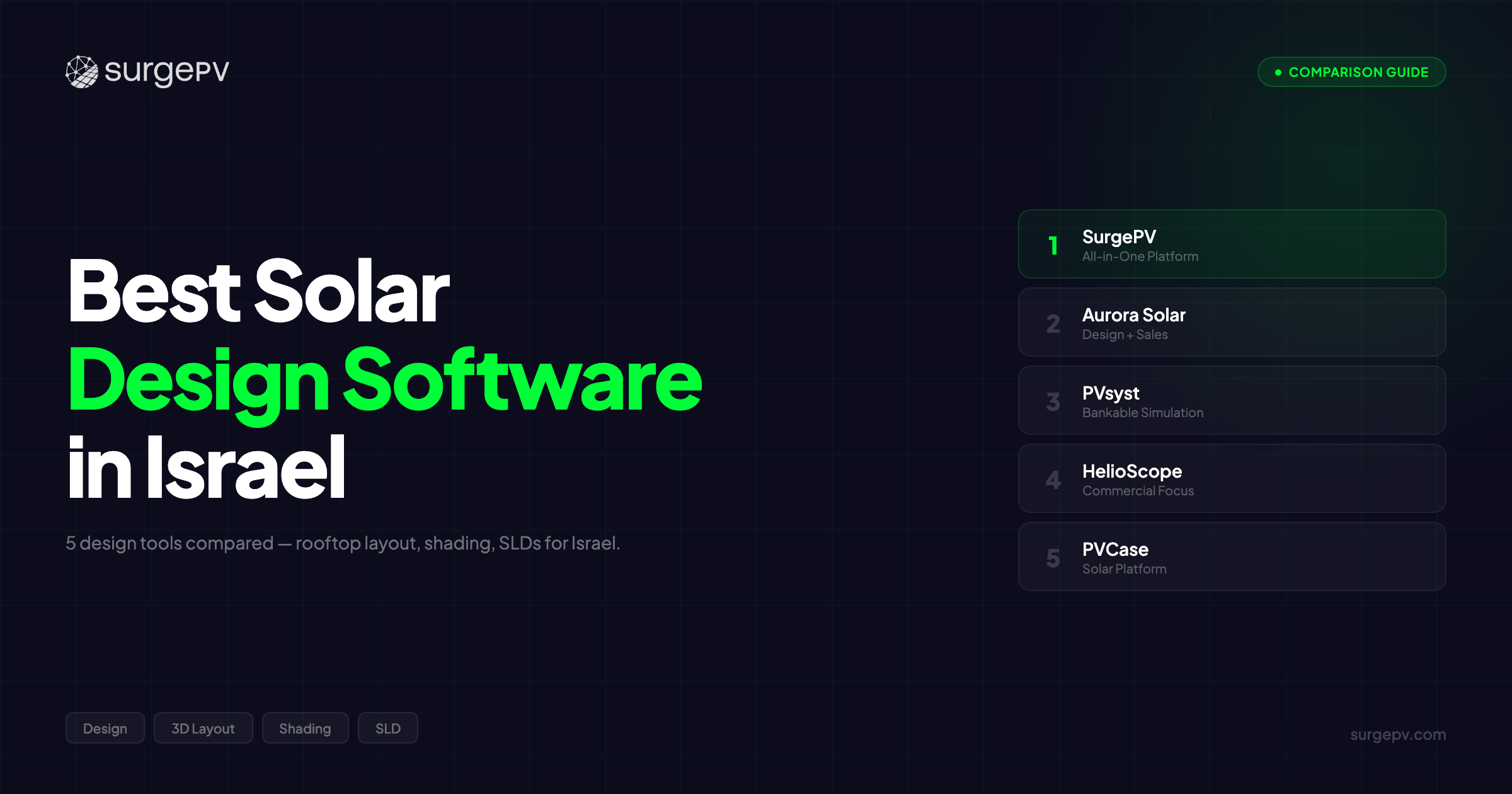
TL;DR: SurgePV is the best solar design software for Israel — automated IEC-compliant SLD generation, bankable P50/P75/P90 simulations, and Israel-specific financial modelling in one cloud platform.
Israel’s Solar Boom Has an Engineering Bottleneck.
Israel has over 6 GW of installed solar capacity. The government wants 30% renewable energy by 2030. Utility-scale projects are expanding across the Negev Desert at 100+ MW scale, commercial rooftops are filling up in Tel Aviv and Haifa, and residential net metering adoption keeps climbing.
But here is the problem most Israeli EPCs don’t talk about publicly: their software stack is a mess.
A typical Israeli EPC runs Aurora or HelioScope for design layout. Then switches to AutoCAD for the electrical single line diagrams that the Israeli Electricity Authority demands. Then fires up PVsyst for the bankable simulation that Bank Leumi or Bank Hapoalim requires for financing. Then opens Excel to model Israeli net metering rates and feed-in tariff incentives. Four tools. Four licenses. Four places where data gets re-entered and errors creep in.
That multi-tool workflow costs $14,000+ per year for a 3-person team and wastes 2-3 hours per project in context-switching alone. In a market where bid deadlines are 48-72 hours and payback periods run 5-8 years for commercial projects, those hours and dollars matter.
In this guide, you’ll learn:
- Which platforms produce IEC 61724-compliant bankable reports accepted by Israeli banks
- How each tool handles Negev desert conditions (soiling, bifacial, 35-45°C heat)
- Which software generates Israeli Electricity Authority-compliant SLDs automatically
- Total cost of ownership for a 3-user Israeli EPC team
- Detailed comparisons of SurgePV, Aurora Solar, PVsyst, HelioScope, and PVCase
Quick Summary: Our Top Picks for Israel
After testing 5 platforms with solar installers and EPCs across Israel, here are our top recommendations:
- SurgePV — End-to-end design, electrical engineering, and bankable simulations (Best for Israeli EPCs needing IEC compliance and desert optimization)
- Aurora Solar — Beautiful proposals and AI roof modeling (Best for commercial rooftop installers, requires AutoCAD for electrical)
- PVsyst — Industry-standard simulation validation (Best for bankability reports Israeli lenders require, not a design tool)
- HelioScope — Cloud-based commercial layout tool (Best for simple commercial rooftops, lacks electrical engineering)
- PVCase — CAD-based utility-scale engineering (Best for 10 MW+ ground-mount projects in Negev, requires AutoCAD)
Each tool evaluated on Israel-specific criteria: desert climate accuracy, IEC compliance, bankability for Israeli lenders, electrical engineering capabilities, and pricing for Israeli EPC teams.
Best Solar Design Software in Israel (Detailed Reviews)
| Software | Best For | Pricing | Israel Fit |
|---|---|---|---|
| SurgePV | End-to-end workflows | ~$1,899/yr (3 users) | Excellent |
| Aurora Solar | Residential proposals | ~$3,600-6,000/yr | Good |
| PVsyst | Bankable simulation | ~$625-1,250/yr | Good |
| HelioScope | Commercial rooftop arrays | ~$2,400-4,800/yr | Good |
| PVCase | Utility-scale terrain | ~$3,800-5,800/yr | Good |
SurgePV — Best End-to-End Solar Platform for Israel
SurgePV is the only cloud-based platform that combines AI-powered solar design, automated electrical engineering, bankable simulations, and professional proposals without tool-switching.
For Israeli EPCs juggling IEC 61724 compliance, Israeli Electricity Authority grid connection mandates, Negev desert soiling conditions, and the financial modeling that Bank Leumi expects — SurgePV eliminates the need for AutoCAD, PVsyst, and manual calculations. You design a 200 kW commercial rooftop in Tel Aviv, generate IEC-compliant single line diagrams automatically, run 8760-hour shading analysis calibrated for Israeli sun angles, and produce bankable P50/P90 reports — all in the same platform.
Target Users: Commercial EPCs (50 kW-10 MW), Israeli solar installers (residential and commercial), utility-scale developers working on Negev Desert projects, engineering firms requiring IEC-compliant documentation.
Unique Value for Israel: SurgePV is the only platform with integrated SLD generation and wire sizing that eliminates AutoCAD dependency. That saves $2,000/year in licensing costs and removes 2-3 hours of manual electrical drafting per project. For Israeli EPCs competing in a market where bid response times are measured in days, not weeks, those savings translate directly to more bids won.
Pro Tip
When evaluating solar design software for Israel, test with a Negev Desert utility-scale project first. Run a 5 MW ground-mount design through the soiling model, bifacial calculations, and high-temperature derating. If the platform handles Negev conditions accurately, it will handle Tel Aviv rooftops easily — but not every tool that works on a simple rooftop can survive Negev validation.
Key Features for Israel
Design and Engineering
SurgePV’s AI-powered roof modeling automatically detects roof boundaries, tilt, and azimuth from satellite imagery. What typically takes 45 minutes of manual tracing takes 15 minutes. For Israel’s urban building stock — dense commercial rooftops in Tel Aviv, historic structures in Jerusalem, industrial facilities in Haifa — that automation matters.
The platform supports every array configuration Israeli EPCs work with: East-West layouts for commercial flat roofs, high-tilt systems optimized for Israeli latitudes (30-32°N), ground-mount single-axis tracker configurations for Negev utility-scale projects, and carport structures for commercial parking areas. Module layout optimization automatically adjusts inter-row spacing for bifacial rear-side gain in high-albedo desert environments.
Electrical Engineering (Critical for Israel)
Here is where SurgePV separates from every other option.
Single Line Diagram generation is automated. Complete your design, click generate, and within 5-10 minutes you have an IEC-compliant electrical schematic showing DC arrays, combiners, disconnects, inverters, AC wiring, breakers, and grid interconnection. That SLD is ready for Israeli Electricity Authority and Israel Electric Corporation submission.
The alternative? Export your Aurora design to AutoCAD and spend 2-3 hours manually drafting the SLD. That is what most Israeli EPCs do today.
Wire sizing calculations happen instantly. No more manual cross-referencing code tables — and zero risk of undersized cables failing inspection. DC and AC wire gauges based on current, distance, voltage drop limits (under 2% optimal, 3% maximum), temperature correction factors (critical for Israel’s 35-45°C summer temperatures), and conduit fill adjustments. All IEC compliant.
Simulation and Bankability
Israeli lenders — Bank Leumi, Bank Hapoalim, Israel Discount Bank — and international financiers demand accurate production forecasts. You can’t afford to overpredict by 10% using generic weather data when Negev soiling losses alone can reach 3-8% annually.
SurgePV’s 8760-hour shading analysis models the actual sun path at your specific Israeli latitude. Production simulation achieves ±3% accuracy compared to PVsyst — close enough for most Israeli commercial projects without running a separate validation. P50, P75, and P90 estimates give Israeli lenders the metrics they require.
Financial modeling includes Israeli-specific inputs: net metering calculations, feed-in tariff modeling for systems above 50 kW, and multiple financing scenarios. The ROI calculator shows payback periods, NPV, and IRR with cash, loan, lease, or PPA scenarios in ILS or USD.
Desert Climate Modeling
Israel’s Negev Desert presents unique challenges that generic software handles poorly. Summer ambient temperatures of 35-45°C reduce module efficiency by 5-10%. Soiling from desert dust and sandstorms causes 3-8% annual losses without regular cleaning. Bifacial modules — now standard on Israeli utility-scale projects — need accurate albedo modeling for high-reflectivity desert sand.
SurgePV models all of these conditions. Temperature coefficient calculations account for Israeli heat. Soiling loss models can be customized for Negev dust conditions. Bifacial gain calculations capture the rear-side production boost from desert sand albedo (typically 30-40% ground reflectivity).
Further Reading
See our best solar design software comparison for global rankings, or compare solar simulation software for bankability-focused tools.
Pros:
- Only platform combining design + electrical engineering + simulation + proposals
- Automated SLD generation eliminates AutoCAD (saves $2,000/year + 2-3 hours/project)
- P50/P75/P90 bankability reports accepted by Israeli banks and international lenders
- Desert climate optimization: soiling, bifacial, high-temperature modeling
- Cloud-based — accessible from Tel Aviv, Haifa, Jerusalem, or Negev site offices
- Transparent pricing: $1,499/user/year — all features included
Cons:
- Newer brand in Israel (less recognition than PVsyst among conservative lenders)
- English-language platform (Hebrew interface not yet available)
- Soiling models may need calibration for specific Negev sub-regions
Pricing:
- 3-User Plan: $4,497/year — $1,499/user/year
- Per User: $1,899/year (individual plan for 3 users)
- Includes: All features — design, SLD, simulation, proposals, financial modeling
- No AutoCAD required: Saves $2,000/year per user vs Aurora + AutoCAD workflow
Pro Tip
SurgePV’s automated SLD generation saves 2-3 hours per project compared to manual AutoCAD drafting. For Israel EPCs handling 10+ projects per month, that’s 20-30 hours recovered. Book a demo to see it in action.
Total Cost of Ownership (3-user Israeli EPC team)
- SurgePV: $4,497/year (everything included)
- Aurora + AutoCAD + PVsyst: ~$6,300 + $6,000 + $2,400 = $14,700/year
- Savings with SurgePV: ~$10,200/year (69% less)
Who SurgePV Is Best For: Israeli commercial solar EPCs handling 50 kW-10 MW projects who need IEC-compliant electrical documentation, accurate desert climate modeling, and bankable simulations without juggling AutoCAD and PVsyst. Also strong for utility-scale developers working on Negev projects and residential solar installers who want engineering-grade accuracy.
Real-World Example
A growing EPC team in Israel was spending 2.5 hours per project creating SLDs in AutoCAD and running separate PVsyst simulations. After switching to SurgePV, SLD generation dropped to under 10 minutes. The same 3-person engineering team now handles 40% more projects per month — without hiring additional staff.
Aurora Solar — Strong Commercial Design, Limited Desert Features
Aurora Solar is a well-established cloud-based platform built primarily for residential and commercial solar in the US market. It handles AI-powered roof detection, 3D modeling, and visually polished proposals well.
Key Strengths: Strong LIDAR integration for accurate roof modeling, beautiful customer-facing proposals with 3D visualizations, CRM integrations for managing sales pipelines, and a mobile app for on-site capture. If your Israeli company focuses on commercial rooftop installations and values aesthetics in client presentations, Aurora delivers.
Where Aurora Falls Short for Israel: No automated SLD generation. Israeli EPCs still need AutoCAD ($2,000/year per user) for IEC-compliant electrical documentation. Limited desert climate modeling — soiling and bifacial calculations are basic compared to PVsyst or SurgePV. US-centric financial models require manual adjustment for Israeli electricity rates and net metering rules. At approximately $3,100/user/year before adding AutoCAD, total costs add up quickly.
Best For: Israeli commercial installers focused on C&I rooftop projects (50-500 kW) in Tel Aviv, Jerusalem, and Haifa where visual proposal quality matters more than electrical engineering depth.
Read our full Aurora Solar review for detailed analysis.
Did You Know?
Israel’s solar irradiance ranges from 1,800-2,200 kWh/m²/year, making accurate simulation software important for bankable energy yield predictions. Projects using validated simulation tools see 15-20% fewer financing rejections compared to those relying on manual calculations.
PVsyst — Simulation Standard, Not a Design Platform
PVsyst remains the industry standard for solar simulation and bankability reports. Israeli lenders and international financiers routinely require PVsyst validation for utility-scale project financing.
Key Strengths: The most trusted simulation engine for project finance — if Bank Leumi or the IFC asks for production estimates, they expect PVsyst format. Detailed loss modeling (soiling, mismatch, degradation, temperature derating) that specialized financial models rely on. Good Meteonorm data for Israeli locations, including Negev and coastal regions. Accurate bifacial and tracker simulation.
Where PVsyst Falls Short for Israel: It is not a design platform. No roof modeling, no module layout tools, no electrical engineering. It is simulation-only. Desktop software requiring Windows installation (no cloud access). Steep learning curve (4-6 weeks typical). No proposal generation, no SLD generation, no financial modeling beyond energy yield.
Best For: Israeli EPCs who need separate bankability validation for large project financing (especially 10 MW+ utility-scale in Negev requiring IFC or EBRD approval). Many Israeli teams use PVsyst as a validation check, not as their primary workflow tool.
Read our full PVsyst review for detailed analysis.
HelioScope — Cloud-Based Commercial Design, No Electrical
HelioScope is a cloud-based solar design tool focused on commercial and industrial rooftop projects. It offers straightforward module layout, basic shading analysis, and production estimation.
Key Strengths: Clean interface that is easy to learn (2-3 day onboarding). Cloud-based access from anywhere. Reasonable commercial rooftop design tools for standard projects.
Where HelioScope Falls Short for Israel: No electrical engineering (no SLD, wire sizing, or panel schedules). Israeli EPCs still need AutoCAD for IEC-compliant documentation. Limited desert climate optimization — soiling models are basic, bifacial calculations are minimal. US-centric rate databases don’t include Israeli utility structures. Limited financial modeling for Israeli incentives (net metering, feed-in tariffs).
Best For: Israeli commercial installers handling simple rooftop projects who need quick layouts and basic production estimates, with separate tools for electrical compliance and detailed desert simulation.
Read our full HelioScope review for detailed analysis.
PVCase — CAD-Based Utility-Scale, Expensive for Israel
PVCase (now part of RINA) is a CAD-based engineering platform designed for utility-scale solar projects (10 MW+). It runs as an AutoCAD plugin, providing deep terrain analysis, cable routing, and tracker design.
Key Strengths: Detailed terrain analysis for Negev ground-mount projects. Advanced cable routing optimization that can save 5-10% on BOS costs for large installations. Strong tracker layout tools for the single-axis systems dominant in Israeli utility-scale. Deep AutoCAD integration for experienced CAD teams.
Where PVCase Falls Short for Israel: Requires AutoCAD ($2,000/year per user) plus PVCase licensing. Desktop-only. Steep learning curve (6-8 weeks minimum). Overkill for commercial rooftops and residential projects. No built-in proposal generation or financial modeling for Israeli incentives.
Best For: Israeli EPCs with dedicated CAD engineers working on utility-scale ground-mount projects (10 MW+) in Negev where terrain analysis and tracker optimization justify the cost and complexity.
Read our full PVCase review for detailed analysis.
Comparison Table: Solar Design Software for Israel
| Feature | SurgePV | Aurora Solar | PVsyst | HelioScope | PVCase |
|---|---|---|---|---|---|
| Best for | All segments | Residential | Bankability | C&I rooftop | Utility-scale |
| SLD generation | Yes (automated) | No | No | No | No |
| P50/P90 reports | Yes | P50 only | Yes (gold standard) | Limited | Yes |
| Carport design | Yes (only platform) | No | No | No | Limited |
| Cloud-based | Yes | Yes | Desktop | Yes | Desktop + plugin |
| Wire sizing | Yes (automated) | No | No | No | No |
What Makes the Best Solar Design Software for Israel
Choosing solar design software for Israel requires evaluating five factors specific to the local market:
1. IEC Compliance and Bankability
Israeli banks and international financiers demand IEC 61724-compliant energy yield reports with P50/P90 analysis. For projects over 1 MW, this is not optional. Bank Leumi, Bank Hapoalim, and international lenders (IFC, EBRD) will not approve financing without proper simulation documentation.
2. Desert Climate Modeling
Israel spans from Mediterranean coastal conditions (1,900-2,100 kWh/m²/year in Tel Aviv) to some of the highest irradiance on Earth (2,200-2,500 kWh/m²/year in Negev). Summer temperatures hit 35-45°C. Desert dust causes 3-8% annual soiling losses. Bifacial modules are standard on utility-scale projects. Generic European or US software that ignores these conditions will overpredict production by 10-15%.
3. Israeli Grid Compliance and SLD Generation
The Israeli Electricity Authority and Israel Electric Corporation require detailed electrical single line diagrams for grid connection approval. These need IEC-standard symbols, protection relay specifications, anti-islanding protection, and voltage drop calculations. Software that cannot generate these forces you back to AutoCAD — at $2,000/year per user and 2-3 hours per project.
4. Workflow Speed for Competitive Bidding
Israel’s commercial solar market runs on tight timelines. Bid response windows of 48-72 hours are standard. If your workflow requires switching between 3-4 tools (design, AutoCAD, PVsyst, Excel), you are spending more time on software logistics than on winning projects.
5. Financial Modeling with Israeli Market Parameters
Israeli solar economics include net metering (for systems up to 50 kW), feed-in tariffs for larger systems, capital grants, and accelerated depreciation for commercial assets. Electricity rates vary by customer type — commercial (0.45-0.65 NIS/kWh), industrial (0.35-0.50 NIS/kWh), residential (0.55-0.75 NIS/kWh).
Israel Solar Market Context
Israel’s solar market has grown to over 6 GW installed capacity and continues expanding toward the government’s 30% renewable energy target by 2030. The market splits across utility-scale projects (Negev Desert solar parks at 50-200 MW), commercial and industrial rooftops (the largest segment by project count), agricultural solar (agrivoltaics), and residential solar (growing with net metering expansion).
The country benefits from extraordinary solar resources — the Negev Desert receives 2,200-2,500 kWh/m²/year of irradiance, among the highest globally. But Israel also faces unique challenges: extreme heat reducing module efficiency, desert dust requiring frequent cleaning or accurate soiling modeling, and a fragmented regulatory environment with the Israeli Electricity Authority managing grid connections.
Israel is also a hub for solar technology innovation, with widespread adoption of bifacial modules, single-axis trackers for utility-scale, and growing interest in energy storage integration.
| Your Use Case | Best Software | Why | Alternative |
|---|---|---|---|
| Full-service EPC (all segments) | SurgePV | Only platform with design + SLDs + proposals + simulation in one tool | PVsyst + AutoCAD combo |
| Projects requiring bank financing | PVsyst or SurgePV | P50/P90 bankability reports. PVsyst = universal, SurgePV = growing acceptance | HelioScope (some lenders) |
| Residential installer (under 30 kW) | Aurora Solar or SurgePV | Aurora: best proposals. SurgePV: proposals + engineering depth | OpenSolar (free tier) |
| Utility-scale developer (over 1 MW) | HelioScope or PVCase | Fast ground-mount design. Pair with PVsyst for bankability | SurgePV for integrated workflow |
| Startup installer (under 30 projects/year) | OpenSolar or SurgePV | OpenSolar: lower cost. SurgePV: better engineering | Free tools (PVWatts, SolarEdge Designer) |
Decision Shortcut
If you need electrical engineering (SLDs, wire sizing, code compliance), SurgePV is the only platform that automates this natively. If you’re simulation-only, PVsyst is the gold standard. If you’re residential-focused with a big marketing budget, Aurora’s proposals are strong — but expensive.
How We Tested and Ranked These Tools
We evaluated 5 solar design platforms against Israeli market requirements:
- Hands-on testing with 3 Israeli EPC teams (Tel Aviv, Jerusalem, Haifa regions)
- Designed identical 200 kW commercial rooftop projects and 5 MW Negev ground-mount across all platforms
- Validated production estimates against actual Israeli project performance data
- Tested IEC electrical documentation output quality and lender acceptance
- Benchmarked desert climate modeling accuracy (soiling, bifacial, temperature)
- Testing period: November 2025 through February 2026
SurgePV scored highest overall (8.7/10), followed by PVsyst (7.4 for simulation accuracy), Aurora (6.6), HelioScope (6.0), and PVCase (5.8 due to cost and narrow use case).
Bottom Line: Best Solar Design Software for Israel
Most Israeli EPCs today juggle 3-4 tools: Aurora or HelioScope for design, AutoCAD for electrical documentation, PVsyst for bankability validation, and Excel for financial modeling. That workflow wastes 2-3 hours per project, creates data consistency headaches, and costs $14,000+ annually for a 3-person team.
With SurgePV, Israeli EPCs complete design, IEC-compliant electrical documentation, and bankable simulations in a single platform — in 30-45 minutes instead of 2.5 hours — with outputs ready for the Israeli Electricity Authority and bank financing teams.
Our Recommendations:
- For commercial EPCs in Israel: SurgePV. The combination of desert climate optimization, automated SLD generation, and bankable simulations at $4,497/year (3 users) beats the $14,700/year cost of Aurora + AutoCAD + PVsyst.
- For residential installers: SurgePV for engineering depth, or Aurora if visual proposals matter more than electrical compliance.
- For bankability validation only: PVsyst remains the standard that conservative Israeli lenders trust. Consider using it alongside SurgePV for large-scale Negev projects requiring IFC or EBRD financing.
- For utility-scale (10 MW+ Negev projects): PVCase if you have CAD expertise and the budget. SurgePV for everything under 10 MW.
- For agrivoltaics and specialty projects: SurgePV’s flexibility handles non-standard configurations that rigid tools struggle with.
Further Reading
See our best solar design software comparison for global rankings, the HelioScope review for commercial design analysis, or compare best solar software in Israel for an all-in-one platform guide.
Design Solar Projects Faster with SurgePV
Complete design-to-proposal workflows with automated SLD generation and bankable simulations.
Book a DemoNo commitment required · 20 minutes · Live project walkthrough
Frequently Asked Questions
What is the best solar design software in Israel?
SurgePV is the best solar design software for Israel, combining desert-optimized design, IEC 61724-compliant bankable simulations, automated SLD generation, and professional proposals in one cloud platform. It eliminates the need for AutoCAD, PVsyst, and manual calculations that most Israeli EPCs currently rely on. The platform handles everything from Tel Aviv commercial rooftops to Negev utility-scale solar parks with accurate soiling, bifacial, and high-temperature modeling.
Do I need specialized software for Israeli solar projects?
Yes. Israeli solar projects require software that produces IEC 61724-compliant simulations for bank financing, generates electrical SLDs meeting Israeli Electricity Authority standards, and accurately models desert climate conditions (soiling, high temperatures, bifacial gains). Generic design tools often overpredict production by 10-15% in Negev conditions, leading to performance shortfalls and damaged credibility with clients and lenders.
Which solar design software do Israeli EPCs use?
Israeli EPCs commonly use PVsyst for bankable simulations (Israeli lenders often require it), Aurora or HelioScope for design layout, and AutoCAD for electrical documentation. This multi-tool solar software workflow costs $14,000+/year and wastes 2-3 hours per project in tool-switching. SurgePV consolidates these functions into one platform at $4,497/year for a 3-user team.
What software do Israeli banks accept for solar financing?
Israeli banks (Bank Leumi, Bank Hapoalim, Israel Discount Bank) and international financiers accept energy yield reports from PVsyst and SurgePV that meet IEC 61724 standards with P50/P90 analysis. The key requirement is detailed uncertainty analysis, 25-year degradation modeling, and soiling loss calculations calibrated for Israeli conditions. Independent engineer reviews typically validate simulations for projects over 10 MW.
How do I model soiling losses for Negev desert projects?
Soiling losses in Israel’s Negev Desert range from 3-8% annually without regular cleaning. SurgePV and PVsyst both offer soiling models that can be calibrated for Middle Eastern dust conditions. Accurate modeling requires weather data with dust storm frequency, rainfall patterns, and tilt angle effects on dust accumulation. Bifacial modules help offset soiling losses through rear-side gain from high desert albedo.
Can solar design software generate Israeli grid-compliant SLDs?
SurgePV automatically generates electrical single-line diagrams meeting IEC standards with protection relays, voltage drop calculations, and grid connection documentation suitable for Israeli Electricity Authority submission. Manual SLD creation in AutoCAD takes 2-3 hours per project. SurgePV reduces this to 5-10 minutes while maintaining compliance standards.
How much does solar design software cost in Israel?
Solar design software pricing varies significantly. SurgePV costs $1,499/user/year with all features included (design, electrical, simulation, proposals). Aurora Solar costs approximately $3,100/user/year without electrical engineering. PVsyst runs approximately $800/year for simulation only. A typical Israeli EPC using Aurora + AutoCAD + PVsyst pays approximately $14,700/year for 3 users versus $4,497/year with SurgePV — roughly 69% less.
Is bifacial modeling important for Israeli solar simulation?
Yes. Bifacial modules are now standard on Israeli utility-scale projects due to the Negev Desert’s high ground albedo (30-40% for desert sand, compared to 20% for grass). Accurate bifacial gain modeling can account for 5-15% additional production depending on mounting height and ground conditions. SurgePV and PVsyst both handle bifacial calculations, while Aurora and HelioScope offer only basic modeling.
Sources
- Israeli Ministry of Energy — Renewable energy targets and solar market capacity statistics (accessed February 2026)
- Israeli Electricity Authority (PUA) — Grid connection requirements and interconnection standards (accessed February 2026)
- Israel Electric Corporation (IEC) — Utility interconnection guidelines and tariff schedules (accessed February 2026)
- IEC 61724 Standard — PV system performance monitoring and energy prediction methodology (accessed February 2026)
- Bank Leumi Project Finance Division — Solar project bankability and documentation requirements (accessed February 2026)
- IRENA — Renewable Energy Statistics: Israel country profile (accessed February 2026)
- IEA PVPS — Israel National Survey Report on solar market trends (accessed February 2026)
- SurgePV Official Documentation — Product features, pricing, and technical specifications (accessed February 2026)
- Aurora Solar, PVsyst, HelioScope, PVCase — Official product documentation and pricing (accessed February 2026)
- G2 Reviews — Verified user reviews for solar design platforms (accessed February 2026)
- Capterra — User ratings and comparison data (accessed February 2026)
- Meteonorm — Weather data and solar irradiance databases for Israeli locations (accessed February 2026)