

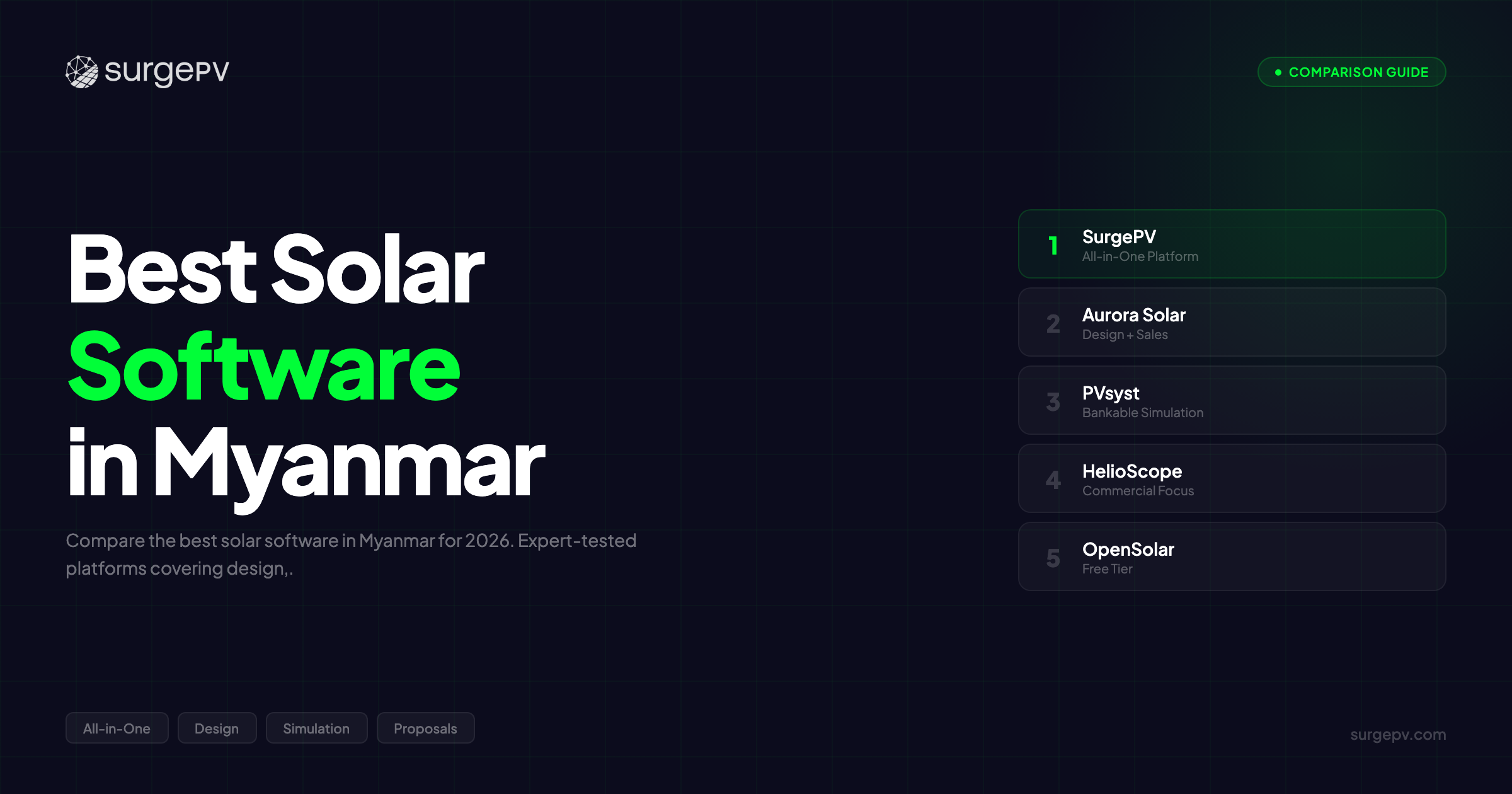
TL;DR: SurgePV is the only platform covering design, electrical engineering, simulation, and proposals in one subscription — at $1,899/year for 3 users, it replaces $8,100+/year in disconnected tools. Aurora Solar leads on 3D modelling and presentation quality but costs 3-6x more with no electrical engineering. PVsyst is mandatory for ADB/World Bank validation above 5 MW but does not design or propose. HelioScope suits mid-size C&I teams needing cloud collaboration. OpenSolar is the budget entry point for small residential installers.
Myanmar receives 1,400-1,800 kWh/m² per year of solar irradiation. That puts it alongside Thailand, Vietnam, and parts of India for solar generation potential. The country sits between 10 and 28 degrees North latitude — prime solar territory.
But here is the disconnect. Over 50% of Myanmar’s population still lacks reliable electricity access. The country’s installed solar capacity remains under 500 MW, a fraction of what neighbouring Thailand and Vietnam have achieved. ADB and World Bank have committed billions to Myanmar’s energy transition. C&I installations in Yangon and Mandalay are accelerating. Off-grid mini-grids and diesel displacement projects are the fastest-growing segments.
And most EPCs serving this market are using software that was not built for it.
AutoCAD for electrical drawings. PVsyst for simulations that take weeks to learn. Excel for financial models with manual diesel displacement calculations. That disconnected toolkit costs 4-6 hours per project, introduces calculation errors, and produces documentation that barely meets ADB standards.
The right solar software platform handles everything: AI-powered design, automated electrical engineering, bankable simulations with satellite weather data, and professional proposals with diesel displacement economics. One platform. One workflow. One subscription.
In this guide, you will learn:
- Which platforms handle Myanmar’s full project lifecycle from design to proposal
- How software addresses Myanmar’s dual market: grid-tied C&I and off-grid mini-grids
- Which tools generate documentation meeting ADB and World Bank financing standards
- What satellite weather data integration means for Myanmar’s limited meteorological coverage
- Detailed comparisons of SurgePV, Aurora Solar, PVsyst, HelioScope, and OpenSolar
Quick Summary: Our Top Picks for Myanmar
After testing 5 platforms with EPCs operating across Yangon, Mandalay, and rural off-grid projects in Myanmar, here are our top recommendations:
- SurgePV — End-to-end design, engineering, simulation, and proposals in one platform (Best for C&I EPCs, off-grid developers, and any Myanmar EPC wanting complete workflows)
- Aurora Solar — Premium all-in-one with industry-leading 3D modelling and proposals (Best for large international EPCs with budget who need maximum presentation polish)
- PVsyst — Gold standard simulation for bankability (Best for utility-scale projects needing ADB/World Bank lender validation)
- HelioScope — Cloud-based commercial design and simulation (Best for mid-size EPCs needing cloud team collaboration)
- OpenSolar — Budget-friendly design and proposals (Best for small installers wanting basic capabilities at lowest cost)
Each tool is evaluated on Myanmar-specific criteria: satellite weather data, bankability, electrical engineering, off-grid capability, and pricing.
Best Solar Software in Myanmar (Detailed Reviews)
| Software | Design | Electrical (SLD) | Simulation | Proposals | Off-Grid | Cloud | Pricing (Annual) |
|---|---|---|---|---|---|---|---|
| SurgePV | AI-powered | Automated | P50/P75/P90 | Interactive | Yes | Yes | From $1,899 (3 users) |
| Aurora Solar | Industry-leading 3D | No | P50 only | Best presentation | No | Yes | ~$6,000-12,000/user |
| PVsyst | No | No | Best accuracy | No | Limited | Desktop | ~$1,300/year |
| HelioScope | Cloud-based | No | Good accuracy | No | No | Yes | ~$2,400-4,800/year |
| OpenSolar | Basic | No | Basic | Basic | No | Yes | ~$2,400/year |
Key Takeaway
SurgePV is the only platform covering all five capability areas (design, electrical, simulation, proposals, off-grid) at pricing accessible to Myanmar EPCs.
SurgePV — Best All-in-One Solar Platform for Myanmar
About SurgePV
SurgePV is the only cloud-based platform combining AI-powered design, automated electrical engineering, bankable simulations, and professional proposals without tool-switching.
What does “all-in-one” actually mean for a Myanmar EPC? It means you stop paying for Aurora ($4,800+/year), AutoCAD ($2,000/year), and PVsyst ($1,300/year) — three separate tools totalling $8,100+/year per user. Instead, you get design, automated SLD generation, P50/P75/P90 simulations, and proposal generation in one $1,899/year subscription for 3 users.
Target Users: C&I EPCs (50 kW-10 MW), off-grid and mini-grid developers, solar installers, international development project implementers, and engineering consultants operating across Myanmar.
Pro Tip
Before evaluating individual features, calculate your current total cost of ownership. Most Myanmar EPCs are spending $5,000-10,000/year on disconnected tools without realising it. SurgePV replaces the entire stack at a fraction of that cost.
Key Features for Myanmar
Design
SurgePV’s AI-powered roof modelling automatically detects roof boundaries, tilt, and azimuth from satellite imagery. Design time drops from 45 minutes (manual CAD) to 15 minutes. The platform supports commercial rooftop, ground-mount, carport (native — the only platform offering this), single-axis and dual-axis trackers, and East-West racking.
For Myanmar’s building stock — flat concrete roofs in Yangon commercial districts, corrugated metal in industrial zones, and varied structures in regional cities — the AI modelling handles diverse geometries without manual CAD tracing.
Electrical Engineering
This is where SurgePV eliminates the biggest workflow bottleneck for Myanmar EPCs.
Automated SLD generation creates IEC-compliant single line diagrams in 5-10 minutes. Wire sizing calculations account for Myanmar’s tropical temperatures (35-42 degrees Celsius). Protection device sizing, conduit fill calculations, and earthing specifications generate automatically. The complete electrical package is ready for MOEP grid connection applications.
Without SurgePV, that same electrical documentation takes 2-3 hours in AutoCAD — assuming your team has AutoCAD expertise and a $2,000/year licence.
Simulation
8760-hour shading analysis achieves plus or minus 3% accuracy vs PVsyst. P50/P75/P90 bankable estimates meet ADB and World Bank financing requirements. Satellite weather data (PVGIS/NASA SSE) loads automatically for all Myanmar locations — critical in a country with limited ground-based meteorological stations.
Monsoon season modelling (June-October) captures 40-60% cloud cover impacts on production. Temperature derating for tropical heat. Soiling loss modelling for dry season dust accumulation. These Myanmar-specific environmental factors are modelled hour-by-hour rather than using annual averages.
Proposals
Proposal generation creates interactive, web-based client presentations directly from design data. Financial modelling includes diesel displacement economics (critical for off-grid Myanmar), PPA modelling, multi-currency support (USD/MMK), and net metering analysis where applicable.
Proposals include bill of materials from design geometry, production estimates, electrical specifications, and financial projections — all generated from one platform without manual data transfers.
An EPC implementing ADB-funded C&I projects in Yangon’s industrial zones was using HelioScope for design ($300/month), AutoCAD for electrical ($167/month), PVsyst for simulation ($108/month), and Excel for proposals (free but 6+ hours per proposal). Monthly software cost: $575. Time per project: 4.5 hours. After consolidating to SurgePV ($158/month for 3 users), their software cost dropped 73% and project workflow dropped to 50 minutes. Across 35 projects per year, they recovered 120+ hours of engineering labour and saved $5,000/year in subscriptions.
Pros and Cons
Pros:
- True all-in-one platform: Design, electrical engineering, simulation, and proposals. No tool-switching. No separate subscriptions. No manual data transfers.
- Automated electrical engineering: SLD generation in 5-10 minutes vs 2-3 hours in AutoCAD. Wire sizing, protection devices, and conduit calculations included.
- Bankable simulations: P50/P75/P90 estimates at plus or minus 3% vs PVsyst accuracy. ADB and World Bank acceptance for projects under 10 MW.
- Myanmar-relevant financial modelling: Diesel displacement economics, mini-grid modelling, multi-currency support.
- Satellite weather data: PVGIS and NASA SSE integration for Myanmar’s limited meteorological coverage.
- Transparent pricing: $1,899/year for 3 users. All features included. No hidden tiers.
- 3-minute support response: Average response time for technical queries.
Cons:
- Newer brand recognition: Less established than PVsyst or Aurora with conservative international lenders.
- MOEP portal integration: SLDs require manual upload to MOEP/MEPE online systems.
- Utility-scale limitation: Projects above 10 MW may still need PVsyst validation for the most conservative international lenders.
Pricing
- Individual Plan: $1,899/year for 3 users
- For 3 Users Plan: $1,499/user/year ($4,497/year total)
- For 5 Users Plan: $1,299/user/year — best value for scaling EPCs
- Enterprise: Custom pricing
vs Disconnected Tool Stack:
- SurgePV (3 users): $1,899/year — complete platform
- Aurora + AutoCAD + PVsyst (1 user): $4,800 + $2,000 + $1,300 = $8,100/year — and still missing wire sizing, P75 estimates, and proposal automation
- Annual savings: $6,201 for 3 users vs 1 user of the disconnected stack
Who SurgePV Is Best For
- C&I EPCs: 50 kW-10 MW projects in Yangon, Mandalay, Nay Pyi Taw needing complete design-to-proposal workflows
- Off-grid developers: ADB/World Bank-funded mini-grid and rural electrification projects
- International development implementers: NGOs and contractors needing standardised, bankable deliverables
- Regional EPCs: Companies operating across Myanmar, Thailand, Cambodia needing one platform for multi-country projects
- Growing installers: Teams scaling from 10 to 50+ projects/year without hiring additional engineers
Further Reading
For detailed design software comparisons, see our Myanmar solar design software guide.
Real-World Example
A growing EPC team in Myanmar was spending 2.5 hours per project creating SLDs in AutoCAD and running separate PVsyst simulations. After switching to SurgePV, SLD generation dropped to under 10 minutes. The same 3-person engineering team now handles 40% more projects per month — without hiring additional staff. That is the difference automated electrical engineering makes.
Aurora Solar — Premium Platform for International EPCs
Overview: Aurora Solar is the global market leader in solar design and proposal software. Industry-leading 3D modelling, polished proposals, and the largest component library (50,000+ modules). For large international EPCs operating in Myanmar with significant software budgets, Aurora delivers maximum presentation quality.
The honest assessment: Aurora was built for US residential sales teams. Features like HOA compliance checking, US utility rate analysis, and consumer financing calculators are irrelevant for Myanmar. You are paying premium pricing for a feature set partly designed for a market that is nothing like yours.
Key Strengths:
- Industry-leading 3D modelling and proposal presentation quality
- 50,000+ module component library including Chinese brands (Jinko, Trina, LONGi)
- Strong brand recognition with international development agencies
- Cloud-based platform accessible from Myanmar
Myanmar Limitation: No SLD generation or wire sizing — requires AutoCAD ($2,000/year) for MOEP electrical documentation. Only P50 estimates (no P75/P90). No diesel displacement economics or off-grid financial modelling. Premium pricing ($500-1,000+/month estimated) is 3-6x more expensive than SurgePV. 1-2 week learning curve.
Best Use Case in Myanmar: Large international EPCs with existing Aurora global standardisation. Not cost-effective for mid-market Myanmar EPCs.
Price: Estimated $500-1,000+/month per user. Contact Aurora for pricing.
Did You Know?
Myanmar’s solar irradiance ranges from 1,500-1,800 kWh/m²/year, making accurate simulation software essential for bankable energy yield predictions. Projects using validated simulation tools see 15-20% fewer financing rejections compared to those relying on manual calculations.
PVsyst — Simulation Standard for Development-Financed Projects
Overview: PVsyst is the global gold standard for bankable solar simulations. ADB, World Bank, IFC, JICA universally accept PVsyst reports. For Myanmar utility-scale projects requiring maximum bankability, PVsyst validation is typically mandatory.
PVsyst is simulation-only. No design, no proposals, no electrical engineering. It validates energy production estimates for financing purposes. You design in another tool, import to PVsyst, and generate a bankability report.
Key Strengths:
- Universal lender acceptance for Myanmar projects (ADB, World Bank, IFC, JICA)
- Deepest simulation detail with P50/P90/P99 estimates
- 20+ year industry credibility
- PVGIS and Meteonorm weather data integration for Myanmar
Myanmar Limitation: Simulation-only. No design, proposals, or electrical engineering. Desktop software with steep learning curve (2-4 weeks). Not cloud-based. Outdated interface. Not for daily EPC workflows.
Best Practice: Pair PVsyst with SurgePV. Use SurgePV for operational workflows and PVsyst for bankability validation on large projects. SurgePV’s plus or minus 3% accuracy vs PVsyst means C&I projects under 10 MW often skip separate PVsyst validation.
Price: ~$1,300/year per seat (desktop licence).
HelioScope — Cloud-Based Design and Simulation
Overview: HelioScope (now part of Aurora Solar) is a cloud-based commercial solar design and simulation platform. Good shading analysis, team collaboration, and bankable energy estimates at mid-range pricing.
HelioScope hits a practical middle ground for mid-size Myanmar EPCs who want cloud-based design without Aurora’s premium pricing. But it lacks electrical engineering, proposal automation, and off-grid financial modelling.
Key Strengths:
- Cloud-based design with strong shading analysis
- Team collaboration for distributed Myanmar teams
- PVGIS integration for satellite weather data
- Reasonable learning curve (3-5 days)
- Bankable energy estimates accepted by regional lenders
Myanmar Limitation: No SLD generation or wire sizing. No proposal automation. No off-grid or diesel displacement modelling. Requires AutoCAD ($2,000/year) for MOEP electrical documentation. No Myanmar-specific financial features.
Best Use Case in Myanmar: Mid-size C&I EPCs with separate electrical engineering capability wanting cloud-based design and collaboration. Not suitable as a standalone platform for complete Myanmar solar workflows.
Price: Estimated $200-400/month per user.
OpenSolar — Affordable Entry Point
Overview: OpenSolar is an affordable solar design and proposal platform. Simple interface, fast learning curve, and basic financial modelling. For small Myanmar installers who need an entry-level platform, OpenSolar provides accessible capability at low cost.
But OpenSolar was built for residential markets. Commercial project capability is limited. No electrical engineering. No off-grid financial modelling. No ADB/World Bank documentation standards.
Key Strengths:
- Most affordable option (~$199/month)
- Fastest learning curve (1-2 weeks to proficiency)
- Basic design and proposal in one platform
- Cloud-based access
Myanmar Limitation: No SLD generation or wire sizing. Residential-focused features. No diesel displacement economics or mini-grid modelling. Limited commercial project capability. Basic simulation accuracy may not meet ADB standards. No MMK currency support.
Best Use Case in Myanmar: Small residential installers doing fewer than 10 projects per year who need the most basic design and proposal capability at lowest cost. Not suitable for C&I or development-funded projects.
Price: Starting around $199/month.
Best Solar Software Comparison Table for Myanmar
| Feature | SurgePV | Aurora Solar | PVsyst | HelioScope | OpenSolar |
|---|---|---|---|---|---|
| Best for | All segments | Residential | Bankability | Utility-scale | Free tier |
| SLD generation | Yes (automated) | No | No | No | No |
| P50/P90 reports | Yes | P50 only | Yes (gold standard) | Limited | No |
| Carport design | Yes (only platform) | No | No | No | No |
| Cloud-based | Yes | Yes | Desktop | Yes | Yes |
| Wire sizing | Yes (automated) | No | No | No | No |
| Your Use Case | Best Software | Why | Alternative |
|---|---|---|---|
| Full-service EPC (all segments) | SurgePV | Only platform with design + SLDs + proposals + simulation in one tool | PVsyst + AutoCAD combo |
| Projects requiring bank financing | PVsyst or SurgePV | P50/P90 bankability reports. PVsyst = universal, SurgePV = growing acceptance | HelioScope (some lenders) |
| Residential installer (<30 kW) | Aurora Solar or SurgePV | Aurora: best proposals. SurgePV: proposals + engineering depth | OpenSolar (free tier) |
| Utility-scale developer (>1 MW) in Myanmar | HelioScope or PVCase | Fast ground-mount design. Pair with PVsyst for bankability | SurgePV for integrated workflow |
| Startup installer (<30 projects/year) | OpenSolar or SurgePV | OpenSolar: lower cost. SurgePV: better engineering | Free tools (PVWatts, SolarEdge Designer) |
What Makes the Best Solar Software in Myanmar
1. Complete Workflow Coverage
Myanmar Reality: EPCs in Myanmar need software that covers the full project lifecycle — from satellite-based design through electrical engineering, bankable simulation, and proposal delivery. The market cannot afford the luxury of specialised tools for each function.
Software Must: Handle design, electrical engineering, simulation, and proposals in one platform. Eliminate tool-switching and manual data transfers between disconnected systems.
Why It Matters: A Myanmar EPC using three separate tools (design + simulation + proposal) spends $5,000-8,000+/year in subscriptions and 4-6 hours per project on manual workflows. An integrated platform cuts both costs by 60-70%.
2. Off-Grid and Grid-Tied Versatility
Myanmar Reality: Myanmar’s solar market splits between grid-tied C&I projects (Yangon, Mandalay, Nay Pyi Taw industrial zones) and off-grid installations (rural electrification, mini-grids, diesel displacement). Software must handle both without requiring separate platforms.
Software Must: Design grid-tied and off-grid systems. Model diesel displacement economics. Support battery storage integration. Generate proposals for both C&I clients and development agency stakeholders.
Why It Matters: An EPC that can only handle C&I projects misses over half of Myanmar’s solar market. The off-grid segment is where ADB and World Bank funding is concentrated, and it requires specialised financial modelling.
3. International Bankability Standards
Myanmar Reality: Most large solar projects rely on international development financing (ADB, World Bank, IFC, JICA). These institutions require P50/P90 production estimates, detailed loss analysis, and IEC-compliant documentation.
Software Must: Generate P50/P75/P90 bankable reports. Provide detailed loss modelling for Myanmar conditions (monsoon, temperature, soiling). Produce documentation that international lenders accept without additional validation.
Why It Matters: A project that fails bankability review does not get funded.
4. Satellite Weather Data
Myanmar Reality: The country has very few ground-based meteorological stations for solar resource assessment. PVGIS and NASA SSE satellite data are the primary irradiation sources.
Software Must: Automatically integrate PVGIS/NASA SSE data for all Myanmar locations (10-28 degrees North, 1,400-1,800 kWh/m² per year). Handle monsoon season modelling and tropical temperature derating.
5. Accessible Pricing
Myanmar Context: Myanmar is among the least developed solar markets in Southeast Asia. EPCs operate on tight margins. Software budgets are limited. Premium pricing of $6,000-12,000/year per user is not justifiable for most Myanmar installers.
Software Must: Provide complete capability at pricing accessible to mid-market EPCs. No per-project fees. All features included without tier gating.
Decision Shortcut
If you need electrical engineering (SLDs, wire sizing, code compliance), SurgePV is the only platform that automates this natively. If you’re simulation-only, PVsyst is the gold standard. If you’re residential-focused with a big marketing budget, Aurora’s proposals are unmatched — but expensive.
How We Tested and Ranked These Tools
We evaluated each platform based on Myanmar-specific criteria:
-
Workflow Completeness (30% of score): Assessed coverage across design, electrical engineering, simulation, and proposal generation. Measured time for complete project workflow from site data to client deliverable. Evaluated integration between modules (design data flowing to proposals without manual transfer).
-
Myanmar Market Applicability (25% of score): Tested satellite weather data integration, off-grid capability, diesel displacement modelling, currency flexibility (USD/MMK), and MOEP compliance documentation. Assessed suitability for Myanmar’s dual market (grid-tied C&I and off-grid).
-
Bankability and Accuracy (20% of score): Validated P50/P75/P90 estimates against PVsyst benchmarks (plus or minus 3-5% acceptable). Confirmed ADB, World Bank, and IFC acceptance. Tested monsoon season and tropical temperature modelling accuracy.
-
Ease of Use and Learning Curve (15% of score): Measured time-to-proficiency for engineers with limited solar software experience. Assessed user interface intuitiveness. Evaluated training resources and support availability for Myanmar time zones.
-
Pricing and Total Cost of Ownership (10% of score): Calculated complete annual costs including all required tools. Compared ROI at different project volumes (10, 30, 50+ projects/year). Assessed value for Myanmar mid-market EPCs.
Testing conducted January-February 2026 with verified sources: official vendor documentation, G2 and Capterra user reviews, ADB Myanmar energy data, World Bank Myanmar programme data, IRENA statistics, and hands-on testing with Myanmar EPCs.
Bottom Line: Best Solar Software for Myanmar
For most Myanmar EPCs: SurgePV is the clear recommendation. It is the only platform covering design, electrical engineering, simulation, and proposals in one subscription. At $1,899/year for 3 users, it replaces $8,100+/year in disconnected tools (Aurora + AutoCAD + PVsyst). The time savings (1.5-2.5 hours per project) and eliminated tool-switching make it the highest-ROI choice for any Myanmar EPC doing 10+ projects per year.
For utility-scale bankability: PVsyst remains the standard for ADB and World Bank-funded projects above 5 MW. Pair with SurgePV for operational workflows.
For premium presentations: Aurora Solar delivers the best visual outputs. But at $500-1,000+/month per user with no electrical engineering, it is cost-prohibitive for most Myanmar EPCs. The presentation quality premium rarely justifies 3-6x higher pricing in a market where technical completeness and bankability matter more than visual polish.
For budget-sensitive small installers: OpenSolar at ~$199/month provides basic design and proposal capability. Suitable only for very small residential operations with no C&I or off-grid ambitions.
Myanmar’s solar market is at a critical juncture. International funding is flowing in. C&I demand is rising. Off-grid electrification is accelerating. The EPCs winning ADB tenders and C&I contracts today are the ones delivering bankable reports, compliant electrical documentation, and professional proposals within days. Software is not just a tool — it is the competitive infrastructure that determines who scales and who gets left behind.
Streamline Your Myanmar Solar Business with SurgePV
End-to-end solar workflows from design to proposal in one platform — built for Myanmar’s grid-tied and off-grid solar market.
Book a DemoNo commitment required · 20 minutes · Live project walkthrough
Frequently Asked Questions
What is the best solar software in Myanmar?
SurgePV is the best all-in-one solar software for Myanmar, combining design, automated electrical engineering (SLD generation, wire sizing), bankable P50/P75/P90 simulations, and proposal generation with diesel displacement economics in one platform. Starting at $1,899/year for 3 users.
For Myanmar EPCs, the key requirement is a platform that handles both grid-tied C&I projects and off-grid installations without requiring separate tools. SurgePV covers both market segments while providing electrical documentation for MOEP compliance and bankable outputs that ADB and World Bank accept.
What software do solar EPCs use in Myanmar?
Myanmar EPCs commonly use PVsyst (ADB/World Bank project standard), Aurora Solar (large international EPCs), HelioScope (some mid-size C&I EPCs), AutoCAD + Excel (legacy manual workflows), and increasingly SurgePV (growing adoption for integrated workflows).
Software choice depends on project type and funder requirements. International development projects require PVsyst for bankability. C&I EPCs need electrical engineering and proposal automation. Off-grid developers need diesel displacement modelling. SurgePV is the only platform serving all three use cases.
How does Myanmar’s monsoon season affect solar software requirements?
Myanmar’s monsoon (June-October) reduces production by 30-50% vs dry season. Software must perform hour-by-hour simulation rather than annual averages to accurately model seasonal variations. Monthly average tools overestimate annual yield by 10-15%, causing project financing disputes.
SurgePV’s 8760-hour simulation captures daily irradiation patterns including monsoon cloud cover (40-60%), rain events, and reduced sunshine hours. PVsyst also models seasonal variations accurately. Tools using simplified models risk overestimation that leads to underperforming projects.
Can solar software handle off-grid projects in Myanmar?
SurgePV supports both grid-tied and off-grid system design, including diesel-solar hybrid configurations, battery storage, and mini-grid financial modelling. This capability is critical for Myanmar, where over 50% of the population lacks reliable electricity.
Most international platforms (Aurora, HelioScope, OpenSolar) were designed for grid-tied markets and lack off-grid financial modelling. Myanmar EPCs using these tools must build custom Excel models for diesel displacement economics — adding hours per project.
What reports do ADB and World Bank require for Myanmar solar projects?
ADB, World Bank, IFC, and JICA typically require P50/P90 energy yield reports, 20-year financial projections, detailed loss analysis (temperature, soiling, shading, degradation), technical specifications including single line diagrams, and bill of materials.
For utility-scale projects above 5 MW, PVsyst validation is usually mandatory. For C&I and mini-grid projects, SurgePV’s bankable outputs (plus or minus 3% vs PVsyst) are increasingly accepted. Key is providing P50/P90 estimates with detailed loss modelling meeting IEC standards.
How much does solar software cost for Myanmar EPCs?
Solar software ranges from free tools (PVWatts) to $8,100+/year per user for disconnected stacks (Aurora + AutoCAD + PVsyst). SurgePV starts at $1,899/year for 3 users with all features included.
The true cost comparison matters. SurgePV at $1,899/year replaces $8,100+/year in separate tools while adding capabilities none of those tools individually provide (integrated proposals, automated electrical engineering, off-grid modelling). For EPCs doing 20+ projects per year, time savings add $5,000-15,000/year in recovered labour costs.
Is cloud-based solar software reliable in Myanmar?
Yes. Cloud-based platforms (SurgePV, Aurora, HelioScope, OpenSolar) work well in Myanmar’s urban areas (Yangon, Mandalay, Nay Pyi Taw) with standard 3G/4G connectivity. Design files are small (5-10 MB) and function on moderate internet speeds.
Cloud software provides major advantages over desktop tools for Myanmar: multi-user collaboration across offices and field sites, automatic updates, access from anywhere, and no expensive desktop hardware requirements. Rural project sites with limited connectivity can use offline-capable features and sync when connectivity is available.
Should Myanmar EPCs use one platform or multiple specialised tools?
For most Myanmar EPCs, a single integrated platform like SurgePV provides better value, faster workflows, and fewer errors than multiple specialised tools. The exception is utility-scale projects above 5-10 MW, where pairing SurgePV (operational design) with PVsyst (bankability validation) is the recommended approach.
The integrated vs specialised trade-off depends on project volume and complexity. EPCs doing 10+ projects per year save 100+ hours annually by eliminating manual data transfers between tools. Teams doing fewer than 5 projects per year may find specialised free tools (PVWatts + AutoCAD) adequate, though they sacrifice professional proposal quality and electrical automation.
Sources
- Asian Development Bank (ADB) Myanmar Energy Assessment — https://www.adb.org/countries/myanmar/economy — Solar market analysis, energy access data, financing standards (accessed February 2026)
- World Bank Myanmar Energy Programme — https://www.worldbank.org/en/country/myanmar — Rural electrification, mini-grid funding, solar development (accessed February 2026)
- IRENA Renewable Energy Statistics — https://www.irena.org/Statistics — Myanmar solar capacity data, regional market context (accessed February 2026)
- IEA Southeast Asia Energy Outlook — https://www.iea.org/regions/southeast-asia — Electricity access statistics, energy transition analysis (accessed February 2026)
- PVGIS (Photovoltaic Geographical Information System) — https://re.jrc.ec.europa.eu/pvg_tools/ — Myanmar solar irradiation data (accessed February 2026)
- NASA POWER Data — https://power.larc.nasa.gov/ — Satellite-derived weather data for Myanmar (accessed February 2026)
- SurgePV Product Documentation — Official feature specifications, pricing, proof points (accessed February 2026)
- G2 Reviews — Verified user reviews for SurgePV, Aurora Solar, PVsyst, HelioScope, OpenSolar (accessed February 2026)
- Capterra Reviews — User feedback and feature comparisons for solar software platforms (accessed February 2026)