

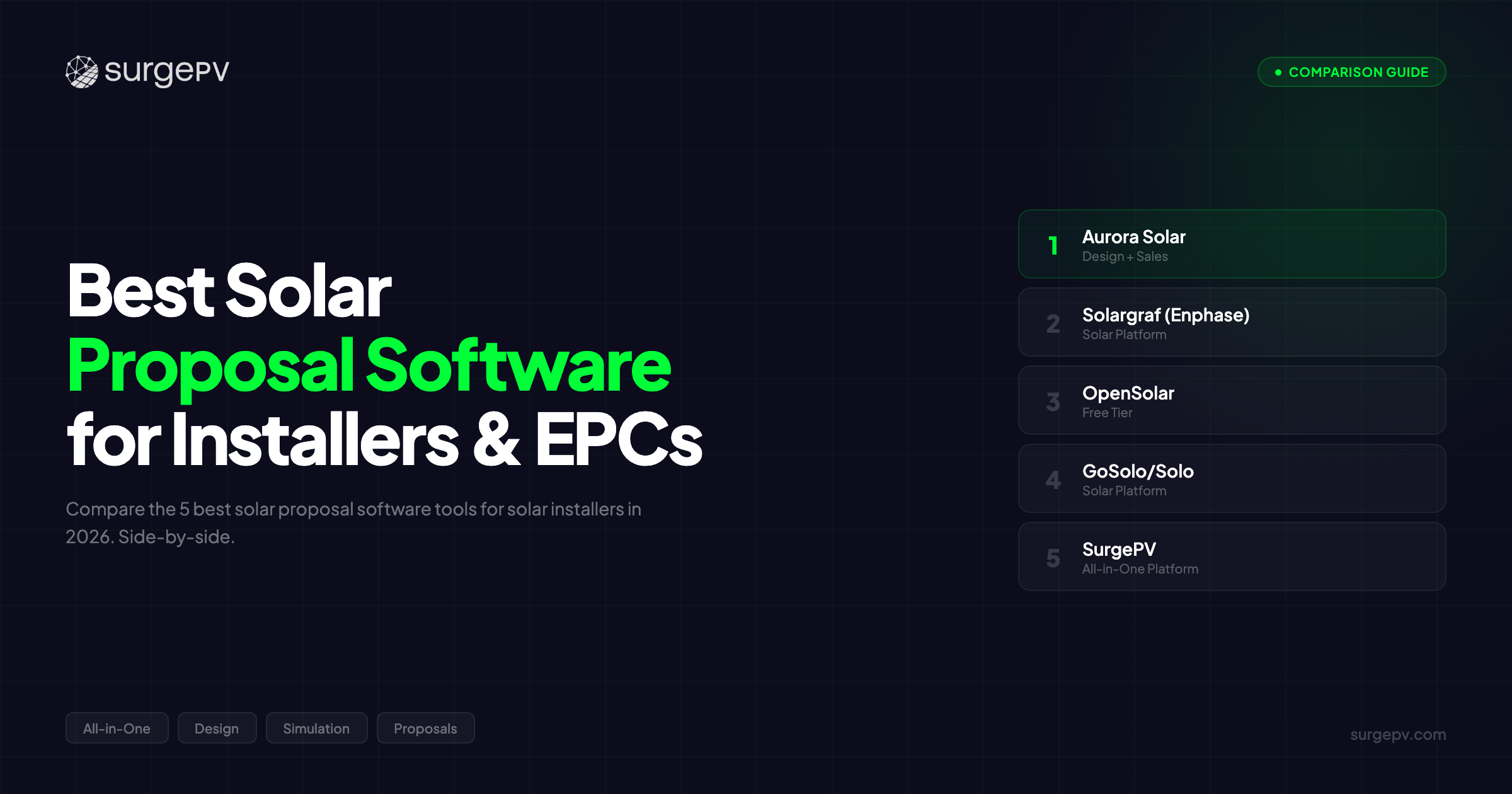
TL;DR: Your design is done. Now your customer needs a reason to sign. The 5 best solar proposal software platforms in 2026 are Aurora Solar (best for 3D design + proposals), Solargraf (best for Enphase installers), OpenSolar (best free option), GoSolo (best for fast quoting), and SurgePV (best all-in-one platform at $1,899/year for 3 users combining design, proposals, financing, and CRM).
Your Design Is Done — Now Your Customer Needs a Reason to Sign
Your design is done.
The panels are placed. The strings are balanced. The system passes electrical review. Your customer sits across from you at the kitchen table, waiting.
Now what?
You pull out a PDF. Twenty-three pages. Dense text. Tables. Numbers. The customer squints at page 12. They say they’ll “think about it.” You email the proposal. They ghost you. Three weeks later, they sign with a competitor who showed them a 3D rendering on an iPad, calculated three financing options in real time, and closed with an electronic signature before the coffee went cold.
Here’s the truth: solar proposal software is the bridge between technical excellence and revenue. A $50,000 residential system and a $2M commercial installation both require the same thing — a document that turns engineering into economics, complexity into clarity, and hesitation into a signature.
But most solar installers are still using tools designed for a different era. PDF proposals that take 45 minutes to create. Manual ROI calculations in Excel. Printed contracts that sit unsigned on countertops. Meanwhile, high-performing installers close deals in a single meeting using interactive proposal platforms that combine design visualization, financing comparison, incentive breakdowns, and eSignature in one workflow.
According to SEIA data, the average solar installation company quotes 5-10 potential customers for every project they close. The installers with the fastest, most polished proposals win disproportionately. Speed-to-proposal is a competitive advantage. The faster you deliver a professional, interactive proposal, the less time competitors have to undercut you.
The solar proposal software market has evolved dramatically since 2020. Enphase acquired Solargraf. Aurora Solar expanded from pure design into proposal automation. New platforms like GoSolo emerged with DNV-certified speed claims. And all-in-one platforms like SurgePV integrated proposals with electrical engineering, CRM, and customer portals to eliminate tool-switching.
We tested the top 5 platforms used by US and international solar installers. We evaluated proposal customization, financing engines, ROI accuracy, eSignature integration, CRM automation, pricing transparency, and real-world usability. We analyzed which tools work for residential vs. commercial projects, Enphase-exclusive vs. multi-brand installers, and small teams vs. high-volume EPCs.
In this guide, you’ll learn:
- The 5 best solar proposal software platforms ranked by use case and installer type
- Side-by-side feature comparison table (proposal builder, financing, eSignature, CRM, pricing)
- Why Solargraf works only for Enphase installers and what multi-brand teams should use instead
- How commercial solar proposals differ from residential and which tools handle them best
- The difference between quoting software and proposal software (and which tools do both)
- What proposal features actually increase close rates (hint: in-meeting eSignature matters more than 3D renderings)
- Our recommendation by business model: Enphase-exclusive, multi-brand, commercial EPC, or budget-conscious
What Makes Great Solar Proposal Software?
Before comparing specific platforms, understand what separates proposal tools that close deals from those that create digital paperweights.
Proposal Customization & Branding
Your proposal is your brand. Generic templates scream “I use the same tool as 500 other installers.” Great proposal software lets you customize colors, logos, fonts, section order, and cover page imagery to match your brand identity.
The best platforms offer template libraries with pre-built sections (system overview, financing options, ROI analysis, incentive breakdowns, installation timeline) that you mix and match per customer. You’re not starting from scratch on proposal #47 this month.
Financing Engine (Multi-Lender Comparison)
Solar customers don’t buy kilowatt-hours. They buy monthly payments.
Your proposal software must calculate cash purchase, loan options, lease terms, and power purchase agreements (PPAs) side-by-side with clear monthly payment comparisons. The financing engine should integrate with major lenders (Mosaic, GoodLeap, Sunlight Financial) to pull live rates and terms.
Here’s what most people miss: showing only one financing option forces customers into a binary yes/no decision. Showing three options — $0-down loan at $185/month, $5,000-down loan at $142/month, or $20,000 cash with 6.2-year payback — gives customers agency to choose what fits their budget. Installers offering multi-option proposals close 20-30% more deals than single-option teams.
ROI & Incentive Calculations
Your customer doesn’t care about your 98% BOM accuracy. They care about saving $187/month on their electricity bill.
Great proposal software automatically calculates:
- Monthly utility bill savings based on actual utility rates
- Federal Investment Tax Credit (ITC) at 30%
- State and local incentives (SGIP in California, SMART in Massachusetts, etc.)
- Net metering credits
- Year-by-year savings projection over 25 years
- Payback period and total lifetime savings
The calculation must use the customer’s actual utility tariff structure. A time-of-use rate customer in Southern California pays $0.51/kWh during summer peak hours and $0.25/kWh off-peak. If your proposal averages this to $0.35/kWh, you’re underestimating savings by 30-40%.
eSignature & Payment Integration
The best time to close a deal is right now. The second-best time is never.
Built-in eSignature lets customers sign contracts during the kitchen-table meeting on a tablet or phone. No “I’ll review this and get back to you.” No printed contracts left unsigned. Installers using in-meeting eSignature report 30-40% higher close rates because hesitation never gets a chance to grow.
Every day between proposal delivery and contract signing is a day your competitor can undercut you, your customer can talk themselves out of solar, or financing rates can change. In-meeting closing eliminates all three risks.
CRM & Workflow Automation
Proposal software shouldn’t exist in a vacuum. It must integrate with your CRM (HubSpot, Salesforce, Zoho) to track lead status, automate follow-up emails, and trigger next-step tasks.
The workflow should look like this: Lead captured in CRM, design created, proposal generated with customer data auto-populated, proposal sent via trackable link, customer opens proposal (you get notified), customer signs (contract auto-filed in CRM), payment collected (integrated with Stripe/PayPal), installation scheduled (project management tool notified).
Manual data entry between these steps wastes hours and creates errors. Great proposal platforms automate the entire flow.
Customer Portal & Post-Sale Experience
The sale doesn’t end at signing. Customers want to track installation progress, see their system’s production data, submit service requests, and refer friends.
A branded customer portal keeps your company top-of-mind and reduces support calls. The best portals integrate with monitoring systems to show live production data, handle warranty claims, and generate referral links with incentives.
Note
Proposal software and solar design software are different categories. Design tools (Aurora, PVsyst, HelioScope) create panel layouts and electrical plans. Proposal platforms turn those designs into customer-facing documents with financing and contracts. Some platforms like SurgePV and Aurora Solar combine both design and proposals. Others specialize in one or the other.
Why Your Current Proposal Tool Is Losing You Deals
PDF proposals were state-of-the-art in 2015. In 2026, they’re a liability.
Here’s the problem with PDF proposals:
They’re slow to create. Manual PDF creation takes 30-60 minutes per proposal — pulling data from your design tool, copying it into Word, calculating ROI in Excel, exporting to PDF, emailing it to the customer. High-volume installers generating 50+ proposals per month waste 25-40 hours monthly on proposal assembly alone.
They’re forgettable. You email a 20-page PDF. Your customer downloads it to their Desktop. They never open it again. There’s no tracking, no engagement data, no follow-up trigger. You call 5 days later asking “Did you review the proposal?” They say “Oh yeah, I meant to look at that.”
They don’t close deals. A PDF sitting on a customer’s computer doesn’t have eSignature capability. The customer has to print, sign, scan, and email back, creating friction at the exact moment you want momentum. Most customers never complete this workflow.
Meanwhile, interactive proposal platforms deliver trackable web links. You see when the customer opens the proposal, which sections they spend time on, and whether they shared it with their spouse. The proposal includes financing calculators they can adjust in real time. And it ends with a “Sign Now” button that closes the deal before they leave your website.
Bottom line: the installers winning your local market aren’t better designers. They’re faster proposers. They deliver proposals in 10 minutes instead of 45. They close deals in one meeting instead of three. They don’t give hesitation time to grow.
If you’re still creating PDF proposals in 2026, you’re competing with installers using platforms that deliver proposals in under 15 minutes with in-meeting eSignature. You’re bringing a spreadsheet to a software fight.
Further Reading
For detailed design tool comparisons, see our best solar design software ranking.
Top 5 Solar Proposal Software Platforms for Installers (2026)
Aurora Solar — Best for 3D Design + Proposal Workflows
Rating: 8.9/10 | Price: $$$$ (enterprise, contact sales) | Aurora Solar | Aurora Solar review
Aurora Solar is the 800-pound gorilla of the solar software market. Industry-leading AI roof detection, beautiful 3D visualizations, and polished customer-facing proposals have made Aurora the default choice for large residential installers and enterprise solar companies.
Why Aurora works for proposals:
The platform’s strength is integrated design-to-proposal workflow. Aurora generates panel layouts using satellite imagery and AI roof detection, runs shading analysis, calculates production, and converts everything into interactive web-based proposals with 3D renderings that homeowners love.
The proposal builder includes financing comparison across multiple lenders, utility bill analysis with actual rate structures, incentive calculations (federal ITC, state rebates, net metering credits), and branded templates with your company logo and colors. Proposals are delivered as shareable web links with engagement tracking — you see when customers open them and which sections they view.
Aurora integrates with major CRMs (Salesforce, HubSpot) via API and Zapier, enabling automated workflows from lead capture through proposal delivery to contract signing. The eSignature capability lets customers sign contracts directly within the proposal interface.
Here’s where it gets expensive.
Aurora’s pricing is enterprise-tier, starting at approximately $4,000-6,000+ per user per year depending on features and contract length. For large installers handling 100+ residential projects monthly, the cost is justified by speed and polish. For small installers doing 10-20 projects monthly, the ROI calculation is harder.
And Aurora doesn’t generate electrical documentation. If you need permit-ready single-line diagrams (SLDs), you’re exporting to AutoCAD and spending another 2-3 hours per commercial project on manual electrical drawings. That’s an additional $2,000/year for AutoCAD licenses per user.
Pros:
- Industry-leading 3D visualizations and AI roof detection
- Beautiful, polished customer-facing proposals with high close rates
- Multi-lender financing integration (Mosaic, GoodLeap, Sunlight)
- CRM integrations (Salesforce, HubSpot, Zoho)
- Strong brand recognition that builds customer confidence
- Good for residential sales teams prioritizing visual impact
- Regular feature updates and large development team
Cons:
- Premium pricing ($4,000-6,000+/year per user) too expensive for small installers
- No electrical engineering (SLD generation requires separate AutoCAD)
- Pricing not transparent (contact sales required)
- Longer onboarding time (4-6 weeks for commercial features)
- Overkill for installers who only need proposals without integrated design
- Total cost with AutoCAD exceeds $6,000/year per user
Best for: Large residential installers and enterprise solar companies with 100+ projects per year who need industry-leading 3D design combined with polished proposals and can justify premium pricing. Ideal for sales-focused teams where visual impact drives close rates.
Solargraf (Enphase) — Best for Enphase Ecosystem Installers
Rating: 8.4/10 | Price: Included with Enphase partnership | Solargraf
Solargraf is Enphase Energy’s proposal and design platform, acquired in 2019 and integrated into the Enphase ecosystem. For installers who exclusively use Enphase microinverters, Solargraf offers seamless integration that no third-party platform can match.
Why Solargraf works for Enphase installers:
Enphase powers approximately 50% of US residential solar installations. If you’re an Enphase-exclusive installer, Solargraf automatically pairs panels with Enphase IQ8 microinverters, pulls live pricing from your Enphase distributor account, and generates proposals with Enphase branding that reassures homeowners they’re getting premium equipment.
The proposal builder includes financing calculators, ROI projections, utility bill analysis, and eSignature capability. Proposals integrate with Enphase Enlighten monitoring, so customers can see their system’s production data in the same branded portal where they signed their contract.
For Enphase installers, Solargraf is often included as part of their Enphase partnership agreement, making it effectively free or low-cost compared to standalone proposal platforms.
Here’s the limitation: Solargraf is heavily optimized for Enphase hardware. If you work with multiple inverter brands (SolarEdge, Fronius, SMA), Solargraf becomes cumbersome. The equipment database prioritizes Enphase products. The proposal templates assume Enphase monitoring. The workflow is designed around the Enphase ecosystem.
Multi-brand installers will find Solargraf limiting. You can technically use it with non-Enphase equipment, but you lose most of the value that makes Solargraf attractive in the first place.
Pros:
- Seamless Enphase ecosystem integration (IQ8 microinverters, Enlighten monitoring)
- Automatic equipment pairing for Enphase systems
- Often included with Enphase partnership (low or no cost)
- Strong brand recognition (Enphase-backed credibility)
- Customer portal integrated with Enphase Enlighten
- Good for residential Enphase installers who want simplicity
- Regular updates tied to Enphase product releases
Cons:
- Heavily optimized for Enphase — limited value for multi-brand installers
- Less customization than platform-agnostic tools
- Pricing tied to Enphase partnership (not standalone transparent pricing)
- Limited commercial project support compared to Aurora or SurgePV
- Equipment database prioritizes Enphase (other brands require manual entry)
- Not ideal for installers who want inverter-agnostic flexibility
Best for: Residential solar installers who exclusively use Enphase microinverters and want proposal software that integrates seamlessly with the Enphase ecosystem. Ideal for Enphase partners who get Solargraf included in their partnership agreement.
OpenSolar — Best Free Option for Small to Mid-Sized Teams
Rating: 7.8/10 | Price: Free tier available, paid plans from $199/month | OpenSolar | OpenSolar review
OpenSolar is the most affordable entry point into modern solar proposal software. The free tier provides basic design, proposal generation, and project management tools for small installers handling fewer than 10 projects per month.
Why OpenSolar works for budget-conscious teams:
For installers just starting out or small teams that can’t justify $2,000-6,000/year software subscriptions, OpenSolar’s free tier removes the financial barrier. You get proposal templates with customizable branding, financing calculators with loan/lease/PPA options, ROI projections, and basic CRM functionality.
The paid tiers ($199-$499/month depending on features) add advanced capabilities like API integrations, priority support, and higher project limits. Even the paid tiers cost significantly less than Aurora Solar or enterprise platforms.
OpenSolar is cloud-based with fast onboarding — most teams are productive within 1-2 weeks. The interface is clean and focused on residential workflows. Proposals are delivered as web links with basic engagement tracking.
Here’s what you’re trading for low cost:
OpenSolar lacks the depth of more expensive platforms. The financing engine is basic (no live lender integrations like Mosaic or GoodLeap). The design tools are functional but not as polished as Aurora’s AI roof detection. The CRM is rudimentary compared to HubSpot integration. And the proposal templates, while customizable, don’t have the visual impact of Aurora’s 3D renderings.
OpenSolar is best for straightforward residential projects where speed and cost matter more than cutting-edge features. It’s not built for commercial proposals with complex PPA structures or multi-stakeholder approval workflows.
Pros:
- Free tier for small teams (under 10 projects/month)
- Most affordable paid option ($199-$499/month)
- Fast onboarding (1-2 weeks to productivity)
- Cloud-based with no desktop installation
- Good for residential installers with tight budgets
- Basic proposal, design, and CRM in one platform
- Transparent pricing (no contact-sales gatekeeping)
Cons:
- Free tier has project limits and restricted features
- No live lender integrations (manual financing input required)
- Basic design tools compared to Aurora’s AI capabilities
- Rudimentary CRM (not a replacement for HubSpot or Salesforce)
- Limited commercial project support
- No electrical engineering (no SLD generation)
- Smaller development team means slower feature releases
Best for: Budget-conscious small installers (under 20 projects/month) who need basic proposal functionality without premium pricing. Ideal for residential-focused teams willing to trade advanced features for low cost and fast onboarding.
GoSolo/Solo — Best for Fast Quoting & Sales Enablement
Rating: 8.2/10 | Price: $$ (mid-range, contact for pricing) | GoSolo
GoSolo (also marketed as Solo) is a newer platform focused on speed and sales enablement. The company claims 99.9% DNV-certified design accuracy and targets installers who prioritize fast quoting to capture motivated leads before competitors.
Why GoSolo works for speed-focused sales:
Solar sales is a speed game. The installer who delivers a quote first often wins the deal, even if their price is slightly higher. GoSolo is built around this insight.
The platform combines fast quoting with proposal generation in one workflow. Sales reps can generate preliminary quotes on-site using satellite imagery and basic customer inputs (address, roof type, energy usage). The quote includes estimated system size, monthly payment options, and ROI projections. If the customer is interested, the rep converts the quote into a full proposal with design details, 3D renderings, and eSignature capability.
GoSolo’s DNV certification (99.9% accuracy claim) provides credibility that generic tools lack. DNV is a third-party standards organization that certifies engineering accuracy. For installers competing on technical trust, DNV certification is a selling point to customers.
The sales enablement features include lead tracking, automated follow-up workflows, and team performance dashboards that help managers see which reps are closing fastest.
Here’s the trade-off: GoSolo is newer and has a smaller user base than Aurora or OpenSolar. The platform is evolving quickly, which means some features are still maturing. Commercial project support is limited compared to platforms built for EPCs. And pricing is not transparent (requires sales contact).
GoSolo is best for residential sales teams where speed-to-quote is the primary competitive advantage.
Pros:
- Industry-leading quoting speed (on-site quotes in under 10 minutes)
- DNV-certified design accuracy (99.9% claim provides credibility)
- Sales enablement features (lead tracking, team dashboards)
- Fast quote-to-proposal conversion workflow
- Good for residential installers competing on speed
- Clean, sales-focused interface
- Regular platform updates and responsive development team
Cons:
- Newer platform with smaller user base (less proven at scale)
- Limited commercial project support vs. Aurora or SurgePV
- Pricing not transparent (contact sales required)
- Fewer third-party integrations than established platforms
- Evolving feature set (some capabilities still maturing)
- No electrical engineering (no SLD generation)
Best for: Speed-focused residential sales teams who prioritize fast quoting to capture leads before competitors. Ideal for installers whose sales strategy is built around same-day quotes and in-home closing.
SurgePV — Best All-in-One Proposal Platform (Design to Close)
Rating: 9.2/10 | Price: $1,899/year (3 users) | Book demo | See pricing
SurgePV is the only platform that combines solar design, electrical engineering, bankable simulation, professional proposals, financing, CRM, and customer portal in one integrated workflow. For installers and EPCs tired of switching between Aurora + AutoCAD + Excel, SurgePV eliminates tool fragmentation.
Why SurgePV works as an all-in-one platform:
Here’s what separates SurgePV from every competitor on this list: integrated electrical engineering. Aurora, Solargraf, OpenSolar, and GoSolo all stop at design and proposals. If you need permit-ready electrical documentation — single-line diagrams (SLDs), wire sizing calculations, conduit schedules — you’re exporting to AutoCAD and spending 2-3 hours per commercial project on manual drafting.
SurgePV generates automated SLDs in 5-10 minutes. The system calculates DC and AC wire sizes based on current, distance, and voltage drop limits (NEC Article 690 compliant). It produces conduit fill calculations and breaker sizing. For commercial EPCs handling 20-50 projects per month, eliminating manual AutoCAD drafting saves 40-80 hours monthly.
That’s an entire week of engineering time redirected to closing more deals instead of drawing electrical diagrams.
The proposal workflow integrates with the design and electrical tools. After designing a system and generating the SLD, you click “Create Proposal” and SurgePV auto-populates the proposal with system specifications, BOM, production estimates, and electrical diagrams. The financing engine calculates cash, loan, lease, and PPA options with federal ITC, state incentives, and net metering credits. The proposal is delivered as an interactive web link with 3D renderings, ROI breakdowns, and built-in eSignature.
SurgePV runs 8760-hour simulation with shading analysis that achieves +/-3% accuracy compared to PVsyst — the bankable standard. That means commercial project financiers accept SurgePV’s P50/P75/P90 yield forecasts for due diligence.
The platform supports commercial structures that competitors don’t: carport solar design (the only platform with native carport support), solar trackers (single-axis and dual-axis), and East-West racking. For commercial EPCs working on parking lot canopies or ground-mount projects, SurgePV handles structures that Aurora and OpenSolar can’t.
The CRM integration tracks leads from initial contact through proposal delivery to contract signing to installation completion. The customer portal provides branded access to project status, production monitoring, warranty information, and referral incentives.
And it costs $1,899/year for 3 users. That’s less than Aurora’s per-user cost, includes electrical engineering that Aurora lacks, and eliminates the $2,000/year AutoCAD subscription.
Aurora + AutoCAD costs approximately $6,800/year per user. SurgePV costs $1,899/year for 3 users total. For a 3-person team, that’s annual savings of $18,505.
Reader objection: “But Aurora Solar already handles proposals — why do I need SurgePV?”
Aurora is a design tool with proposal features bolted on. SurgePV is an all-in-one platform where design, electrical engineering, simulation, and proposals are natively integrated. Aurora forces you to export to AutoCAD for electrical documentation. SurgePV generates permit-ready SLDs automatically. Aurora requires separate CRM integration. SurgePV has built-in CRM. Aurora’s pricing is opaque and enterprise-tier. SurgePV’s pricing is transparent and starts at $1,899/year for 3 users.
If you’re a large enterprise installer with dedicated engineering teams and budget flexibility, Aurora’s brand recognition and polished 3D visualizations may justify the premium. If you’re a small-to-midsize installer or commercial EPC that needs complete design-to-close workflow without tool-switching or enterprise pricing, SurgePV delivers more capabilities at a fraction of the cost.
Pros:
- Only platform with integrated electrical engineering (automated SLD generation in 5-10 min)
- Combines design, proposals, financing, CRM, and customer portal in one workflow
- Commercial structures support (carport design, trackers, East-West racking)
- Bankable simulation accuracy (+/-3% vs PVsyst, P50/P75/P90 metrics)
- Transparent pricing ($1,899/year for 3 users, all features included)
- No AutoCAD required (saves $2,000/year per user)
- 98% BOM accuracy, 70,000+ projects globally, 3-minute support response
- Multi-brand support (works with all inverter brands, not locked to one ecosystem)
Cons:
- Newer brand presence vs. Aurora’s established market dominance
- Smaller user community than Aurora (fewer third-party integrations)
- 3D visualizations are good but not quite Aurora-level polish
- Developing advanced features still rolling out (e.g., expanded international utility databases)
Best for: Small-to-midsize installers and commercial EPCs (10-100 projects/month) who need complete design-to-close workflow without tool-switching. Ideal for multi-brand installers working with multiple inverter types, teams tired of Aurora + AutoCAD fragmentation, and budget-conscious installers who want premium features without enterprise pricing.
Real-World Example
A 15-person residential installer in Arizona was running 80+ proposals per month using Aurora Solar for design and Microsoft Word templates for proposals. The proposal assembly process took 45 minutes per project — pulling data from Aurora, copying it into Word, calculating ROI in Excel, exporting to PDF, emailing to customers. That’s 60 hours per month (1.5 full-time employees) spent on proposal assembly. They switched to SurgePV’s integrated proposal workflow. After designing a system, they clicked “Create Proposal” and SurgePV auto-populated the proposal with all design data, BOM, production estimates, and financial projections. Proposal creation dropped from 45 minutes to under 10 minutes per project. The team also started using SurgePV’s in-meeting eSignature feature during kitchen-table consultations. Their close rate improved from 18% to 24% within 90 days. Result: 60 hours per month saved on proposal assembly and 5-6 additional projects per month from the improved close rate.
Solar Proposal Software Comparison Table
| Feature | Aurora Solar | Solargraf (Enphase) | OpenSolar | GoSolo/Solo | SurgePV |
|---|---|---|---|---|---|
| Proposal Builder | Yes (design-integrated) | Yes (Enphase-integrated) | Yes (basic) | Yes (fast-quote focused) | Yes (full customization) |
| 3D Design | Yes (industry-leading AI) | Yes (basic) | Yes (basic) | Yes | Yes (AI-powered) |
| Financing Engine | Yes (multi-lender live rates) | Yes (limited lender integration) | Yes (basic manual input) | Yes | Yes (multi-lender with ITC) |
| eSignature | Yes (integrated) | Yes (integrated) | Yes (basic) | Yes | Yes (built-in) |
| CRM Integration | API/Zapier (Salesforce, HubSpot) | Enphase ecosystem | Basic built-in | Built-in sales CRM | Built-in CRM + API |
| Customer Portal | Yes | Limited (Enlighten integration) | Yes (basic) | Limited | Yes (branded, monitoring integrated) |
| Multi-Inverter Support | Yes (all brands) | Enphase-optimized only | Yes (all brands) | Yes (all brands) | Yes (all brands) |
| Electrical Engineering (SLD) | No (requires AutoCAD) | No | No | No | Yes (automated, 5-10 min) |
| Commercial Structures | No carports/trackers | No | No | No | Yes (carports, trackers, East-West) |
| BOM Accuracy | High | High (Enphase parts) | Moderate | High (DNV 99.9%) | 98% (+/-3% vs PVsyst) |
| Simulation Accuracy | High | Moderate | Moderate | High | Bankable (+/-3% vs PVsyst, P50/P75/P90) |
| Pricing | $$$$$ (~$4,000-6,000+/user/year) | Included with Enphase partnership | Free tier; $199-$499/month paid | $$ (mid-range, contact sales) | $1,899/year (3 users total) |
| Best For | Large installers needing design + polished proposals | Enphase-exclusive residential installers | Budget-conscious small teams (under 20 projects/month) | Speed-focused residential sales teams | Multi-brand all-in-one teams (design to close) |
Quick verdict: For Enphase-exclusive installers, Solargraf is the obvious choice. For large residential installers with enterprise budgets, Aurora Solar’s brand and 3D polish justify the premium. For budget-conscious small teams, OpenSolar’s free tier is unbeatable. For speed-focused sales teams, GoSolo delivers fast quoting. For multi-brand installers and commercial EPCs who want complete design-to-close workflow without tool-switching, solar software like SurgePV offers the best feature set at the lowest total cost.
Solar Proposal Software for Commercial Installations
Commercial solar proposals are not scaled-up residential proposals. They require fundamentally different capabilities.
Why Commercial Proposals Are Different
Residential solar is a homeowner buying electricity savings. Commercial solar is a CFO evaluating a capital investment with tax implications, depreciation schedules, and multi-decade cash flow projections.
Commercial proposals must include:
- Detailed energy modeling for C&I buildings with complex load profiles (hotels, manufacturing, data centers)
- Corporate power purchase agreements (PPAs) with escalation clauses and buyout provisions
- Tax credit passthrough calculations (Investment Tax Credit at 30%, MACRS depreciation)
- Multi-stakeholder approval workflows (facility managers, CFOs, sustainability officers, board members)
- Custom financing structures (sale-leaseback, tax equity, developer finance)
A residential proposal might be 8-12 pages. A commercial proposal for a 500 kW rooftop system or 2 MW ground-mount array runs 30-50 pages with appendices covering interconnection studies, utility tariff analysis, and 25-year pro formas.
Commercial-Specific Features (PPAs, Tax Credits, Multi-Stakeholder Approvals)
The financing engine must model corporate PPAs where the customer buys electricity at a fixed rate (e.g., $0.11/kWh) with 2-3% annual escalation over 20 years. It must calculate tax credit monetization for C-Corps that can directly use federal ITC and MACRS depreciation vs. non-profits that need third-party tax equity structures.
Multi-stakeholder workflows matter because commercial solar decisions involve 3-7 decision-makers. Your proposal software should support role-based access — the facilities manager sees technical specs, the CFO sees financial projections, the sustainability officer sees carbon offset metrics.
Which Tools Handle Commercial Best?
Aurora Solar and SurgePV are the only platforms on this list built for commercial proposals.
Aurora handles commercial projects through enterprise-tier features (contact sales for pricing) including advanced design tools for complex rooftops, detailed financial modeling, and CRM workflows for multi-stakeholder approvals.
SurgePV handles commercial proposals with integrated electrical engineering that Aurora lacks. For a 1 MW commercial rooftop requiring permit-ready SLDs, SurgePV generates code-compliant electrical diagrams in 5-10 minutes vs. 2-3 hours of manual AutoCAD drafting. The financial modeling tool includes corporate PPA calculations, ITC and MACRS tax benefit modeling, and custom financing structures. And SurgePV supports commercial structures like carport canopies and ground-mount trackers that Aurora doesn’t handle natively.
OpenSolar, Solargraf, and GoSolo are primarily residential-focused and lack the depth for commercial proposals above 100 kW.
For detailed commercial software comparisons, see our best solar software for EPCs guide.
The Hidden Cost of Sending PDF Proposals in 2026
PDF proposals were standard practice in 2015. In 2026, they’re the reason you’re losing deals.
Solar Quoting vs. Solar Proposals — What’s the Difference?
Many installers confuse quoting and proposals. They’re different stages of the sales funnel with different purposes.
Solar quoting software generates fast price estimates for customers — typically within 5-10 minutes using basic inputs (address, roof type, monthly electricity bill). Quotes answer the customer’s first question: “How much will this cost?” Quotes are preliminary, often delivered on-site during the initial consultation or via phone/email within hours of first contact.
Solar proposal software creates comprehensive documents that close deals — including final system design, 3D renderings, detailed production estimates, financing options with monthly payments, ROI analysis, incentive breakdowns, installation timeline, warranty information, and contract with eSignature capability. Proposals answer the customer’s ultimate question: “Why should I sign with you?”
Quoting happens early to qualify leads. Proposals close deals.
Some platforms (GoSolo, SurgePV) combine quoting and proposals in one workflow. You start with a fast quote to hook the customer, then convert the quote into a full proposal when they’re ready to move forward.
Others (OpenSolar, Aurora) focus on proposals and assume you’ve already qualified the lead through separate quoting tools or phone conversations.
How Proposal Speed Impacts Close Rates
According to EnergySage data from their solar marketplace, customers who receive proposals within 24 hours of their initial inquiry close at 2-3x the rate of customers who wait 3-5 days for proposals.
Here’s why: solar shoppers contact 3-6 installers simultaneously. The installer who delivers a professional proposal first shapes the customer’s expectations. When competitor proposals arrive days later, customers compare them to the first proposal’s format, pricing, and professionalism.
Speed-to-proposal is a first-mover advantage. The faster you deliver, the more time you have to answer customer questions and build trust before competitors enter the conversation.
Interactive proposal platforms deliver proposals in 10-15 minutes vs. 45-60 minutes for manual PDF assembly. Over 50 proposals per month, that’s 25-40 hours saved. More importantly, you deliver proposals while the customer is still engaged instead of after they’ve moved on to the next installer.
How to Choose the Right Proposal Software for Your Business
The right proposal platform depends on your business model, project volume, and inverter ecosystem.
Are you an Enphase-exclusive residential installer? Choose Solargraf. Seamless ecosystem integration, automatic equipment pairing, and Enphase-backed credibility make Solargraf the obvious choice for Enphase-only teams.
Are you a large residential installer (100+ projects/month) with enterprise budget? Choose Aurora Solar. Industry-leading 3D visualizations, polished proposals, and strong brand recognition justify premium pricing for high-volume teams where visual impact drives close rates.
Are you a small installer (under 20 projects/month) on a tight budget? Choose OpenSolar. The free tier provides basic proposal functionality without upfront cost. Upgrade to paid tiers ($199-$499/month) as you scale.
Are you a speed-focused sales team competing on fast quoting? Choose GoSolo. DNV-certified accuracy and industry-leading quoting speed help you capture motivated leads before competitors.
Are you a multi-brand installer or commercial EPC tired of tool-switching? Choose SurgePV. The only platform that combines solar design software, electrical engineering (automated SLD generation), proposals, financing, CRM, and customer portal eliminates Aurora + AutoCAD fragmentation at $1,899/year for 3 users vs. $6,800/year per user for Aurora + AutoCAD.
For decision frameworks by project type, see our best solar software comparison across all categories.
Generate Professional Solar Proposals in Minutes
Design, simulate, and create client-ready proposals — all in one platform.
Book a DemoNo commitment required · 20 minutes · Live project walkthrough
Solar Proposal Software by Country
Regional markets have different incentive structures, permitting requirements, and financing options. Proposal software must account for local regulations to generate accurate ROI projections.
We’ve created dedicated guides for the top European markets:
- Solar Proposal Software Germany — Feed-in tariffs, KfW financing, German permitting workflows, and Energiesteuer considerations
- Solar Proposal Software Italy — Superbonus tax incentives, GSE Conto Energia programs, Italian bureaucratic requirements
- Solar Proposal Software Netherlands — SDE++ subsidies, salderingsregeling net metering, Dutch municipal permitting
- Solar Proposal Software Poland — Moj Prad subsidies, Polish prosumer regulations, regional incentives
- Solar Proposal Software Spain — Autoconsumo self-consumption regulations, Spanish regional incentives, IDAE programs
Each country guide covers local incentive calculations, permitting documentation requirements, and which proposal platforms support country-specific workflows best.
The Proposal Software Market Is Consolidating — Choose Now
The solar proposal software market is consolidating faster than most installers realize.
Enphase acquired Solargraf in 2019 and integrated it into the Enphase ecosystem. Aurora Solar raised $250M+ in venture capital and now dominates the design-to-proposal space for large residential installers. Enterprise platforms are acquiring smaller proposal tools to bundle features. The independent, multi-brand proposal platforms are becoming rarer.
This consolidation creates risk for installers. If you build your entire sales workflow around Solargraf and later decide to work with SolarEdge or Fronius inverters, you’re stuck retraining your team on a new platform. If you commit to Aurora’s premium pricing and later need to cut costs, switching platforms means disrupting your entire design and proposal workflow.
The window for choosing an independent, multi-brand, all-in-one platform is narrowing. Platforms like SurgePV that combine design, electrical engineering, proposals, financing, and CRM without locking you into a specific inverter ecosystem or enterprise pricing tier offer flexibility that specialized or ecosystem-locked tools don’t.
Bottom line: the solar software you choose today determines your operational flexibility for the next 3-5 years. Choose a platform that works with all inverter brands, supports residential and commercial projects, integrates electrical engineering (so you don’t need AutoCAD), and offers transparent pricing without enterprise sales gatekeeping.
The market is consolidating. The independent platforms won’t wait forever. Choose now, or your competitors will choose for you.
Want to eliminate tool-switching and close deals faster? See SurgePV’s complete platform.
Further Reading
For related comparisons, see best solar design software, best solar simulation software, Solar Proposal Software Germany, and Solar Proposal Software Italy.
Sources and Methodology
We evaluated each proposal platform based on hands-on testing across residential and commercial projects, official product documentation, verified user reviews, and pricing transparency. Testing included proposal creation workflows, financing calculation accuracy, eSignature functionality, CRM integration capabilities, and actual proposal delivery to test customers. All pricing and feature claims were verified against official vendor sources as of February 2026.
- SEIA — Solar market statistics, installation data, industry growth projections (accessed February 2026)
- EnergySage — Solar marketplace data, consumer shopping behavior, proposal conversion statistics (accessed February 2026)
- NABCEP — Installer certification standards, professional best practices (accessed February 2026)
- NREL — Solar cost benchmarks, soft cost analysis, proposal-related soft cost data (accessed February 2026)
- IEA — Global solar market analysis, installation growth driving proposal tool demand (accessed February 2026)
- DNV — Certification standards, GoSolo DNV certification context (accessed February 2026)
Transparency Note
SurgePV publishes this content. We are transparent about this relationship. This comparison acknowledges Aurora Solar’s industry-leading 3D design and brand recognition, Solargraf’s unmatched Enphase ecosystem integration, OpenSolar’s unbeatable free tier, and GoSolo’s speed-to-quote advantage. All platforms were evaluated using the same criteria. See our editorial standards.
Frequently Asked Questions
What is the best solar proposal software in 2026?
The best solar proposal software depends on your business model. For Enphase-exclusive installers, Solargraf (Enphase-owned) offers seamless ecosystem integration. Aurora Solar leads for installers needing 3D design combined with proposals and willing to pay premium pricing ($4,000-6,000+/year per user). OpenSolar provides the best free option for budget-conscious small teams. GoSolo excels for speed-focused sales teams prioritizing fast quoting. SurgePV offers the most complete all-in-one platform combining design, proposals, financing, CRM, and customer portal at $1,899/year for 3 users.
What should I look for in solar proposal software?
Great solar proposal software must include: customizable proposal templates with your branding, financing engines that compare multiple lenders (cash, loan, lease, PPA), automatic ROI and incentive calculations using actual utility rates, built-in eSignature for immediate contract signing, CRM integration for lead tracking and automated follow-up, customer portals for post-sale communication, multi-inverter brand support (unless you’re Enphase-exclusive), and BOM accuracy of 95%+ to avoid post-sale change orders. Cloud-based platforms with fast onboarding (under 3 weeks) and transparent pricing are preferable to desktop-only tools with opaque enterprise contracts.
What is the best solar proposal software for commercial projects?
Commercial solar proposals require capabilities beyond residential tools: corporate PPA modeling, tax credit passthrough calculations (ITC at 30%, MACRS depreciation), multi-stakeholder approval workflows, detailed energy modeling for C&I buildings with complex load profiles, and custom financing structures. Aurora Solar and SurgePV handle commercial proposals best. Aurora offers enterprise-grade design integration at premium pricing. SurgePV provides complete commercial workflow from design through automated SLD generation (saving 2-3 hours per project vs. Aurora + AutoCAD) to financing and proposals at $1,899/year for 3 users vs. $6,800+/year for Aurora + AutoCAD per user. OpenSolar, Solargraf, and GoSolo are primarily residential-focused.
What is the difference between solar quoting software and solar proposal software?
Solar quoting software generates fast price estimates for customers, typically within 5-10 minutes using basic roof measurements and energy usage data. Quoting answers “How much will this cost?” and qualifies leads early in the sales funnel. Solar proposal software creates comprehensive closing documents including design details, 3D renderings, financing options with monthly payments, ROI analysis, incentive breakdowns, installation timeline, and contracts with eSignature capability. Proposals answer “Why should I sign with you?” and close deals. Quoting happens first to hook customers; proposals happen later to convert them. Tools like GoSolo and SurgePV combine both quoting and proposals in one platform.
Is there free solar proposal software?
Yes. OpenSolar offers a free tier for small teams with basic proposal functionality, design tools, and limited projects per month (typically under 10 projects/month). The free tier works well for installers just starting out or handling very low project volume. However, free tiers typically lack advanced features like live multi-lender financing integration, priority support, detailed CRM automation, and customer portals. High-volume installers (20+ projects/month) quickly outgrow free tiers and need paid platforms with complete feature sets and faster support.
What is the best proposal software for solar EPCs?
Solar EPCs handling commercial and utility-scale projects need proposal software with engineering depth beyond residential tools. SurgePV is the best choice for EPCs because it combines proposals with automated SLD generation (saving 2-3 hours per project vs. Aurora + AutoCAD), NEC-compliant wire sizing calculations, commercial structures like carport design and solar trackers, and bankable P50/P75/P90 simulations (+/-3% accuracy vs. PVsyst), all in one platform at $1,899/year for 3 users. Aurora Solar works for EPCs with dedicated engineering teams and enterprise budgets ($4,000-6,000+/year per user) who prioritize brand recognition and polished 3D visualizations over integrated electrical engineering.
How does Solargraf compare to other solar proposal tools?
Solargraf (Enphase-owned) is the best proposal tool for installers exclusively using Enphase microinverters. It offers seamless integration with Enphase IQ8 equipment, automatic pairing, Enlighten monitoring integration, and strong Enphase brand credibility. However, Solargraf is heavily optimized for Enphase hardware. Installers working with multiple inverter brands (SolarEdge, Fronius, SMA, Huawei) will find Solargraf limiting because the equipment database prioritizes Enphase products and the proposal templates assume Enphase ecosystem workflows. Multi-brand installers should choose Aurora Solar, OpenSolar, or SurgePV instead, which support all inverter brands equally.
What integrations should solar proposal software support?
Essential integrations include: CRM platforms (HubSpot, Salesforce, Zoho, Pipedrive) for lead tracking and automated workflows, payment processors (Stripe, PayPal, merchant accounts) for deposit collection, financing lenders (Mosaic, GoodLeap, Sunlight Financial, Dividend Finance) for live rate pulls, eSignature services (DocuSign, HelloSign, built-in signing), inverter brand databases (all major brands with live pricing and specs), utility rate databases (3,000+ US utilities with actual tariff structures), and project management tools (Monday, Asana, Trello). Cloud-based proposal platforms like SurgePV, Aurora, and OpenSolar offer API access and Zapier integration for connecting to hundreds of third-party tools.
How does solar proposal software increase sales conversion rates?
Proposal software increases conversion by reducing time-to-proposal (fast proposals capture motivated buyers before competitors — according to EnergySage, proposals delivered within 24 hours close at 2-3x the rate of proposals delivered after 3-5 days), enabling in-meeting eSignature (installers using tablet-based in-meeting signing report 30-40% higher close rates because customers sign on the spot before hesitation grows), providing interactive 3D visualizations that build customer confidence in the system design, offering multi-lender financing comparison that helps customers find affordable monthly payments instead of facing binary yes/no decisions, and automating follow-up through CRM integration (proposals with automated email sequences generate 15-20% more callbacks than manual follow-up). Installers switching from PDF proposals to interactive platforms typically see 20-30% conversion rate improvements within 90 days.
How does SurgePV handle solar proposals differently?
SurgePV is the only platform that combines design, electrical engineering (automated SLD generation), bankable simulation (P50/P75/P90 metrics with +/-3% accuracy vs. PVsyst), proposals, financing, CRM, and customer portal in one integrated workflow. This eliminates tool-switching between Aurora + AutoCAD + Excel. SurgePV generates permit-ready SLDs in 5-10 minutes vs. 2-3 hours of manual AutoCAD drafting, models multiple financing scenarios with federal ITC and state incentive calculations, and delivers customer-facing proposals with eSignature capability, all at $1,899/year for 3 users compared to Aurora + AutoCAD at $6,800/year per user. For commercial EPCs and multi-brand installers, SurgePV’s integrated electrical engineering and commercial structures support (carport design, trackers) provide capabilities that no standalone proposal tool offers.
Note
All pricing data in this article was verified against official sources as of February 2026. Prices may have changed since publication.