

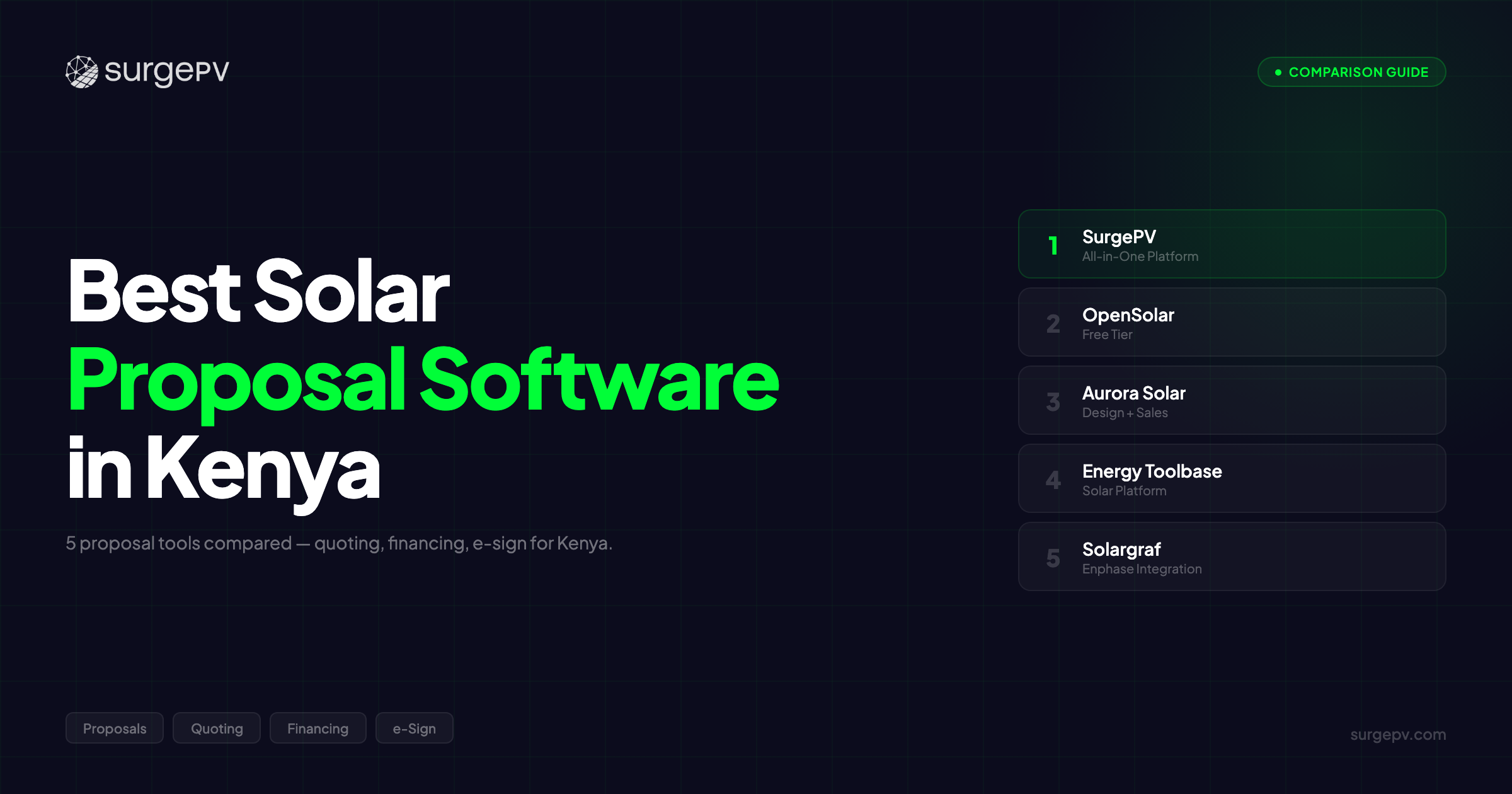
TL;DR: SurgePV is the best solar proposal software for Kenya — automated proposals with net metering modelling per EPRA regulations and Kenya Power tariff analysis.
Kenyan Solar Clients Don’t Buy Panels. They Buy Diesel Savings. Your Proposals Need to Show That.
A flower farm owner in Naivasha doesn’t care about your panel wattage. A manufacturing CEO in Mombasa’s industrial zone doesn’t care about your inverter brand. They care about one number: how much they’ll save compared to running diesel generators at 180–220 KES per liter.
Kenya’s commercial solar market is growing at 25–35% annually. But closing deals in East Africa’s largest economy requires proposals that speak the client’s language — diesel savings in KES, payback periods that account for KPLC tariff escalation, battery backup hours during grid outages, and financing structures that work with AfDB/IFC project financing or PAYGO models.
The solar proposal software you use directly impacts your close rate. A generic PDF with system specs and a price tag loses to a professional proposal showing monthly diesel savings, cumulative KES savings over 25 years, battery backup coverage during KPLC outages, and clear ROI metrics. In Kenya’s competitive C&I market, the EPC that delivers a professional, localized proposal within 24 hours wins the deal.
Most solar proposal software was built for American residential sales. PAYGO financing? Not supported. Diesel comparison? Missing. Off-grid system quoting? Nonexistent. KES currency and Kenyan tax structures? Forget it.
In this guide, you’ll learn:
- Which platforms generate proposals with diesel savings calculations in KES
- How each tool handles PAYGO and C&I financing structures for the Kenyan market
- Which software combines design accuracy with professional proposal output
- Total cost of ownership for Kenyan EPC sales teams
- Detailed comparisons of SurgePV, OpenSolar, Aurora Solar, Energy Toolbase, and Solargraf
Quick Summary: Our Top Picks for Kenya
After testing 5 proposal platforms with solar installers and EPCs across Nairobi, Mombasa, and Kisumu, here are our top recommendations:
- SurgePV — Design-to-proposal in one platform with diesel savings modeling and battery backup proposals (Best for Kenyan EPCs selling C&I hybrid systems)
- OpenSolar — Affordable cloud-based proposals with basic financing (Best for budget-conscious residential installers with simple grid-tied systems)
- Aurora Solar — Beautiful residential proposals with 3D visualizations (Best for visual impact, lacks Kenya-specific financial modeling)
- Energy Toolbase — Battery storage and energy economics modeling (Best for storage-specific analysis, US market focus limits Kenya applicability)
- Solargraf — Quick residential proposals with financing integrations (Best for North American residential market, minimal East African features)
Each tool evaluated on Kenya-specific criteria: diesel savings proposals, PAYGO financing support, off-grid/hybrid quoting, battery backup proposal accuracy, and proposal presentation quality.
Best Solar Proposal Software in Kenya (Detailed Reviews)
| Software | Best For | Pricing | Kenya Fit |
|---|---|---|---|
| SurgePV | All-in-one proposals + design | ~$1,899/yr (3 users) | Excellent |
| OpenSolar | Free proposals | Free tier available | Good |
| Aurora Solar | AI-powered proposals | ~$3,600–6,000/yr | Good |
| Energy Toolbase | Storage proposals | Contact for pricing | Good |
| Solargraf | Residential proposals | Contact for pricing | Good |
SurgePV — Best Proposal Platform for Kenyan Solar Market
About SurgePV
SurgePV combines engineering-grade solar design with professional proposal generation in one platform. For Kenyan EPCs, that means designing a 300 kW commercial hybrid system and generating a client-ready proposal — complete with diesel savings analysis, battery backup specifications, and bankable P50/P90 production estimates — without switching tools.
The difference matters in Kenya. When a flower farm owner in Naivasha asks “how much will I save versus diesel?” your proposal needs to show actual diesel cost displacement, not just energy production in kWh. When an office park manager in Westlands asks about battery backup during KPLC outages, your proposal needs to show exactly how many hours of backup the system provides at their specific load profile.
Target Users: Commercial EPCs selling 50 kW–2 MW hybrid systems, solar installers handling PAYGO residential proposals, consultants presenting to AfDB/IFC-financed projects, sales teams competing on proposal speed and quality in Nairobi’s market.
Create Winning Solar Proposals with SurgePV
Professional proposals with integrated design, simulation, and financing — diesel savings in KES, battery backup specs, and bankable P50/P90 estimates in 30–45 minutes.
Book a DemoNo commitment required · 20 minutes · Live project walkthrough
OpenSolar — Affordable Proposals, Limited Kenya Features
OpenSolar is a cloud-based solar proposal software with a free tier that makes it accessible to small residential installers. It handles basic grid-tied proposal generation with standard financial modeling.
Key Strengths: Free tier available. Cloud-based with mobile access. Basic financing options. Reasonable proposal templates for residential grid-tied systems.
Where OpenSolar Falls Short for Kenya: No diesel comparison modeling. No PAYGO financing support. Limited battery backup proposal capabilities. Generic financial modeling that doesn’t account for KPLC tariff escalation or EPRA net metering structures. No Kenya-specific currency or tax modeling built in.
Best For: Budget-conscious residential installers handling simple grid-tied systems under 30 kW. Not suitable for C&I EPCs selling hybrid systems or agricultural solar where diesel comparison is essential.
Aurora Solar — Polished Residential Proposals, Wrong Market Fit
Aurora Solar produces visually impressive residential proposals with 3D renderings and professional formatting. In the US residential market, these proposals close deals.
Key Strengths: Best-in-class visual proposal quality. AI-powered site assessment. Strong US residential financing integrations (loans, leases, PPAs). CRM and workflow tools.
Where Aurora Falls Short for Kenya: No diesel savings modeling in KES. No PAYGO financing structures. No battery backup proposal templates for KPLC grid outage scenarios. Pricing at $259/user/month (~645,000 KES/user/year) is the highest on this list. US residential focus means most features are irrelevant for Kenya’s C&I-dominated market.
Best For: High-end residential projects in Kenya’s affluent neighborhoods where visual proposal quality matters. Not viable for the C&I hybrid system market that drives most Kenyan EPC revenue.
Energy Toolbase — Storage-Focused, US-Centric
Energy Toolbase specializes in battery storage economics modeling — rate arbitrage, demand charge reduction, and storage ROI analysis tuned for US utility rate structures.
Key Strengths: Deep battery storage financial analysis. Rate arbitrage modeling. Strong for US commercial projects with time-of-use tariffs. Battery sizing and dispatch optimization.
Where Energy Toolbase Falls Short for Kenya: Built entirely around US utility rate structures that don’t apply to Kenya’s KPLC tariff system. No diesel comparison modeling. No PAYGO financing. Limited proposal quality compared to SurgePV or Aurora. Contact-only pricing adds friction.
Best For: Storage-specific analysis for US commercial projects. Limited applicability in Kenya where storage economics are driven by diesel displacement rather than US-style rate arbitrage.
Solargraf — Residential Proposal Tool, No East African Support
Solargraf provides quick residential proposal generation with some financing integrations. It works reasonably well in North American and European residential markets.
Key Strengths: Fast proposal generation. Good residential financing integrations. Clean proposal templates. Reasonable pricing.
Where Solargraf Falls Short for Kenya: No diesel comparison modeling. No PAYGO support. No East African market customization. No EPRA or KPLC-specific financial modeling. Designed for stable-grid residential markets that bear little resemblance to Kenya’s CC&I hybrid landscapeI hybrid market.
Best For: North American and European residential markets. Not recommended for Kenya.
What Makes the Best Solar Proposal Software for Kenya
Kenyan proposal software must do things Western tools were never designed for:
1. Diesel Savings Analysis in KES
This is the single most important feature for Kenya’s C&I market. Your proposal must show: current monthly diesel spend (liters × 180–220 KES/liter), projected annual diesel savings after solar installation, cumulative 25-year savings in KES, and payback period based on diesel displacement alone. If your software can’t generate this, your sales team is building it manually in Excel — losing hours and making mistakes.
2. Battery Backup Specifications
KPLC grid reliability below 85% in some areas means every C&I proposal needs battery backup coverage. Clients want to know: how many hours of backup does this system provide, which loads are covered during outages, and what’s the cost of battery storage versus continued diesel dependence. SurgePV’s solar proposals calculate backup hours at client-specific load profiles automatically.
3. PAYGO Financing Models
Kenya’s distributed solar market runs on PAYGO — mobile payment financing pioneered by M-KOPA that has brought solar to millions of Kenyan households. Proposal software needs to model pay-as-you-go cash flows, customer payment schedules, and operator ROI for PAYGO businesses. Western tools with US loan/lease financing are useless here.
4. EPRA Net Metering and KPLC Tariff Modeling
Grid-tied commercial proposals must account for EPRA’s net metering framework and KPLC’s commercial tariff structure. This includes feed-in tariff rates, escalation assumptions, and the financial impact of grid export versus self-consumption optimization.
5. Bankable Production Estimates
For projects seeking AfDB, IFC, or commercial bank financing, proposals need P50/P75/P90 production estimates with documented methodology. SurgePV generates these within ±3% accuracy versus PVsyst — the standard international lenders recognize.
Comparison: Key Proposal Features for Kenya
| Feature | SurgePV | OpenSolar | Aurora Solar | Energy Toolbase | Solargraf |
|---|---|---|---|---|---|
| Diesel savings in KES | Yes | No | No | No | No |
| PAYGO financing models | Yes | No | No | No | No |
| Battery backup proposals | Yes (detailed) | Limited | Limited | Yes (US-focused) | No |
| EPRA/KPLC modeling | Yes | No | No | No | No |
| P50/P90 production estimates | Yes | No | P50 only | No | No |
| Integrated design + proposal | Yes | Partial | Yes | No | No |
| Mobile-friendly output | Yes | Yes | Yes | Limited | Yes |
| Pricing (approx. KES/yr) | 245,000/user | Free–463,000 | 645,000+/user | Contact | Contact |
Further Reading
For a broader comparison beyond this market, see our guide to the best solar proposal software globally, or compare solar design software in Kenya for engineering-focused analysis.
Bottom Line: Best Solar Proposal Software for Kenya
Most Kenyan EPCs generate proposals using Excel spreadsheets, PowerPoint presentations, and manual calculations. This process takes 4–8 hours per commercial proposal, produces inconsistent outputs, and misses critical details like battery backup hours, diesel savings projections, and bankable production estimates.
With SurgePV, Kenyan EPCs generate professional proposals with diesel savings analysis, battery backup specifications, and bankable production estimates — in 30–45 minutes from design to deliverable — with interactive, mobile-friendly output that works in Nairobi boardrooms and agricultural field offices.
Our Recommendations:
- For C&I EPCs in Nairobi, Mombasa, Kisumu: SurgePV. Diesel savings proposals, battery backup specifications, and engineering-accurate estimates in one platform at 580,000 KES per year (3 users).
- For budget-conscious residential installers: OpenSolar for basic grid-tied proposals, but expect to do diesel comparison and battery sizing manually for commercial clients.
- For luxury residential sales: Aurora Solar if visual presentation quality is the primary differentiator and budget allows 401,000 KES per user per year.
- For agricultural solar (flower farms, tea estates): SurgePV. Ground-mount design with diesel comparison, battery backup, and professional proposals in one workflow.
Frequently Asked Questions
What is the best solar proposal software in Kenya?
SurgePV is the best solar proposal software for Kenya, combining engineering-grade design with professional proposal generation including diesel savings modeling in KES, battery backup specifications, PAYGO financing analysis, and bankable P50/P90 production estimates. It addresses Kenya-specific requirements that Western proposal tools miss: diesel displacement economics at 180–220 KES per liter, KPLC grid outage backup proposals, and flexible financing structures for the East African market. See our solar proposal features for the full breakdown.
Can solar proposal software calculate diesel savings in Kenya?
SurgePV models diesel displacement economics for Kenyan commercial proposals — current diesel consumption, fuel costs at 180–220 KES per liter, annual diesel expenditure versus solar + battery system cost, and payback period based on diesel savings. This is the most important metric for Kenya’s C&I solar market, where solar competes against diesel generators rather than grid electricity. OpenSolar, Aurora Solar, Energy Toolbase, and Solargraf do not include Kenyan diesel comparison modeling.
Which solar proposal software supports PAYGO financing?
SurgePV supports PAYGO cash flow modeling for Kenya’s distributed solar market — the financing model used by M-KOPA and similar companies serving millions of Kenyan households. The platform models pay-as-you-go revenue streams, customer payment schedules, and ROI for PAYGO operators. Western proposal tools (Aurora, Solargraf, Energy Toolbase) focus on US-style loan and lease financing that doesn’t apply to Kenya’s PAYGO market.
How fast can I generate a solar proposal in Kenya?
With SurgePV, the complete design-to-proposal workflow takes 30–45 minutes for a commercial hybrid system — including roof modeling, battery sizing, diesel comparison financial analysis, and professional proposal generation. Manual processes using Excel and PowerPoint typically take 4–8 hours for comparable commercial proposals. Speed matters in Nairobi’s competitive market where the first professional proposal often wins the deal.
Do Kenyan lenders accept proposals from solar software?
AfDB, IFC, and World Bank program lenders typically require formal bankability reports (PVsyst format) for projects above 500 kW. For commercial projects under 2 MW, SurgePV proposals with P50/P90 production estimates (±3% accuracy versus PVsyst) are accepted by most commercial banks and off-taker agreements. Include the bankability report as a technical appendix to your commercial proposals.
What should a Kenyan solar proposal include?
Effective Kenyan commercial solar proposals include diesel savings analysis (monthly and annual KES savings), battery backup specifications (backup hours by load category), system design with production estimates, equipment specifications with bill of materials, financial analysis (payback period, NPV, IRR), financing options (cash, loan, PPA), and EPRA compliance documentation. SurgePV generates all of these elements from a single design workflow.
Can I generate proposals on mobile in Kenya?
Yes. SurgePV generates interactive, web-based proposals viewable on any device — smartphone, tablet, or laptop. This matters for Kenyan sales teams who present to clients in field conditions, factory floors, and remote agricultural sites. Proposals load on Safaricom and Airtel 4G networks and can be shared via WhatsApp or email link.
How much does solar proposal software cost in Kenya?
Solar proposal software pricing for Kenyan teams: SurgePV at 193,000 KES per user per year (design + proposals + engineering included), OpenSolar at 153,000–463,000 KES per year, Aurora Solar at 401,000 KES per user per year, Energy Toolbase at 451,000–774,000 KES per year, and Solargraf at 232,000–464,000 KES per year. SurgePV provides the best value for Kenyan EPCs because proposals include integrated design, battery sizing, diesel comparison, and electrical documentation — eliminating the need for separate tools. Compare all options on our pricing page.
Sources
- Energy and Petroleum Regulatory Authority (EPRA) — Grid connection and licensing regulations (accessed February 2026)
- Kenya Power and Lighting Company (KPLC) — Tariff schedules and net metering guidelines (accessed February 2026)
- World Bank — Kenya Solar Market and Off-Grid Access reports (accessed February 2026)
- IFC (International Finance Corporation) — East Africa solar financing frameworks (accessed February 2026)
- African Development Bank (AfDB) — Kenya renewable energy project financing (accessed February 2026)
- IRENA — Kenya Renewable Energy Statistics 2025 (accessed February 2026)
- Kenya National Bureau of Statistics — Energy sector data and diesel pricing (accessed February 2026)
- SurgePV Official Documentation — Product features and pricing (accessed February 2026)
- G2 Reviews — Verified user reviews for solar proposal platforms (accessed February 2026)
- Bloomberg NEF — East Africa Solar Investment Report 2025 (accessed February 2026)