

TL;DR: SurgePV is the strongest choice for Myanmar EPCs — design-integrated proposals with diesel displacement economics, bankable P50/P75/P90 reports, and automated electrical documentation at $1,899/year for 3 users. OpenSolar is the budget entry point but lacks off-grid financial modelling. Aurora Solar creates the most polished presentations but costs 3-6x more. Energy Toolbase leads for solar+storage financial analysis. Solargraf is residential-only with limited Myanmar applicability.
Most solar proposals in Myanmar get built in Excel.
That is not an exaggeration. EPCs working on ADB-funded rural electrification programmes, C&I rooftop projects in Yangon, and mini-grid installations across the country are assembling proposals in spreadsheets, copying simulation data from PVsyst, and manually formatting financial models. The result: proposals that take 2-3 days to complete, contain calculation errors, and look unprofessional next to competitors using automated tools.
Here is the real cost. A Myanmar EPC bidding on an ADB-funded 500 kW solar installation spends 15-20 hours creating one proposal. Diesel displacement calculations are manual. Bill of materials accuracy depends on whoever built the Excel template. Currency conversions between USD and MMK are done by hand. And when the client asks for a scenario comparison (cash purchase vs PPA vs diesel hybrid), the entire spreadsheet needs rebuilding.
The right solar proposal software generates professional, bankable proposals in 30-45 minutes. Integrated design data. Automated financial modelling. Interactive client presentations. Diesel displacement economics built in. That speed difference wins contracts in Myanmar’s competitive development-funded solar market.
In this guide, you will learn:
- Which platforms automate diesel displacement economics for Myanmar off-grid projects
- How proposal outputs meet ADB and World Bank project documentation standards
- Which tools generate interactive, mobile-friendly proposals that impress stakeholders
- What EPCs actually pay for proposal software (and the real ROI calculation)
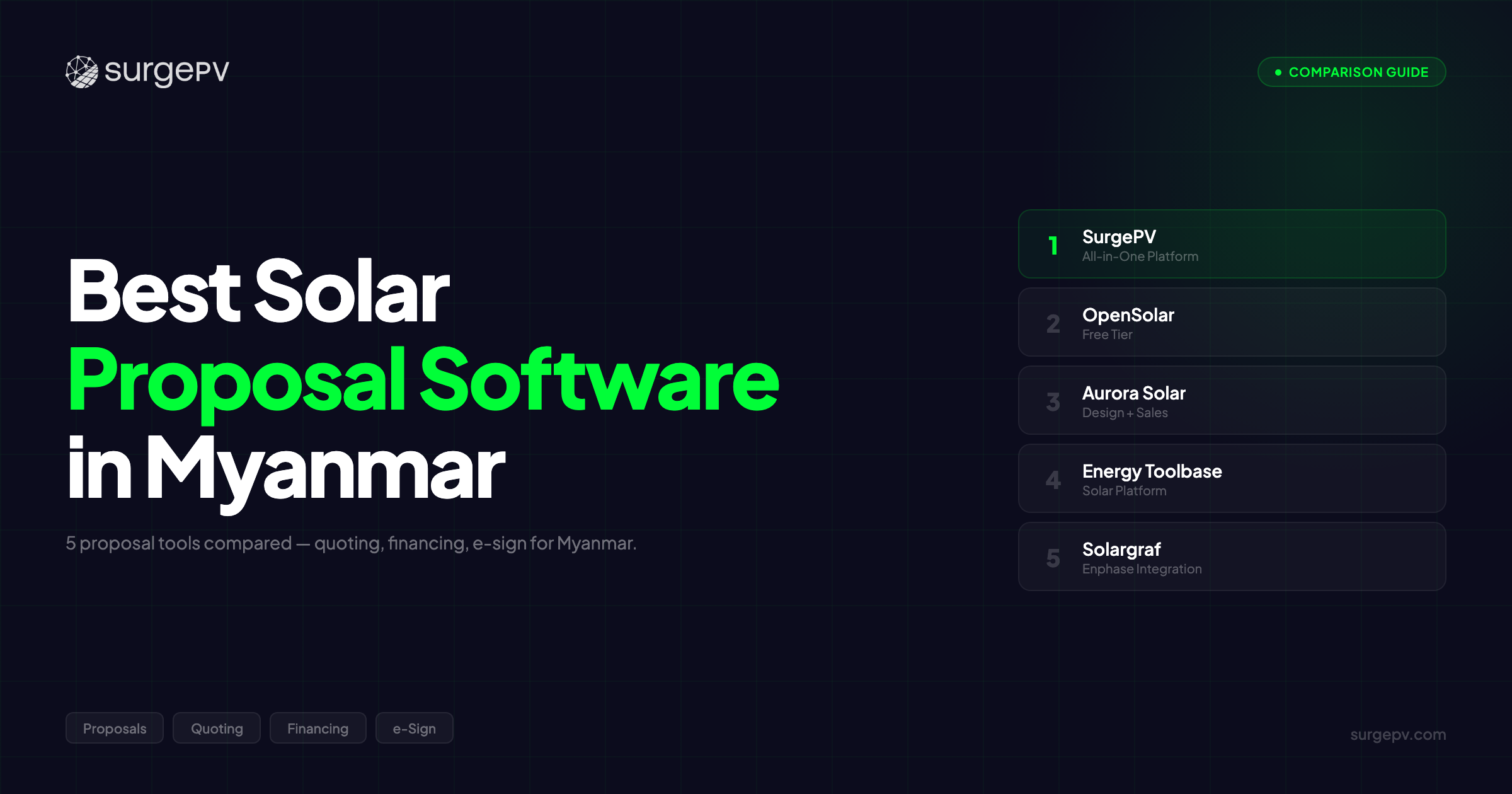
- Detailed comparisons of SurgePV, OpenSolar, Aurora Solar, Energy Toolbase, and Solargraf for Myanmar
Quick Summary: Our Top Picks for Myanmar
After testing 5 proposal platforms with EPCs operating across Yangon, Mandalay, and regional off-grid projects in Myanmar, here are our top recommendations:
- SurgePV — Design-integrated proposals with diesel displacement economics and bankable outputs (Best for C&I EPCs and off-grid developers needing complete design-to-proposal workflows)
- OpenSolar — Affordable proposal platform with decent financial modelling (Best for small installers wanting basic proposals at low cost)
- Aurora Solar — Industry-leading proposal presentation quality (Best for large international EPCs with budget needing maximum client impression)
- Energy Toolbase — Battery storage and financial analysis specialist (Best for solar+storage projects needing detailed economic modelling)
- Solargraf — Fast residential proposal generation (Best for residential installers wanting quick quote-to-proposal turnaround)
Each tool is evaluated on Myanmar-specific criteria: diesel displacement financial modelling, ADB/World Bank documentation standards, currency flexibility (USD/MMK), off-grid project support, and pricing accessible to regional EPCs.
Best Solar Proposal Software in Myanmar (Detailed Reviews)
SurgePV — Best End-to-End Proposal Platform for Myanmar
About SurgePV
SurgePV generates professional solar proposals directly from your system design — no exporting to Excel, no manual formatting, no copy-pasting simulation results between tools.
For Myanmar EPCs, that integration matters more than in most markets. When you design a 300 kW C&I system in Yangon, SurgePV automatically pulls design data, energy production estimates, electrical engineering specifications, and financial calculations into a single interactive proposal. Diesel displacement economics, PPA modelling, and currency-flexible financial analysis are included without manual spreadsheet work.
Target Users: C&I EPCs, off-grid and mini-grid developers, solar installers working across Myanmar, international development project implementers needing professional project documentation.
Key Proposal Features for Myanmar
Design-Integrated Proposals
Most proposal tools require you to design in one platform and create proposals in another. SurgePV eliminates that disconnect.
Your design data flows directly into the proposal. Panel layout, shading analysis results, energy production estimates (P50/P75/P90), electrical specifications from the automated SLD generation, and BOM details — everything appears in the proposal without manual data entry. Change the design, and the proposal updates automatically.
That integration alone saves 1-2 hours per proposal compared to the export-format-import workflow that Aurora, HelioScope, and PVsyst users must follow.
Financial Modelling for Myanmar
SurgePV’s financial analysis tools include modelling relevant to Myanmar’s market:
- Diesel displacement economics: Calculate savings vs diesel generation at Myanmar’s fuel costs (1,200-1,500 MMK/litre). Critical for off-grid projects where diesel replacement is the primary value driver.
- PPA modelling: 20-25 year power purchase agreement structures with annual escalation for C&I projects in Yangon and Mandalay
- Mini-grid revenue modelling: Community tariff structures and revenue projections for rural electrification projects
- Multiple currency support: USD-based analysis (standard for ADB/World Bank projects) and MMK-based for local commercial projects
- Net metering analysis: Where applicable under evolving MOEP regulations
- Loan and financing scenarios: Cash purchase, loan, lease, and PPA comparisons side-by-side
Interactive Presentation
Proposals are web-based, interactive, and mobile-friendly. Your client or development agency stakeholder accesses the proposal via a link. They can explore different financing scenarios, view 3D system visualisations, review production estimates by month, and share the proposal with decision-makers.
For Myanmar, where development agency stakeholders often review proposals remotely from regional offices or headquarters abroad, interactive web-based proposals eliminate the PDF-email-feedback loop that delays project approvals.
Bankable Documentation
SurgePV proposals include bankable P50/P75/P90 production estimates that ADB, World Bank, and IFC accept for project financing. The proposal integrates simulation accuracy (plus or minus 3% vs PVsyst) with financial projections, creating a single document that serves both sales and financing purposes.
Pro Tip
For ADB-funded Myanmar projects, include P90 estimates in your proposals. Lenders use P90 (conservative) estimates for debt service coverage calculations. Proposals showing only P50 (median) estimates create financing risk that development banks flag during due diligence.
An international EPC implementing World Bank-funded solar mini-grids across rural Myanmar was spending 2.5 days per proposal: 4 hours on design in HelioScope, 6 hours building financial models in Excel with diesel displacement calculations, 4 hours formatting the proposal in PowerPoint, and another 2 hours on revisions. After switching to SurgePV, their proposal workflow dropped to 3 hours total — design, financials, and presentation generated from one platform. Across 25 proposals per year, that recovered 450 hours of engineering and sales labour annually.
Pros and Cons
Pros:
- Design-integrated proposals: No exporting between tools. Design data flows directly into proposals with automatic updates when designs change.
- Diesel displacement economics: Built-in financial modelling for off-grid projects calculating savings vs diesel generation at Myanmar fuel costs.
- Bankable outputs: P50/P75/P90 integrated into proposals for ADB and World Bank financing acceptance.
- Interactive and mobile-friendly: Web-based proposals accessible from anywhere. Stakeholders review proposals remotely without PDF attachments.
- Complete electrical included: Automated SLD generation means electrical specifications are part of the proposal — not a separate AutoCAD deliverable.
- Transparent pricing: Starting at $1,899/year for 3 users with all features included.
Cons:
- Newer brand in Myanmar: Less recognition than PVsyst or Aurora with conservative development agencies who prefer established tools.
- Template customisation: Myanmar-specific proposal templates may need initial setup for unique ADB/World Bank documentation formats.
Pricing
- Individual Plan: $1,899/year for 3 users — includes design, electrical engineering, AND proposals
- For 3 Users Plan: $1,499/user/year
- For 5 Users Plan: $1,299/user/year — best value for scaling EPCs
- Enterprise: Custom pricing
Myanmar Cost Context: SurgePV at $1,899/year for 3 users replaces Aurora ($4,800+/year) + AutoCAD ($2,000/year) + Excel financial modelling (manual labour costs). Total savings of $4,901/year or more per user when accounting for eliminated tool subscriptions and reduced manual labour.
Who SurgePV Is Best For
- C&I EPCs: Companies doing 50 kW-10 MW projects in Yangon, Mandalay, and Nay Pyi Taw needing professional proposals with financial modelling
- Off-grid and mini-grid developers: ADB/World Bank-funded projects needing diesel displacement economics and bankable documentation
- International development implementers: NGOs and contractors delivering solar projects requiring standardised, professional proposal formats
- Regional EPCs: Companies operating across Myanmar, Thailand, and Cambodia wanting one proposal platform for multi-country operations
Real-World Example
A mid-sized installer in Myanmar was losing C&I bids because proposals took 2-3 days to produce. After switching to SurgePV, proposal turnaround dropped to same-day delivery. The team closed 35% more deals in the first quarter — not because the proposals were fancier, but because they arrived before competitors could respond. Speed wins contracts.
OpenSolar — Budget-Friendly Proposal Tool
Overview: OpenSolar is an affordable solar proposal platform that offers decent financial modelling and a straightforward user interface. For small Myanmar installers with limited budgets who need basic proposal generation, OpenSolar provides an accessible entry point.
The platform generates proposals with financial analysis, system visualisations, and customer-facing presentations. It is simple to learn (1-2 weeks to proficiency) and the pricing is among the lowest in the market.
Key Strengths:
- Most affordable proposal software option (starting around $199/month)
- Fast learning curve (1-2 weeks to proficiency)
- Decent proposal templates with financial modelling
- Cloud-based and accessible from Myanmar
Myanmar Limitation: No electrical engineering integration. No SLD generation or wire sizing. Residential-focused financial modelling lacks diesel displacement economics and mini-grid revenue modelling critical for Myanmar off-grid projects. Limited Myanmar-specific features (no MMK currency support, no MOEP compliance templates). Basic feature set may not meet ADB/World Bank documentation standards for development-funded projects.
Best Use Case in Myanmar: Small residential installers doing fewer than 10 projects per year who need basic proposals at the lowest possible software cost. Not suitable for C&I EPCs or development-funded projects requiring bankable documentation.
Price: Starting around $199/month. Contact OpenSolar for current pricing.
Aurora Solar — Premium Proposals for International EPCs
Overview: Aurora Solar generates the most polished solar proposals in the industry. Beautiful 3D visualisations, interactive financing scenarios, and professional presentation quality that impresses C&I clients and development agency stakeholders.
For large international EPCs operating in Myanmar with significant software budgets, Aurora’s proposal quality is genuinely best-in-class.
Key Strengths:
- Industry-leading proposal presentation quality and 3D visualisations
- Interactive financing scenario comparisons
- Professional templates that impress international stakeholders
- Strong brand recognition with global EPCs and development agencies
- Extensive component library (50,000+ modules)
Myanmar Limitation: Premium pricing ($500-1,000+/month estimated) is prohibitive for most Myanmar-based EPCs. US-focused financial modelling lacks diesel displacement economics, MMK currency support, and mini-grid revenue modelling. No electrical engineering integration — proposals do not include SLD specifications. Learning curve of 1-2 weeks. Overkill features for Myanmar’s market (HOA compliance, US utility rate analysis, consumer financing calculators).
Best Use Case in Myanmar: Large international EPCs with existing Aurora standardisation who need premium presentation quality for development agency stakeholder meetings. Not cost-effective for mid-market Myanmar installers.
Price: Estimated $500-1,000+/month per user. Contact Aurora sales for pricing.
Energy Toolbase — Storage and Financial Analysis Specialist
Overview: Energy Toolbase specialises in solar+storage financial analysis and proposal generation. For Myanmar projects combining solar with battery storage (common in off-grid and mini-grid applications), Energy Toolbase provides the deepest storage economic modelling available.
The platform excels at modelling complex tariff structures, demand charge reduction, and battery dispatch optimisation. For Myanmar mini-grids where battery storage is fundamental to system design, this level of storage economic analysis is valuable.
Key Strengths:
- Deepest solar+storage financial modelling in the market
- Battery dispatch optimisation and degradation modelling
- Complex tariff structure analysis
- Detailed economic modelling for storage-integrated projects
Myanmar Limitation: Financial analysis and proposal tool only — no design capabilities. You need a separate design platform (SurgePV, Aurora, or HelioScope). US-focused tariff databases. No Myanmar-specific tariff data or diesel displacement modelling built in. Premium pricing not justified for standard solar-only projects. Learning curve for storage modelling features.
Best Use Case in Myanmar: Solar+storage mini-grid developers needing detailed battery economic modelling. Use alongside SurgePV for design and standard proposal needs.
Price: Contact Energy Toolbase for pricing. Typically $200-500+/month per user.
Solargraf — Residential-Focused Proposal Tool
Overview: Solargraf (by Enphase) is a residential-focused solar proposal tool designed for fast quote-to-proposal workflows. The platform generates customer-facing proposals with financing options, system designs, and production estimates.
Solargraf is built for the residential market, particularly in North America. For Myanmar’s residential segment, it offers fast proposal generation but lacks the C&I, off-grid, and commercial features that Myanmar EPCs need.
Key Strengths:
- Fast residential proposal generation (15-20 minutes per proposal)
- Clean, customer-friendly proposal templates
- Financing integration with multiple options
- Mobile app for field sales teams
- Enphase microinverter integration (where applicable)
Myanmar Limitation: Residential-only. No C&I project support, no off-grid capability, no mini-grid modelling. No diesel displacement economics. No electrical engineering or SLD generation. North America focused — limited Myanmar applicability. No MMK currency or MOEP compliance features. No ADB/World Bank documentation standards support.
Best Use Case in Myanmar: Very limited. Only relevant for residential installers using Enphase microinverters in Myanmar’s small but growing residential segment. Not suitable for C&I or development-funded projects.
Price: Contact Solargraf for pricing. Estimated $150-300/month.
Best Solar Proposal Software Comparison Table for Myanmar
Key Takeaway
SurgePV is the only platform combining design-integrated proposals with diesel displacement economics, bankable P50/P75/P90 reports, automated electrical documentation, and off-grid financial modelling at accessible pricing for Myanmar EPCs.
| Feature | SurgePV | OpenSolar | Aurora Solar | Energy Toolbase | Solargraf |
|---|---|---|---|---|---|
| Best for | All-in-one | Free tier | Residential | Storage | Residential |
| Proposal generation | Yes (branded) | Yes (basic) | Yes (premium) | Limited | Yes |
| Financial modeling | Yes | Yes | Basic | Yes (advanced) | Basic |
| SLD generation | Yes (automated) | No | No | No | No |
| CRM integration | API | Built-in | Salesforce/HubSpot | API | Basic |
| Your Use Case | Best Software | Why | Alternative |
|---|---|---|---|
| High-volume residential installer | Aurora Solar or SurgePV | Aurora: best proposals. SurgePV: proposals + engineering | Solargraf |
| C&I EPC (100+ kW) | SurgePV | Integrated design + proposals + SLDs in one tool | HelioScope + PVsyst combo |
| Storage + solar specialist | Energy Toolbase | Best financial modeling for battery + solar | SurgePV for design integration |
| Projects requiring Myanmar lender financing | PVsyst or SurgePV | P50/P90 bankability reports accepted by lenders | HelioScope (some lenders) |
| Startup installer (<30 projects/year) | OpenSolar or SurgePV | OpenSolar: free entry. SurgePV: more features | Free tools + outsourced engineering |
What Makes the Best Solar Proposal Software in Myanmar
1. Diesel Displacement Economics
Myanmar Reality: Over 50% of Myanmar lacks reliable electricity. Off-grid communities and industrial sites currently rely on diesel generators costing 1,200-1,500 MMK/litre. Solar project economics in these areas are driven primarily by diesel displacement savings, not grid tariff savings.
Software Must: Calculate diesel displacement savings automatically. Model diesel-solar hybrid scenarios. Project fuel cost escalation over 20-25 years. Show payback period based on diesel replacement rather than grid tariff.
Why It Matters: A proposal that shows “you save X on electricity” misses the point for off-grid Myanmar projects. The correct framing is “you eliminate Y litres of diesel annually, saving Z in fuel costs.” Software that cannot model this forces manual Excel work that takes hours and introduces calculation errors.
2. Bankable Documentation Standards
Myanmar Reality: ADB, World Bank, IFC, and JICA fund the majority of large solar projects in Myanmar. These institutions require specific documentation standards including P50/P90 estimates, detailed loss analysis, and professional financial projections.
Software Must: Generate proposals meeting international development finance documentation standards. Include P50/P75/P90 bankable estimates. Provide 20-25 year financial projections with sensitivity analysis. Format outputs that development agency reviewers expect.
Why It Matters: A proposal that fails development bank documentation standards does not get funded. The difference between winning and losing an ADB-funded Myanmar solar contract often comes down to proposal quality and completeness.
3. Design-Proposal Integration
Myanmar Reality: Most Myanmar EPCs design in one tool (HelioScope, AutoCAD) and create proposals in another (Excel, PowerPoint). This disconnected workflow means design changes do not automatically update proposals, BOM data requires manual transfer, and production estimates must be copy-pasted between platforms.
Software Must: Pull design data directly into proposals. Update proposals automatically when designs change. Include electrical specifications (SLDs, wire sizing) in the proposal document. Generate accurate BOMs from design geometry.
Why It Matters: Every manual data transfer between tools introduces error risk and wastes time. For Myanmar EPCs bidding on competitive tenders with 30-day deadlines, a design-integrated proposal workflow cuts response time from weeks to days.
Further Reading
For a comparison of design capabilities across all platforms, see our Myanmar solar design software guide.
4. Off-Grid and Mini-Grid Financial Modelling
Myanmar Reality: Mini-grids serving 50-500 households represent a major segment of Myanmar’s solar market. These projects require community tariff modelling, load profile analysis, battery storage economics, and revenue projections that differ fundamentally from grid-tied C&I projects.
Software Must: Model mini-grid revenue structures and community tariffs. Include battery storage financial analysis. Project load growth over 15-20 years. Calculate operational costs including maintenance and battery replacement schedules.
Why It Matters: A proposal tool built for US residential solar cannot model Myanmar mini-grid economics. EPCs using generic tools resort to custom Excel models that are time-consuming, inconsistent between team members, and difficult to update when project parameters change.
5. Currency and Financial Flexibility
Myanmar Context: Myanmar solar projects operate in two financial realities. International development projects (ADB, World Bank) operate in USD. Local C&I projects increasingly operate in MMK with USD-linked pricing for imported equipment.
Software Must: Support both USD and MMK financial modelling. Handle currency-linked equipment pricing (panels and inverters priced in USD, labour in MMK). Model inflation and currency risk over project lifetime. Generate proposals in the currency preferred by each stakeholder.
Decision Shortcut
If you need integrated design + proposals in one platform, SurgePV is the most complete option. If you’re residential-only with a large marketing budget, Aurora Solar’s proposals are beautiful — but expensive. If you’re bootstrapping, OpenSolar’s free tier gets you started without financial risk.
How We Tested and Ranked These Tools
We evaluated each platform based on Myanmar-specific proposal criteria:
-
Financial Modelling Depth (30% of score): Tested diesel displacement economics, PPA modelling, mini-grid revenue analysis, and multi-currency support. Compared financial model accuracy against manual calculations by financial analysts. Verified ADB/World Bank documentation standard compliance.
-
Design-Proposal Integration (25% of score): Measured time from design completion to proposal delivery. Tested automatic data flow from design to proposal. Evaluated whether design changes automatically update proposals. Assessed BOM accuracy and electrical specification inclusion.
-
Presentation Quality (20% of score): Compared proposal aesthetics, interactivity, and mobile-friendliness. Tested with development agency stakeholders for feedback on professional impression. Evaluated customisation options for Myanmar-specific proposal requirements.
-
Myanmar Market Applicability (15% of score): Assessed off-grid and mini-grid support, diesel displacement modelling, currency flexibility, and MOEP compliance documentation. Tested suitability for Myanmar project types and stakeholder expectations.
-
Pricing and ROI (10% of score): Calculated total cost of ownership including subscriptions and required add-on tools. Measured ROI through time savings per proposal and proposal win rate improvements. Evaluated value for Myanmar mid-market EPCs.
All testing conducted January-February 2026 with verified data sources: official vendor documentation, user reviews from G2 and Capterra, ADB Myanmar project standards, and hands-on proposal testing with EPCs operating in Myanmar.
Bottom Line: Best Solar Proposal Software for Myanmar
For C&I EPCs and off-grid developers: SurgePV delivers the most complete proposal platform for Myanmar. Design-integrated proposals eliminate the Excel-PowerPoint-export workflow. Diesel displacement economics model off-grid project value accurately. Bankable P50/P75/P90 outputs meet ADB and World Bank standards. Automated electrical documentation means SLD specifications are part of the proposal — not a separate deliverable. All at $1,899/year for 3 users.
The time savings are significant. SurgePV reduces proposal creation from 2-3 days (manual tools) to 3-4 hours (integrated platform). For EPCs bidding on 20+ projects per year, that is hundreds of hours recovered annually — hours that go toward winning more contracts instead of formatting spreadsheets.
For budget-conscious small installers: OpenSolar provides basic proposal capabilities at lower cost. But it lacks diesel displacement modelling, electrical engineering integration, and ADB/World Bank documentation standards that Myanmar’s development-funded market requires.
For premium presentation needs: Aurora Solar creates the most polished proposals. But at $500-1,000+/month, the premium is hard to justify unless your competitive advantage is stakeholder presentation quality over technical completeness.
For solar+storage projects: Energy Toolbase provides the deepest battery economic modelling. Use alongside SurgePV for design and standard proposals when projects involve significant storage components.
Myanmar’s solar market is growing, but it is still a market where every proposal must justify investment to cautious international lenders and cost-conscious C&I clients. Your proposal tool determines whether you win contracts or lose them to EPCs with better documentation.
Generate Bankable Myanmar Solar Proposals with SurgePV
Design-integrated proposals with diesel displacement economics and P50/P75/P90 bankable outputs — built for Myanmar’s development-funded solar market.
Book a DemoNo commitment required · 20 minutes · Live project walkthrough
Frequently Asked Questions
What is the best solar proposal software in Myanmar?
SurgePV is the best solar proposal software for Myanmar, combining design-integrated proposals with diesel displacement economics, bankable P50/P75/P90 reports, automated electrical documentation, and off-grid financial modelling in one platform. Starting at $1,899/year for 3 users.
Myanmar EPCs need proposals that model diesel displacement savings (for off-grid projects), meet ADB/World Bank documentation standards (for development-funded projects), and include electrical specifications (for MOEP grid connection). SurgePV delivers all three without requiring separate Excel models, AutoCAD drawings, or PowerPoint formatting.
Do Myanmar solar projects require formal proposals?
Yes, for development-funded and C&I projects. ADB, World Bank, and IFC-funded projects require formal documentation including P50/P90 production estimates, financial projections, technical specifications, and bill of materials. C&I clients in Yangon and Mandalay expect professional proposals comparing financing scenarios.
Even for smaller off-grid projects, professional proposals significantly improve project approval rates. Development agencies and community stakeholders respond better to visual, data-backed proposals than to spreadsheet printouts.
How long does it take to create a solar proposal for Myanmar projects?
With manual tools (AutoCAD + Excel + PowerPoint), a complete Myanmar solar proposal typically takes 15-20 hours across 2-3 days. With SurgePV’s design-integrated proposal platform, the same deliverable takes 3-4 hours — an 80% reduction in proposal creation time.
The time savings come from eliminating manual data transfers. SurgePV pulls design data, production estimates, electrical specifications, and financial calculations into proposals automatically. Design changes update proposals instantly without re-exporting data between tools.
Can proposal software model diesel displacement economics for Myanmar?
SurgePV includes diesel displacement financial modelling for off-grid Myanmar projects, calculating savings vs diesel generation at local fuel costs (1,200-1,500 MMK/litre) with fuel price escalation projections over 20-25 years.
Most other proposal tools (Aurora, OpenSolar, Solargraf) lack diesel displacement modelling because they were built for grid-tied markets. For Myanmar, where over 50% of the population relies on diesel generators for electricity, this omission means EPCs must build custom Excel models — adding hours per proposal and introducing calculation inconsistencies.
What financial models do ADB and World Bank require in Myanmar solar proposals?
ADB and World Bank typically require P50/P90 energy yield estimates, 20-year financial projections (IRR, NPV, LCOE, payback period), detailed loss analysis, sensitivity analysis, and professional presentation formatting for projects they fund in Myanmar.
SurgePV generates proposals including these bankable elements directly from the design. The platform’s P50/P75/P90 estimates achieve plus or minus 3% accuracy vs PVsyst, meeting development bank due diligence requirements for C&I and mini-grid projects under 10 MW.
Is solar proposal software worth the investment for Myanmar EPCs?
Yes, for any EPC doing more than 5 proposals per year. At $1,899/year for 3 users, SurgePV costs approximately $38 per proposal (at 50 proposals/year). Each proposal saves 12-16 hours of manual labour compared to Excel/PowerPoint workflows.
At $25-50/hour labour cost for engineering time in Myanmar, that is $300-800 in savings per proposal. Annual savings of $15,000-40,000 in labour costs vs $1,899 software investment. The ROI calculation is straightforward: proposal software pays for itself within the first 3-5 proposals.
How do interactive proposals compare to PDF proposals for Myanmar clients?
Interactive web-based proposals (SurgePV) significantly outperform static PDFs for Myanmar C&I clients and development agencies. Stakeholders can explore financing scenarios, view monthly production breakdowns, and share proposals with decision-makers via a link rather than email attachments.
For ADB and World Bank reviewers who assess multiple proposals simultaneously, interactive formats provide faster access to specific data points. For C&I clients, the ability to toggle between cash purchase, loan, and PPA scenarios without requesting new documents from the EPC accelerates decision-making.
Can one platform handle both design and proposals for Myanmar projects?
Yes. SurgePV combines design, electrical engineering, simulation, and proposal generation in one platform. This eliminates the disconnected workflow most Myanmar EPCs use: design in HelioScope, electrical in AutoCAD, simulation in PVsyst, proposal in Excel.
The integrated approach ensures data consistency (design changes automatically update proposals), saves time (no manual data transfers), and reduces errors (no copy-paste mistakes between tools). For Myanmar EPCs handling 20+ projects per year, the efficiency gain from an integrated platform vs tool-switching adds up to hundreds of hours annually.
Sources
- Asian Development Bank (ADB) Myanmar Energy Assessment — https://www.adb.org/countries/myanmar/economy — Solar market analysis, project financing standards (accessed February 2026)
- World Bank Myanmar Energy Programme — https://www.worldbank.org/en/country/myanmar — Rural electrification data, mini-grid programme documentation (accessed February 2026)
- IRENA Renewable Energy Statistics — https://www.irena.org/Statistics — Myanmar solar capacity data, off-grid market analysis (accessed February 2026)
- IEA Southeast Asia Energy Outlook — https://www.iea.org/regions/southeast-asia — Myanmar electricity access statistics (accessed February 2026)
- SurgePV Product Documentation — Official feature specifications, pricing, proof points (accessed February 2026)
- G2 Reviews — Aurora Solar — https://www.g2.com/products/aurora-solar/reviews (verified February 2026)
- G2 Reviews — OpenSolar — https://www.g2.com/products/opensolar/reviews (verified February 2026)
- G2 Reviews — Energy Toolbase — https://www.g2.com/products/energy-toolbase/reviews (verified February 2026)
- IFC Solar Financing Guidelines — P50/P90 requirements, accepted tools, bankability criteria for Southeast Asia (accessed February 2026)
- PVGIS Documentation — https://re.jrc.ec.europa.eu/pvg_tools/ — Myanmar solar irradiation data methodology (accessed February 2026)