
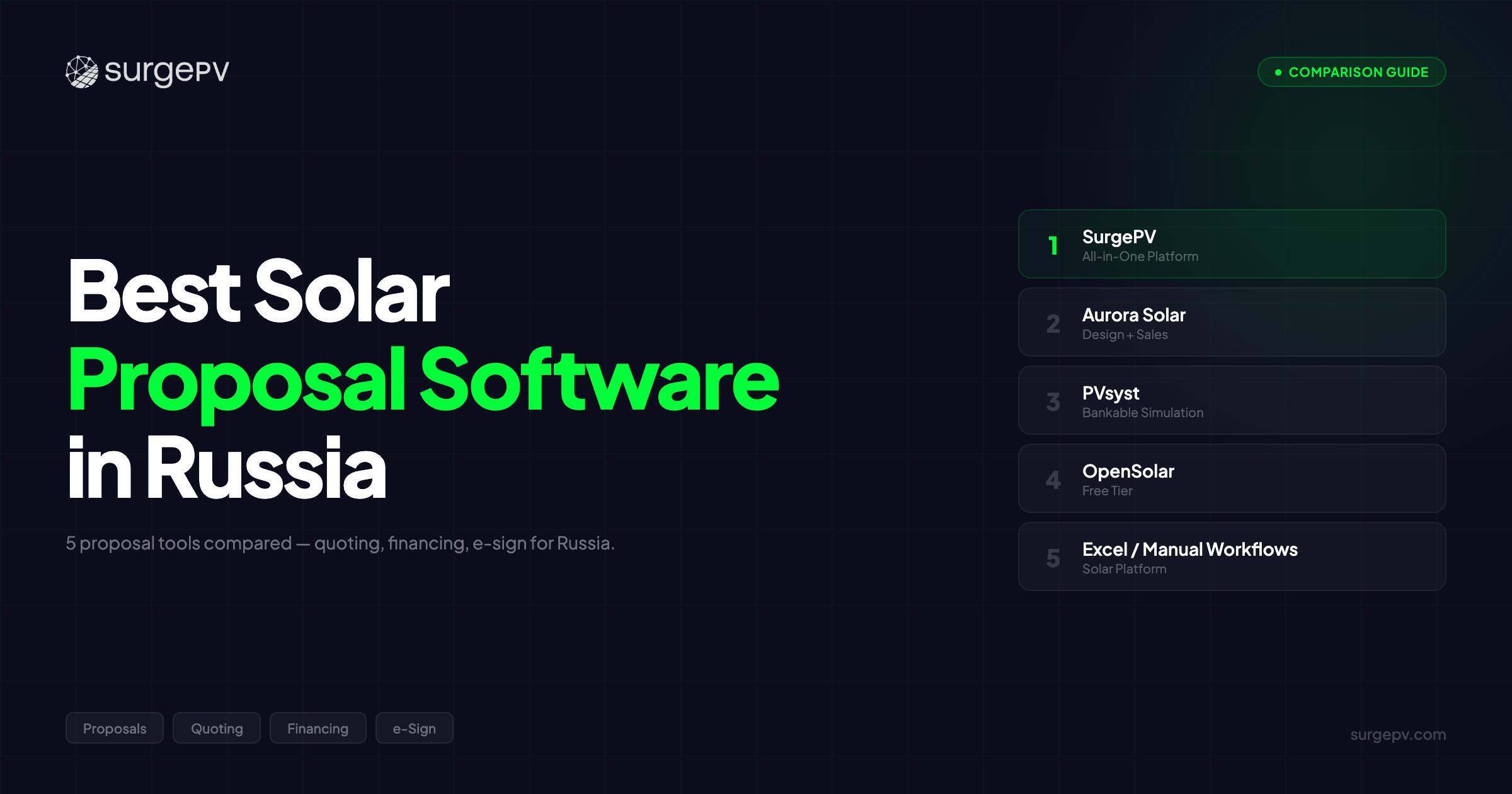
TL;DR: SurgePV is the best solar proposal software for Russia in 2026 — delivering design-to-proposal workflows with capacity payment modeling, regional tariff analysis in RUB, hybrid system economics for diesel displacement, and bankable P50/P90 simulations in one platform at $1,899/year for 3 users. PVsyst provides the bankable simulation data DPM evaluators require but generates no proposals. OpenSolar is the best free entry point for basic residential proposals.
Most Russian solar companies still build proposals in Excel. Manually pulling regional tariff data from Minenergo databases. Copy-pasting production estimates from PVsyst. Building financial models from scratch for every DPM tender. For a single utility-scale bid, that process takes 2–3 days. For a C&I quote in a competitive market where 5–15 other companies are also bidding? Those days add up fast.
Russia’s solar market is adding 500–800 MW annually under the DPM wholesale capacity contract program (IRENA Renewable Energy Statistics). The C&I segment is growing. Microgeneration under the 2019 law is picking up. And diesel displacement projects in Siberia, the Far East, and Arctic territories are becoming serious business — where diesel costs RUB 15–50/kWh, solar proposals practically sell themselves. If they’re delivered fast enough.
The problem isn’t demand. It’s speed. Russian EPCs lose deals because their proposals take too long, contain manual calculation errors, or lack the bankable data that DPM evaluators and commercial clients actually require.
We tested and compared the top 5 solar proposal platforms for the Russian market, evaluating each on financial modeling depth, proposal quality, DPM program support, software accessibility, and pricing.
In this guide, you’ll learn:
- Which platform generates complete Russian solar proposals fastest — including DPM tender documentation
- How pricing compares across tools (from free to over $3,100/year)
- Which software models regional Russian tariffs, diesel displacement, and microgeneration economics
- Software accessibility considerations for Russian-based teams
- Our recommendation based on evaluating 30+ solar sales platforms globally
Quick Comparison Table
| Software | Best For | Pricing/Year | Proposal Generation | DPM Modeling |
|---|---|---|---|---|
| SurgePV | End-to-end (all segments) | $1,899 (3 users) | Yes (automated) | Yes |
| Aurora Solar | Residential proposals | $3,108+ | Yes | No |
| PVsyst | Bankable simulation | ~$1,250 + $400/yr | No (simulation only) | Simulation data only |
| OpenSolar | Budget option | Free | Basic | No |
| Excel / Manual | Full customization | Free / low | Manual | Manual |
Best Solar Proposal Software in Russia (Detailed Reviews)
SurgePV — Best End-to-End Solar Proposal Platform for Russia
Best For: EPCs, developers, and installers across DPM utility-scale, C&I, and microgeneration
Pricing: $1,899/year (3 users); $1,499/user/year (For 3 Users plan)
Proposal Speed: 15–20 minutes per complete proposal
SurgePV is an end-to-end solar platform that combines 3D design, bankable simulation, automated SLD generation, and professional proposal output in a single cloud-based tool.
For Russian solar companies, the proposal capabilities solve a specific pain point.
Most Russian EPCs piece together proposals using 3–4 separate tools. Design in AutoCAD, simulate in PVsyst, build financial models in Excel, then format everything in Word or PowerPoint. For a single DPM tender with 10+ site variants, that fragmented workflow eats 20–30 hours of engineering time. For competitive C&I bids where turnaround speed determines who gets the contract, those extra days cost real revenue.
SurgePV collapses that entire process into one workflow. Design the system, run the simulation, generate the SLD, model the financials, and produce the proposal — all without switching tools or re-entering data.
Key Proposal Features for Russia
- Capacity payment modeling — Supports 15-year revenue projections for wholesale market capacity contract mechanisms, including capacity payment structures and return analysis in RUB. DPM tender proposals can include the financial framework evaluators expect — not just generic IRR tables.
- Regional tariff analysis — Supports the full range of Russian commercial electricity rates (RUB 5–12/kWh depending on region) with self-consumption savings modeling. Russia’s tariff variation is massive — a proposal that works in Krasnodar won’t work in Novosibirsk without adjusting the economics.
- Hybrid system economics — Models solar-plus-battery economics for remote areas (Siberia, Far East, Arctic) where diesel generation costs RUB 15–50/kWh (~$0.16–0.55/kWh). Shows payback period, annual energy cost savings, and lifetime economics in a single document.
- Microgeneration net metering — Proposals for systems up to 15 kW under Russia’s 2019 Microgeneration Law, modeling excess energy credit at wholesale rates and homeowner ROI.
- Design-to-proposal integration — Every proposal automatically includes production estimates from 8760-hour shading analysis, a 98% accurate bill of materials, and P50/P90 bankable metrics (+/-3% vs PVsyst). No copy-pasting between tools.
- Financial modeling — RUB currency support, inflation adjustments, Russian VAT (20%), equipment customs duties, and localization cost impact modeling for the 65–70% local content requirement on DPM projects.
Pro Tip
For DPM tenders requiring multiple site variant proposals, SurgePV’s design-to-proposal workflow saves 20–30 hours per tender compared to the AutoCAD + PVsyst + Excel approach. Book a demo to see the full DPM proposal workflow.
Pricing
| Plan | Price | Users |
|---|---|---|
| Individual | $1,899/year | 3 users |
| For 3 Users | $1,499/user/year | 3 users |
| For 5 Users | $1,299/user/year | 5 users |
| Enterprise | Custom | Multiple |
All features included on every plan — design, simulation, SLDs, proposals, financial modeling. No hidden fees, no feature gating. See full pricing.
Who SurgePV Is Best for in Russia
- Utility-scale developers preparing DPM tender proposals with multiple site variants and 15-year financial projections
- C&I EPCs needing fast turnaround on competitive commercial quotes (RUB 5–20M deal size)
- Companies working on diesel displacement projects in remote Siberian and Far East locations
- Residential installers designing microgeneration proposals up to 15 kW
- Teams replacing fragmented AutoCAD + PVsyst + Excel proposal workflows
Limitations
- English interface (no Russian localization yet) — proposals can include Russian-language content via templates
- Russian regional tariffs require manual input (not pre-loaded)
- Cloud-based — requires stable internet connection
Real-World Example
A 5-person EPC team in southern Russia was spending 2–3 days per C&I proposal — pulling PVsyst data, building Excel financial models, and formatting documents in PowerPoint. After switching to SurgePV, complete proposals with bankable production data and regional tariff analysis are generated in under 20 minutes. The team now responds to 3x more bid requests per month. In a market where 5–15 companies bid on every C&I project, that speed is the difference between winning and losing contracts.
Further Reading
See our Best Solar Proposal Software (2026) for a global comparison across 10+ platforms, and our Best Solar Design Software in Russia for the design platform comparison.
Aurora Solar — Polished Residential Proposals (Access May Be Limited)
Best For: Residential installers with confirmed platform access
Pricing: $259/user/month ($3,108/year)
Aurora Solar is the market leader in US residential solar proposals. Its AI-powered roof modeling and professionally designed proposal templates are genuinely best-in-class for homeowner-facing sales documents.
What Works (Where Accessible)
- Industry-leading proposal design quality — clean, professional, client-ready
- AI-powered 3D roof modeling speeds up residential system layout
- CRM integrations (Salesforce, HubSpot) streamline sales pipeline management
- Interactive web-based proposals with e-signature capability
Where It Falls Short in Russia
- Access restrictions — As a US-based cloud platform, Aurora Solar may have limited or restricted access for Russian users. Verify availability before purchasing annual subscriptions
- No DPM program support — Cannot model capacity payments, 15-year wholesale market contracts, or localization requirements
- No RUB financial modeling — No Russian regional tariff analysis, no hybrid system economics modeling
- No GOST/PUE compliance — Proposals do not reference Russian electrical standards
- No extreme climate data — Limited temperature derating below -20°C; snow load modeling insufficient for Russian conditions
- P50 only — No P75/P90 bankability metrics that Russian banks expect
- US-centric pricing — $3,108/year is steep for Russian market economics
Best for: International teams with confirmed platform access who need polished residential proposal templates — not Russian-focused DPM or C&I workflows.
PVsyst — Bankable Simulation for DPM Tender Data (Not a Proposal Tool)
Best For: Engineers providing simulation data for DPM tender proposals
Pricing: CHF 1,100 perpetual + CHF 350/year updates ($1,250 + $400/year)
PVsyst is not proposal software. It’s important to state that clearly. PVsyst is the industry gold standard for bankable energy production simulation — and it appears on this list because its outputs are a critical input to Russian solar proposals, especially for DPM tenders and bank financing applications.
What Works for Russia
- P50/P90 reports universally accepted by Sberbank, VTB, Gazprombank, and DPM program evaluators
- Detailed loss modeling including temperature derating, snow, soiling, and mismatch
- Compatible with GOST IEC harmonized standards for simulation outputs
- Desktop-based — no internet dependency, no access restrictions for Russian teams
- Meteonorm integration includes weather data for all major Russian regions
Where It Falls Short for Proposals
- No proposal generation at all — PVsyst outputs raw simulation reports, not client-facing proposals or tender documents
- No financial modeling — No RUB tariff analysis, no DPM capacity payment calculations, no diesel displacement, no ROI projections
- No design integration — Simulation-only; layout design requires a separate platform
- No SLD generation — Electrical documentation requires external CAD tools
- Desktop-only — No cloud collaboration or team sharing
Best for: Engineers who need bankable P50/P90 data to feed into proposals built in other tools.
Did You Know?
Russia’s DPM program has supported over 2 GW of solar installations through wholesale market capacity contracts since 2013, with 15-year guaranteed returns for winning bidders (Minenergo). Every successful bid requires bankable production estimates.
OpenSolar — Free Basic Proposals (Access May Be Limited)
Best For: Small companies needing a free starting point for basic proposals
Pricing: Free
OpenSolar is a free, cloud-based solar platform that covers basic design and proposal generation. For budget-constrained Russian companies entering the residential market, it offers a zero-cost entry point with simple proposal templates.
What Works
- Free — no licensing costs, low barrier to entry
- Basic proposal generation with customizable templates
- Simple 3D design for residential systems
- Easy learning curve for teams new to solar software
Where It Falls Short in Russia
- Access may be restricted — Cloud-based platform; verify availability for Russian users
- No DPM support — Cannot model capacity payments or utility-scale tender economics
- No RUB financial modeling — No Russian regional tariffs, no diesel displacement
- No GOST/PUE compliance — No Russian electrical standards support
- No bankable simulation — No P50/P90 reports for financing applications
- No SLD generation — No electrical documentation
- No extreme climate modeling — Not designed for -40°C conditions or heavy snow
Best for: Small residential companies with confirmed access who need basic proposals at zero cost — not commercial or utility-scale workflows.
Excel / Manual Workflows — The Traditional Russian Approach
Best For: Companies needing full customization with existing tools
Pricing: Free to low cost (Microsoft Office license)
This is the reality for most Russian solar companies today. Proposals are built manually in Excel (financial models), Word or PowerPoint (client documents), combined with PVsyst simulation outputs and AutoCAD drawings. It works — but it’s slow, error-prone, and doesn’t scale.
What Works
- Complete customization — build exactly what you need
- No access restrictions — runs locally
- Russian-language output — full control over formatting and content
- Familiar tools — no learning curve for existing teams
Where It Falls Short
- Speed — 2–3 days per commercial proposal vs 15–20 minutes in SurgePV
- Error rate — Manual data transfer between tools introduces calculation mistakes
- No design integration — Production estimates copied manually from PVsyst
- No automation — Every proposal built from scratch
- Version control — Multiple Excel files, no single source of truth
- Scalability — Adding team members doesn’t reduce per-proposal time
Best for: Companies with highly customized proposal requirements who haven’t yet found a platform that handles Russian-specific financial modeling — which is exactly the gap SurgePV fills.
What Makes Proposal Software Work in Russia (And Why Most Tools Don’t)
DPM Program Financial Modeling
Russia’s DPM wholesale capacity contract mechanism is the primary driver for utility-scale solar. Projects compete for 15-year capacity payment contracts through competitive auctions administered by Minenergo. Winning proposals require detailed financial models showing capacity payment schedules, return on investment, localization compliance (65–70% local content), and bankable production estimates. Most solar proposal tools were built for US net metering or European feed-in tariff markets — they cannot model DPM capacity payment structures at all.
Regional Tariff Variation
Russia’s electricity pricing varies more than almost any other solar market. Wholesale rates range from RUB 2.5–4.5/kWh. Commercial rates span RUB 5–12/kWh depending on the region. A proposal that shows 5-year payback in Krasnodar might show 12-year payback in Moscow with the same system design. Your financial modeling needs to pull the right regional data — and most Western platforms don’t have Russian tariff support at all.
Diesel Displacement Economics
The highest-margin solar opportunity in Russia isn’t grid-connected. It’s displacing diesel generators in remote areas — Siberia, the Far East, Arctic territories — where fuel logistics push diesel generation costs to RUB 15–50/kWh (~$0.16–0.55/kWh). At those rates, solar with battery storage pays for itself in 3–5 years. But the proposal needs to model fuel cost escalation, battery degradation, and seasonal generation variation accurately (Global Solar Atlas). Most solar proposal tools don’t support diesel displacement modeling.
Bankability Requirements
Russian banks — Sberbank, VTB, Gazprombank — require P50/P90 production estimates for project financing. DPM tender evaluators require the same. PVsyst reports are universally accepted. SurgePV achieves +/-3% accuracy versus PVsyst. Proposals without bankable production data get rejected — regardless of how professional the formatting looks.
Software Accessibility
Since 2022, access to some Western cloud-based platforms has been restricted for Russian users. This directly affects proposal software selection. Desktop applications (PVsyst) and platforms that maintain Russian accessibility (SurgePV) offer more reliable long-term access. Companies should verify platform availability before committing to annual subscriptions or building workflows around a specific tool (IEA Russia Energy Profile).
Microgeneration Under the 15 kW Law
Russia’s 2019 Microgeneration Law provides net metering for systems up to 15 kW. Excess energy is credited at the wholesale electricity rate — lower than retail. Proposals for this segment need to model self-consumption ratios accurately and show homeowners realistic payback periods, not inflated retail-rate savings. System sizing to maximize self-consumption within the 15 kW threshold is where the real value lies.
Our Testing Methodology
We evaluated each platform against five weighted criteria specific to Russian solar proposal requirements:
- Russian financial modeling (30%) — Capacity payment modeling, regional tariff analysis (RUB), hybrid system economics, microgeneration net metering, VAT and customs handling
- Proposal quality and speed (25%) — Professional output, turnaround time, template customization, DPM tender format support
- Accessibility and reliability (20%) — Software access for Russian teams, desktop vs cloud, long-term availability
- Design integration (15%) — Single-platform workflow, automatic BOM, extreme climate data inclusion, SLD generation
- Pricing and value (10%) — Annual cost relative to feature set, ROI for Russian market economics
Testing was conducted between January and February 2026, using real Russian project data from multiple regions and regulatory documentation from Minenergo and SO UPS.
Generate Solar Proposals Faster with SurgePV
Complete design-to-proposal workflows with capacity payment modeling, regional tariff analysis, and bankable simulations for the Russian market.
Book a DemoNo commitment required · 20 minutes · Live project walkthrough
Bottom Line: Best Solar Proposal Software for Russia
Russia’s solar proposal market has a clear problem: most companies are still building proposals manually. DPM tender documents take days. C&I quotes lose to faster competitors. Diesel displacement opportunities sit unquoted because the financial modeling is too complex to do by hand every time.
For EPCs and multi-segment teams: SurgePV delivers the most complete proposal workflow for Russia. Capacity payment modeling, regional tariff analysis in RUB, hybrid system economics, bankable P50/P90 data, and automated SLD generation — all producing a client-ready proposal in 15–20 minutes instead of 2–3 days. $1,899/year for 3 users.
For bankable simulation data: PVsyst remains the gold standard for P50/P90 production estimates that Russian banks and DPM evaluators accept. But it’s simulation-only — you’ll still need a separate tool for the actual proposal.
For international teams with confirmed access: Aurora Solar offers polished residential proposal templates, but verify platform availability and understand that it lacks Russian financial modeling entirely.
For budget-constrained startups: OpenSolar provides basic proposals at no cost, but lacks Russian-specific features. Verify access before building workflows around it.
For sticking with what you know: Excel and manual workflows offer full customization and no access concerns — but the 2–3 day turnaround per proposal is a competitive disadvantage that compounds with every bid you submit.
The Russian solar market is becoming more competitive. DPM tenders attract more bidders each year. C&I clients receive more quotes. The companies winning contracts are the ones delivering complete, bankable, professionally formatted proposals faster than their competitors.
Want to see how SurgePV generates a complete Russian solar proposal? Book a demo and our team will build a proposal using your actual project data and regional tariffs.
Frequently Asked Questions
What is the best solar proposal software in Russia?
SurgePV is the best solar proposal software for Russia in 2026. It combines design-to-proposal workflows with multi-currency financial analysis, capacity payment modeling, regional tariff analysis (RUB 5–12/kWh commercial), and hybrid system economics — all in one platform at $1,899/year for 3 users. For bankable simulation data, PVsyst provides the P50/P90 reports that Russian banks accept.
Can proposal software model DPM program economics?
SurgePV’s financial modeling supports capacity payment calculations for wholesale market projects, 15-year contract projections, localization cost impact (65–70% requirement), and return analysis in multiple currencies including RUB. PVsyst provides the bankable simulation data that DPM tender evaluators require but does not generate proposals or financial models.
How much does solar proposal software cost in Russia?
Costs range from free (Excel, manual workflows) to $3,108/year (Aurora Solar, access may be restricted). SurgePV starts at $1,899/year for 3 users with design, simulation, SLDs, and proposal features included. PVsyst costs approximately $1,250 perpetual plus $400/year for updates but provides simulation only — no proposal generation.
Which proposal software supports Russian regional tariffs?
SurgePV supports custom regional tariff input covering the full range of Russian commercial electricity rates (RUB 5–12/kWh depending on region) with self-consumption savings modeling. Other platforms — Aurora Solar, HelioScope, OpenSolar — do not include Russian tariff databases.
Can proposal software create documents in Russian?
SurgePV supports customizable proposal templates that can include Russian-language content. PVsyst generates reports primarily in English and French. Aurora Solar is primarily English. SurgePV’s template system offers a middle ground between full localization and manual formatting.
Can proposal software model diesel displacement economics?
SurgePV models hybrid system economics for remote Russian areas (Siberia, Far East, Arctic) where diesel generation costs RUB 15–50/kWh. Proposals include solar-plus-battery payback periods, annual energy cost savings, and lifetime economics. No other tested platform offers this capability natively.
Do Russian banks accept software-generated proposals?
Russian banks and investors accept bankable P50/P90 simulation reports from PVsyst (the gold standard) and SurgePV (+/-3% accuracy versus PVsyst) for DPM and commercial project financing. Sberbank, VTB, and Gazprombank all accept PVsyst-format production estimates for project due diligence.
What about microgeneration proposals under the 15 kW law?
SurgePV supports microgeneration proposals under Russia’s 2019 Microgeneration Law (up to 15 kW), modeling self-consumption versus export at wholesale rates, system sizing optimization within the 15 kW cap, and homeowner ROI calculations in RUB. This is an increasingly important segment as residential solar adoption grows in Russia.
Sources
- IRENA Renewable Energy Statistics — Russia renewable energy capacity data
- Minenergo (Ministry of Energy of Russia) — DPM program, energy policy, renewable energy targets
- SO UPS (System Operator of the Unified Power System) — Grid standards and connection requirements
- Global Solar Atlas — GHI data and solar resource mapping for Russian regions
- IEA Russia Energy Profile — Energy data and renewable energy context
- RAWI (Russian Association of Wind Power Industry) — Renewable energy industry data and market analysis
- Hevel Solar — Russian solar manufacturer and developer market data
- SurgePV Product Documentation — Official feature specifications (accessed February 2026)