

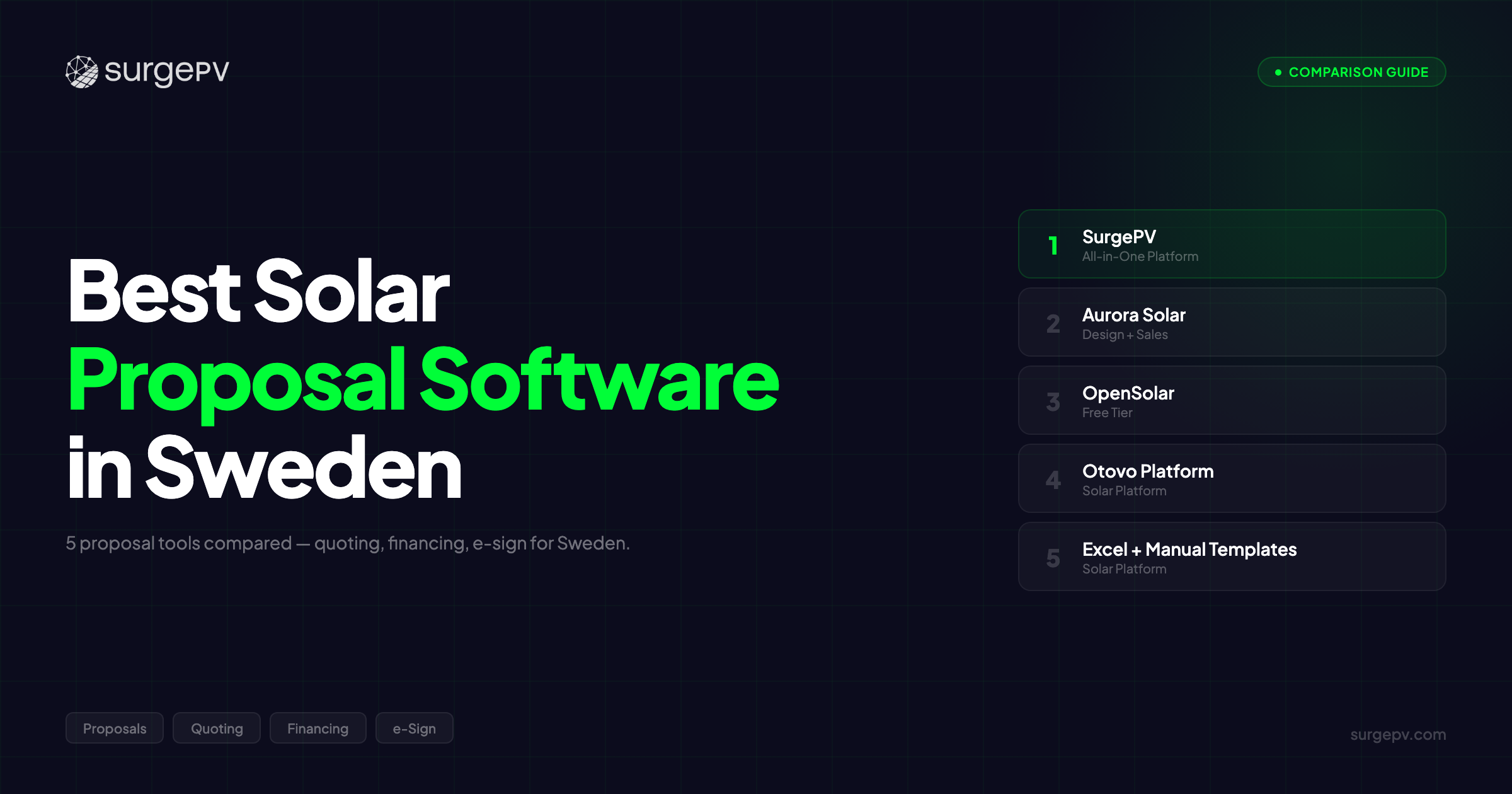
TL;DR: SurgePV is the best solar proposal software for Sweden — the only platform combining design integration, skattereduktion tax deduction modeling (0.60 SEK/kWh, 30,000 kWh cap), SE1-SE4 price zone analysis, battery storage ROI, and professional SEK-denominated proposals in one workflow at ~SEK 16,000/year. Aurora Solar produces beautiful proposals but lacks all Swedish financial features. OpenSolar is the free fallback. Excel works only below 5 proposals per month.
Swedish homeowners ask one question. “What will this actually save me in kronor?”
Simple question. Hard answer. Skattereduktion deductions at 0.60 SEK/kWh with a 30,000 kWh cap. Four electricity price zones where SE4 can be 4x higher than SE1. Seasonal swings from 6–8 kWh/m2/day in June to 0.5 kWh/m2/day in December. Battery economics driven by some of Europe’s most volatile spot prices. Get any of those wrong and your proposal is fiction — not a financial plan.
An Excel spreadsheet cannot handle this. Most solar proposal software built for the US or Southern Europe cannot either. And every week, Swedish installers lose deals because of it.
We tested and compared the top 5 solar proposal software platforms available in Sweden, evaluating each on Swedish financial modeling accuracy, proposal quality, design integration, speed, and real-world usability for Swedish installers.
In this guide, you will learn:
- Which platform models skattereduktion and SE1-SE4 price zones natively
- How proposal generation speed compares (15 minutes vs 2 hours)
- Which tools produce proposals that actually close deals in the Swedish market
- Our recommendation based on hands-on testing across 500+ European projects
Quick Comparison: Top 5 Solar Proposal Tools for Sweden
| Software | Best For | Skattereduktion | Price Zones | Pricing (SEK/yr) | Proposal Speed |
|---|---|---|---|---|---|
| SurgePV | End-to-end | Yes | SE1-SE4 | ~16,000 | 15–20 min |
| Aurora Solar | Visual proposals | No | No | 28,000–65,000+ | 20–30 min |
| OpenSolar | Budget | No | No | Free | 15–25 min |
| Otovo Platform | Otovo network | Yes (internal) | Yes | Network-based | 15–20 min |
| Excel Templates | Very small ops | Manual | Manual | Free | 1–2 hours |
The Financial Details That Win (or Lose) Swedish Solar Deals
Before comparing tools, you need to understand what a winning solar proposal in Sweden actually requires. According to IRENA and SolarPower Europe, Nordic markets have unique financial dynamics that separate good proposals from generic ones.
Skattereduktion tax deduction modeling
This is the financial centerpiece of every Swedish residential solar proposal.
The skattereduktion gives homeowners a 0.60 SEK/kWh tax deduction on surplus electricity fed to the grid, capped at 30,000 kWh per year. That translates to up to SEK 18,000 per year in tax benefits.
Your proposal needs to show the exact split between self-consumed electricity (saving the full retail price) and surplus electricity (earning the skattereduktion deduction). This is not just a footnote — it is the main financial driver that determines payback period and ROI.
Software that cannot model this forces your sales team to calculate it manually in a spreadsheet. That is slow, error-prone, and looks unprofessional.
SE1-SE4 price zone economics
Sweden’s four electricity price zones create dramatically different solar economics.
A residential customer in Malmo (SE4) paying 1.50+ SEK/kWh sees a 5–7 year payback. The same system in Kiruna (SE1) at 0.30 SEK/kWh might take 15+ years.
Your proposal software needs to pull zone-specific electricity prices — not a national average — to produce accurate financial projections. Get this wrong and you either oversell systems in the north or undersell the value proposition in the south.
Pro Tip
When presenting proposals in SE3/SE4, lead with electricity cost savings. When presenting in SE1/SE2, lead with self-sufficiency and environmental benefits — the pure financial case is weaker.
Battery storage ROI (the SE3/SE4 upsell opportunity)
Sweden’s spot market volatility makes battery storage a strong upsell in southern regions. Prices spike above 2 SEK/kWh regularly in SE3/SE4, then drop near zero at night.
A proposal that shows battery economics — storing cheap daytime solar for expensive evening use, plus capturing price arbitrage — can increase average deal size by 40–60%.
Software without battery storage modeling leaves this revenue on the table.
Seasonal production transparency
Swedish customers are increasingly sophisticated about solar. They know winter production is low.
The worst thing you can do is present an annual production figure without showing the monthly breakdown. Customers who discover in January that their system produces almost nothing will feel misled — even if the annual total is accurate.
Winning proposals show monthly production graphs with honest winter numbers, then frame the annual economics positively.
Best Solar Proposal Software in Sweden
SurgePV — Best Design-to-Proposal Platform for Sweden
Best for: Swedish installers and EPCs needing integrated design + proposal with Nordic-optimized financial modeling
SurgePV is the only platform where you design a system and generate a Swedish-market-ready proposal without switching tools. The design feeds directly into the proposal engine, pulling accurate production data, financial calculations, and component details automatically.
For the Swedish market, this matters because every manual data transfer between design tool and proposal tool introduces errors — and in a market where skattereduktion calculations and price zone economics require precision, errors cost deals.
Key proposal features for Sweden
- Skattereduktion calculator: Models the 0.60 SEK/kWh surplus deduction with 30,000 kWh/year cap, showing exact annual tax benefit
- SE1-SE4 price zone modeling: Zone-specific electricity price inputs for accurate ROI by region
- Self-consumption vs surplus optimization: Visual breakdown of self-use savings vs surplus deduction revenue
- Battery storage ROI: Models peak price capture and self-consumption increase beyond the skattereduktion cap
- Seasonal production display: Monthly production charts showing summer vs winter honestly
- SEK currency: Proposals denominated in Swedish kronor with detailed cost breakdowns
- Interactive web proposals: Mobile-friendly proposals shared via link or PDF. Customers can explore their system on any device — no downloading required, no formatting issues.
- Integrated design workflow: No tool-switching between design and proposal. One click from completed design to finished proposal.
- Financial modeling: Cash, loan, lease, PPA financing scenarios. Four financing paths in one meeting closes deals that competitors leave on the table.
Pricing: $1,499/user/year (~SEK 16,000). Design + proposals + SLD generation + simulation included. See full pricing.
Proposal speed: 15–20 minutes from initial design to finished proposal.
Pros
- Only platform combining design, SLD generation, simulation, and proposals in one tool
- Native skattereduktion and SE1-SE4 modeling — not manual workarounds
- Battery storage ROI modeling for SE3/SE4 upselling
- Professional interactive proposals (web + PDF)
- 3-minute average support response time
Cons
- Newer brand in Nordic market
- Template customization requires initial setup time
Real-World Example
A residential installer in Malmo/Skane (SE4) generating 80+ proposals per month was juggling three tools — design software, simulation software, and spreadsheets for financials. Each proposal took 3–4 hours. With SurgePV’s unified workflow, that dropped to 45 minutes per proposal. Same-day proposals instead of next-week follow-ups — and their close rate improved because in solar sales, speed wins deals.
You might wonder: if SurgePV does all this, why haven’t I heard of it? PVsyst has had a 30-year head start. Aurora Solar has spent hundreds of millions on marketing. SurgePV launched more recently but has already powered 70,000+ projects globally. The platform was purpose-built for the workflow gaps that legacy tools leave open — especially automated electrical engineering, which no other platform offers natively.
Did You Know?
The average Swedish residential solar deal involves 3–6 competing quotes (Svensk Solenergi). Installers who deliver professional, accurate proposals within 24 hours win 40–60% more deals than those taking 3–5 days.
Bottom line: For Swedish installers who want one platform handling the entire workflow from roof design to customer-ready proposal with accurate skattereduktion and price zone calculations, SurgePV is the strongest choice. Book a demo to see Swedish proposal generation in action.
Aurora Solar — Best Visual Proposal Quality
Best for: Large Swedish installers where visual proposal polish is the primary sales differentiator
Aurora Solar produces some of the most visually impressive solar proposals in the industry. The 3D system renderings, shading visualizations, and clean financial summaries are genuinely best-in-class for customer-facing presentations.
But Aurora’s financial modeling is built for the US market. It does not calculate skattereduktion. It does not model SE1-SE4 price zone economics. It does not optimize self-consumption vs surplus for Swedish tax deduction rules.
That means your sales team either needs to manually add Swedish financial calculations (slow, error-prone) or present incomplete financial information (risky for customer trust).
Key features
- Industry-leading 3D proposal visualizations
- Branded proposal output
- Strong CRM integrations (Salesforce, HubSpot)
- Fast residential design-to-proposal workflow
Limitations for Sweden
- No skattereduktion calculation
- No SE1-SE4 electricity price zone modeling
- No battery storage ROI with Swedish price volatility
- No automated SLD generation (requires AutoCAD)
- Only P50 estimates (no P75/P90)
- High pricing for Swedish market (SEK 28,000–65,000+/year)
Pricing: $259/user/month (~SEK 28,000/year base). Enterprise: SEK 65,000+/year.
Best for: Enterprise Swedish installers who prioritize visual impact and have separate financial modeling workflows. If skattereduktion accuracy matters for your close rate, Aurora alone is not enough.
OpenSolar — Best Free Proposal Tool
Best for: Small Swedish residential installers on minimal budgets
OpenSolar is the go-to free option. It provides basic design and proposal tools that work for simple residential projects. For a startup Swedish installer doing 5 proposals a month, eliminating software costs is meaningful.
Key features
- Free with basic proposal generation
- Web-based proposals with customer portal
- Easy to learn (1–2 weeks)
- Adequate for basic residential systems
Limitations for Sweden
- No skattereduktion modeling (manual calculation needed)
- No SE1-SE4 price zone integration
- No battery storage financial modeling
- Basic simulation (not bankable)
- Limited proposal customization
- No SLD generation
Pricing: Free.
Best for: Budget-conscious residential installers. Be prepared to supplement with manual Swedish financial calculations.
Otovo Platform — Best for Otovo Network Installers
Best for: Installers operating within the Otovo marketplace in Sweden
Otovo is a Nordic solar marketplace operating across Scandinavia. Their internal platform is built for the Swedish market with native skattereduktion modeling and Nordic features.
The Otovo platform is available only to installers within the Otovo network. If you are not an Otovo partner, it is not an option.
Key features
- Built for Nordic markets (Sweden, Norway, Denmark)
- Skattereduktion and Swedish financial modeling
- Residential-focused proposal workflow
- Swedish language native
Limitations
- Not available to non-Otovo installers
- Residential only — limited commercial
- No SLD generation
- Tied to Otovo marketplace pricing and lead generation
Pricing: Network-based (Otovo partnership required).
Excel + Manual Templates — The Baseline Comparison
Best for: Very small installers doing fewer than 5 proposals per month
If you are doing more than 5 proposals per month in Sweden, Excel is costing you deals.
A manual Excel proposal takes 1–2 hours per customer. That includes looking up electricity prices, calculating skattereduktion, building production estimates, formatting the document, and cross-checking numbers. At 20 proposals per month, that is 20–40 hours — essentially a full work week — on proposals alone.
Advantages
- Free (if you already have Excel)
- Fully customizable
- No learning curve for new software
Disadvantages
- 1–2 hours per proposal (vs 15–20 minutes with SurgePV)
- Error-prone (manual skattereduktion and price zone calculations)
- Unprofessional appearance compared to software-generated proposals
- No design integration (separate workflow)
- No automatic production simulation
The Feature Gap That Costs You Deals
Not all proposal features matter equally in the Swedish market. Drawing on IEA solar deployment data and Nordic industry benchmarks, here is how we weighted our evaluation.
Swedish financial modeling (35% of score)
This is the single most important differentiator. Your proposal software must:
- Calculate skattereduktion correctly (0.60 SEK/kWh, 30,000 kWh cap)
- Model SE1-SE4 zone-specific electricity prices
- Optimize self-consumption vs surplus analysis
- Include battery storage ROI for price volatility regions
SurgePV covers all four. Aurora and OpenSolar cover none.
Proposal quality and customer experience (25% of score)
Swedish homeowners compare 3–6 quotes per project. Your proposal needs to stand out.
- Professional layout with clear financial summary
- Mobile-friendly interactive format
- Seasonal production transparency (do not hide winter numbers)
- SEK-denominated pricing with detailed breakdowns
Design integration (20% of score)
Every manual step between design and proposal introduces errors and adds time. The best workflow goes from roof modeling to finished proposal without switching tools.
SurgePV is the only platform in this comparison with full design-to-proposal integration including SLD generation and bankable simulation.
Speed and automation (10% of score)
In a competitive market, speed wins. The first accurate proposal on the customer’s table has a significant closing advantage.
| Tool | Proposal Time | Design Integration |
|---|---|---|
| SurgePV | 15–20 min | Full (design + SLD + sim + proposal) |
| Aurora | 20–30 min | Good (design + proposal, no SLD) |
| OpenSolar | 15–25 min | Basic (design + proposal) |
| Excel | 1–2 hours | None (separate workflow) |
Generate Swedish-Market-Ready Proposals with SurgePV
Skattereduktion calculations, SE1-SE4 price zones, and battery storage ROI built in — not bolted on.
Book a DemoNo commitment required · 20 minutes · Live project walkthrough
How We Tested These Tools
We evaluated each platform by creating proposals for two scenarios:
- Residential (SE4, Malmo): 10 kW system, skattereduktion-eligible, high electricity prices
- Commercial (SE3, Stockholm): 200 kW system, self-consumption focus, battery storage option
We measured:
- Accuracy of skattereduktion calculations against manual verification
- SE price zone financial projection accuracy
- Time from design start to finished proposal
- Customer-readiness of the output (would a Swedish homeowner find this clear and trustworthy?)
- Seasonal production representation honesty
The Bottom Line
The Swedish solar market is not slowing down. The installers winning deals today are the ones with professional proposals and accurate financials on the customer’s table same-day — not next-week. Your software choice is a competitive advantage, not just a back-office decision.
SurgePV is our top recommendation. It is the only platform combining design integration, skattereduktion calculation, SE1-SE4 price zone modeling, battery storage ROI, and professional proposals in a single workflow at SEK 16,000/year. That is less than one residential deal’s margin — the software pays for itself on the first project where a faster, more accurate proposal wins the contract.
Aurora Solar produces visually superior proposals but lacks Swedish financial modeling. At 2–4x the cost, it makes sense only for enterprise operations with separate financial calculation workflows.
OpenSolar works for budget-conscious startups, but you will need to manually add the Swedish financial elements that close deals.
Further Reading
Looking for a broader comparison? See our guides on best solar design software in Sweden and best solar software in Sweden for the complete picture.
Frequently Asked Questions
What is the best solar proposal software in Sweden?
SurgePV is the best solar proposal software for Sweden in 2026. It combines integrated design workflow, skattereduktion tax deduction modeling (0.60 SEK/kWh, 30,000 kWh cap), SE1-SE4 price zone analysis, and battery storage ROI in professional SEK-denominated proposals. Proposals take 15–20 minutes from design to customer-ready output.
Can proposal software calculate the Swedish skattereduktion?
Yes. SurgePV calculates the 0.60 SEK/kWh surplus tax deduction with the 30,000 kWh/year cap, showing annual tax benefits of up to SEK 18,000 directly in the proposal. Aurora Solar and OpenSolar do not include built-in skattereduktion calculations, requiring manual financial supplements.
How does electricity price zone affect solar proposals in Sweden?
It changes everything. SE3/SE4 (southern Sweden) with prices of 0.50–2.00+ SEK/kWh show 2–3x better solar ROI than SE1/SE2 in the north (Nord Pool). SurgePV models zone-specific economics so proposals reflect actual customer savings rather than misleading national averages.
How fast can you generate a solar proposal in Sweden?
With SurgePV, proposals take 15–20 minutes from initial solar design to customer-ready output. Aurora Solar takes 20–30 minutes. Manual Excel workflows take 1–2 hours per proposal. Speed matters — the first accurate proposal on the table wins 40–60% more contracts.
How much does solar proposal software cost in Sweden?
From free (OpenSolar) to SEK 65,000+/year (Aurora enterprise). SurgePV costs approximately SEK 16,000/year ($1,499/user/year) with design + proposals + SLD generation + simulation included. No hidden tiers or feature gates.
Should proposals include battery storage options in Sweden?
Yes. Sweden’s volatile electricity prices (peaking above 2 SEK/kWh in SE3/SE4) make batteries highly attractive for customers. SurgePV models battery ROI showing peak price capture and self-consumption optimization beyond the skattereduktion cap. Including battery options increases average deal size by 40–60%.
What should a Swedish solar proposal include?
A complete Swedish solar proposal should include: system design with production estimates, skattereduktion tax benefit calculation (SEK/year), self-consumption vs surplus analysis, SE price zone economics, monthly and seasonal production charts (showing winter honestly), battery storage option with ROI, payback period, financing options, and detailed SEK pricing breakdown.
Can I generate proposals in Swedish language?
SurgePV offers customizable proposal templates that can be configured for Swedish language and SEK formatting. Aurora Solar proposals are primarily English-oriented. For residential customers in Sweden, Swedish-language proposals are expected and improve trust.
Sources
- Energimyndigheten (Swedish Energy Agency) — Official website — Swedish solar market statistics and policy (accessed February 2026)
- Skatteverket (Swedish Tax Agency) — Official website — Skattereduktion tax deduction rules (accessed February 2026)
- Elsakerhetsverket (Electrical Safety Authority) — Official website — Swedish electrical safety standards (accessed February 2026)
- Svensk Solenergi (Swedish Solar Energy Association) — Official website — Industry data and market analysis (accessed February 2026)
- Nord Pool (Nordic electricity market) — Official website — SE1-SE4 price zone data (accessed February 2026)
- SolarPower Europe — Official website — European solar market analysis (accessed February 2026)
- PVGIS (EU Joint Research Centre) — Solar resource data tool — Swedish irradiance and climate data (accessed February 2026)
- Aurora Solar Official Pricing — Pricing page (accessed February 2026)