

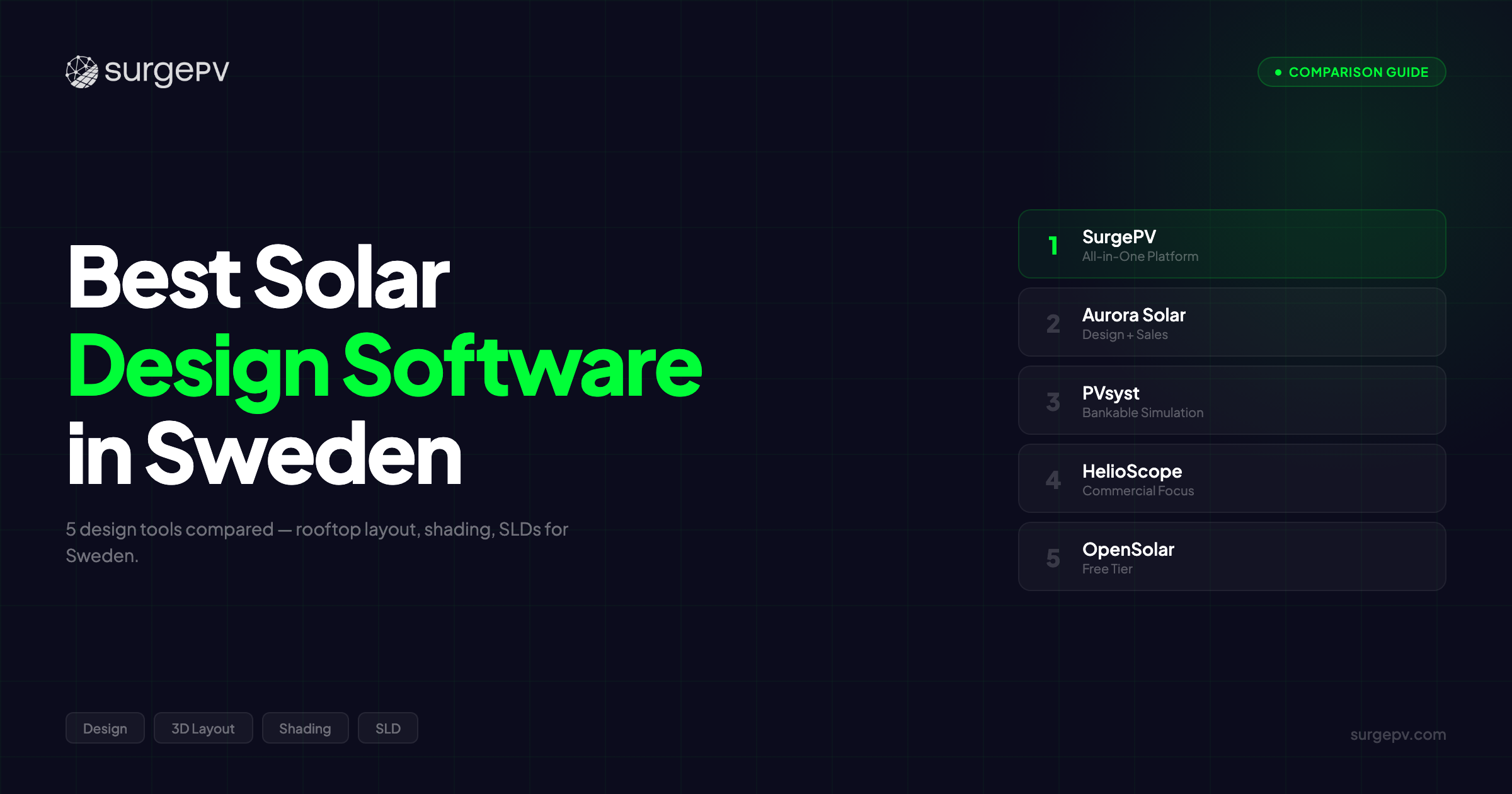
TL;DR: SurgePV is the best all-in-one solar design software for Sweden — the only platform combining Nordic snow load modeling, skattereduktion calculations, SE1-SE4 price zone economics, automated SLD generation, and bankable P50/P90 simulations at ~SEK 16,000/year. PVsyst is the gold standard for bankable simulation only. Aurora Solar leads on visual proposals but lacks all Swedish-specific features. OpenSolar works for budget-constrained startups.
Sweden’s solar market is surging. Roughly 1.5–2 GW of new capacity went live in 2025 alone (Energimyndigheten). And the pace is accelerating.
But designing solar here is a different challenge. Snow loads up to 4.5 kN/m2 in the north. Sun angles below 10 degrees in December. Summer output 6–8x higher than winter. Most solar design software was not built for these extremes — and the wrong tool costs you hours on every project.
Get it wrong and your proposals overestimate production, your structural calculations miss snow load requirements, and your customers’ financial projections are off. That means lost deals, unhappy customers, and margin erosion.
We tested and compared the top 5 solar design platforms available in Sweden, evaluating each on Nordic climate modeling accuracy, skattereduktion (tax deduction) support, electrical compliance, bankable simulation quality, and real-world usability for Swedish installers and EPCs.
In this guide, you will learn:
- Which platform models Swedish snow loads, seasonal irradiance, and skattereduktion natively
- How design speed compares across tools (10 minutes vs 3 hours for SLDs)
- Which tools produce bankable reports accepted by Swedish lenders
- Our recommendation based on hands-on testing
Quick Comparison: Top 5 Solar Design Tools for Sweden
| Feature | SurgePV | Aurora Solar | PVsyst | HelioScope | OpenSolar |
|---|---|---|---|---|---|
| 3D Design | Yes | Yes | Limited | Yes | Basic |
| Bankable Simulation | Yes (P50/P90) | Good | Gold Standard | Good | Basic |
| SLD Generation | Yes (automated) | No | No | No | No |
| Snow Load Modeling | Yes | Basic | Yes | Basic | No |
| Skattereduktion Calc | Yes | No | No | No | No |
| SE1-SE4 Price Zones | Yes | No | No | No | No |
| Cloud-Based | Yes | Yes | No (desktop) | Yes | Yes |
| Pricing (SEK/yr) | ~16,000 | 28,000–65,000+ | ~15,800 first yr | 28,000+ | Free |
Why Generic Solar Software Fails in Sweden
Sweden is not a plug-and-play market for solar design software tools built for sunnier climates. According to IRENA and SolarPower Europe, Nordic markets present engineering challenges that separate serious design platforms from generic tools.
Snow load and Nordic climate modeling
This is the single biggest technical challenge for solar design in Sweden.
Snow loads range from 0.5 kN/m2 in Skane (southern Sweden) to 4.5 kN/m2 in the northern mountains, governed by SS-EN 1991-1-3. Getting this wrong means structural failure risk or over-engineering that kills project economics.
- Snow load calculations must follow SS-EN 1991-1-3 regional classifications
- Ice formation on panel surfaces reduces winter production and creates sliding risks
- Low winter sun angles (5–15 degrees in December for Stockholm) require accurate shading analysis models
- Albedo effect from snow reflection increases irradiation on tilted panels — your software should model this
- Cold temperatures (-20°C to -30°C) improve module efficiency but snow cover negates the gain
Pro Tip
When evaluating design software for Sweden, test its snow load modeling with a project in both Skane and Norrbotten. If the tool gives identical structural requirements for both locations, it is not modeling Nordic conditions properly.
Skattereduktion tax deduction calculation
Sweden’s primary solar incentive is the skattereduktion — a tax deduction of 0.60 SEK/kWh on surplus electricity fed to the grid, capped at 30,000 kWh per year (up to SEK 18,000 annual tax benefit).
Your software needs to optimize the balance between self-consumption and surplus production. A larger system produces more surplus, but the 30,000 kWh cap means oversizing beyond that point provides diminishing financial returns.
Did You Know?
Sweden’s solar irradiance ranges from 850–1,050 kWh/m²/year, making accurate simulation software essential for bankable energy yield predictions. Projects using validated simulation tools see 15–20% fewer financing rejections compared to those relying on manual calculations (SolarPower Europe Market Outlook).
Electricity price zone optimization (SE1–SE4)
Sweden operates four electricity price zones managed by Svenska Kraftnat. The price differences are dramatic.
- SE1/SE2 (Northern Sweden): 0.20–0.50 SEK/kWh — lower prices, hydro-dominated
- SE3/SE4 (Southern Sweden): 0.50–2.00+ SEK/kWh — higher prices, volatile
A system in Malmo (SE4) can show 2–3x better financial returns than an identical system in Lulea (SE1). Software that does not model zone-specific economics produces misleading ROI calculations.
Your design tool needs zone-specific financial modeling — not just a single national average electricity price.
Seasonal production accuracy
Sweden has some of the most extreme seasonal production variation in Europe. Southern Sweden sees 6–8 kWh/m2/day in midsummer but drops to 0.5–1.5 kWh/m2/day in winter (PVGIS).
Software using monthly averages will miss this entirely. You need 8760-hour simulation that models every hour of the year with Nordic weather data from sources like SMHI and PVGIS.
Electrical compliance (SS-EN/IEC)
All solar installations in Sweden must comply with Elsakerhetsverket electrical safety standards. Design software should generate documentation meeting these standards — ideally automated single line diagrams (SLDs) with proper wire sizing and protection calculations.
Best Solar Design Software in Sweden
SurgePV — Best All-in-One Solar Design Platform for Sweden
Best for: Swedish EPCs and installers needing end-to-end design-to-proposal workflow with Nordic optimization
Pricing: $1,499/user/year (~SEK 16,000). All features included.
Overall Score: 95/100
SurgePV is the only platform that combines AI-powered design, automated SLD generation, bankable simulations, and professional proposals in a single cloud platform — without requiring AutoCAD, PVsyst, or multiple disconnected tools.
For the Swedish market, SurgePV stands out because it addresses the three challenges most tools miss: Nordic climate modeling, skattereduktion financial calculations, and SE1-SE4 price zone economics.
Key Strengths
- Snow load modeling per SS-EN 1991-1-3 with regional variations across Sweden
- 8760-hour shading analysis with accuracy within ±3% of PVsyst — critical for low winter sun angles
- Skattereduktion calculator modeling the 0.60 SEK/kWh surplus deduction and 30,000 kWh cap
- SE1-SE4 price zone modeling for accurate zone-specific financial projections
- Automated SLD generation in 5–10 minutes vs 2–3 hours in AutoCAD. No more manual drafting and zero risk of documentation errors delaying permit approval.
- P50/P75/P90 bankability metrics accepted by Swedish lenders. Your financing applications include the bankability data lenders actually require, not just optimistic P50 estimates that get rejected.
- Native carport design — the only platform with this capability. With Swedish EV adoption among the highest in Europe, solar carports are a growing revenue stream.
- East-west racking support — popular for Swedish flat commercial roofs. This layout maximizes energy harvest across Sweden’s long summer days.
Limitations
- Newer brand in the Nordic market compared to established names
- Annual subscription model (no perpetual license option)
Real-World Example
A mid-size EPC team in Stockholm (SE3) was spending 2.5 hours per project creating SLDs in AutoCAD. After switching to SurgePV, SLD generation dropped to under 10 minutes. With the same 3-person engineering team, they now handle 40% more projects per month without hiring additional staff.
You might wonder: if SurgePV does all this, why haven’t I heard of it? PVsyst has had a 30-year head start. Aurora Solar has spent hundreds of millions on marketing. SurgePV launched more recently but has already powered 70,000+ projects globally. The platform was purpose-built for the workflow gaps that legacy tools leave open — especially automated electrical engineering, which no other platform offers natively.
Further Reading
For a broader comparison beyond this market, see our guide to the best solar design software globally.
Who Should Consider SurgePV
Swedish installers and EPCs who want one platform handling design, electrical engineering, simulation, and proposals with Nordic-specific features. Book a demo to test it with a Swedish project.
Aurora Solar — Best for Enterprise Residential Volume
Best for: Large Swedish installers processing high residential volumes with enterprise budgets
Pricing: $259/user/month (~SEK 28,000/year). Enterprise: SEK 65,000+/year.
Overall Score: 78/100
Aurora Solar is the global market leader for residential solar design and sales. Its AI roof modeling is industry-leading. For high-volume Swedish residential installers, Aurora’s workflow speed is a genuine advantage.
But Aurora was built for the US market. It lacks skattereduktion modeling, does not support SE1-SE4 price zone economics, and has no automated SLD generation for Swedish electrical documentation.
Key Strengths
- Industry-leading AI roof detection and 3D modeling
- Fast proposal generation with polished visual output
- Large module and inverter database
- CRM integrations (Salesforce, HubSpot)
Limitations
- No skattereduktion tax deduction calculator
- No SE1-SE4 electricity price zone modeling
- No automated SLD generation (requires AutoCAD at $2,000/year)
- No native snow load modeling per SS-EN 1991-1-3
- Only P50 estimates (no P75/P90 for bankability)
Who Should Consider Aurora
Enterprise-scale Swedish installers with separate engineering teams who can handle electrical documentation externally. If you need skattereduktion modeling or SLD generation, look elsewhere.
PVsyst — Best for Bankable Simulation Accuracy
Best for: EPCs needing gold-standard bankable reports for Swedish lender acceptance
Pricing: CHF 1,100 initial + CHF 350/year (~SEK 12,000 + SEK 3,800/year)
Overall Score: 75/100
PVsyst is the global standard for bankable solar simulations. Swedish banks at SEB, Handelsbanken, and Nordea know and trust PVsyst output. PVsyst handles Nordic conditions well with snow losses and seasonal irradiance modeling.
But PVsyst is not a design platform. It is a simulation engine — no 3D modeling, no panel placement, no proposals, no SLD generation.
Limitations
- Desktop-only software (not cloud)
- Not a design platform — simulation engine only
- No proposal generation
- No SLD generation
- No skattereduktion or price zone financial modeling
- Steep learning curve (4–6 weeks)
Who Should Consider PVsyst
Use PVsyst alongside a design platform when lenders require its specific reports. SurgePV supports PVsyst export for validation when bankable reports are mandated.
HelioScope — Best for Large Commercial Projects
Best for: Commercial EPCs already on the Aurora platform needing commercial design tools
Pricing: Part of Aurora Premium (~SEK 28,000+/year)
Overall Score: 70/100
HelioScope (now part of Aurora Solar) is a solid commercial solar design tool with good shading analysis and layout optimization. It handles larger arrays well.
Limitations
- Limited Nordic-specific features (no snow load modeling per SS-EN)
- No skattereduktion or SE1-SE4 financial modeling
- No SLD generation
- Tied to Aurora pricing (expensive)
OpenSolar — Best Free Option for Budget Installers
Best for: Small Swedish residential installers on tight budgets
Pricing: Free
Overall Score: 60/100
OpenSolar offers a free solar design platform genuinely functional for basic residential projects. For small Swedish installers doing a handful of projects per month, it removes the software cost barrier.
Limitations
- No Nordic snow load modeling
- No skattereduktion calculation
- No SE1-SE4 price zone modeling
- No SLD generation
- Basic simulation accuracy (not bankable)
Decision Shortcut
If you need electrical engineering (SLDs, wire sizing, code compliance), SurgePV is the only platform that automates this natively. If you’re simulation-only, PVsyst is the gold standard. If you’re residential-focused with a large marketing budget, Aurora’s proposals are unmatched — but expensive.
Our Testing Methodology
Our evaluation criteria were developed specifically for the Swedish market, informed by IEA solar deployment data and Nordic industry benchmarks:
- Nordic Climate Modeling (30%): Snow load accuracy, seasonal variance handling, low winter sun angle modeling, albedo effect
- Swedish Financial Modeling (25%): Skattereduktion calculation, SE1-SE4 zone economics, self-consumption optimization, battery storage ROI
- Design Speed and Ease of Use (20%): Time from address to completed design, Swedish roof type support, learning curve
- Electrical Compliance and Bankability (15%): SLD generation per SS-EN/IEC, P50/P90 lender acceptance
- Pricing and Value (10%): Total cost of ownership in SEK, feature-to-price ratio
Each platform was tested with residential (10 kW) and commercial (200 kW) projects in Stockholm (SE3) and Lulea (SE1) to capture both climate extremes and price zone impacts.
Which Software Is Right for Your Use Case?
Choose your solar design software based on your business model, project types, and workflow priorities:
| Your Business Profile | Recommended Software | Why This Choice |
|---|---|---|
| Multi-segment EPC (residential + commercial) | SurgePV | Handles all project types in one platform. Automated SLD generation eliminates AutoCAD dependency. Bankable P50/P90 simulations for commercial financing. |
| High-volume residential installer (50+ projects/month) | Aurora Solar or SurgePV | Aurora excels at fast residential proposals. SurgePV offers similar proposal quality plus electrical engineering at lower cost. |
| Utility-scale developer (financing required) | PVsyst + SurgePV | PVsyst delivers gold-standard bankable reports. Use SurgePV for design and electrical documentation, then validate with PVsyst for final financing submissions. |
| Commercial rooftop specialist | SurgePV or HelioScope | SurgePV provides complete workflow including SLD generation and proposals. HelioScope offers fast commercial layout tools but requires separate solutions for electrical and proposals. |
| Small installer (under 10 projects/month) | OpenSolar or SurgePV | OpenSolar is free for basic design. Upgrade to SurgePV as volume grows. |
Design Solar Projects Faster with SurgePV
Complete design-to-proposal workflows with automated electrical engineering and bankable simulations — built for the Swedish market.
Book a DemoNo commitment required · 20 minutes · Live project walkthrough
The Bottom Line
The Swedish solar market is not slowing down. The installers winning projects today are the ones delivering accurate designs with proper Nordic engineering on the client’s desk first.
For Swedish installers and EPCs in 2026, the best solar software depends on your project mix and budget.
SurgePV is our top recommendation for most Swedish solar businesses. It is the only platform combining Nordic climate modeling, skattereduktion financial calculations, automated SLD generation, and professional proposals at SEK 16,000/year. That covers what would otherwise require Aurora ($28,000+/year) plus AutoCAD ($2,000/year) plus PVsyst (SEK 15,800) — three separate tools, three separate licenses, hours of switching between them.
PVsyst remains essential when Swedish lenders mandate their specific bankable reports for large commercial financing.
Aurora works for enterprise-scale residential operations with dedicated engineering teams — but at 2–4x the cost and without Swedish financial features.
Related Guides
See our Best All-in-One Solar Design Software guide for a complete platform comparison, and our Best Solar Shading Analysis Software guide — critical for Nordic low-angle sun.
Frequently Asked Questions
What is the best solar design software in Sweden?
SurgePV is the best all-in-one solar design software for Sweden in 2026. It combines 3D design, Nordic climate modeling, bankable simulations with P50/P90 metrics, automated SLD generation, and skattereduktion tax deduction calculations in one cloud platform at approximately SEK 16,000/year. For bankable simulation only, PVsyst remains the gold standard.
Does solar design software handle Swedish snow load calculations?
SurgePV models snow load requirements per SS-EN 1991-1-3, accounting for regional variations from 0.5 kN/m2 in southern Sweden (Skane) to 4.5 kN/m2 in northern mountains. This is critical for structural compliance and accurate system sizing. PVsyst also models snow losses well. Aurora Solar and OpenSolar offer only basic or no snow load modeling for Swedish conditions.
Can software calculate the Swedish solar tax deduction (skattereduktion)?
SurgePV includes skattereduktion calculations modeling the 0.60 SEK/kWh surplus tax deduction with the 30,000 kWh/year cap, showing customers annual tax benefits of up to SEK 18,000 and the impact on total system payback period. Neither Aurora Solar, PVsyst, nor OpenSolar offer built-in skattereduktion modeling.
Which solar software works best for Swedish electricity price zones?
SurgePV models all four Swedish electricity price zones (SE1 through SE4) with spot price integration. This is critical because SE3/SE4 (southern Sweden) with prices of 0.50–2.00+ SEK/kWh show 2–3x better solar ROI than SE1/SE2 in the north (Nord Pool). Most competing platforms use a single national average, which produces inaccurate financial projections.
Do Swedish banks accept solar software reports?
Swedish lenders accept bankable P50/P90 reports from PVsyst (gold standard) and from platforms like SurgePV that produce similar bankable reports. For large commercial financing through major Swedish banks (SEB, Handelsbanken, Nordea), PVsyst reports are sometimes specifically required. SurgePV supports PVsyst export for validation when needed.
How much does solar design software cost in Sweden?
Pricing ranges from free (OpenSolar) to SEK 65,000+/year (Aurora enterprise). SurgePV costs approximately SEK 16,000/year ($1,499/user/year) with all features included. PVsyst costs approximately SEK 15,800 in the first year (CHF 1,100 license + CHF 350/year renewal).
Does software account for Swedish seasonal production variation?
SurgePV and PVsyst both use 8760-hour simulation modeling Sweden’s extreme seasonal differences: 6–8 kWh/m2/day in summer versus 0.5–1.5 kWh/m2/day in winter for southern Sweden. This granularity is essential because monthly-average simulations can overestimate winter production by 20–40%, misleading customers about system performance.
Which software supports battery storage design for Sweden?
SurgePV models battery storage ROI accounting for Sweden’s volatile electricity prices, showing how batteries capture peak prices (2+ SEK/kWh in SE3/SE4) and optimize self-consumption beyond the 30,000 kWh skattereduktion cap. With spot prices fluctuating dramatically, battery storage is a critical part of Swedish solar proposals.
What is the best free solar design software for Sweden?
OpenSolar is the best free option for Swedish installers. However, it lacks Nordic snow load modeling, skattereduktion calculations, SE1-SE4 price zone modeling, and SLD generation. For anything beyond basic residential design, the limitations will impact proposal accuracy and sales effectiveness.
Sources
- Energimyndigheten (Swedish Energy Agency) — Official website — Swedish solar market statistics and policy (accessed February 2026)
- Elsakerhetsverket (Electrical Safety Authority) — Official website — Swedish electrical safety standards (accessed February 2026)
- Svensk Solenergi (Swedish Solar Energy Association) — Official website — Industry data and market analysis (accessed February 2026)
- Skatteverket (Swedish Tax Agency) — Official website — Skattereduktion tax deduction rules (accessed February 2026)
- Nord Pool (Nordic electricity market) — Official website — SE1-SE4 price zone data (accessed February 2026)
- PVGIS (EU Joint Research Centre) — Solar resource data tool — Swedish irradiance and climate data (accessed February 2026)
- Aurora Solar Official Documentation — Feature specifications and pricing (accessed February 2026)