

TL;DR: US solar installers lose deals not on price but on proposal quality and financial accuracy. The 30% ITC with bonus adders, MACRS depreciation, SRECs, and 3,000+ utility rate structures require software that models the full incentive stack automatically. SurgePV handles design + NEC-compliant SLDs + bankable simulations + proposals in one platform at $1,499/user/year. Aurora Solar leads for residential sales velocity. OpenSolar is free for basic residential use.
US solar installers send out millions of proposals every year. Most of them lose.
The close rate for residential solar sits between 15-25% with professional solar software proposals — and drops to single digits with basic PDF quotes. In a market where homeowners collect 3-5 quotes before signing, the quality of your proposal is the difference between winning the deal and funding your competitor’s growth.
Here’s what makes the US market uniquely demanding for solar sales teams: financial complexity. The 30% Investment Tax Credit (ITC) under the Inflation Reduction Act comes with bonus adders that can push savings to 40-50%. MACRS depreciation knocks another 20-25% off commercial system costs.
State incentives — SRECs in New Jersey and Massachusetts, the 25% state tax credit in New York and South Carolina, California’s NEM 3.0 transition — stack on top of all that. And you need to model every dollar accurately across 3,000+ utility rate structures that range from $0.13/kWh in Louisiana to $0.43/kWh in Hawaii.
Get any of those numbers wrong in a proposal, and you lose the deal. Or worse — you win it with bad numbers and lose money on the install.
The right solar proposal software automates all of this. ITC calculations, MACRS depreciation, state incentive stacking, utility rate analysis, financing comparisons — in 15-20 minutes instead of the 1-3 hours most teams still spend wrestling with Excel.
In this guide, you’ll find:
- Which 5 platforms handle US financial complexity best
- How each tool models ITC, MACRS, SRECs, and state-specific incentives
- Real pricing comparisons (no “contact sales” guesswork where possible)
- Where most platforms fall short for US EPCs and installers
Quick Summary: Our Top Picks for the US
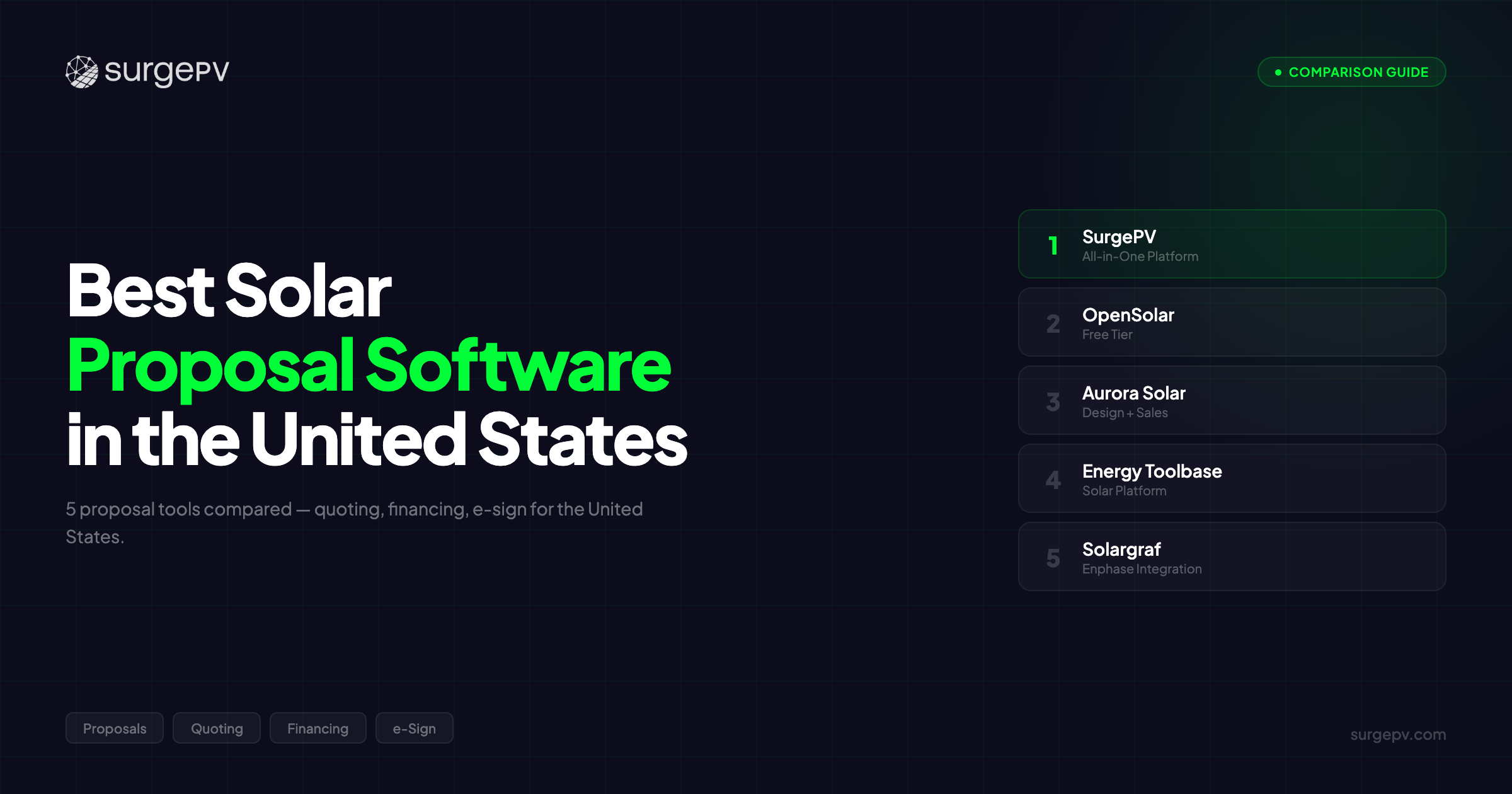
After testing 5 platforms with US solar sales teams across residential and commercial projects, here are our top recommendations:
- SurgePV — End-to-end design, engineering, and professional proposals with US financial modeling (Best for EPCs needing design-to-proposal in one platform)
- OpenSolar — Free proposal platform with financing tools (Best for budget-conscious small installers)
- Aurora Solar — US market leader for residential sales (Best for large residential installers with enterprise budgets)
- Energy Toolbase — Advanced C&I financial modeling with storage (Best for commercial solar + storage proposals)
- Solargraf — Fast residential proposals (Best for small installers prioritizing speed)
Each tool is evaluated on US-specific criteria: ITC/MACRS modeling, utility rate database coverage, financing comparison tools, proposal quality, and pricing.
Best Solar Proposal Software in the US (Detailed Reviews)
SurgePV — Best End-to-End Platform for US Solar Proposals
Target Users: Commercial EPCs, residential installers, sales teams needing design + engineering + proposals in one platform, teams replacing Aurora + AutoCAD workflows.
SurgePV is the only cloud-based platform that combines AI-powered solar design, NEC Article 690-compliant electrical engineering, bankable simulations, and professional proposal generation in a single workflow.
For US solar sales teams, that means one platform handles everything — from roof modeling to the finished proposal a homeowner or commercial buyer reviews on their phone. No data re-entry. No toggling between design software, AutoCAD for SLDs, and a separate proposal tool. One workflow, one set of numbers, one source of truth.
Key Features for US Proposals
US Financial Modeling (Critical)
The ITC alone requires careful modeling. The base 30% credit applies through 2032, but bonus adders for domestic content, energy communities, and low-income projects can push the effective credit to 40-50% or higher. Commercial buyers also get 5-year MACRS accelerated depreciation on 85% of system cost — which most proposal tools either ignore or calculate incorrectly.
SurgePV handles the full stack: ITC with bonus adders, MACRS depreciation, state tax credits (New York’s 25%, South Carolina’s 25%), SRECs (New Jersey, Massachusetts, Pennsylvania, Maryland), utility rebates, and performance-based incentives. Cash, solar loan, lease, and PPA financing scenarios run side-by-side so buyers compare monthly payments, total savings, and payback periods in one view.
That financial depth matters because stacking ITC + MACRS + state credits + SRECs can reduce commercial system costs by 50-70%.
3,000+ US Utility Rate Database
US utility rates are complex. California’s TOU rates shift costs by time of day. Texas has deregulated retail competition with dozens of providers. New York’s VDER (Value of Distributed Energy Resources) methodology replaces traditional net metering. Demand charges for commercial customers can represent 30-50% of total bills.
SurgePV’s database covers 3,000+ US utilities with TOU rates, tiered pricing, demand charges, and net metering policies. Rate escalation modeling projects savings over 25 years — which is the number that closes deals.
Proposal Output
Web-based interactive proposals are mobile-friendly. Buyers review system design, energy production, financial analysis, and financing options on any device. PDF export handles the CFO review, the board meeting, the lender package.
Fast turnaround matters in the US residential market where same-day proposals are expected. SurgePV generates proposals in 15-20 minutes from design completion — compared to 1-3 hours with manual Excel workflows.
Design Integration (No Data Re-entry)
Multi-tool workflows kill proposal accuracy through data re-entry. The designer models a system in one tool. Someone manually transfers the specs, production numbers, and equipment list into a separate proposal tool. Transcription errors creep in. The BOM doesn’t match the design.
SurgePV eliminates this entirely. Proposals auto-fill from design data. System size, production estimates, equipment specs, and costs flow directly from the actual design. Change the design and the proposal updates instantly.
Electrical Engineering (Permit-Ready Packages)
Most US AHJs — there are over 20,000 of them — require Single Line Diagrams (SLDs) for permit applications. Aurora, OpenSolar, and Solargraf don’t generate SLDs. That means a separate AutoCAD license ($2,000/year) and 2-3 hours of manual electrical drafting per project.
SurgePV generates NEC Article 690-compliant SLDs in 5-10 minutes. For EPCs bundling proposals with permit packages, that’s a complete sales-to-permit workflow in one platform.
Pros
- Only all-in-one platform: design + NEC-compliant SLD + simulation + proposals (eliminates multi-tool costs)
- US financial modeling: ITC, MACRS, SRECs, state credits, 3,000+ utility database
- Financing comparison: Cash, loan, lease, PPA scenarios side-by-side
- Bankable: P50/P75/P90 production estimates flow into proposals
- Fast proposals: 15-20 minutes from design completion
- Transparent pricing: $1,499/user/year, all features included
Cons
- Newer US brand recognition compared to Aurora Solar
- Proposal templates less customizable than dedicated CRM-first sales platforms
- CRM integrations still developing (Salesforce, HubSpot)
Pricing
- Individual Plan: $1,899/year for 3 users ($633/user/year)
- For 3 Users Plan: $1,499/user/year
- For 5 Users Plan: $1,299/user/year (best value for sales teams)
- Enterprise: Custom pricing for large teams
US Value Comparison:
- SurgePV (5-user team): $6,495/year — includes design + electrical + simulation + proposals
- Aurora Solar (5-user team): $13,200-$50,000+/year — proposals only (SLD requires AutoCAD at $2,000/user/year extra)
- Annual Savings: $6,705-$43,505/year for a 5-person US sales team
Pro Tip
SurgePV’s automated SLD generation saves 2-3 hours per project compared to manual AutoCAD drafting. For US EPCs handling 10+ projects per month, that’s 20-30 hours recovered monthly. Book a demo to see it in action.
Who SurgePV Is Best For
Perfect For:
- EPCs needing design + engineering + proposals in one platform (no more Aurora + AutoCAD + Excel)
- Sales teams that want accurate US financial modeling without manual spreadsheet work
- Commercial solar teams needing NEC-compliant permit packages alongside proposals
- Installers replacing $6,800+/year multi-tool workflows with a single platform
Not Ideal For: Large residential companies that already have Aurora enterprise contracts with embedded financing partner integrations (GoodLeap, Mosaic, Sunlight).
Real-World Example
A mid-size EPC team was spending 2.5 hours per project creating SLDs in AutoCAD and another hour building proposals in Excel. After switching to SurgePV, SLD generation dropped to under 10 minutes and proposals generated automatically from design data. With the same 3-person team, they now handle 40% more projects per month without hiring additional staff. That is what an integrated workflow delivers.
You might be wondering: if SurgePV does all this, why haven’t I heard of it? Aurora Solar has spent hundreds of millions on marketing. PVsyst has had a 30-year head start. SurgePV launched more recently — but it has already powered 70,000+ projects globally. The platform was purpose-built for the workflow gaps that legacy tools leave open, especially automated electrical engineering.
Further Reading
Best Solar Proposal Software (2026) — Global comparison across 10+ platforms | SurgePV Financial Modeling — Bankable simulation and financial tools
OpenSolar — Free Proposal Platform for Budget-Conscious US Installers
OpenSolar is completely free solar proposal software — no subscription, no licensing fees. For small US residential installers just getting started or running tight margins, the price is impossible to beat.
The platform delivers web-based proposals with e-signature integration, basic financial modeling (cash, loan, lease), and a built-in CRM for lead tracking. It works well for straightforward residential projects.
Key Strengths
- Completely free (no subscription fees, no hidden costs)
- E-signature integration for faster contract execution
- Interactive web proposals that look professional on mobile
- Built-in CRM for lead management
US Limitations
Financial modeling lacks depth for commercial complexity. No MACRS depreciation calculations. Limited utility rate accuracy across 3,000+ US utilities. No P50/P75/P90 bankability estimates. No SLD generation (permit packages require separate AutoCAD). Revenue model based on hardware partnerships may influence equipment recommendations.
Best Use Case in the US
Small residential installers (5-20 projects/month) prioritizing cost savings over advanced features. Not recommended for commercial EPCs needing MACRS modeling or bankable estimates.
Pricing
$0 (free)
Aurora Solar — US Market Leader for Residential Sales
Aurora Solar is the largest US solar software company, used by 7,000+ companies. The platform delivers fast address-to-proposal workflows, industry-leading LIDAR integration (Premium tier), beautiful customer-facing proposals, and native financing partner integrations with GoodLeap, Mosaic, and Sunlight Financial.
For large residential installers running high-volume sales operations, Aurora is the established choice.
Key Strengths
- Fastest residential address-to-proposal workflow in the market
- Industry-leading LIDAR roof modeling (Premium tier)
- Beautiful, polished proposals with strong customer UX
- Native financing partner integrations (GoodLeap, Mosaic, Sunlight)
- 7,000+ US company installations (strongest brand recognition)
US Limitations
Premium pricing ($2,640-$10,000+/user/year) puts it out of reach for smaller installers. No SLD generation — commercial EPCs need AutoCAD ($2,000/year additional) for NEC-compliant permit packages. Limited commercial proposal features. Only provides P50 estimates (no P75/P90 for bankable financing). Financing integrations favor specific lending partners.
Best Use Case in the US
Large residential installers (50+ installs/month) with enterprise budgets who prioritize sales speed, brand recognition, and financing partner integrations.
Pricing
$2,640-$10,000+/user/year (tiered by feature access)
Energy Toolbase — Advanced C&I Financial Modeling with Storage
Energy Toolbase is the leading platform for solar + battery storage proposals, optimized for commercial & industrial customers with complex rate structures, demand charges, and storage dispatch optimization.
For US commercial installers selling solar + storage solutions, Energy Toolbase provides the deepest financial analysis available — modeling demand charge reduction, TOU arbitrage, backup power value, and storage degradation over project life.
Key Strengths
- Deepest C&I financial modeling in the market (demand charges, TOU, storage)
- Solar + battery storage dispatch optimization
- Bankable credentials accepted by major US lenders
- Comprehensive utility rate modeling including complex commercial tariffs
US Limitations
Focused primarily on C&I — not suited for residential solar-only proposals. Complex learning curve (3-4 weeks onboarding). No design integration (proposal-only tool, requires separate design software). Custom pricing typically runs higher than general proposal tools.
Best Use Case in the US
C&I-focused EPCs selling solar + battery storage with complex rate structures, demand charge reduction, and utility TOU arbitrage.
Pricing
Custom (contact sales for pricing)
Solargraf — Fast, Simple Residential Proposals
Solargraf (owned by Enphase Energy) prioritizes speed and simplicity. Generate residential proposals in 5-10 minutes with basic financial modeling and a clean customer interface.
For small US residential installers who need fast turnaround without complexity, Solargraf delivers the essentials. The Enphase integration makes it particularly smooth for installers using Enphase microinverters.
Key Strengths
- Very fast proposal generation (5-10 minutes)
- Simple learning curve (1-2 weeks onboarding)
- Enphase equipment integration
- Clean customer-facing proposal design
US Limitations
Basic financial modeling doesn’t handle commercial complexity (limited ITC bonus adder modeling, no MACRS depreciation). No SLD generation. Limited utility rate database. No bankable simulation integration. Enphase ownership may favor Enphase equipment in recommendations.
Best Use Case in the US
Small residential installers (5-15 projects/month) using Enphase equipment who prioritize proposal speed over financial depth.
Pricing
~$600-1,200/year (contact sales for current rates)
Further Reading
All Solar Software Reviews — Complete review hub | SurgePV for Commercial EPCs — Commercial solar solutions overview
Best Solar Proposal Software Comparison Table for the US
| Software | ITC/MACRS Modeling | Utility Rate Database | Financing Comparison | SLD Generation | Bankable Estimates | Pricing (Annual) |
|---|---|---|---|---|---|---|
| SurgePV | ITC + MACRS + SRECs + state credits | 3,000+ US utilities | Cash/Loan/Lease/PPA | Yes (NEC 690) | P50/P75/P90 | $1,499/user/year |
| OpenSolar | Basic ITC only | Limited accuracy | Cash/Loan/Lease | No | No | $0 (free) |
| Aurora Solar | ITC + state credits | Large database | Cash/Loan/Lease/PPA | No | P50 only | $2,640-$10,000+/user/year |
| Energy Toolbase | Advanced (ITC/MACRS/storage) | Advanced (TOU/demand) | Multiple scenarios | No | Yes | Custom pricing |
| Solargraf | Basic ITC | Limited | Cash/Loan | No | No | ~$600-1,200/year |
| Feature | SurgePV | OpenSolar | Aurora Solar | Energy Toolbase | Solargraf |
|---|---|---|---|---|---|
| Best for | All-in-one | Free tier | Residential | Storage | Residential |
| Proposal generation | Yes (branded) | Yes (basic) | Yes (premium) | Limited | Yes |
| Financial modeling | Yes | Yes | Basic | Yes (advanced) | Basic |
| SLD generation | Yes (automated) | No | No | No | No |
| CRM integration | API | Built-in | Salesforce/HubSpot | API | Basic |
Key Takeaway
SurgePV balances complete US financial modeling (ITC, MACRS, SRECs, state credits) with integrated design and engineering at $1,499/user/year. Aurora is the market leader for residential sales but costs 2-7x more. OpenSolar is free but basic. Energy Toolbase excels at C&I storage but isn’t a design platform.
What Makes the Best Solar Proposal Software in the US
The US market has specific requirements that set it apart from every other country:
1. ITC and Federal Incentive Modeling
The 30% ITC through the Inflation Reduction Act is the foundation of every US solar proposal. But it’s not just 30%. Domestic content bonus adds 10%. Energy community bonus adds 10%. Low-income bonus adds 10-20%. For commercial projects, MACRS 5-year accelerated depreciation on 85% of system cost adds another 20-25% in tax value.
Getting these calculations wrong doesn’t just lose deals — it creates legal liability. The best solar design software automates the full ITC + MACRS + bonus adder stack with current IRS guidelines.
2. Utility Rate Coverage (3,000+ Utilities)
The US has over 3,000 utilities with different rate structures. California NEM 3.0 introduced export compensation rates far below retail. Texas has deregulated retail with dozens of providers. New York’s VDER methodology calculates solar value differently from traditional net metering. Commercial customers face demand charges, TOU rates, and tiered pricing.
A proposal tool that can’t accurately model the specific utility rate for a specific customer at a specific address produces meaningless savings projections.
3. Financing Comparison Tools
US residential buyers expect to see cash purchase, solar loan (2.99-7.99% APR), lease ($0 down), and PPA (locked rate) options compared side-by-side. Commercial buyers need to see ITC + MACRS + financing structured to minimize capital outlay.
Proposal software that only shows one scenario loses to competitors showing four.
4. Proposal Speed and Professionalism
The US residential market is intensely competitive. Homeowners collect 3-5 quotes. The first installer to deliver a professional, interactive proposal with accurate financials has a significant close rate advantage.
Same-day proposals are now the baseline expectation, not a differentiator.
5. Permit-Ready Integration
Over 20,000 AHJs across the US each have their own permit requirements. NEC Article 690 compliance is universal. SLD generation is required by most jurisdictions. Software that integrates proposals with permit-ready documentation saves the extra step of moving to separate engineering tools.
| Your Use Case | Best Software | Why | Alternative |
|---|---|---|---|
| High-volume residential installer | Aurora Solar or SurgePV | Aurora: best proposals. SurgePV: proposals + engineering | Solargraf |
| C&I EPC (100+ kW) | SurgePV | Integrated design + proposals + SLDs in one tool | HelioScope + PVsyst combo |
| Storage + solar specialist | Energy Toolbase | Best financial modeling for battery + solar | SurgePV for design integration |
| Projects requiring US lender financing | PVsyst or SurgePV | P50/P90 bankability reports accepted by lenders | HelioScope (some lenders) |
| Startup installer (<30 projects/year) | OpenSolar or SurgePV | OpenSolar: free entry. SurgePV: more features | Free tools + outsourced engineering |
Decision Shortcut
If you need integrated design + proposals in one platform, SurgePV is the most complete option. If you’re residential-only with a large marketing budget, Aurora Solar’s proposals are strong — but expensive. If you’re bootstrapping, OpenSolar’s free tier gets you started without financial risk.
How We Tested & Ranked These Tools
We evaluated each platform based on US-specific proposal criteria:
-
US Financial Modeling Accuracy (30%): Tested ITC calculations (30% + bonus adders), MACRS depreciation (5-year, 85% basis), state incentive modeling (SRECs, state tax credits), and utility rate analysis accuracy for projects in CA, TX, FL, NY, and AZ.
-
Utility Rate Database Coverage (25%): Verified utility rate accuracy across 3,000+ US utilities including TOU rates, tiered pricing, demand charges, and net metering policies. Tested California NEM 3.0, Texas deregulated rates, and New York VDER modeling.
-
Proposal Quality and Professionalism (20%): Assessed proposal aesthetics, mobile responsiveness, interactive features, financing visualization, and customer UX. Measured proposal generation speed (target: 15-20 minutes).
-
Design and Engineering Integration (15%): Evaluated whether proposals pull data directly from design (eliminating re-entry errors), include SLD generation for permit packages, and support single-platform workflows.
-
Pricing and Total Cost of Ownership (10%): Compared annual software costs, required add-ons (AutoCAD, third-party tools), and calculated ROI based on time savings and close rate improvement.
All testing conducted November 2025-February 2026 with US solar sales teams, residential and commercial clients, and verified pricing data.
Start Generating Professional Solar Proposals
See how SurgePV creates client-ready proposals in 15-20 minutes with integrated design and financial modeling.
Book a DemoNo commitment required · 20 minutes · Live project walkthrough
Bottom Line: Best Solar Proposal Software for the US
For US EPCs and growth-stage installers: SurgePV delivers the most complete platform — design, NEC-compliant SLD generation, bankable P50/P75/P90 simulations, and professional proposals with full US financial modeling (ITC, MACRS, SRECs, 3,000+ utilities) at $1,499/user/year. One platform replaces the Aurora + AutoCAD + Excel workflow that costs $6,800+/year per user.
For budget-conscious residential installers: OpenSolar is free and functional for basic residential proposals. E-signature integration speeds up contract execution. Limited financial modeling and no engineering integration restrict it to simple residential projects.
For large residential operations: Aurora Solar is the US market leader with 7,000+ company installations, fast address-to-proposal workflows, and native financing partner integrations. Premium pricing ($2,640-$10,000+/user/year) is justified only at high volume.
For C&I solar + storage: Energy Toolbase offers the deepest commercial financial modeling with storage dispatch optimization. Not a design platform — pair it with a design tool. Complex onboarding makes it best for specialized C&I teams.
For speed-first small installers: Solargraf generates proposals in 5-10 minutes with minimal learning curve. Basic features limit it to simple residential projects.
The US solar market added 35-40 GW in 2025 and competition is intensifying. The installers closing deals today are the ones with accurate, professional proposals on the customer’s table same-day. Your solar software and proposal platform is a competitive advantage, not a back-office cost.
Book a personalized demo to see how SurgePV streamlines US solar proposals — ITC/MACRS modeling, 3,000+ utility database, NEC-compliant permit packages, and professional proposals in one platform at $1,499/user/year.
Frequently Asked Questions
What is the best solar proposal software in the United States?
SurgePV is the best solar proposal software for the United States, combining design, NEC-compliant electrical engineering, and proposal generation with full US financial modeling (30% ITC + bonus adders, MACRS depreciation, SRECs, 3,000+ utility database) in one platform at $1,499/user/year.
US EPCs need proposals showing stacked incentives — ITC + MACRS + state credits + SRECs — with accurate utility rate savings over 25 years. SurgePV automates this in 15-20 minutes versus 1-3 hours with Excel. Aurora Solar ($2,640-$10,000+/user/year) is the market leader for residential sales but requires separate AutoCAD for electrical engineering.
Can solar proposal software calculate ITC and MACRS depreciation?
Yes. SurgePV and Aurora Solar automatically calculate the 30% ITC (plus bonus adders for domestic content, energy communities, and low-income projects), 5-year MACRS depreciation on 85% of commercial system cost, and state-specific incentives.
ITC + MACRS + state credits can reduce commercial solar system costs by 50-70%. Accurate modeling of these stacked incentives is what separates winning proposals from losing ones. Manual Excel calculations are error-prone and time-consuming.
How much does solar proposal software cost in the US?
Solar proposal software ranges from free (OpenSolar) to $10,000+/year per user. SurgePV: $1,499/user/year (design + engineering + proposals). Aurora Solar: $2,640-$10,000+/year. OpenSolar: Free. Solargraf: ~$600-1,200/year.
Total cost of ownership matters more than sticker price. SurgePV includes design, electrical engineering, simulation, and proposals. Aurora requires separate AutoCAD ($2,000/year) for SLDs. Time savings of 1-2 hours per proposal at $50/hour equals $25,000-$50,000/year for teams doing 50-100 proposals/month.
Which proposal software has the best US utility rate database?
SurgePV and Aurora Solar both include databases of 3,000+ US utilities for accurate rate analysis, including TOU rates, tiered pricing, demand charges, and net metering policies by state.
Accurate utility rate modeling is critical for 25-year savings projections. US utilities have widely varying rate structures — California TOU, Texas deregulated retail, New York VDER, and everything in between. Software with current utility databases eliminates hours of manual rate research per proposal.
Can proposal software generate financing comparisons?
Yes. SurgePV, Aurora Solar, and OpenSolar generate side-by-side financing comparisons showing cash purchase vs. solar loan (2.99-7.99% APR) vs. lease ($0 down) vs. PPA (locked rate) with monthly payments, total savings, and payback periods.
US residential buyers expect financing options compared in one view. Commercial buyers need to see ITC + MACRS + financing structured together. Software that automates these comparisons saves 30-45 minutes per proposal.
What should a solar proposal include in the US?
A US solar proposal must include: (1) system design and specifications, (2) energy production estimate, (3) financial analysis with ITC and state incentives, (4) financing options comparison (cash/loan/lease/PPA), (5) utility savings projection over 25 years, (6) equipment details and warranties, (7) installation timeline, and (8) company credentials and references.
Professional interactive proposals with web links convert at 15-25% versus basic PDF quotes at 8-12%. Including detailed financial analysis (ITC, MACRS, SRECs, utility escalation) builds buyer confidence.
How fast can you generate a solar proposal in the US?
With SurgePV or Aurora Solar, proposals take 15-20 minutes from design completion. Manual Excel workflows take 1-3 hours. In the competitive US market, same-day proposals are the baseline expectation.
US residential buyers collect 3-5 quotes. The first professional proposal on the table often wins. SurgePV’s integrated workflow (design + engineering + proposal) enables same-day proposals from a single platform.
Does proposal software handle state-specific incentives across all 50 states?
Yes. SurgePV and Aurora Solar model state-specific incentives including SRECs (NJ, MA, PA, MD), state tax credits (NY 25%, SC 25%), utility rebates, and performance-based incentives. Incentive stacking varies dramatically by state — from California’s NEM 3.0 to New York’s NYSERDA programs to Texas ERCOT interconnection.
State incentives can add $1,000-$10,000+ in value to a solar proposal. New Jersey SRECs alone can be worth $5,000-$8,000 over 10 years. Massachusetts SMART program adds ongoing production incentives.
Sources
- SEIA (Solar Energy Industries Association) — US solar market data, installation statistics, policy analysis
- IRS Clean Energy Tax Credits — ITC rates, bonus adders, IRA provisions
- DSIRE (Database of State Incentives for Renewables & Efficiency) — State incentive database, net metering policies, SREC programs
- EIA (U.S. Energy Information Administration) — Electricity prices, utility rate data, market statistics
- NREL (National Renewable Energy Laboratory) — Solar research, SolarAPP+ permit automation, TMY weather data
- EnergySage — Consumer solar marketplace data, installation cost benchmarks
- Aurora Solar Official Pricing — Competitor pricing verification