

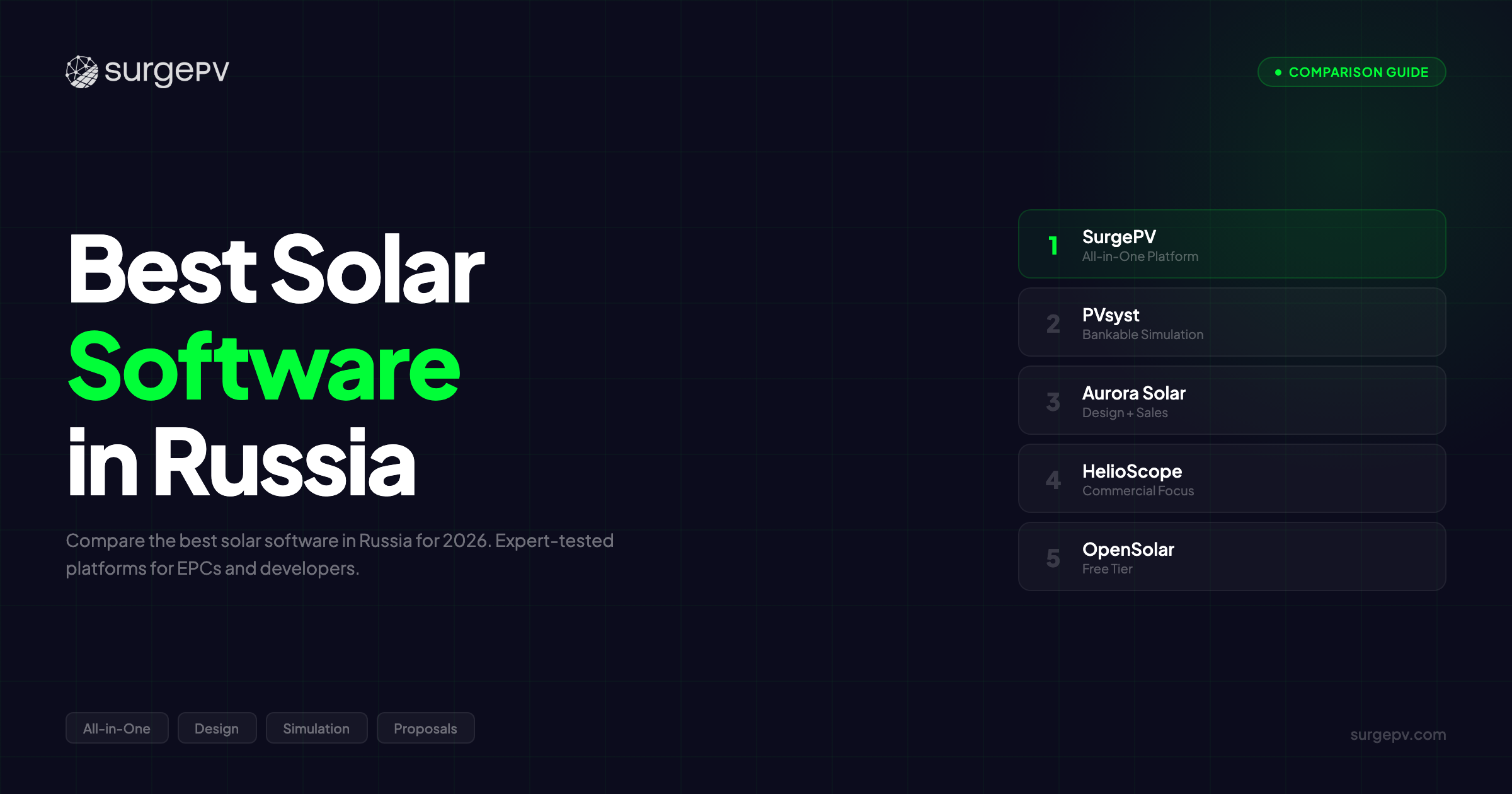
TL;DR: SurgePV is the best all-in-one solar software for Russia in 2026 — delivering extreme climate design (-40°C to +40°C), automated SLD generation for PUE compliance, bankable P50/P90 simulations, DPM financial modeling, and proposal generation in one cloud-based platform at $1,899/year for 3 users. PVsyst is the bankable simulation gold standard for DPM tenders. OpenSolar is the best free entry point for small residential companies.
Russia’s solar industry has reached 4–5 GW of total PV capacity, with 500–800 MW installed annually under the DPM wholesale capacity contract program (IRENA Renewable Energy Statistics). Southern Russia — Krasnodar, Astrakhan, Orenburg, Bashkortostan — leads utility-scale deployment. But the fastest-growing segment isn’t grid-connected solar. It’s diesel displacement in Siberia, the Far East, and Arctic territories where fuel costs make solar-plus-battery economically obvious.
And yet, most Russian solar companies are still stitching together workflows from 3–4 separate tools. Design in AutoCAD. Simulate in PVsyst. Build financial models in Excel. Format proposals in PowerPoint. That fragmented stack worked when the market was small and project timelines were long. It doesn’t work now — not when DPM tenders attract more bidders, C&I clients expect faster turnaround, and the microgeneration segment is creating volume that manual workflows simply can’t scale to serve.
So what does the Russian market actually need from solar software? Three things: extreme climate accuracy (from -40°C in Yakutsk to +40°C in Krasnodar), GOST/PUE standards compliance for electrical documentation, and financial modeling that handles DPM capacity payments, regional tariff variation, and diesel displacement — in RUB.
We tested and compared the top 5 solar software platforms for the Russian market, evaluating each on climate modeling, standards compliance, feature completeness, accessibility, and pricing.
In this guide, you’ll learn:
- Which platform handles the full Russian solar workflow — design, simulation, SLDs, proposals — in one tool
- How pricing compares (from free to over $3,100/year)
- Which software models extreme Russian conditions, GOST standards, and DPM economics
- Software accessibility considerations for Russian-based teams
- Our recommendation based on 400+ commercial projects across Europe and Asia
Quick Comparison Table
| Software | Best For | Pricing/Year | Russia Fit | Access |
|---|---|---|---|---|
| SurgePV | All-in-one (end-to-end) | $1,899 (3 users) | High | Available |
| PVsyst | Bankable simulation | ~$1,250 + $400/yr | High (simulation) | Available (desktop) |
| Aurora Solar | Residential design | $3,108+ | Medium | May be restricted |
| HelioScope | Commercial C&I | $2,640+ | Medium | May be restricted |
| OpenSolar | Budget / basic | Free | Low | May be restricted |
Best Solar Software in Russia (Detailed Reviews)
SurgePV — Best All-in-One Solar Platform for Russia
Best For: EPCs, developers, and installers across DPM utility-scale, C&I, and microgeneration
Pricing: $1,899/year (3 users); $1,499/user/year (For 3 Users plan)
Onboarding: 2–3 weeks
SurgePV is an end-to-end solar platform that combines 3D design, 8760-hour shading analysis, bankable P50/P90 simulation, automated SLD generation, financial modeling, and proposal generation in a single cloud-based tool.
For the Russian market, that matters because of what it replaces.
The typical Russian EPC workflow today: AutoCAD for layout ($2,000/year license), PVsyst for simulation (~$1,250 + $400/year), Excel for financial modeling (free but slow), and Word/PowerPoint for proposals (hours of formatting). Total cost: $3,250+/year in licenses alone, plus 5–8 hours per project in manual tool-switching and data re-entry. SurgePV consolidates all of that into one platform at $1,899/year for 3 users — and cuts per-project time by more than half.
Key Features for Russia
- Extreme climate modeling (-40°C to +40°C) — Full temperature derating calculations for Russia’s continental and subarctic climates. Module output varies by 15–20% between summer peaks and winter lows in most Russian regions. SurgePV models this automatically, including snow albedo effects that can boost winter generation by 5–15% at the right tilt angles.
- Automated SLD generation — Creates electrical schematics compatible with PUE (Pravila Ustroistva Elektroustanovok) standards in 5–10 minutes. Manual AutoCAD drafting takes 2–3 hours. For grid connection applications to regional distribution companies, this is the documentation they actually need.
- P50/P75/P90 bankable simulations — Accuracy within +/-3% of PVsyst. Russian banks (Sberbank, VTB, Gazprombank) and DPM program evaluators accept these metrics for project financing. Your tender submissions include bankable data — not just optimistic annual estimates.
- Financial modeling capabilities — Capacity payment calculations for wholesale market projects, 15-year contract projections, localization cost impact (65–70% local content requirement), and return analysis in RUB. Also models hybrid system economics for remote areas (diesel generation RUB 15–50/kWh) and microgeneration net metering up to 15 kW.
- Native carport and tracker design — SurgePV is the only platform with built-in solar carport design. Single-axis and dual-axis tracker support included. With DPM projects increasingly using trackers in southern Russia’s high-GHI regions, this feature directly impacts project economics.
- 98% BOM accuracy — Automated bill of materials generation eliminates manual component counting. When your DPM bid includes a BOM, the numbers need to be right — procurement errors on utility-scale projects cost tens of thousands of dollars.
Pro Tip
For DPM tenders with multiple site variants, SurgePV’s all-in-one workflow saves 20–30 hours per tender compared to the AutoCAD + PVsyst + Excel stack. That’s engineering time you can redirect to winning more bids. Book a demo to see it in action.
Pricing
| Plan | Price | Users |
|---|---|---|
| Individual | $1,899/year | 3 users |
| For 3 Users | $1,499/user/year | 3 users |
| For 5 Users | $1,299/user/year | 5 users |
| Enterprise | Custom | Multiple |
All features included on every plan. No hidden fees, no feature gating. See full pricing.
Who SurgePV Is Best for in Russia
- Utility-scale developers bidding on DPM tenders who need complete documentation packages and bankable simulations
- C&I EPCs handling 50 kW–10 MW projects needing PUE-compliant SLDs and regional tariff analysis
- Residential installers designing microgeneration systems up to 15 kW
- Teams working on diesel displacement projects in Siberia, the Far East, and Arctic territories
- Companies replacing fragmented AutoCAD + PVsyst + Excel workflows with a single platform
Limitations
- English interface (no Russian localization yet)
- Russian regional tariffs require manual input (not pre-loaded)
- Cloud-based — requires stable internet connection
Real-World Example
A utility-scale developer in Orenburg was spending 4–5 days preparing each DPM tender package — designing in AutoCAD, running PVsyst simulations, building financial models in Excel, and assembling documentation in Word. After switching to SurgePV, the complete tender preparation workflow — including multiple site variants with bankable P50/P90 data and PUE-compliant SLDs — dropped to 1.5 days. The same 4-person team now submits bids for 2x more tenders per quarter, directly increasing their win rate through volume.
Further Reading
See our Best Solar Design Software in Russia and Best Solar Proposal Software in Russia for focused comparisons on each workflow stage.
PVsyst — Bankable Simulation Gold Standard
Best For: Engineers focused on bankable production estimates for DPM tenders and financing
Pricing: CHF 1,100 perpetual + CHF 350/year updates ($1,250 + $400/year)
PVsyst is the global gold standard for bankable energy production simulation. In Russia, its reports carry unmatched credibility with DPM program evaluators and financial institutions. As a Swiss desktop application, it has no cloud-based access restrictions — a significant practical advantage for Russian teams.
What Works for Russia
- P50/P90 reports universally accepted by Sberbank, VTB, Gazprombank, and DPM evaluators
- Detailed loss modeling — temperature derating, snow, soiling, mismatch, inverter efficiency
- Meteonorm integration includes Russian weather data across all major regions
- Compatible with GOST IEC harmonized standards for simulation outputs
- Desktop-based — reliable access, no internet dependency
Where It Falls Short in Russia
- Simulation-only — Not a design platform. Layout requires separate AutoCAD or design tool
- No SLD generation — Electrical documentation requires external CAD software
- No proposal generation — Cannot produce client-facing documents or DPM tender proposals
- No financial modeling — No RUB tariff analysis, no DPM capacity payment calculations, no diesel displacement
- No team collaboration — Desktop-only, no cloud project sharing
PVsyst excels at one thing — bankable simulation — and it does it better than any competitor. But a Russian EPC using PVsyst alone still needs AutoCAD ($2,000/year), Excel (for financials), and manual document assembly (for proposals). Total ecosystem cost: $3,650+/year with hours of manual work per project.
Did You Know?
Russia’s DPM program has supported over 2 GW of solar installations since 2013, with projects concentrated in Orenburg, Astrakhan, Saratov, and Krasnodar regions. The program provides 15-year guaranteed capacity payments for winning bidders (Minenergo).
Aurora Solar — Residential Design Platform (Access May Be Limited)
Best For: Residential installers with confirmed platform access
Pricing: $259/user/month ($3,108/year)
Aurora Solar is the dominant residential solar platform in the US market. Its AI-powered 3D roof modeling, polished proposals, and CRM integrations are best-in-class for homeowner-facing sales workflows.
What Works (Where Accessible)
- Industry-leading AI roof detection and 3D modeling
- Professional proposal templates with e-signature
- CRM integrations (Salesforce, HubSpot)
- Strong user experience and fast learning curve
Where It Falls Short in Russia
- Access restrictions — US-based cloud platform; may have limited access for Russian users. Verify before purchasing
- No GOST/PUE compliance — Does not generate Russian-standard electrical documentation
- No DPM support — Cannot model capacity payments or utility-scale tender economics
- No RUB financial modeling — No regional tariff analysis, no diesel displacement
- No extreme cold modeling — Limited temperature derating below -20°C
- P50 only — No P75/P90 metrics, which Russian banks expect
- No SLD generation — PUE-compliant documentation needs external tools
Best for: International teams with confirmed access who need polished residential proposals.
HelioScope — Commercial Solar Design (Access May Be Limited)
Best For: C&I EPCs designing commercial rooftop systems (where accessible)
Pricing: $220+/user/month ($2,640+/year)
HelioScope is a cloud-based design platform built for commercial and industrial solar projects. Its browser-based CAD tools make it fast to learn and fast to use for mid-scale rooftop work. HelioScope is now owned by Aurora Solar.
What Works (Where Accessible)
- Fast commercial rooftop design with browser-based interface
- Integrated simulation with credible production estimates
- Supports international locations with Russian weather data
- Team collaboration through cloud project sharing
Where It Falls Short in Russia
- Access restrictions — Aurora-owned US cloud platform; same access considerations
- No SLD generation — PUE-compliant electrical documentation requires external tools
- No GOST compliance — Does not address Russian electrical standards
- No RUB financial modeling — No regional tariff databases, no DPM modeling, no diesel displacement
- Limited extreme climate modeling — Not optimized for -40°C conditions or heavy snow loads
- No proposal generation — Basic export capabilities only
Best for: International teams with confirmed access designing commercial rooftop systems in Russia.
OpenSolar — Free Basic Option (Access May Be Limited)
Best For: Small companies needing a free starting point
Pricing: Free
OpenSolar is a free, cloud-based solar platform that covers basic design and proposal generation. For budget-constrained Russian companies testing the solar market, it offers a zero-cost entry point.
What Works
- Free — no licensing costs for small teams starting out
- Basic 3D design and proposal generation
- Simple interface, easy to learn
Where It Falls Short in Russia
- Access may be restricted — Cloud-based; verify availability
- No GOST/PUE compliance — No Russian standards support at all
- No extreme climate modeling — Not designed for -40°C or heavy snow loads
- No bankable simulation — No P50/P90 reports for financing
- No SLD generation — No electrical documentation
- No DPM or RUB financial modeling — No Russian market features
Best for: Small companies with confirmed access exploring basic residential design at zero cost.
Solar Software Comparison Table for Russia
| Feature | SurgePV | PVsyst | Aurora Solar | HelioScope | OpenSolar |
|---|---|---|---|---|---|
| Platform Type | All-in-one cloud | Desktop simulation | Cloud design + proposals | Cloud commercial | Cloud residential |
| Extreme Climate (-40°C) | Yes | Yes | Limited | Limited | No |
| Snow Load Modeling | Yes | Limited | Limited | Limited | No |
| SLD Generation (PUE) | Yes (automated) | No | No | No | No |
| P50/P90 Bankable | Yes (+/-3% vs PVsyst) | Industry standard | P50 only | Limited | No |
| DPM Financial Modeling | Yes | Simulation data only | No | No | No |
| RUB Financial Modeling | Yes | No | No | No | No |
| Diesel Displacement | Yes | No | No | No | No |
| Carport/Tracker Design | Yes (only platform) | Simulation only | No | Limited | No |
| Proposal Generation | Yes | No | Yes | Basic | Basic |
| Access for Russia | Available | Available (desktop) | May be restricted | May be restricted | May be restricted |
| Pricing/year | $1,899 (3 users) | ~$1,250 + $400/yr | $3,108+ | $2,640+ | Free |
What to Look for in Solar Software for Russia
Extreme Climate Design: -40°C to +40°C
Russia spans 11 time zones and every climate type from subarctic to steppe. Temperature swings from -40°C in Yakutsk to +40°C in Krasnodar mean temperature coefficients affect module output by 15–20% across the year. Snow loads require steep panel tilts (35–55 degrees) for shedding in northern and central regions. Albedo effects from snow reflection can boost winter generation by 5–15% at optimized tilt angles (Global Solar Atlas). GHI ranges from 1,000 kWh/m² in Moscow to 1,700 kWh/m² in the southern steppe. Your software needs to model all of this accurately.
GOST Standards and PUE Compliance
Every solar installation in Russia must comply with GOST R standards for electrical equipment and PUE for electrical installations. GOST R 56978-2016 covers PV system requirements. GOST R 58694-2019 addresses grid-connected PV. Grid connection applications to regional distribution companies require technical documentation — including single line diagrams, protection schemes, and equipment specifications referencing these standards (SO UPS). Software with automated SLD generation saves 2–3 hours per project versus manual AutoCAD drafting.
DPM Program and Bankability
Russia’s DPM wholesale capacity contract mechanism drives the majority of solar installations. Projects compete for 15-year capacity payment contracts through competitive auctions administered by Minenergo. Winning bids require bankable feasibility studies with IEC-compliant simulations. Russian banks — Sberbank, VTB, Gazprombank — expect P50/P90 production estimates for financing. PVsyst is the gold standard. SurgePV achieves +/-3% accuracy versus PVsyst.
Regional Tariff Variation and Diesel Displacement
Russia’s electricity pricing varies more than almost any other market. Wholesale rates: RUB 2.5–4.5/kWh. Commercial: RUB 5–12/kWh by region. But the highest-margin opportunity is diesel displacement in remote areas — Siberia, Far East, Arctic — where fuel logistics push generation costs to RUB 15–50/kWh (~$0.16–0.55/kWh). Solar with battery storage pays for itself in 3–5 years at those rates. Your financial modeling needs to handle this range accurately.
Software Accessibility
Since 2022, access to some Western cloud-based platforms has been restricted for Russian users. This is a practical consideration that directly affects software selection. Desktop applications (PVsyst) and platforms that maintain Russian accessibility (SurgePV) offer more reliable long-term access. Russian companies should verify platform availability before committing to annual subscriptions or building team workflows around a specific tool (IEA Russia Energy Profile).
Our Testing Methodology
We evaluated each platform against five weighted criteria specific to the Russian market:
- Russia market fit (35%) — Extreme climate modeling (-40°C to +40°C), GOST/PUE compliance, capacity payment modeling support, regional tariff databases, RUB financial modeling, hybrid system economics
- Feature completeness (25%) — Design, simulation, SLD generation, proposals, wire sizing, BOM accuracy, carport/tracker support
- Accessibility and reliability (20%) — Software access for Russian teams, desktop vs cloud, data sovereignty, long-term availability
- Bankability (15%) — Russian bank and investor acceptance, P50/P90 capabilities, DPM evaluator standards
- Cost-effectiveness (5%) — Annual cost relative to feature set, total cost of ownership including supplementary tools
Testing was conducted between January and February 2026, using real Russian project data from multiple regions and regulatory documentation from Minenergo and SO UPS.
One Platform for Every Russian Solar Project
Design, simulate, engineer, and propose — from DPM utility-scale to microgeneration — in a single workflow with SurgePV.
Book a DemoNo commitment required · 20 minutes · Live project walkthrough
Bottom Line: Best Solar Software for Russia
Russia’s solar market presents unique challenges — extreme climate, GOST/PUE standards, DPM program complexity, massive regional tariff variation, and software accessibility considerations. Most global solar platforms were built for Western European or US markets and don’t account for these realities.
For EPCs and multi-segment teams: SurgePV delivers the most complete workflow for Russia. Extreme climate modeling, automated SLD generation for PUE compliance, P50/P90 simulations for DPM tenders, RUB financial tools including diesel displacement, and integrated proposals — all in one platform at $1,899/year for 3 users. It replaces the AutoCAD + PVsyst + Excel stack entirely.
For simulation-only needs: PVsyst remains the bankability gold standard. Russian banks and DPM evaluators trust its P50/P90 outputs above all others. Its desktop architecture means no access concerns. Pair it with SurgePV for the complete workflow, or with AutoCAD + Excel for the traditional approach.
For international teams with confirmed access: Aurora Solar offers polished residential design and proposals. HelioScope handles commercial layouts well. Both lack Russian-specific features — verify platform availability before purchasing.
For budget-constrained startups: OpenSolar provides basic design at no cost, but lacks Russian-specific features, bankable simulation, and electrical engineering capabilities. Verify access.
The Russian solar market is maturing. DPM tenders attract more bidders. C&I clients demand faster turnaround. Microgeneration is creating volume. The companies winning in this market are the ones that design, simulate, engineer, and propose faster than their competitors — not the ones spending 3–4 days assembling tender packages from 4 different tools.
Want to see how SurgePV handles Russian solar workflows? Book a demo and our team will walk you through a project using your actual site data and regional tariffs.
Which Software Is Right for Your Use Case?
| Your Situation | Recommended Software | Why It Fits |
|---|---|---|
| Large EPC doing commercial projects | SurgePV + PVsyst | Need bankable simulation, electrical design automation, and grid compliance documentation for DSO approvals |
| Commercial installer (5–20 projects/month) | SurgePV | Balance between design accuracy and proposal speed; integrated workflow reduces tool-switching |
| Residential-focused installer | Aurora Solar or SurgePV | Prioritize fast proposals with visual sales tools; moderate simulation depth sufficient for residential financing |
| Developer doing feasibility studies | PVsyst + SurgePV | Need accurate energy yield modeling and financial analysis for investment decisions; banks require P50/P90 |
| Small team (1–3 people) | SurgePV or OpenSolar | All-in-one platforms reduce software stack complexity and training time; eliminate AutoCAD dependency for SLDs |
| Multi-regional operations | SurgePV | Cloud collaboration handles regional differences from a single platform; flexible regional input for tariff modeling |
Frequently Asked Questions
What is the best solar software in Russia?
SurgePV is the best all-in-one solar software for Russia in 2026. It combines extreme climate design (-40°C to +40°C), automated SLD generation compatible with PUE standards, P50/P90 bankable simulations, DPM financial modeling, and proposal generation in one cloud-based platform at $1,899/year for 3 users. For simulation-only needs, PVsyst remains the bankability standard.
Can solar software handle Russian extreme weather conditions?
SurgePV and PVsyst model extreme Russian conditions including -40°C winter temperatures, snow loading, seasonal GHI variation (1,000–1,700 kWh/m²/year across regions), and albedo effects from snow reflection for accurate year-round energy yield predictions. Most other platforms have limited modeling below -20°C.
Which solar software do Russian companies use?
Russian utility-scale developers primarily use PVsyst for bankable simulations required by investors and the DPM program. SurgePV is adopted for end-to-end design-to-proposal workflows. Many smaller Russian companies rely on fragmented AutoCAD + Excel workflows — a process that SurgePV replaces entirely with a single platform.
How much does solar software cost in Russia?
Costs range from free (OpenSolar, basic features) to $3,108/year (Aurora Solar, access may be restricted). SurgePV starts at $1,899/year for 3 users with all features included. PVsyst costs approximately CHF 1,100 perpetual plus CHF 350/year for updates. Consider total cost of ownership — the AutoCAD + PVsyst + Excel stack runs $3,650+/year with hours of manual work per project.
Does solar software support GOST standards?
SurgePV generates SLD documentation compatible with PUE standards and GOST requirements. PVsyst outputs align with GOST IEC harmonized standards for bankable simulations. Western cloud platforms — Aurora Solar, HelioScope, OpenSolar — do not specifically address GOST compliance.
Can solar software model DPM program economics?
SurgePV’s financial modeling supports capacity payment calculations for wholesale market projects, 15-year contract projections, localization cost impact (65–70% requirement), and return analysis in multiple currencies including RUB. PVsyst provides the bankable simulation data that DPM tender evaluators require but does not model financial returns or generate tender documentation.
Do Russian banks accept software simulation reports?
Russian banks accept P50/P90 reports from PVsyst (the gold standard) and SurgePV (+/-3% accuracy versus PVsyst) for DPM and commercial solar project financing. Sberbank, VTB, and Gazprombank all accept PVsyst-format reports for project due diligence and loan approvals.
What about software access from Russia?
PVsyst (Swiss, desktop-based) and SurgePV maintain accessibility for Russian users. Some US-based cloud platforms — including Aurora Solar and HelioScope — may have access restrictions. Russian companies should verify platform accessibility before purchasing annual subscriptions. Desktop software avoids cloud-based access dependencies entirely.
Sources
- IRENA Renewable Energy Statistics — Russia renewable energy capacity data and annual additions
- Minenergo (Ministry of Energy of Russia) — DPM program, energy policy, renewable energy targets
- SO UPS (System Operator of the Unified Power System) — Grid standards and connection requirements
- Global Solar Atlas — GHI data and solar resource mapping for Russian regions
- IEA Russia Energy Profile — Energy data and renewable energy context
- RAWI (Russian Association of Wind Power Industry) — Renewable energy industry data and market analysis
- Hevel Solar — Russian solar manufacturer and developer market data
- SurgePV Product Documentation — Official feature specifications (accessed February 2026)