

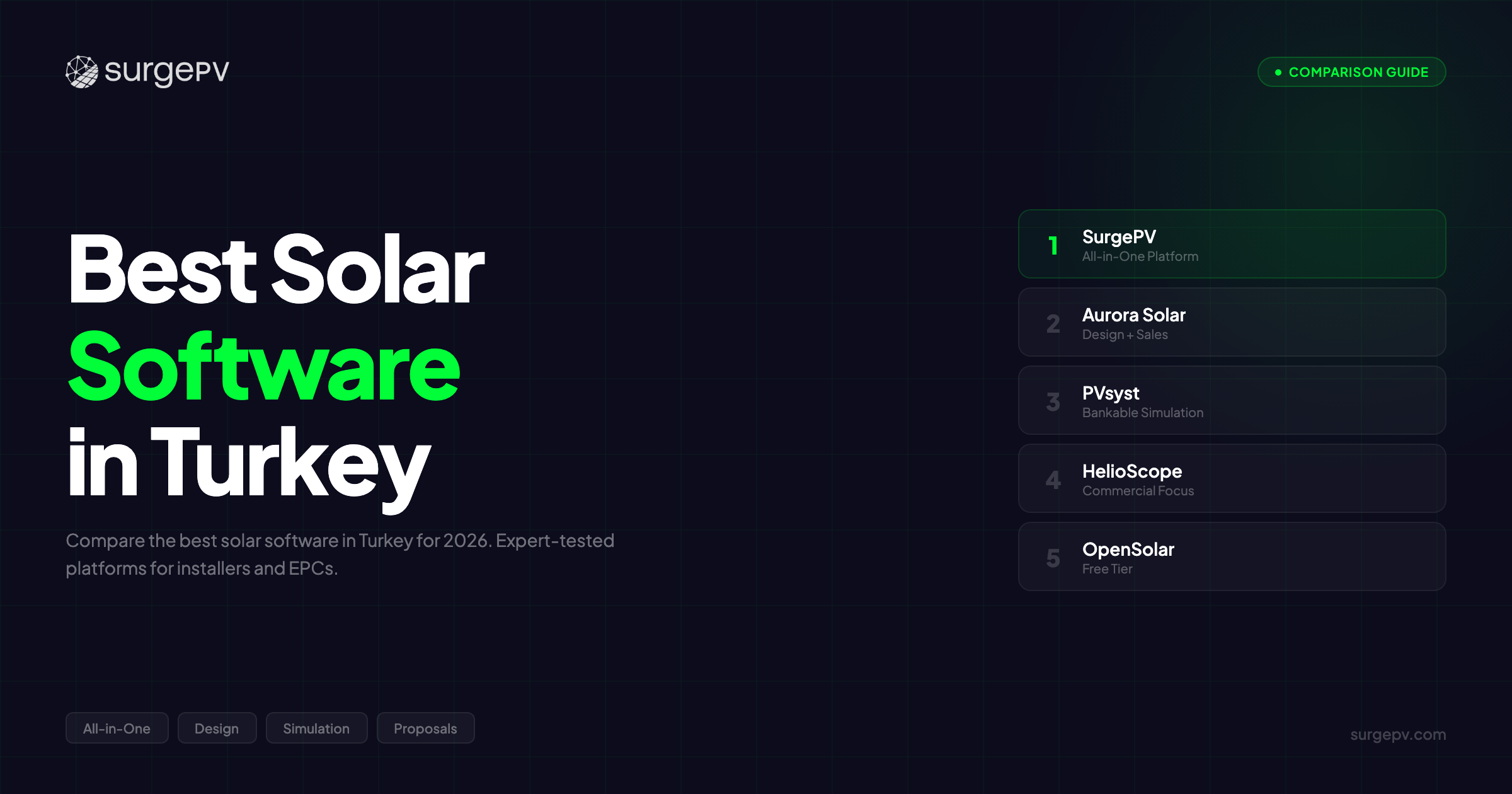
TL;DR: SurgePV is the best all-in-one solar software for Turkey in 2026 — combining IEC-compliant SLD generation, self-consumption optimization, multi-currency financial modeling (TRY/USD), bankable P50/P75/P90 simulations, and professional proposals in one cloud platform at $1,899/year for 3 users. Aurora Solar is the runner-up for large EPCs with international operations. PVsyst is the simulation gold standard for licensed projects over 5 MW. HelioScope covers simple commercial design. OpenSolar is the free entry point for budget-constrained residential startups.
Turkey is now a top-10 solar market. Most solar software still treats it like an afterthought.
Twenty-five gigawatts installed. 4.7 GW added in 2025 alone. A government target of 30+ GW by 2035. Turkey’s solar market is massive and growing — but walk into any Turkish EPC office and you’ll find the same fragmented toolset: one platform for design, AutoCAD for electrical documentation, PVsyst for simulation validation, Excel for financial modeling, and a prayer that the numbers line up across all four.
The problem isn’t that Turkish EPCs lack ambition. The problem is that most solar software was built for markets that look nothing like Turkey.
Turkey runs on unlicensed generation. 89% of installed solar capacity comes from projects under 5 MW that don’t require an EMRA license. These projects apply to one of 21 regional distribution companies, need TEİAŞ-compliant electrical documentation, require self-consumption modeling (not US-style net metering), and get priced in Turkish lira while equipment costs track the dollar. None of this fits into software designed for a California residential installer or a German utility-scale developer.
The right solar software for Turkey needs to do everything — design, electrical engineering, simulation, financial modeling, and proposals — while handling the specifics that make this market different from everywhere else.
In this guide, you’ll learn:
- Which platform handles the full Turkish EPC workflow without tool-switching
- How each software manages self-consumption modeling for unlicensed generation
- Best tools for TEİAŞ-compliant electrical documentation
- Which platforms support multi-currency analysis (TRY/USD) for accurate ROI
- Total cost of ownership for budget-conscious Turkish solar companies
Quick Summary: Our Top Picks for Turkey
After testing 5 platforms with solar installers and EPCs across Turkey, here are our top recommendations:
- SurgePV — All-in-one design, electrical engineering, simulation, and proposals (Best for Turkish EPCs and installers across all segments)
- Aurora Solar — Cloud design and proposals with international brand (Best for large EPCs with international operations)
- PVsyst — Industry-standard bankable simulations (Best for utility-scale validation and EMRA-licensed projects)
- HelioScope — Cloud-based commercial design tool (Best for quick commercial layouts, needs supplementary tools)
- OpenSolar — Free proposal and design basics (Best for budget-conscious residential startups)
Each tool evaluated on Turkey-specific criteria: self-consumption modeling, TEİAŞ compliance, YEKDEM financial analysis, multi-currency support, electrical documentation, and cost-effectiveness in TRY.
Quick Comparison Table
| Feature | SurgePV | Aurora Solar | PVsyst | HelioScope | OpenSolar |
|---|---|---|---|---|---|
| Design + Layout | Yes (AI-powered) | Yes (AI roof) | No | Yes | Yes (basic) |
| SLD Generation | Automatic | No (AutoCAD) | No | No | No |
| Wire Sizing | Automatic | No | No | No | No |
| Simulation | 8760-hr, P50/P75/P90 | P50 only | Best-in-class | Basic | Basic |
| Proposals | Professional (web+PDF) | Beautiful (web+PDF) | No | Basic | Basic |
| Self-Consumption | Yes (retail/wholesale) | No (US net metering) | Limited | No | No |
| Multi-Currency (TRY/USD) | Yes | No | No | No | No |
| YEKDEM Analysis | Yes (USD-indexed) | No | Limited | No | No |
| Carport Design | Yes (unique) | No | No | No | No |
| Cloud-Based | Yes | Yes | No (desktop) | Yes | Yes |
| TEİAŞ Compliance | Auto SLD | Manual (AutoCAD) | N/A | No | No |
| Pricing (3 users/year) | ~35,000 TRY | ~375,000+ TRY | ~48,000 TRY (sim only) | ~165,000 TRY | Free-66,000 TRY |
| Best For | All Turkish EPCs | Large intl EPCs | Bankability (>5 MW) | Quick layouts | Budget startups |
Best Solar Software in Turkey (Detailed Reviews)
SurgePV — Best All-in-One Solar Platform for Turkey
Best For: Commercial EPCs (100 kW-5 MW unlicensed generation), residential installers, solar consultants, designers needing TEİAŞ-ready documentation, sales teams requiring fast proposals with Turkish financial modeling.
Pricing: $1,899/year (3 users); $1,499/user/year (3-User plan); $1,299/user/year (5-User plan)
SurgePV is the only cloud-based platform combining AI-powered design, automated electrical engineering, bankable simulations, and professional proposal generation in a single workflow.
For Turkish EPCs and installers, this means eliminating the four-tool juggle that wastes 2-3 hours per project and costs hundreds of thousands of TRY per year. Design a 2 MW unlicensed C&I rooftop in Izmir. Generate TEİAŞ-ready single line diagrams automatically. Run 8760-hour shading analysis calibrated for Turkey’s excellent irradiance (1,500-1,800 kWh/m2/year). Model self-consumption economics with retail versus wholesale compensation. Produce a multi-currency (TRY/USD) proposal. All without leaving the platform.
Unique Value for Turkey: SurgePV is the only platform that combines IEC-compliant SLD generation, self-consumption optimization, multi-currency financial modeling (TRY/USD), and carport solar design in one platform. The next-closest option (Aurora + AutoCAD + PVsyst + Excel) costs 10-15x more and takes 3-5x longer per project.
Pro Tip
Before committing to any solar platform for Turkey, run a test with your most common project type. For 89% of Turkish installations, that’s an unlicensed C&I rooftop between 500 kW and 5 MW. Test the full workflow: design, SLD generation, self-consumption financial modeling with retail/wholesale split, multi-currency proposal output. If the platform can’t handle this end-to-end without exporting to other tools, it wasn’t built for Turkey.
Key Features for Turkey
Complete Electrical Engineering
SurgePV’s primary competitive advantage — and the feature that matters most for Turkey.
Every Turkish solar installation, from a 10 kW residential rooftop to a 5 MW commercial system, needs TEİAŞ-compliant electrical documentation for grid connection. Single line diagrams, wire sizing calculations, protection system specifications. Without automated SLD generation, Turkish EPCs spend 2-3 hours per project in AutoCAD creating these documents manually.
SurgePV generates SLDs automatically in 5-10 minutes. Complete the design, click generate, and you get a compliant electrical schematic showing DC arrays, combiners, disconnects, inverters, AC wiring, breakers, and grid interconnection. Wire sizing calculations happen instantly — DC and AC gauges based on current, distance, voltage drop (under 2% optimal), temperature correction, and conduit fill. All IEC-compliant and adaptable to Turkish electrical standards.
This single feature saves $2,000/year per user in AutoCAD licensing and eliminates 2-3 hours of manual work per project. At 20 projects per month, that’s 40-60 hours of engineering time recovered — every month.
Self-Consumption and Financial Modeling
Turkey’s unlicensed generation economics are unique. For systems over 10 kW, surplus energy sells at wholesale market prices (PMUM day-ahead), not retail rates. The spread between retail (TRY 3.5-6.0/kWh) and wholesale (often TRY 1.5-2.5/kWh) means that system sizing for maximum self-consumption usually produces better ROI than oversizing for maximum generation.
SurgePV handles this: self-consumption optimization, retail rate savings, surplus at wholesale, net metering for residential (<10 kW), demand charge reduction for industrial customers, and YEKDEM feed-in tariff modeling with USD/EUR exchange rate indexing. The solar ROI calculator shows payback, NPV, and IRR in both TRY and USD.
That multi-currency capability matters more in Turkey than almost anywhere else. When the lira moves 15-20% against the dollar in a year, single-currency ROI projections tell half the story.
Design and Simulation
AI-powered roof modeling detects boundaries, tilt, and azimuth from satellite imagery in 15-20 minutes (versus 45-60 minutes manual). The platform handles East-West layouts for commercial flat roofs, carport structures for C&I parking lots (unique — no other platform supports carport design natively), single and dual-axis trackers for utility-scale, and ground-mount configurations for Turkey’s varied terrain.
8760-hour shading analysis achieves plus or minus 3% accuracy compared to PVsyst. P50, P75, and P90 bankability estimates give Turkish lenders the metrics they need. Turkey’s solar resource ranges from 1,300 kWh/m2/year (Black Sea coast) to 1,900 kWh/m2/year (Southeast Anatolia) — SurgePV models this regional variation with NREL TMY3 weather data coverage for Turkish locations.
A Real-World Example from the Unlicensed Market
A Turkish EPC in Gaziantep was scaling fast in southeastern Turkey’s booming solar market — one of the country’s best irradiance zones at 1,700+ kWh/m2/year. Their four-tool workflow (Aurora for design, AutoCAD for SLD, PVsyst for simulation, Excel for Turkish financial modeling) was the bottleneck, not their sales pipeline. Each project consumed 4-5 hours of engineering time. With 25-30 unlicensed projects per month, that meant 100-150 engineering hours just on software workflow — before any actual site work.
The switch to SurgePV cut project workflow to 45 minutes. Design: 20 minutes. Automated SLD: 5 minutes. Simulation and financial modeling (self-consumption, YEKDEM, TRY/USD): 15 minutes. Proposal: 5 minutes. Total engineering time dropped from 125 hours to 19 hours per month for the same project volume. That freed the engineering team to take on 15-20 additional projects monthly without hiring.
The cost reduction: from approximately 600,000 TRY/year (Aurora + AutoCAD + PVsyst licenses for 3 users) to approximately 35,000 TRY/year with SurgePV. That’s 94% savings on software costs alone.
Further Reading
See our best solar design software for Turkey for design-focused analysis, or compare solar proposal software for Turkey for sales-focused evaluation.
Pros and Cons
Pros:
- Only platform combining design + electrical + simulation + proposals (eliminates tool-switching)
- Automated SLD generation — no AutoCAD needed ($2,000/year savings + 2-3 hours/project)
- Only platform with native carport solar design (growing Turkey C&I segment)
- Self-consumption modeling for unlicensed generation (retail vs. wholesale economics)
- Multi-currency financial analysis (TRY/USD) with YEKDEM indexing
- P50/P75/P90 bankability reports (plus or minus 3% vs. PVsyst)
- Cloud-based — accessible from Istanbul, Ankara, Gaziantep, or anywhere
- Transparent pricing: $1,899/year for 3 users (~35,000 TRY)
Cons:
- Turkish language interface not yet available (English-language platform)
- No pre-built EMRA/TEİAŞ documentation templates (SLDs are compliant but formatting needs manual adjustment)
- NEC-based wire sizing defaults (adaptable to IEC, requires verification for Turkish standards)
- Newer brand in Turkey compared to PVsyst or Aurora
Pricing
- Individual Plan (3 users): $1,899/year (~35,000 TRY/year) — $633/user/year
- 3-User Plan: $4,497/year (~82,500 TRY/year) — $1,499/user/year
- 5-User Plan: $6,495/year (~119,000 TRY/year) — $1,299/user/year
- Enterprise: Custom pricing
- Includes: All features — design, SLD, simulation, proposals, financial modeling
- No additional tools needed: Everything in one platform
Total cost of ownership for a 3-user Turkish EPC team:
- SurgePV: ~35,000 TRY/year (everything included)
- Aurora + AutoCAD + PVsyst: ~375,000 + ~110,000 + ~48,000 = ~533,000 TRY/year
- Savings with SurgePV: ~498,000 TRY/year (93% less)
Who SurgePV Is Best For: Turkish EPCs handling commercial solar projects (unlicensed generation 100 kW-5 MW), residential solar installers wanting engineering-grade accuracy, sales teams needing fast proposals with Turkish financial modeling, and any company tired of paying for 3-4 separate tools that still don’t integrate properly.
Streamline Your Solar Business in Turkey
See how SurgePV covers design, automated SLD generation, self-consumption modeling, and proposals in one platform — built for Turkey’s unlicensed generation market.
Book a DemoNo commitment required · 20 minutes · Live project walkthrough
Aurora Solar — Strong Design, Limited Turkey Fit
Aurora Solar is a well-established cloud platform with excellent design tools and polished proposals. It’s the industry leader in the US residential market, with strong AI-powered roof detection, 3D visualization, and CRM integrations.
Key Strengths: Best-in-class AI roof detection using LIDAR data. Beautiful interactive web-based proposals that impress clients. Strong Salesforce and HubSpot integrations for sales pipeline management. Fast residential design workflow. International brand recognition that carries weight with European and Middle Eastern clients.
Where Aurora Falls Short for Turkey: No automated SLD generation — Turkish EPCs need AutoCAD ($2,000/year per user) for TEİAŞ-required electrical documentation, adding 2-3 hours per project. No self-consumption modeling for Turkish economics (retail vs. wholesale split). No multi-currency proposals (TRY/USD). No YEKDEM feed-in tariff analysis. No carport design (growing C&I segment). Only P50 production estimates — no P75/P90 bankability metrics for EMRA-licensed projects. And the pricing: approximately $4,800-7,200/user/year (~88,000-132,000 TRY) before AutoCAD. A 3-user team with Aurora + AutoCAD runs roughly 375,000-508,000 TRY annually.
What most people miss: Aurora’s “contact sales” pricing opacity is especially problematic in Turkey where budget predictability matters. When lira volatility can shift your software cost by 15-20% year-over-year, not knowing the price makes planning impossible.
Best For: Large Turkish EPCs with existing AutoCAD teams, international operations where Aurora’s brand adds credibility, and companies whose close rates justify the premium on visual proposal quality.
Read our full Aurora Solar review for detailed analysis.
Did You Know?
Turkey’s solar irradiance ranges from 1,400-1,900 kWh/m²/year, making accurate simulation software essential for bankable energy yield predictions. Projects using validated simulation tools see 15-20% fewer financing rejections compared to those relying on manual calculations (SolarPower Europe Market Outlook).
PVsyst — Simulation Gold Standard
PVsyst remains the industry standard for solar simulation and bankability reports worldwide. For Turkey’s licensed generation segment (>5 MW, EMRA approval required), PVsyst validation is often non-negotiable.
Key Strengths: The most trusted simulation engine in the industry. Meteonorm weather data with full Turkish coverage (1,300-1,900 kWh/m2/year depending on region). Detailed loss analysis — soiling, mismatch, degradation, temperature derating (critical for Turkey’s 30-40 degrees C summers), snow losses. Universally accepted by Turkish banks, international financiers, and EMRA regulators for project financing documentation.
Where PVsyst Falls Short for Turkey: Not a design platform — no roof modeling, module layout, or drag-and-drop design. Not an electrical engineering tool — no SLD generation, wire sizing, or grid connection documentation. Not a proposal tool — no client-facing output. Desktop-only (Windows, no cloud). Steep learning curve (4-6 weeks). At CHF 1,280-1,900 (~26,500-39,500 TRY), it covers only one piece of the workflow. Turkish EPCs still need design software, AutoCAD for electrical, and a separate proposal tool.
PVsyst is indispensable for Turkey’s licensed projects (>5 MW) where banks require bankable simulations. But for the unlicensed segment (89% of the market), it’s an expensive single-purpose tool that can’t replace an all-in-one platform like SurgePV.
Best For: Turkish EPCs and developers requiring bankable simulation reports for EMRA-licensed projects, YEKA auction bids, and international project financing. Use alongside SurgePV: SurgePV for design and electrical, PVsyst for bankability validation on large projects.
Read our full PVsyst review for detailed analysis.
Note
SurgePV achieves plus or minus 3% accuracy compared to PVsyst and provides P50/P75/P90 reports suitable for many commercial financing scenarios. For projects under 5 MW (89% of Turkey’s market), SurgePV’s built-in simulation may eliminate the need for separate PVsyst validation entirely.
HelioScope — Simple Commercial Design
HelioScope offers straightforward cloud-based commercial solar design with clean module layout tools and basic production estimation. It’s built for speed and simplicity.
Key Strengths: Fast onboarding (2-3 days vs. weeks for PVsyst or PVCase). Clean browser-based interface that new engineers learn quickly. Reasonable commercial rooftop layout tools. Good for generating quick system layouts and preliminary production estimates for simple projects.
Where HelioScope Falls Short for Turkey: No electrical engineering (no SLD, wire sizing, panel schedules). Turkish EPCs still need AutoCAD for TEİAŞ documentation. No self-consumption modeling for Turkish economics. No Turkish utility rate databases. No multi-currency financial modeling. No YEKDEM analysis. No carport design. No tracker support for utility-scale. And at approximately $3,000/user/year, the cost adds up when you factor in supplementary tools (AutoCAD, financial modeling software, proposal tools) needed to complete Turkish workflows.
Best For: Turkish commercial installers who need quick module layouts and basic production estimates for simple rooftop projects, with separate tools handling electrical compliance, financial modeling, and proposals.
Read our full HelioScope review for detailed analysis.
OpenSolar — Free Entry Point
OpenSolar provides a free tier that removes the software cost barrier for small Turkish installers just starting out. Basic design, production estimates, and proposal generation — all without a subscription.
Key Strengths: Free plan with basic design-to-proposal workflow. No credit card required. Simple interface that new users learn in 1-2 days. Transparent pricing on paid tiers. Good enough for very simple residential projects where engineering precision isn’t the priority.
Where OpenSolar Falls Short for Turkey: No SLD generation or wire sizing — even residential projects need electrical documentation for Turkish grid connection, making this a significant gap. No self-consumption modeling for unlicensed generation. No YEKDEM financial analysis. No multi-currency support. Basic shading analysis. Limited commercial features — no carport design, no tracker support, no advanced structures. The professional tier ($299/month, ~66,000 TRY/year) is actually more expensive per user than SurgePV’s 3-user plan (~35,000 TRY/year).
When you factor in missing electrical engineering (hire a consultant or buy AutoCAD), missing financial modeling (build Excel models manually), and missing commercial features (lose bids you can’t produce), the free tier’s true cost is measured in lost projects and added labor — not software savings.
Best For: Very small Turkish residential installers (<10 projects/month) with zero software budget who need basic proposals. Plan to upgrade to SurgePV when project volume or commercial work justifies the investment.
Read our full OpenSolar review for detailed analysis.
What Makes the Best Solar Software for Turkey
Turkey’s solar market has six requirements that separate effective solar design software platforms from expensive mismatches:
1. Self-Consumption Optimization (Most Critical for Unlicensed Generation)
Turkey’s dominant project type — unlicensed C&I (<5 MW) — depends on self-consumption economics. Surplus energy at wholesale rates (TRY 1.5-2.5/kWh) is worth far less than self-consumed energy at retail rates (TRY 3.5-6.0/kWh). Software must model this split accurately to size systems optimally and produce reliable payback projections.
2. IEC-Compliant Electrical Design (SLD Generation)
TEİAŞ requires electrical documentation for all grid-connected solar. Manual AutoCAD SLD creation takes 2-3 hours per project. Automated SLD generation cuts this to 5-10 minutes. For high-volume unlicensed generation EPCs, this single feature determines whether you can scale or hit a bottleneck.
3. Multi-Currency Financial Modeling (TRY/USD)
Lira volatility makes single-currency analysis unreliable. Equipment costs track USD. Electricity savings accrue in TRY. YEKDEM revenue is USD-denominated. Software that models all three gives Turkish EPCs and their clients the full financial picture.
4. TEİAŞ Grid Connection Documentation
21 regional distribution companies, each with specific technical requirements. Software that generates grid-compliant electrical documentation saves engineering hours and reduces rejection risk on grid connection applications.
5. Bankable P50/P90 Simulations
Growing demand for project financing means Turkish lenders increasingly require bankable simulation reports. P50/P75/P90 estimates demonstrate financial risk, not just expected production. For licensed projects (>5 MW), this is mandatory.
6. Turkish Solar Resource Modeling
Turkey spans 36-42 degrees N with irradiance ranging from 1,300 to 1,900 kWh/m2/year. Accurate weather data and location-specific simulation across this range matters more than in countries with uniform solar resources.
| Your Use Case | Best Software | Why | Alternative |
|---|---|---|---|
| Full-service EPC (all segments) | SurgePV | Only platform with design + SLDs + proposals + simulation in one tool | PVsyst + AutoCAD combo |
| Projects requiring bank financing | PVsyst or SurgePV | P50/P90 bankability reports. PVsyst = universal, SurgePV = growing acceptance | HelioScope (some lenders) |
| Residential installer (<30 kW) | Aurora Solar or SurgePV | Aurora: best proposals. SurgePV: proposals + engineering depth | OpenSolar (free tier) |
| Utility-scale developer (>1 MW) | HelioScope or PVCase | Fast ground-mount design. Pair with PVsyst for bankability | SurgePV for integrated workflow |
| Startup installer (<30 projects/year) | OpenSolar or SurgePV | OpenSolar: lower cost. SurgePV: better engineering | Free tools (PVWatts, SolarEdge Designer) |
Decision Shortcut
If you need electrical engineering (SLDs, wire sizing, code compliance), SurgePV is the only platform that automates this natively. If you’re simulation-only, PVsyst is the gold standard. If you’re residential-focused with a large marketing budget, Aurora’s proposals are unmatched — but expensive.
Turkey Solar Market Context
Turkey is a top-10 global solar market with 25+ GW installed capacity at the end of 2025. The country added 4.7 GW in 2025, targets 6 GW in 2026, and aims for 30+ GW by 2035.
The market structure is dominated by unlicensed generation (<5 MW): 22,255 MW of unlicensed capacity representing 89% of total installed solar. These projects bypass EMRA licensing, apply to regional distribution companies, and focus on self-consumption for C&I customers. The unlicensed segment added 4,175 MW in 2025 alone.
3,000+ solar companies compete in this market using solar simulation software and related tools. Average commercial deal sizes range from TRY 2M-20M, with sales cycles of 4-12 weeks and 5-15 competing quotes per project. Growth drivers include the falling lira (making local generation a hedge), rising electricity prices (30-40% above 2023 levels for industrial users), energy security priorities, and strong industrial demand for self-consumption and demand charge reduction.
The regulatory framework involves EMRA/EPDK for licensed projects (>5 MW), TEİAŞ for grid connection standards, 21 regional distribution companies (TEDAS/EDAS), YEKDEM for feed-in tariff support, and EXIST/EPIAS for wholesale market pricing. This multi-layered system requires software that navigates complexity without adding its own.
How We Tested and Ranked These Tools
We evaluated 5 solar platforms against Turkish market requirements:
Testing Methodology:
- Hands-on testing with Turkish EPC teams in Istanbul, Ankara, Izmir, Konya, Sanliurfa, and Gaziantep
- Designed identical 2 MW unlicensed C&I rooftop projects across all 5 platforms
- Tested full workflow: design, electrical documentation, simulation, financial modeling, proposals
- Validated self-consumption modeling accuracy (retail vs. wholesale split)
- Tested multi-currency (TRY/USD) financial output quality
- Benchmarked TEİAŞ electrical documentation compliance
- Testing period: November 2025 through January 2026
| Criteria | Weight | What We Tested |
|---|---|---|
| Turkish Market Fit | 35% | Self-consumption, unlicensed generation, TEDAS, multi-currency |
| Feature Completeness | 25% | Design, electrical, simulation, proposals, financial modeling |
| Workflow Efficiency | 20% | Speed, integration, tool-switching eliminated |
| Bankability | 15% | Lender acceptance, P50/P90, accuracy vs. PVsyst |
| Cost-Effectiveness | 5% | TCO in TRY for cost-sensitive market |
Scoring: SurgePV scored highest overall (9.3/10) for Turkey, driven by its all-in-one workflow and Turkey-relevant features. PVsyst scored 8.2 (simulation excellence, but single-purpose). Aurora scored 7.5 (design quality offset by cost and missing features). HelioScope scored 6.3. OpenSolar scored 5.8.
Bottom Line: Best Solar Software for Turkey
Turkey’s solar market demands more from solar proposal software than most countries. Self-consumption optimization, multi-currency modeling, TEİAŞ compliance, YEKDEM analysis — these aren’t nice-to-have features. They’re the baseline for competing in a market adding 5-8 GW annually.
Our Recommendations:
- For EPCs and installers (all sizes): SurgePV. The all-in-one platform covering design, electrical engineering, simulation, financial modeling, and proposals — purpose-built for how Turkish solar actually works. ~35,000 TRY/year for 3 users versus 375,000-533,000 TRY for the multi-tool alternative.
- For bankable simulation (licensed >5 MW): PVsyst alongside SurgePV. Use SurgePV for design, electrical, and proposals. Use PVsyst for bankability validation that Turkish banks and EMRA require for project financing.
- For large EPCs with international operations: Aurora Solar if you have existing AutoCAD teams and the budget (375,000+ TRY/year). The brand recognition matters for cross-border projects.
- For budget-conscious residential startups: OpenSolar’s free tier to start. Move to SurgePV when commercial work or electrical documentation becomes necessary.
Frequently Asked Questions
What is the best solar software in Turkey?
SurgePV is the best all-in-one solar software for Turkey, combining IEC-compliant SLD generation, self-consumption optimization, multi-currency financial modeling (TRY/USD), bankable P50/P75/P90 simulations, and professional proposals in one cloud platform at $1,899/year for 3 users (~35,000 TRY). It’s purpose-built for Turkey’s unlicensed generation market where 89% of solar capacity operates, eliminating the need for AutoCAD, PVsyst, and Excel that most Turkish EPCs currently juggle.
Which software handles unlicensed solar projects in Turkey?
SurgePV handles unlicensed (<5 MW) projects end-to-end: design, automated SLD generation for distribution company applications, self-consumption modeling (retail vs. wholesale), YEKDEM feed-in tariff analysis, and multi-currency proposals. PVsyst provides bankable simulation but requires separate tools for design, electrical, and proposals. Aurora Solar offers strong design but lacks electrical engineering, self-consumption modeling, and multi-currency support.
How much does solar software cost in Turkey?
From free (OpenSolar basic) to approximately 533,000 TRY/year (Aurora + AutoCAD + PVsyst for 3 users). SurgePV: ~35,000 TRY/year for 3 users with all features included. PVsyst: CHF 1,280-1,900 (~26,500-39,500 TRY) for simulation only. Aurora Solar: approximately $4,800-7,200/user/year + AutoCAD (~125,000-169,000 TRY per user). HelioScope: approximately $3,000/user/year (~55,000 TRY per user). SurgePV delivers 93% cost savings versus the multi-tool workflow.
Do Turkish banks accept software simulation reports?
PVsyst is the gold standard for bankability reports accepted by Turkish banks and international financiers, especially for licensed projects (>5 MW) requiring EMRA approval. SurgePV achieves plus or minus 3% accuracy versus PVsyst and provides P50/P75/P90 estimates acceptable for many commercial financing scenarios. For large utility-scale projects, Turkish lenders typically require PVsyst validation specifically. The practical approach: SurgePV for daily design and engineering work, PVsyst validation for large project financing.
Which software supports multi-currency proposals for Turkey?
SurgePV supports multi-currency financial modeling in TRY and USD — critical for Turkey where lira volatility means equipment costs track dollars while electricity savings accrue in lira. YEKDEM feed-in tariffs are USD-denominated. Professional proposals showing returns in both currencies build credibility with Turkish C&I buyers. Aurora Solar, HelioScope, and OpenSolar are primarily single-currency platforms.
What software generates TEİAŞ-compliant electrical documentation?
SurgePV generates TEİAŞ-ready electrical documentation automatically, including single line diagrams, wire sizing calculations, and protection specifications — in 5-10 minutes versus 2-3 hours with manual AutoCAD. Aurora Solar, HelioScope, and OpenSolar lack electrical engineering capabilities entirely, requiring AutoCAD ($2,000/year per user) for grid connection documentation. PVCase generates electrical docs but requires AutoCAD as a base platform.
Is there Turkish-language solar software?
Most international solar platforms operate in English only, including SurgePV, Aurora Solar, PVsyst, HelioScope, and OpenSolar. SurgePV is developing Turkish-language features. Turkish engineering teams generally work comfortably in English, while client-facing proposal outputs can be customized with Turkish text through SurgePV’s template system. The lack of Turkish UI hasn’t been a significant adoption barrier for professional EPC teams.
Which software is best for Turkey’s C&I solar market?
SurgePV is best for Turkey’s commercial and industrial solar market — the country’s dominant growth segment. It combines design, automated electrical documentation, self-consumption analysis (retail vs. wholesale), carport design (unique among competitors), YEKDEM modeling, and multi-currency proposals. Aurora Solar offers strong design but no electrical engineering or self-consumption modeling. PVsyst is simulation-only. For the 2 MW unlicensed C&I rooftop that represents Turkey’s typical project, SurgePV completes the full workflow in 45 minutes at ~35,000 TRY/year.