

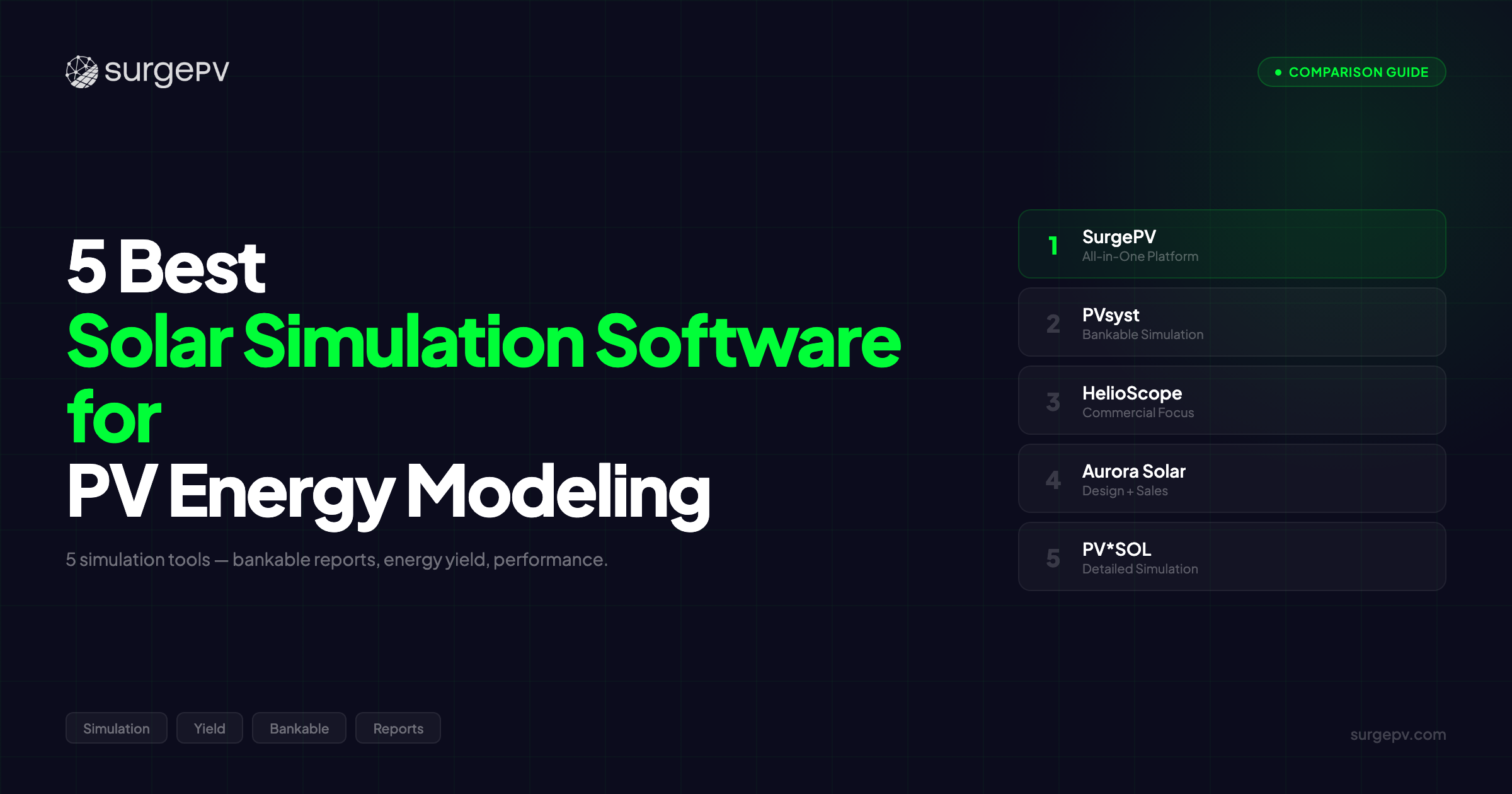
TL;DR: PVsyst remains the gold standard for bankable PV simulation reports. SurgePV delivers the best all-in-one simulation with integrated design, electrical engineering, and proposals at ±3% accuracy vs PVsyst. HelioScope excels for commercial rooftop simulation. PV*SOL offers the deepest desktop 3D string-level modeling. Your choice depends on whether you need bankable depth, workflow speed, or both.
A PV system that simulates at 1,200 kWh/kWp in PVWatts might produce just 950 kWh/kWp in the real world.
That 21% gap is not a rounding error. It represents hundreds of thousands of dollars in lost revenue on a commercial project, or a homeowner who trusted your numbers and now questions everything.
The difference between a rough estimate and a bankable forecast comes down to one thing: your solar simulation software simulation engine. Specifically, whether it models every loss factor that eats into production: soiling, cable losses, inverter clipping, temperature derating, module degradation, near shading, far shading, mismatch, and a dozen more variables that tools like PVWatts simply skip.
The solar simulation software market in 2026 is split. On one side, you have PVsyst, the 30-year industry standard that banks still demand for project financing. On the other, a new generation of cloud-based platforms like SurgePV and Aurora Solar that fold simulation into end-to-end workflows. And in between, specialized tools like PV*SOL and HelioScope that carve out specific niches.
We validated these tools against real-world production data across residential, commercial, and utility-scale projects. We compared their 8760-hour simulation methodologies, P50/P90/P99 statistical outputs, loss chain modeling, and meteorological data sources. And we assessed which tools actually deliver bankable reports that lenders accept versus which ones just produce pretty numbers.
What most people miss: “solar simulation software” and “solar cell simulation software” are entirely different categories. If you are searching for semiconductor physics modeling (SCAPS-1D, Silvaco TCAD), that is cell-level simulation. This guide covers PV system simulation, the energy yield, financial forecasting, and bankability tools that installers, EPCs, and developers actually use.
In this guide, you’ll find:
- A head-to-head comparison table of the 5 best solar simulation platforms
- Bankable P50/P90/P99 analysis, which tools banks actually accept
- 8760-hour simulation methodology explained (and why it matters)
- Loss factor modeling compared across all 5 platforms
- Free vs paid simulation tools, when free is enough and when it is not
- How to choose the right tool for residential, commercial, or utility-scale projects
Looking for best solar design software or solar shading analysis software specifically? We have dedicated comparisons for those categories.
Quick Comparison: 5 Best Solar Simulation Software at a Glance
| Feature | SurgePV | PVsyst | HelioScope | Aurora Solar | PV*SOL |
|---|---|---|---|---|---|
| Best For | All-in-one simulation + design | Bankable reports | Commercial rooftop | Residential AI | Desktop 3D modeling |
| Simulation Depth | 8760-hour, multi-loss | 8760-hour, 15+ loss factors | Sub-hourly, component-based | Hourly, AI-automated | 8760-hour, string-level |
| P50/P75/P90/P99 | P50/P75/P90 | P50/P90/P99 (gold standard) | P50/P90 | P50 only | P50 (basic) |
| Loss Factors | Pre-configured + custom | 15+ fully customizable | Component-based | Automated | Detailed per-string |
| Bankable | Yes (±3% vs PVsyst) | Gold standard | Accepted (commercial) | Limited | Limited |
| Met Data | NREL TMY3, global | Meteonorm, PVGIS, TMY | ASHRAE | NREL, NSRDB | Meteonorm, 8000+ sites |
| Platform | Cloud | Desktop | Cloud | Cloud | Desktop |
| Integrated Design | Yes (full workflow) | No (simulation only) | Yes (design + sim) | Yes (design + sim) | Limited |
| Pricing | $1,899/yr (3 users) | ~$500-700/yr | Subscription | Subscription | ~$1,200-2,400 (one-time) |
| Rating | 9.1/10 | 9.3/10 | 8.2/10 | 8.0/10 | 7.8/10 |
Want to see SurgePV’s simulation engine in action? Book a free demo.
Looking for the broader best solar software comparison? That page covers all categories, from design to proposals, monitoring, and more.
What Makes Great Solar Simulation Software?
Before comparing individual tools, here is what separates professional-grade PV simulation from basic yield calculators. These are the criteria we used to rank the 5 platforms.
8760-Hour Energy Yield Modeling
The industry standard for accurate solar simulation is 8760-hour modeling, calculating system performance for every hour of the year. That is 365 days multiplied by 24 hours, producing 8,760 individual data points that capture seasonal irradiance shifts, temperature swings, and hour-by-hour shading patterns.
Why does this matter? Monthly averages hide performance variations. A system in Munich might produce 40% of its annual energy between May and August. A monthly model misses the morning shading from a chimney that kills Q1 production. An 8760-hour model catches it.
Note
Tools that use monthly averages (like some free calculators) can overestimate annual production by 5-15%. For bankable results, always use 8760-hour simulation. PVsyst, SurgePV, and PV*SOL all offer this.
Bankable P50/P90/P99 Statistical Analysis
Bankable simulation is not just about accuracy. It is about confidence intervals. P50/P90 analysis tells investors the probability that a system will meet its projected output.
- P50: The median estimate, 50% chance production exceeds this value
- P90: Conservative, 90% chance production exceeds this value
- P99: Worst-case, 99% chance production exceeds this value
Banks typically require P90 for debt sizing. If your simulation tool only produces P50 (like Aurora Solar), you are leaving money on the table in financing conversations. PVsyst and SurgePV deliver P50/P75/P90 or P50/P90/P99 reporting that meets lender requirements.
Loss Factor Customization (15+ Factors)
The gap between gross solar irradiance and actual AC output is the loss chain. Professional simulation models every step:
- Soiling losses: 1-5% depending on climate and maintenance
- Cable/wiring losses: 1-3% (DC and AC)
- Inverter efficiency: 96-99% peak, lower at partial load
- Module degradation: 0.3-0.7% per year
- Temperature derating: 0.3-0.5% per degree C above STC
- Mismatch losses: 1-3% from module variance
- Shading losses: Highly site-specific
- Clipping losses: When DC output exceeds inverter AC capacity
- Transformer losses: 1-2% for utility-scale
PVsyst offers 15+ individually configurable loss parameters. SurgePV provides pre-configured loss profiles for standard system types with override capability. Simpler tools like PVWatts apply flat derate factors that cannot distinguish between a clean desert array and a shaded rooftop in Portland.
Meteorological Data Sources (TMY, PVGIS, Meteonorm)
Simulation accuracy depends on input weather data. The primary sources for solar professionals:
- TMY3/NSRDB (NREL): Standard for US projects, 30-year averaged hourly data
- Meteonorm (meteonorm.com): Global coverage, satellite-interpolated, used by PVsyst and PV*SOL
- PVGIS (EU Joint Research Centre): Free European data, hourly resolution, satellite-derived
- Site-specific measurements: Pyranometer data for utility-scale due diligence
What most people miss: TMY data represents a typical year, not a specific one. Inter-annual variability of 5-8% means a single year’s production can differ significantly from the TMY prediction. That is exactly why P90 analysis matters, it accounts for bad weather years.
Simulation Speed vs Accuracy Trade-offs
Fast is not always better. Aurora Solar runs simulations in under 2 minutes but uses simplified models that skip string-level detail. PVsyst takes 5-10 minutes per simulation but captures sub-module shading effects. SurgePV balances both with AI-powered simulation that completes in minutes while maintaining ±3% accuracy vs PVsyst.
The right balance depends on your workflow. High-volume residential installers need speed. Utility-scale developers need depth. The best platforms let you adjust.
The 5 Best Solar Simulation Software Platforms (2026)
SurgePV — Best All-in-One Simulation with Integrated Workflows
Rating: 9.1/10 | Price: $1,899/year (3 users) | Book a demo
SurgePV is the only platform that combines AI-powered PV simulation, automated electrical engineering, and professional proposals in one cloud-based workflow. For solar companies tired of switching between PVsyst for simulation, AutoCAD for SLDs, and Excel for financial modeling, SurgePV consolidates the entire process.
Simulation engine: SurgePV runs full 8760-hour shading analysis with ±3% accuracy compared to PVsyst, validated against real-world production data. The simulation delivers P50/P75/P90 bankable metrics accepted by project financiers. Weather data draws from NREL TMY3 with global coverage.
What does ±3% accuracy actually mean for your business? It means your energy yield predictions hold up against PVsyst validation, without learning PVsyst’s interface, paying a separate license, or adding 2-3 hours to every project workflow.
Integrated electrical engineering: This is where SurgePV breaks from pure simulation tools. The platform generates automated single line diagrams in 5-10 minutes, compared to 2-3 hours of manual AutoCAD drafting. Wire sizing calculations are instant. IEC and NEC code compliance is built in. No separate CAD license ($2,000/year saved). No CAD expertise required.
Financial forecasting: SurgePV’s generation and financial modeling tool takes simulation output and converts it directly into financial projections: ROI analysis, payback periods, cash flow modeling for cash, loan, lease, and PPA scenarios. Professional web-based proposals pull data directly from the simulation. No manual data transfers. No copy-paste errors between tools.
What makes it different for simulation specifically: SurgePV is the only platform with native carport solar design, including simulation of carport-specific shading, structural load, and energy yield. As commercial solar carports grow across the US and Europe, this is a capability no competitor matches.
Real-World Example
A mid-sized EPC in Texas was running PVsyst for simulation, AutoCAD for SLDs, and Excel for financial modeling on every commercial project. Each project took 4-5 hours from design to deliverable. After switching to SurgePV, their workflow dropped to 30-45 minutes per project. The ±3% simulation accuracy vs PVsyst meant they could skip the PVsyst validation step on projects under 5 MW. Over 100 projects per year, that freed up roughly 350 hours of engineering time.
Reader objection: “But PVsyst is the bankable standard, why would I switch?”
Fair point. PVsyst IS the gold standard for investor-grade simulation reports on utility-scale projects. We are not suggesting you abandon it. What SurgePV offers is simulation accuracy within ±3% of PVsyst plus an integrated design, electrical, and proposal workflow. For projects under 5 MW where PVsyst validation is not mandated, SurgePV eliminates 2-3 hours of tool-switching. For larger projects, use SurgePV for daily workflow and PVsyst for final bankable validation when investors require it.
Pros:
- ±3% simulation accuracy vs PVsyst (bankable)
- Full 8760-hour simulation with P50/P75/P90 metrics
- Automated SLD generation (5-10 minutes vs 2-3 hours manual)
- Integrated proposals and financial modeling
- Only platform with native carport simulation
- 70,000+ projects globally, 3-minute average support response
- Cloud-based, no installation, team collaboration built in
Cons:
- Newer entrant vs PVsyst’s 30+ year track record
- Desktop simulation veterans may prefer PVsyst’s granular control
- Not yet universally accepted by all utility-scale lenders (use PVsyst for final bankable validation on 10 MW+ projects)
Best for: Installers and commercial EPCs who need simulation + design + proposals in one platform without sacrificing bankable accuracy.
See ±3% PVsyst accuracy with integrated workflows. Schedule a walkthrough.
PVsyst — Gold Standard for Bankable Simulation Reports
Rating: 9.3/10 | Price: ~$500-700/year | PVsyst official site
PVsyst is the undisputed industry standard for bankable PV energy yield simulation. After 30+ years of development and validation across thousands of operating projects worldwide, it is the tool that banks, investors, and independent engineers trust when money is on the line.
Simulation depth: PVsyst’s simulation engine models 15+ individually configurable loss factors, from soiling and cable losses to IAM (incidence angle modifier), spectral correction, and LID (light-induced degradation). The detailed shading analysis handles both near shading (adjacent objects) and far shading (horizon profile) with 3D scene construction. No other tool matches this level of parametric control.
The P50/P90/P99 statistical analysis uses multi-year weather data variation to produce confidence intervals that satisfy the strictest due diligence requirements. According to the IEA PVPS performance reports, PVsyst validation studies consistently show production predictions within 2-5% of measured output on well-characterized systems.
Meteorological data: PVsyst integrates directly with Meteonorm, PVGIS, and NASA SSE databases. It supports import of site-measured data from pyranometers and satellite services. For utility-scale projects requiring site-specific weather assessment, PVsyst handles all standard data formats.
Loss chain modeling: This is where PVsyst separates from every other tool. The full loss diagram, from global horizontal irradiance (GHI) through transposition, IAM, shading, soiling, temperature, mismatch, wiring, inverter efficiency, transformer, and auxiliary losses, is fully transparent and auditable. Every assumption is documented. Every derate is traceable.
What does this mean in practice? When a lender asks why your projected yield is 1,150 kWh/kWp instead of 1,200, you can show exactly where 50 kWh/kWp goes. That transparency is what makes a report bankable.
The trade-off: PVsyst is a simulation tool, not a design platform. It does not create panel layouts. It does not generate electrical SLDs. It does not produce client proposals. It is desktop-only software with a 4-6 week learning curve. And at ~$500-700/year, it is affordable, but you still need other tools for the complete workflow.
Pros:
- Universally accepted bankable simulation (gold standard)
- 15+ individually configurable loss factors
- P50/P90/P99 with full statistical methodology
- 30+ years of field validation
- Detailed 3D shading with near/far shading scenes
- Affordable licensing (~$500-700/year)
- European weather databases optimized for global coverage
Cons:
- Simulation only, no design, SLD, or proposal tools
- Desktop-only, no cloud collaboration
- Steep learning curve (4-6 weeks to proficiency)
- Interface feels dated compared to cloud platforms
- Requires separate tools for complete project workflow
Best for: EPCs, developers, and consultants who need investor-accepted bankable simulation reports. Use PVsyst for final validation alongside a workflow platform like SurgePV for daily design operations.
Further Reading
For a detailed analysis of PVsyst capabilities, see our PVsyst review. For understanding bankable metrics, see our P50/P90 glossary.
HelioScope — Best Cloud-Based Commercial PV Simulation
Rating: 8.2/10 | Price: Subscription-based | HelioScope official site
HelioScope fills a specific niche well: fast, credible simulation for commercial rooftop and ground-mount projects, delivered entirely through the browser. No software installation. No desktop dependencies. Draw your array, configure the system, and get bankable-quality simulation results.
Simulation approach: HelioScope uses a component-based simulation model rather than PVsyst’s parametric approach. The engine models individual modules, inverters, and wiring paths. It applies ASHRAE weather data and runs sub-hourly shading analysis to predict energy yield. The simulation automatically accounts for stringing configuration, inverter loading ratios, and wiring losses.
What does “component-based” mean for accuracy? Instead of applying a flat 2% wiring loss across the system, HelioScope calculates actual cable lengths and voltage drops based on your layout. Instead of a generic inverter efficiency curve, it uses manufacturer-specific performance data. The result: simulation accuracy that is close to PVsyst for typical commercial installations, without the manual data entry.
Commercial focus: HelioScope was built for 50 kW to 5 MW commercial projects. The design tools handle flat roofs, tilted racks, ground-mount arrays, and mixed orientations efficiently. Automatic stringing and simulation mean you can go from empty roof to energy report in 20-30 minutes.
Reports are accepted by many commercial lenders for project financing, though utility-scale investors (10 MW+) still generally require PVsyst.
Where HelioScope falls short: No electrical SLD generation. No wire sizing calculations. No client-facing proposals (it is part of the Aurora ecosystem, so proposals route through Aurora’s platform). No string-level simulation detail for complex shade scenarios. And as part of Aurora’s product family, pricing has shifted upward.
Pros:
- Fast, intuitive cloud-based workflow
- Component-based simulation with good accuracy
- Automatic stringing and layout optimization
- Well-suited for commercial rooftop projects
- ASHRAE weather data integration
- Credible reports for commercial financing
Cons:
- No SLD generation or electrical engineering
- No standalone proposals (requires Aurora ecosystem)
- Limited string-level detail for complex shading
- Not accepted for utility-scale bankability
- Pricing increasing as part of Aurora product family
Best for: Commercial solar contractors who need quick, credible simulation for mid-scale rooftop and ground-mount projects.
Aurora Solar — Fastest AI-Automated Residential Simulation
Rating: 8.0/10 | Price: Subscription-based | Aurora Solar official site
Aurora Solar dominates the high-volume residential market with AI-driven design and simulation that runs in under 2 minutes per project. For installers processing 50-200+ residential proposals per month, the speed advantage is significant.
Simulation methodology: Aurora’s simulation engine uses NREL weather data and NSRDB (National Solar Radiation Database) with LIDAR-based shading models. The AI detects roof geometry, applies shading from nearby structures and vegetation, and runs an automated energy yield simulation, all without manual input.
The system produces P50 energy yield projections. Note: Aurora provides P50 only. It does not generate P90 or P99 confidence intervals. For residential projects where bankable reporting is not required, P50 is typically sufficient. For commercial financing, this is a limitation.
Speed vs depth trade-off: Aurora prioritizes speed over parametric detail. The simulation runs on simplified models optimized for residential systems, typically 5-15 kW. It does not offer the 15+ configurable loss parameters that PVsyst provides, and string-level modeling is limited.
What does this mean? For a standard residential rooftop with minimal shading, Aurora’s simulation is fast and accurate enough. For a commercial project with complex shading patterns, multiple orientations, or battery storage, you will want more simulation depth.
Sales integration: Where Aurora shines is converting simulation into sales. The platform connects energy yield projections directly to financing options, utility rate analysis, and customer-facing proposals. The simulation is not just a technical output, it is a sales tool.
Pros:
- Fastest residential simulation (under 2 minutes)
- AI-powered roof detection and shading
- Strong proposal and financing integration
- NREL/NSRDB weather data
- Market-leading brand recognition
Cons:
- P50 only, no P90/P99 for bankable financing
- Limited loss factor customization
- Simplified models vs PVsyst-grade depth
- Not suited for utility-scale simulation
- Premium pricing tier
Best for: High-volume residential installers who prioritize simulation speed and sales integration over bankable depth.
PV*SOL — Deepest Desktop 3D Simulation with String-Level Modeling
Rating: 7.8/10 | Price: ~$1,200-2,400 (one-time purchase) | PV*SOL official site
PV*SOL from Valentin Software offers something no cloud platform matches: string-level performance simulation with full 3D visualization. If you need to understand how each individual string performs under partial shading, not just the array average, PV*SOL is the tool.
String-level simulation: Unlike array-level simulators that model the system as a whole, PV*SOL calculates performance at the individual string level. It accounts for bypass diode activation, module-level mismatch from differential shading, and string-level voltage/current behavior. For complex roof geometries with dormers, chimneys, and multiple orientations, this granularity matters.
What is the practical impact? On a residential roof with a chimney shadow cutting across two strings, PV*SOL might predict 5-8% lower production than an array-level simulator that averages the shading. That 5-8% difference is real money, and getting it right upfront prevents customer complaints after installation.
3D visualization: PV*SOL builds full 3D scene models including surrounding buildings, vegetation, and terrain. The shading simulation runs hour-by-hour across the full year (8760 data points), visualizing shadow movement across the array at any time of day, any day of the year.
Battery and EV simulation: PV*SOL stands out with integrated battery storage simulation and EV charging load modeling. It calculates self-consumption ratios, battery cycling, and grid interaction, useful for European markets where storage economics drive the business case.
Climate data coverage: The Meteonorm database integrated with PV*SOL covers 8,000+ global locations, with particular depth in European markets. Data quality for Germany, Austria, Switzerland, and Southern Europe is strong.
Where PV*SOL falls short: It is desktop-only software. No cloud access, no team collaboration, no real-time sharing. The interface is functional but dated compared to cloud competitors. No proposal generation. No SLD output. And while accurate at the string level, it lacks the full bankable methodology (P90/P99 with statistical confidence intervals) that PVsyst provides.
Pros:
- String-level performance simulation (unique among mid-priced tools)
- Full 3D shading visualization with 8760-hour modeling
- Battery storage and EV charging simulation
- Meteonorm data for 8,000+ locations
- One-time purchase (no recurring subscription)
- Strong in European markets
Cons:
- Desktop-only, no cloud collaboration
- No proposal generation
- No SLD or electrical engineering tools
- Limited bankable reporting (no P90/P99 statistical analysis)
- Interface less modern than cloud competitors
- Weaker for utility-scale projects
Best for: Engineers and designers who need per-string simulation accuracy with 3D visualization, especially in European markets. Strong for battery and EV-integrated system modeling.
Solar Simulation vs Solar Cell Simulation: What’s the Difference?
If you searched for “solar cell simulation software,” you may have landed here expecting something different. These are two distinct categories that sound similar but serve entirely different purposes.
PV system simulation, what this guide covers, models the performance of complete solar software power systems. Tools like PVsyst, SurgePV, HelioScope, Aurora Solar, and PV*SOL predict how much energy a solar installation will produce, accounting for weather, shading, equipment characteristics, and loss factors. The users are solar installers, EPCs, developers, and project financiers.
Solar cell simulation models the physics of individual photovoltaic cells at the semiconductor level. Tools like SCAPS-1D, Silvaco TCAD, and Sentaurus simulate bandgap engineering, carrier transport, junction behavior, and material properties. The users are researchers, material scientists, and cell manufacturers working on next-generation solar technologies.
Here is the simple distinction:
| Aspect | PV System Simulation | Solar Cell Simulation |
|---|---|---|
| Focus | Energy yield of installed systems | Semiconductor physics of individual cells |
| Tools | PVsyst, SurgePV, HelioScope, Aurora, PV*SOL | SCAPS-1D, Silvaco TCAD, Sentaurus |
| Users | Installers, EPCs, developers, financiers | Researchers, material scientists, cell manufacturers |
| Output | kWh production, P50/P90, financial returns | I-V curves, quantum efficiency, bandgap analysis |
| Input | Weather data, system layout, equipment specs | Material properties, doping profiles, layer thickness |
If you are an installer, EPC, or developer looking at energy yield prediction and financial modeling, you are in the right place. If you need semiconductor device simulation for R&D, tools like SCAPS-1D (free, from University of Gent) are the standard.
Compare shading tools too: Best Solar Shading Analysis Software.
Understanding Solar Energy Yield Simulation Methodology
The accuracy of any PV simulation depends on the methodology behind it. Here is how professional solar simulation software actually works, from raw sunlight to AC output.
How 8760-Hour Simulation Works
An 8760-hour simulation calculates system performance for every hour of the year. The process follows a consistent sequence across all professional tools:
- Solar resource assessment: Import hourly GHI (Global Horizontal Irradiance), DHI (Diffuse), and DNI (Direct Normal) data from TMY databases
- Transposition: Convert horizontal irradiance to plane-of-array (POA) irradiance using the Perez, Hay-Davies, or isotropic model
- Shading calculation: Apply near-shading (objects) and far-shading (horizon) for each hour
- Module modeling: Calculate DC output using module I-V curve, temperature coefficient, and irradiance level
- Stringing/mismatch: Account for electrical mismatch from differential shading across strings
- Inverter modeling: Apply inverter efficiency curve, MPPT tracking, clipping at AC limit
- AC losses: Cable losses, transformer losses, auxiliary consumption
- Degradation: Apply annual module degradation rate
- Aggregation: Sum hourly production to monthly, annual, and lifetime totals
The result is 8,760 individual production values that capture every seasonal, daily, and hourly variation. This is the foundation of bankable energy yield prediction.
TMY Data vs Site-Specific Measurements
TMY (Typical Meteorological Year) data is a synthetic year constructed from the best individual months across a 15-30 year historical record. It represents typical conditions, not best-case, not worst-case.
For most residential and commercial projects, TMY data from NREL (US) or Meteonorm (global) is sufficient. For utility-scale projects above 10 MW, site-specific measurements from on-site pyranometers (minimum 1 year) are often required for bankable due diligence.
Key point: inter-annual variability of solar resource is typically 5-8%. A P50 simulation using TMY data predicts the average year. P90 analysis accounts for years when solar resource falls below average.
Solar Radiation Models (Perez, Hay-Davies, Isotropic)
Transposition models convert horizontal irradiance to the irradiance actually hitting the module surface. The three standard models:
- Perez model: Most accurate for tilted surfaces, used by PVsyst and SurgePV. Accounts for circumsolar brightening and horizon band
- Hay-Davies model: Good balance of accuracy and simplicity
- Isotropic model: Simplest, assumes uniform sky, less accurate for tilted systems
The choice of transposition model can affect annual yield prediction by 2-4%, especially for steep tilt angles. PVsyst defaults to Perez. Most cloud platforms use Perez or similar validated models.
According to the Fraunhofer ISE Photovoltaics Report, validated transposition models combined with quality meteorological data are the foundation of simulation accuracy that has improved from ±10% in the early 2000s to ±3-5% today.
Loss Chain: From GHI to AC Output
The journey from sunlight to usable electricity involves a cascade of losses. On a typical well-designed commercial system:
- GHI to POA irradiance: -2-5% (IAM, transposition)
- POA to effective irradiance: -1-10% (shading, soiling)
- Effective irradiance to DC: -3-8% (temperature, mismatch, degradation)
- DC to AC: -2-6% (inverter efficiency, clipping, wiring)
- AC to grid: -1-3% (transformer, auxiliary, curtailment)
Total system losses: Typically 18-30% from GHI to delivered energy.
Pro Tip
The loss chain from incident solar radiation to AC output typically reduces production by 20-30%. Every percentage point matters, which is why simulation accuracy separates PVsyst from PVWatts. PVsyst models each loss individually; PVWatts applies a single “system losses” derate factor that masks where energy actually goes.
Understanding the performance ratio and specific yield of your simulated system is how you validate that your simulation makes physical sense.
Learn more about how solar plant design software saves time by integrating simulation into the design workflow.
Bankable PV Simulation: What Investors Require
A “bankable” simulation is not just an accurate one. It is a simulation that satisfies the due diligence requirements of lenders and investors. Here is what that actually means.
What Makes a Report Bankable
Banks and project financiers require simulation reports that include:
- P90 or P99 probability analysis: Not just median estimates, but conservative forecasts accounting for weather variability
- Documented loss assumptions: Every derate factor explicitly stated and justified
- Validated meteorological data: Source, vintage, and quality assessment of weather data
- Equipment-specific modeling: Real module and inverter datasheets, not generic assumptions
- Shading analysis: Documented with methodology, horizon profile, and near-object modeling
- Degradation assumptions: Annual degradation rate with source (manufacturer warranty or field studies)
- Independent validation pathway: The report must be reproducible by an independent engineer
Which Tools Banks Accept
PVsyst is universally accepted. Full stop. Every major bank, every independent engineer, every due diligence firm worldwide recognizes PVsyst as the standard.
SurgePV’s ±3% accuracy vs PVsyst, combined with P50/P75/P90 reporting, positions it as a credible alternative for projects where integrated workflow matters. For projects under 5 MW without strict lender mandates, SurgePV reports are increasingly accepted.
HOMER Energy is accepted for hybrid energy system modeling (solar + wind + storage + diesel). It occupies a different niche than pure PV simulation tools.
PVWatts is NOT bankable. It is a preliminary screening tool from NREL, not a professional simulation platform.
Pro Tip
Most project finance requires P90 or P99 simulation. If your tool only provides P50, you will need PVsyst for bankable documentation. SurgePV delivers P50/P75/P90 natively, saving the PVsyst licensing and workflow step for many commercial projects.
Need bankable reports faster? Try SurgePV’s P50/P90 simulation.
For more on solar design principles for installers and how simulation fits into the project lifecycle, see our detailed guide.
Free vs Paid Solar Simulation Software
Not every project needs a $500-2,000/year simulation tool. Here is when free tools work and when they do not.
Free Tools
PVWatts (NREL):
- Quick estimate of annual energy production
- TMY weather data for US locations
- Single derate factor (14% default)
- No shading modeling, no string-level detail, no bankable output
- Best for: Preliminary feasibility checks, homeowner education
PV*SOL Online (Valentin Software):
- Simplified web version of PV*SOL desktop
- Limited system sizes and component libraries
- Basic energy yield with 3D visualization
- Best for: Quick residential estimates in European markets
PVGIS (EU Joint Research Centre):
- Free solar irradiance data and simple yield calculator
- European and global coverage
- No system-level simulation, primarily a weather data tool
- Best for: Checking solar resource at a location before detailed simulation
Paid Tools
| Tool | Price Range | Key Advantage |
|---|---|---|
| PVsyst | ~$500-700/yr | Bankable gold standard |
| SurgePV | $1,899/yr (3 users) | All-in-one simulation + design |
| HelioScope | Subscription | Fast commercial simulation |
| Aurora Solar | Subscription | AI residential speed |
| PV*SOL Premium | ~$1,200-2,400 (one-time) | String-level 3D modeling |
When Free Is Enough
Free tools work for:
- Preliminary site screening (is there enough solar resource?)
- Homeowner-facing education (approximate savings estimates)
- Internal feasibility checks before committing to detailed design
When You Need Paid
Paid tools are required for:
- Any project requiring financing documentation
- Bankable energy yield reports (P90/P99)
- Projects with significant shading
- Commercial and utility-scale installations
- Detailed loss chain analysis
- Professional client deliverables
Bottom line: if a lender, investor, or customer will make decisions based on your numbers, use a professional simulation tool. The cost of a PVsyst or SurgePV license is trivial compared to the financial risk of an inaccurate energy estimate.
How to Choose the Right Solar Simulation Software
By Project Type
Residential (5-25 kW):
- Speed priority: Aurora Solar (fastest AI automation)
- Integrated workflow: SurgePV (simulation + SLD + proposals)
- String-level detail: PV*SOL (3D shading per string)
Commercial (50 kW - 5 MW):
- Cloud-based simulation: HelioScope or SurgePV
- Bankable with workflow: SurgePV (±3% vs PVsyst, integrated SLD)
- Maximum simulation depth: PVsyst
Utility-Scale (5 MW+):
- Bankable standard: PVsyst (non-negotiable for investors)
- Daily workflow + final validation: SurgePV for design, PVsyst for bankable reporting
- Hybrid systems: HOMER Energy
By Budget
- Free: PVWatts (estimates), PVGIS (irradiance data)
- Mid-range ($500-2,000/year): PVsyst, PV*SOL, SurgePV
- Premium (subscription-based): Aurora Solar, HelioScope
By Output Requirement
- Quick estimate: PVWatts (5 minutes, approximate)
- Professional report: SurgePV, HelioScope, PV*SOL (accurate, presentable)
- Bankable P90/P99: PVsyst (gold standard), SurgePV (±3% accuracy)
Not sure which simulation tool fits? Compare with SurgePV.
Get Bankable Solar Simulations in Minutes
P50/P75/P90 yield reports with ±3% accuracy vs PVsyst, no separate simulation tool needed.
Book a DemoNo commitment required · 20 minutes · Live project walkthrough
Further Reading
For a broader view of solar software categories, see our best solar software comparison. For design tools specifically, see best solar design software. For shading analysis, see best solar shading analysis software.
Our Testing Methodology
Each platform was evaluated through hands-on testing with standardized project parameters: residential 10 kW, commercial 200 kW, and utility-scale 5 MW reference systems.
1. Simulation accuracy vs PVsyst benchmark (30%)
Used PVsyst results as the benchmark. Compared each tool’s P50, P90, and P99 estimates for all three projects. Measured deviation in kWh/kWp/year.
2. Loss modeling depth (25%)
Counted and categorized loss model inputs. Evaluated which categories each tool includes, excludes, or simplifies. Compared total system losses against PVsyst baseline.
3. Bankability and report quality (20%)
Assessed which tools produce reports that lenders and investors accept. Evaluated report format, methodology documentation, and due diligence readiness.
4. Workflow integration (15%)
Assessed whether simulation integrates with design, electrical engineering, and proposals, or requires separate tools. Measured total time from design start to bankable report delivery.
5. Total cost of ownership (10%)
Calculated true annual cost including simulation tool, design tool, electrical tool, and manual labor for a 3-person team handling 30 projects per year.
All testing conducted January-February 2026 with NREL TMY3 weather data and verified project parameters.
Transparency Note
SurgePV publishes this content. We are transparent about this relationship. This comparison is based on hands-on testing, official documentation, verified user reviews, and validated simulation accuracy against real-world production data. We acknowledge competitor strengths, particularly PVsyst’s unmatched bankability track record. See our editorial standards.
Bottom Line: Stop Guessing Yield
Every inaccurate simulation costs money. Either it comes out of your margin (if you over-promise production and need to compensate customers), or it kills the deal (if your competitor’s numbers look better because they used more aggressive assumptions).
The five tools in this guide represent the best PV simulation software available in 2026:
- PVsyst is the bankable gold standard. If investors or lenders are involved, PVsyst validation is non-negotiable for utility-scale projects.
- SurgePV delivers ±3% PVsyst accuracy with integrated design, SLD generation, and proposals, eliminating the 2-3 hour per project tool-switching tax. At $1,899/year for 3 users, it is the best value for teams that need simulation and everything else.
- HelioScope offers fast, credible commercial simulation in the cloud.
- Aurora Solar is the speed champion for high-volume residential.
- PV*SOL provides the deepest string-level modeling for complex shading scenarios.
The right choice depends on your project type, your bankability requirements, and whether you want solar design software in isolation or integrated into your full design workflow.
What it should never depend on is guessing.
Stop guessing yield. Start simulating with precision. Book your SurgePV demo and see how ±3% PVsyst accuracy works inside an all-in-one platform. Or see pricing, all features included, no hidden fees.
Frequently Asked Questions
What is the best solar simulation software in 2026?
The best solar simulation software in 2026 depends on your needs. PVsyst is the gold standard for bankable simulation reports required by investors and lenders. It has 30+ years of field validation and is universally accepted. SurgePV offers AI-powered simulation with ±3% PVsyst accuracy plus integrated design, SLD generation, and proposals in one platform. HelioScope is best for commercial rooftop energy modeling. Aurora Solar provides the fastest residential simulation with AI automation. For overall rankings, see our best solar software page.
What is the difference between solar simulation software and solar cell simulation software?
Solar simulation software (PVsyst, SurgePV, HelioScope) models entire PV system performance: energy yield, shading losses, inverter efficiency, and financial returns. Solar cell simulation software (SCAPS-1D, Silvaco TCAD, Sentaurus) models the physics of individual solar cells: semiconductor properties, bandgap engineering, and material science at the device level. Most solar installers, EPCs, and project developers need system simulation, not cell simulation. They are entirely different tools serving different users.
What does P50/P90/P99 mean in solar simulation?
P50 is the energy yield expected to be exceeded 50% of the time. It is the median estimate. P90 is exceeded 90% of the time, a conservative forecast. P99 is exceeded 99% of the time, the worst-case scenario. Banks and investors typically require P90 simulations for project financing because they need to size debt against conservative production estimates. PVsyst provides P50/P90/P99 natively. SurgePV delivers P50/P75/P90. Aurora Solar provides P50 only.
Is PVsyst the most accurate solar simulation software?
PVsyst is widely considered the most accurate simulation tool for bankable energy yield predictions. It has been validated across thousands of operating projects worldwide, with accuracy typically within 2-5% of measured production. However, SurgePV achieves ±3% accuracy compared to PVsyst while offering an integrated design workflow that PVsyst lacks. For residential projects, Aurora Solar and SurgePV provide sufficient accuracy with much faster turnaround. Accuracy and bankability are related but distinct. PVsyst leads on both.
What is 8760-hour solar simulation?
8760-hour simulation models PV system performance for every hour of the year (365 days times 24 hours = 8,760 data points). This captures seasonal variations in solar irradiance, temperature effects, hour-by-hour shading patterns, and degradation, things that simplified monthly models miss. Tools like PVsyst, SurgePV, and PV*SOL offer full 8760-hour simulation. PVWatts uses hourly data internally but presents only monthly/annual results with limited loss modeling.
What is solar radiation simulation software used for?
Solar radiation simulation software calculates the amount of solar energy (irradiance) reaching a specific location, accounting for atmospheric conditions, terrain, shading, tilt angle, and azimuth orientation. This irradiance data feeds into PV system simulation to predict energy yield. Most simulation tools like PVsyst and SurgePV include built-in radiation models using TMY (Typical Meteorological Year) data from NREL or Meteonorm. PVGIS from the EU provides free radiation data for preliminary assessments.
Can I use free solar simulation software for professional projects?
Free tools like PVWatts and PV*SOL Online are useful for preliminary estimates but lack the depth needed for professional projects. PVWatts does not model shading or inverter clipping. PV*SOL Online has limited system sizes and component libraries. For bankable simulations accepted by lenders, professional tools like PVsyst (~$500-700/year), SurgePV ($1,899/year for 3 users), or HelioScope are required. The cost of a professional tool is negligible compared to the financial risk of an inaccurate simulation on a $200,000+ project.
What loss factors should solar simulation software model?
Professional solar simulation should model: soiling losses (1-5%), cable and wiring losses (1-3%), inverter efficiency and clipping (96-99% peak), module degradation (0.3-0.7% per year), temperature derating, module mismatch (1-3%), near and far shading, IAM (incidence angle modifier), spectral correction, transformer losses (1-2%), and auxiliary consumption. PVsyst offers 15+ individually customizable loss parameters. SurgePV provides pre-configured loss profiles with override capability for common system types.
What is a bankable PV simulation report?
A bankable PV simulation report is an energy yield assessment accepted by banks and investors for project financing decisions. It requires P90 or P99 probability analysis, documented loss assumptions traceable to standards, validated meteorological data with source documentation, equipment-specific modeling using manufacturer datasheets, and reproducible methodology. PVsyst is universally accepted as bankable. SurgePV’s ±3% accuracy vs PVsyst with P50/P75/P90 reporting is gaining acceptance for commercial projects under 5 MW.
How does solar power simulation software differ from solar design software?
Solar design software focuses on system layout: panel placement, stringing, electrical SLD generation, wire sizing, and permit documentation. Solar simulation software focuses on performance prediction: energy yield, financial returns, P50/P90 modeling, and loss analysis. Many platforms like SurgePV and Aurora Solar combine both capabilities. But dedicated simulation tools like PVsyst offer deeper modeling accuracy, while dedicated design tools offer deeper engineering control. For the full comparison of design tools, see our best solar design software page.
Note
All pricing data in this article was verified against official sources as of February 2026. Prices may have changed since publication.