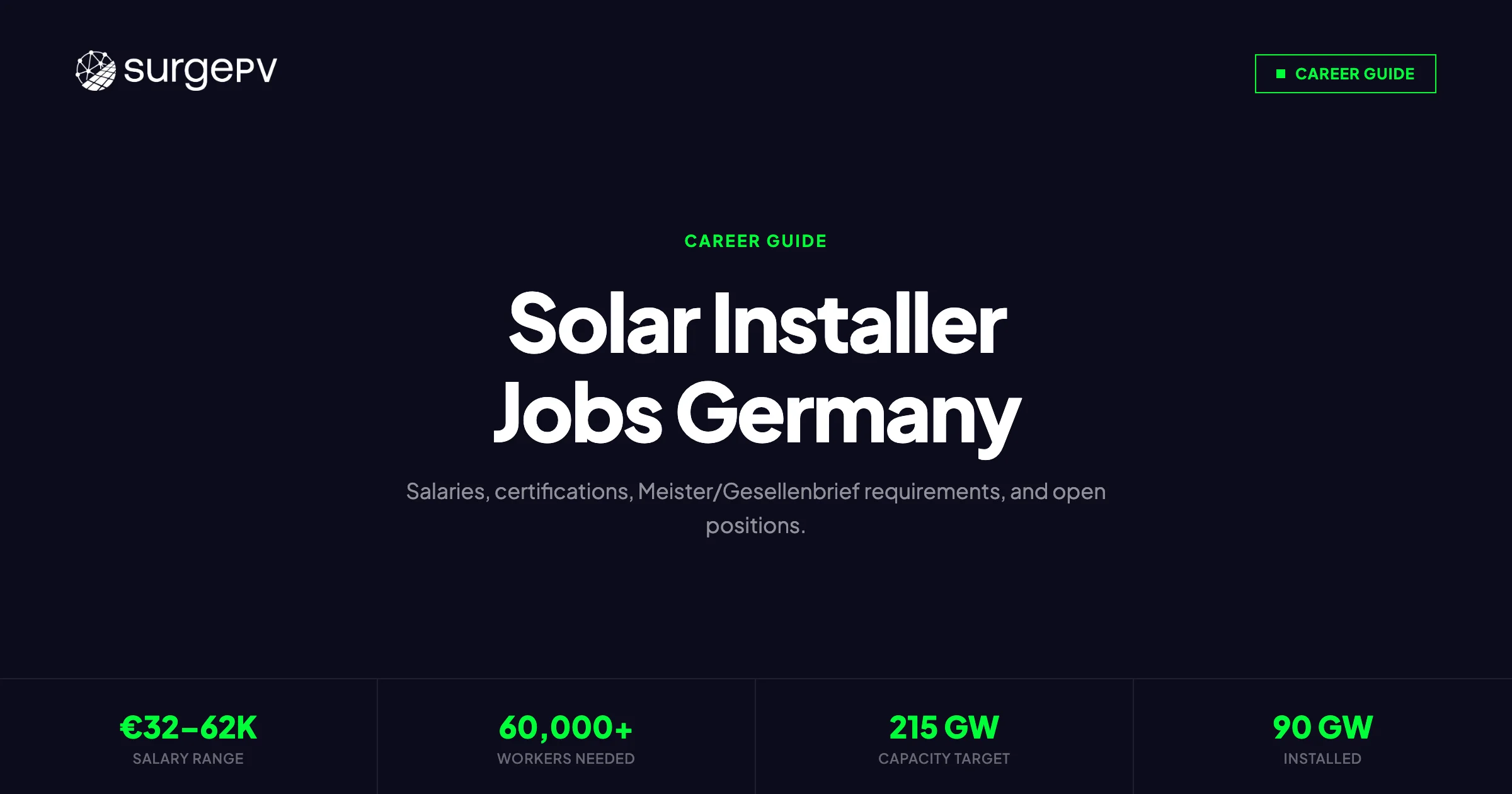
Germany’s solar expansion is running into a hard ceiling — not a technology ceiling, but a workforce one. The country’s installed PV capacity surpassed 90 GW by end of 2025, and the federal government’s target of 215 GW by 2030 demands roughly 20 GW of new capacity per year. That pace requires a construction workforce the German solar industry simply does not have today.
The Bundesverband Solarwirtschaft (BSW Solar) estimated in late 2024 that the sector needs at least 60,000 additional trained solar workers by 2026 to stay on track. Current training capacity covers roughly 60% of that need, and high-demand regions like North Rhine-Westphalia, Bavaria, and Baden-Württemberg are competing for the same limited pool of qualified Elektriker and Solarteure.
If you are looking for solar installer jobs in Germany — whether you are a recent Auszubildender, a tradesperson retraining from a related field, a foreign-qualified electrician navigating the German recognition process, or an installer already in the field looking to move into planning or project management — this guide covers the full picture for 2026: real salary data by role and region, every required qualification, the complete career progression pathway, immigration routes, and the top employers hiring now.
TL;DR — Solar Installer Jobs Germany 2026
Germany needs 60,000+ additional solar workers to hit its 215 GW target by 2030. Entry-level Monteur roles pay €28,000–€38,000; experienced Elektriker reach €38,000–€50,000; Projektleiter earn €55,000–€70,000+. Required qualifications: Gesellenbrief Elektrotechnik for electrical work, Meisterbrief to run an independent business, Handwerkskammer registration for companies. Ausbildung (apprenticeship) programs take 3 years. Non-EU workers can enter via the Fachkräfteeinwanderungsgesetz (Skilled Immigration Act) with recognized equivalent qualifications.
In this guide:
- Latest 2026 updates: Germany solar job market open positions and shortage data
- Job market overview: vacancy numbers, regional gaps, and what is driving demand
- Required qualifications: Gesellenbrief, Meisterbrief, Handwerkskammer registration
- Salary ranges by role: Monteur, Elektriker, Planer, Projektleiter — real Gehalts data
- Career progression path from apprentice to project manager
- Ausbildung (apprenticeship) programs and how to get started
- Handwerkskammer registration requirements for solar companies
- Immigration pathways for EU and non-EU solar workers
- Top German solar employers hiring in 2026
- How design software increases installer productivity and revenue per employee
- Remote design roles available in Germany’s solar sector
Latest Updates: Germany Solar Job Market 2026
The German solar job market is changing faster in 2026 than at any point in the past decade. Here is what practitioners need to know right now, before diving into the detailed sections below.
EEG 2023 and its workforce consequences are now fully in effect. The Erneuerbare-Energien-Gesetz 2023 set aggressive deployment targets and mandated rooftop solar on new commercial buildings. The practical result is that installation backlogs at many German EPCs now run 8–14 weeks — a direct proxy for demand exceeding workforce supply.
The Fachkräftemangel (skilled worker shortage) has reached critical levels in solar. The Institut für Arbeitsmarkt- und Berufsforschung (IAB) reported in Q4 2025 that solar and energy technology roles are among the hardest-to-fill positions in the German economy, with an average vacancy duration of 142 days — compared to 85 days across all sectors.
Wages are rising sharply. Average pay for solar Elektrotechniker increased approximately 9% between 2023 and 2025 as employers competed for qualified staff. Several large EPCs have introduced retention bonuses of €1,500–€3,000 for technicians who complete a 12-month service period.
Ausbildungsreform 2025 created a new specialized qualification. The Federal Institute for Vocational Education and Training (BIBB) formalized the Elektroniker für Energie- und Gebäudetechnik curriculum update in 2025, adding a dedicated photovoltaic module to the three-year Ausbildung program — reducing the gap between generic electrical training and solar-specific field competency.
Immigration law expanded significantly. The Fachkräfteeinwanderungsgesetz amendments effective March 2024 broadened the definition of recognized equivalent qualifications, making it substantially easier for solar-qualified workers from non-EU countries to obtain a German work permit.
Germany Solar Job Market — Key Figures, 2026
| Metric | Value | Source |
|---|---|---|
| Current PV installed capacity | ~94 GW | Bundesnetzagentur, early 2026 |
| 2030 PV target | 215 GW | EEG 2023 |
| Additional capacity required 2026–2030 | ~120 GW | Calculated |
| Additional solar workers needed by 2030 | 100,000+ | BSW Solar estimate |
| Average solar vacancy duration | 142 days | IAB, Q4 2025 |
| North Rhine-Westphalia workforce shortfall | ~38% | BSW Solar regional report |
| Saxony-Anhalt workforce shortfall | ~52% | BSW Solar regional report |
| Wage growth for solar Elektrotechniker, 2023–2025 | ~9% | Entgeltatlas, Bundesagentur für Arbeit |
Key Takeaway — 2026 Job Market Conditions
Germany’s solar installer shortage is structural, not cyclical. Even if training capacity doubled tomorrow, the 3-year Ausbildung pipeline means the shortfall persists through at least 2028. For job seekers, this is a strong market — qualified candidates receive multiple offers. For employers, retention strategy is now as important as recruitment.
Germany Solar Job Market Overview: Open Positions and Workforce Gaps
The Scale of the Shortage
Germany’s solar workforce challenge is documented and quantified. The Bundesverband Solarwirtschaft (BSW Solar) — the national solar industry association — regularly surveys member companies on staffing. Their 2025 survey found that 74% of German solar installation companies reported difficulty filling technical positions, with electrical roles the hardest to staff.
The Bundesagentur für Arbeit (Federal Employment Agency) publishes live vacancy data through its Jobbörse and Entgeltatlas tools. As of early 2026, a search for “Elektriker Photovoltaik” returns over 3,400 active listings nationally, with Bayern, NRW, and Baden-Württemberg accounting for roughly 55% of postings. This figure does not capture informal hiring through industry networks or positions filled before being listed publicly — the true demand is meaningfully higher.
What Is Driving Demand
Several forces are compounding simultaneously:
EEG 2023 mandates. The law requires new commercial and public buildings to install PV on available roof surfaces. This created a sustained pipeline of commercial installations that did not exist before 2022.
Balkonkraftwerk boom. Germany’s plug-in solar (Balkonkraftwerk) market expanded dramatically in 2023–2025, partly because of regulatory simplifications. While these small systems typically do not require professional installation, the regulatory environment signaled broad public support for solar — driving demand for full rooftop systems as well.
Heat pump and EV integration. German households replacing gas boilers with heat pumps and adding EV charging points are simultaneously upgrading their PV systems. This “electrification stack” means installers who understand PV, storage, EV charging, and heat pump integration command the highest wages and face the least competition.
Replacement demand. Germany’s first-generation solar installations from the 2000–2012 Einspeisevergütung era are reaching end of life. Repowering those systems — tearing out old modules, reconfiguring inverters, and installing modern hardware — is creating a secondary wave of demand for experienced installers.
Regional Breakdown: Where Jobs Are Concentrated
| State (Bundesland) | Estimated Workforce Shortfall | Key Employers Present |
|---|---|---|
| Bayern | 28–35% | BayWa r.e., IBC Solar, SunEnviro |
| Baden-Württemberg | 25–32% | EnBW, Enerix franchise network |
| North Rhine-Westphalia | 35–42% | RWE Solar, GP Joule, E.ON |
| Brandenburg / Berlin | 30–38% | Enviria, Enerparc |
| Saxony / Thuringia | 30–40% | VSE Aktiengesellschaft, regional EPCs |
| Saxony-Anhalt | 45–55% | Solarworld legacy operations, greenfield installs |
| Hamburg / Schleswig-Holstein | 20–28% | Juwi, PV Elektro Nord |
The east-west divide matters. New Bundesländer (former East Germany) face higher shortfalls partly because fewer vocational schools offer solar-specific programs, and partly because wages have historically lagged western Germany — though that gap has narrowed significantly since 2022.
Pro Tip — Where to Search for Solar Jobs in Germany
The Bundesagentur für Arbeit Jobbörse (arbeitsagentur.de) is the most comprehensive free database. For specialized solar roles, check BSW Solar’s Jobbörse, LinkedIn (search “Photovoltaik Techniker” or “Solareur”), and the career pages of major EPCs directly. Many mid-size solar companies hire 2–4 weeks before they post publicly — industry trade fairs like Intersolar Europe (Munich, June) are valuable for direct contact.
Required Qualifications: What You Need to Work in Solar in Germany
Germany’s handwerk (trade) system is one of the most structured in the world. Roles, responsibilities, and legal operating permissions are tightly defined. Understanding the qualification structure is essential before applying for solar installer jobs Germany.
The Core Qualification Hierarchy
1. Gesellenbrief (Journeyman Certificate)
The Gesellenbrief is the foundational professional qualification in German trades. For solar electrical work — wiring PV strings, installing inverters, connecting to the grid — you need a Gesellenbrief in one of the following:
- Elektroniker für Energie- und Gebäudetechnik (most common and most directly applicable)
- Elektroinstallateur (older designation, still recognized)
- Anlagenmechaniker (relevant for mounting and mechanical installation, not electrical)
- Dachdecker (roofer — relevant for mounting systems, not electrical work)
The Gesellenbrief is awarded after completing and passing the Abschlussprüfung at the end of a 3-year Ausbildung program. It authorizes you to perform skilled trade work as an employee under the supervision of a Meister.
2. Meisterbrief (Master Craftsman Certificate)
The Meisterbrief is required to operate an independent solar installation business in Germany, employ apprentices, or supervise electrical work as the responsible technical person (verantwortliche Elektrofachkraft). It is not required to be an employee.
Achieving the Meisterbrief in Elektrotechnik requires:
- Several years of post-Gesellenbrief experience (typically 3+ years)
- Completing the Meisterschule program (6–12 months full-time, or 2–3 years part-time)
- Passing four examination parts: technical knowledge, business management, teaching methods, and law
The Meisterbrief is the German equivalent of a contractor’s license in the US or a master electrician license in the UK. For anyone who wants to start a solar installation company in Germany, it is non-negotiable.
3. Handwerkskammer Registration
Any business that performs electrical or roofing work — including solar installation — must be registered in the Handwerksrolle (trade register) of the relevant regional Handwerkskammer (Chamber of Crafts). Registration requires:
- A Meisterbrief holder as the technical director (or recognized equivalent qualification)
- Company registration with the Gewerbeamt (business registration office)
- Trade liability insurance
- Filing with the Handwerkskammer in the district where the business is located
Companies from other EU member states that wish to perform work in Germany can use the EU Services Directive to operate temporarily without full Handwerkskammer registration, but extended operations require formal enrollment.
4. Anerkannte Gleichwertigkeitsprüfung (Recognized Equivalent Qualification)
For workers trained outside Germany, the relevant Handwerkskammer can assess whether foreign qualifications are equivalent to German Gesellenbrief or Meisterbrief level. This process is covered in detail in the Immigration section below.
Additional Certifications That Add Market Value
Beyond the core handwerk qualifications, the following certifications meaningfully improve employability and compensation in German solar roles:
| Certification | Issuing Body | Value Added |
|---|---|---|
| VDE 0100-712 (PV Electrical Installation Standard) | VDE (German Electrotechnical Association) | Electrical safety compliance for PV systems |
| DIN EN 62446 / IEC 62446 (PV System Testing) | VDE / DKE | Required for commissioning documentation |
| SMA Certified Installer | SMA Solar Technology | Preferred status with Germany’s largest inverter manufacturer |
| Fronius Solar.Academy certification | Fronius | Inverter-specific; valued by commercial clients |
| Handwerkskammer Energieberater | HWK regional | Opens access to BAFA subsidy advisory roles |
| Dachdeckermeister | HWK | Enables combined roofing + solar offering |
Key Takeaway — Qualification Priority
If you are entering the field from another trade, the fastest path to solar employment is a Gesellenbrief in Elektrotechnik plus a short (2–4 week) solar-specific upskilling course from a manufacturer like SMA, Fronius, or Enphase. If you plan to run your own business within 5 years, begin the Meisterschule application process as early as possible — enrollment queues in high-demand regions can be 12–18 months.
Salary Ranges: Photovoltaik Techniker Gehalt Germany 2026
Salary data for solar installer jobs in Germany comes from several sources: the Bundesagentur für Arbeit’s Entgeltatlas tool, the Gehaltsreporter survey by StepStone, and salary disclosure data from XING and LinkedIn. The figures below represent market ranges as of early 2026 and reflect full-time employment (Vollzeitstelle). Figures are annual gross (brutto) salary before tax and social contributions.
Salary by Role
| Role (German) | English Equivalent | Annual Gross (€) | Notes |
|---|---|---|---|
| Montagetechniker / Monteur | Installation Technician | €28,000 – €38,000 | Entry level; roof mounting, module installation |
| Elektriker / Elektrotechniker PV | PV Electrician | €33,000 – €48,000 | Wiring, inverter connection, grid commissioning |
| Solareur / Solarteur | Solar Technician | €35,000 – €52,000 | Broader PV role; increasingly common job title |
| Systemtechniker Energie | Energy Systems Technician | €38,000 – €55,000 | PV + storage + EV charging integration |
| Planungsingenieur / PV-Planer | PV Design Engineer | €42,000 – €65,000 | CAD/software design, yield modeling |
| Bauleiter | Site Supervisor | €45,000 – €62,000 | Multi-crew management, schedule, quality |
| Projektleiter Solar | Solar Project Manager | €52,000 – €72,000 | End-to-end project delivery; P&L accountability |
| Vertriebsingenieur Solar | Solar Sales Engineer | €48,000 – €70,000 | Proposal generation, client management; often includes commission |
| Meister Elektrotechnik (PV) | Master Electrician (PV) | €50,000 – €75,000 | Business-qualified; premium for independent or senior site roles |
Regional Salary Variation
Germany’s federal wage structure means solar salaries vary meaningfully by location:
| Region | Salary Adjustment vs. National Average |
|---|---|
| München (Bavaria) | +12% to +18% |
| Frankfurt / Rhein-Main | +10% to +15% |
| Stuttgart (Baden-Württemberg) | +8% to +14% |
| Hamburg | +6% to +12% |
| Berlin | +2% to +6% |
| Köln / Düsseldorf (NRW) | +4% to +8% |
| Dresden / Leipzig (Saxony) | -5% to -10% |
| Erfurt / Magdeburg (East) | -8% to -14% |
Regional variation partly reflects cost of living differences, but also reflects local market tightness. In München and Stuttgart, solar Elektrotechniker with 3+ years of experience can realistically command offers at or above the upper end of the national range.
What Influences Pay at the Individual Level
Several factors move individual salaries within these ranges:
- Kombikompetenz (combined skills): Installers who can handle PV + battery storage + EV charging + heat pump integration typically earn 15–25% more than PV-only specialists.
- English and other language skills: For roles involving international clients or foreign project teams, B2+ English can add €2,000–€4,000 to base salary.
- Design software proficiency: Planners who can operate solar design software independently — generating layout, SLD, and yield reports without requiring a dedicated design team — are increasingly valuable and compensated accordingly.
- Driver’s license and own vehicle: Most field roles require a valid German or recognized EU driving license (Führerschein Klasse B). Some employers provide a Dienstwagen (company vehicle) for senior technicians.
- Union membership and Tarifvertrag: Workers in companies covered by the ZVEH (Central Association of the German Electrical Crafts) Tarifvertrag receive defined minimum wages. In 2025, the ZVEH electrical trade minimum was €15.50/hour for helpers, rising to €22–€28/hour for qualified Gesellen, depending on experience tier.
Pro Tip — Negotiating Your Solar Salary in Germany
Use the Bundesagentur für Arbeit’s free Entgeltatlas tool (entgeltatlas.arbeitsagentur.de) before any salary negotiation. Enter your specific occupation code (e.g., “Elektrotechniker Energie- und Gebäudetechnik”) and your region to see median, lower quartile, and upper quartile pay. This data is updated quarterly and is recognized by German employers as a neutral reference point.
Career Progression in German Solar
Germany’s handwerk system creates a clear and well-understood career ladder in solar. Understanding this progression helps both job seekers plan their trajectory and employers design meaningful promotion pathways.
The Standard Career Path
Stage 1: Auszubildender (Apprentice) — Years 1–3
The typical entry point for new professionals is the 3-year Ausbildung in Elektroniker für Energie- und Gebäudetechnik or a related trade. During Ausbildung, apprentices spend 3–4 days per week at a training company (Ausbildungsbetrieb) and 1–2 days at the Berufsschule (vocational school). Ausbildungsvergütung (apprentice pay) is set by Tarifvertrag and typically ranges from €600–€1,000 per month, increasing in each year of the program.
Stage 2: Geselle / Monteur — Years 3–6
Immediately after passing the Gesellenprüfung, workers begin employment as Gesellen. In solar, this typically means field installation: mounting structures, wiring DC strings, installing inverters, connecting grid interconnect points. Field experience in this stage is essential for later career advancement — the technical foundation for planning and project management roles is built here.
Stage 3: Fachkraft / Senior Techniker — Years 4–8
After 3–5 years of field experience, many solar technicians move into senior installation roles, take on mentoring responsibilities for Auszubildende and new hires, or begin specializing in commissioning, yield testing, or system maintenance. Salary increases in this stage are meaningful — a 5-year Elektriker with commissioning experience typically earns €42,000–€52,000.
Stage 4: Bauleiter / Planer — Years 6–12
The Bauleiter (site manager) manages multiple installation crews simultaneously, handles client-facing quality checks, and takes responsibility for schedule adherence. The Planer (design engineer) transitions away from field work into office-based system design using solar design software and yield modeling tools. These are the roles where academic credentials (Meisterbrief or an engineering degree) begin to separate career trajectories more sharply.
Stage 5: Projektleiter / Technischer Leiter — Years 8+
Senior project management roles require full command of technical, commercial, and regulatory requirements. Projektleiter manage end-to-end project delivery — from feasibility and customer contract through permitting, construction, grid connection (Netzanschluss), and handover documentation per IEC 62446. Technischer Leiter (technical directors) at larger EPCs may oversee portfolios of 50–200 projects annually.
Stage 6: Selbstständiger Meister / Unternehmer (Independent Business)
The Meisterbrief enables independent operation. Many experienced solar professionals in Germany start their own installation companies after 8–12 years of industry experience. The German solar installation market is fragmented — hundreds of small and mid-size Handwerksbetriebe — and new entrants with strong local reputations can build profitable businesses, particularly in rural areas where national EPCs have less market penetration.
Ausbildung Programs: Apprenticeship Routes into German Solar
Germany’s Ausbildung system is the primary pipeline for new solar workers. Understanding how it works is essential for anyone considering a career in the sector.
Main Ausbildung Routes for Solar Careers
Elektroniker für Energie- und Gebäudetechnik (3 years)
This is the most directly applicable Ausbildung for solar installation. The program covers:
- Electrical installation principles and safety (VDE standards)
- Building automation and smart home systems
- Photovoltaic system design and installation (newly strengthened in the 2025 curriculum revision)
- Battery storage integration
- Grid connection procedures and Netzanschluss documentation
Approximately 24,000 new apprentices began this Ausbildung in Germany in 2024, according to BIBB data. Competition for Ausbildungsplätze (apprenticeship positions) with solar-focused companies is intensifying — top EPCs and Handwerksbetriebe receive 5–15 applications per place.
Dachdecker/in — Fachrichtung Reetdach und Außenwandverkleidung (3 years)
Roofers are increasingly involved in solar installations, particularly in the residential market where roof assessment, flashing, and weatherproofing are as important as the electrical work. Solar-focused roofing Betriebe are a growing segment of the Ausbildungsmarkt.
Anlagenmechaniker/in für Sanitär-, Heizungs- und Klimatechnik (3.5 years)
HVAC mechanics who integrate heat pumps, solar thermal, and PV — the “Wärmewende + Energiewende” combination — are among the most valued tradespeople in Germany today. This Ausbildung leads to roles that command wages at or above electrical Gesellen.
How to Find an Ausbildungsplatz
- Bundesagentur für Arbeit Ausbildungssuche (ausbildung.de / arbeitsagentur.de): The national database of available apprenticeship positions. Search “Elektroniker Energie” and your postal code.
- Direct contact with solar Betriebe: Many small solar companies fill Ausbildungsplätze before posting. A direct letter (Bewerbungsschreiben) to local solar installation companies in autumn for the following September start is effective.
- Handwerkskammer Lehrstellenbörse: Each regional HWK maintains a job board specifically for Ausbildungsplätze in registered trades.
- Berufsschulen: Vocational school counselors often have contact with local companies looking for apprentices.
Ausbildung Pay (Ausbildungsvergütung)
| Year of Ausbildung | Minimum (ZVEH Tarifvertrag 2025) | Typical at Solar EPC |
|---|---|---|
| Jahr 1 | €620/month | €650–€850/month |
| Jahr 2 | €660/month | €700–€900/month |
| Jahr 3 | €700/month | €750–€950/month |
Many solar companies pay above the Tarifvertrag minimum to attract and retain apprentices in a competitive market.
Key Takeaway — Ausbildung in Solar
The Ausbildung is the most reliable route to a well-paying solar career in Germany. The 3-year investment yields a recognized qualification valid across the EU, direct entry into a sector with structural labor shortage, and a starting salary 40–60% above the German median for new workers without a university degree. Companies that offer strong mentorship and rotations across installation, commissioning, and design roles produce significantly higher apprentice retention rates.
Handwerkskammer Registration: What Solar Companies Need to Know
Any business that wants to provide solar installation services in Germany must navigate the Handwerkskammer registration system. This section is directed primarily at entrepreneurs, EPCs, and international companies entering the German market — but it is also relevant context for job seekers evaluating whether a prospective employer is operating legally.
Registration Requirements
Step 1: Identify your trade category.
Solar installation falls into two trade classifications depending on what work is performed:
- Elektrotechniker (Anlage A, Nr. 25): For all electrical work — wiring, inverter installation, grid connection. This is a zulassungspflichtiges Handwerk (licensed trade), meaning a Meisterbrief or equivalent is legally required.
- Dachdecker (Anlage A, Nr. 8): For roofing-related installation — penetrations, flashings, module mounting on rooftops. Also zulassungspflichtig.
Step 2: Designate a technical director (Betriebsleiter).
The company must designate a Betriebsleiter who holds the required Meisterbrief (or recognized equivalent). The Betriebsleiter must be genuinely involved in the business operation — “paper Meister” arrangements that exist only on paper are illegal and result in deregistration.
Step 3: Register with the local Handwerkskammer.
Contact the Handwerkskammer in the district where your business address is located. Required documents include:
- Gewerbeanmeldung (business registration certificate) from the local Gewerbeamt
- Meisterbrief or qualification certificate of the Betriebsleiter
- For non-German qualifications: recognition decision from the HWK or ANABIN database confirmation
- Haftpflichtversicherung (liability insurance) certificate
Step 4: Register with the Gewerbeamt.
Parallel to HWK registration, all businesses must register their Gewerbe (trade) with the local Gewerbeamt. This is typically done first — the HWK uses the Gewerbeanmeldung as part of its own process.
Costs and Timeline
| Item | Cost | Timeline |
|---|---|---|
| HWK registration fee | €150 – €400 (varies by HWK) | 2–6 weeks processing |
| Gewerbeanmeldung | €20 – €60 | Same day or 1 week |
| Annual HWK membership | €200 – €600/year | Ongoing |
| Liability insurance (annual) | €800 – €3,000/year | Concurrent |
Pro Tip — EU Companies Working in Germany
Companies registered in another EU member state can provide temporary and occasional services in Germany without full HWK registration, under the EU Services Directive (2006/123/EC) and the Dienstleistungsfreiheitsgesetz. For a single project or a few weeks of work per year, this is a viable route. For recurring or permanent German market presence, full HWK registration is required. Check with the HWK in your target region before committing to German contracts.
Immigration Pathways for Solar Workers in Germany
Germany’s Fachkräfteeinwanderungsgesetz (Skilled Immigration Act) has been significantly expanded since 2022. The 2024 amendments specifically targeted the trades shortage, making it meaningfully easier for non-EU solar workers to obtain legal working status.
EU and EEA Citizens
For citizens of EU and EEA member states, the path is straightforward:
- Freedom of movement applies: no visa or work permit required.
- Qualification recognition: EU electrical qualifications are generally recognized across member states under Directive 2005/36/EC (Professional Qualifications Directive). However, the German HWK will still review the qualification for equivalence. For most EU electrical Gesellenbrief equivalents (e.g., French BEP Électrotechnique, Italian qualifica professionale, Polish technik elektryk), recognition is typically granted within 4–8 weeks.
- Language requirement: German law does not set a statutory German language requirement for employment. However, practical safety requirements on German solar job sites mean B1–B2 German is effectively necessary for most installation roles. Planning and remote design roles are more accessible with lower German proficiency.
Non-EU Citizens: The Fachkräfteeinwanderungsgesetz Pathway
The 2020 Skilled Immigration Act, significantly expanded in March 2024, created the following routes for non-EU solar workers:
Route 1: Anerkannte Fachkraft (Recognized Skilled Worker)
- Requires a recognized vocational qualification equivalent to German Gesellenbrief level
- Recognition is processed by the Zentralstelle für ausländisches Bildungswesen (ZAB) or the relevant Handwerkskammer
- After recognition, a Fachkräftevisa (skilled worker visa) is issued — standard processing time is 4–12 weeks depending on consulate
- No employer sponsorship required in theory, but a confirmed job offer from a German employer significantly accelerates the process
Route 2: Anerkennungspartnerschaft (Recognition Partnership)
Introduced in the 2024 reform, this route allows workers to enter Germany while their qualification recognition is still in progress:
- Requires a written agreement with a German employer confirming the recognition process will be pursued
- The worker receives a 12-month residence permit to work while awaiting the recognition decision
- Particularly useful for workers from countries where the recognition process takes 6–12 months
Route 3: Chancenkarte (Opportunity Card)
Also introduced in 2024, the Chancenkarte is a points-based visa for skilled workers who do not yet have a job offer:
- Points awarded for: vocational/academic qualifications, language skills, professional experience, age, connections to Germany
- Allows 12 months in Germany to search for a qualified job
- Does not guarantee employment — but allows the holder to take up trial work placements (up to 20 hours/week, max 2 weeks per employer)
Route 4: Western Balkans Regulation (§ 26 Abs. 2 AufenthG)
Citizens of Albania, Bosnia-Herzegovina, Kosovo, North Macedonia, Montenegro, and Serbia can work in Germany in any occupation, including solar installation, without requiring qualification recognition — subject only to employer confirmation and visa issuance.
Source Countries for German Solar Workforce Immigration
Based on current hiring patterns and qualification recognition agreements, the following countries produce solar workers most readily placed in Germany:
| Country | Route | Typical Recognition Timeline |
|---|---|---|
| Poland | EU freedom of movement + Directive 2005/36/EC | 4–8 weeks |
| Romania | EU freedom of movement + Directive 2005/36/EC | 4–8 weeks |
| Portugal | EU freedom of movement | 4–8 weeks |
| Türkiye | Anerkannte Fachkraft or Anerkennungspartnerschaft | 12–20 weeks |
| Morocco | Anerkannte Fachkraft | 16–24 weeks |
| India | Anerkannte Fachkraft | 16–24 weeks |
| Philippines | Anerkannte Fachkraft or Western Balkans equivalent | 16–28 weeks |
| Western Balkans (6 countries) | § 26 Abs. 2 — no recognition required | 8–12 weeks (visa only) |
Key Takeaway — Immigration to Germany for Solar Work
The 2024 Fachkräfteeinwanderungsgesetz reforms have materially reduced barriers for non-EU solar workers. The Anerkennungspartnerschaft is the most practical route for workers with relevant experience but complex qualification documentation — it allows immediate employment while paperwork is processed. German language skills at B1+ level remain the single biggest practical barrier for most non-EU candidates targeting installation roles.
Top German Solar Employers Hiring in 2026
The German solar installation market spans large integrated energy companies, specialist EPCs, Handwerksbetriebe, and emerging technology integrators. Here is an overview of the major employers actively hiring solar professionals in 2026.
Large-Scale EPCs and Developers
BayWa r.e. (München) One of the largest renewable energy developers in Europe, with significant German solar operations. Active in utility-scale, commercial rooftop, and agri-PV. Hires Projektleiter, Planungsingenieure, and site supervisors. Known for structured career development and international transfer opportunities.
GP Joule (Reußenköge, Schleswig-Holstein) Strong presence in North Germany and expanding nationally. Focuses on integrated energy solutions (solar + wind + green hydrogen). Actively recruits experienced Elektriker and Projektleiter, with particular demand in the offshore-adjacent regions.
Enerparc AG (Hamburg) Utility-scale solar developer with a growing portfolio of ground-mount projects. Hires technical project managers, O&M engineers, and grid connection specialists.
EnBW Solar (Stuttgart) The solar development arm of the Baden-Württemberg utility, with a focus on large commercial and industrial rooftop installations. Offers structured Ausbildung programs and engineering career tracks.
RWE Solar (Essen) The solar division of RWE, Germany’s largest electricity producer, focuses on utility-scale development and hybrid projects. Primarily hires at the Projektleiter and engineering level.
Mid-Size Specialist Solar EPCs
IBC Solar (Bad Staffelstein, Bayern) One of Germany’s oldest and largest solar distributors and EPC contractors. Hires installers, planners, and customer service staff. Strong track record of developing careers internally from installer to Planer.
Enviria (München) Focuses on commercial and industrial rooftop PV and combined heat-and-power. Known for a structured approach to project management and active training investment.
Enerix (franchise network, nationwide) A franchise model operating across Germany, with 250+ franchise partners. Individual franchise units hire locally, making Enerix a significant source of regional solar employment — particularly in areas underserved by large EPCs.
Juwi GmbH (Wörrstadt, Rhineland-Palatinate) Renewable energy developer with combined solar and wind portfolio. Active in large commercial PV and community energy. International operations mean English language skills are valued for certain roles.
Emerging Employers: Software-Forward and Remote
A growing category of German solar employers focuses on design-intensive work rather than physical installation. These companies hire solar software and design professionals who work primarily remotely or in office environments:
- Remote PV design services (Ferndesignbüros): Companies that design systems for installers who lack in-house design capacity
- SaaS companies serving the solar sector: Software companies building tools for yield simulation, proposal generation, and project management
- Consulting and energy advisory firms: Companies providing bankability studies, technical due diligence, and asset management for solar portfolios
These roles are covered in more detail in the remote design section below.
How Design Software Makes Solar Installers More Productive
One of the most consistent drivers of higher compensation in German solar roles is the ability to operate independently across the full project lifecycle — from site survey to finished design to client proposal. This competency is increasingly enabled by modern solar design software that automates the most time-intensive parts of the workflow.
The Productivity Gap Between Equipped and Unequipped Installers
Research from industry surveys and EPC operational data consistently shows that solar professionals who can generate complete system designs — including layout, SLD, and preliminary yield report — without requiring a separate design engineer produce significantly more revenue per employee than those who cannot.
The specific numbers vary by company size and market segment, but the pattern is consistent:
- Planners using modern solar design tools generate 3–5 complete system designs per day, versus 1–2 using manual CAD workflows
- Installers who can complete a site survey and generate a proposal on the same day close 20–35% more projects than those who require a multi-day design turnaround
- Companies using solar software that integrates automatic shading analysis, module layout, and string sizing reduce field design errors by 40–60%, cutting costly rework visits
For individual career development, this means that solar professionals who invest in design software proficiency — using tools like SurgePV that are built for fast, accurate residential and commercial system design — can justify substantially higher compensation, take on senior roles earlier, and attract better employers.
What Design Software Competency Adds to a Solar CV
| Competency | Tools | CV Value |
|---|---|---|
| PV layout and module placement | SurgePV, PVsol, PV*SOL Premium | Required for Planer roles; premium for technicians |
| Shading and yield analysis | SurgePV, PVsyst | Standard for Projektleiter applications |
| SLD generation | SurgePV, AutoCAD Electrical | Required for Bauleiter and Planer |
| Proposal generation | solar proposal software | High value for sales-facing roles |
| Battery/EV integration modeling | SurgePV, SMA Planning Tool | Premium for Systemtechniker roles |
Impact on Revenue Per Employee
German solar EPCs that have deployed integrated design platforms report measurable improvements in revenue per technical employee. The mechanism is straightforward: when an experienced technician can handle site survey, system design, and client proposal in a single workflow — rather than passing work to a separate design team — the company eliminates handoffs, reduces turnaround time, and can close more projects with the same headcount.
For mid-size solar companies competing in the German market, this productivity differential is increasingly a competitive moat. Companies whose technicians can operate solar design software independently are winning a disproportionate share of the commercial and industrial segment, where fast turnaround on design and proposal is a key purchase criterion.
See How SurgePV Helps Solar Installers Work Faster
SurgePV generates install-ready system designs, SLDs, and client proposals in minutes — not days. Used by solar professionals across Germany and Europe.
Book a DemoNo commitment required · 20 minutes · Live project walkthrough
Remote Solar Design Roles in Germany
Not all solar career growth requires climbing a roof. Germany’s solar sector has a growing and underserved category of remote and hybrid roles — positions that enable experienced professionals to leverage technical expertise without the physical demands of field installation.
Categories of Remote Solar Work
PV System Design (Fernplanung)
German solar EPCs increasingly separate design work from installation. A Fernplaner (remote planner) works from CAD and solar design software tools to generate system layouts, shading studies, string sizing calculations, SLDs, and documentation packages that field crews execute on site. This role is well-suited to:
- Experienced installers with 5+ years of field experience who want to transition off the roof
- Engineering graduates (Elektrotechnik, Regenerative Energietechnik) without extensive field experience
- International professionals with strong technical English and German who are in the HWK qualification recognition process
Typical salaries for remote PV design roles: €42,000–€60,000, depending on experience and system complexity handled.
Technical Support and Commissioning Coordination
Several German solar companies use remote technical support specialists to guide field teams through commissioning — particularly for complex multi-inverter systems or systems with unusual configurations. These roles typically require strong inverter product knowledge (SMA, Fronius, Huawei, Enphase) and the ability to diagnose system issues from monitoring platform data without being on site.
Yield Modeling and Technical Due Diligence
Banks, insurance companies, and institutional investors financing large German solar projects require bankability studies and technical due diligence reports. These are produced by specialized engineers using PVsyst, SurgePV, or similar tools to validate energy yield estimates and assess technical risk. This is a niche but well-compensated role (€55,000–€80,000) that rewards deep technical knowledge combined with strong documentation and communication skills.
Solar Sales Engineering
Sales engineers in Germany’s commercial solar market generate proposals for large rooftop and ground-mount systems — often working from home or from client offices rather than the field. They use solar proposal software to produce financial models, system designs, and presentation materials. Strong German language skills, commercial awareness, and solar technical knowledge are the primary requirements.
How to Find Remote Solar Roles in Germany
- Search LinkedIn for “Photovoltaik Fernplanung”, “PV Planer remote”, or “Solar Planer Homeoffice”
- Check job boards of major EPCs directly — BayWa r.e., Enerix, and IBC Solar have all listed remote design roles in 2025
- Solar-specific recruitment agencies (e.g., renewable energy divisions of Hays Germany, Michael Page Energy) maintain active databases of remote technical roles
- XING (Germany’s professional network) is more widely used than LinkedIn for mid-size company hiring in Germany — a complete XING profile is worthwhile for any professional targeting the German solar market
Related Resources
If you are building a career in German solar or managing a team in this market, these related guides cover adjacent topics in detail:
- For an overview of the software tools used by German solar professionals, see our guide to solar software Germany
- For the latest on German solar incentives that your clients will ask about, see solar incentives and subsidies Germany
- If you are interested in transitioning into a design-focused role, see how to become a solar designer
Frequently Asked Questions
How much does a solar installer earn in Germany?
Entry-level Monteure (solar installation technicians) earn €28,000–€38,000 per year in Germany. Experienced Elektriker and Solarteure with 3–5 years of site experience typically earn €38,000–€50,000. Projektleiter (project managers) at established EPCs can reach €55,000–€70,000 including performance bonuses. Regional premiums apply in Bavaria and Baden-Württemberg, where labor markets are tighter.
What qualifications do you need to install solar in Germany?
For electrical work on PV systems, German law requires either a Gesellenbrief (journeyman certificate) in Elektrotechnik or an equivalent EU qualification recognized by the Handwerkskammer. A Meisterbrief (master craftsman certificate) is required to operate an independent solar installation business. Non-electrical mounting roles can be filled by workers with a Dachdecker or Metallbauer background. All businesses must register with the Handwerkskammer in their district.
Is there a solar worker shortage in Germany?
Yes — significantly. The Bundesverband Solarwirtschaft estimates Germany needs 100,000+ additional solar workers by 2030 to meet its 215 GW capacity target. Current vocational training produces roughly 60% of required annual output. Average vacancy duration for solar electrical roles is 142 days, nearly double the cross-sector average, and wages are rising 8–10% annually as a result.
Can I work as a solar installer in Germany if I trained in another EU country?
Yes. EU citizens have freedom of movement and their qualifications are subject to recognition under Directive 2005/36/EC. The regional Handwerkskammer processes qualification equivalence assessments, which typically take 4–8 weeks for common EU electrical qualifications. Practical German language skills (B1–B2) are necessary for most installation site environments.
Can non-EU solar workers get a visa to work in Germany?
Yes, via the Fachkräfteeinwanderungsgesetz. Workers with recognized vocational qualifications can apply for a Fachkräftevisa after obtaining qualification recognition from the ZAB or HWK. The 2024 Anerkennungspartnerschaft route allows workers to enter Germany and work while recognition is pending — a significant practical improvement over the previous process. Citizens of the Western Balkans six countries can work in Germany without qualification recognition under § 26 Abs. 2 AufenthG.
What is the difference between a Monteur and a Solareur in Germany?
Monteur (installer) is a generic term for workers who perform physical installation work — mounting modules, running conduit, installing hardware. It does not imply a specific qualification level. Solareur or Solarteur is an emerging job title (not a formal qualification) used by companies to describe solar-specialized technicians who handle the full technical scope of a PV installation including electrical work. In practice, a Solareur role typically requires a Gesellenbrief in Elektrotechnik.
How long does the Meisterbrief take in Germany?
The Meisterschule takes 6–12 months full-time or 2–3 years part-time, depending on the format and the institution. Prerequisites vary, but most programs require at least 3 years of post-Gesellenbrief experience. The total timeline from Ausbildung completion to Meisterbrief is typically 6–9 years on an accelerated path, or 8–12 years on a standard timeline. Some HWK districts offer fast-track formats for experienced professionals.
Which software do German solar planners use?
German PV planners commonly use PVsyst and PV*SOL for yield modeling, AutoCAD or EPLAN for SLD creation, and increasingly cloud-based solar design software platforms like SurgePV for integrated layout, shading, string sizing, and proposal generation. The shift toward cloud platforms is accelerating because they reduce the time from site survey to complete design package — a key competitive advantage for installation companies.