Germany’s commercial solar market is entering a new phase. With Solarpaket I now fully implemented, EEG 2023 market premiums locked in for a new tender cycle, and KfW’s commercial loan terms adjusted in 2025, businesses that understand the full incentive stack — and its permit requirements — can build fundamentally different project economics than those relying on a single subsidy channel.
The gap between a well-structured commercial project and a poorly-structured one in Germany is not marginal. A 500 kWp logistics rooftop capturing the full incentive stack — Marktprämie auction premium, KfW 270 financing, accelerated §7g depreciation, and VAT recovery — achieves an effective net cost roughly 40–50% below the gross installation price. The same project missing two of those channels pays full price for a slower-returning asset.
This guide covers every active commercial solar incentive in Germany for 2026, with a dedicated section on the permit and approval process that applies to projects by size. It is written specifically for solar installers, EPCs, commercial property owners, and energy managers making capital decisions in the 2025–2026 window.
TL;DR — Commercial Solar Incentives Germany 2026
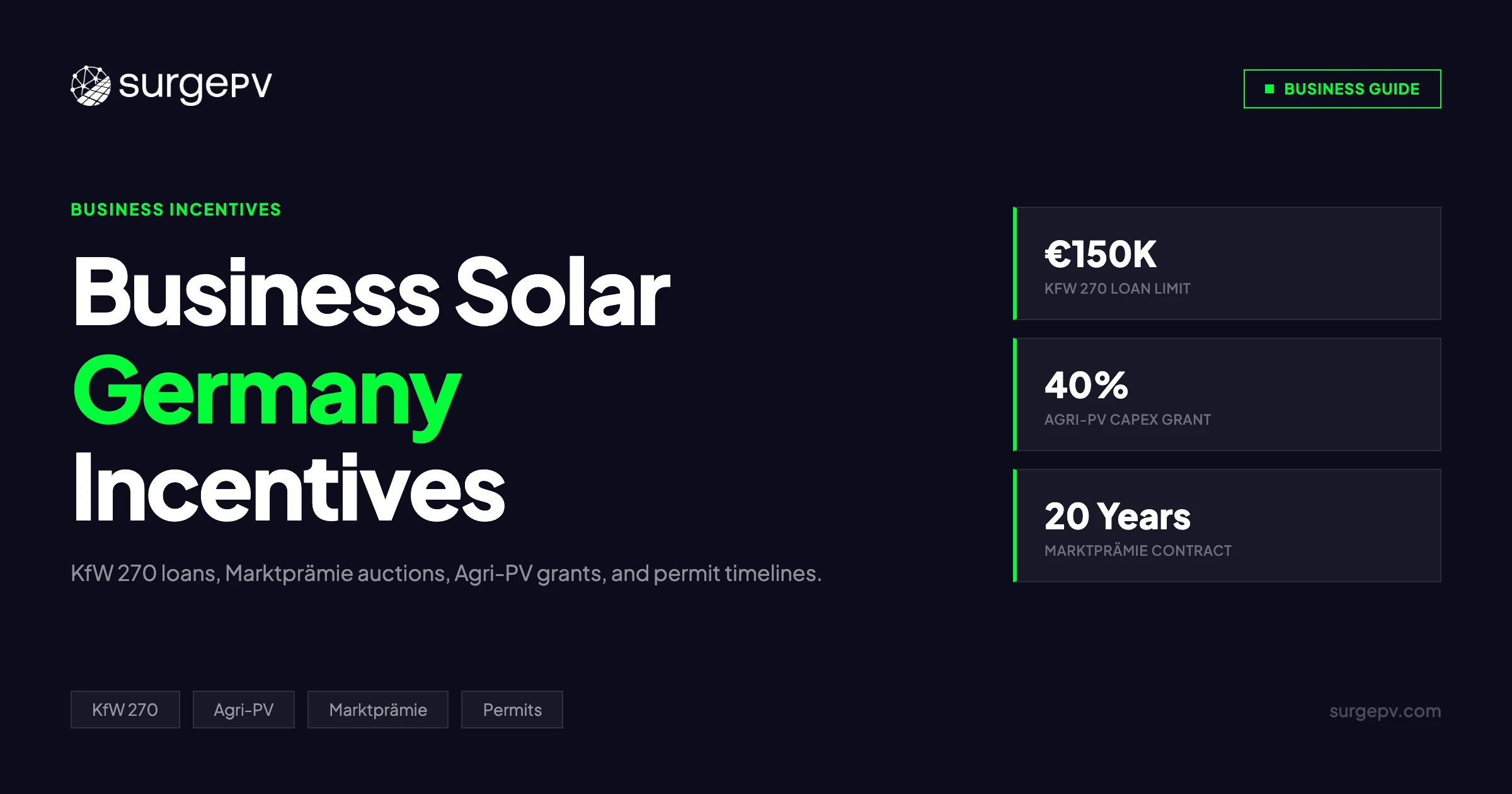
Active programs: KfW 270 low-interest loans (up to €150K per project), Marktprämie auction premiums (4.88–7.84 ct/kWh, 20-year contracts), Agri-PV CAPEX grants (up to 40%), BAFA investment grants (20–35%), §7g EStG accelerated depreciation (20% in year one), full VAT recovery. Permits range from 4–8 weeks for small rooftop to 18–36 months for ground-mount. All grant programs require pre-installation application — retroactive applications are voided.
In this guide:
- Latest 2026 status of every active commercial solar program in Germany
- KfW 270 commercial loan — terms, eligibility, and application process
- BAFA grants — what qualifies and how to apply
- Marktprämie auction system — how it works, bid strategy, 2026 tender results
- Agri-PV grants — 40% CAPEX, eligibility, and design requirements
- §7g EStG accelerated depreciation and VAT recovery — commercial tax benefits
- Permits and approvals — step-by-step timelines by project size (rooftop vs ground-mount)
- DSO grid connection coordination — the step businesses most often underestimate
- Commercial ROI examples with and without full incentive stack
Latest Updates: Germany Business Solar 2026
For commercial solar decision-makers, here is the current status of every relevant program as of March 2026.
Germany Commercial Solar Program Status — March 2026
| Program | Type | Status | Key Terms |
|---|---|---|---|
| KfW 270 Renewable Energies Loan | Loan | Active | Up to €150K, below-market rate, 5–20 yr |
| Marktprämie Q1 2026 Tender | Auction premium | Active | Q2 tender open; avg 6.12 ct/kWh rooftop |
| BAFA Energy Investment Grant | Direct grant | Active | 20–35% for solar + storage combinations |
| Agri-PV CAPEX Grant (EEG §36) | Direct grant | Active | Up to 40% eligible CAPEX |
| §7g EStG Accelerated Depreciation | Tax benefit | Active | Up to 20% in year one (legislative, no cap) |
| VAT Recovery (§15 UStG) | Tax benefit | Active | Full recovery for VAT-registered businesses |
| Bayern Mittelstand PV Program | State grant | Active | Up to €100K for SME commercial installs |
| NRW Progress.NRW Commercial | State grant | Active | 2026 allocation available |
| Solarpaket I implementation | Regulatory | In effect | Simplified permitting for rooftop < 30 kWp |
| Solarpaket II | Regulatory | In preparation | Energy community rules, expanded storage |
Key Changes Since 2025
- Solarpaket I (May 2024, fully in effect): Rooftop systems under 30 kWp are now exempt from building permit requirements at the federal level. Grid registration process simplified. Direct marketing obligation threshold reduced from 100 kWp to 400 W for balcony systems.
- KfW 270 rate adjustment (Q3 2025): KfW adjusted the interest rate corridor on Program 270 in September 2025. Current rates remain below market levels but are approximately 0.4 percentage points higher than the 2024 floor. Check kfw.de for current indicative rate.
- Marktprämie tender volumes: The Bundesnetzagentur increased the annual auction volume for rooftop commercial solar in 2026 from 1,800 MW to 2,400 MW in response to undersubscription in 2025 Q3–Q4 tenders.
- Agri-PV registry opened: The Bundesnetzagentur launched a dedicated Agri-PV project registry in January 2026 to streamline grant disbursement.
Key Takeaway — Tender Volume Increase
The expanded 2026 Marktprämie auction volume means more commercial rooftop projects will win contracts in 2026 than in recent years. Undersubscription in late 2025 tenders increased average awarded premiums slightly. The window to lock in a competitive long-term premium contract is currently favorable for well-prepared bidders.
KfW 270: Commercial Solar Loan Terms and Application
KfW Program 270 (Erneuerbare Energien Standard) is the primary federal financing vehicle for commercial solar installations in Germany. It is a loan program — not a grant — but its below-market interest rates and flexible terms make it a core component of most commercial project finance structures.
KfW 270 Commercial Loan Parameters
| Parameter | Detail |
|---|---|
| Maximum loan amount | €150,000 per project (higher amounts via KfW “large project” track) |
| Interest rate | Below market — check kfw.de for current corridor (indicative: 4.2–5.1% as of Q1 2026) |
| Repayment term | 5, 10, 15, or 20 years (borrower’s choice) |
| Repayment-free period | Up to 3 years (interest-only) |
| Eligible costs | PV system, battery storage, grid connection, planning and engineering fees |
| Eligible borrowers | Companies, freelancers, agricultural businesses, municipalities, nonprofits |
| Application route | Through a certified KfW partner bank — not directly through KfW |
| Combination | Can be combined with BAFA grants, Agri-PV grants, Bundesland programs |
| Application timing | Before project start — retroactive applications not accepted |
What KfW 270 Covers for Commercial Projects
KfW 270 covers the full cost chain for a commercial solar installation:
- Solar modules, inverters, mounting systems, and BOS components
- Battery storage systems (when paired with solar)
- Grid connection infrastructure (cables, meters, switchgear)
- Engineering, planning, and commissioning fees
- Monitoring and remote operations systems
- Initial operations and maintenance setup costs
One important distinction from the KfW 442 residential battery grant: KfW 270 is a loan, not a non-repayable grant. The financial benefit is the interest rate differential — typically 1.5–2.5 percentage points below equivalent commercial bank rates — which translates to €8,000–€22,000 in interest savings over a 10-year loan on a €150,000 project.
KfW 270 Application Process — Step by Step
Step 1 — Obtain certified installer quote with technical specification The quote must include system size (kWp), battery spec if applicable, component list, and total installed cost broken down by category. This document drives both the KfW application and any parallel BAFA or Bundesland grant submissions.
Step 2 — Approach a certified KfW partner bank KfW does not accept direct applications from businesses. You must apply through a KfW Hausbank (partner bank). Most major German banks — Sparkasse, Volksbank, Deutsche Bank, Commerzbank — are certified partners. Present the installer quote and business financial profile.
Step 3 — Bank forwards application to KfW The partner bank reviews the application and forwards it to KfW. The bank also assumes partial credit risk, which is why bank relationship quality affects processing speed. KfW processes commercial applications within 3–6 weeks of receipt.
Step 4 — KfW issues loan commitment Upon approval, KfW issues a Darlehenszusage (loan commitment) specifying amount, rate, and disbursement conditions. Do not begin installation until this is received.
Step 5 — Project execution and milestone disbursement For larger projects, KfW may disburse in tranches tied to construction milestones. Retain all invoices and commissioning documentation.
Step 6 — Final documentation and loan registration After commissioning, submit the Verwendungsnachweis (proof of use) to the bank, which forwards to KfW. This confirms the funds were used as intended.
Pro Tip — Run KfW and BAFA Applications in Parallel
KfW 270 and BAFA grants can be applied for simultaneously from the same installer quote documentation. Running them in parallel reduces total pre-approval timeline from 10–12 weeks to 6–8 weeks. The bank forwards the KfW application while you submit the BAFA application directly to bafa.de. Ensure the project description documents are identical — discrepancies between KfW and BAFA submissions trigger review delays.
For commercial projects where accurate system sizing directly affects financing amounts, solar design software ensures the kWp specification in your KfW application matches your actual project output projections.
BAFA Grants for Commercial Solar in Germany
The Federal Office for Economic Affairs and Export Control (BAFA — Bundesamt für Wirtschaft und Ausfuhrkontrolle) administers direct investment grants for commercial energy efficiency and renewable energy projects. For commercial solar, the most relevant programs are the Energy Efficiency in Business (Bundesförderung für Energie- und Ressourceneffizienz in der Wirtschaft — EEW) and the Federal Funding for Efficient Buildings (BEG) for commercial properties.
BAFA Solar Grant Parameters
| Parameter | Detail |
|---|---|
| Eligible project types | Solar PV paired with battery storage, heat pump, or EV charging infrastructure |
| Grant rate | 20–35% of eligible project costs (rate depends on company size and project type) |
| Maximum grant (SME) | Up to €200,000 per project in some program tracks |
| Eligible businesses | All VAT-registered businesses operating in Germany |
| Application portal | bafa.de — online application required |
| Application timing | Before project start (Antragstellung vor Vorhabenbeginn) — mandatory |
| Processing time | 4–8 weeks for standard applications |
BAFA Eligibility Rules
BAFA commercial solar grants have specific combination requirements. A standalone rooftop PV system without storage or other energy system integration does not qualify for BAFA investment grants — it qualifies for KfW 270 and Marktprämie only. The BAFA programs target combined energy systems:
- Solar + battery storage: Qualifies for EEW grant track, typically 20–25% of combined system cost
- Solar + heat pump: Qualifies for BEG commercial track, up to 35% for new buildings or major renovations
- Solar + EV charging infrastructure: Qualifies for combined mobility and energy grants
For large industrial projects, BAFA also administers the “Transformation of Industrial Processes” program, which can fund solar as part of broader decarbonization investment programs.
BAFA Application Process
Step 1 — Energy audit (required for projects above €50,000 eligible cost) A certified energy auditor must confirm the project’s energy savings potential before BAFA application. The audit report is attached to the grant application. Audit costs are themselves partially reimbursable.
Step 2 — Online pre-application at bafa.de Register on the BAFA portal and submit the Antrag (application) including installer quote, audit report, company details, and VAT registration. BAFA issues a provisional confirmation within 2–3 days — this is the formal “green light” to proceed with planning but not installation.
Step 3 — Await BAFA grant approval Full approval takes 4–8 weeks. BAFA may request clarification documents. Do not order equipment or begin installation before receiving the Zuwendungsbescheid (grant award notice).
Step 4 — Project execution Proceed with installation after grant award. Retain all original invoices — photocopies are not accepted.
Step 5 — Proof of completion (Verwendungsnachweis) Submit the completion report, original invoices, and commissioning documentation via the BAFA portal within the deadline specified in the grant award (typically 12–18 months from award date). Grant disbursement follows within 4–6 weeks of accepted completion proof.
Marktprämie Auction System for Commercial Solar
The Marktprämie (market premium) is the central commercial solar support mechanism in Germany for projects above 100 kWp. Unlike residential feed-in tariffs, Marktprämie is awarded through competitive quarterly auctions administered by the Bundesnetzagentur.
For any commercial project above 100 kWp, understanding how bids are priced, what drives awarded premiums, and how the 20-year contract is structured is a prerequisite.
How the Marktprämie Works
The Marktprämie operates as a Contract for Difference (CfD) mechanism:
- Developers submit bids in Bundesnetzagentur tenders specifying the minimum premium (in ct/kWh) they require above the monthly average wholesale market price (Monatsmarktwert)
- Bids are ranked from lowest to highest. The tender closes when the total awarded volume reaches the tender cap
- Winning bidders receive the highest accepted bid price (pay-as-cleared auction) — not their individual bid price
- The awarded premium is paid for every kWh generated over a 20-year contract period, on top of the market price the generator receives for selling electricity
The result: a Marktprämie winner receives two revenue streams — the spot market electricity price (variable) plus the fixed Marktprämie premium (constant). This structure makes project revenue largely predictable over 20 years, which is why Marktprämie contracts serve as collateral in commercial project finance.
2025–2026 Marktprämie Results
| Auction Category | Tender Volume (2026) | Avg Awarded Premium | Contract Term |
|---|---|---|---|
| Ground-mounted (< 750 kWp) | 800 MW/quarter | 5.21 ct/kWh | 20 years |
| Commercial rooftop (100–750 kWp) | 600 MW/quarter | 6.73 ct/kWh | 20 years |
| Agri-PV | 200 MW/quarter | 7.84 ct/kWh | 20 years |
| Large ground-mount (> 750 kWp) | 500 MW/quarter | 4.88 ct/kWh | 20 years |
| Innovation auction (floating, BIPV) | 50 MW/quarter | 9.10 ct/kWh | 20 years |
Source: Bundesnetzagentur tender results, 2025–2026 average. Premiums vary by quarter.
Marktprämie Bidding Strategy
The difference between winning a Marktprämie auction and locking in an uneconomic contract for 20 years comes down to accurate project modeling. Bid too high and you lose the tender. Bid too low and the contract is unworkable.
The winning bid price is driven by your actual project economics:
- Total installed cost (€/kWp): Lower costs allow lower bids
- Annual yield (MWh/year): Higher yield improves revenue per unit of capital
- Financing costs (KfW 270 rate): Lower debt service reduces required premium
- Operations and maintenance costs: Ongoing costs must be recovered from the premium
- Target IRR: Internal rate of return requirements determine the floor bid price
For large commercial bids, accurate annual yield modeling from solar design software is a prerequisite for competitive tendering. A 5% error in projected annual yield translates directly to a 5% mispricing of the minimum viable bid.
Systems Below 100 kWp — EEG Feed-in Tariffs Apply
Commercial systems below 100 kWp are not subject to competitive bidding. They receive EEG feed-in tariffs automatically upon MaStR registration, at the same rates available to residential systems:
| System Size | Partial Export Rate | Full Export Rate |
|---|---|---|
| Up to 10 kWp | 8.11 ct/kWh | 12.87 ct/kWh |
| 10–40 kWp | 7.03 ct/kWh | 10.79 ct/kWh |
| 40–100 kWp | 5.74 ct/kWh | — |
These rates are locked in for 20 years at MaStR registration and decline approximately 1% every 6 months. For commercial systems in the 40–100 kWp range, the self-consumption value often exceeds the feed-in rate by 4–5x — making system sizing for maximum self-consumption the priority over maximizing export.
Key Takeaway — 100 kWp Threshold
The 100 kWp threshold separates the fixed-rate EEG world from the competitive Marktprämie auction world. For commercial projects close to this boundary, a deliberate sizing decision matters. A 95 kWp system receives automatic EEG tariffs with no bidding risk. A 105 kWp system must enter competitive tender — but gains access to the higher volumes and 20-year premium contract structure that commercial lenders prefer.
Agri-PV Grants: 40% CAPEX Support for Dual-Use Agriculture
Agri-PV (agrivoltaic) systems — solar panels installed over or alongside active agricultural land — receive the most generous direct CAPEX grant in Germany’s commercial solar support framework. The program reflects the government’s goal of increasing solar deployment without reducing agricultural production.
Agri-PV Grant Structure
| Parameter | Detail |
|---|---|
| CAPEX grant rate | Up to 40% of eligible installation costs |
| Maximum grant | No fixed cap per project (volume-limited by annual program budget) |
| Eligible structures | Elevated arrays over crops, vertical east-west bifacial systems, greenhouse-integrated PV |
| Agricultural requirement | Land must remain in active agricultural use during and after installation |
| Minimum system size | 100 kWp (to access dedicated Agri-PV Marktprämie track) |
| Marktprämie bonus | +€0.01–0.02/kWh above standard ground-mount rate |
| Application route | Via Bundesnetzagentur Agri-PV registry + BAFA grant application |
| Processing time | 8–16 weeks (combined registry + grant approval) |
Eligible Agricultural Applications
Germany’s Agri-PV program accepts a wide range of dual-use configurations:
- Permanent crops: Vineyards, orchards, berry bushes — panels mounted on elevated structure above crop rows
- Arable land: Raised panel rows with crop cultivation between support columns
- Livestock grazing: Ground-level panels with sheep or goat grazing underneath
- Horticulture: Greenhouse-integrated systems where panels replace conventional glazing
- Irrigation zones: Panels providing shade reduction over water-intensive crops
To qualify, the agricultural yield from the land must remain above 66% of the pre-installation baseline. This is measured over a rolling 3-year average from the installation year. Projects must demonstrate this through an agricultural assessment submitted with the grant application.
Agri-PV Design Considerations
Agri-PV installations present shading and energy yield modeling challenges that differ significantly from conventional rooftop or ground-mount projects. Panel rows are typically elevated 3–5 meters, oriented for minimal crop shading rather than maximum yield, and often bifacial — capturing reflected light from the ground.
Solar shadow analysis software is critical for Agri-PV design because crop shading impact and panel shading losses must be modeled simultaneously. Incorrect shading analysis in an Agri-PV tender bid affects both the Marktprämie bid price and the BAFA grant eligibility assessment.
Pro Tip — Vertical East-West Bifacial Arrays
Vertical bifacial panel arrays oriented east-west receive priority status under EEG 2023 and qualify for the full Agri-PV Marktprämie premium. They produce two yield peaks per day (morning and evening), aligning with grid demand patterns and improving self-consumption for farm operations. They also have the lowest crop shading impact of any Agri-PV configuration. For agricultural businesses with existing electricity demand, this configuration often yields the best combined economics.
Tax Benefits for Commercial Solar in Germany
Tax benefits are the most underused component of Germany’s commercial solar incentive stack. Unlike grants or loans, they require no separate application and no pre-installation registration — but they are only available to businesses with taxable income and proper bookkeeping.
§7g EStG: Accelerated Depreciation (Investitionsabzugsbetrag and Sonderabschreibung)
Germany’s Income Tax Act (Einkommensteuergesetz) provides two overlapping mechanisms for accelerated depreciation of solar installations:
Investitionsabzugsbetrag (IAB) — Investment Deduction
- Businesses can deduct up to 50% of the planned investment from taxable income in the year before purchase
- Maximum deduction: €200,000 per year
- Must be used within 3 years (investment must follow the deduction)
- Eligible for all businesses with annual profit below €200,000
Sonderabschreibung (§7g Abs. 5 EStG) — Special Depreciation
- On top of standard straight-line depreciation, an additional 20% of the acquisition cost can be deducted in the year of purchase
- Available for businesses meeting the same profit threshold
- Can be combined with IAB — the two mechanisms together can offset 60–70% of a solar investment in the first two years
Standard straight-line depreciation for solar PV systems runs over 20 years (5% per year). The §7g mechanisms front-load this significantly.
Commercial Tax Benefit Calculation — 250 kWp Rooftop Example
| Year | Depreciation Mechanism | Cost Offset | Tax Saving (30% rate) |
|---|---|---|---|
| Year -1 | IAB (50% of planned investment) | €112,500 | €33,750 |
| Year 1 | Sonderabschreibung (20%) + standard (5%) | €56,250 | €16,875 |
| Year 2–20 | Standard straight-line (5%/year) | €11,250/yr | €3,375/yr |
Based on €225,000 total investment (250 kWp at €900/kWp). Tax rate 30% (combined Körperschaftsteuer + Gewerbesteuer).
Over the first two years, a business can claim tax savings of €50,625 — 22.5% of the total investment — through depreciation alone. This is in addition to VAT recovery and any grants received.
VAT Recovery (§15 UStG)
VAT-registered businesses can reclaim 19% VAT on all solar installation costs. This is not a grant — it is a VAT input tax credit applied against the business’s regular VAT return.
| Cost Component | VAT Rate | Recovery per €100K Cost |
|---|---|---|
| Solar modules | 19% | €15,966 |
| Inverters and electrical | 19% | €15,966 |
| Mounting and installation labor | 19% | €15,966 |
| Engineering and planning fees | 19% | €15,966 |
| Total recovery on €400K project | €63,866 |
VAT recovery is claimed in the normal monthly or quarterly VAT return. For large projects, a monthly VAT return cycle (instead of quarterly) accelerates the cash recovery by 2–6 months, which is relevant for project cash flow management.
Key Takeaway — VAT Recovery Timeline
On a €400,000 commercial installation, VAT recovery alone returns €63,866 to the business. For businesses filing monthly VAT returns, this recovery arrives within 4–6 weeks of invoice payment. For quarterly filers, it may take up to 4 months. For large projects, switching to monthly filing during the installation year materially improves project cash flow.
Trade Tax Exemption (Gewerbesteuer)
Commercial solar systems with capacity under 10 MW used primarily for self-consumption are exempt from trade tax (Gewerbesteuer) on the solar income component. This exemption applies when the solar operation is ancillary to the main business activity — the typical case for commercial rooftop installations on warehouses, factories, or retail properties.
Permits and Approvals for Commercial Solar in Germany: Step-by-Step Timeline by Project Size
The permit and approval process is consistently what businesses underestimate most when planning commercial solar projects in Germany. Timeline varies significantly by project size, mounting type, and DSO grid capacity constraints.
This section provides a complete step-by-step breakdown of the permit process for each commercial project category, with realistic timelines based on current DSO and planning authority processing speeds.
Category 1: Rooftop Systems Under 30 kWp (Simplified Process)
Following Solarpaket I, rooftop systems under 30 kWp on existing commercial buildings no longer require a building permit at the federal level. Individual states may impose additional requirements — check Bundesland-specific rules before assuming exemption.
| Step | Action | Responsible Party | Timeline |
|---|---|---|---|
| 1 | MaStR pre-registration | System owner | 1–2 days |
| 2 | Grid connection request (Netzanschlussbegehren) to DSO | Installer on behalf of owner | Submit day 1 |
| 3 | DSO grid compatibility check | DSO | 2–4 weeks |
| 4 | DSO connection confirmation | DSO | 1–2 weeks |
| 5 | Installation | Certified installer | 1–5 days |
| 6 | Meter installation/configuration | DSO / metering operator | 2–4 weeks |
| 7 | MaStR final registration | System owner | Within 1 month of commissioning |
| 8 | EEG contract / MaStR confirmation | Grid operator / Bundesnetzagentur | 2–4 weeks |
| Total timeline | 6–10 weeks |
Documents required: Installer quote and technical spec, electrical commissioning certificate, building ownership proof or lease agreement confirming installation rights.
Category 2: Commercial Rooftop 30 kWp – 750 kWp (Standard Process)
This is the most common category for commercial solar in Germany — warehouses, logistics centers, factories, supermarkets, and office buildings. Systems in this range require a building permit and a DSO grid study.
| Step | Action | Responsible Party | Timeline |
|---|---|---|---|
| 1 | Structural assessment of roof | Structural engineer | 2–4 weeks |
| 2 | Preliminary planning approval inquiry (Bauvoranfrage) | Installer or owner | 2–4 weeks |
| 3 | Building permit application (Baugenehmigung) | Owner / architect | Submit after Bauvoranfrage |
| 4 | Building permit processing | Local Bauamt | 4–12 weeks |
| 5 | Grid connection request to DSO (Netzanschlussbegehren) | Installer | Submit at Step 3 (parallel) |
| 6 | DSO grid study (Netzverträglichkeitsprüfung) | DSO | 6–16 weeks |
| 7 | Grid reinforcement agreement (if required) | DSO + owner | 2–6 weeks |
| 8 | MaStR pre-registration | System owner | Before installation |
| 9 | Installation | Certified EPC | 2–6 weeks |
| 10 | Commissioning inspection and sign-off | Certified electrician + DSO | 1–2 weeks |
| 11 | Meter configuration and EEG contract | DSO / grid operator | 2–4 weeks |
| 12 | MaStR final registration | System owner | Within 1 month |
| Total timeline | 4–7 months |
Critical path item: The DSO grid study (Step 6) is typically the longest single step and cannot be shortened. Start the DSO process on the same day you submit the building permit application. DSOs that identify grid reinforcement needs add another 2–6 months to the timeline.
Documents required: Structural engineer’s roof assessment, electrical single-line diagram, technical specification of inverter (grid codes), building permit application package, proof of land/building ownership or lease.
Pro Tip — Submit DSO Request Before Building Permit
Many commercial project timelines are delayed because owners wait for building permit approval before contacting the DSO. In practice, the DSO grid study can be initiated with a preliminary project description before the building permit is issued. Starting the DSO process 4–6 weeks earlier compresses the overall approval timeline by the same amount. Experienced EPCs always initiate DSO contact at the earliest planning stage.
Category 3: Ground-Mounted Systems 750 kWp – 10 MW (Complex Process)
Ground-mounted commercial systems require a formal planning process (Bauleitplanverfahren) in addition to all Category 2 requirements. This involves local authority participation, public consultation, and in most cases a change to the municipal development plan (Bebauungsplan).
| Step | Action | Responsible Party | Timeline |
|---|---|---|---|
| 1 | Site feasibility assessment (zoning, grid, agricultural impact) | Developer | 1–2 months |
| 2 | Municipal pre-consultation (Voranfrage) | Developer | 1–2 months |
| 3 | Development plan change initiation (Bebauungsplan Änderung) | Municipality | Municipality decision |
| 4 | Scoping report (Scopingbericht) for environmental assessment | Developer + authority | 2–3 months |
| 5 | Environmental impact assessment (Umweltprüfung) | Licensed assessor | 3–6 months |
| 6 | Public consultation period (Öffentlichkeitsbeteiligung) | Municipality | 1 month (minimum) |
| 7 | Final development plan approval | Local council | 2–4 months |
| 8 | Grid connection request and network planning study | DSO / transmission operator | 4–12 months |
| 9 | Grid reinforcement (if required) | DSO | 6–24 months |
| 10 | Building permit | Bauamt | 2–4 months |
| 11 | Marktprämie tender participation | Bundesnetzagentur | Quarterly window |
| 12 | Installation | EPC | 2–6 months |
| 13 | Commissioning, metering, MaStR registration | EPC + DSO | 1–2 months |
| Total timeline | 18–36 months |
Critical consideration: Grid connection for systems in this category often requires distribution grid reinforcement by the DSO or, for projects above 3–5 MW, transmission grid studies by the regional TSO. This step is both the longest and the least controllable from the developer’s side. Select sites with confirmed grid capacity before committing to project development costs.
Category 4: Large Ground-Mount and Utility-Scale (> 10 MW)
Projects above 10 MW follow the same process as Category 3 but with additional federal and EU-level requirements. EIA (Umweltverträglichkeitsprüfung) under § 3b UVPG becomes mandatory. Grid connection studies involve the Übertragungsnetzbetreiber (TSO). Marktprämie auction participation is required.
Realistic timeline: 24–48 months from site identification to commissioning.
At this scale, the generation financial tool integrated with bankable yield modeling and subsidy scenario modeling is the analytical infrastructure that supports investor-grade project documentation.
DSO Grid Connection: The Bottleneck
Across all project categories, grid connection is the most common source of timeline overruns in German commercial solar projects.
| DSO Process Step | Common Issue | Mitigation |
|---|---|---|
| Grid connection request (Netzanschlussbegehren) | DSO response time varies 2–16 weeks | Submit as early as possible, before other permits |
| Grid compatibility study (Netzverträglichkeitsprüfung) | Underestimated demand on local network | Choose sites with known grid headroom |
| Grid reinforcement agreement | Cost allocation disputes | Negotiate early; understand §17 EnWG cost rules |
| Metering point assignment | Registry backlog | Apply to metering operator immediately after DSO confirmation |
| Meter installation | Metering operator scheduling | Schedule independently from DSO timeline |
Key Takeaway — Grid Connection Drives the Timeline
For commercial rooftop projects (30–750 kWp), DSO grid studies take 6–16 weeks and cannot be expedited. For ground-mount projects above 750 kWp, grid reinforcement can add 6–24 months. The decisive factor in commercial solar project development speed in Germany is not the building permit — it is the DSO grid capacity at the target site. Always begin DSO engagement before finalizing site selection.
Commercial Solar Financing Models in Germany
Beyond KfW 270 and grants, commercial solar projects in Germany use several additional financing structures depending on project size and business profile.
Project Finance for Marktprämie Projects
For projects above 500 kWp that have won a Marktprämie contract, full project finance structures are available through specialized renewable energy lenders. The 20-year Marktprämie contract serves as collateral, enabling non-recourse or limited-recourse financing where the debt service is secured against project cash flows.
Typical project finance terms for a 1 MW+ Marktprämie rooftop project in Germany:
| Term | Typical Range |
|---|---|
| Debt/equity ratio | 70:30 to 80:20 |
| Loan tenor | 15–18 years |
| Interest rate | 3.8–5.2% (as of Q1 2026) |
| Debt service cover ratio (DSCR) | 1.25–1.35 minimum |
| Security | Assignment of Marktprämie contract + project asset charge |
Solar Leasing for SMEs
For SMEs that prefer off-balance-sheet financing and minimal upfront cost, solar leasing removes capital requirements entirely. A third-party investor owns and maintains the installation; the business pays monthly lease fees based on the system’s capacity.
Typical SME commercial lease terms in Germany:
- Monthly lease: €60–€120 per kWp of installed capacity
- Contract term: 10–20 years
- Maintenance: included in lease fee
- Grid revenue: retained by system owner (leasing company) or split with host business
- End-of-term: purchase option at residual value or system removal
Power Purchase Agreements (PPAs) for Commercial Buyers
Corporate PPAs allow businesses to purchase electricity from a solar system at a fixed per-kWh rate, typically below grid retail tariffs, without owning the system. The solar developer or utility retains system ownership and sells the electricity under contract.
German corporate PPA market 2026:
- On-site PPA: Developer installs on business roof/land; business purchases all production at fixed rate (typically €0.08–0.12/kWh, vs €0.25–0.30/kWh grid retail for commercial users)
- Virtual/financial PPA: Off-site system; financial settlement mechanism (common for large corporate buyers above 2 MW)
- Contract term: 10–20 years
- Upfront cost to buyer: None
PPAs are increasingly popular with logistics, manufacturing, and food processing companies with large, stable electricity demands. For solar proposal software workflows, PPA structures require energy generation and financial modeling that goes beyond simple ROI payback — they require contract price discovery against wholesale market projections.
State-Level (Bundesland) Commercial Solar Programs 2026
Bundesland programs add significant direct grant funding on top of federal incentives. For commercial projects, state programs are particularly valuable because they often have higher per-project caps than residential equivalents.
Active Commercial Bundesland Programs 2026
| State | Program | Commercial Grant Amount | Status |
|---|---|---|---|
| Bavaria | Bayern Mittelstand PV Program | Up to €100,000 for SME commercial installations | Active |
| NRW | Progress.NRW Renewable Energy | €50–€150K for commercial rooftop and storage | Active — 2026 allocation available |
| Baden-Württemberg | L-Bank Green Economy Loan | Low-interest commercial loans (below KfW rates in some tranches) | Ongoing |
| Berlin | Berlin Solar PLUS (commercial track) | €500/kWp up to 100 kWp | Active — limited |
| Saxony | SAB energy grants | Up to €200K for industrial solar + storage | Periodic — check status |
| Hamburg | HWF business solar program | €20,000–€80,000 for Hamburg-based commercial projects | Active |
| Thuringia | EFRE Renewable Energy | Up to €200K (EU structural funds) | Periodic |
Subsidy Stacking for Commercial Projects — Bavaria SME Example
| Incentive Layer | Type | Value (250 kWp project, €225K installed cost) |
|---|---|---|
| KfW 270 loan | Below-market financing | ~€18,000 in interest savings (10yr) |
| BAFA grant (solar + storage) | Direct grant | €45,000–€56,000 (20–25%) |
| Bayern Mittelstand PV Program | Direct grant | €100,000 (state cap) |
| §7g EStG (IAB + Sonderabschreibung) | Tax benefit (year 0–1) | ~€50,000 |
| VAT recovery | Tax credit | €42,750 |
| Marktprämie (20 yr, 6.73 ct/kWh) | Revenue contract | ~€265,000 cumulative (present value) |
| Total incentive value | ~€520,750 |
Against a gross project cost of €225,000, the 20-year NPV of combined incentives significantly exceeds the initial investment — the project returns its capital primarily from the Marktprämie stream, with direct grants and tax benefits substantially reducing or eliminating effective net cost in years 0–2.
Pro Tip — Bundesland Programs Exhaust Mid-Year
State commercial solar programs operate on annual budget allocations and are first-come, first-served. The Bayern Mittelstand PV Program and NRW Progress.NRW commercial tracks have historically exhausted available funds by Q2–Q3. Submit applications in January–February for the highest probability of receiving full allocated amounts. Applications after budget exhaustion are waitlisted for the next budget year.
Model Germany Commercial Solar Projects With Full Incentive Stack
SurgePV’s generation and financial tool models KfW 270, Marktprämie auction premiums, Agri-PV grants, and §7g depreciation in a single bankable financial model — so you deliver accurate ROI to commercial clients at the proposal stage.
Book a DemoNo commitment required · 20 minutes · Live project walkthrough
Commercial Solar ROI Examples: Germany 2026
Example 1: 250 kWp Logistics Rooftop — Bavaria (Marktprämie + Full Stack)
| Without Incentives | With Full Incentive Stack | |
|---|---|---|
| Gross installed cost | €225,000 | €225,000 |
| BAFA grant (22%) | — | −€49,500 |
| Bayern Mittelstand PV grant | — | −€100,000 |
| VAT recovery | — | −€42,750 |
| §7g depreciation tax benefit (yr 0–1) | — | −€50,000 |
| Net effective investment | €225,000 | −€17,250 |
| Annual electricity savings (self-consumption) | €28,500 | €28,500 |
| Annual Marktprämie income | €16,800 | €16,800 |
| Annual operations and maintenance | −€4,500 | −€4,500 |
| Net annual benefit | €40,800 | €40,800 |
| Simple payback (undiscounted) | 5.5 years | <1 year |
The full incentive stack — particularly the combination of BAFA grant, Bayern state grant, and tax benefits in year 0–1 — creates a near-zero net investment for a well-structured Bavaria commercial project. The Marktprämie stream then functions as a 20-year annuity on essentially zero residual capital.
Example 2: 500 kWp Industrial Rooftop — NRW (Project Finance)
| Parameter | Value |
|---|---|
| Installed cost | €415,000 (€830/kWp) |
| KfW 270 (€150K) + commercial bank (€180K) | €330,000 debt (80% LTV) |
| BAFA grant | €83,000 (20%) |
| NRW Progress.NRW grant | €75,000 (state cap) |
| VAT recovery | €78,850 |
| §7g year-1 tax benefit | €45,000 |
| Net equity requirement | ~€0 (grants + tax > equity share) |
| Annual debt service (10yr, 4.5%) | €41,200 |
| Annual electricity savings | €57,500 |
| Annual Marktprämie (6.73 ct/kWh, 20yr) | €30,200 |
| Annual net cash flow (after debt service) | €46,500 |
| Unlevered project IRR | ~18% |
At this scale, using solar software that produces bankable yield and financial models is what differentiates proposals that get financed from those that stall in bank credit committees.
Example 3: 150 kWp Agri-PV — Lower Saxony (Agri-PV Premium + CAPEX Grant)
| Parameter | Value |
|---|---|
| Installed cost (elevated structure) | €280,000 (€1,867/kWp) |
| Agri-PV CAPEX grant (40%) | −€112,000 |
| VAT recovery | −€53,200 |
| Net effective investment | €114,800 |
| Annual Marktprämie (Agri-PV rate, 7.84 ct/kWh) | €19,800 |
| Annual farm electricity savings | €18,200 |
| Total annual benefit | €38,000 |
| Simple payback | 3.0 years |
Agri-PV delivers the fastest payback in Germany’s commercial solar sector when the full grant stack is captured. The elevated structure cost premium over conventional ground-mount (approximately €400–600/kWp) is entirely offset by the 40% CAPEX grant and the Agri-PV Marktprämie bonus.
How to Access Commercial Solar Incentives: Application Checklist
Document Checklist for Commercial Solar Applications
| Document | Required For | Notes |
|---|---|---|
| Technical system specification | KfW 270, BAFA, permits, MaStR | Must include kWp, panel model, inverter, mounting type |
| Installer quote (certified EPC) | All applications | Must be from a certified (ZVEH/ZVSHK) installer |
| Structural engineer’s roof assessment | Building permits > 30 kWp | Required before building permit submission |
| Energy audit report | BAFA grants > €50K eligible cost | Must be from BfEE-listed auditor |
| Business registration (Gewerbeanmeldung) | KfW 270, BAFA, state grants | Current extract from Handelsregister |
| VAT registration confirmation | VAT recovery | USt-IdNr. required |
| Building ownership proof or lease | Permits, KfW | Grundbuchauszug or lease agreement |
| Grid connection request acknowledgment | MaStR registration | DSO confirmation number |
| MaStR pre-registration confirmation | EEG tariff, Marktprämie | Required before commissioning |
| Commissioning certificate | All post-installation claims | Signed by certified electrician |
Common Commercial Application Errors
| Error | Programs Affected | Consequence | Prevention |
|---|---|---|---|
| Installation before grant approval | BAFA, Bundesland grants | Grant voided — no exceptions | Apply and await Zuwendungsbescheid before ordering equipment |
| Missing energy audit for BAFA | BAFA (>€50K projects) | Application rejected | Commission BfEE auditor before application |
| Wrong MaStR category | EEG tariffs, Marktprämie | Incorrect tariff assignment | Verify category with installer before registration |
| DSO contact delayed | All permit categories | Timeline overrun by months | Contact DSO on project initiation day |
| KfW application via wrong channel | KfW 270 | Application rejected | Apply only through certified Hausbank |
| Late MaStR registration | EEG feed-in income | Loss of tariff income from missed registration days | Register within 30 days of commissioning — no exceptions |
Conclusion
Germany’s commercial solar incentive framework in 2026 rewards businesses that plan their incentive stack before breaking ground. The difference between a commercial project that captures the full stack — KfW 270 financing, BAFA grant, state program, §7g accelerated depreciation, VAT recovery, and a Marktprämie contract — and one that misses two or three of those channels is not incremental. In the Bavaria logistics example above, it is the difference between a 5.5-year payback and an effectively capital-free installation.
The permit process is equally decisive. DSO grid connection is the longest and least controllable step in every commercial project category above 30 kWp. Starting DSO engagement at project initiation — not after building permit approval — is the most impactful single action any commercial solar developer can take to compress timelines.
For EPCs and solar installers serving commercial clients in Germany, delivering accurate subsidy modeling in proposals is a competitive differentiator. Using solar design software that integrates financial modeling with accurate irradiance and yield data ensures that the ROI you present to clients holds up under scrutiny — from bank credit committees, BAFA reviewers, and Bundesnetzagentur tender assessors alike.
Three most time-sensitive actions for commercial solar in Germany in 2026:
- Initiate DSO grid connection request on project initiation day — this step has the longest fixed processing time and cannot be shortened
- Apply for BAFA and Bundesland grants before any equipment is ordered — retroactive applications are automatically voided with no exceptions
- Submit Marktprämie bid in Q2 2026 — expanded tender volumes and slightly higher awarded premiums make this the most favorable commercial bidding environment in two years
For the residential subsidy picture alongside commercial programs, see our Germany solar subsidies overview. For the broader European context, see our guides to European solar incentives and EU solar energy policies.
Frequently Asked Questions
What business solar incentives are available in Germany in 2026?
Germany’s active commercial incentives include KfW 270 low-interest loans (up to €150K), Marktprämie auction premiums (4.88–7.84 ct/kWh for 20 years), Agri-PV CAPEX grants (up to 40%), BAFA investment grants (20–35% for solar with storage), §7g EStG accelerated depreciation (20% in year one), full VAT recovery for registered businesses, and state programs including Bayern Mittelstand PV (up to €100K) and NRW Progress.NRW (up to €150K). Total incentive value for a well-structured Bavaria commercial project can exceed the gross installation cost over the 20-year Marktprämie contract period.
What are the government subsidies for solar in Germany for businesses?
Federal government subsidies for commercial solar: EEG Marktprämie (competitive auction, 20-year contract), KfW 270 (below-market loan, up to €150K), BAFA grants (direct investment grants 20–35% for solar + storage combinations), Agri-PV CAPEX grants (up to 40%). State-level subsidies add €50,000–€200,000 for qualifying commercial projects depending on the Bundesland. All direct grants require pre-installation application — projects that begin before grant approval are ineligible.
How does solar financing work for businesses in Germany?
Commercial solar financing uses KfW 270 loans as the primary debt vehicle, supplemented by BAFA and state grants as equity reduction. Large projects with Marktprämie contracts access project finance structures (70–80% LTV) where the 20-year contract is collateral. SMEs often use solar leasing or PPA structures to avoid balance sheet impact. Tax benefits — §7g accelerated depreciation and 19% VAT recovery — are captured through standard tax returns rather than grant applications.
What permits and approvals are required for commercial solar in Germany?
Under 30 kWp rooftop: grid connection registration only (6–10 weeks total). 30–750 kWp rooftop: building permit plus DSO grid study (4–7 months). 750 kWp–10 MW ground-mount: development plan change, environmental assessment, grid reinforcement (18–36 months). Above 10 MW: federal EIA, TSO grid study, full public consultation (24–48 months). DSO grid connection is the critical path item in every category — initiate it before submitting any other permit application.
What is the Marktprämie auction system for commercial solar in Germany?
The Marktprämie is a competitive auction where developers bid the minimum premium (in ct/kWh) they require above wholesale market prices. Quarterly Bundesnetzagentur tenders award 20-year contracts to the lowest-cost bids. Winners receive the clearing price (highest accepted bid), not their individual bid. Average awarded premiums in 2026 range from 4.88 ct/kWh for large ground-mount to 7.84 ct/kWh for Agri-PV. Systems under 100 kWp receive automatic EEG feed-in tariffs without bidding.
What is the KfW 270 commercial solar loan?
KfW 270 provides below-market-rate loans up to €150,000 per project for commercial renewable energy installations, including solar PV, battery storage, and grid connection. Terms are 5–20 years with up to 3 repayment-free years. Applications must go through a certified KfW Hausbank — not directly through KfW. The loan can be combined with BAFA grants and Bundesland programs. Apply before project start; retroactive applications are rejected.
Are there solar energy grants in Germany for commercial projects?
Yes: BAFA grants (20–35% for solar + storage), Agri-PV CAPEX grants (up to 40%), and multiple Bundesland programs providing €50,000–€200,000 for qualifying commercial installations. Grant applications must be submitted and approved before any equipment is ordered. BAFA applications above €50,000 require a certified energy audit as part of the submission package.
How long does the commercial solar permit process take in Germany?
Rooftop under 30 kWp: 6–10 weeks. Rooftop 30–750 kWp: 4–7 months. Ground-mount 750 kWp–10 MW: 18–36 months. Above 10 MW: 24–48 months. The most common cause of overruns is delayed DSO contact — most developers contact the grid operator too late in the process. Starting DSO engagement at project initiation, before building permit submission, compresses total timelines by 2–4 months in the 30–750 kWp category.