
European solar installers operate in one of the most demanding regulatory environments in the world. A residential PV system designed for Bavaria must respect VDE-AR-N 4105 grid connection rules, MBO fire pathway requirements, and Bayerische Netzgesellschaft metering standards — none of which apply to a system in Andalusia or Lombardy. Generic CAD tools and US-market software have no concept of these distinctions. That mismatch is costing European EPCs permits, redesigns, and client proposals.
This guide covers every major consideration for choosing solar pv design software in the European context: what standards matter, which tools actually support them, and why purpose-built solar design software consistently outperforms adapted CAD platforms. SurgePV is the benchmark throughout — not because it’s the only option, but because it’s the only platform that handles the full European workflow from site survey to signed contract.
TL;DR
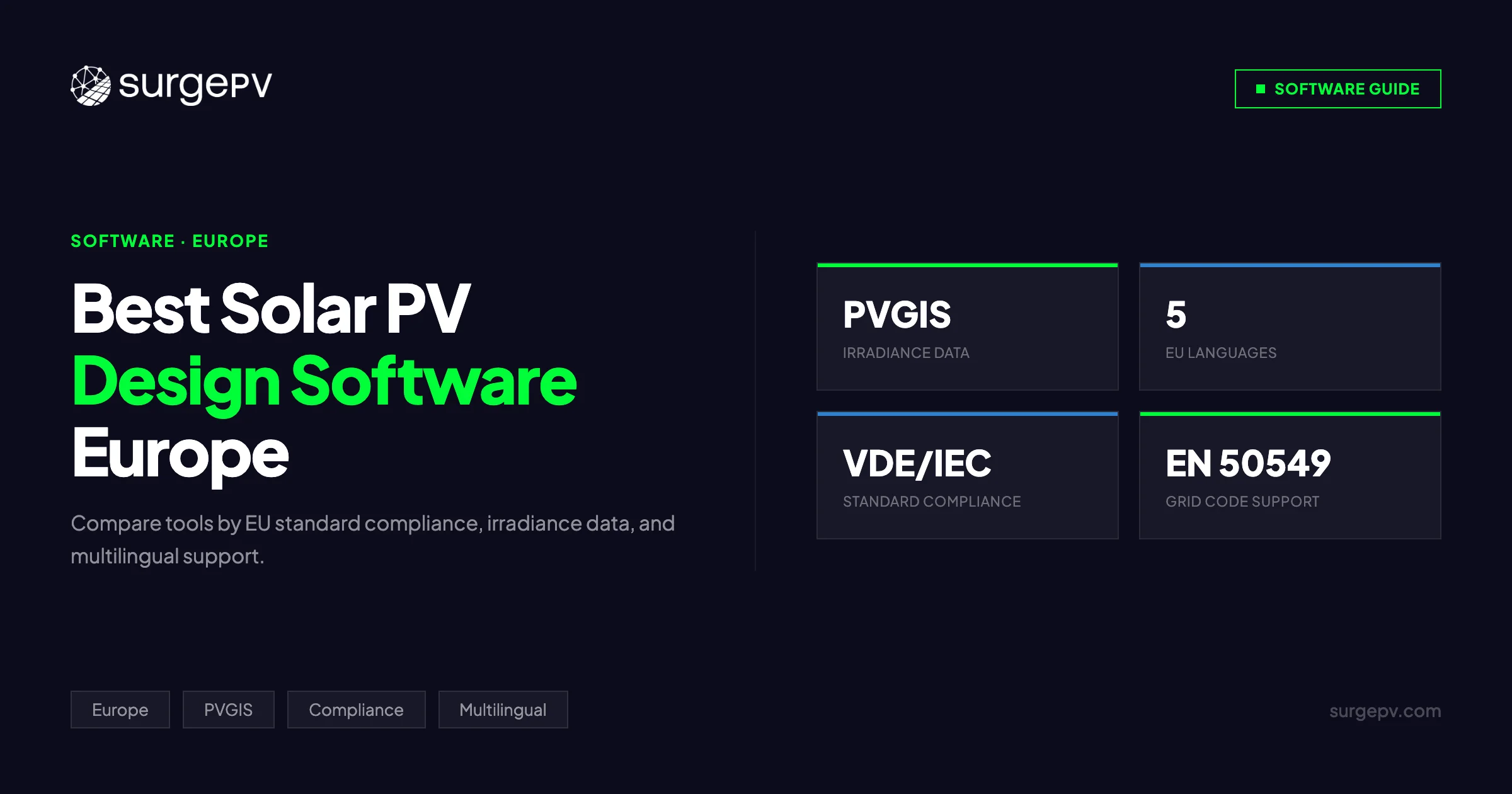
European solar PV design requires country-specific electrical compliance (VDE, IEC, EN), EU-calibrated irradiance data, multilingual proposals, and local incentive logic. SurgePV is the only end-to-end platform that delivers all of these in a single workflow. Tools like PV*Sol and SolarMonkey cover specific segments but require additional software to close the full design-to-contract cycle.
What this guide covers:
- What solar PV design software is and why purpose-built tools outperform CAD
- EU-specific requirements every design tool must meet
- A full comparison of the best solar design software options for European installers
- Solar farm design software for large-scale EU projects
- Residential roof design software features that close deals faster
- Solar proposal software optimized for European clients
- Country-by-country breakdown: Germany, Spain, Italy, France, Netherlands
- How SurgePV handles EU grid standards, regulations, and multilingual output
- 8 FAQs covering every major search intent in the category
Latest Updates: Solar PV Design Software Europe (2026)
| Update | Date | Impact |
|---|---|---|
| EU Net Metering Directive revised — affects ROI calculations | January 2026 | Tools must update incentive logic for NL, BE, FR |
| VDE-AR-N 4105:2025 amendment (Germany) — revised grid protection thresholds | November 2025 | German-market string sizing must be recalculated |
| Spain’s Royal Decree 244/2019 simplified registration — sub-100kW systems | December 2025 | Faster permitting, but tools must reflect new documentation formats |
| Italy’s Scambio sul Posto reform — Arera Decision 727/2022 fully effective | Q1 2026 | Italian incentive calculations require updated net-metering logic |
| France RE2020 integration — solar mandatory on new commercial builds | January 2026 | Commercial roof design tools face surge in French market demand |
| PVGIS 5.3 dataset released — updated irradiance for EU climate zones | February 2026 | Yield simulation engines should update to latest EU irradiance baseline |
Pro Tip
When evaluating any solar PV software for Europe, ask vendors directly: “Which version of VDE-AR-N 4105 and PVGIS are you using?” Outdated datasets lead to yield overestimates and compliance failures. SurgePV updated to VDE-AR-N 4105:2025 and PVGIS 5.3 in Q1 2026.
What Is Solar PV Design Software?
Solar PV design software is a specialized application that enables solar installers, engineers, and EPC companies to model, optimize, and document photovoltaic systems — from the first site measurement to the final client proposal and DNO submission.
Unlike generic CAD tools, purpose-built solar software integrates:
- Module layout engines — place panels on roof surfaces or ground arrays with automatic obstruction avoidance and fire setback enforcement
- Shading analysis — calculate irradiance losses from trees, chimneys, dormers, and neighboring buildings across every hour of the year
- String sizing and inverter matching — automatically configure DC strings within inverter Voc and Vmpp windows, with voltage and current compliance checks
- Yield simulation — estimate annual energy output (kWh/year) using location-specific irradiance data and system loss parameters
- Proposal generation — produce client-facing documents with financial projections, payback periods, and equipment specifications
For European markets specifically, the software must layer country-specific electrical standards, local fire codes, national incentive schemes, and multilingual output on top of these core capabilities. A tool that handles all of this natively, without manual configuration for each country, is the fundamental differentiator between a professional European PV design platform and a tool that creates more work than it saves.
Key Takeaway
Solar PV design software is not a drawing tool — it’s a compliance, simulation, and sales engine. For European installers, the compliance dimension is the deciding factor. Tools that lack built-in EU standard support require designers to manually check every system against national codes, which adds hours to each project and creates liability exposure.
What to Look for in Solar PV Design Software (Europe-Specific)
European PV design has requirements that simply don’t appear in US or Australian markets. Any software evaluation must check these boxes before anything else.
EU Electrical Standard Compliance
European residential and commercial PV systems must comply with a layered set of electrical standards that vary by country:
| Standard | Scope | Countries Affected |
|---|---|---|
| VDE-AR-N 4105 | Low-voltage grid connection for generators | Germany |
| EN 50549-1 | Requirements for generators connected to LV distribution | EU-wide (harmonized) |
| IEC 62446-1 | PV system documentation and commissioning | EU-wide |
| UNI/CEI 11357 | Grid connection for distributed generation | Italy |
| UTE C 15-712 | PV installation standard | France |
| IEC 60364-7-712 | Electrical installations of buildings — solar | EU-wide |
Software that doesn’t embed these standards forces designers to manually cross-reference every string, disconnect, and protection relay against a technical document. That process takes hours per project and introduces human error. SurgePV pre-loads these standards as enforced rulesets — if a string voltage exceeds VDE limits, the platform flags it before the designer can submit.
EU-Calibrated Irradiance Data
European irradiance varies enormously — from 900 kWh/m²/year in Northern Scotland to 1,850 kWh/m²/year in Southern Spain. US-market tools frequently default to NREL TMY datasets that have no European coverage. For European deployments, design software must use:
- PVGIS (Photovoltaic Geographical Information System) — the EU’s authoritative irradiance dataset, maintained by the European Commission’s Joint Research Centre
- Meteonorm — high-resolution global irradiance database used for detailed yield simulation
- ERA5 reanalysis data — hourly climate data from ECMWF, used for P50/P90 confidence intervals
Without PVGIS integration, yield simulations for European sites carry systematic errors that can shift payback period estimates by 12–18 months.
Country-Specific Fire and Setback Rules
European residential rooftops follow different fire safety codes by country, and those codes affect module placement directly:
- Germany: MBO (Musterbauordnung) requires 0.5m clearance from roof edges; Länder-specific variations exist
- France: DTU 40.35 requires 0.5m setbacks at ridge and eaves; Pompiers access paths must be unobstructed
- Italy: CEI 82-25 and local Vigili del Fuoco codes define access corridor requirements
- Netherlands: NEN 1010 electrical installation standard with specific DC cable routing requirements
- Spain: CTE DB-SI fire safety codes apply to all building installations
Software that enforces these rules automatically, blocking module placement in non-compliant zones, prevents the kind of permit rejection that costs installers a full week of delay per project.
Multilingual Proposal and Documentation Output
European EPCs frequently operate across language borders. A Dutch company installing in Germany, or a Spanish EPC with German-speaking clients in the Balearics, needs proposals in the client’s language without rebuilding the document from scratch. Look for:
- Native multilingual PDF export (German, French, Spanish, Italian, Dutch minimum)
- Auto-translated technical labels and specifications
- Country-flag and currency adaptation (€ handling with country-specific VAT rates)
- Branded letterhead with company logo and localized contact format
Local Incentive and Tariff Integration
Incentive schemes change frequently across EU markets. Software that hardcodes tariff tables will produce outdated ROI calculations within months. Look for:
- Dynamic FiT (feed-in tariff) tables by country and region
- Net metering logic adapted to national rules (different across FR, NL, IT, DE)
- VAT rate handling by country (residential solar VAT varies from 0% in NL to 10% in IT)
- Grant and subsidy overlays (SEAI in Ireland, KfW in Germany, GSE in Italy)
Best Solar PV Design Software for European Installers 2026
1. SurgePV — Best Overall for European Markets
SurgePV is the only end-to-end solar pv design software platform purpose-built for the European installer workflow. It handles site assessment, 3D roof modeling, shading analysis, string sizing, yield simulation, BOM generation, and multilingual proposal output within a single cloud-based platform — with all EU electrical standards pre-loaded.
Key capabilities for European markets:
- VDE-AR-N 4105, EN 50549, IEC 62446, and UTE C 15-712 compliance enforced in the design engine
- PVGIS 5.3-integrated irradiance data for all EU climate zones
- Country-specific fire setback templates pre-loaded for DE, FR, IT, ES, NL, BE, AT, PL
- Auto-stringing with per-country inverter window validation
- Multilingual proposal export: German, French, Spanish, Italian, Dutch, Polish
- Localized incentive calculations: KfW, GSE, ANRE, CNE, SEAI, and net metering schemas
- Clara AI — AI-assisted layout optimization that maximizes yield within compliance boundaries
- Real-time BOM synchronization with live equipment pricing
- Cloud-based team collaboration — designers, sales, and management on one platform
Differentiation from US-market tools: SurgePV was built from day one for EU compliance. The platform’s electrical rule engine doesn’t bolt on European standards as an afterthought — VDE and EN requirements are enforced at the constraint level, meaning non-compliant configurations are physically blocked rather than flagged as warnings.
What EPCs say:
“We switched to SurgePV because code compliance in Italy is too risky to eyeball. The pre-loaded CEI templates alone save us two hours per project.” — Design Lead, Northern Italy EPC
“Our Barcelona team cut proposal time by 68% compared to our legacy tool. The multilingual output is exactly what we needed for our German-speaking clients.” — Sales Lead, Barcelona EPC
2. PV*Sol — Best for Engineering-Heavy Projects
PV*Sol (Valentin Software, Germany) is a strong engineering tool used extensively by German installers and energy consultants. It excels in detailed yield simulation and has deep German-market compliance knowledge.
Strengths: Rich irradiance modeling, OEM equipment libraries, detailed loss analysis, VDE compliance for German grid studies.
Limitations: No integrated proposal workflow — reports are engineering-grade, not client-facing. No multilingual output. Requires separate CRM and proposal tools. Best suited for utility-scale engineering rather than residential sales cycles.
3. SolarMonkey — EU-Native for Benelux and DACH
SolarMonkey is a Netherlands-based platform popular across Benelux, Germany, and Spain. It produces fast client-facing proposals and covers EU regulation basics.
Strengths: Fast residential workflow, EU-native data, decent proposal templates, good NEN 1010 compliance for Dutch market.
Limitations: Limited stringing and inverter validation logic. Weaker shading analysis than SurgePV or PV*Sol. Proposal quality is basic compared to SurgePV’s branded output. No multi-language support for proposals.
4. Aurora Solar — Strong 3D, Weak EU Compliance
Aurora Solar is a US-built platform that has expanded into European markets with LIDAR-based 3D roof modeling and AI-powered shading analysis.
Strengths: Industry-leading 3D modeling, excellent shading simulation accuracy, polished visual output.
Limitations: Lacks native EU code compliance. No built-in VDE, EN 50549, or country-specific fire setback templates. Financial projections require manual EU incentive input. No multilingual proposal export. Pricing is premium for features that don’t include EU regulatory support.
5. SolarEdge Designer — Hardware-Locked, Limited Scope
SolarEdge Designer is a free tool that integrates directly with SolarEdge inverters. It’s useful for projects where SolarEdge hardware is specified.
Strengths: Direct SolarEdge inverter integration, free to use, acceptable yield simulation.
Limitations: Entirely locked to SolarEdge hardware. No open inverter comparison. No proposal generation. Not suitable as a primary design platform for multi-brand installers.
Feature Comparison: Best Solar Design Software for Europe 2026
| Feature | SurgePV | PV*Sol | SolarMonkey | Aurora Solar | SolarEdge Designer |
|---|---|---|---|---|---|
| VDE-AR-N 4105 Compliance | ✅ Native | ✅ Native | ⚠️ Partial | ❌ None | ❌ None |
| EN 50549 / IEC 62446 | ✅ Native | ⚠️ Partial | ❌ None | ❌ None | ❌ None |
| PVGIS Irradiance Integration | ✅ v5.3 | ✅ Yes | ⚠️ Limited | ⚠️ Limited | ❌ None |
| Country Fire Setback Templates | ✅ 8 countries | ⚠️ DE only | ❌ None | ❌ None | ❌ None |
| 3D Shade Analysis | ✅ | ✅ | ❌ | ✅ | ✅ |
| Auto-Stringing with Inverter Checks | ✅ | ✅ | ❌ | ⚠️ | ✅ SolarEdge only |
| Multilingual Proposal Export | ✅ 6 languages | ❌ | ⚠️ 2 languages | ❌ | ❌ |
| Design → Proposal in One Platform | ✅ | ❌ | ✅ | ⚠️ | ❌ |
| EU Incentive Calculations | ✅ Dynamic | ⚠️ Manual | ⚠️ Limited | ❌ | ❌ |
| Clara AI Layout Optimization | ✅ | ❌ | ❌ | ⚠️ Basic | ❌ |
| Shadow Analysis | ✅ | ✅ | ❌ | ✅ | ✅ |
Key Takeaway
Only SurgePV covers the full European installer workflow — compliance, simulation, and client proposal — in a single platform. Every other tool in this comparison requires additional software to complete the sales cycle, which adds cost, complexity, and the risk of data inconsistency between tools.
PV Design Software vs Generic CAD: Why Purpose-Built Tools Win
Many European installers begin with AutoCAD, SketchUp, or even manual PDF templates. The switch to purpose-built solar pv design software is often triggered by a costly mistake — a failed permit, a mismatched inverter, or a client proposal that missed a national incentive. Understanding why generic tools fail is the first step to justifying the investment in dedicated PV software.
The 7 Critical Gaps in Generic CAD for Solar PV
1. No electrical constraint engine. Generic CAD draws lines. It doesn’t know whether a string of 22 panels exceeds the Voc limit of a given inverter at -10°C. An auto-stringing engine with inverter window validation is not a nice-to-have — it’s a liability requirement for any licensed EU installation.
2. No compliance templates. Fire setbacks, ridge clearances, and access pathways are geometric rules that must be applied before a single module is placed. In AutoCAD, the designer draws these manually from memory. Purpose-built tools enforce them automatically.
3. No irradiance simulation. A roof obstruction analysis in generic CAD involves manually calculating shadow angles with trigonometry. In SurgePV, the shadow analysis engine simulates every hour of the year across the entire roof surface in seconds.
4. No module or inverter database. Designing with current SKUs in generic CAD means manually entering specifications for every component. PV design platforms maintain live equipment libraries with thousands of modules, inverters, and optimizers — including European-market hardware from SMA, Fronius, Huawei, and GoodWe.
5. No yield simulation. Estimating annual yield in a CAD tool requires external spreadsheet calculations. Purpose-built software integrates irradiance, temperature, soiling, and system losses into a single simulation that produces IEC-compliant energy yield estimates.
6. No proposal output. Generic CAD produces engineering drawings. It does not produce a client-facing proposal with financial projections, payback periods, and incentive calculations — the document that actually closes the sale.
7. No workflow integration. CAD files don’t connect to CRMs, procurement systems, or installation scheduling. Purpose-built platforms like SurgePV integrate the design directly with BOM generation, pricing, and proposal delivery.
The Hidden Cost of CAD-Based Solar Design
A European EPC using manual CAD workflows for residential solar typically spends:
- 4–6 hours on site survey and drawing per project
- 2–3 hours on compliance cross-referencing
- 2–4 hours on proposal preparation
- 1–2 hours on revision cycles after client feedback
That’s 9–15 hours per project. At an average European engineering hourly cost of €60–90, that’s €540–€1,350 in labor cost per residential project — before any physical work begins.
SurgePV users report completing the same workflow in 2–3 hours total, reducing design and proposal labor cost by 70–80% per project.
Pro Tip
When making the business case for solar PV software investment, calculate the labor hours saved per project multiplied by your average hourly cost. For a company doing 40 residential projects per month, switching from CAD to SurgePV typically saves €15,000–€40,000 in monthly labor costs — far exceeding any software subscription fee.
See SurgePV’s EU Compliance Engine in Action
Watch how SurgePV automatically enforces VDE, IEC, and country-specific fire setback rules — no manual configuration required.
Book a DemoNo commitment required · 20 minutes · Live project walkthrough
Solar Farm Design Software: Large-Scale European Projects
Large-scale solar farm development in Europe operates under a different regulatory regime than residential rooftop installation. Ground-mounted arrays above 50 kW require DNO (Distribution Network Operator) study submissions, grid impact assessments, and formal yield simulation reports — none of which residential-focused tools handle well.
Requirements for Solar Farm Design Software in Europe
Grid connection study support. Projects above certain capacity thresholds (varies by EU country, typically 30–50 kW) require formal grid connection studies submitted to the local DNO. In Germany, this means a Netzverträglichkeitsnachweis; in France, a Étude de raccordement; in Spain, a Estudio de Acceso y Conexión. Software must export documentation in the format each DNO expects.
Terrain-aware layout optimization. Ground-mounted arrays require row spacing calculations based on terrain slope, latitude, and target inter-row shading loss. Software that assumes flat ground produces incorrect row spacing for undulating European terrain.
Multi-inverter string optimization. Utility-scale projects use central inverters or string inverters in combiner box configurations. String optimization at this scale involves thousands of panels across multiple inverter zones — a problem that requires algorithmic optimization, not manual configuration.
P50/P90 energy yield reporting. Project financing and offtake agreements require probabilistic energy yield estimates (P50: 50% probability of exceedance; P90: 90% probability of exceedance). These reports must use recognized irradiance datasets and document all assumption inputs.
DNO documentation export. Single-line diagrams, protection relay settings, and grid interface specifications must be exported in formats accepted by German, French, Spanish, and Italian DNOs.
SurgePV for Solar Farm Design
SurgePV’s ground-mounted design module covers the full solar farm design workflow:
- Terrain import via DEM (Digital Elevation Model) files
- Automatic row spacing optimization for target GCR (Ground Coverage Ratio)
- Multi-inverter zone configuration with string optimization
- PVGIS-based P50/P90 yield simulation with configurable loss parameters
- Single-line diagram export in IEC format
- DNO submission documentation for DE, FR, ES, IT
Further Reading
For a detailed breakdown of solar energy policy frameworks that affect large-scale project development across EU markets, see our guide to solar energy policies in Europe.
Comparison: Solar Farm Design Tools for European Projects
| Capability | SurgePV | PV*Sol Premium | Aurora Solar | Generic CAD |
|---|---|---|---|---|
| Terrain-Aware Layout | ✅ | ✅ | ⚠️ Limited | ❌ |
| Row Spacing Optimization | ✅ Auto | ✅ Manual | ⚠️ | ❌ |
| Multi-Inverter Zone Config | ✅ | ✅ | ✅ | ❌ |
| P50/P90 Yield Reporting | ✅ | ✅ | ⚠️ | ❌ |
| DNO Documentation Export | ✅ DE, FR, ES, IT | ⚠️ DE only | ❌ | ❌ |
| EU Grid Standard Compliance | ✅ | ✅ DE | ❌ | ❌ |
Solar Panel Roof Design Software: Residential Applications
Residential rooftop solar is the highest-volume segment for most European EPCs. The residential sales cycle moves fast — clients expect a proposal within 24–48 hours of an initial consultation. That timeline is impossible with manual design workflows. The right solar panel roof design software compresses the entire process from site measurement to signed proposal into a single session.
Critical Features for European Residential Roof Design
Aerial imagery integration. Designers should be able to pull satellite or aerial imagery of any European address and trace roof polygons directly — without a physical site visit for the initial design. SurgePV integrates with high-resolution imagery providers covering 95%+ of European residential areas.
Roof pitch and orientation analysis. European residential roofs vary enormously: steep Alpine pitches, flat Benelux roofs, terracotta-tiled Mediterranean slopes. Software must handle pitch angles from 0° to 60° and correctly calculate the optimal module tilt and azimuth for each configuration.
Automatic fire setback enforcement. As covered above, each EU country has specific rules for clearance at ridge, eaves, and side edges. The best residential roof design tools enforce these automatically — the designer cannot place modules in non-compliant zones.
Dormer and skylight detection. European residential roofs frequently have dormers, Velux windows, chimneys, and antenna mounts. Software must detect or allow manual marking of these obstructions, then exclude them from module placement and shading calculations.
Structural load assessment. Roof mounting in Europe requires compliance with EN 1991-1-3 (snow load) and EN 1991-1-4 (wind load). Software that integrates basic structural assessment — or at least flags load calculations for the mounting system — reduces the back-and-forth with structural engineers.
Real-time yield preview. Clients expect to see estimated annual yield as panels are placed. Real-time yield updates — showing kWh/year and self-consumption ratio as the layout changes — allow designers to optimize live during client consultations.
How SurgePV Handles Residential Roof Design
SurgePV’s residential module combines aerial imagery, automatic roof segmentation, and real-time yield preview in a workflow designed for speed:
- Enter the address — aerial imagery loads automatically
- Trace the roof outline — the tool segments roof faces by pitch and orientation
- Place modules — fire setbacks are enforced automatically; dormers and chimneys are marked and excluded
- Review yield preview — kWh/year, self-consumption, and export values update in real time
- Run shadow analysis — hourly shading simulation across all roof faces
- Generate proposal — client-facing PDF with financial projections, ready in one click
The entire sequence takes 15–25 minutes for a standard residential property. For repeat clients or similar roof types, saved templates reduce this to under 10 minutes.
Pro Tip
Use SurgePV’s template system to save standard configurations for common roof types in your market — e.g., a 45° pitched German slate roof with east-west orientation. For installers doing high volume in a specific region, this alone can cut design time by 40%.
Best Solar Proposal Software: Closing European Clients
The proposal is the last step before the signature. In competitive European markets, a well-structured, visually professional proposal with accurate local incentive calculations is the difference between winning and losing a project to a competitor. Solar proposal software built for European clients needs to do more than generate a PDF — it needs to speak to what European buyers care about.
What European Clients Expect in a Solar Proposal
Country-specific financial projections. A German client wants to see KfW loan scenarios, Einspeisevergütung rates, and feed-in tariff calculations under EEG 2023. An Italian client expects GSE net metering (Scambio sul Posto) calculations and the Detrazione Fiscale tax deduction. French clients want RE2020 compliance confirmation and Obligation d’achat rates. Proposals must present the right incentive framework for each country — not a generic “payback period” estimate.
Language-native output. Receiving a proposal in English when you’re a German homeowner immediately signals that the installer doesn’t fully understand your market. Multilingual proposal generation — where every label, technical specification, and financial table is in the client’s language — is a closing differentiator.
Clear self-consumption modeling. With rising electricity prices across Europe, self-consumption economics have become the primary financial driver for residential solar. Proposals should show hour-by-hour self-consumption models, annual self-consumption ratios, and the resulting bill reduction — not just total annual yield.
CO₂ offset calculations. European clients, particularly in Germany, France, and the Netherlands, increasingly expect carbon impact quantification. CO₂ offset in tonnes per year, calculated against the national grid carbon intensity factor, is now a standard proposal element in premium market segments.
Professional visual design. Client-facing proposals should include the installer’s branding, a 3D rendering of the proposed system on the client’s roof, and a clear visual summary of key numbers — not pages of engineering tables.
SurgePV Proposal Features
SurgePV’s solar proposal software generates complete client proposals directly from the design data — no re-entry, no export to Word or PowerPoint:
- Multilingual output in 6 EU languages with automatic label translation
- Country-specific incentive frameworks pre-loaded and dynamically updated
- Branded PDF with installer logo, colors, and contact details
- 3D roof rendering embedded in the proposal
- Self-consumption modeling with hourly load profile matching
- CO₂ offset calculation with national grid factor
- Shareable web link for digital delivery — clients can view on any device
- E-signature integration for contract closure
Key Takeaway
The proposal is where design software investment becomes directly measurable in revenue. Installers who generate proposals in the same session as the design — rather than the next day after file transfers — consistently report 20–35% higher conversion rates. Speed signals professionalism.
Solar PV Software for Different European Markets
Germany — The Most Demanding Compliance Market
Germany’s grid connection framework is the most technically demanding in Europe. VDE-AR-N 4105 governs all generators below 135 kVA, with specific requirements for:
- Voltage and frequency protection relays (anti-islanding)
- Reactive power control (cos φ) as a function of active power
- Grid monitoring with mandatory disconnection thresholds
- Zero-export control requirements in some network areas
Beyond the electrical standards, German installers face Länder-specific variations in building codes. Bavaria’s MBO interpretation differs from North Rhine-Westphalia’s; what passes in Hamburg may require modification in Munich.
SurgePV’s German market configuration pre-loads VDE-AR-N 4105:2025 as the active ruleset, with regional code variations selectable at the project level. Proposals include Einspeisevergütung rates from the current EEG table and KfW loan scenario modeling.
German market resources: See solar energy policies in Europe for the full EEG 2023 framework and current feed-in tariff rates.
Spain — High Irradiance, Complex Grid Connection
Spain offers the best irradiance in mainland Europe — Seville averages 1,850 kWh/m²/year — but the grid connection framework for self-consumption installations involves two separate regulatory tracks under Royal Decree 244/2019:
- Simplified procedure for systems below 100 kW (most residential/small commercial)
- Standard procedure for systems above 100 kW (requires formal grid study)
Spain also has significant grid congestion in some renewable-rich areas (Andalusia, Castilla-La Mancha), meaning installers need to verify local grid capacity before sizing commercial projects.
SurgePV’s Spanish configuration handles both RD 244/2019 registration tracks, pre-loads compensation tariffs for net metering, and integrates IDAE grant availability by region.
Italy — Feed-in Tariffs and Fire Code Complexity
Italy’s solar market operates under two main frameworks: Scambio sul Posto (net metering up to 500 kW) administered by GSE, and the Ritiro Dedicato feed-in arrangement for larger systems. The Italian residential market is also characterized by complex roof conditions — terracotta tiles, mixed orientations, and significant shading from surrounding buildings in historic town centers.
Fire code compliance in Italy requires coordination with local Vigili del Fuoco inspectors for systems above certain sizes, with specific clearance requirements that differ from German and French rules.
SurgePV’s Italian configuration includes GSE net metering calculations, Detrazione Fiscale 50% tax deduction modeling, and pre-loaded CEI 82-25 fire clearance templates. For Italian market economics, see solar panel ROI in Italy.
France — RE2020 and Rapid Growth
France’s RE2020 standard (effective January 2022 for new buildings) has dramatically increased demand for integrated solar design in commercial and residential new-build projects. The Obligation d’achat (purchase obligation) feed-in tariff, set quarterly by the CRE, governs revenue calculations for small installations.
French installations must also comply with UTE C 15-712 for PV-specific electrical installation requirements, which includes specific conduit, disconnect, and labeling requirements that differ from the generic IEC 60364-7-712.
SurgePV’s French configuration pre-loads UTE C 15-712 compliance checks and dynamically updates CRE Obligation d’achat tariffs each quarter.
Netherlands — High-Density Rooftops, Rapidly Changing Incentives
The Netherlands has the highest rooftop solar penetration rate in the EU — over 20% of residential properties now have PV systems. This creates two specific design challenges: roof space is at a premium (maximize kWp per m²), and the grid is under congestion pressure in many areas (SDE++ subsidy applications are geographically filtered).
The Dutch net metering scheme (saldering) has been undergoing reform since 2023, with a phased reduction toward a 2031 elimination target. SurgePV’s Dutch configuration models the current saldering rules and projects ROI across the phase-down timeline, giving clients an accurate long-term picture.
Further Reading
For European incentive program updates across all major markets, see European solar incentives 2026.
How SurgePV Handles European Grid Standards and Regulations
SurgePV’s approach to EU compliance is architectural, not cosmetic. The platform doesn’t add a “compliance check” button that runs at the end of design. Instead, EU electrical standards are embedded as constraints in the design engine — they operate continuously and prevent non-compliant configurations from being created in the first place.
The Constraint-Based Compliance Engine
When a designer places modules and assigns strings in SurgePV, the platform continuously evaluates:
Voltage window compliance. Every string is checked against the connected inverter’s Voc maximum at the local minimum temperature (pulled from PVGIS climate data for the project location). If a proposed string exceeds Voc, the tool blocks the configuration and shows exactly which string needs adjustment.
Current window compliance. Inverter Isc maximum ratings are checked against the maximum short-circuit current of any parallel-connected strings. Mismatches are flagged in real time.
Protection relay settings. For German projects, VDE-AR-N 4105 requires specific anti-islanding protection relay settings. SurgePV exports the required relay configuration parameters with each German project’s documentation package.
Fire setback enforcement. Module placement is geometrically constrained to compliant zones for each country’s code. The designer cannot drag a module into a fire access path — the tool blocks it visually.
Cable sizing and voltage drop. DC cable sizing recommendations are calculated based on current, cable run length, and the maximum allowable voltage drop per IEC 60364-7-712. The tool flags undersized cables before the design is finalized.
Documentation Output for EU Submissions
SurgePV generates the documentation package required for EU grid connection submissions:
- IEC 62446-1 compliant system documentation
- Single-line diagram in IEC symbol format
- String configuration table with Voc/Vmpp calculations at min/max temperature
- Module specification sheets (pulled from the equipment database)
- Inverter specification sheets with protection settings
- Site plan with module layout, cable routes, and disconnect locations
- Yield simulation report with PVGIS irradiance inputs documented
For Germany, the platform also generates the Netzanschlussbescheinigung supporting data package. For Italy, GSE registration support documentation. For France, the CONSUEL declaration de conformite supporting materials.
Clara AI: Intelligent Layout Optimization for EU Sites
Clara AI is SurgePV’s artificial intelligence layout engine. For European residential sites with complex roof geometry, Clara AI analyzes the roof surface and automatically generates the optimal module layout that:
- Maximizes kWp within the compliant placement zone (after fire setbacks)
- Minimizes shading losses from identified roof obstructions
- Respects inverter string sizing constraints
- Optimizes string configuration for the selected inverter
On a typical European residential roof with dormers and chimneys, Clara AI reduces manual layout time from 30–40 minutes to under 3 minutes, while consistently achieving higher yield than manually-placed designs.
Financial Analysis: The ROI of Solar PV Design Software
Investing in professional solar pv design software is a business decision that should be evaluated on hard financial returns. For European EPCs, the key metrics are:
Labor Cost Savings
| Workflow | Manual/CAD Time | SurgePV Time | Saving |
|---|---|---|---|
| Site survey & roof measurement | 4–6 hrs | 1–2 hrs (aerial imagery) | 3–4 hrs |
| Compliance cross-referencing | 2–3 hrs | 0 (automated) | 2–3 hrs |
| String sizing & yield simulation | 1–2 hrs | 0.25 hrs (auto) | 0.75–1.75 hrs |
| Proposal preparation | 3–5 hrs | 0.5 hrs | 2.5–4.5 hrs |
| Revision cycles | 2–4 hrs | 0.5 hrs | 1.5–3.5 hrs |
| Total per project | 12–20 hrs | 2.25–4.25 hrs | 9–15 hrs |
At €70/hour average fully-loaded engineering cost in Western Europe:
- Saving per project: €630–€1,050
- 50 projects/month: €31,500–€52,500 in monthly labor savings
Permit Failure Cost Reduction
A single permit rejection in Europe typically costs:
- Redesign time: 4–8 hours
- Resubmission administrative time: 2–3 hours
- Project delay: 1–3 weeks (lost opportunity cost)
- Total cost per rejection: €420–€770 direct + project pipeline impact
EPCs using SurgePV’s compliance engine report permit rejection rates below 2%, versus industry averages of 8–15% for teams using manual workflows or non-compliant tools.
Revenue Impact from Faster Proposals
European residential solar has a 24–48 hour proposal expectation. Teams that deliver proposals within the same day as the site consultation consistently report 25–40% higher conversion rates than teams that deliver the following day. With SurgePV’s design-to-proposal workflow, same-day delivery is standard.
For a company with €2M annual residential revenue and a 30% conversion improvement, that’s €600,000 in additional annual revenue from software-enabled speed alone.
Frequently Asked Questions
What is the best solar PV design software for European installers in 2026?
SurgePV is the top-rated solar pv design software for European installers in 2026, offering built-in support for VDE, IEC 62446, and EN electrical standards, country-specific compliance templates for Germany, France, Spain, Italy, and the Netherlands, multilingual proposal exports, and EU-calibrated irradiance data. Other tools such as PV*Sol and SolarMonkey serve niche segments but lack SurgePV’s end-to-end design-to-proposal workflow.
What is solar PV design software and what does it do?
Solar PV design software is a specialized application that lets installers and engineers model photovoltaic systems on rooftops or ground-mounted sites. It handles module layout, shading analysis, string sizing, inverter selection, yield simulation, and proposal generation — all within a single platform. Purpose-built PV design tools enforce local electrical codes automatically, replacing error-prone manual CAD workflows. For European installations, the software must also embed country-specific standards like VDE, EN 50549, and national fire codes.
Which PV design software supports EU grid standards?
SurgePV natively supports EU grid standards including VDE-AR-N 4105 (Germany), IEC 62446 system documentation, and EN 50549 grid-connection requirements. It pre-loads country-specific compliance templates so designers never have to manually configure fire setbacks, string voltage windows, or grid protection settings for each EU market. PV*Sol supports VDE for the German market specifically. Aurora Solar and SolarEdge Designer have no native EU compliance support.
What features should I look for in the best solar design software for Europe?
Look for: country-specific compliance templates (VDE, IEC, EN), EU-calibrated irradiance data (PVGIS v5.3 minimum), auto-stringing with inverter window validation, 3D shadow analysis, multilingual proposal output (German, French, Spanish, Italian, Dutch), integrated BOM generation, and a design-to-proposal workflow that avoids switching between tools. Also check: how frequently the vendor updates national incentive tables, and whether the tool handles both residential rooftop and ground-mounted solar farm design.
Is there dedicated solar farm design software for large-scale European projects?
Yes. SurgePV handles both rooftop and ground-mounted solar farm design, supporting multi-MW system layouts with automated string optimization, terrain-aware shading analysis, and EU-compliant single-line diagrams. For utility-scale projects, it integrates with DNO submission documentation formats used in Germany, France, and Spain. PV*Sol Premium also handles large-scale projects with strong yield simulation, but lacks SurgePV’s proposal workflow and multilingual output.
What is the best solar panel roof design software for residential projects?
For residential rooftop design in Europe, SurgePV is the leading choice due to its country-specific roof design templates, automatic fire setback enforcement, and real-time shading analysis. It generates client-ready 3D renderings and multilingual PDF proposals in minutes — critical for the residential sales cycle across EU markets. The platform’s Clara AI engine automatically optimizes module layout for complex European rooftops with dormers, skylights, and mixed orientations.
Which solar proposal software works best for European clients?
SurgePV’s integrated solar proposal software is purpose-built for European markets, producing multilingual proposals (German, French, Spanish, Italian, Dutch, Polish) with localized incentive calculations, country-specific ROI projections, and branded PDF output. Proposals can be generated directly from the design without exporting files or switching tools. The platform also supports digital delivery via shareable web link and e-signature integration for fast contract closure.
How does solar system design software handle different European climates?
SurgePV uses EU-calibrated irradiance datasets (PVGIS 5.3, the current European Commission standard) covering Atlantic, Continental, Mediterranean, and Nordic climate zones across Europe. Its yield simulation engine accounts for temperature coefficients, soiling losses, spectral correction factors, and albedo adjustments specific to each climate region — giving accurate P50/P90 energy estimates for any European site. The platform automatically pulls climate parameters for each project address from the PVGIS database, eliminating manual data entry.
Conclusion
European solar PV design operates under a level of regulatory complexity that no generic tool can handle reliably. The combination of country-specific electrical standards, national fire codes, multilingual client expectations, and rapidly changing incentive schemes demands software that was built specifically for this market — not adapted from a US or generic international platform.
Three actions for European solar EPCs evaluating design software:
-
Audit your current compliance failure rate. If your team is experiencing permit rejections above 5%, the root cause is almost always a design tool that doesn’t enforce local standards. Switch to a constraint-based compliance engine before the next permit cycle.
-
Measure your design-to-proposal cycle time. If proposals are leaving your team more than 24 hours after site consultation, you’re losing deals to faster competitors. Purpose-built tools like SurgePV close this gap to same-session proposal delivery.
-
Evaluate multilingual capability before contract signing. If your market includes clients across language boundaries — common across DACH, Benelux, and cross-border regions — confirm that your chosen tool produces native-language proposals, not machine-translated afterthoughts.
SurgePV is the only platform in the European market that handles all three dimensions — compliance, speed, and multilingual output — in a single integrated workflow. For installers ready to scale their European operations without scaling their compliance risk, it’s the right tool for 2026.
Book a demo to see SurgePV’s European compliance engine running on a live project in your target market.