
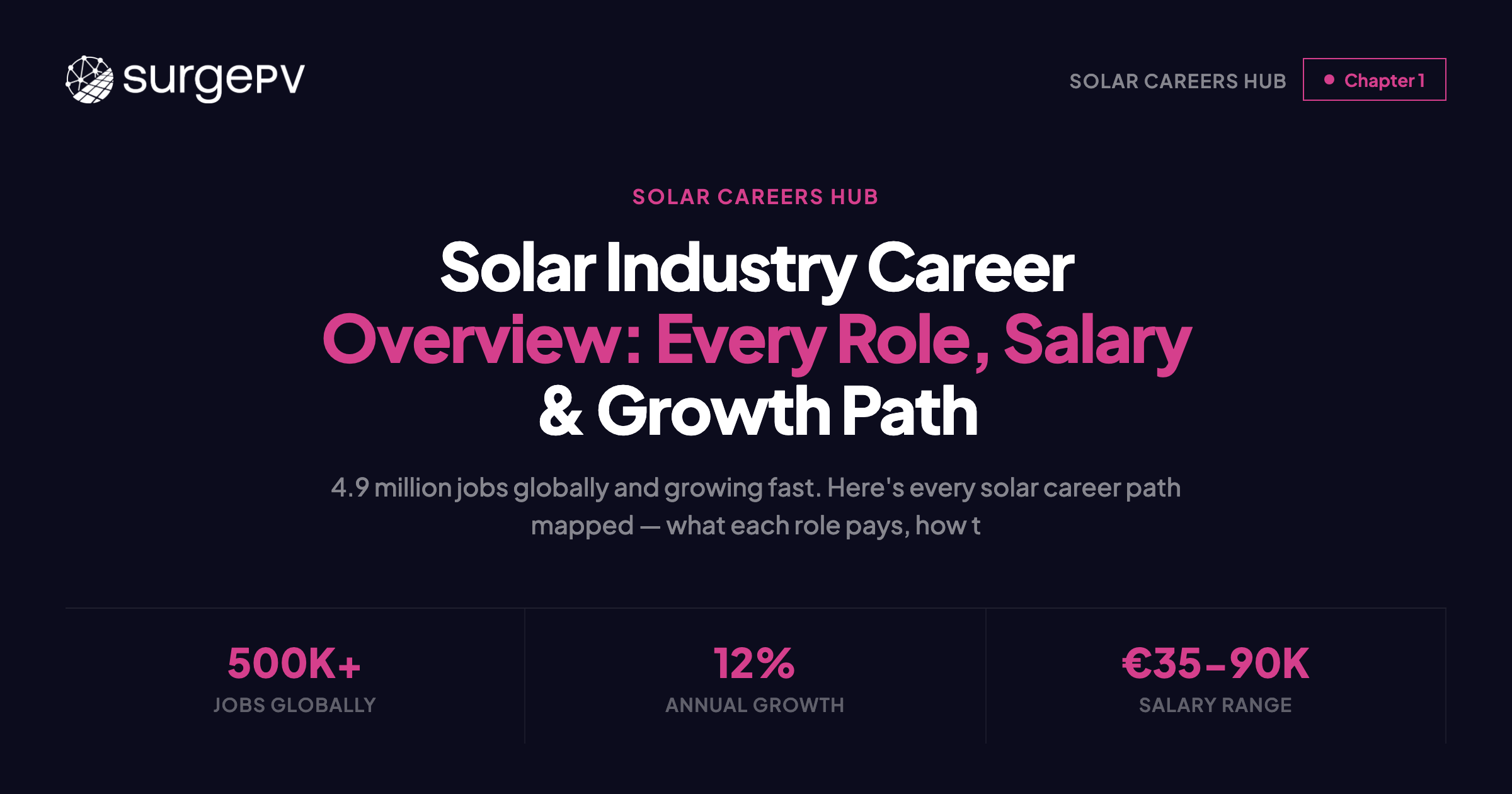
The solar industry added more jobs last year than any other energy sector. According to IRENA, global solar PV employment hit 4.9 million in 2023 — and the trajectory to 2030 points sharply upward. Europe is targeting 600 GW of installed capacity by the end of the decade. The US passed the Inflation Reduction Act, unleashing hundreds of billions in clean energy investment. Emerging markets across Southeast Asia and Latin America are scaling fast. The people building, designing, selling, and engineering these systems have to come from somewhere. This guide maps every major career path — what each role involves, how you enter it, what it pays, and where it grows from here.
What you'll learn in this chapter
- The current state of the solar job market — real numbers, not projections
- Every major solar career role with salary ranges and demand outlook
- How solar jobs divide across residential, commercial, and utility-scale
- Which skills and backgrounds transfer most directly into solar
- The career progression ladder from entry-level to senior roles
- Where solar jobs are concentrated by country in Europe and the US
- Job growth forecasts to 2030 with IEA and IRENA source data
- A decision framework for choosing your solar career entry point
The Solar Job Market in 2026
Solar PV is now the world's largest renewable energy employer. The 4.9 million figure from IRENA's 2023 report represents a 44% increase from 3.4 million in 2019 — growth that occurred during a period of supply chain disruption, rising material costs, and the tail end of a pandemic. The fundamentals driving that growth haven't changed: electricity prices are elevated, government incentives remain strong in all major markets, and panel costs continue to fall.
In Europe specifically, the solar surge has been sharp. EU-wide solar capacity grew from 165 GW in 2021 to over 260 GW by end of 2024 — a 60% increase in three years. Germany remains the largest market by installed capacity, but Spain is adding the most new capacity annually and Italy is close behind. The UK, Netherlands, and Poland are also growing rapidly.
The EU Solar Industry Association (SolarPower Europe) estimates that Europe will need 1 million additional solar workers by 2030 to meet capacity targets. That's roughly 200,000 new jobs per year across the continent — more than the current annual output of all relevant training programs combined. The talent gap is real, and it's the single biggest constraint on how fast Europe can deploy solar.
In the US, the IRA has created a sustained investment wave. The Solar Energy Industries Association (SEIA) estimates that the US solar workforce reached 280,000 in 2024, with projections to exceed 400,000 by 2030. California, Texas, and Florida employ the most solar workers, but mid-size markets like North Carolina, Nevada, and Arizona are growing quickly.
Global Solar PV Jobs (millions)
Sources: IRENA (2019–2023 actuals). 2025 and 2030 are IRENA projections. *Estimated.
Every Solar Career Role Explained
Solar is a broad industry that spans physical installation, software-driven design, customer-facing sales, and large-scale project management. Understanding the full range of roles — and where each sits in terms of entry requirements, pay, and career trajectory — is the first step in choosing your path.
| Role | Entry Path | Salary Range (EU) | Demand Level |
|---|---|---|---|
| Solar Installer | Short course + on-the-job | €28,000–€45,000 | Very High |
| Lead Installer / Crew Lead | 2–4 years installation experience | €38,000–€52,000 | High |
| Solar Designer | Technical training + design software | €32,000–€60,000 | High |
| Solar Sales Representative | No formal requirements | €30,000–€90,000+ (OTE) | Very High |
| Solar Project Manager | Degree or 5+ years experience | €50,000–€85,000 | High |
| Solar PV Engineer | Engineering degree | €50,000–€90,000 | High |
| O&M Technician | Electrical qualification + on-the-job | €30,000–€50,000 | Growing |
| Energy Consultant | Technical + commercial background | €40,000–€75,000 | Moderate |
| Site Supervisor | Installation experience + SMSTS | €40,000–€62,000 | High |
| Solar Procurement / Supply Chain | Business or technical degree | €38,000–€65,000 | Moderate |
Solar Installer: The highest-volume role in the industry. Installers handle physical mounting, racking, module placement, DC wiring, inverter installation, and commissioning. The role is accessible without a degree — a short accredited course and an offer from a company that trains on the job is the typical entry point. Demand is very high across all major EU markets and the US.
Solar Designer: Designers use software tools to model rooftops, optimise panel layouts, run shading analysis, and produce financial projections. It's a desk-based role with strong growth as residential and commercial solar volumes scale. Solar design software is the core tool — proficiency in platforms like SurgePV is increasingly listed as a job requirement. Designers typically earn more than entry-level installers and face lower physical demands.
Solar Sales Representative: The engine of solar company revenue. Sales reps identify prospects, run site assessments, present proposals, and close deals. The role requires no formal qualification — sales ability, product knowledge, and financial fluency matter more than credentials. Total earnings vary enormously depending on commission structure, deal volumes, and market.
Solar Project Manager: Responsible for the full delivery of solar installations — from contract handover through design, permitting, procurement, installation, and grid connection. PMs typically manage multiple projects simultaneously and coordinate between sales, design, installation, and client teams. The role requires either a relevant degree or several years of field experience.
O&M Technician: Operations and maintenance roles are growing fast as Europe's installed base ages. O&M techs inspect, troubleshoot, and maintain operational systems — inverter replacements, soiling checks, string-level fault diagnosis, and performance monitoring. The role sits between installation and engineering in terms of technical depth.
Pro Tip
If you're unsure which role to pursue, assess your current skills honestly. Electricians and roofers transfer most easily into installation. CAD users, architects, and technically-minded graduates transfer well into design. B2B or home improvement sales experience transfers directly into solar sales. Engineering degrees open the project management and engineering path.
Residential, Commercial, and Utility-Scale: How Solar Jobs Divide
Most solar jobs data aggregates across all three segments, which obscures important differences. The skills, tools, timelines, and pay structures vary significantly between residential rooftop, commercial, and utility-scale solar.
Residential solar is the highest-volume segment in Europe by number of installations. A residential installer might complete two to four jobs per week. The systems are small (typically 4–15 kWp), the projects are fast-moving, and the customer relationship is direct. Sales cycles are 2–8 weeks. Design is relatively straightforward — a competent designer using solar design software can complete a residential design in 20–40 minutes. The main challenge is volume: companies need reliable installation crews and fast proposal turnaround.
Commercial solar covers C&I (commercial and industrial) installations — businesses, warehouses, farms, schools, hospitals, retail parks. Systems range from 20 kWp to several MWp. Projects take weeks to months from survey to commissioning. Decision cycles are longer, proposals are more financially complex, and installation logistics require more coordination. Pay is generally higher than residential across all roles.
Utility-scale solar involves large ground-mount installations of 1 MWp and above. These are engineering-led projects, typically procured through competitive tender, with long development timelines (1–5 years from land to commissioning). Roles here tend to be more specialised — project developers, permitting specialists, structural engineers, grid connection engineers, and EPC project managers. Entry is typically through engineering or project management rather than installation.
| Factor | Residential | Commercial | Utility-Scale |
|---|---|---|---|
| System size | 4–15 kWp | 20 kWp–5 MWp | 1 MWp–500+ MWp |
| Project duration | 1–3 days | 1 week–3 months | 1–5 years |
| Main roles | Installer, Sales, Designer | PM, Designer, Sales | Engineer, PM, Developer |
| Entry difficulty | Low–Medium | Medium | High |
| Pay premium | Baseline | +10–25% | +20–40% |
Entry-Level vs Experienced Paths: What Transfers
One of the most common questions from people considering a solar career transition: "Does my background count for anything?" The answer is usually yes — the solar industry draws on a wide range of prior skills.
Electrical background: If you're a qualified electrician, you're already most of the way to a solar installer or O&M technician role. You understand AC/DC fundamentals, safe isolation procedures, and fault-finding. A short PV-specific course covers the gaps (string inverters, DC circuit design, array sizing) and most solar companies actively recruit from electrical trades.
Construction / roofing background: Knowledge of working at heights, safe roof access, structural load considerations, and building regulations is directly applicable to installation. Companies hiring installers are often more interested in safety awareness and physical capability than PV-specific knowledge — they'll train the solar side.
Sales and business development experience: Any experience in B2B or B2C sales — especially home improvement products, energy services, or financial services — transfers well into solar sales. The mechanics of a consultative sales cycle, proposal presentation, and objection handling are the same. Product knowledge can be learned in weeks.
Engineering degree (any discipline): Mechanical, civil, and electrical engineers can move into solar engineering, project management, or technical design roles. The sector values analytical rigor and the ability to review structural calculations and grid connection applications. Some EPC companies actively hire graduate engineers for fast-track PM programmes.
CAD / design software: If you've used AutoCAD, Revit, or similar tools in architecture or engineering, the transition to solar design tools is short. Solar design software like SurgePV has a comparable interface, and the core competency — translating physical space into an optimised layout — is familiar.
Starting From Scratch?
If you have no background in any adjacent field, installation is still accessible. Most markets have 2–4 week accredited courses that meet minimum requirements for entry-level roles. What employers value most is attitude: willingness to work early starts, outdoor conditions, and a structured learning approach. The technical knowledge accumulates quickly on the job.
Build Real Solar Design Skills
SurgePV is the solar design platform used by professionals across 50+ countries. Explore system design, shading analysis, and proposal generation — the tools that employers look for.
Try FreeThe Solar Career Progression Ladder
Solar careers don't follow a single track — but there are well-worn paths from entry level to senior roles. Understanding the typical progression helps you plan how long each stage takes and what you need to demonstrate to advance.
Installation Career Ladder
Solar Installer (Entry)
0–2 years · €28–38K · Short course + on-the-job
Lead Installer / Crew Lead
2–4 years · €38–52K · Demonstrated leadership on site
Site Supervisor
4–7 years · €42–62K · SMSTS / health & safety qualification
Project Manager
7+ years · €55–85K · Full project lifecycle ownership
The installation ladder is the most common path but not the only one. Installers who develop strong technical aptitude often transition into design or O&M roles. Those who are drawn to the customer-facing side frequently move into solar sales — the technical credibility from installation experience gives them a significant advantage over sales-only hires.
The design career ladder is shorter but steeper. Junior designers typically progress to senior designer within 3–5 years, at which point they either move into team lead or technical management roles, or transition into project management. The key accelerator is software proficiency — designers who are fluent across multiple platforms (SurgePV, PVsyst, AutoCAD) and can handle complex commercial projects command significantly higher salaries.
Sales careers have a different dynamic: progression is often measured in earnings rather than title. A residential closer who builds a strong referral network and consistent deal flow can earn more than a sales manager, and may prefer to remain as an individual contributor. Commercial sales progression typically runs: junior sales executive → account manager → senior account manager → commercial director.
Where Solar Jobs Are Concentrated by Country
Geography matters. Solar job concentration follows installed capacity, government incentive levels, and construction activity — not just population. Here's where the demand is in Europe and North America.
| Country | Installed Capacity (2024) | Estimated Solar Jobs | Key Opportunity |
|---|---|---|---|
| Germany | ~90 GW | 65,000+ | Rooftop residential + C&I; strong demand for designers and PMs |
| Spain | ~40 GW | 45,000+ | Utility-scale growth; large projects need engineers and project managers |
| Italy | ~35 GW | 40,000+ | Superbonus-driven residential boom; high installer demand |
| Netherlands | ~25 GW | 20,000+ | High installer wages; strong saldering policy driving residential |
| UK | ~17 GW | 35,000+ | SEG scheme + heat pump integration; MCS-certified installers in short supply |
| US (California) | ~50 GW statewide | 80,000+ | Largest single state market; NEM 3.0 pushing battery integration roles |
| US (Texas) | ~30 GW | 30,000+ | Fast-growing utility-scale market; project developer and PM demand |
Germany pays the best in Europe on average for installation and engineering roles. The Netherlands has a shortage of MCS-equivalent certified installers relative to demand, driving up wages. Italy and Spain offer high installation volumes but lower per-project wages compared to northern Europe. The UK is particularly short of certified heat pump and solar hybrid installers — a combination that commands a premium in 2026.
In the US, compensation scales significantly with state — a solar installer in California earns substantially more than the same role in Texas or Florida, reflecting both cost of living and union density. Engineers and project managers at utility-scale developers tend to be concentrated in California, Texas, and Arizona.
Solar Job Growth Forecasts to 2030
The forward-looking data on solar employment is about as bullish as you'll find in any sector. IRENA's 1.5-degree scenario, published in the 2023 World Energy Transitions Outlook, projects solar PV employment reaching 7.1 million globally by 2030. The IEA's Net Zero by 2050 scenario requires clean energy jobs — including solar — to nearly triple from current levels by mid-century.
For Europe specifically, SolarPower Europe's EU Market Outlook 2023–2027 projects annual solar additions of 80–100 GW by 2026. Installing 80 GW in a year requires a very large workforce. For comparison, Germany alone installed 14 GW in 2023 — its best year on record — and reported labour shortages throughout the installation and design pipeline.
The roles most likely to grow fastest to 2030:
- O&M Technicians: Europe's installed base is maturing. Systems installed in 2015–2020 are now reaching the stage where inverter replacements, string reconfigurations, and performance optimisation are needed. O&M employment is expected to grow at roughly 15–20% annually through 2030.
- Solar Designers: Increasing complexity — battery integration, EV charging, complex roof geometry — requires more rigorous design. The designer-to-installer ratio is increasing.
- Solar Project Managers: As commercial and utility-scale projects accelerate, PM headcount must scale proportionally. There's a structural shortage of experienced solar PMs with 5+ years of relevant experience.
- Energy Storage Specialists: Battery-solar hybrid systems are standard in new residential and commercial installations. Technicians and designers who understand both PV and BESS are commanding premium wages.
Key Takeaway
The structural demand for solar workers is durable. It's not a cyclical job market driven by a single incentive scheme. The combination of falling costs, rising electricity prices, corporate net-zero commitments, and government mandates creates multi-decade demand that isn't going away regardless of which political party is in power in any given year.
How to Choose Your Solar Career Path
The honest answer is that the "best" solar career depends entirely on what you want from work. The decision framework below cuts through the noise.
Do you want to work outdoors, physically, with immediate visible results? Installation is the right fit. The work is tangible — you arrive at a blank roof and leave with a working system. It suits people who prefer practical work over desk-based roles and who want to see the direct output of their day.
Do you want a desk-based technical role with creative problem-solving? Solar design is the fit. You're translating physical rooftop constraints into optimised system layouts, running shade modelling, and producing financial simulations. The work is analytical and methodical. Solar software is your primary tool.
Do you want high earning potential and are comfortable with commission-based risk? Solar sales. The ceiling is high for good performers, and the skills — financial fluency, customer communication, persistence — are learnable. The floor is lower, and rejection is a daily reality.
Do you want to lead projects, manage teams, and own end-to-end delivery? Project management. This role is for people who want breadth over depth — coordinating between design, installation, permitting, and client teams rather than specialising in any one function.
Do you want a highly paid technical specialist role? Solar engineering — PV, electrical, or structural. This requires the longest entry runway (engineering degree or equivalent) but offers the most stable long-term career trajectory and the highest non-commission salaries.
Most people starting in solar don't need to commit to one track permanently. Installation experience improves your design work. Design experience makes you a better sales rep. Sales experience makes you a better project manager. The industry is small enough that cross-functional experience is genuinely valued, not just tolerated.
Design Solar Systems Like a Professional
SurgePV gives aspiring solar designers hands-on experience with real design, shading analysis, and proposal tools — the same platform used by professionals across 50+ countries.
Try Free →Frequently Asked Questions
How many jobs are in the solar industry?
The global solar PV workforce reached 4.9 million in 2023 according to IRENA — making solar the single largest renewable energy employer. That's up from 3.4 million in 2019. IRENA projects the number will exceed 7 million by 2030. In Europe, SolarPower Europe estimates the industry will need 1 million additional workers by 2030 to meet capacity targets. Germany currently employs over 65,000 people in direct solar PV roles; Spain and Italy are not far behind.
What are the highest-paying solar energy careers?
Solar project managers and senior PV engineers are typically the top-paid non-commission roles, earning €60,000–€95,000 in Europe and $80,000–$130,000 in the US. High-performing commercial solar sales reps can earn more through commission. Senior solar designers earn €45,000–€70,000 in EU markets. O&M technicians specialising in battery-solar hybrid systems are commanding a growing premium as the installed base matures. For a full salary breakdown by role and country, see Chapter 7: Solar Salary Guide.
Is solar a good career choice in 2026?
For most entry points, yes. Europe targets 600 GW of solar capacity by 2030 — up from 260 GW today. The US IRA has created sustained investment demand. Both require a large sustained increase in the solar workforce. Job growth in solar has outpaced most sectors for five consecutive years. The key caveat: entry-level installation in southern Europe pays substantially less than design or engineering roles in Germany or the UK. Choose your entry point with an eye on the specific market you're in.
Can I get into solar with no qualifications?
Yes, in several roles. Installation is the most accessible — many companies hire based on physical fitness, basic electrical awareness, and safety awareness. A 2–4 week accredited course covering electrical safety and rooftop PV is typically sufficient. Solar sales requires no technical qualification — sales or customer service experience matters more. Design and engineering require more structured training, but online courses and professional software tools can accelerate entry significantly.
Which countries have the most solar jobs?
China dominates globally with over 2.5 million solar jobs. Within Europe, Germany leads with 65,000+ direct solar PV jobs, followed by Spain, Italy, the Netherlands, and the UK. In the US, California, Texas, and Florida account for the majority of installation roles. Germany and the Netherlands pay the best in Europe; the US offers the highest absolute compensation for engineers and project managers. For a full country-by-country breakdown, see Chapter 8: Solar Jobs by Country.
About the Contributors

CEO & Co-Founder · SurgePV
Keyur Rakholiya is CEO & Co-Founder of SurgePV and Founder of Heaven Green Energy Limited, where he has delivered over 1 GW of solar projects across commercial, utility, and rooftop sectors in India. With 10+ years in the solar industry, he has managed 800+ project deliveries, evaluated 20+ solar design platforms firsthand, and led engineering teams of 50+ people.