

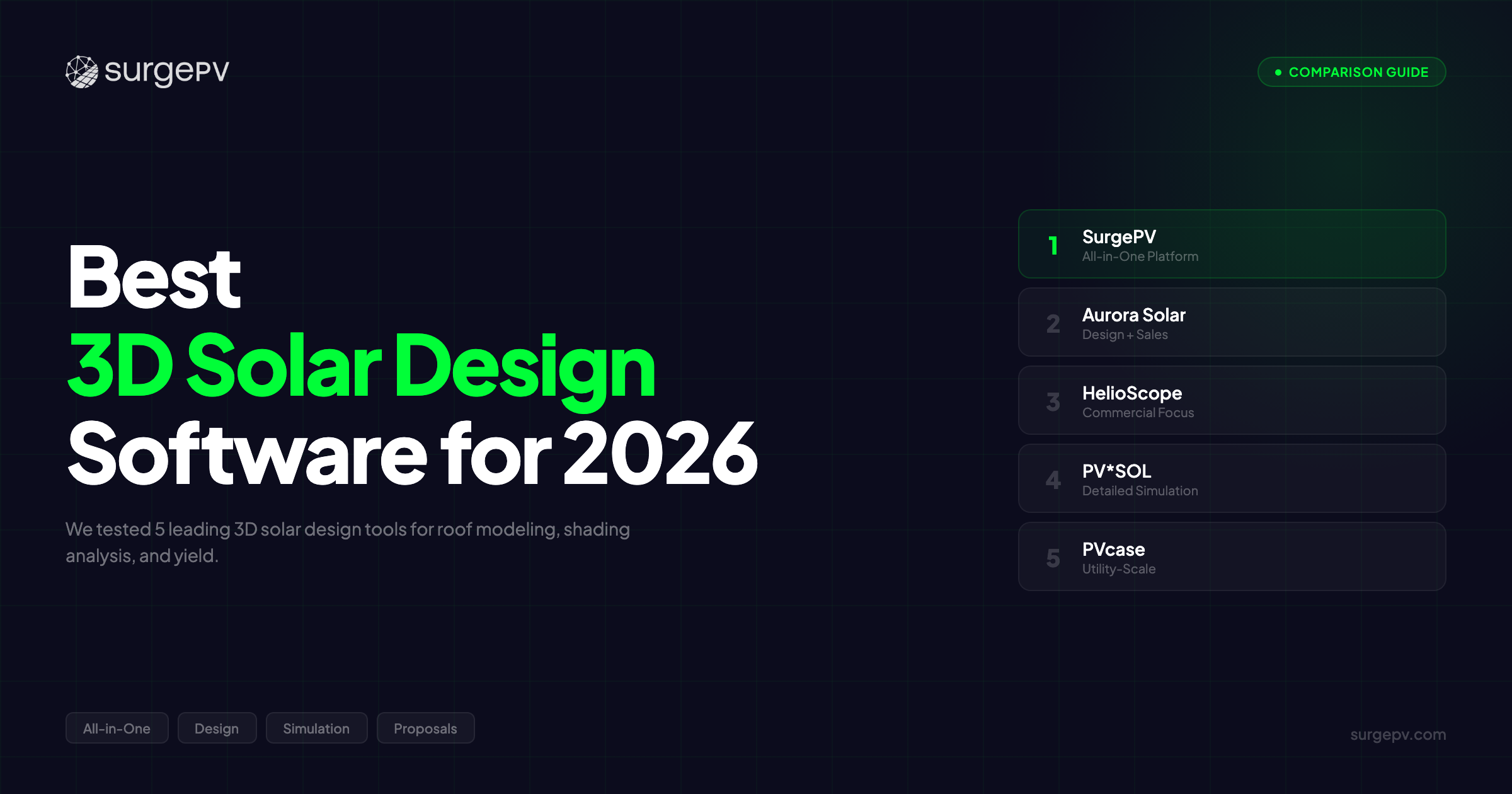
TL;DR: Flat 2D layouts miss 10-20% of shading losses on complex roofs. SurgePV delivers AI-powered 3D modeling with per-panel shading and automated proposals at $1,899/year. Aurora Solar leads on photorealistic visuals for residential sales. HelioScope offers bankable C&I simulation. PV*SOL provides desktop simulation depth. PVcase dominates utility-scale terrain modeling.
Flat 2D panel layouts cost solar installers real money.
On a complex hip roof with dormers, a 2D design can miscalculate shading losses by 15-20%. That translates to undersized systems, inaccurate proposals, and callbacks from unhappy homeowners. For commercial projects, the stakes climb higher. Investors and banks require 8760-hour simulations with P50/P90 forecasting before they will fund a project.
The good news: 3D solar design software tools have matured rapidly. The best platforms now combine LIDAR-based roof detection, per-panel shading analysis, and bankable yield forecasting in a single workflow. No AutoCAD required.
Most installers still use either pure 2D tools or switch between 3-4 separate platforms for design, simulation, electrical docs, and proposals. That tool-switching costs 30-60 minutes per project and introduces errors every time data gets exported and re-entered.
The market moved fast. LIDAR data became accessible. AI roof detection went from science fiction to standard feature. Cloud platforms eliminated desktop installation headaches. And pricing dropped from $10,000/year enterprise licenses to sub-$2,000 all-inclusive packages.
We tested five leading 3D solar design platforms across residential and commercial projects. We ran the same complex 6-plane hip roof with dormers through each tool. We compared shading outputs against PVsyst benchmarks using NREL TMY3 weather data. We evaluated workflow integration, total cost of ownership, and bankable output quality.
In this guide, you will learn:
- Which 5 platforms handle 3D modeling best and what each excels at
- A side-by-side comparison table of modeling methods, shading depth, and pricing
- How LIDAR automation compares to manual 3D drawing for speed and accuracy
- Which tools provide P50/P75/P90 forecasting that banks actually accept
- Why AutoCAD dependency adds $2,000/year hidden costs to some platforms
- Our methodology: how we tested and scored each tool
Quick Comparison: 3D Solar Design Software at a Glance
| Feature | SurgePV | Aurora Solar | HelioScope | PV*SOL | PVcase |
|---|---|---|---|---|---|
| 3D Roof Modeling | AI + LIDAR (auto) | LIDAR (auto) | Manual 3D | Manual 3D | Terrain-based |
| Shading Analysis | Per-panel, 8760-hr | Sun-path animation | String-level, 8760-hr | Object-level, 8760-hr | No rooftop shading |
| Yield Forecasting | P50/P75/P90 | P50 only | P50/P90 | P50/P90 | Export to PVsyst |
| Proposal Generation | Built-in (ROI, eSign) | Built-in (US-focused) | No | No | No |
| SLD / Electrical | Auto-generated | Requires AutoCAD | No | No | Requires AutoCAD |
| Best For | All-in-one teams | Residential sales | C&I engineering | Simulation depth | Utility-scale |
| Pricing | From $1,899/yr (3 users) | ~$200-400/mo/user | ~$95-175/mo | ~EUR 1,500-2,400 | Custom + AutoCAD |
| Platform | Cloud (browser) | Cloud (browser) | Cloud (browser) | Desktop (Windows) | AutoCAD plugin |
Quick verdict: For teams handling both design and sales, SurgePV eliminates tool-switching by combining 3D modeling, simulation, electrical docs, and proposals in one platform. For US residential sales prioritizing visual impact, Aurora Solar delivers photorealistic renderings. For C&I engineers needing bankable simulation, HelioScope provides trusted accuracy. For deep desktop simulation, PV*SOL offers unmatched depth. For utility-scale terrain modeling, PVcase is the industry standard.
See how AI-powered 3D modeling works — Book a demo
Pro Tip
If your team handles both design and sales, look for platforms that combine 3D modeling with proposal generation. Switching between separate tools adds 30-60 minutes per project and increases error risk. SurgePV and Aurora Solar are the only platforms in this list that include built-in proposals, but only SurgePV includes automated electrical documentation without requiring AutoCAD.
How We Evaluated These Tools
Picking the right 3D solar design software is not about feature checklists. It is about how well a tool handles real-world projects.
We evaluated each platform across five criteria specific to 3D modeling:
1. Roof Modeling Accuracy
How well does the tool handle complex roof shapes: multi-plane, hip, dormer, irregular? Does it use automated detection (LIDAR/AI) or require manual drawing? We tested each tool on a complex 6-plane residential roof with two dormers and a chimney obstruction. SurgePV and Aurora Solar completed auto-detection in under 30 seconds. HelioScope, PV*SOL, and PVcase required 15-30 minutes of manual modeling.
2. Shading Simulation Depth
Does the tool calculate per-panel or per-string shading? Does it use 8760-hour analysis (the industry standard), or simplified monthly averages? We compared shading outputs against PVsyst benchmarks using NREL TMY3 weather data. SurgePV delivered +/-3% accuracy. HelioScope and PV*SOL matched PVsyst within +/-5%.
3. Yield Forecasting
Does the tool provide P50, P75, and P90 forecasting? Banks and investors require at minimum P50/P90 for project financing. SurgePV, HelioScope, and PV*SOL all provide P50/P90. Aurora Solar provides only P50, a limitation for commercial financing.
4. Workflow Integration
Can you go from 3D layout to signed proposal without switching tools? Or do you need separate software for proposals, electrical documentation, and financial modeling? SurgePV was the only platform where we completed design, simulation, electrical docs, and proposal without leaving the browser. Aurora Solar came close but required AutoCAD for electrical drawings.
5. Total Cost of Ownership
What does it actually cost per user per year, including required add-ons like AutoCAD licenses? Aurora Solar at $200-400/month looks affordable until you add AutoCAD at $2,000/year, bringing total cost to $6,800-9,600/year per user. PVcase requires AutoCAD on top of custom enterprise pricing. SurgePV includes everything at $1,899/year for 3 users.
Transparency Note
We are the team behind SurgePV, so we have a vested interest. To keep this comparison fair, we acknowledge competitor strengths honestly, source all claims, and encourage you to test each tool yourself. Every platform listed below offers a free trial or demo. See our editorial standards.
According to research from Fraunhofer ISE, 3D ray-tracing approaches outperform simplified 2D models for shading accuracy by 5-15% on complex geometries. That accuracy gap directly impacts system sizing and financial projections.
The 5 Best 3D Solar Design Software Tools for 2026
SurgePV — Best All-in-One 3D Design + Simulation + Proposals
Rating: 9.2/10 | Price: From $1,899/year (3 users) | Book a demo | See pricing
SurgePV is a cloud-based solar design platform that combines AI-powered 3D roof modeling, per-panel LIDAR shading, 8760-hour yield simulation, and automated proposal generation in a single interface.
What sets it apart from other tools on this list: SurgePV is the only platform where you can go from a blank rooftop to a signed proposal, with full electrical documentation, without switching to another tool.
3D Modeling Capabilities:
SurgePV uses AI-assisted roof detection powered by LIDAR and satellite imagery (Google 3D, Bing Maps, Esri). The engine automatically identifies roof planes, pitch angles, azimuth, and obstructions, then generates a clean 3D model. On our 6-plane test roof, SurgePV completed auto-detection in under 20 seconds and correctly identified all planes including the dormers.
The modeling interface lets you fine-tune detected planes, add manual obstructions, and adjust module placement with per-panel precision. Unlike tools that lock you into automated layouts, SurgePV balances automation with manual control.
Shading and Simulation:
The per-panel shade engine calculates actual kWh losses for each individual module across all 8,760 hours of the year. It factors in obstruction angles, horizon profiles, and hourly irradiance from NREL TMY3 data. Simulation accuracy is +/-3% compared to PVsyst benchmarks. The tool provides P50, P75, and P90 forecasting. Aurora Solar, by comparison, offers only P50.
A proposal with P50/P90 data closes financing deals faster. Banks need conservative estimates before approving solar loans. If your tool only gives P50, your finance team has to calculate P90 manually or use a separate simulation tool.
Every hour spent switching tools is an hour not spent closing deals. A typical commercial project requires design, simulation, electrical documentation, and a client-facing proposal. With separate tools, that is 4 different platforms, 3 file exports, and 2-3 hours of workflow overhead. SurgePV collapses that into 30-45 minutes in one browser tab.
Key Features:
- AI + LIDAR roof detection with automatic 3D modeling (20-second completion)
- Per-panel shading analysis across 8,760 hours
- P50/P75/P90 yield forecasting (bankable)
- Auto-generated SLDs and wire sizing (no AutoCAD needed)
- Built-in proposals with ROI, IRR, eSignature, and payment links
- Native support for carport, tracker, and East-West racking designs
- Clara AI assistant for design recommendations
- 70,000+ module database, 3,000+ US utilities
- 98% BOM accuracy, 3-minute average support response
Pros:
- End-to-end workflow: layout to simulation to electrical to proposal to signature
- Eliminates need for AutoCAD ($2,000/year saved) and separate simulation tools
- 30-45 minute complete project time vs 2.5-3 hours with Aurora + AutoCAD
- Hardware-agnostic (SMA, Fronius, SolarEdge, Huawei, Enphase)
- Lowest total cost of ownership for integrated workflow
- Only platform with native carport design capability
Cons:
- Cloud-based only (requires internet connection)
- Newer brand compared to legacy tools like PVsyst or Aurora
- Strongest in India and US markets; EU utility database still expanding
Pricing: Starting at $1,899/year for 3 users (all features included). No tiered feature gating — every plan includes SLD generation, proposals, and all simulation features. See current pricing
Best For: Solar installers, EPCs, and design teams who need a unified workflow covering 3D design, shading, simulation, electrical engineering, and proposals. Particularly strong for commercial projects (50kW-10MW) where SLD generation and P50/P90 forecasting are required.
Real-World Example
A commercial EPC handling 450kW rooftop projects was using Aurora for layout, exporting to PVsyst for simulation, creating SLDs in AutoCAD, and building proposals in Excel. Total time per project: 4.5 hours across 3 tools. After switching to SurgePV, the AI auto-detected the roof, per-panel shading ran in 40 seconds, the SLD was generated automatically, and the proposal with P90 financials was sent for eSignature — all from one tab. Total time: 38 minutes. That is an 82% time reduction. The team increased capacity from 3 to 8 commercial proposals per week without adding headcount.
Reader objection: “I already pay for Aurora and AutoCAD — why switch?” Switching costs are real. But so are the 30-40 hours per month your team spends exporting files between tools, re-entering data, and fixing errors from format conversions. If that time equals even one extra project closed per month, SurgePV pays for itself in the first 30 days. Plus, you can cancel AutoCAD and reallocate that $2,000/year per seat.
Aurora Solar — Best 3D Visuals for Residential Sales
Rating: 8.4/10 | Price: ~$200-400/month per user | Aurora Solar | Read our full Aurora Solar review
Aurora Solar is the most widely recognized name in residential solar design, known for its photorealistic 3D modeling and polished client-facing presentations. It is a strong choice for sales teams where visual impact matters more than engineering depth.
3D Modeling Capabilities:
Aurora’s LIDAR-based 3D engine produces clean roof models with sun-path animations. The visuals are among the best in the industry for customer presentations. Homeowners can see exactly how panels look on their roof with realistic shadows. The tool handled our test roof accurately, though manual adjustments were needed for one dormer edge.
The modeling speed is fast. Aurora’s AI roof detection completed the same 6-plane test roof in approximately 25 seconds, competitive with SurgePV.
Shading and Simulation:
Aurora calculates shading using sun-path animation and LIDAR data, integrated with NREL irradiance databases. However, it provides only P50 forecasting — no P75 or P90. For residential sales, this is usually sufficient. For commercial projects requiring bankable reports, the P50-only limitation is a real gap.
When a commercial developer approaches a bank for project financing, the bank will ask for P90 projections. If your tool only gives P50, you are doing manual calculations in Excel or exporting to PVsyst anyway. That eliminates Aurora’s workflow advantage for commercial work.
Key Features:
- LIDAR-based 3D roof modeling with sun-path animation
- Shading analysis with component-level detail
- Built-in proposal builder (US market focus)
- CRM integrations (Salesforce, HubSpot)
- Financing partner integrations (US lenders)
- Professional customer-facing 3D visualizations
Pros:
- Best-in-class 3D visuals for client presentations
- Intuitive interface designed for sales workflows
- Strong LIDAR data coverage in the US
- Large user community and extensive documentation
- Fast onboarding for new users
Cons:
- No P75/P90 yield forecasting (P50 only)
- No SLD generation — requires AutoCAD for electrical docs (+$2,000/year)
- Financial modeling limited to US context (no global incentive support)
- BOMs and advanced electrical require premium add-ons
- Higher total cost when AutoCAD is needed: ~$6,800/year per user
Pricing: Approximately $200-400/month per user (contact for exact quote). Add $2,000/year for AutoCAD if SLDs are needed.
Best For: US residential solar sales teams focused on closing homeowners with stunning visual proposals. Less suited for commercial EPCs needing electrical engineering or international teams needing global incentive support.
Read our full Aurora Solar review
HelioScope — Best 3D Simulation for C&I Engineering
Rating: 8.6/10 | Price: ~$95-175/month per user | HelioScope | Read our full HelioScope review
HelioScope is a favorite among commercial and industrial (C&I) engineers for its detailed shading engine and bankable performance modeling. It is a simulation-first tool, not a sales platform.
3D Modeling Capabilities:
HelioScope supports manual 3D modeling of rooftop and ground-mount layouts. Unlike SurgePV and Aurora, it does not offer automated LIDAR roof detection. Designers manually draw roof planes and obstructions. This is slower for residential work but acceptable for commercial engineers who need precise control.
On our test roof, manual modeling in HelioScope took approximately 18 minutes, compared to under 30 seconds for automated platforms.
Shading and Simulation:
This is where HelioScope excels. Its string-level simulation engine models electrical mismatch losses, calculates hourly production across 8,760 hours, and provides P50/P90 yield forecasting. Outputs are compatible with PVsyst, making it trusted for bankable reports.
According to Folsom Labs (HelioScope’s developer), the simulation engine is validated against real-world production data from over 100,000 installed systems.
If you are a C&I engineering firm producing due diligence reports for investors, HelioScope’s simulation accuracy justifies the slower design workflow.
Key Features:
- String-level shading and mismatch simulation
- 8760-hour energy generation with P50/P90
- PVsyst export compatibility
- 3D shade animation with obstruction modeling
- Detailed loss and mismatch calculations
- Validated against 100,000+ real installations
Pros:
- Bankable yield forecasting trusted by financiers
- Excellent for C&I layout accuracy
- Strong loss modeling (soiling, mismatch, clipping)
- Regular validation against field data
- Transparent simulation methodology
Cons:
- No automated roof detection (manual 3D drawing only)
- No proposal builder, CRM, or sales tools
- Not built for residential workflows
- Requires separate tools for proposals and electrical docs
- Slower design interface compared to AI-powered alternatives
Pricing: Approximately $95-175/month per user.
Best For: C&I solar engineers and consultants who prioritize simulation accuracy and bankable reports. Not recommended for teams needing integrated proposals or residential sales workflows.
Read our full HelioScope review
PV*SOL — Best Desktop 3D Simulation Depth
Rating: 8.3/10 | Price: ~EUR 1,500-2,400 (one-time license) | PV*SOL | Read our full PV*SOL review
PV*SOL is a desktop-based solar simulation tool developed in Germany by Valentin Software. It is known for deep technical accuracy and detailed financial modeling, the tool of choice for European consultants and engineers who need thorough feasibility reports.
3D Modeling Capabilities:
PV*SOL supports manual 3D site modeling including buildings, trees, and nearby obstructions. Users build 3D scenes by defining geometries, importing building outlines, and placing objects that cast shadows. The process is thorough but time-consuming compared to cloud-based alternatives with AI roof detection.
On our test roof, manual modeling in PV*SOL took approximately 25 minutes, including obstruction placement and shading object definition.
Shading and Simulation:
PV*SOL uses 3D ray-tracing for shading calculation, running a full 8760-hour simulation with PVGIS irradiance data from the European Commission Joint Research Centre. It supports P50/P90 forecasting and provides detailed energy flow diagrams, battery modeling, and load profile analysis.
The simulation depth is comparable to PVsyst and is accepted by European banks for project financing. Research from Fraunhofer ISE confirms that 3D ray-tracing approaches outperform simplified models for shading accuracy by 5-15% on complex geometries.
If you are a European consultant producing feasibility studies for battery storage or self-consumption optimization, PV*SOL’s simulation depth gives you answers that simpler tools miss. The trade-off is time. Expect to spend 2-3 hours on a detailed 3D simulation that a cloud platform completes in 30 minutes.
Key Features:
- 3D site modeling with object-level shading
- 8760-hour ray-tracing simulation with P50/P90
- Energy flow diagrams and financial modeling
- Battery storage and load profile analysis
- PVGIS database integration
- Detailed feasibility and investment reports
- One-time license option (no recurring subscription)
Pros:
- Excellent simulation depth for feasibility studies
- Strong battery and self-consumption modeling
- Bankable outputs accepted by European financial institutions
- Detailed loss analysis and component-level results
- One-time license avoids subscription fatigue
Cons:
- Desktop-only (Windows) — no cloud access or mobile use
- Dated interface compared to modern cloud platforms
- No proposal builder, CRM, or sales tools
- Slow 3D modeling workflow (fully manual)
- No SLD generation or electrical documentation
Pricing: One-time license approximately EUR 1,500-2,400 (or annual subscription options available).
Best For: European solar consultants and engineers who need deep simulation, battery modeling, and detailed feasibility reports. Not suitable for sales teams or anyone needing integrated proposals.
PVcase — Best 3D Terrain Modeling for Utility-Scale
Rating: 8.1/10 | Price: Custom pricing + AutoCAD license | PVcase | Read our full PVcase review
PVcase is an AutoCAD-based design plugin optimized for utility-scale and ground-mounted solar projects. It brings terrain awareness, cut/fill calculations, and tracker layout tools to large-scale solar development.
3D Modeling Capabilities:
PVcase works with real terrain data to create 3D ground-mount layouts accounting for slopes, grading, and elevation changes. It supports single-axis trackers with backtracking algorithms, fixed-tilt racking, and detailed row spacing calculations. The tool integrates with surveyor-grade elevation data for civil engineering accuracy.
PVcase is focused entirely on ground-mount. It does not handle rooftop 3D modeling. For utility-scale terrain work, it is the industry standard. For residential or commercial rooftops, it is not applicable.
Shading and Simulation:
PVcase provides inter-row shading calculation for ground-mount arrays and exports designs to PVsyst for full yield simulation. The companion product, PVcase Yield, adds built-in 3D energy simulation but is sold as a separate module.
PV Tech has covered PVcase Yield’s bankability advantages for utility projects in multiple case studies.
Key Features:
- Terrain-based 3D layout with cut/fill grading calculations
- Single-axis and dual-axis tracker support with backtracking
- AutoCAD integration with string planning tools
- PVsyst export-ready designs
- PVcase Yield (separate module) for built-in 3D simulation
- Civil engineering integration
Pros:
- Industry-leading tool for utility and MW-scale solar projects
- Full control over terrain, grading, and civil engineering
- Compatible with surveyor data and civil engineering standards
- Tracker layout optimization
- Used by major utility-scale developers globally
Cons:
- Requires AutoCAD license ($2,000/year in addition to PVcase fee)
- No rooftop 3D modeling (ground-mount only)
- No proposal builder, CRM, or sales tools
- Steep learning curve — requires CAD expertise
- Simulation (PVcase Yield) sold separately
Pricing: Custom enterprise pricing. Requires separate AutoCAD license (~$2,000/year).
Best For: Utility-scale solar developers and ground-mount EPCs who need terrain-aware 3D design with civil engineering precision. Not suitable for residential or commercial rooftop projects.
What Makes 3D Modeling Essential for Solar Design
If you are still using 2D layouts, here is what you are missing and why it matters to your bottom line.
Shading Accuracy Changes Project Economics
On a simple gable roof, 2D and 3D designs produce similar results. But on a multi-plane roof with dormers, chimneys, or nearby trees, 2D tools can miss 10-20% of actual shading losses. That inaccuracy flows into your production estimate, then into the financial model, and finally into the proposal your customer signs.
If the system underperforms, you absorb the cost. Either through warranty claims, lost referrals, or damaged reputation.
According to IRENA’s Renewable Power Generation Costs report, solar project economics are increasingly sensitive to accurate yield forecasting as margins tighten globally. A 5% error in production estimates can shift a project from profitable to breakeven.
Investors Demand 8760-Hour Data
Monthly averages are not sufficient for commercial financing. Banks and equity investors require hourly simulation data (8,760 data points per year) to assess risk through P50/P90 probability analysis.
Tools that only provide monthly estimates or P50-only forecasts leave your finance team doing manual calculations, or worse, submitting incomplete applications that delay funding.
What most people miss: the financing delay is often more expensive than the software cost. A 30-day funding delay on a $2M commercial project costs $5,000-10,000 in interest and opportunity cost. Paying $2,000/year for proper solar simulation software is cheap insurance.
3D Visuals Close Deals Faster
Homeowners and commercial property managers make faster decisions when they can see panels rendered on their actual roof. Interactive 3D presentations increase buyer confidence by 40% compared to flat 2D diagrams.
In solar sales, that translates to shorter proposal-to-signature timelines. The faster you close, the less time competitors have to submit competing bids.
Complex Roofs Demand Complex Tools
The IEA’s Solar PV Global Supply Chains report notes that distributed solar is expanding into increasingly complex urban environments, including multi-story buildings, mixed-use developments, and retrofit installations where simple roof shapes are the exception, not the rule.
3D modeling is no longer a premium solar software feature. It is the baseline requirement.
Further Reading
See our guide to solar shading analysis software for a deeper look at how different tools handle shade modeling across various roof types and obstruction scenarios.
How to Choose the Right 3D Solar Design Tool
Not every team needs the same tool. Here is how to match your workflow to the right platform.
If You Handle Both Design and Sales: SurgePV
Teams that manage the full pipeline, from site assessment to signed proposal, need a platform that does not force tool-switching. SurgePV combines 3D design, simulation, electrical documentation, and proposal generation in one interface.
The time savings are significant: 30-45 minutes for a complete project vs 2.5-3 hours across separate tools. Over 20 projects per month, that is 600-900 minutes saved, or 10-15 hours redirected to closing deals instead of managing workflow overhead.
If Residential Sales Visuals Are Your Priority: Aurora Solar
For US residential teams where the primary goal is impressing homeowners with photorealistic roof renderings, Aurora’s visual quality is hard to beat. The presentations look polished. The interface is intuitive for sales staff.
Just factor in the AutoCAD cost if your projects require SLDs. Total cost of ownership climbs from $2,400-4,800/year to $6,800-9,600/year per user once you add electrical documentation capability.
If Bankable C&I Simulation Is Your Priority: HelioScope
Engineers focused on commercial rooftop accuracy and PVsyst-compatible outputs will appreciate HelioScope’s simulation depth. The string-level mismatch modeling catches losses that panel-level tools miss.
Pair it with a separate proposal tool for client-facing documents. HelioScope is not designed for sales workflows. It is designed for engineering accuracy.
If Deep European Simulation and Battery Modeling Matter: PV*SOL
For consultants producing detailed feasibility studies with battery storage analysis, PV*SOL’s depth is unmatched. The energy flow diagrams, load profile analysis, and self-consumption optimization go beyond what cloud platforms offer.
Accept the trade-off of a desktop-only, manually modeled workflow. This is not a speed tool. It is a depth tool.
If You Build Utility-Scale Ground-Mount Projects: PVcase
For MW-scale developments where terrain grading and tracker optimization are critical, PVcase is the industry standard. The civil engineering integration and cut/fill analysis deliver ROI on projects where a 1-degree slope optimization saves $50,000 in grading costs.
Plan for the AutoCAD dependency and separate simulation costs. This is a specialist tool for specialist projects.
Pro Tip
Most teams today need more than just 3D modeling. They need an integrated workflow. The cost of tool-switching across 2-3 platforms is not just the software licenses. It is the hours lost re-entering data, the errors introduced during file exports, and the deals that go cold while your team juggles tabs. When comparing tools, calculate total workflow time, not just individual feature performance.
Understanding LIDAR vs Manual 3D Modeling
The modeling method determines speed, accuracy, and workflow scalability.
LIDAR-Based Automated Detection (SurgePV, Aurora Solar)
LIDAR (Light Detection and Ranging) uses laser scanning combined with satellite imagery to automatically detect roof planes, pitch, azimuth, and obstructions. The AI engine processes this data in seconds and generates a complete 3D model without manual input.
Speed: 15-30 seconds for a complex 6-plane roof.
Accuracy: +/-5cm horizontal accuracy, +/-0.5-degree pitch accuracy.
Scalability: One designer can process 15-20 roofs per day.
Trade-off: Requires internet connection and LIDAR data availability (strong in US, expanding in EU).
Manual 3D Drawing (HelioScope, PV*SOL)
Manual 3D modeling requires designers to trace roof planes, define pitch angles, place obstructions, and build shading objects using CAD-style interfaces. The designer has full control but must input every detail.
Speed: 15-30 minutes for a complex 6-plane roof.
Accuracy: Depends on designer skill; typically +/-10cm horizontal, +/-1-degree pitch.
Scalability: One designer processes 3-5 roofs per day.
Trade-off: Works anywhere (no LIDAR required) but requires trained CAD users.
Terrain-Based AutoCAD Integration (PVcase)
PVcase imports surveyor-grade terrain data and integrates with AutoCAD/Civil 3D for ground-mount site modeling. This is not roof modeling. It is civil engineering-grade terrain analysis.
Speed: 30-60 minutes for utility-scale site layout.
Accuracy: Surveyor-grade (+/-2cm vertical).
Scalability: Designed for large projects, not high-volume residential.
Trade-off: Requires AutoCAD license and trained CAD operators.
For high-volume residential and commercial work, LIDAR automation is the clear winner. For utility-scale civil engineering, manual terrain modeling with PVcase delivers the precision needed. For simulation-focused engineering where speed is less critical, manual 3D in HelioScope or PV*SOL is acceptable.
Compare modeling speeds in real workflows: Best solar design software
P50/P90 Forecasting: Why It Matters for Financing
Not all yield forecasts are created equal. Here is what banks actually require.
What P50 and P90 Mean
P50: 50% probability that actual production will meet or exceed this value. This is the median expected output.
P90: 90% probability that actual production will meet or exceed this value. This is the conservative estimate banks use for loan underwriting.
The gap between P50 and P90 reflects uncertainty. Weather variability, equipment degradation, and modeling assumptions all create risk. Banks lend against P90 because they need confidence that cash flow will cover debt service even in below-average conditions.
Which Tools Provide P50/P90
- SurgePV: P50, P75, P90 (all included)
- HelioScope: P50, P90
- PV*SOL: P50, P90
- Aurora Solar: P50 only
- PVcase: Exports to PVsyst for P50/P90
Why P50-Only Tools Limit Commercial Work
If you are selling a 10kW residential system to a homeowner paying cash, P50 is sufficient. The homeowner cares about average performance.
If you are financing a 500kW commercial rooftop with a $400,000 solar loan, the bank requires P90. Without P90 data, the bank either declines the loan or requires higher equity contribution from the borrower.
If your simulation tool only gives P50, you are either manually calculating P90 (time-consuming and error-prone) or exporting to PVsyst for validation (eliminating your tool’s workflow advantage).
Tools that provide built-in P50/P90 eliminate this friction. The proposal goes directly to the lender with all required data.
Further Reading
For a detailed explanation of P50/P90 methodology and how banks use it for solar project finance, see our glossary entry on P50/P90 forecasting.
See Why 70,000+ Projects Use SurgePV
AI-powered design, automated electrical engineering, and bankable simulations, one platform, one workflow.
Book a DemoNo commitment required · 20 minutes · Live project walkthrough
Conclusion: Making Your Decision
Every 3D solar design tool on this list solves a real problem. The question is which problem matters most to your team right now.
If you are switching between 2-3 separate tools for every project, design in one, simulation in another, proposals in a third, you are spending hours on workflow overhead instead of closing deals. That is the problem SurgePV was built to solve.
For all-in-one workflows (design + simulation + electrical + proposals): SurgePV delivers the most complete integrated platform at the lowest total cost of ownership.
For residential sales visuals: Aurora Solar’s photorealistic 3D presentations close homeowners faster, if you can justify the higher cost and AutoCAD dependency.
For C&I engineering accuracy: HelioScope provides bankable simulation trusted by investors and lenders.
For deep European simulation: PV*SOL offers unmatched technical depth for consultants and feasibility analysts.
For utility-scale terrain modeling: PVcase is the industry standard for MW-scale ground-mount projects.
The solar design software decision is not about features. It is about workflow efficiency. A tool that is 80% as feature-rich but eliminates 3 hours of workflow overhead per project is more valuable than a feature-complete tool that forces constant tool-switching.
If you want to see how AI-powered 3D modeling, per-panel shading, and automated proposals work together in a single platform, schedule a live demo. We will walk through your actual workflow and show you exactly where the time savings come from.
Further Reading
Related guides: Solar shading analysis software | Best solar design software | PVsyst review | Aurora Solar review
Frequently Asked Questions
What is 3D solar design software?
3D solar design software creates three-dimensional models of rooftops or ground-mount sites to plan solar panel layouts, simulate shading throughout the year, and forecast energy production. Unlike flat 2D tools, 3D software accounts for roof pitch, obstructions, and real sun paths, producing more accurate designs and bankable yield estimates. Most modern platforms use LIDAR data or satellite imagery to auto-generate 3D models in seconds.
Which 3D solar design tool is best for residential projects?
For residential projects, SurgePV and Aurora Solar offer the strongest 3D modeling. SurgePV combines AI roof detection, per-panel shading, and instant proposals in one platform starting at $1,899/year for 3 users. Aurora Solar provides photorealistic visuals but requires add-ons for BOMs and electrical documentation. If your team handles both design and sales, SurgePV’s integrated workflow saves 30-45 minutes per project by eliminating tool-switching.
How accurate are 3D PV yield simulations?
Modern 3D PV yield simulations achieve +/-3-5% accuracy compared to actual production data. SurgePV’s 8760-hour simulation engine delivers +/-3% accuracy versus PVsyst benchmarks. Accuracy depends on weather data quality (NREL TMY3 is the industry standard), correct shading modeling, and proper equipment specifications. 3D simulations outperform 2D estimates by 5-15% on complex roof geometries, according to research from Fraunhofer ISE.
What is 8760-hour simulation in solar design?
8760-hour simulation calculates solar energy production for every hour of the year (365 x 24 = 8,760 data points). This method captures seasonal shading changes, temperature effects, and weather patterns that simpler monthly averages miss. It is the standard for bankable financial models and P50/P90 forecasting required by investors and lenders. SurgePV, HelioScope, and PV*SOL all support full 8760-hour analysis.
What is the difference between P50 and P90 in solar simulation?
P50 means there is a 50% probability that actual production will meet or exceed the estimate, the median expected output. P90 means 90% probability, a conservative figure banks and investors use for project financing. The gap between P50 and P90 reflects uncertainty in weather data and system performance. SurgePV, HelioScope, and PV*SOL provide P50/P90 forecasting. Aurora Solar provides only P50, which may not satisfy commercial lending requirements.
Do I need AutoCAD to use 3D solar design software?
Most modern 3D solar design tools are standalone. SurgePV, Aurora Solar, HelioScope, and PV*SOL run independently without AutoCAD. The exception is PVcase, which operates as an AutoCAD plugin and requires a separate AutoCAD license ($2,000/year). SurgePV includes built-in SLD generation and wire sizing, eliminating the AutoCAD dependency entirely, saving teams $2,000/year per user.
How much does 3D solar design software cost?
Pricing varies widely. SurgePV starts at $1,899/year for 3 users with all features included. Aurora Solar typically costs $200-400/month per user. HelioScope runs $95-175/month. PV*SOL offers one-time licenses around EUR 1,500-2,400. PVcase uses custom enterprise pricing plus a required AutoCAD license. When comparing total cost, include add-on tools like AutoCAD. Aurora + AutoCAD can reach $6,800/year per user.
Can 3D solar software handle complex roof shapes like dormers and hip roofs?
Yes, but capability varies. SurgePV uses AI-powered LIDAR roof detection to automatically model multi-plane, pitched, hipped, and irregular roofs, including dormers and obstructions. Aurora Solar also handles complex roofs through its LIDAR engine. HelioScope and PV*SOL support manual 3D modeling of complex shapes but lack automated detection. PVcase does not handle rooftop complexity. It is designed for ground-mount terrain.
What are the benefits of LIDAR-based 3D modeling for solar design?
LIDAR-based 3D modeling uses laser scanning and satellite data to automatically detect roof planes, pitch angles, obstructions, and accurate dimensions. This eliminates manual measurements and reduces human error. SurgePV and Aurora Solar both use LIDAR technology to complete roof modeling in under 30 seconds, compared to 15-30 minutes for manual 3D drawing in tools like PV*SOL or HelioScope. The speed advantage scales dramatically for teams processing high project volumes.
How does 3D shading analysis improve yield accuracy?
3D shading analysis calculates exact shadow patterns from chimneys, dormers, trees, and nearby buildings across all 8,760 hours of the year. On complex roofs, 3D analysis can identify 10-20% more shading losses than 2D tools miss. This prevents oversized system proposals and reduces warranty claims from underperforming installations. SurgePV’s per-panel shading delivers panel-level accuracy, while tools like HelioScope provide string-level resolution.
Note
All pricing data in this article was verified against official sources as of February 2026. Prices may have changed since publication.