

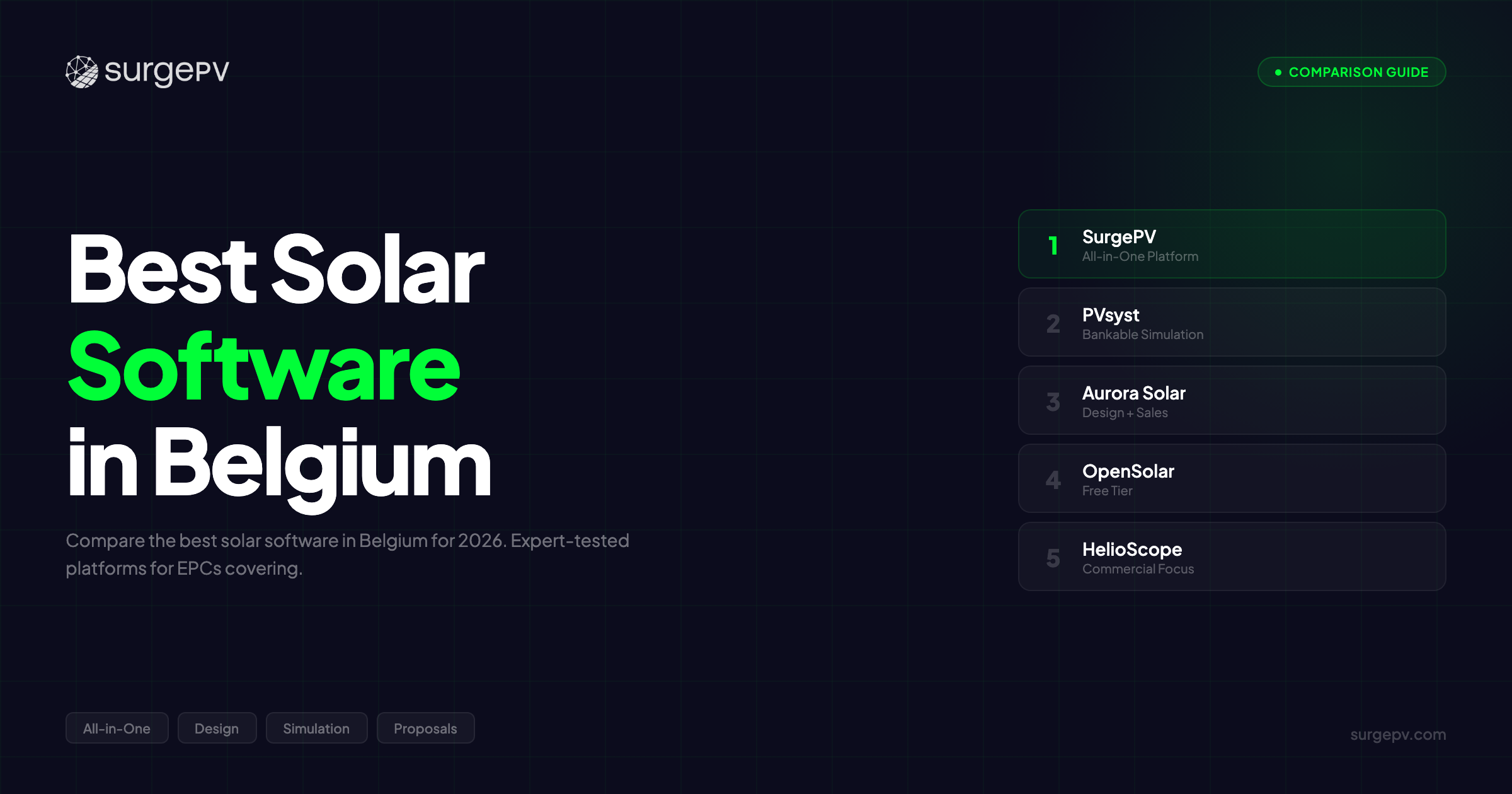
TL;DR: SurgePV is the best all-in-one solar software for Belgian EPCs and installers in 2026, combining design, electrical engineering, simulation, and proposals in one platform. PVsyst remains essential for bank-financed projects. Aurora Solar leads for high-volume Flemish residential. OpenSolar offers the most affordable entry point for small teams.
Belgium’s solar market is growing fast. 8.3 GW installed. 12-14 GW targeted by 2030 (APERe, Elia). That is 45-70% growth in six years.
But here is what most software vendors do not tell you: Belgium is not one solar market. It is three.
Flanders (66% of capacity) ended net metering in 2020. Prosumer tariff: EUR 57.91/kW (VREG). Wallonia (26%) offers green certificates worth EUR 85-95 each (CWaPE). Brussels (8%) still has net metering plus green certificates and Prime Energie subsidies (Brugel).
Three regions. Three regulatory systems. One country.
No single platform natively models all three Belgian frameworks. But some handle the regional differences far better than others — and the wrong choice costs you 2-3 hours of wasted time per project, EUR 1,800/year in unnecessary AutoCAD licensing, and DSO approval delays that cost you deals.
We tested 5 solar software platforms across Flanders, Wallonia, and Brussels to find the best options for Belgian EPCs, installers, and consultants in 2026.
In this guide, you will learn:
- Which platform handles Belgian DSO approvals (Fluvius, ORES, Sibelga) best
- How to choose between all-in-one platforms and specialized tools
- Pricing comparisons including hidden costs (AutoCAD, tool-switching time)
- Our recommendation by region, business size, and project type
Editorial Independence
SurgePV publishes this guide. We reviewed competing platforms objectively, listed their strengths, and recommend them where they genuinely fit the use case better. Our goal is to help Belgian EPCs pick the right tool, not to win every comparison.
Quick Comparison Table
| Software | Best For | Key Limitation | Ideal Project Type | Starting Price |
|---|---|---|---|---|
| SurgePV | Belgian EPCs needing end-to-end workflow (design, SLDs, simulation, proposals) in one platform | Green certificate modeling requires manual input for Wallonia | Commercial 50-500 kW, multi-regional operations, teams eliminating AutoCAD | ~EUR 1,200-1,760/user/year |
| PVsyst | Projects requiring bank-accepted simulation reports; Belgian financiers’ gold standard | No design or proposal tools; requires separate software for complete workflow | Commercial above 500 kW, utility-scale, projects needing financing approval | ~EUR 1,150 one-time |
| Aurora Solar | High-volume Flemish residential with AI roof modeling; most polished visual proposals | No automated SLD generation (requires AutoCAD at EUR 1,800/year); P50-only simulation | Flemish residential high-volume, sales teams prioritizing proposal aesthetics | EUR 3,565+/user/year |
| OpenSolar | Budget-conscious small teams doing simple residential projects | No SLD generation, limited simulation depth (P50 only), basic electrical engineering | Flemish residential under 20 kW, small installers with fewer than 10 projects/month | EUR 900-1,685/year |
| HelioScope | Commercial projects needing detailed shading analysis and accurate P50/P75/P90 estimates | No automated SLD generation (requires AutoCAD); limited proposal customization | Commercial 100-1000 kW, developers doing feasibility studies | EUR 1,800-3,000/year |
Pro Tip
The “total cost of ownership” is the real number. Aurora Solar at EUR 1,765-2,875/year looks competitive until you add AutoCAD (EUR 1,800/year) for electrical documentation and 2-3 hours of manual labor per project. Factor in these hidden costs before deciding.
Why Solar Projects in Belgium Require Specialized Software
Three regions, three regulatory systems
Flanders operates under VREG with a prosumer tariff (EUR 57.91/kW) that makes self-consumption optimization the key to positive ROI. Fluvius handles grid connections.
Wallonia operates under CWaPE with green certificates (approximately 2.5 certificates/MWh for commercial, valued at EUR 85-95 each) as the primary incentive. ORES and Resa handle grid connections.
Brussels operates under Brugel with net metering (1:1 compensation, ending 2027-2028), green certificates (3 certificates/MWh for under 5 kWp), and Prime Energie subsidies (EUR 2,500-3,500). Sibelga handles grid connections.
DSO grid approvals require electrical documentation
Fluvius, ORES, and Sibelga all require IEC 61727-compliant electrical documentation for grid connection. Single Line Diagrams, wire sizing calculations, and protection system specifications are mandatory for commercial systems above 10 kW.
Without automated SLD generation, that is 2-3 hours of AutoCAD work per project.
Belgian banks demand bankable simulations
KBC, BNP Paribas Fortis, Belfius, and ING Belgium require conservative P50/P75/P90 production estimates for commercial project financing. P50-only tools do not meet these requirements. As SolarPower Europe notes, bankability standards across European markets are tightening — and Belgium is no exception.
Belgium has Europe’s highest electricity prices
Residential rates of EUR 0.27-0.32/kWh and commercial rates of EUR 0.18-0.22/kWh mean solar ROI is strong in Belgium — but only if your software models self-consumption economics accurately. Get the self-consumption ratio wrong by 10%, and your customer’s payback projection is off by 1-2 years.
Local Project Workflow and Technical Requirements
Belgium’s solar projects follow a region-specific workflow that requires software to handle distinct technical and regulatory steps.
1. Grid Connection Process
- Flanders (Fluvius): Online connection portal requires IEC 61727-compliant electrical documentation uploaded as PDF. Manual AutoCAD SLDs take 2-3 hours; automated tools reduce this to 5-10 minutes.
- Wallonia (ORES/Resa): Grid connection applications require wire sizing calculations and protection system specifications for systems above 10 kW.
- Brussels (Sibelga): Similar requirements with additional documentation for green certificate eligibility verification.
2. Financial Modeling Requirements
Belgian banks (KBC, BNP Paribas Fortis, Belfius, ING Belgium) require P50/P75/P90 production estimates for commercial solar financing. Software that only provides P50 estimates does not meet bankability standards for projects above 100 kW.
3. Regional Incentive Optimization
Accurate self-consumption modeling is important because incentive structures vary by region. In Flanders, the prosumer tariff (EUR 57.91/kW) makes self-consumption economics the primary ROI driver. In Wallonia, green certificate values (EUR 85-95 each) require precise annual production estimates. Software that cannot model region-specific incentives produces inaccurate financial projections.
4. Required Engineering Documents
- Single Line Diagrams (IEC 61727-compliant)
- DC/AC wire sizing calculations
- Protection system specifications
- Voltage drop analysis
- RGIE (Belgian electrical code) compliance documentation
5. Typical EPC Workflow Steps
- Site assessment and shading analysis
- Initial design and layout optimization
- Energy production simulation (8760-hour analysis)
- Electrical engineering (SLD, wire sizing, protection)
- Financial modeling with region-specific incentives
- Proposal generation with visual renderings
- Grid connection documentation submission
Software that handles all seven steps reduces the design-to-proposal timeline from 3+ hours (multi-tool workflows) to 45-60 minutes (integrated platforms like SurgePV).
Top Software Options for Belgium
SurgePV — Best All-in-One Solar Platform for Belgium
SurgePV is the only platform that combines solar design, electrical engineering, bankable simulation, and proposal generation in a single cloud-based workflow.
For Belgian EPCs, a 50 kW commercial project goes from initial design to final proposal in 45 minutes — versus 3+ hours juggling Aurora, AutoCAD, PVsyst, and Excel.
Key capabilities for Belgium
- Automated SLD generation — IEC 61727-compliant documentation for Fluvius, ORES, and Sibelga in 5-10 minutes
- Wire sizing calculations (DC/AC, voltage drop analysis) meeting RGIE requirements — no manual cross-referencing code tables, zero risk of undersized cables failing inspection
- P50/P75/P90 production estimates accepted by Belgian banks — your financing applications include the bankability data lenders actually require
- 8760-hour shading analysis with +/-3% accuracy vs. PVsyst
- Native carport solar design — the only platform offering this. With Belgium’s growing commercial carport mandates, this is a competitive differentiator, not a nice-to-have
- Solar tracker support for emerging ground-mount projects
- Cloud-based multi-user workflows for multi-regional Belgian EPCs
Pros
- End-to-end platform — design, engineering, simulation, and proposals in one tool
- Eliminates AutoCAD — saves EUR 1,800/year per user
- Bankable P50/P75/P90 — accepted by Belgian financiers
- Significantly faster complete workflow (45 min vs. 3+ hours with Aurora+AutoCAD+Excel)
- Transparent pricing — EUR 1,200-1,760/user/year, all features included
Cons
- Regional tariff modeling requires manual input (Fluvius, ORES, Sibelga rates not pre-loaded)
- Green certificate revenue needs manual configuration for Wallonia and Brussels
- Module database may not include all Belgian-specific distributor catalogs
Pricing
- Individual Plan: $1,899/year (for 3 users) = ~EUR 585/user/year
- For 3 Users Plan: $1,499/user/year = ~EUR 1,385/user/year
- For 5 Users Plan: $1,299/user/year = ~EUR 1,200/user/year
- Enterprise: Custom pricing for large Belgian EPCs
Did You Know?
SurgePV at $1,499/user/year vs. Aurora+AutoCAD at $6,800/year per user saves over $5,301 per user annually. For a 5-person Belgian EPC team, that is more than $26,000/year in software cost savings alone.
Real-World Example
A growing EPC in Flanders with both residential and commercial projects was paying over $12,000/year for separate design, simulation, and CAD licenses — and still spending 15 hours per week on tool-switching overhead. After consolidating to SurgePV at $4,497/year (3-user plan), they freed up two full working days per week and cut their software costs by 63%.
If SurgePV does all this, why haven’t you heard of it? Fair question. PVsyst has had a 30-year head start. Aurora Solar has spent hundreds of millions on marketing. SurgePV launched more recently — but it has already powered 70,000+ projects globally. The platform was built to fill the workflow gaps that legacy tools leave open, especially automated electrical engineering, which no other platform offers natively.
Further Reading
- Best All-in-One Solar Design Software — Complete platform comparison
- Best Commercial Solar Design Software — EPC-focused analysis
- HelioScope Review — Commercial design deep-dive
See How SurgePV Handles Belgian Solar Projects End-to-End
One platform for all three Belgian regions. Design, engineering, simulation, and proposals — with zero tool-switching.
Book a DemoNo commitment required · 20 minutes · Live project walkthrough
PVsyst — Gold Standard Simulation for Belgian Bank Financing
PVsyst is not a design platform, not a proposal tool, and not an operational workflow solution. It is a simulation engine. And for Belgian bank financing, it is the standard.
Every major Belgian bank accepts PVsyst reports for commercial project lending decisions. If your project needs bank financing above 500 kW, you probably need PVsyst somewhere in your workflow.
Key strengths
- Universal bank acceptance — the only simulation tool universally trusted by Belgian financiers
- P50/P75/P90/P99 estimates — conservative metrics for loan risk assessment
- Green certificate modeling — native support for Wallonia and Brussels calculations
- Deep loss analysis — captures Belgium’s moderate irradiation and high cloud cover
Key limitations
- Not a design platform — simulation and validation only
- No electrical engineering — no SLDs, wire sizing, or DSO documentation
- Desktop-only — no cloud collaboration
- No proposal generation
Pricing: ~CHF 1,200 (~EUR 1,150) one-time license + CHF 200-300/year maintenance.
Best for: Large Belgian commercial projects (above 500 kW) requiring bank financing. Pair with SurgePV for design and proposals.
Further Reading
- PVsyst Review — Full simulation platform deep-dive
Aurora Solar — Best AI Roof Modeling for Flemish Residential Volume
Aurora Solar dominates the residential solar design and proposal space. Its AI roof modeling is best-in-class, and its interactive proposals are the most visually polished in the industry.
For Flemish residential installers handling 100+ projects per year, Aurora’s speed and proposal quality can drive higher close rates.
But Aurora lacks electrical engineering. Every project requiring DSO documentation needs AutoCAD (EUR 1,800/year) and 2-3 hours of manual SLD drafting. Aurora also provides only P50 estimates — insufficient for Belgian bank financing.
Key strengths
- Best-in-class AI 3D roof modeling
- Beautiful, interactive proposals for Flemish homeowner sales
- CRM integrations (Salesforce, HubSpot)
- Self-consumption modeling for Flanders prosumer tariff analysis
Key limitations
- No SLD generation — AutoCAD required (EUR 1,800/year)
- P50 only — no P75/P90 for bank financing
- No carport design
- No green certificate modeling
- Expensive — EUR 3,565+/user/year including AutoCAD
Pricing: Basic: ~EUR 1,765/year. Premium: ~EUR 2,875/year. Plus AutoCAD: EUR 1,800/year. Total: EUR 3,565+/user/year.
Best for: High-volume Flemish residential solar installers (100+ projects/year). Not cost-effective for commercial EPCs.
Further Reading
- Aurora Solar Review — Full platform analysis
OpenSolar — Most Affordable Option for Small Belgian Teams
OpenSolar is the entry-level choice for small Belgian installers. At EUR 900-1,685/year, it delivers design, proposals, and basic CRM with a learning curve measured in days.
Key strengths
- Most affordable pricing (EUR 900-1,685/year)
- Fast learning curve (1 week to proficiency)
- Professional proposals for Belgian homeowners
- Built-in CRM and project management
Key limitations
- No SLD generation or wire sizing
- Not suitable for commercial projects above 50 kW
- No P75/P90 estimates for bank financing
- No green certificate or prosumer tariff modeling
Pricing: EUR 900-1,685/year.
Best for: Small Flemish residential installers (1-5 employees, under 50 projects/year).
Further Reading
- OpenSolar Review — Full platform analysis
HelioScope — Commercial Cloud Design for Large Belgian Projects
HelioScope (now part of Aurora Solar) targets commercial and utility-scale projects (100 kW to 10 MW). Cloud-based collaboration and bankable simulation reports suit large Belgian commercial EPCs.
Key strengths
- Commercial and utility-scale project focus
- Cloud-based team collaboration
- Bankable reports with P50/P75/P90 metrics
- Advanced shading analysis
Key limitations
- No electrical engineering (requires AutoCAD)
- Aurora acquisition creates pricing uncertainty
- Not suitable for residential market
Pricing: EUR 1,800-3,000/year.
Best for: Large Belgian commercial EPCs (above 100 kW).
Further Reading
- HelioScope Review — Commercial design deep-dive
Detailed Feature Comparison: All Platforms
| Capability | SurgePV | PVsyst | Aurora Solar | OpenSolar | HelioScope |
|---|---|---|---|---|---|
| Solar design | Yes | No | Yes | Yes | Yes |
| SLD generation | Yes (automated) | No | No | No | No |
| Wire sizing | Yes | No | No | No | No |
| P50/P75/P90 | Yes | Yes (P99 too) | P50 only | P50 only | Yes |
| Proposals | Yes | No | Yes (best visual) | Yes | Limited |
| Cloud-based | Yes | No (desktop) | Yes | Yes | Yes |
| Carport design | Yes (unique) | No | No | No | No |
| Green cert. modeling | Manual input | Yes | No | No | No |
| Learning curve | 2-3 weeks | 4-6 weeks | 4-6 weeks | 1 week | 2-3 weeks |
| Pricing (EUR/user/year) | 1,200-1,760 | ~1,150 one-time | 3,565+ (w/AutoCAD) | 900-1,685 | 1,800-3,000 |
Which Software Is Right for Your Use Case?
| Your Situation | Recommended Software | Why It Fits |
|---|---|---|
| Large EPC doing commercial projects | SurgePV, PVsyst, HelioScope | Need bankable simulation, electrical design automation, and grid compliance documentation for Belgian DSOs (Fluvius, ORES, Sibelga) |
| Commercial installer (5-20 projects/month) | SurgePV, HelioScope, Aurora Solar | Balance between design accuracy and proposal speed; integrated workflow reduces tool-switching across Flanders, Wallonia, Brussels |
| Residential-focused installer | Aurora Solar, OpenSolar, SurgePV | Prioritize fast proposals with visual sales tools; moderate simulation depth sufficient for residential financing |
| Developer doing feasibility studies | PVsyst, SurgePV, HelioScope | Need accurate energy yield modeling and financial analysis for investment decisions; Belgian banks require P50/P75/P90 estimates |
| Small team (1-3 people) | SurgePV, OpenSolar | All-in-one platforms reduce software stack complexity and training time; eliminate AutoCAD dependency for SLD generation |
| Multi-regional Belgian operations | SurgePV | Cloud collaboration handles Flanders, Wallonia, and Brussels regulatory differences from single platform; flexible regional input for incentive modeling |
Pro Tip
Multi-regional Belgian EPCs managing Flanders, Wallonia, and Brussels projects simultaneously save the most with SurgePV’s cloud-based collaboration. One platform, three regulatory systems, zero tool-switching. See how it works.
How We Evaluated These Solar Tools
1. Workflow completeness (25% weight): How many steps of the Belgian solar workflow does the platform handle natively?
2. DSO compliance capability (25% weight): Can the platform generate IEC 61727-compliant electrical documentation for Fluvius, ORES, and Sibelga?
3. Regional flexibility (20% weight): How easily can the platform accommodate three different regulatory frameworks?
4. Bankability and accuracy (15% weight): P50/P75/P90 estimates tested against PVsyst benchmarks. Verified acceptance by Belgian banks.
5. Pricing and total cost of ownership (15% weight): All-in cost including AutoCAD dependencies and labor time. Use our Solar ROI Calculator for your own estimate.
Testing conducted January-February 2026 with verified Belgian EPC teams and official documentation from VREG, CWaPE, and Brugel.
When You May Not Need Advanced Solar Software
Not every solar project requires comprehensive design and simulation platforms. Consider simpler alternatives if:
- Small residential projects with standard layouts — Basic design tools or manufacturer calculators may suffice for simple rooftop arrays with minimal shading complexity.
- Engineering is outsourced — If your company uses external engineering services, you may only need proposal and CRM tools rather than full design platforms.
- Very limited project volume — Teams handling fewer than 5 projects per year may find that manual AutoCAD workflows and spreadsheet modeling are more cost-effective than software subscriptions.
- Non-technical sales teams — Sales-focused companies without in-house engineers may only require proposal generation tools rather than technical design software.
Most Belgian EPCs, developers, and medium-to-large installers benefit from integrated platforms that reduce manual work and improve accuracy. With Belgium’s complex three-region regulatory structure (Flanders, Wallonia, Brussels) and strict DSO requirements for electrical documentation, manual workflows create bottlenecks that delay project approvals and increase labor costs.
Bottom Line: Best Solar Software for Belgium
For Belgian EPCs needing end-to-end workflows: SurgePV is the clear winner. It is the only platform combining solar design, electrical engineering, bankable simulations, and proposals in one cloud-based workflow. It eliminates AutoCAD dependency (EUR 1,800/year savings per user) and cuts design-to-proposal time from 3+ hours to 45 minutes.
For large projects requiring bank financing: PVsyst remains the simulation standard accepted by all Belgian banks.
For high-volume Flemish residential: Aurora Solar has the best AI roof modeling and most polished proposals. Factor in the full cost: EUR 3,565+/user/year with mandatory AutoCAD.
For budget-conscious small teams: OpenSolar at EUR 900-1,685/year delivers professional proposals for small residential operations.
For multi-regional Belgian operations: SurgePV’s cloud collaboration and flexible regional input handle Flanders, Wallonia, and Brussels from a single platform.
The Belgian solar market is not slowing down. With 12-14 GW targeted by 2030 and Brussels net metering ending in 2027-2028, the EPCs winning projects today are the ones with accurate designs, compliant documentation, and professional proposals delivered same-day. Your solar design software choice is a competitive advantage, not just a back-office decision.
Book a personalized demo to see how SurgePV simplifies solar design, engineering, and proposals for Belgian projects.
See pricing — transparent, all-inclusive, no hidden fees.
Frequently Asked Questions
What is the best solar software in Belgium?
SurgePV is the best all-in-one solar software for Belgium in 2026. It combines design, electrical engineering (automated SLDs, wire sizing), bankable simulations (P50/P75/P90), and proposals in one platform — eliminating AutoCAD dependency and supporting all three Belgian regions.
Is solar software required for grid connection in Belgium?
Yes. Belgian DSOs (Fluvius, ORES, Sibelga) require IEC 61727-compliant electrical documentation — Single Line Diagrams, wire sizing calculations, and protection system specifications — for grid connection approvals. SurgePV automates SLD generation in 5-10 minutes versus 2-3 hours with manual AutoCAD drafting.
Which solar software do Belgian banks accept?
Belgian banks (KBC, BNP Paribas Fortis, Belfius, ING Belgium) universally accept PVsyst reports for commercial solar financing. SurgePV and HelioScope reports are accepted case-by-case depending on project size. PVsyst is the gold standard for projects above 500 kW requiring bankable P50/P75/P90 metrics.
Do Belgian installers need separate design and proposal software?
No. Integrated design+proposal platforms (SurgePV, Aurora Solar, OpenSolar) eliminate tool-switching and data re-entry. Separate tools increase proposal creation time by 2-3x. The integrated workflow advantage: zero data re-entry, consistent accuracy from shading analysis through financial ROI.
How much does solar software cost in Belgium?
Pricing ranges from EUR 900/year (OpenSolar) to EUR 3,565+/year (Aurora+AutoCAD). SurgePV costs $1,499/user/year (~EUR 1,385/user/year) with all features included. PVsyst is approximately EUR 1,150 one-time plus annual maintenance. See detailed pricing.
What software supports Flanders prosumer tariff modeling?
Most solar software requires manual input for the Flanders prosumer tariff (EUR 57.91/kW inverter capacity through VREG). Model it as a fixed annual cost in your financial analysis. SurgePV, Aurora Solar, and OpenSolar support self-consumption analysis with manual prosumer fee input.
Can solar software model Wallonia green certificates?
PVsyst natively supports Wallonia green certificate modeling. SurgePV, Aurora, and OpenSolar require manual input: approximately 2.5 certificates/MWh x EUR 85-95/certificate x production MWh x 10 years. Use the CWaPE green certificate calculator for current values.
What is Belgium’s solar capacity target for 2030?
Belgium targets 12-14 GW of installed solar capacity by 2030, up from approximately 8.3 GW in 2024. This represents 45-70% growth driven by EU REPowerEU goals and Belgium’s 47% GHG reduction target (Elia, APERe).
Which Belgian region has the best solar ROI?
Brussels currently offers the best residential solar ROI (6-9 year payback) due to net metering (1:1 compensation) plus green certificates plus Prime Energie subsidies (EUR 2,500-3,500). However, net metering is expected to end in 2027-2028 (Brugel). Flanders payback: 8-11 years. Wallonia payback: 8-12 years.
Does SurgePV work for all three Belgian regions?
Yes. SurgePV supports multi-regional Belgian projects with flexible manual input for Flanders prosumer tariff (EUR 57.91/kW), Wallonia green certificates (2.5 certificates/MWh), and Brussels net metering. Its IEC 61727-compliant SLD generation meets technical requirements for all Belgian DSOs. Book a demo to see multi-regional workflows.
Sources
- SurgePV Product Documentation — Official features, pricing. surgepv.com (accessed February 2026)
- VREG (Flemish Regulator) — Prosumer tariff, Fluvius technical requirements. vreg.be (accessed February 2026)
- CWaPE (Walloon Energy Commission) — Green certificate system, Wallonia PV regulations. cwape.be (accessed February 2026)
- Brugel (Brussels Regulator) — Net metering, Prime Energie subsidies, green certificates. brugel.brussels (accessed February 2026)
- Elia Group — Belgian TSO, grid connection requirements, capacity targets. elia.be (accessed February 2026)
- APERe — Belgian renewable energy observatory, installation data. apere.org (accessed February 2026)
- CREG — Belgian electricity price monitoring. creg.be (accessed February 2026)
- Aurora Solar — Official pricing, features. aurorasolar.com (accessed February 2026)
- PVsyst — Official pricing, features. pvsyst.com (accessed February 2026)
- G2 Reviews — Verified user reviews. g2.com (accessed February 2026)
- Eurostat — Belgium electricity price statistics. ec.europa.eu/eurostat (accessed February 2026)
- SolarPower Europe — Belgium Solar Market Report 2025. solarpowereurope.org (accessed February 2026)