

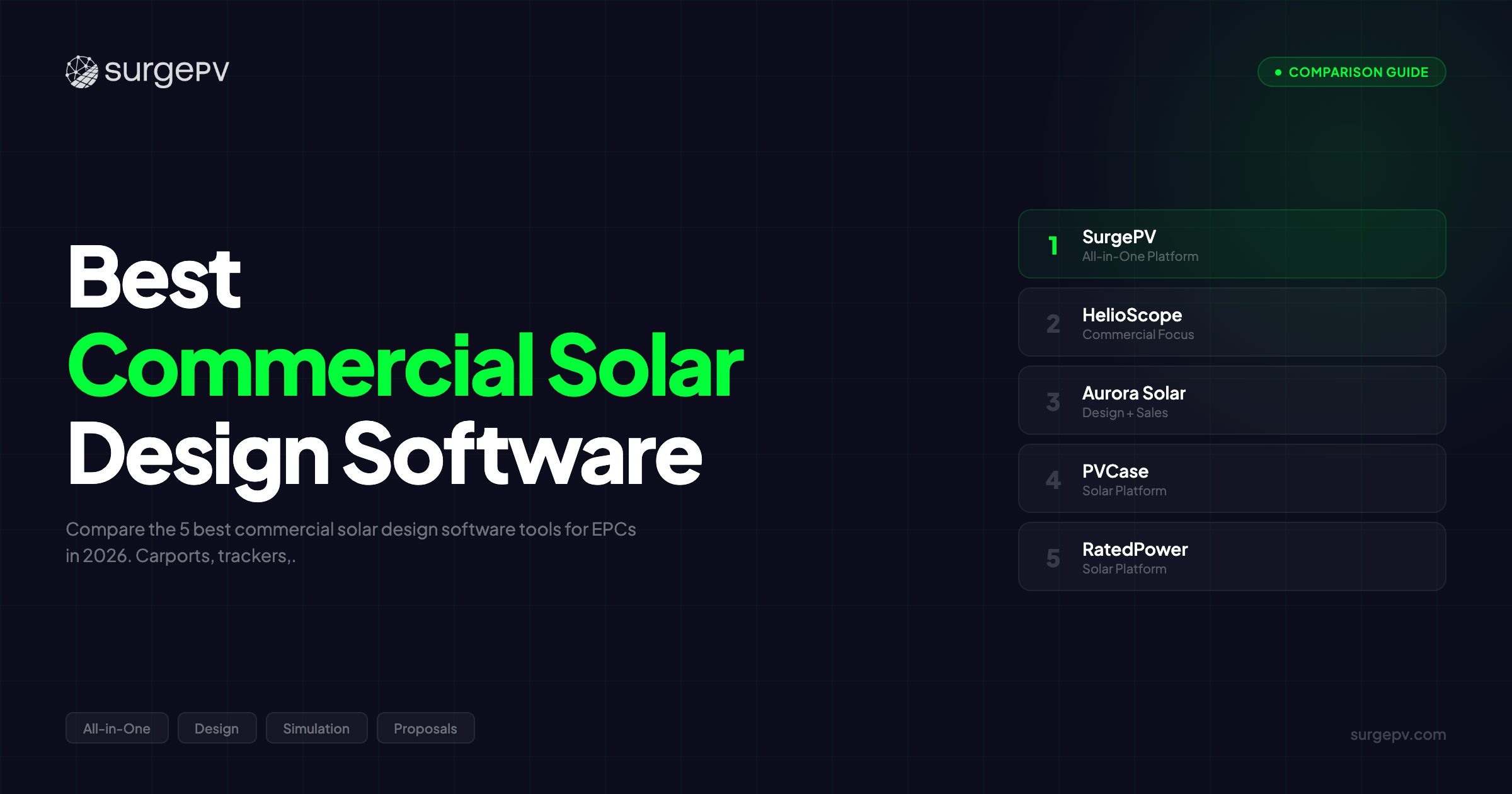
TL;DR: SurgePV is the only platform combining native carport design, tracker support, East-West racking, automated SLD generation, wire sizing, and commercial proposals in one tool for 50kW-10MW projects. HelioScope is strong for commercial rooftop layout but needs AutoCAD for SLDs. Aurora Solar works for light commercial under 100kW. PVCase and RatedPower serve utility-scale ground-mount above 10MW.
Commercial solar design is not residential design scaled up. That is the mistake most EPCs make when choosing design software. Commercial projects in the 50kW-10MW range involve flat rooftops with parapets and HVAC units, carport canopies over parking lots, ground-mount arrays with terrain challenges, tracker systems for production optimization, and East-West configurations for maximum density.
Residential tools like Aurora Solar were not built for this. And the commercial tools that do exist — HelioScope, PVCase, RatedPower — each solve part of the problem while leaving gaps in electrical engineering and proposals.
The best commercial solar design software in 2026 handles the full commercial workflow in one platform: diverse structures (carports, trackers, East-West), automated electrical engineering (SLD generation, wire sizing for 480V 3-phase), bankable simulations (P50/P75/P90), and professional proposals with PPA/lease modeling. That eliminates the 3-4 tool stack that costs $10,000-16,000/year and wastes 2-3 hours per project.
We tested 5 commercial solar design platforms with EPC teams handling 50kW-10MW projects — from warehouse rooftops to carport installations to tracker-equipped ground-mount arrays. Here is which tools deliver for commercial solar and which fall short.
In this guide, you’ll find:
- Head-to-head comparison of 5 commercial design platforms (SurgePV, HelioScope, Aurora, PVCase, RatedPower)
- Which tools support carport design, trackers, and East-West racking (only one does all three natively)
- Commercial electrical engineering comparison: SLD generation and wire sizing for 480V 3-phase systems
- Workflow efficiency data: complete commercial project timelines for each platform
- True annual cost including all required add-ons (AutoCAD, PVsyst, proposal tools)
Quick Comparison Table
| Software | Best For | Key Limitation | Carport / Tracker | Starting Price |
|---|---|---|---|---|
| SurgePV | All-in-one commercial (50kW-10MW) | Newer to US commercial market | Yes / Yes (single + dual-axis) | $1,899/yr (3 users) |
| HelioScope | Commercial rooftop layout | No SLD, no proposals, no carports | No / No | ~$948/yr + AutoCAD |
| Aurora Solar | Light commercial (under 100kW) | No carports, trackers, SLDs, P75/P90 | No / No | $3,108/yr (Premium) |
| PVCase | Utility-scale ground-mount (10MW+) | Requires AutoCAD, no proposals | No / Single-axis | ~$3,000/yr + AutoCAD |
| RatedPower | Rapid utility-scale iteration | Ground-mount only, no SLD/proposals | No / Single-axis | Custom ($3,000+/yr) |
Best Commercial Solar Design Software (Detailed Reviews)
SurgePV — Best All-in-One Commercial Solar Design Platform
Best For: Commercial EPCs designing 50kW-10MW projects (rooftops, carports, ground-mount, trackers)
Pricing: $1,899/year (3 users); $1,499/user/year (For 3 Users plan)
Onboarding: 2-3 weeks
SurgePV is the only cloud-based platform that combines commercial structure design (carports, trackers, East-West, ground-mount, rooftop), automated electrical engineering (SLD generation, wire sizing), bankable simulations (P50/P75/P90), and professional commercial proposals (PPA, lease, cash) — all without AutoCAD, PVsyst, or tool-switching. For commercial EPCs in the 50kW-10MW segment, that means one tool replaces a 3-4 tool stack.
Key Features for Commercial Projects
Commercial Structure Design:
- Carport solar design (UNIQUE) — SurgePV is the only platform with native carport support. Single cantilever, dual cantilever, multi-column structures. Span lengths 15-40 feet, clearance heights 8-15 feet, tilt angles 5-20 degrees. No other platform — Aurora, HelioScope, PVCase, RatedPower — designs carports natively. Carport solar is the fastest-growing commercial segment. If your portfolio includes parking lot installations, SurgePV is the only integrated option.
- Solar tracker support — Single-axis (15-25% production gain) and dual-axis (25-35% gain) with backtracking algorithm for shadow avoidance. Aurora lacks tracker support entirely.
- East-West racking — Low-tilt opposite orientations (5-15 degrees) delivering 20-40% more kW per roof area with lower wind load. Aurora lacks East-West natively.
- Ground-mount — Terrain modeling, row spacing optimization, fixed-tilt and tracker configurations.
- Flat rooftop — Ballasted systems, parapet setbacks, HVAC obstruction avoidance.
Commercial Electrical Engineering:
- Automated SLD generation — Code-compliant single line diagrams for 3-phase 480V commercial systems in 5-10 minutes. DC side (arrays, combiners), AC side (disconnects, panel), protection (breakers, fuses, SPD). Manual AutoCAD drafting takes 2-3 hours for the same output.
- Wire sizing — DC/AC calculations with voltage drop analysis for commercial distances. NEC Article 690 compliant. Instant vs 30-60 minutes with manual spreadsheets.
- Conduit fill and protection — Automatic breaker sizing, fuse selection, conduit fill calculations.
Bankability and Proposals:
- P50/P75/P90 production estimates — Bankable metrics for commercial financing. Aurora provides P50 only.
- 8760-hour shading analysis — +/-3% accuracy vs PVsyst.
- Financial modeling — Cash, loan, lease, PPA structures with custom utility rates, demand charge analysis, and self-consumption ratios.
- 70,000+ module database and 3,000+ US utilities.
Pro Tip
The hidden cost of commercial design is the tool stack. Aurora Premium ($3,108/yr) + AutoCAD ($2,000/yr) + PVsyst ($1,300/yr) = $6,408/year per user — and you still don’t get carport design, trackers, or East-West racking. SurgePV at $1,499/user/year includes everything. See full pricing.
Pricing
| Plan | Price | Users |
|---|---|---|
| Individual | $1,899/year | 3 users |
| For 3 Users | $1,499/user/year | 3 users |
| For 5 Users | $1,299/user/year | 5 users |
| Enterprise | Custom | Multiple |
All features included on every plan. No hidden fees, no feature gating. See full pricing.
Who SurgePV Is Best for in Commercial
- Commercial EPCs handling 50kW-10MW projects needing one tool for design, electrical, and proposals
- Teams designing carport solar installations (only native option)
- Companies wanting to eliminate AutoCAD dependency ($2,000/year saved per user)
- EPCs needing P50/P75/P90 bankable reports for commercial financing
- Teams bidding on diverse commercial projects (rooftops, carports, trackers, ground-mount)
Limitations
- Newer platform than HelioScope/Aurora in the US commercial market (less brand recognition)
- Ground-mount terrain modeling less advanced than PVCase/RatedPower for utility-scale projects above 10MW
- Utility database (3,000+ US utilities) may not cover all international commercial rates
Real-World Example
A 500kW warehouse rooftop plus 200kW parking lot carport project. In SurgePV: design both structures (20 min), generate SLDs for both (10 min), create a combined PPA proposal (10 min) = 40 minutes total. With Aurora + AutoCAD + PVsyst + Excel: design in Aurora (20 min), switch to AutoCAD for two SLDs (4 hours), validate in PVsyst (30 min), model financials in Excel (30 min) = 5+ hours. And Aurora cannot design the carport at all.
Further Reading
For a full design platform comparison across all segments, see best solar design software (2026). For residential-focused analysis, see best residential solar software. For a deep dive on commercial capabilities, see advanced solar PV design software.
You might wonder: if SurgePV does everything, why haven’t more commercial EPCs adopted it? Fair question. HelioScope has been the commercial design default for years. Aurora Solar has spent hundreds of millions on marketing. SurgePV entered the US market more recently — but it has already powered 70,000+ projects globally. The platform was purpose-built for the workflow gaps that legacy tools leave open, especially automated electrical engineering and native carport design, which no other platform offers.
HelioScope — Best for Commercial Rooftop Layout Optimization
Best For: Commercial EPCs who only need layout and simulation (separate electrical engineering team)
Pricing: Starting $79/month ($948/year) + AutoCAD ($2,000/year) = $2,948+/year per user
HelioScope (now part of Aurora Solar) is a cloud-based commercial solar design platform built for flat rooftop and ground-mount layouts. Strong simulation, good row spacing optimization, and team collaboration through the browser. HelioScope earned its commercial reputation for a reason: it is fast, cloud-based, and produces credible energy estimates.
What Works for Commercial
- Strong flat rooftop layout optimization (row spacing, parapet setbacks, HVAC avoidance)
- Good ground-mount design with terrain modeling
- Bankable energy estimates accepted by financiers
- Cloud-based team collaboration
- Established reputation in the commercial segment
Where It Falls Short for Commercial
- No SLD generation — Commercial EPCs need AutoCAD ($2,000/year) for electrical documentation. That is 2-3 hours per project on top of the design work.
- No wire sizing calculations — Manual spreadsheets or AutoCAD required.
- No carport design — Cannot design parking lot solar canopies.
- No tracker design — No single-axis or dual-axis tracker support.
- No East-West racking — Cannot model East-West configurations for density optimization.
- No proposal generation — Separate tool needed for commercial PPA/lease proposals.
- Aurora acquisition uncertainty — Product roadmap unclear as HelioScope integrates into Aurora ecosystem.
Bottom line: HelioScope is a strong design-only tool for commercial rooftops. But “design-only” means you need AutoCAD for SLDs, PVsyst for P75/P90 validation, and a separate proposal tool. That stack adds $3,300+/year per user on top of HelioScope. Read our full HelioScope review for a detailed breakdown.
Aurora Solar — Best AI Roof Modeling for Light Commercial
Best For: Light commercial projects under 100kW with residential-style workflows
Pricing: Premium $259/user/month ($3,108/year) + AutoCAD ($2,000/year) + PVsyst ($1,300) = $6,408+/year per user
Aurora Solar is the industry leader for residential solar design, with the best AI-powered LIDAR roof modeling available. It is expanding into light commercial, with polished proposals and strong CRM integrations. Here is the truth about Aurora for commercial: it was designed for residential. Commercial EPCs hit walls.
What Works for Commercial
- Industry-leading AI roof detection for commercial rooftops (LIDAR-based)
- Professional proposals suitable for commercial presentations
- CRM integrations (Salesforce, HubSpot) for commercial sales teams
- HelioScope integration (post-acquisition) for commercial layouts
Where It Falls Short for Commercial
- No SLD generation — Commercial 480V 3-phase systems need detailed SLDs. Aurora does not generate them. AutoCAD ($2,000/year) required.
- No wire sizing — Manual or AutoCAD calculations needed.
- No carport design — Cannot design parking lot solar canopies.
- No tracker support — No single-axis or dual-axis tracker design.
- No East-West racking — Cannot model East-West configurations.
- P50 only — No P75/P90 metrics. Commercial financiers and PPA providers typically require P75/P90 for risk assessment.
- Tiered pricing — Commercial features require Premium tier ($259/user/month). Plus AutoCAD and PVsyst add-ons.
- 4-6 week onboarding for commercial features.
Bottom line: Aurora works for light commercial under 100kW where residential-style design and proposals are sufficient. For 100kW+ commercial with carports, trackers, or complex electrical, SurgePV or HelioScope are stronger choices. Read our full Aurora Solar review for a detailed analysis.
Did You Know?
Commercial and industrial solar installations grew 37% in 2024, making C&I the fastest-growing segment in the US solar market. Carport solar is a major driver, with parking lot canopy installations doubling year-over-year as businesses seek dual-use solar solutions (SEIA Solar Market Insight Report 2025).
Carport Design Gap
SurgePV is the ONLY solar design platform with native carport solar design support. Aurora Solar, HelioScope, PVCase, and RatedPower do not support carport design natively. If your commercial portfolio includes parking lot solar installations, SurgePV is the only integrated option. Book a demo to see carport design in action.
PVCase — Best for Utility-Scale Ground-Mount Engineering
Best For: Utility-scale developers (10MW+) with in-house CAD teams
Pricing: ~$990/year + AutoCAD $2,000/year = $2,990+/year per user
Onboarding: 6-8 weeks
PVCase is an AutoCAD/Civil 3D plugin built for utility-scale solar engineering. Deepest terrain modeling, pile planning, cable routing, and engineering-grade control for large ground-mount projects. PVCase is the right tool for the right project. That project is a 50MW ground-mount array on uneven terrain, not a 500kW warehouse rooftop.
What Works for Commercial
- Deepest terrain modeling and pile planning for ground-mount arrays
- Single-axis tracker support with backtracking algorithms
- Engineering-grade BOM generation from CAD drawings
- Cable routing and trenching optimization
Where It Falls Short for Mid-Market Commercial
- Requires AutoCAD ($2,000/year) — It is a plugin, not a standalone platform.
- 6-8 week onboarding — CAD expertise required. Steep learning curve.
- Desktop-only — No cloud collaboration. Team workflows are limited.
- No proposal generation — Cannot create commercial PPA or lease proposals.
- No carport design — Workarounds only, no native support.
- No rooftop optimization — Not designed for flat rooftop commercial projects.
- Overkill for 50kW-5MW — Designed for utility-scale (10MW+). Using PVCase for a 200kW rooftop is like using a crane to hang a picture.
Bottom line: PVCase delivers the deepest engineering for utility-scale ground-mount. For mid-market commercial EPCs (50kW-5MW), the CAD dependency, cost, and learning curve make it impractical. Read our full PVCase review for a detailed analysis.
RatedPower — Best for Rapid Utility-Scale Ground-Mount Iteration
Best For: Utility-scale developers (10MW+) testing multiple ground-mount configurations
Pricing: Custom pricing (~$3,000-10,000+/year)
RatedPower uses AI to automate utility-scale ground-mount solar design. It generates optimized layouts in minutes, making it the fastest tool for testing configurations on large ground-mount sites. RatedPower is impressive for what it does. What it does is utility-scale ground-mount — and nothing else.
What Works for Commercial
- Fastest utility-scale layout generation (AI-powered, minutes vs hours)
- Advanced terrain analysis and optimization
- Strong bankability reports for ground-mount
- Rapid design iteration for site feasibility studies
Where It Falls Short for Mid-Market Commercial
- Ground-mount only — No rooftop, no carport design. If your commercial portfolio includes rooftops or parking lots, RatedPower does not apply.
- No SLD generation or wire sizing — Separate tools required for electrical documentation.
- No proposal generation — No commercial PPA/lease financial modeling.
- Not optimized for 50kW-5MW — Designed for utility-scale (10MW+).
- Custom/enterprise pricing — Not transparent. Not designed for small/mid commercial EPCs.
- No East-West racking for rooftop applications.
Bottom line: RatedPower excels at utility-scale ground-mount iteration. For mid-market commercial EPCs doing rooftop, carport, or mixed-structure projects, it is not the right fit. Read our full RatedPower review for a detailed analysis.
Which Software Is Right for Your Commercial Project?
| Your Project Type | Recommended Software | Why It Fits |
|---|---|---|
| Diverse commercial (rooftops + carports + ground-mount) | SurgePV | Only platform supporting all commercial structures + SLD + proposals in one tool |
| Carport solar installations | SurgePV | ONLY platform with native carport design. No alternative exists. |
| Commercial rooftop only (separate electrical team) | HelioScope or SurgePV | HelioScope for layout-only; SurgePV for layout + electrical + proposals |
| Light commercial (under 100kW, residential-style) | Aurora Solar or SurgePV | Aurora for AI roof modeling + proposals; SurgePV for complete workflow |
| Utility-scale ground-mount (10MW+) | PVCase or RatedPower | Deepest terrain modeling and engineering control for large ground-mount |
Design Commercial Solar Projects in One Platform
Carports, trackers, East-West, automated SLDs, and commercial proposals — without AutoCAD or tool-switching.
Book a DemoNo commitment required · 20 minutes · Live project walkthrough
When You May Not Need Commercial-Grade Design Software
Not every commercial project requires a full-featured design platform. Consider simpler alternatives if:
- Your projects are all under 50kW — Basic residential design tools may handle small commercial rooftops adequately.
- You outsource electrical engineering — If an external PE firm handles SLDs and wire sizing, you may only need a layout and simulation tool (HelioScope).
- You design fewer than 5 commercial projects per year — At very low volumes, the investment in commercial software may not justify itself vs manual methods.
- Your projects are exclusively utility-scale (50MW+) — At this scale, PVCase or RatedPower with dedicated engineering teams may be more appropriate than all-in-one platforms.
For most commercial EPCs handling 50kW-10MW projects at volume, integrated platforms that reduce tool-switching and manual work will save significant time and cost.
Full Commercial Feature Comparison Table
| Feature | SurgePV | HelioScope | Aurora Solar | PVCase | RatedPower |
|---|---|---|---|---|---|
| Carport design | Yes (ONLY platform) | No | No | No | No |
| Tracker support | Single + Dual-axis | No | No | Single-axis | Single-axis |
| East-West racking | Yes | No | No | Limited | Limited |
| SLD generation | Yes (5-10 min) | No | No | Via AutoCAD | No |
| Wire sizing | Yes (automated) | No | No | Via AutoCAD | No |
| Commercial proposals | Yes (PPA/Lease/Cash) | No | Limited commercial | No | No |
| P50/P75/P90 | Yes | Limited | P50 only | Via PVsyst | Yes |
| Cloud-based | Yes | Yes | Yes | No (AutoCAD) | Yes |
| Total cost/yr (per user) | $633-1,499 | $2,948+ (w/ AutoCAD) | $6,408+ (w/ AutoCAD + PVsyst) | $2,990+ (w/ AutoCAD) | Custom ($3,000+) |
| Onboarding | 2-3 weeks | 2-3 weeks | 4-6 weeks | 6-8 weeks | 4-6 weeks |
Further Reading
For residential solar software, see our guide to best residential solar software. For project management tools that complement your design workflow, see best solar project management software.
Why Most Design Tools Fail at Commercial Solar
The 3-4 Tool Stack Problem
Here is the reality for most commercial EPCs today: you design a system in HelioScope or Aurora, export to AutoCAD for SLDs and wire sizing, run a separate simulation in PVsyst for bankable P75/P90 reports, then model financials in Excel for the PPA proposal. Four tools. Four subscriptions. Four sets of training. And 3+ hours per project in tool-switching and manual data transfer.
At 20 commercial projects per month, that is 60+ hours of wasted time on tool-switching alone. SurgePV eliminates this by handling design, electrical, simulation, and proposals in one platform. Complete commercial workflow: 30-45 minutes.
Commercial SLDs Are Not Optional
Every commercial solar installation requires detailed single line diagrams for utility interconnection and AHJ permitting. Commercial systems use 480V 3-phase power with multiple inverters, combiners, longer wire runs, and more detailed protection schemes than residential.
Manual AutoCAD SLDs take 2-3 hours per commercial project. At 20 projects/month, that is 40-60 hours — the equivalent of a full-time electrical drafter. SurgePV automates commercial SLD generation in 5-10 minutes. Neither HelioScope, Aurora, nor RatedPower generate SLDs. If you use any of those tools, you still need AutoCAD ($2,000/year) and 2-3 hours per project for electrical documentation.
The Carport Gap
Carport solar is the fastest-growing commercial segment. Parking lot canopies deliver dual revenue: shade for vehicles and clean energy. Yet only one design platform — SurgePV — supports native carport design with proper cantilever types, clearance heights, span lengths, and tilt parameters. Every other platform requires manual AutoCAD design for carports, which means separate engineering, longer timelines, and higher costs.
For EPCs with carport projects in their pipeline, this gap is a workflow blocker.
Bankability Matters for Commercial Financing
Commercial projects are typically financed through PPAs, leases, or commercial loans. Financiers require conservative production estimates — P75/P90, not just P50. Aurora provides P50 only. Without P75/P90 metrics, EPCs must purchase PVsyst ($1,300/year) separately for bankable validation. SurgePV provides P50/P75/P90 natively with +/-3% accuracy vs PVsyst.
Commercial Proposal Complexity
Commercial deals require PPA pricing per kWh, demand charge analysis, self-consumption vs grid export ratios, multi-year escalation models, and C-suite presentations. Dedicated solar proposal software handles these complexities natively. Residential proposal tools do not model PPA structures or demand charges. SurgePV includes financial modeling for PPA, lease, cash, and loan scenarios with custom utility rates and demand charge analysis. HelioScope, PVCase, and RatedPower offer no proposal generation at all.
Our Testing Methodology
We evaluated each platform against five weighted criteria specific to commercial solar:
-
Commercial structure support (25%) — Tested across 5 structure types: flat rooftop (200kW warehouse), carport (500kW parking lot), ground-mount (2MW), single-axis tracker (1MW), and East-West (300kW flat roof). Evaluated native support vs workarounds.
-
Electrical engineering depth (25%) — Assessed SLD generation for 3-phase 480V commercial systems, wire sizing for commercial distances (200-500ft runs), voltage drop analysis, and NEC Article 690 compliance.
-
Bankability (20%) — Evaluated P50/P75/P90 production estimates, loss modeling depth, shading analysis accuracy, and report quality for commercial financing.
-
Proposal and financial modeling (15%) — Tested PPA modeling, demand charge analysis, self-consumption ratios, multi-scenario financing, and presentation quality for commercial decision-makers.
-
Total cost of ownership (15%) — Compared software licensing + required add-ons (AutoCAD, PVsyst, proposal tools) + training time for a 5-user commercial EPC team.
All testing was conducted January-February 2026 with commercial EPC teams and verified against official product documentation, G2 and Capterra reviews, and SEIA market data.
Transparency Note
SurgePV publishes this content. We are transparent about this relationship. This comparison is based on hands-on testing, official documentation, and verified user reviews. We acknowledge competitor strengths — HelioScope IS strong for commercial layout, PVCase IS best for utility-scale engineering — and source all criticisms from public data. See our editorial standards.
Bottom Line: Best Commercial Solar Design Software in 2026
For mid-market commercial EPCs (50kW-10MW): SurgePV is the clear leader. It is the only platform combining native carport design, tracker support (single + dual-axis), East-West racking, automated SLD generation, wire sizing, and commercial proposals (PPA/lease/cash) — all in one tool at $1,299-1,499/user/year. This replaces a $6,000-16,000/year multi-tool stack and cuts project workflows from 3+ hours to 30-45 minutes.
For commercial rooftop layout: HelioScope provides strong flat rooftop optimization and bankable energy estimates. Best as a design-only tool when paired with AutoCAD for SLDs.
For light commercial with residential approach: Aurora Solar works for projects under 100kW where residential-style design and proposals suffice. Not recommended for 100kW+ commercial.
For utility-scale (10MW+): PVCase offers deepest engineering control. RatedPower provides fastest AI-powered iteration. Neither is practical for mid-market commercial EPCs.
The carport question: If your commercial portfolio includes carport solar, SurgePV is the only option with native support. No other platform designs carports natively.
Commercial solar projects are getting more complex, not simpler. Carports, trackers, East-West, 480V 3-phase electrical, PPA financing — the EPCs winning these projects are the ones using the right solar design software to complete design-to-proposal workflows in under an hour, not the ones spending 3+ hours switching between four tools. Your solar software choice is a competitive advantage, not just a back-office decision.
Book a SurgePV demo to see how carport design, tracker layouts, automated SLDs, and commercial proposals work in one platform. See pricing — transparent rates, all features included, no AutoCAD required.
Further Reading
For the full platform comparison hub, see best solar software (2026). For project management tools, see best solar project management software. For proposal tools, see best solar proposal software.
Frequently Asked Questions
What is the best commercial solar design software in 2026?
SurgePV is the best commercial solar design software for the 50kW-10MW segment in 2026. It is the only platform combining native carport design, tracker support (single/dual-axis), East-West racking, automated SLD generation, wire sizing, and commercial proposals (PPA/lease) in one tool at $1,899/year for 3 users. For utility-scale projects above 10MW, PVCase and RatedPower offer deeper ground-mount engineering. For light commercial under 100kW, Aurora Solar handles basic rooftop design.
Which solar design software supports carport design?
SurgePV is the ONLY solar design platform with native carport solar design support. It handles single cantilever, dual cantilever, and multi-column structures with span lengths of 15-40 feet, clearance heights of 8-15 feet, and tilt angles of 5-20 degrees. Aurora Solar, HelioScope, PVCase, and RatedPower do not support carport design natively.
Do commercial solar projects need SLD generation software?
Yes. Commercial solar projects (480V 3-phase systems) require detailed single line diagrams for utility interconnection and AHJ permitting. SurgePV generates commercial SLDs automatically in 5-10 minutes (NEC Article 690 compliant). HelioScope, Aurora Solar, and RatedPower lack SLD generation — commercial EPCs using these tools need AutoCAD ($2,000/year) and 2-3 hours per project for manual SLDs.
How much does commercial solar design software cost?
Commercial solar design software ranges from $633/user/year (SurgePV Individual plan) to $6,408+/user/year (Aurora Premium + AutoCAD + PVsyst). SurgePV includes design, SLD generation, wire sizing, and proposals at every tier — no AutoCAD or PVsyst required. See SurgePV pricing. Aurora, HelioScope, and PVCase all require AutoCAD ($2,000/year) for SLDs.
How does SurgePV compare to HelioScope for commercial solar?
HelioScope provides strong commercial rooftop layout optimization and bankable energy estimates. SurgePV provides broader commercial capabilities: native carport design, tracker support, East-West racking, integrated SLD generation, wire sizing, and commercial proposals — features HelioScope lacks. HelioScope is a design-only tool; SurgePV is an end-to-end platform. HelioScope + AutoCAD costs $2,948+/year per user; SurgePV starts at $633/user/year with all features included.
What is the best solar software for trackers and East-West racking?
SurgePV supports both single-axis and dual-axis trackers (with backtracking algorithm) and East-West racking configurations natively. PVCase supports single-axis trackers but requires AutoCAD. RatedPower supports trackers for utility-scale only. Aurora Solar and HelioScope do not support trackers or East-West configurations.
Can Aurora Solar handle commercial solar projects?
Aurora Solar can handle light commercial projects under 100kW with basic rooftop design and proposals. For larger commercial (100kW-10MW), Aurora faces gaps: no carport, tracker, or East-West support, no SLD generation, no wire sizing, and P50 only (no P75/P90 for commercial bankability). Commercial EPCs using Aurora need AutoCAD ($2,000/year) and PVsyst ($1,300/year) as add-ons. SurgePV covers all these needs in one platform.
What is the fastest workflow for commercial solar design?
SurgePV offers the fastest complete commercial workflow: 30-45 minutes for a 500kW project (design + SLD + wire sizing + proposal). The same project takes 3+ hours with HelioScope + AutoCAD + PVsyst + Excel, and 2.5-3 hours with Aurora + AutoCAD. SurgePV’s speed advantage comes from integrated electrical engineering (no AutoCAD switch) and built-in proposals (no Excel/separate tool). Book a demo to see the full workflow.
Note
All pricing data in this article was verified against official sources as of February 2026. Prices may have changed since publication.